
Showing 7 items matching "1886 petition"
-
 Bendigo Historical Society Inc.
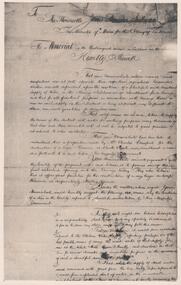
Photograph - PETITION FOR BACK CREEK RESERVOIR
... ...1886 petition...Petition sent in 1886 by the residents of Sandhurst to the Honourable James Sullivan Minister of mines in the colony of Victoria requesting the construction of a reservoir on back creek. ...GOVERNMENT State 1886 petition Petition sent in 1886 by the residents of Sandhurst to the Honourable James Sullivan Minister of mines in the colony of Victoria requesting the construction of a reservoir on back creek. ...Petition sent in 1886 by the residents of Sandhurst to the Honourable James Sullivan Minister of mines in the colony of Victoria requesting the construction of a reservoir on back creek. The petition is on thirty-three photographs and is inside a quite well worn plain brown folder. On the front of the folder a stamp of the Royal Historical Society of Victoria Bendigo branch with the date:1960 and the number 217. Inside the cover in blue pen: donated by the Victoria Legislative through Mr. Galvin MLA and another RHSV stamp. The Mayor of Sandhurst at the time was John McIntyre.government, state, 1886 petition -
 Federation University Historical Collection
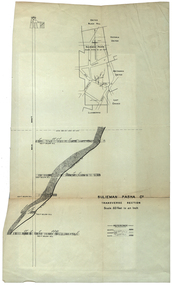
Plan, Sulieman Pasha Co Plan Transverse Section
... In 1886, the company approached the Minister for Mines, and attended heated public meetings on the matter. The local residents, shop owners, and church submitted a 60 person petition to the local council and government authorities. ...In 1886, the company approached the Minister for Mines, and attended heated public meetings on the matter. The local residents, shop owners, and church submitted a 60 person petition to the local council and government authorities. ...The Sulieman Pasha is possibly named after the most important Sultan of the Ottoman Empire, Suleiman One, or Suleiman the Magnificent, when the Ottoman Empire was at its peak. Or potentially a number of Ottoman governors, statesmen and military commanders with the same name after, however the spelling is slightly different to the mine name. No Turkish connection was found relating to the formation of the company, and remains unconfirmed. The mine operated from two shafts; No. 1 near the corner of Humffray and Mair streets, and also near where the Welcome Nugget (2217 ounces) was found years earlier; and the controversial No. 2 shaft several blocks south bordering the northern side of the main highway through Ballarat. The company produced 62 666 ounces of gold, the twelfth highest quartz reef gold production for any mine on the Ballarat goldfield. Some crushing figure examples are January-June 1881: 3674 tonnes 1085 ounces; January-June 1885: 2949 tonnes 1281 ounces; July-December 1885: 4459 tonnes 1119 ounces; January-June 1887: 1869 tonnes 730 ounces; July-December 1892: 1450 tonnes 771 ounces; July-December 1896: 4365 tonnes 1372 ounces. Like many mines in the area, gold grades were low. John Watson was noted as mine manager in the 1880s, and John Williams 1890s. The company was re-organised twice increasing the number of shares from 4000 to 24 000, and increasing the capital available. The Sulieman Pasha Company was formed in 1878. David Fitzpatrick was given the honour of turning the first sod of both the No.1 and later No. 2 shafts. The first dividend was given to shareholders in July 1881. The company obtained a prospecting vote (government grant) to start, and was very proud to be the first Victorian gold mining company to pay the funds back to the government. The event was marked by a lavish banquet laid out for ministers and government officials by the company. Leases were purchased to the south in 1885 to the Llanberris Mine boundary, after poor results began accumulating from the small No. 1 shaft. To take advantage of this new land the company planned to sink a second shaft. Initially this was to take place on government land, but the uproar from nearby residents caused the company to purchase land along the Main Road (now Western Highway), and the old Yarrowee Hotel which had occupied the site since the alluvial digger days of the 1850's was demolished. The area had since those days become heavily occupied with a number of shops, houses, a post office, church and two schools in the immediate area. The thought of an underground mine next door drew considerable opposition. The company (before the days of public relations departments) wrote 'most people would have thought that progress as vital as mining would be supported by tradesmen whose business rely on the mining industry. It seems when it comes to mining they are bereft of their senses, and considering the low ebb of mining in Ballarat East, the action of our opponents are unaccountable. (Sarcastically) There are certain engineering difficulties in moving the quartz reefs to a new location, but if we could to appease our opponents we would'. The company also wanted to take over 4 acres of the St Paul's school oval for machinery, but accused the St Paul's Church of wanting extortionate amounts of money upfront, and on a yearly basis for the privilege. It stated the church could not be opposed to mining when several years earlier it had formed its own company to mine the land, only for shareholders to lose their money. In 1886, the company approached the Minister for Mines, and attended heated public meetings on the matter. The local residents, shop owners, and church submitted a 60 person petition to the local council and government authorities. They stated the shaft contravened the mining statutes, which stating no mining could take place within 150 yards of a public building or church. A speech by a resident stated 'mining always comes with glorious pictures of the great benefits which would accrue all parties concerned if their request is granted, but if property is destroyed or depreciated in value, no-one then comes forward and compensates them'. The No. 2 shaft was approved including taking over part of the school oval. In 1888, workers at the company's No. 2 shaft went on strike to try and bring their wages in line with other mines in the district (the No. 1 shaft was operated by tributers). William Madden (26) was killed from a fall of earth underground the same year, while a year later his father John Madden (70) was similarly killed in the Madame Berry Mine elsewhere in the district. In 1897 as the amount of gold being found fell away, it came to light part of the deal to purchase the Yarrowee Hotel site was a 5% royalty on gold found. Shareholders could not understand why they were paying a royalty to the former owners of the property. The mine closed in 1898 due to a lack of gold. In 1902 a boy (age unknown) called Charles Lee was killed from a fractured skull while working to dismantle the Sulieman Pasha plant. The fuss over the No. 2 shaft had a sequel. On the company winding up, the land was purchased by J.S. Trethowan who built a house next to the shaft. In 1907, the shaft caved-in creating a sinkhole immediately at the back of the house. A Mr Chamberlain heard a deep rumbling sound at 5am, and looked out the window to see his fowl house and thirteen chickens disappear down an expanding hole. He then went back to bed, and called the police later in the day. The shaft was 1050 feet deep, and the hole at the surface that developed was 20 feet by 17 feet across, and 20 feet depth. In 1930 it is reported a syndicate had been formed to clean out the old shaft, and re-open the mine. It is assumed this was the No. 1 shaft but no more was found. (https://www.mindat.org/loc-304239.html, accessed 07/08/2019) A transverse section plan of the Sulieman Pasha Mine.sulieman pasha company, plan, mining, united black hill mine, victoria united mine, victoria street, britannia united mine, last chance mine, llanberris mine, ottoman empire, john watson, john williams, david fitzpatrick -
 Sunshine and District Historical Society Incorporated
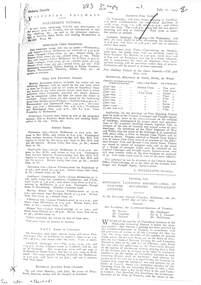
Document - Naming of Sunshine Railway Station, Rigg, Tom (re.notes), Various
... 1886 and to Bacchus Marsh in 1887. The junction of the two lines was known as Bacchus Marsh Junction during construction and after completion the area became Braybrook Junction no doubt influenced by the nearby settlement of Braybrook. In 1907 the Braybrook Junction Progress Association petitioned...1886 and to Bacchus Marsh in 1887. The junction of the two lines was known as Bacchus Marsh Junction during construction and after completion the area became Braybrook Junction no doubt influenced by the nearby settlement of Braybrook. In 1907 the Braybrook Junction Progress Association petitioned ...Collected by Tom RiggUntil about 1884 the general area now occupied by Sunshine / Braybrook was known as CUT PAW PAW. The Melbourne to Bendigo railway was built in 1859 and the railway to Ballarat began first to Melton in 1884 to Parwan in 1886 and to Bacchus Marsh in 1887. The junction of the two lines was known as Bacchus Marsh Junction during construction and after completion the area became Braybrook Junction no doubt influenced by the nearby settlement of Braybrook. In 1907 the Braybrook Junction Progress Association petitioned the Victorian Railways Commissioners requesting that the station name be changed to Sunshine Junction possibly recognising the dominating presence of the Sunshine Harvester Works. Approval was very promptly granted by the Commissioners and in the Victoria Gazette of July 17 1907 page 3419 the Victorian Railways gazetted that on and after Monday 15th July the name of Braybrook Junction station will be changed to Sunshine.sunshine railway station, railway -
 Uniting Church Archives - Synod of Victoria
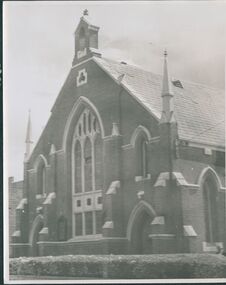
Photograph - B&W Photograph, Sale Methodist Church, c.1960
... petitioned Conference to appoint a minister. The men were: Nehemiah Guthridge, G. Ross, J.H. Walters, J.E. Derrick, G.E. Hawkins, R. Gibbs, J.J. Drew, J. James. The Rev. Henry Baker arrived in the Gippsland Circuit later in 1864. The first Methodist services in Sale were held in the Mechanics Institute, but by July 1865 a Methodist church had been opened for worship. A Sunday School was constructed in 1886...petitioned Conference to appoint a minister. The men were: Nehemiah Guthridge, G. Ross, J.H. Walters, J.E. Derrick, G.E. Hawkins, R. Gibbs, J.J. Drew, J. James. The Rev. Henry Baker arrived in the Gippsland Circuit later in 1864. The first Methodist services in Sale were held in the Mechanics Institute, but by July 1865 a Methodist church had been opened for worship. A Sunday School was constructed in 1886 ...In October 1863 the Rev. James Bickford visited Sale to explore the possibilities of establishing a Methodist cause there. In March 1864 a group of 8 local men petitioned Conference to appoint a minister. The men were: Nehemiah Guthridge, G. Ross, J.H. Walters, J.E. Derrick, G.E. Hawkins, R. Gibbs, J.J. Drew, J. James. The Rev. Henry Baker arrived in the Gippsland Circuit later in 1864. The first Methodist services in Sale were held in the Mechanics Institute, but by July 1865 a Methodist church had been opened for worship. A Sunday School was constructed in 1886. The Sale Methodist Church was renovated at a cost of 2500 pounds in 1951.B & W exterior view of the Sale Methodist Church. sale, methodist church, apse, painted arch -
 Uniting Church Archives - Synod of Victoria
Photograph - B&W Photograph, Sale Methodist Church c1960, undated c.1965
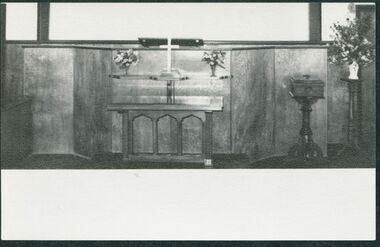
... petitioned Conference to appoint a minister. The men were: Nehemiah Guthridge, G. Ross, J.H. Walters, J.E. Derrick, G.E. Hawkins, R. Gibbs, J.J. Drew, J. James. The Rev. Henry Baker arrived in the Gippsland Circuit later in 1864. The first Methodist services in Sale were held in the Mechanics Institute, but by July 1865 a Methodist church had been opened for worship. A Sunday School was constructed in 1886...petitioned Conference to appoint a minister. The men were: Nehemiah Guthridge, G. Ross, J.H. Walters, J.E. Derrick, G.E. Hawkins, R. Gibbs, J.J. Drew, J. James. The Rev. Henry Baker arrived in the Gippsland Circuit later in 1864. The first Methodist services in Sale were held in the Mechanics Institute, but by July 1865 a Methodist church had been opened for worship. A Sunday School was constructed in 1886 ...In October 1863 the Rev. James Bickford visited Sale to explore the possibilities of establishing a Methodist cause there. In March 1864 a group of 8 local men petitioned Conference to appoint a minister. The men were: Nehemiah Guthridge, G. Ross, J.H. Walters, J.E. Derrick, G.E. Hawkins, R. Gibbs, J.J. Drew, J. James. The Rev. Henry Baker arrived in the Gippsland Circuit later in 1864. The first Methodist services in Sale were held in the Mechanics Institute, but by July 1865 a Methodist church had been opened for worship. A Sunday School was constructed in 1886. The Sale Methodist Church was renovated at a cost of 2500 pounds in 1951. The new Sale Methodist Church was opened on 25 September 1965.B & W interior view of the new Sale Methodist Church. The image of the apse shows a communion table, cross, font, pulpit and flowers.c1960methodist, sale, rev. james bickford, rev henry baker, gippsland circuit -
 Uniting Church Archives - Synod of Victoria
Photograph - B&W Photograph, Sale Methodist Church, 1956
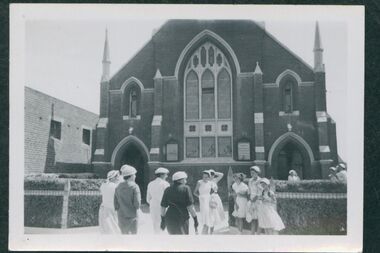
... petitioned Conference to appoint a minister. The men were: Nehemiah Guthridge, G. Ross, J.H. Walters, J.E. Derrick, G.E. Hawkins, R. Gibbs, J.J. Drew, J. James. The Rev. Henry Baker arrived in the Gippsland Circuit later in 1864. The first Methodist services in Sale were held in the Mechanics Institute, but by July 1865 a Methodist church had been opened for worship. A Sunday School was constructed in 1886...petitioned Conference to appoint a minister. The men were: Nehemiah Guthridge, G. Ross, J.H. Walters, J.E. Derrick, G.E. Hawkins, R. Gibbs, J.J. Drew, J. James. The Rev. Henry Baker arrived in the Gippsland Circuit later in 1864. The first Methodist services in Sale were held in the Mechanics Institute, but by July 1865 a Methodist church had been opened for worship. A Sunday School was constructed in 1886 ...In October 1863 the Rev. James Bickford visited Sale to explore the possibilities of establishing a Methodist cause there. In March 1864 a group of 8 local men petitioned Conference to appoint a minister. The men were: Nehemiah Guthridge, G. Ross, J.H. Walters, J.E. Derrick, G.E. Hawkins, R. Gibbs, J.J. Drew, J. James. The Rev. Henry Baker arrived in the Gippsland Circuit later in 1864. The first Methodist services in Sale were held in the Mechanics Institute, but by July 1865 a Methodist church had been opened for worship. A Sunday School was constructed in 1886. The Sale Methodist Church was renovated at a cost of 2500 pounds in 1951. The new Sale Methodist Church was opened on 25 September 1965.B & W exterior view of the Sale Methodist Church showing a group of women and girls, hatted and gloved, standing in front of the church.methodist, sale, rev. james bickford, rev henry baker, gippsland circuit -
 Uniting Church Archives - Synod of Victoria
Photograph - B&W Photograph mounted on card, Sale Methodist Church, undated
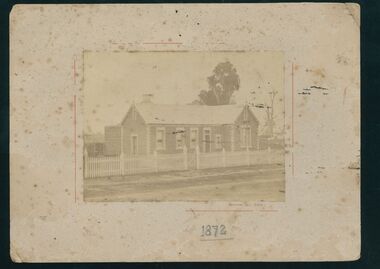
... petitioned Conference to appoint a minister. The men were: Nehemiah Guthridge, G. Ross, J.H. Walters, J.E. Derrick, G.E. Hawkins, R. Gibbs, J.J. Drew, J. James. The Rev. Henry Baker arrived in the Gippsland Circuit later in 1864. The first Methodist services in Sale were held in the Mechanics Institute, but by July 1865 a Methodist church had been opened for worship. The parsonage was built in 1872 and the Sunday School in 1886...petitioned Conference to appoint a minister. The men were: Nehemiah Guthridge, G. Ross, J.H. Walters, J.E. Derrick, G.E. Hawkins, R. Gibbs, J.J. Drew, J. James. The Rev. Henry Baker arrived in the Gippsland Circuit later in 1864. The first Methodist services in Sale were held in the Mechanics Institute, but by July 1865 a Methodist church had been opened for worship. The parsonage was built in 1872 and the Sunday School in 1886 ...In October 1863 the Rev. James Bickford visited Sale to explore the possibilities of establishing a Methodist cause there. In March 1864 a group of 8 local men petitioned Conference to appoint a minister. The men were: Nehemiah Guthridge, G. Ross, J.H. Walters, J.E. Derrick, G.E. Hawkins, R. Gibbs, J.J. Drew, J. James. The Rev. Henry Baker arrived in the Gippsland Circuit later in 1864. The first Methodist services in Sale were held in the Mechanics Institute, but by July 1865 a Methodist church had been opened for worship. The parsonage was built in 1872 and the Sunday School in 1886. The Sale Methodist Church was renovated at a cost of 2500 pounds in 1951. The new Sale Methodist Church was opened on 25 September 1965. The parsonage was later used by Kilmany Family Care.B & W exterior view of the Sale Wesleyan parsonage, built next to the church in 1872.methodist, sale, rev. james bickford, rev henry baker, gippsland circuit, parsonage
