
Showing 19 items matching "1897 1950"
-
 Learmonth and District Historical Society Inc.
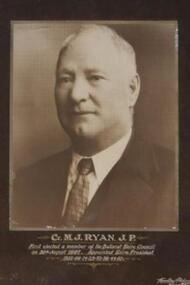
Photo - Ryan.M.J, Thornton Richards & Co, M.J.Ryan,(J.P.) Councilor/Shire President, "Circa 1950"
... ...1897 1950...Original Historic photo. ballarat shire council ryan m j j p 1897 1950 Councilor M.J.Ryan (J.P.). First elected a member of the Ballarat Shire Council on 30th August 1897.Appointed Shire President 1902-08-14-23-32-38-44-50. ...Councilor M.J.Ryan,(J.P.),was first elected as a member of the Ballarat Shire Council on the 30th. August 1897, serving until 1915. He was then re-elected in 1918 and served until1953. He was appointed Shire President in 1902-08-14-23-32-38-44-50.Original Historic photo.Sepia Photo of Councilor M.J.Ryan,(J.P.),set in a dark Brown plain wooden frame with gold trim on inside of frame.photo surounded by dark brown mount. Councilor M.J.Ryan (J.P.). First elected a member of the Ballarat Shire Council on 30th August 1897.Appointed Shire President 1902-08-14-23-32-38-44-50.ballarat shire council, ryan m j j p, 1897 1950 -
 Mont De Lancey
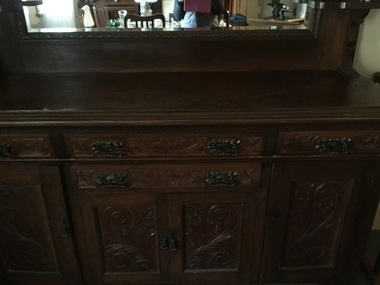
Furniture - Buffet
... Used at 'Lyndhurst' 1897-1950's. Donated by William's daughter - Annette Sebire. ...Used at 'Lyndhurst' 1897-1950's. Donated by William's daughter - Annette Sebire. buffet sideboard furniture Large wooded sideboard/buffet with mirror. ...Belonged to Mr. William Sebire, son of Henry Sebire. Used at 'Lyndhurst' 1897-1950's. Donated by William's daughter - Annette Sebire. Large wooded sideboard/buffet with mirror. Carved oak leaf design on doors and mirror surround. Two carved pillars, one each side of mirror. Ornate metal handles on drawers and cupboards.buffet, sideboard, furniture -
 Federation University Historical Collection
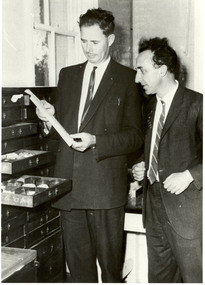
Photograph, Jack Barker and Phil Day with the Baragwanath Donation
... 1897, was director of the geological survey (1922-4), Chief Mining Surveyor (1924-43), Secretary for Mines (1932-34), consultant to the Department of Mines (1943-50) . He was born at Durham Lead on 1 August 1878 and was a former student of the Ballarat School of Mines. Baragwanath was president of the Royal society of Victoria (1943-44) and a councillor of the Ballarat School of Mines (1916-1950...1897, was director of the geological survey (1922-4), Chief Mining Surveyor (1924-43), Secretary for Mines (1932-34), consultant to the Department of Mines (1943-50) . He was born at Durham Lead on 1 August 1878 and was a former student of the Ballarat School of Mines. Baragwanath was president of the Royal society of Victoria (1943-44) and a councillor of the Ballarat School of Mines (1916-1950 ...William Baragwanath joined the Victorian Department of Mines in 1897, was director of the geological survey (1922-4), Chief Mining Surveyor (1924-43), Secretary for Mines (1932-34), consultant to the Department of Mines (1943-50) . He was born at Durham Lead on 1 August 1878 and was a former student of the Ballarat School of Mines. Baragwanath was president of the Royal society of Victoria (1943-44) and a councillor of the Ballarat School of Mines (1916-1950). After Baragwanath's death on 20 September 1966 the Department of Minerals and Energy (Geological Survey division) donated a number of Baragwanath's items to the Ballarat School of Mines, including this collection. Black and white photograph of E.J. Jack Barker (Ballarat School of Mines Principal) and Phil Day (Head of Geology) standing in front of a cabinet of geological specimens housed in a timber cabinet. ballarat school of mines, geology, ej barker, jack barker, phil day, baragwanath, william baragwanath, victorian mines department -
 Federation University Historical Collection
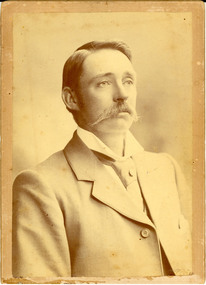
Photograph, William Smerdon Holmes, c1890, c1890
... 1897 - 1954) married Edith Sarah Pickford 28/2/1922. William Smerdon Holmes was the grandfather of Henry John (Jack) Holmes (1922-1972) William Smerdon Holmes (1927-1993), David Coghill Holmes (1929-1950) and Mary Elizabeth Chatham (Elizabeth) (nee Holmes) (1932 - 2006). ...1897 - 1954) married Edith Sarah Pickford 28/2/1922. William Smerdon Holmes was the grandfather of Henry John (Jack) Holmes (1922-1972) William Smerdon Holmes (1927-1993), David Coghill Holmes (1929-1950) and Mary Elizabeth Chatham (Elizabeth) (nee Holmes) (1932 - 2006). ...William Smerdon Holmes married Violet Mary Macfie (1859 – 1942) on 9 April 1890 at Geelong. William and Violet lived at "Sauchieburn", Ascot on the 291 ha (720 acre) property that William inherited from his aunt Catherine Coghill (nee Holmes). William and Violet Holmes had four children: • Violet Catherine (1891- 1949) married Samuel Gordon Spittle 11 August 1920; Mary Coghill (1892 - 1979); • William Edward (1894 - 1964) married Charlotte Anne Alexander 20 June 1933; • Henry Smerdon (1897 - 1954) married Edith Sarah Pickford 28/2/1922. William Smerdon Holmes was the grandfather of Henry John (Jack) Holmes (1922-1972) William Smerdon Holmes (1927-1993), David Coghill Holmes (1929-1950) and Mary Elizabeth Chatham (Elizabeth) (nee Holmes) (1932 - 2006). William Smerdon Holmes died in June 1914 and is buried at the Ballarat New Cemetery. A black and white photograph glued into card. It shows a moustached man in coat, collar, tie and tie-pin. It is William Smerdon Holmeschatham family archive, chatham, holmes, william holmes, william smerdon holmes, ascot, sauchieburn -
 Phillip Island and District Historical Society Inc.
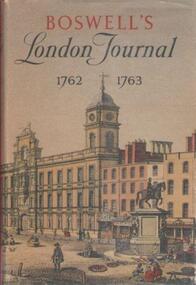
Book, Boswell's London journal, 1762-1763, 1952
... (frederick albert), 1897-1987 reprint society heinemann rudolf himmer Labelled: Himmer Bequest Stamped: Cowes Public Library as first published in 1950 from the original mss. prepared for the press with introduction and notes by Frederick A. ...Book belonged to Rudolf Himmer, Programme Controller for ABC Radio Victoria, who had a holiday home in Cowes on Phillip Island.Book belonged to Rudolf Himmer, Programme Controller for ABC Radio Victoria, who had a holiday home in Cowes on Phillip Island.as first published in 1950 from the original mss. prepared for the press with introduction and notes by Frederick A. Pottle. xii, 360 p. Labelled: Himmer Bequest Stamped: Cowes Public Libraryboswell's london journal, 1762-1763, boswell, james, 1740-1795, pottle, frederick a. (frederick albert), 1897-1987, reprint society, heinemann, rudolf himmer -
 Eltham District Historical Society Inc
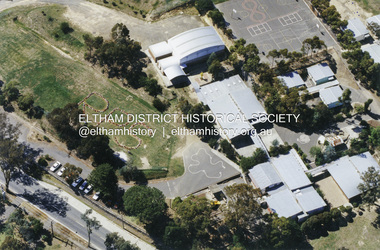
Document - Archive Box, 1570 Main Road, Research (Research Primary School)
... School Historical Documents (Folder 5) School Historical Documents • Certificate of Merit Ernest Reynolds • Inventory of Books and Equipment 1891 • Letter from Teacher Frank Scott explain poor results • Letter from Henry Cole recommending appointment of Mary Jane Rodda as Sewing Mistress • Special Certificate for Regular Attendance Anton Brinkkotter (2 copies • Certificate of Merit Anton Brinkkotter 1911 • Merit Certificate Lyla Dickson 1922 • Special Certificate for Regular Attendance Margery Palmer 1927 • Letter from Head teacher Reg Jackman 1957 • Petition to Education Dept 1884 from Research Gully to open a school • Joseph Mankey's complaints about temporary classroom 1890 • Research 1890 - Plan of one acre site to be purchased by education Dept for permanent school • List of buildings and dates • Need for extensions and improvements 1949 • Looking to the Future 1950 • Negotiations to buy school site 1890 2. Magenta Folio 1. USB drive containing • Class photos 1897-2014 • Class photo names • List of head teachers/Principals 1989-2014 • List of Infant Productions 2001-2010 • School photo names typed up identified at centenary reunion 1925-1984 • List of school camps 1964-2014 • List of Senior Productions 1986-2014 • Staff list 1989-2014 • List of grades by year taught by Mrs Avril Baker 1976-2010 2. ...School Historical Documents (Folder 5) School Historical Documents • Certificate of Merit Ernest Reynolds • Inventory of Books and Equipment 1891 • Letter from Teacher Frank Scott explain poor results • Letter from Henry Cole recommending appointment of Mary Jane Rodda as Sewing Mistress • Special Certificate for Regular Attendance Anton Brinkkotter (2 copies • Certificate of Merit Anton Brinkkotter 1911 • Merit Certificate Lyla Dickson 1922 • Special Certificate for Regular Attendance Margery Palmer 1927 • Letter from Head teacher Reg Jackman 1957 • Petition to Education Dept 1884 from Research Gully to open a school • Joseph Mankey's complaints about temporary classroom 1890 • Research 1890 - Plan of one acre site to be purchased by education Dept for permanent school • List of buildings and dates • Need for extensions and improvements 1949 • Looking to the Future 1950 • Negotiations to buy school site 1890 2. Magenta Folio 1. USB drive containing • Class photos 1897-2014 • Class photo names • List of head teachers/Principals 1989-2014 • List of Infant Productions 2001-2010 • School photo names typed up identified at centenary reunion 1925-1984 • List of school camps 1964-2014 • List of Senior Productions 1986-2014 • Staff list 1989-2014 • List of grades by year taught by Mrs Avril Baker 1976-2010 2. ...Contents: 1. Andrew Lemon's Working File of Return to Research Andrew Lemon's Working File for his 1989 book, “Return to Research: A Centenary History of Research Primary School" (EDHS_00867). Includes a disassembled copy of the book. (All other documentation and photos passed to Research Primary School 3 September 2013) 1.1. EDHS_05004 - Cassette Tape of "Afternoon Tea with Senior Residents Nov 1st 1984" Reminiscences, chit chat and banter between group of senior citizens at an afternoon tea held for them at Research Primary School. 1.2. School Register 1935-1994 (Box 1) Photocopy of Research Primary School register from 1935 to 1994 (originals held at school) From 1994 onwards registrations were made online via the Education Department CASES system. 1.3. School Register A-Z 1935-1987 (Box 2) Computer print-out of alphabetized register 1935-87 (Research Primary School) (Done by David and Sue Grigg in 1987 from the register) Contains some extra details/corrections/current addresses Plus disks containing this data (not housed in box – there is a separate floppy disc box containing several 5 ¾” and 3 ½” floppy disks which are not readable as no hardware/software to support) 1.4. Research Locality History (Yellow Folder 1) Research Locality History Newspaper cuttings, Photocopies etc Collection for Research Primary School History 1989 Contents • 3 x photocopies (A3) regarding sale of Raglan Estate, Research [2 x A3 and 1 x composite A3 colour photocopy] • Souvenir Map of area with pictures of historical items and wild life - A Visitor's Guide Map; ELTHAM, WARRANDYTE and Environs (see also EDHS_01633-1) • EO article 26 Mar 1897 "Research State School picnic expedition to Mordialloc" • TA article 25 Jul 30" Research Affairs" plus an add for J Ingram's Research Bakery • DVN articles 14 Jan 69 (2 pages) "Research Fire Victim (Bill Pelling) still in hospital" • DVN 14 Jan 69 Page of Deaths, In Memories, Obituaries, Church Notices, Public Notices and Notices • Age article 24 Jan 84 "Eltham before the Mud Bricks" • DVN article 21 Oct 86 "Facing Good and Bad Times with enthusiasm - Keith Maxwell" • DVN article 29 Aug 87 "Eltham - the historic haven" • DVN article 25 Aug 87 "Eltham - a piece of living history, (the historic haven cont…)" • DVN article 20 Oct 87 "When push bikes were made for touring - Sam Howard" • 6 x pages of what appear to be various student's workbooks/ projects from 1944/45 era • ''They lost their homes- Historical places go at Research" plus other articles on fires 8 Jan 69 [Located in Folder 2] • DVN articles 23 Oct 84 "Centenary Plans" & Folklore surrounds Research township" [Located in Folder 2] • DVN article 23 Sep 86 "The teacher who had cut cane but never used one" Frank Sheehan (3 copies) [Located in Folder 2] • 2 x copies of booklet "Memories of Eltham" [Located in Folder 3] • Photocopy of subdivision Parish of Nillumbik [Located in Folder 4] DVN = Diamond Valley News, EO = Evelyn Observer TA= The Advertiser 1.5. Copies of items held by Public Records Office Victoria (Yellow Folder 2) Copies of items held by Public Records Office Photos and display items from Research Primary School Centenary August 19, 1989 • Laminated photocopy: “State School No. 2959, Copy of the above school property,” signed Henry L. Cole 18.6.91 • Photocopy: Petition for a school at Research, 13/11/1888; Public Record Office Victoria School Building File – School 2959 CUPRS 795/1717 • Photocopy: Negotiation to buy school site – part of Allotment 2, owned by the West family (copy attached to letter) 15/1/1890; Public Record Office Victoria School Building File – School 2959 CUPRS 795/1717 • Photocopy: Frank Scott, Head Teacher Research 1904-1907, letter of explanation (first page) to Department re poor results by pupils at the school, 24/8/1907; Public Record Office Victoria School Building File – 640 / School 2959 • Photocopy: Anton Brinkkotter’s Certificate for Regular Attendance 1908 (This was ‘traded in’ in 1911 for a certificate to mark six years without missing a day of school; Public Record Office Victoria School Building File – 640 / School 2959 for 1911 • Photocopy: Education Department Memorandum 1949 re need for extensions and improvements; Public Record Office Victoria School Building File – 795 / School 2959 • Photocopy: Looking to the future about expanding site for additional land for play space, 1950, Education Department Inspector to Department; Public Record Office Victoria School Building File – 795 / School 2959 • Photocopy (laminated, 2 sheets) First School Fire -1953 copy of Police Report. The old school building was badly damaged but repaired. It burnt down in 1976; Public Record Office Victoria School Building File – 795 / School 2959 • Photocopy: The Argus (28 July 1953) & the (Sun 28 July 1953) Two newspaper cuttings and notes re school fire 1953; Public Record Office Victoria School Building File – / School 2959 • Photocopy: Head Teacher Reg Jackman expresses concern to Education Department about conditions as he takes charge of Research State School, 1957; Public Record Office Victoria School Building File – 640 / School 2959 • Photo print (x2) of Education Department Qualifications and Certificates, Lyla Dickson, State School. (1) Print missing (2) Education department Victoria, Merit Certificate, This is to certify that Lyla Dickson has completed satisfactorily the Course of Study presented for the Eight Grade in Elementary Schools, dated at research Elementary School, this 20th day of November A.D. 1923 • Copy of original photo owned by Nell Howard “Fancy dress night in the school house – 1920s”, black and white print, 10.5 x 18 cm, attached to A4 photocopy of photo with names inscribed10.5 x 18 cm • Copy of original photo (stamped Reynolds Collection), black and white print, 24.5 x 16 cm, attached to paper sheet 37.6 x 25.5 cm, inscribed “Miss Doney” and “Elizabeth Doney and her family owned and ran Research’s Store and Post Office for many years after buying the property from the wests. This land surrounded the school site and includes today’s [1989] Kanandah Ct, Raglan St and shops” • Black and white photo print, 20 x 25 cm, Reconstruction of Main Road in front of Research Primary School, August 1989 • Black and white photo print, 20 x 25 cm, Eastern end of old oval, Research Primary School, 1989 • Black and white photo print, 20 x 25 cm, Portable Buildings, Research Primary School, 1989 • Black and white photo print, 20 x 25 cm, Gymnasium, Research Primary School, 1989 • Black and white photo print, 20 x 25 cm, Administrative Art Building, Research Primary School, c.1989 • Black and white photo print, 20 x 25 cm, Betty Kicker, Cleaner at Research Primary School, c.1989. Betty worked at the school from early 1970s to 1990s 1.6. ‘Memories of Research 1951-1968’ (Yellow Folder 3) Interview by Sue Grigg of Florence Egglestone for publication in Return to Research. Original handwritten notes, ‘Memories of Research 1951-1968’ 1.7. Centenary Committee Minutes & Newsletters (Yellow Folder 4) Centenary Committee Minutes and Newsletters Information regarding attendance of 100th anniversary including lists of staff contact details 1983-1986 Request (1985) to Shire of Eltham Historical Society for information and memorabilia • Letter: Ann Bouchier, Convenor – Centenary Committee, Research Primary School to R. Yeoman, Shire of Eltham Historical Society, 15 October 1985; enquiring about memorabilia etc that could be used in a proposed compilation on the “History of the School.” • Minutes of Meeting, Centenary Sub-Committee, Research Primary School Council o 17 June 1985. Also includes a list of general aim, specific aims and methods for the research Primary School Centenary - 1989 o 15 October 1985. o 17 September 1986. o 20 August 1987. o 2 May 1988. o 9 June 1988. o 22 August 1988. o 12 October 1988. o 24 November 1988. o 17 April 1989. o 24 July 1989. • Outline of Historical Events 1884-1954 (3 pages) • Centenary Newsletters o Number 1 (1989) o Number 2 (1989) o Number 3 (1989) o Newsletter (c. Aug. 1989) • Information re attendance of 100th Anniversary, Research Primary School, 19 August 1989 o Research Primary School – Staff 1984 (includes Name, Address, Telephone) o Research Primary School – Staff 1985 (includes Name, Address, Telephone) o Research Primary School – Staff 1986 (includes Name, Address, Telephone) o Emergency Teacher List 1983 o Emergency Teacher List 1986 o Previous teachers 1984 on • Quotation No. 733, Major Graphics for Engraved Brass Commemorative Plaque for opening of School Gymnasium • Centenary Invitation; Program and Souvenir and Chicken & Champagne Supper order forms • Various Centenary Invitation lists with notations, and various returned RSVPs • Centenary Program and map • Photocopy: 11 pages typed with hand corrections, draft manuscript for Andrew Lemon’s book, Return to Research (pages 13-24) • Bulletin: “I’m an Aussie” Week – 15th-19th April 10/4/85 • Bulletin: Research Centenary 26/4/88 • Bulletin: Official Centenary Logo For Research Primary School 15/12/88 • Bulletin: Centenary School Activity – “Colonial School” 23/5/89 • Bulletin: Centenary Activity Days – Monday, 14th August, Tuesday, 15th August 7/8/89 • Advertisement: A3 photocopy, Centenary Bush Dance, Sat. 4th March featuring “Paradiddle” Bush Band • Photocopy Master: Invitation (blank) to attend “Return to Research” celebration and Official Opening of the School Gymnasium on Saturday, August 19th from 1.00p.m. to 5.00p.m. and attached RSVP (also includes yellow paper sample -blank) • Photocopy Master: Tickets for Centenary Chicken & Champagne Supper, Friday, 18th August 1989, 7.30p.m., $5.00 per head (2 yellow paper samples marked on reverse ‘13’ and ‘55’) • Photocopy Master: Centenary Gift Donated by slips including multiple blank samples • Promotional Notices o Letter, Robert Wenn, Principal, 29 November 1988 for placement of “HELP WANTED” in Public Notices of The Age o Information provided to Ian Reid Real Estate Agent for Board to promote Centenary Bush Dance Paradiddle Band, Saturday 4 March 1989 o Notice Board promoting ‘Old Time’ Gala Fete Saturday 17 June 1989 o Letter, Robert Wenn, Principal, 24 August 1989 to Ian Reid Real Estate thanking for support of Centenary celebration and successful book launch and seeking further support for next event being school musical production “Spirit of Research” written by Andrew Lemon to be performed December 7th. 1.8. 1989 Research Primary School Centenary Visitors Register and Sue Grigg Correspondence (Red Folder) Sue Grigg’s Folder of Visitors to 1989 Centenary Celebrations and correspondence to Sue Grigg as organiser of Centenary Celebrations • 22 A3 Sheets of 1989 Research Primary School Centenary Visitors Register (approx. 238 entries) • Correspondence to Sue Grigg as Organizer of Centenary Celebrations o Trace B? – Ingram, Dunolly, 30 January 1990 re photo of Ingrams Road. Includes hand drawn map of various buildings on Ingrams Road. Also black and white print copy (12.5 x 17.5 cm) of photo of Ingrams and Main Road (possibly one sent to her) – see SEPP_0511 o Barbara Booth (nee Coles); thanks for wonderful celebration o Len and Marlene Parsons, 21 August 1989 o Mrs R. Towers, n.d. thanks for school photo ordered o Winifred L. Lade, 7 August 1989, gg grandparents William and Mary Crozier, daughter Sarah married Thomas Baillie (her g grandparents). Thomas Baillie was one of the petitioners for the school o Winifred L. Lade, n.d., thanks for photo and map o Carol Mathews, thanks for celebrations and payments for photos. Written on reverse of Sue Grigg’s letter to her of 19 September 1989 o Kenneth Ingram, Monday 14th, thanks for invitation but unable to attend • Photo of Ingrams and Main Road 1.9. Student Photos c.1970s (Buff Folder 1) [Not in Archive Box] Quantity of photos of students taken by Mrs Avril Baker (Staff Member) In 1970s 1.10. 1989 Centenary Questionnaires (Buff Folder 2) Research Primary School, 1989 Centenary Questionnaires from school families (approx. 190 responses) 1.11. Archive and Class Photos 1890s-1961 (Buff Folder 3) • Archive photographs of Research and District; 10 x 15 cm prints and digital files on thumb drive (copied to Collection catalogue) o RPS 1- Henry Cole Head Teacher 1891 to 1903. Photo from Mrs E. Williams o RPS 2 - Mary Jane Cole with eldest daughter Doris c 1905 o RPS 3 - Wedding Photo Mary Jane Rodda and Henry Cole o RPS 4 - Joseph Rodda of Chun Grove, Research o RPS 5 - Walter Rodda 1917 son of Joseph Rodda o RPS 6- Henry Cole and Pupils 1897 (Reynolds Collection) o RPS 7 - Elizabeth Doney (Reynolds Collections) o RPS 8 - Doney's Store early 1960's o RPS 9 - Main Road Research to Left, lngrams Road to Right o RPS 10- Main Road Eltham from Griggs family o RPS 11- Eltham near Station from Griggs family o RPS 12 - The Main Street Eltham from Griggs family (Rose Series 4344) o RPS 13 - The Rev and Mrs Thomas Cole. Parents of Henry Cole o RPS 14- Henry Cole as a boy with older brother Tom. From Mrs E. Williams. o RPS 15- Mary Jane Rodda as Mrs Henry Cole, Sewing Mistress Research State School 1891 to 1897 o RPS 16 - Etta Rodda Sewing Mistress Research State School 1897 -1904 o RPS 17 - Frederick Rodda son of Joseph Rodda o RPS 18- Bush Fires 1963 o RPS 19 - The view to the northeast from the top of the School Grounds 1989 o RPS 20- Edwin Rodda son of Joseph Rodda • Class and Staff photos, some with lists and names for identification [see separate folder of digital files – no hard copies in folder] Decade Years Represented 1890-1899 1897 1900-1909 1900, 1904 1910-1919 1910 1920-1929 1922, 1925 1930-1939 1930, 1932, 1937 1940-1949 1940, 1942 1950-1959 1950, 1951, 1952, 1953, 1954, 1955, 1956, 1957, 1958 1960-1969 1960, 1961, 1969 1970-1979 1970, 1971, 1972, 1973, 1975, 1976, 1977, 1978, 1979 Staff: 1971, 1976, 1978, 1979 1980-1989 1980, 1981, 1982, 1983, 1984, 1985, 1986, 1987, 1988, 1989 Staff: 1981, 1982, 1985, 1986, 1987, 1988, 1989 1990-1999 1990, 1991, 1994, 1995, 1996, 1997, 1998, 1999 Staff: 1990, 1994, 1995, 1996, 1998, 1999 2000-2009 2000, 2001, 2002, 2003, 2004, 2005, 2006, 2007, 2008, 2009 Staff: 2000, 2002, 2003, 2004, 2005, 2006, 2007, 2008, 2009 2010-2019 2010, 2011, 2012, 2013, 2014 Staff: 2010, 2011, 2012, 2013, 2014 • Class names; 4 pages handwritten and 2 numbered diagrams of Class names: o 1942 whole school o 1975 Grade 1 o 1976 Grade 2-3 o 1977 Grade 3 o 1978 Grade 4 o 1979 Grade 5 o 1980 Grade 6 • Negatives of photographs, 1 x roll of 36 and contact prints, copied at or for the Centenary 1989 o Neg. S – same as Neg. 27 o Neg. 1 – 1961 2/3 o Neg. 2 – 1960 5/6 o Neg. 3 – 1960 2/3 o Neg. 4 – 1960 Prep o Neg. 5 – 1957 Gr 2 o Neg. 6 – 1956 1A & II o Neg. 7 – Prep & I o Neg. 8 - 1955 o Neg. 9 – 1955 I & II o Neg. 10 – 1958 Gr II o Neg. 11 - 1960 3A & 4 o Neg. 12 – 1961 4 & 5 o Neg. 13 – same as Neg. 17 o Neg. 14 - 1925 o Neg. 15 - 1930 o Neg. 16 - 1942 o Neg. 17 – 1927 whole school o Neg. 18 - 1937 o Neg. 19 - 1932 o Neg. 20 - 1953 o Neg. 21 – 1951 Prep - 3 o Neg. 22 - 1954 o Neg. 23 - 1952 o Neg. 24 – Gr 4-7 o Neg. 25 – 1956 V & VI o Neg. 26 - 1940 o Neg. 27 – 1961 Gr 1 & 2 o Neg. 28 – SEPP_0610 (and 12.5 x 17.5 cm black and white print) o Neg. 29 – SEPP_0611 (and 12.5 x 17.5 cm black and white print) o Neg. 30 – SEPP_0612 o Neg. 31 – SEPP_0516 o Neg. 32 – SEPP_0509 (and 12.5 x 17.5 cm black and white print) o Neg. 33 – SEPP_0510 o Neg. 34 – SEPP_0511 o Neg. 35 – SEPP_0513 • Requests for copies of photos including explanation from Andrew Lemon that copies were made by camera of original photos provided by their owners • Colour photo print (copy of original), 12.5 x 17.5 cm, Doney’s Store, Main Road, Research, early 1960s including black and white photocopy of original print showing slightly wider field of view • Colour photo print, 10 x 15 cm, marked on reverse “19A” and “1 copy”, Aerial view of Research Primary School, c.1989 • Black and white print, 9 x 9 cm, Burnt out houses Ingrams Road Research near Cassell's Road after 1963 bushfire • Black and white print, 9 x 9 cm, Sight see-ers Ingrams Road Research near Cassell's Road after 1963 bushfire • Black and white photo print (copy of original), 20 x 25 cm, A memento of the Eltham Higher Elementary School Past Pupils Association Ball, Research Hall, 9 October 1966; inscribed and stamped on reverse “Reynolds Collection” • Colour photo print (copy of original), Kodak A4 photo paper, Pittaways cnr Main Road and Parsons Road c.1968 • Colour photo print (copy of original), Kodak A4 photo paper, Pittaways cnr Main Road and Parsons Road, my dad’s boat, c.1970, • Black and white photocopies of photos from Reynolds Collection o EDHS_00799-20 - The Research Hotel o EDHS_00799-22 - General Store, Research o EDHS_00799-27 – Plumtree Creek, Blashik family home, Ingrams Road o EDHS_00799-30 - Research o EDHS_00799-34 - Research Gully Bridge, Research Gully Road, c.1895 o EDHS_00799-35 - Research o EDHS_00799-37 - Waiting for the taxi-bus, Main Road, Research o SEPP_0524 - A Bush Home - Research, Vic.. 1.12. Research Primary School Centenary 1989 Display Photos (Buff Folder 4) 7 display pages, 37.8 x 25.5 cm, with 10 x 15 cm sepia coloured reproduction photographs attached and handwritten notations [some have come loose or missing] • Henry Cole, Head Teacher, Research, 1891-1903 o RPS-14 Henry Cole as a boy with his older brother Tom o 2 photos as a young man (missing) • Rodda Family, Jospeh B Rodda and two of his daughters o RPS-4 Joseph Rodda of Chun Grove Research o RPS-15 Mary Jane Rodda as Mrs Henry Cole, Sewing Mistress, Research State School, 1891-1897 o RPS-16 Ettie Rodda, Sewing Mistress, Research State School, 1897-1904 • Cole Family o Henry Cole, Head Teacher, 1891-1903 o RPS-3 Wedding photo 1894, Mary Jane Rodda and Henry Cole (missing) o RPS-2 Mary Jane Cole with eldest daughter, Doris, c.1905 (missing) • Cole Family; The Rev. and Mrs Thomas Cole, parents of Henry Cole o Rev. Thomas Cole o Mrs Thomas Cole o RPS-13 The Rev & Mrs Thomas Cole parents of Henry Cole • Cole Family o Reg Cole, O.B.E., as Town Clerk of Hobart meeting Queen Elizabeth and Prince Phillip, 1954. HJR (Reg) Cole was the eldest child of Henry and Mary Jane Cole, and was a pupil at Research State School c.1900-1903 • Sons of Joseph B. Rodda of ‘Chune Grove’, Research o RPS-17 Frederick Rodda o RPS-20 Edwin Rodda o RPS-5 Walter Rodda, 1917 • The Aqueduct (20 x 25 cm black and white reproduction print); built for opening in 1891 to take water from Maroondah to Reservoir (Reynolds Collection) 1.13. Class Photos (photocopies) - with names identified at Centenary 1989 (Buff Folder 5) [Not in Archive Box] Research Primary School- Class Photos (photocopies) -with names identified at Centenary 1989 1964 - 1984 1.14. News Paper Cuttings (Folder 2) News Paper Cuttings • Diamond Valley News - 23 Oct 1984-Centenary Plans - Folklore surrounding Research Township • Diamond Valley News 23 September 1986 - The Teacher who had cut can but never used one (4 copies) • Diamond Valley News- 20 October 1987 - When push bikes were made for touring (2 copies) • Diamond Valley News-14 January 1969 - They lost their homes (Historical places go at Research) • Diamond Valley News- 14 January 1969 - Bush Havoc ( 10 houses burnt at Warrandyte) • The Age - 24 January 1984- Eltham before the Mud Brick • Diamond Valley News - 14 January 1969- First Fire Call came at 10:25 am • Diamond Valley News - 14 January 1969 - Black Wednesday • The Advertiser- 25 July 1930- Research Affairs and add Research Bakery • Evelyn Observer - 26 March 1897 - Research State School part of a district schools expedition to Mordialloc (2 copies) • Diamond Valley News- 21 October 1986- Facing good and bad times with enthusiasm • Diamond Valley News- 14 January 1969 -Obituary David Leslie Mitchener • Diamond Valley News- 25 August 1987 - Eltham - the historic haven (2 copies) • Diamond Valley News-14 January 1969 - Research fire victim still in hospital 1.15. Reminiscences (Folder 3) • Memories of Eltham (Multiple authors) (2 copies) • List of names of children who attended Research Primary School as recalled by Kenneth Ingram (b.1907) provided in 1987 by his niece Grace Burrows (nee Ingram) including names of students and teachers she recalled from her time at school 1936-1941 • Photocopy of Interview by Sue Grigg of Florence Egglestone for publication in Return to Research, ‘Memories of Research 1951-1968’. [Original handwritten version in Yellow Folder 3.] 1.16. School Site and Buildings (Folder 4) • 3 x photocopies of photos of early school building • Raglan Estate Research • Plan of subdivisions Research 1920s • 1981 Education Department Building Operation process to be followed in the event of criminal damage 1.17. School Historical Documents (Folder 5) School Historical Documents • Certificate of Merit Ernest Reynolds • Inventory of Books and Equipment 1891 • Letter from Teacher Frank Scott explain poor results • Letter from Henry Cole recommending appointment of Mary Jane Rodda as Sewing Mistress • Special Certificate for Regular Attendance Anton Brinkkotter (2 copies • Certificate of Merit Anton Brinkkotter 1911 • Merit Certificate Lyla Dickson 1922 • Special Certificate for Regular Attendance Margery Palmer 1927 • Letter from Head teacher Reg Jackman 1957 • Petition to Education Dept 1884 from Research Gully to open a school • Joseph Mankey's complaints about temporary classroom 1890 • Research 1890 - Plan of one acre site to be purchased by education Dept for permanent school • List of buildings and dates • Need for extensions and improvements 1949 • Looking to the Future 1950 • Negotiations to buy school site 1890 2. Magenta Folio 1. USB drive containing • Class photos 1897-2014 • Class photo names • List of head teachers/Principals 1989-2014 • List of Infant Productions 2001-2010 • School photo names typed up identified at centenary reunion 1925-1984 • List of school camps 1964-2014 • List of Senior Productions 1986-2014 • Staff list 1989-2014 • List of grades by year taught by Mrs Avril Baker 1976-2010 2. CD of School and Class Photos 2013-2014 including laminated print of school photo 2014 3. 2 x CD of photos of Research Remembered. CD 1 containing 20 images of various activities from Centenary Celebrations and CD 2 containing 12 images of various student activities (1990s) 3. Clear Folio 1. Additional RPS Material • History of Research State School No. 2959; F.P. Sheehan (Principal) and Mrs M. Allwood (Historian) – duplicate copy of EDHS_03095-1570 held in Main Road property file. • Invitation; The Official Opening of 4 New Classrooms & Library Extension • Program; The Official Opening of 4 New Classrooms & Library Extension, 27 April 1996 • News clipping; Remember Sleepy Swipers Gully? Diamond Valley News, July 22, 1980, pp28-29 • Site plan of building layouts • Colour photo paper print of Rob Wenn’s retirement, June 1999 • Email from former teacher Brett Barnett sent March 2008 (teacher 1967-1980) with references to pet python that students would look after, and which perished when original school building used as a library burnt down • 2 letters (2009) from Peta McGinley offering some papers and photos for school archives. Her father, Rix McGinley was Principal for 1984 till his retirement in 1987. She was also a casual Relief Teacher in her first year of teaching in 1984. • List of 60 names associated with engraved bricks 2. 100th Anniversary 1989 • News clipping; Celebrations and nostalgia at school, Diamond Valley News, Tuesday, August 29, 1989, p28 3. 120th Anniversary 2009 • Notes of contact details of some former students who expressed interest in a reunion 4. 125th Anniversary 24 August 2014 • 3 pages handwritten of reminiscences of a group of mums whose children attended RPS during the 1980s. • 2 pages dated 29 March 2014 typed by Janet Page (nee Zambra) of reminiscences of her years at school (1948-1954) in support of 125th Anniversary Reunion (24 August 2014) sent to Joy Pagan with some queries noted by Maggie Sakko • Reminisces (single sheet double sided handwritten) of teacher Mrs Jacqui Edwards 1989-2001 retired and Casual Relief Teacher 2001-2014 sent to Maggie Sakko in support for 125th Anniversary book and follow up queries from Maggie Sakko (18 July 2014) • List of regular Casual Relief Teachers established by Brooke and Maria for Maggie Sakko • Two pages of working notes • News clipping: Ring in the years, Diamond Valley Leader, Wednesday, August 27, 2014, p1 – Illustrated – “Koray, Aidan and Lasenya helped ring in the 125th anniversary of Research Primary School. A huge reunion brought together past and present students and staff who reminisced about their school days. Report Page 14” • News clipping: School back to the past, Diamond Valley Leader, Wednesday, August 27, 2014, p14 – Illustrated (2 copies) • Poster: Arbor Week June 23-29 (2008) – Arbor Week is the same age as Research Primary School – note written on poster to possibly include tree planting as part of 125th celebrations 5. Centenary of Federation Medal presented to students of Research Primary School (2001) by former student, Miss Ivy Reynolds • Letter: Ivy Reynolds to staff and children, May 22, 2001, letter of thanks for privilege of sharing the celebrations with her • 9 x laminated paper colour prints of students with medals and Ivy Reynolds 6. Newspaper and Magazine Articles • Newspaper Article: Grand designs at Research Primary School by James Poyner; Manningham and Nillumbik Bulletin, February 2022, p8 • Newspaper Article: School’s reconciliation in action by Fiona Vale; Manningham and Nillumbik Bulletin, September 2022main road, property, research (vic.), research state school no. 2959, caledonian gold field, swiper's gully, wallaby town, research gully, discovery gold plenty ranges, fountain of friendship hotel, ray morris, alice russell, norma family, bettison family, reynolds family, william west, joseph m makey, henry james cole, mary jane rodda, florissa milton, f p sheehan, m allwood, research hotel -
 Bendigo Historical Society Inc.
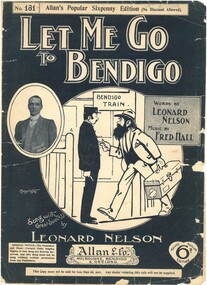
Document - Let Me Go to Bendigo (No. 181 Allan's Popular Sixpenny Edition), 1908
... 1950). Nelson married Lily Maud Haight in Victoria in 1897 and had six children named Roy, Dorothy, Leonard, Lionel, Austin and Marie. ...1950). Nelson married Lily Maud Haight in Victoria in 1897 and had six children named Roy, Dorothy, Leonard, Lionel, Austin and Marie. ...Frederick "Fred" Fifield Hall was born in Carlton, Victoria in 1878. Son of Frederick Hall and Jessie Wallace Hall (nee Lloyd), Fred would marry Elsa May Daegner in 1899 with whom he had a son named Anthony. Hall died on 27th September 1956 in Mont Albert, Victoria and was buried at the Box Hill Cemetery. Hall was known as a solo pianist and the first conductor of the Station Orchestra at 3LO (ABC Radio Station). He was also a notable music editor at Allan & Co. Earning early recognition at 16 years of age when he conducted the Sydney Orchestra, Hall was a versatile composer having written in a variety of styles including solos for the piano, violin and cello, operas, foxtrots and orchestral suites. Publications indicate that between 300 and 400 of his compositions were published. The most famous of which was "Goodbye Melbourne Town" which he wrote with Lyricist Leonard Nelson. "Let Me Go to Bendigo" was another of their joint compositions. Leonard Nelson Snell, professionally known as Leonard Nelson, was born c. 1874 in Melbourne and grew up in Kew (he was 76 in 1950). Nelson married Lily Maud Haight in Victoria in 1897 and had six children named Roy, Dorothy, Leonard, Lionel, Austin and Marie. Nelson died on the 13 August 1962 in Blackheath, NSW and was buried at the local cemetery. Nelson had a varied resume including Cattle station work, song writing and public speaking. Nelson was known for his enjoyment of Australian poetry having known many of the greats personally and could recite works from memory. In his later life, Nelson worked as an entertainer for hire at banquets and other social gatherings. No. 181 Allan's popular sixpenny edition "Sung with great success by Leonard Nelson" Allan & Co. Pty Ltd. Melbourne, Bendigo & Geelong 1 score A B4 size document containing sheet music titled "Let Me Go to Bendigo". The document has a black and white cover with bold lettering and a cartoon of a man boarding the Bendigo Train. The music was written by Fred Hall and the lyrics were written and sung by Leonard Nelson who is pictured on the cover. The music covers 3 pages (1 double sided page and 1 single side) making up this 3-page document including the cover.The front cover contains a handwritten name in the top right-hand corner "Mrs Sinclair"sheet music, leonard nelson, fred hall, allan's popular sixpenny edition, bendigo, piano, songs and music, frederick fifield hall -
 Bendigo Historical Society Inc.
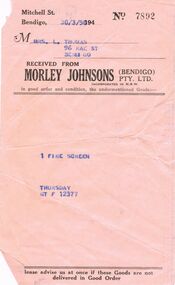
Document - MORLEY JOHNSONS RECEIPT, 30/03/1950
... 1897. The initial business operated from Pall Mall opposite the Post Office and then moved to 23 Mitchell Street in 1898. In 1906 the business moved to Sydney. It became a public company in 1952 and ceased business in 1964. BUSINESS Retail house furnishings Morley Johnsons Receipt: Pink paper with black print and blue ink. Mitchell St. Bendigo. No. 7892. Dated 30/03/1950 ...William Morley Johnson established a stock and general auctioneers business in Kyneton in 1886 before opening a furniture store in Bendigo in 1897. The initial business operated from Pall Mall opposite the Post Office and then moved to 23 Mitchell Street in 1898. In 1906 the business moved to Sydney. It became a public company in 1952 and ceased business in 1964.Morley Johnsons Receipt: Pink paper with black print and blue ink. Mitchell St. Bendigo. No. 7892. Dated 30/03/1950. To: Mrs Thomas, 95 Rae St, Bendigo Received from Morley Johnsons (Bendigo) Pty Ltd. Incorporated in N.S.W. in good order and condition, the undermentioned Goods:- 1 Fire Screen. Thursday GT F 12377. Please advise us at once if these goods are not delivered in Good order. Small tear left top. Box 625business, retail, house furnishings -
 Narre Warren and District Family History Group
Document, Patricia M Frei, Historical indexes of the Canberra/Queanbeyan district, 2006
... 1950 9. Courthouse Records: Minutes of Proceedings in Court of Review, Queanbeyan (selective 1899-1903); Bailiffs Execution Book (selective entries 1897-1918) 10. ...Historical Indexes of the Canberra Queanbeyan District in 4 volumes Volume 1: Bungendore & Michelago NSW contains: 1. Registers of St. Mary's Church, Bungendore NSW: Baptisms 31 Dec 1882-23 Dec 1888 (extracts only) recorded at the back of the Queanbeyan Baptismal Register 1843-1877 2. Court Records, Bungendore NSW: Bench Books 29 Jul 1870-30 Nov 1891-Police & Summons Cases 3. St. Patrick's Church (Catholic), Michelago NSW: Baptisms 1891-1922; Marriages 20 Nov 1899-Oct 1936 & Oct 1937-1946 (selective entries only); Liber Defunctorum [Deaths & Burials] 1910-1973; Clergy List 1891-1972 4. Michelago memorials (St. Patrick's & St. Thomas's); Michelago cemetery register; Jerangle cemetery memorials 5. Court Records, Michelago NSW: Bench books: Police & Summons Cases 1875-1936 including Tickets of Leave; Free Reports; Passports; Applications for Conditional Pardons Volume 2: Council & Court Records, Queanbeyan NSW contains: 6. Selective notes from the: Minutes of meetings of Queanbeyan Municipal Council 1885-1926; Borough Council Record Book; Halloran & Co. vs Queanbeyan Municipal Council; Commons Trust Minute Book 1899-1916 7. Notes transcribed from the District Council Papers 1843-1847 8. Notes transcribed from the Yarrowlumla Shire Council Minutes Apr 1907-Feb 1950 9. Courthouse Records: Minutes of Proceedings in Court of Review, Queanbeyan (selective 1899-1903); Bailiffs Execution Book (selective entries 1897-1918) 10. Notes transcribed from the Bench of Magistrates Correspondence 1833-1851 11. Free Reports 1846-1847; Small Debts Register 1849-1864 (incl Return of Ticket of Leave Holders); Court of Requests-Judgement book Sep 1854- May 1859 (to Jan 1864) & Cash Book: Sep 1844-Aug 1846 12. Selective notes from the Court of Claims: Register of Cases from 1835 13. Publicans Licences 1841-1862 recorded in the Deposition Book from 1838 14. Bench Records-Queanbeyan 1838-1896 Volume 3: Land and Other Records contains: 15. Research notes from the: Queanbeyan Conditional Purchase Registers 1862-1872, 1874-1877; Selections made 1870-1879 under the Volunteers Regulation Act 1867; Conditional Purchase Registers, Queanbeyan 1862-1878; Dates of Birth-Juvenile Selectors 1872-1878 (selective) 16. Alienation of Lands 1812-1853 (selective Queanbeyan & district) incl. County Register 1829-1839 (King, St. Vincent, Murray Counties) 17. Land Selection 1869-1872, 1874-1876 (selective research notes on Queanbeyan & district) 18. Selective notes from the Royal Commission on the Site for a Federal Capital (site proposed at Queanbeyan: Wanniassa, Canberra, Lake George 1899-1902) 19. Teachers in Public Schools 1884 (selective Queanbeyan & district) 20. Notes transcribed from the Queanbeyan School of Arts Minute Book 21 Jul 1925-22 Jul 1935 21. Index to Obituaries & Personal Notices circa 1820s-2001 Volume 4: Parish Registers & Burial Records contains: 22. Deaths registered at Queanbeyan NSW 1856-1901 & Burials in outlying cemeteries 1856-1907 23. Queanbeyan NSW-Gemetery records transferred from denominational trustees 24. Supreme Crt of NSW-Probate Index 1800-1901 (extracts relating to the Queanbeyan district) 25. Supreme Crt of NSW-Wills & Administrations 1800-1901 (extracts only) 26. Cemetery transcriptions—Michelago, Riverside-Queanbeyan, Gundaroo, Upper Gundaroo, Barnsdale-Gundaroo, St.Thomas-Carwoola, Ss Peter & Paul—Hoskingtown (all NSW), Weetangerra, Hall, Tharwa (all ACT) 27. Anglican Church of St. John the Baptist, Canberra: baptisms 1845-1900; marriages 1845-1877; burials 1844-1915 (selective Gundaroo entries only) 28. Christ Church (Anglican), Queanbeyan (selective): baptisms 1838-1866; marriages 1838-1909, burials 1838-1880,1913-1917,1920-1968 29. St. Gregory's (Catholic), Queanbeyan: baptisms 1843-1920; marriages 1843-1857,1856-1898, 1881; burials 1844-1877,1937-1967 (selective) 30. Ministrations by RevT Hassall, Diocese of Goulburn: baptisms 1836; baptisms by T Hassall 1827-1834,1836; marr 1827-1833; burials 1827,1829 31. Fr. J.J. Therry's registers (Catholic baptisms, marriages & burials), Queanbeyan district 1820-1838 32. Anglican Church of St. Clement's, Yass NSW (Gundaroo entries only): baptisms 1839-1863; marriages 1839-1853; burials 1839-1875 33. Parish Registers, Gunning NSW, (Gundaroo entries only): baptisms 1839-1930; marriages 1840-1850; burials 1842-18554 optical discsnon-fictionHistorical Indexes of the Canberra Queanbeyan District in 4 volumes Volume 1: Bungendore & Michelago NSW contains: 1. Registers of St. Mary's Church, Bungendore NSW: Baptisms 31 Dec 1882-23 Dec 1888 (extracts only) recorded at the back of the Queanbeyan Baptismal Register 1843-1877 2. Court Records, Bungendore NSW: Bench Books 29 Jul 1870-30 Nov 1891-Police & Summons Cases 3. St. Patrick's Church (Catholic), Michelago NSW: Baptisms 1891-1922; Marriages 20 Nov 1899-Oct 1936 & Oct 1937-1946 (selective entries only); Liber Defunctorum [Deaths & Burials] 1910-1973; Clergy List 1891-1972 4. Michelago memorials (St. Patrick's & St. Thomas's); Michelago cemetery register; Jerangle cemetery memorials 5. Court Records, Michelago NSW: Bench books: Police & Summons Cases 1875-1936 including Tickets of Leave; Free Reports; Passports; Applications for Conditional Pardons Volume 2: Council & Court Records, Queanbeyan NSW contains: 6. Selective notes from the: Minutes of meetings of Queanbeyan Municipal Council 1885-1926; Borough Council Record Book; Halloran & Co. vs Queanbeyan Municipal Council; Commons Trust Minute Book 1899-1916 7. Notes transcribed from the District Council Papers 1843-1847 8. Notes transcribed from the Yarrowlumla Shire Council Minutes Apr 1907-Feb 1950 9. Courthouse Records: Minutes of Proceedings in Court of Review, Queanbeyan (selective 1899-1903); Bailiffs Execution Book (selective entries 1897-1918) 10. Notes transcribed from the Bench of Magistrates Correspondence 1833-1851 11. Free Reports 1846-1847; Small Debts Register 1849-1864 (incl Return of Ticket of Leave Holders); Court of Requests-Judgement book Sep 1854- May 1859 (to Jan 1864) & Cash Book: Sep 1844-Aug 1846 12. Selective notes from the Court of Claims: Register of Cases from 1835 13. Publicans Licences 1841-1862 recorded in the Deposition Book from 1838 14. Bench Records-Queanbeyan 1838-1896 Volume 3: Land and Other Records contains: 15. Research notes from the: Queanbeyan Conditional Purchase Registers 1862-1872, 1874-1877; Selections made 1870-1879 under the Volunteers Regulation Act 1867; Conditional Purchase Registers, Queanbeyan 1862-1878; Dates of Birth-Juvenile Selectors 1872-1878 (selective) 16. Alienation of Lands 1812-1853 (selective Queanbeyan & district) incl. County Register 1829-1839 (King, St. Vincent, Murray Counties) 17. Land Selection 1869-1872, 1874-1876 (selective research notes on Queanbeyan & district) 18. Selective notes from the Royal Commission on the Site for a Federal Capital (site proposed at Queanbeyan: Wanniassa, Canberra, Lake George 1899-1902) 19. Teachers in Public Schools 1884 (selective Queanbeyan & district) 20. Notes transcribed from the Queanbeyan School of Arts Minute Book 21 Jul 1925-22 Jul 1935 21. Index to Obituaries & Personal Notices circa 1820s-2001 Volume 4: Parish Registers & Burial Records contains: 22. Deaths registered at Queanbeyan NSW 1856-1901 & Burials in outlying cemeteries 1856-1907 23. Queanbeyan NSW-Gemetery records transferred from denominational trustees 24. Supreme Crt of NSW-Probate Index 1800-1901 (extracts relating to the Queanbeyan district) 25. Supreme Crt of NSW-Wills & Administrations 1800-1901 (extracts only) 26. Cemetery transcriptions—Michelago, Riverside-Queanbeyan, Gundaroo, Upper Gundaroo, Barnsdale-Gundaroo, St.Thomas-Carwoola, Ss Peter & Paul—Hoskingtown (all NSW), Weetangerra, Hall, Tharwa (all ACT) 27. Anglican Church of St. John the Baptist, Canberra: baptisms 1845-1900; marriages 1845-1877; burials 1844-1915 (selective Gundaroo entries only) 28. Christ Church (Anglican), Queanbeyan (selective): baptisms 1838-1866; marriages 1838-1909, burials 1838-1880,1913-1917,1920-1968 29. St. Gregory's (Catholic), Queanbeyan: baptisms 1843-1920; marriages 1843-1857,1856-1898, 1881; burials 1844-1877,1937-1967 (selective) 30. Ministrations by RevT Hassall, Diocese of Goulburn: baptisms 1836; baptisms by T Hassall 1827-1834,1836; marr 1827-1833; burials 1827,1829 31. Fr. J.J. Therry's registers (Catholic baptisms, marriages & burials), Queanbeyan district 1820-1838 32. Anglican Church of St. Clement's, Yass NSW (Gundaroo entries only): baptisms 1839-1863; marriages 1839-1853; burials 1839-1875 33. Parish Registers, Gunning NSW, (Gundaroo entries only): baptisms 1839-1930; marriages 1840-1850; burials 1842-1855queanbeyan nsw, canberra district (act), parish registers, burial records -
 Stawell Historical Society Inc
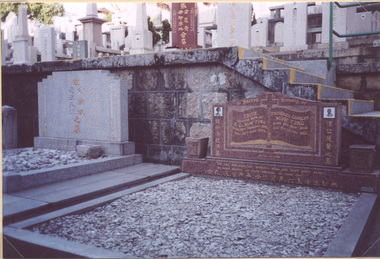
Photograph, Mr Mow Fung & his relations' Gravestones -- Photos -- Coloured
... Headstone on card 275.3 photos (5 & 6) Photo 5 Headstone of Fred Muw Fung dies 5.10.1950 born Deep Lead 9.5.1882 son of (Chung) Mow Fung & Anna Mow Fung d. 1897 - 1899. also headstone of Edith Mow Fung died 16.6.1944 wife of Fred buried Grampian Road Cemetery, Hong Kong. Headstone by G.H. Robson & Sons Stawell. Also on card 275.3 Photo (6) Headstone of David Mow Fung died 1984 son of Fred & Edith Mow Fung d 1950 - 1944 next grave. ...Headstone on card 275.3 photos (5 & 6) Photo 5 Headstone of Fred Mow Fung died 5.10.1950 born Deep Lead 9.5.1882 son of (Chung) Mow Fung & Anna Mow Fung d. 1897 - 1899. also headstone of Edith Mow Fung died 16.6.1944 wife of Fred buried Grampian Road Cemetery, Hong Kong. Headstone by G.H. Robson & Sons Stawell. Also on card 275.3 Photo (6) Headstone of David Mow Fung died 1984 son of Fred & Edith Mow Fung d 1950 - 1944 next grave. ...Headstone on card 275.3 photos (5 & 6) Photo 5 Headstone of Fred Muw Fung dies 5.10.1950 born Deep Lead 9.5.1882 son of (Chung) Mow Fung & Anna Mow Fung d. 1897 - 1899. also headstone of Edith Mow Fung died 16.6.1944 wife of Fred buried Grampian Road Cemetery, Hong Kong. Headstone by G.H. Robson & Sons Stawell. Also on card 275.3 Photo (6) Headstone of David Mow Fung died 1984 son of Fred & Edith Mow Fung d 1950 - 1944 next grave. ...Colour photos of 7 Gravestones Related to Mow Fung. Headstones in Hong Kong Christian Cemetery of Mow Fung (Chung Mow Fung) who kept the Junction Hotel at Deep Lead 1876 - 1895 when he and his wife Anna Mow Fung, their 5 daughters and son Fred returned to China. Daughters Alice, Lizzie, Elsie, Ruby, Lena Mow Fung. The son Hoctor buried Deep Lead cemetery 1892 aged 3 months. Mow Fung died in Hong Kong 1897 aged 76. His wife Anna Mow Fung died in 1899 aged 51. Headstone on cardboard 275.1 Photo (7) Headstone of David of David (Mow Fung) died Hong Kong 1984 son of Fred & Edith Mow Fung next grave. Headstones on cardboard 275.2 Photos (3 & 4) in Hong Kong. In Loving Memory of our dear mother Anna Mow Fung. Headstone on card 275.3 photos (5 & 6) Photo 5 Headstone of Fred Muw Fung dies 5.10.1950 born Deep Lead 9.5.1882 son of (Chung) Mow Fung & Anna Mow Fung d. 1897 - 1899. also headstone of Edith Mow Fung died 16.6.1944 wife of Fred buried Grampian Road Cemetery, Hong Kong. Headstone by G.H. Robson & Sons Stawell. Also on card 275.3 Photo (6) Headstone of David Mow Fung died 1984 son of Fred & Edith Mow Fung d 1950 - 1944 next grave. Headstone on card 275.4 photos 1 & 2 Headstones of Chung Mow Fung died 1897 Hong Kong Christian Cemetery, former Hotel Keeper, Junction Hotel Deep Lead 1895. Seven colour photographs of tomb stones with Chinese and English writing.Headstone on cardboard 275.1 Photo (7) Headstone of David (Mow Fung) died Hong Kong 1984 son of Fred & Edith Mow Fung next grave. Headstones on cardboard 275.2 Photos (3 & 4) in Hong Kong. In Loving Memory of our dear mother Anna Mow Fung. Headstone on card 275.3 photos (5 & 6) Photo 5 Headstone of Fred Mow Fung died 5.10.1950 born Deep Lead 9.5.1882 son of (Chung) Mow Fung & Anna Mow Fung d. 1897 - 1899. also headstone of Edith Mow Fung died 16.6.1944 wife of Fred buried Grampian Road Cemetery, Hong Kong. Headstone by G.H. Robson & Sons Stawell. Also on card 275.3 Photo (6) Headstone of David Mow Fung died 1984 son of Fred & Edith Mow Fung d 1950 - 1944 next grave. Headstone on card 275.4 photos 1 & 2 Headstones of Chung Mow Fung died 1897 Hong Kong Christian Cemetery, former Hotel Keeper Junction Hotel Deep Lead 1895.stawell chinese -
 Clunes Museum
Document - TOURELLO POST OFFICE
... 1950. POST OFFICERS AT TOURELLO RAILWAY STATION WERE; JAMES DAVEY 1887-1888 JOHN WILLIAM RUSSELL ORR 1888-1893 G KINROSS 1893 JOHN ASMUS 1893-1897 E W BIESKE 1897-1902 NOT KNOWN 1902-1909 W SCARFE 1909-1914 M PURCELL 1914-1915 NOT KNOWN 1916-1925 MRS. ...1950. POST OFFICERS AT TOURELLO RAILWAY STATION WERE; JAMES DAVEY 1887-1888 JOHN WILLIAM RUSSELL ORR 1888-1893 G KINROSS 1893 JOHN ASMUS 1893-1897 E W BIESKE 1897-1902 NOT KNOWN 1902-1909 W SCARFE 1909-1914 M PURCELL 1914-1915 NOT KNOWN 1916-1925 MRS. ...TOURELLO POST OFFICE WAS OPENED ON 1ST MAY 1868 AND WAS MOVED TO TOURELLO RAILWAY STATION. THIS WAS 3 KM FROM THE ORIGINAL SITE. ON 8TH OF AUGUST1887 THE ORIGINAL TOURELLO POST OFFICE WAS RE-OPENED AND THE BARREL NUMERAL CANCEL 620 WAS RETURNED THERE. ON THE SAME DAY A NEW BARREL NUMERAL CANCEL 1587 WAS ALLOCATED TO TOURELLO RAILWAY STATION. THIS CANCEL IS RATED AS VERY RARE. TOURELLO RAILWAY STATION POST OFFICE CLOSED ON 6TH JUNE 1950. POST OFFICERS AT TOURELLO RAILWAY STATION WERE; JAMES DAVEY 1887-1888 JOHN WILLIAM RUSSELL ORR 1888-1893 G KINROSS 1893 JOHN ASMUS 1893-1897 E W BIESKE 1897-1902 NOT KNOWN 1902-1909 W SCARFE 1909-1914 M PURCELL 1914-1915 NOT KNOWN 1916-1925 MRS. STONE 1925-1927 NOT KNOWN 1927-1931 MRS. LIZZIE MCRAE 1931-1938 MRS ROSELINE E CANNY 1938-1950 POST OFFICER AT TOURELLO WERE: D MCDONALD 1868-1874 JAMES MCGREGOR 1874-1876 HENRY JUDKINS 1876-1888 WILLIAM THOMAS MERLIN 1888-1895 TOURELLO POST OFFICE WAS CLOSED ON 1ST APRIL 1895 JAMES MCGREGOR WAS ALSO HEAD TEACHER AT SS740 TOURELLOtourello post office, tourello railway station post office, james mcgregor -
Moorabbin Air Museum
Book - Aviation mysteries, Into the Blue Great Mysteries of Aviation
... 1897...The Irish apparition 1913 - 1916...Who killed the aces Immelmann 1916/Ball & Guynemer 1917/Richthofen & Luke 1918...Sam Kinkead 1928...The lost heroes & heroines 1910-1941...Helmut Wick / J.C.Dundas Aug - November 1940...The ghosts of Wight 1940 - 1941...Portsmouth 23/24 December 1940...General Sikorski 1943...Flights without a pilot 1915 - 1945...Joe Kennedy 1944...Zuyder Zee 1917-1950...Aviation mysteries Icarus 1700 BC Andree's Polar balloon 1897 The Irish apparition 1913 - 1916 Who killed the aces Immelmann 1916/Ball & Guynemer 1917/Richthofen & Luke 1918 Sam Kinkead 1928 The lost heroes & heroines 1910-1941 Helmut Wick / J.C.Dundas Aug - November 1940 The ghosts of Wight 1940 - 1941 Portsmouth 23/24 December 1940 General Sikorski 1943 Flights without a pilot 1915 - 1945 Joe Kennedy 1944 Zuyder Zee 1917-1950 The lost airliners 1948 - 1954 Overview of aviation mysteries since early days of flight, circa 1981 Into the Blue Great Mysteries of Aviation Book Aviation mysteries ...Overview of aviation mysteries since early days of flight, circa 1981non-fictionOverview of aviation mysteries since early days of flight, circa 1981icarus 1700 bc, andree's polar balloon 1897, the irish apparition 1913 - 1916, who killed the aces immelmann 1916/ball & guynemer 1917/richthofen & luke 1918, sam kinkead 1928, the lost heroes & heroines 1910-1941, helmut wick / j.c.dundas aug - november 1940, the ghosts of wight 1940 - 1941, portsmouth 23/24 december 1940, general sikorski 1943, flights without a pilot 1915 - 1945, joe kennedy 1944, zuyder zee 1917-1950, the lost airliners 1948 - 1954 -
 Surrey Hills Historical Society Collection
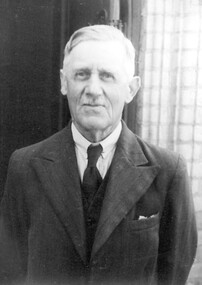
Photograph, Centenary Movie Snap, Frederick John (Fred) Ambler
... 1897. Fred was born in Essex, UK in 1873. The Amblers has a large family: Gordon Frederick William (1898-1910); Malcolm George (1900-1965); Daisy May (1904-1904); Leon Verde (1904-1904); Garnet Leslie (1904-1904); Ruby Isobel (1906-2004); Hector Leon (1909-1994); Sylvia Beatrice (1912 - ); Daisy May (1914-2009); Ronald Edward (1915-1990); Jean Mavis (1918-2001) plus Dorothy (dates not known). Residence: 1900-1914: 59 Sunbury Crescent; 1914-1950...1897. Fred was born in Essex, UK in 1873. The Amblers has a large family: Gordon Frederick William (1898-1910); Malcolm George (1900-1965); Daisy May (1904-1904); Leon Verde (1904-1904); Garnet Leslie (1904-1904); Ruby Isobel (1906-2004); Hector Leon (1909-1994); Sylvia Beatrice (1912 - ); Daisy May (1914-2009); Ronald Edward (1915-1990); Jean Mavis (1918-2001) plus Dorothy (dates not known). Residence: 1900-1914: 59 Sunbury Crescent; 1914-1950 ...Frederick John Ambler was an upholsterer. Married Beatrice Annie Martin in 1897. Fred was born in Essex, UK in 1873. The Amblers has a large family: Gordon Frederick William (1898-1910); Malcolm George (1900-1965); Daisy May (1904-1904); Leon Verde (1904-1904); Garnet Leslie (1904-1904); Ruby Isobel (1906-2004); Hector Leon (1909-1994); Sylvia Beatrice (1912 - ); Daisy May (1914-2009); Ronald Edward (1915-1990); Jean Mavis (1918-2001) plus Dorothy (dates not known). Residence: 1900-1914: 59 Sunbury Crescent; 1914-1950): 362 Canterbury Road (residence and workshop) in the Hansen's Terrace. Fred died at home (362 Canterbury Road) on 27 December 1947. He is buried in Box Hill Cemetery - M-201-0035 along with his wife. Beatrice's parents lived at 18 Lorne Parade, Surrey Hills. Black and white formal portrait of Fred Ambler in a dark suit."MRS. D. CARLSON / 1/80 WATTS ST/ BOX HILL NTH / 898 3621" Separately "FRED AMBLER" Also stamped with the photographer's details.frederick john ambler, 362 canterbury road, 59 sunbury crescent, mrs beatrice annie ambler, miss beatrice annie martin, fred ambler, box hill cemetery -
 Surrey Hills Historical Society Collection
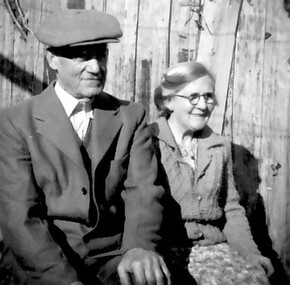
Photograph, Alpha Photo Services, Frederick John (Fred) Ambler and his wife Beatrice Annie (nee Martin)
... 1897. Fred was born in Essex, UK in 1873. The Amblers has a large family: Gordon Frederick William (1898-1910); Malcolm George (1900-1965); Daisy May (1904-1904); Leon Verde (1904-1904); Garnet Leslie (1904-1904); Ruby Isobel (1906-2004); Hector Leon (1909-1994); Sylvia Beatrice (1912 - ); Daisy May (1914-2009); Ronald Edward (1915-1990); Jean Mavis (1918-2001) plus Dorothy (dates not known). Residence: 1900-1914: 59 Sunbury Crescent; 1914-1950...1897. Fred was born in Essex, UK in 1873. The Amblers has a large family: Gordon Frederick William (1898-1910); Malcolm George (1900-1965); Daisy May (1904-1904); Leon Verde (1904-1904); Garnet Leslie (1904-1904); Ruby Isobel (1906-2004); Hector Leon (1909-1994); Sylvia Beatrice (1912 - ); Daisy May (1914-2009); Ronald Edward (1915-1990); Jean Mavis (1918-2001) plus Dorothy (dates not known). Residence: 1900-1914: 59 Sunbury Crescent; 1914-1950 ...Frederick John Ambler was an upholsterer. Married Beatrice Annie Martin in 1897. Fred was born in Essex, UK in 1873. The Amblers has a large family: Gordon Frederick William (1898-1910); Malcolm George (1900-1965); Daisy May (1904-1904); Leon Verde (1904-1904); Garnet Leslie (1904-1904); Ruby Isobel (1906-2004); Hector Leon (1909-1994); Sylvia Beatrice (1912 - ); Daisy May (1914-2009); Ronald Edward (1915-1990); Jean Mavis (1918-2001) plus Dorothy (dates not known). Residence: 1900-1914: 59 Sunbury Crescent; 1914-1950): 362 Canterbury Road (residence and workshop) in the Hansen's Terrace. Fred died at home (362 Canterbury Road) on 27 December 1947. He is buried in Box Hill Cemetery - M-201-0035 along with his wife. Beatrice's parents lived at 18 Lorne Parade, Surrey Hills. Small black and white square portrait of Fred and Annie Ambler against a paling fence."ANNIE & FRED/ AMBLER/ D. CARLSON / 1/80 WATTS ST/ BOX HILL NTH / 898 3621" Also stamped with "2241" plus "ALPHA / PHOTO SERVICES/ BOX HILL"frederick john ambler, 362 canterbury road, 59 sunbury crescent, mrs beatrice annie ambler, miss beatrice annie martin, fred ambler, box hill cemetery -
 Linton and District Historical Society Inc
Photograph, Frederick Charles Tame
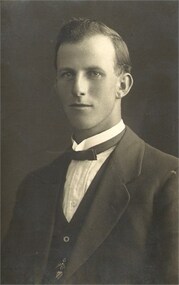
... 1897. He was the youngest son of John Burnham Tame and his wife Sarah Tame née Shields. He married (1) Ethel Vera Bolte, in 1922, and (2) Gladys May Taylor, in 1950....1897. He was the youngest son of John Burnham Tame and his wife Sarah Tame née Shields. He married (1) Ethel Vera Bolte, in 1922, and (2) Gladys May Taylor, in 1950. ...Frederick Charles Tame was born at Linton in 1897. He was the youngest son of John Burnham Tame and his wife Sarah Tame née Shields. He married (1) Ethel Vera Bolte, in 1922, and (2) Gladys May Taylor, in 1950.Digital copy of an original photograph, which shows a young man with short hair, who is wearing a dark, formal suit with bow-tie.frederick charles tame -
 City of Melbourne Libraries
Photograph, Bull, Hugh Jones, 1897-1993, Mrs T S McKay (Miss Odette Lefebvre)
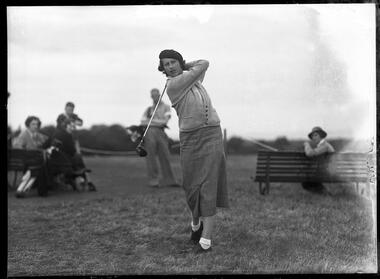
... 1950), p. 6. Retrieved September 18, 2023, from http://nla.gov.au/nla.news-article235071983 Woman Golfer Will Not Play In Stockings (1934, May 5). The Daily Telegraph (Sydney, NSW : 1931 - 1954), p. 1. Retrieved September 18, 2023, from http://nla.gov.au/nla.news-article246443596 GOLF WITHOUT STOCKINGS (1934, May 5). The Herald (Melbourne, Vic. : 1861 - 1954), p. 23. Retrieved September 18, 2023, from http://nla.gov.au/nla.news-article243259621 Golf Women golfers Royal Melbourne Golf Club Photographer notations on slide: "G Ch'ship Mrs McKay B98". Glass slide Mrs T S McKay (Miss Odette Lefebvre) Photograph Bull, Hugh Jones, 1897 ...Mrs T S McKay, née Odette Lefebvre “Killara Amazon who drives like a man, smiles like a school girl and dresses like a picture” – Smiths Weekly 22 July 1933 In 1934, the Ladies Golf Union of NSW introduced a rule forbidding women not wearing stockings from competing in games under their control. Rather than wear stockings, Odette Lefebvre (1910-1991) withdrew from her team causing a media stir. She subsequently agreed to wear stockings for any NSW game she wished to play in. She said that a player had every right to dress as she wished, providing it did not offend modesty. She found it more comfortable to play without stockings. Featured in "Newsworthy: Melbourne in photographs 1933-1936" exhibition at East Melbourne Library, October to December 2023. Exhibition caption by project volunteer, Fiona Collyer. Photographer notations on slide: "Golf Ch'ship Mrs McKay B98" Description: Female golfer teeing off with 3 wood, wearing beret, cardigan, straight skirt, ankle socks, sensible shoes. Blurred spectators are visible in the background. Research by project volunteer, Fiona Collyer: Mrs T S McKay, née Odette Lefebvre (1910-1991), was a NSW champion golfer. She won the NSW Women’s Championship 1931, 1933. Odette competed in the Australian Women’s Golf Championship at Royal Melbourne against the British Women’s Team in 1935. She was defeated by Mrs Sloan Morpeth nee Susie Tolhurst in the semifinals. A tall, willowy, beautiful brunette with a winning smile and sparkly blue eyes and exotically of French origin, the press reported the outdoor sports loving young woman’s social and golf activities closely. In 1933 (27/7/1933), the Smith’s Weekly headline ran “Drives like a man but is a real girl – always”. The article called her the “Killara Amazon who drives like a man, smiles like a school girl and dresses like a picture”. In 1934, the Ladies Golf Union of NSW introduced a rule forbidding women without stockings to compete in games within their control. Rather than wear stockings, Odette withdrew from her team, causing a media stir. She subsequently agreed to wear stockings for any game she was keen to play in. She said that a player had every right to dress as she wished, providing it did not offend modesty. She found it more comfortable to play without stockings. Fellow women golfers were sympathetic to the non-stocking brigade. Mrs J J Hollywood, president of the Maitland Golf Club Associates said, “What a storm in a teacup over nothing! As if a pair of stockings could possibly make all the difference to a person’s game. However, I think the mosquitoes settle that question for the L.G.V. in the North”, she added with a laugh. (Newcastle Sun 5/5/1934) Acting president of the Victorian Women’s Golf Union, Mrs J B Bellair, said, “It is much warmer in Sydney than here and must be more comfortable without stockings. Miss Lefebvre too, has such beautiful legs and they are so brown, that she can afford to dispense with stockings. Women in Victoria are not likely to play without stockings, however, it is much too cold here. I have never seen any of them on the links in bare legs.” (Newcastle Sun 5/5/1934) Mrs L Griffiths, president of the Steelworks Associate Club in Newcastle said, “It appears to be an unnecessary rule that the L.G.V. has enforced. Why, if they started laying down laws like that, where would we end? What about ties etc being compulsory for men?” (Newcastle Sun 5/5/1934) The L.G.V. insisted that the dignity of the game should not be impaired by players who dared to show any originality in clothes, even if they did add comfort. (The Sun, Sydney 5/5/1934) Even in 1941, despite wartime shortages, the L.G.V. NSW was insisting that – “no player may play in open L.G.V. competitions without stockings.” (Yass Tribune-Courier 6/11/1941) In 1934, Odette married champion golfer and barrister Thomas McKay who later became a NSW Liberal Party politician. They had two children before divorcing in 1946. Sources: Drives Like A Man, But Is A Real Girl--Always (1933, July 22). Smith's Weekly (Sydney, NSW : 1919 - 1950), p. 6. Retrieved September 18, 2023, from http://nla.gov.au/nla.news-article235071983 Woman Golfer Will Not Play In Stockings (1934, May 5). The Daily Telegraph (Sydney, NSW : 1931 - 1954), p. 1. Retrieved September 18, 2023, from http://nla.gov.au/nla.news-article246443596 GOLF WITHOUT STOCKINGS (1934, May 5). The Herald (Melbourne, Vic. : 1861 - 1954), p. 23. Retrieved September 18, 2023, from http://nla.gov.au/nla.news-article243259621Photographer notations on slide: "G Ch'ship Mrs McKay B98".golf, women golfers, royal melbourne golf club -
 City of Melbourne Libraries
Photograph, Bull, Hugh Jones, 1897-1993, "On Christmas morning -- Bathing at St Kilda", 1933
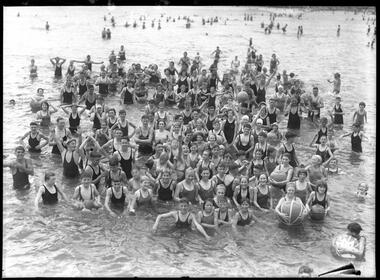
... References: History of Swimwear, Wikipedia, https://en.wikipedia.org/wiki/History_of_swimwear Jantzen Red Diving Girl, Oregon History Project, https://www.oregonhistoryproject.org/articles/historical-records/jantzen-red-diving-girl/ European History 1900-1950, St Kilda Historical Society, https://stkildahistory.org.au/about/timeline-1900-1950 Photographer notations on slide: "Christmas morning St Kilda Age B9". Glass plate negative "On Christmas morning -- Bathing at St Kilda" Photograph Bull, Hugh Jones, 1897-1993 ...Published: 26 Dec 1933 The Age p9 Published title: "ON CHRISTMAS MORNING--BATHING AT ST. KILDA." Published caption: "Yesterday morning everyone who was near the bay seized the opportunity for a cooling dip. St. Kilda foreshore was particularly well patronised, as this picture shows." Trove article identifier: http://nla.gov.au/nla.news-article203364944 Description: Large group of swimmers at St Kilda Beach on Christmas morning. Research by project volunteer, Louise McKenzie: Approximately 150 men, women and children grouped in front of the photographer in the shallows of St Kilda Beach on Christmas morning 1933. All are wearing one piece bathing suits, some have bathing caps, some hold beach balls, and one boy has a model boat. They are happy and exuberant. Their swimming attire is traditional and conservative for the time. However at this time the bathing attire was undergoing a substantial change, as Wikipedia’s History of Swimwear attests. The English practice of men swimming in the nude was banned in the United Kingdom in 1860. In the first half of the 19th century the top became knee-length while an ankle-length drawer was added as a bottom. By the second half of the 19th century, in France, the sleeves started to vanish, the bottom became shorter to reach only the knees and the top became hip-length and both became more form fitting. In the West, in the 19th century women wore a bathing gown in the water. These were loose ankle-length full-sleeve chemise-type gown made of wool or flannel, so that modesty or decency was not threatened. They were long dresses of fabrics that would not become transparent when wet, with weights sewn into the hems so that they would not rise up in the water. The men's swim suit, a rather form-fitting wool garment with long sleeves and legs similar to long underwear, was developed and would change little for a century. By the second half of the 19th century, in France, the sleeves started to vanish, the bottom became shorter to reach only the knees and the top became hip-length and both became more form fitting. In the 1900s women wore wool dresses on the beach that were In the Victorian era, Western cultures deplored nudity of any degree, and people took great pains to cover themselves, even bare chested male swimmers at ocean beaches. In the 1910s despite opposition from some groups, the form-fitting style proved popular. It was not long before swimwear started to shrink further. At first arms were exposed and then legs up to mid-thigh. Necklines receded from around the neck down to around the top of the bosom. The development of new fabrics allowed for new varieties of more comfortable and practical swimwear. The name "swim suit" was coined in 1915 by Jantzen Knitting Mills, a sweater manufacturer who launched a swimwear brand named the "Red Diving Girl”. During the 1920s and 1930s, people began to shift from "taking in the water" to "taking in the sun", at bathhouses and spas, and swimsuit designs shifted from functional considerations to incorporate more decorative features. By the 1930s men began to go without shirts for swimming and barechestedness in male swimwear became the norm by the end of the 1940s, including in competitive swimming events. Following a fire in 1925, the nearby St Kilda Baths were reopened in 1931 – with separate “enclosures” for men and women. But here in the Bay just a few years later, everyone is happily enjoying the refreshing seaside event. References: History of Swimwear, Wikipedia, https://en.wikipedia.org/wiki/History_of_swimwear Jantzen Red Diving Girl, Oregon History Project, https://www.oregonhistoryproject.org/articles/historical-records/jantzen-red-diving-girl/ European History 1900-1950, St Kilda Historical Society, https://stkildahistory.org.au/about/timeline-1900-1950Photographer notations on slide: "Christmas morning St Kilda Age B9". -
 City of Melbourne Libraries
Photograph, Bull, Hugh Jones, 1897-1993, Seventh Day Adventists Camp at Hampton: W.J. Westerman, G.G. Stewart & C.H. Watson
... 1950), p. 21. Retrieved September 9, 2025, from http://nla.gov.au/nla.news-article234426874 Advertising (1947, December 1). The Argus (Melbourne, Vic. : 1848 - 1957), p. 5. Retrieved September 15, 2025, from http://nla.gov.au/nla.news-article22523355 religion health food mini golf 1930-1939 tents churches camps Photographer notations on slide: "Seventh Day Adventists Camp at Hampton W.J. Westerman, G.G. Stewart & C.H. Watson". Glass plate negative Seventh Day Adventists Camp at Hampton: W.J. Westerman, G.G. Stewart & C.H. Watson Photograph Bull, Hugh Jones, 1897 ...Photographer notations on slide: Seventh Day Adventists Camp at Hampton W.J. Westerman, G.G. Stewart & C.H. Watson Published: 28 December 1933 Published title: SEVENTH DAY ADVENTISTS. Published caption: “I. — The Annual Camp of the Seventh Day Adventists in Highett-road, Hampton, comprising more than 250 tents and accommodating over a thousand persons. II. —W. J. Westerman (vice-president of Australasian) and Pastor G. G. Stewart (president of Victoria), conversing with Pastor C. H. Watson (world president of the Seventh Day Adventists).- III.— Evangelist E. R. Gane and family.” SEVENTH DAY ADVENTISTS. (1933, December 28). The Age (Melbourne, Vic. : 1854 - 1954), p. 9. Retrieved August 1, 2025, from http://nla.gov.au/nla.news-article203356427 Research by project volunteer, Fiona Collyer: In December 1933, the annual Seventh Day Adventists Conference of Victoria was held, with over a 1000 participants camping for ten days at Highett Road Hampton. Pastor Charles H. Watson, world president of the Seventh Day Adventists, Walter J. Westerman, vice-president of Australasian and Pastor George G. Stewart, president of Victoria attended. Interestingly, The Age newspaper modified the original photo in their publication, placing the three men close to each other. Description: Three middle aged men dressed in suits converse in front of tents. In December 1933, delegates from all over Victoria and beyond travelled to Melbourne for the annual Seventh Day Adventists Conference of Victoria, held over ten days on a vacant allotment at Highett Road Hampton. A canvas town of 250 tents for over 1000 campers was created along with large marquees for lectures, devotional services and kitchens. Many daily visitors also attended the lectures and services. The principal speaker was Victorian born world president of the Seventh Day Adventists, Pastor Charles H. Watson (1877-1962), who travelled from Washington DC for the event. The Highett Street campers attended a busy schedule of bible readings, devotional services and health lectures during the ten days of the camp. Lecture subjects included- “Among the Head Hunters of the Solomon Islands”, “ Looking Through the Prophetic Telescope into 1934”, “Soul Surgery”, “Viewing the Celestial Land Through the Prophetic Telescope”and “The Four Horsemen of the Apocalypse”. The Seventh Day Adventist religion was established in the USA in 1863. One of its co-founders was American Ellen G. White whose writings are regarded as divinely inspired and are still adhered to today. Ellen preached on the “Eight Laws of Health”- Nutrition, exercise, water, sunshine, temperance, air, rest and trust in God. Adventists regard their bodies as holy temples and avoid food deemed by the Bible as unclean. They eat a mainly plant based diet with no caffeinated beverages and abstain from alcohol and tobacco. They believe in the observance of Saturday, the seventh day of the week in the Christian (Gregorian) and Hebrew calendars as the sabbath and the literal and imminent second coming of Jesus Christ. New converts are baptised by immersion in water. The Adventists opened the Warburton Sanitarium in 1910 as a health retreat, integrating their holistic health philosophy of physical, mental and spiritual well being. It was a resort in the hills “among picturesque mountain scenery…surrounded by tall forests and deep fern gullies…” where highly strung Melburians could alleviate their digestive maladies, stress and jaded nerves as “…worn down nervous systems mend quickly in this peaceful environment…invigorating air and an abundance of home-grown fruit, vegetables, fresh eggs, milk, and cream help to build healthy bodies”. The resort also offered hydrotherapy, massage and electrical treatments. An advertisement in The Argus- 1 December 1947 assured readers- “EVERYTHING SUNNY AGAIN." “That's how you'll feel when you say farewell to Warburton Sanitarium and Hospital after spending a holiday here. Victoria's Hydro is famous far and wide for wonders worked with sufferers from nervous and digestive disorders. Wholesome food, perfectly cooked; splendid air, regulated exercise, sweet natural sleep; these quickly correct faulty digestion, restore vitality, bring back that sunny optimism natural to healthy people. Massage and curative baths under medical supervision…” Later, after further building work, it became the Warburton Hospital with medical, casualty and obstetrics wards as well as offering strategies to stop smoking, lose weight and for stress management. The hospital ceased operation in 2001. Ellen G. White wrote “God sent me to Australia” and in 1891, accompanied by her son William C. White she arrived in Australia to start a Bible school, spread her health philosophy and for missionary work. At first health food products were imported from America, but it soon became apparent that due to the expense and the food becoming stale over the long journey, that local manufacturing was necessary. In 1898 William secured the services of American Adventist baker Edward C. Halsey, who had worked at Dr Kellogg’s Battle Creek (“Cereal City”), Sanitarium, Michigan, USA. They rented the St George’s bakery in Northcote, Melbourne, producing the first ready to eat breakfast cereal Granola, Caramel Cereal, and peanut butter. The fledgling company relocated to larger premises in Cooranbong, NSW soon after. The Sanitarium Health Food Company opened a factory in Warburton in 1925, manufacturing Granose Biscuits, Cerix Puffed Wheat, San-Bran, Bixies malted wheat flakes, Betta peanut butter, Marmite, “Kwic-Bru - A delicious health “coffee” made from choicest cereals and free from drugs that affect the heart and nerves” In 1928, Sanitarium bought out Grain Products Limited who were manufacturing a sweet cereal biscuit called Weet-Bix which soon became Australia’s favourite breakfast cereal. The Warburton factory closed in 1997, with manufacturing shifting interstate. Sanitarium breakfast cereal boxes offered free collectable cards inside and children could buy albums from grocers for sixpence and mount the cards. Subjects of the albums included- “Aboriginal Tribes, Legends, Customs”, “Australia- Yesterday and Today”, “Marvels of the Great Barrier Reef”, “Advance Australia- a Pageant of the Years”. In 1902 the Adventist’s opened the “Pure Food Vegetarian Cafe” in Sydney (In 1907 the name was changed to “Sanitarium Health Food Cafe”), Eating vegetarian food was definitely a curiosity. “Cristina” reviewed the cafe for The Australasian-27 October 1906. Topics For The Block. “Feeling somewhat like a criminal, and hoping to escape detection, I stealthily made my way into a vegetarian restaurant the other day... If my friends happened to catch me walking in there, I should henceforth be considered a crank, a faddist, and little short of a lunatic! Whom did I find within, seated with the air of habitués at the small tables, but heaps of my friends. They had all this while been pursuing their vegetarian way, layin' low and sayin' nuffin'. Flesh-eaters, now that the Sydney summer has set in apparently in good earnest, are beginning to wonder if the vegetarians are not wiser in their day and generation. Roast beef, hot cornea beef, ragouts, and meat curries, the very thought of them makes one feel hot. Frosted lemon pudding, stewed fruits, wheatmeal rolls, and tomatoes sound nice when you look at their names on the vegetarian menu. Such weird messes are served, square, unintelligible blocks of some brown substance, a few bites of which form a full and satisfying meal. Cold nut foods, granose, nuttose, and jam protose, bromose, with jelly and various "ose" sandwiches, impossible for the unbeliever to diagnose, are put before you. You drink malted nut broth, you eat gluten sticks, stewed beans, lentil patties, with vegetable sauce, any or all of which are distinctly nourishing and filling at the price. A mock (decidedly mock) veal cutlet or a red lentil roast is sufficient lunch, it appears, for anyone. Thus, "you obtain the best working results from your machinery with the least possible expenditure..." In December 1906 the Adventists branched out to Melbourne, opening the Sanitarium Health Food Cafe at 289 Collins Street next to the Royal Bank building. (corner Collins and Elizabeth Streets, demolished in 1939). Their motto was “Quality and Purity”. “Cynthia” of The Leader “Social Circle” column reviewed the cafe in 9 March 1907- “Hundreds of people have a feeling of positive affection for a diet that will be satisfying, appetising and nourishing, without having meat for its backbone. It will come as news that we have in Melbourne a cafe where you can really enjoy yourself without eating anything in the way of meat. Cream, custard, cheese and the like are not cold shouldered out of the menu, and the housewife in search of new dishes will find here ever so much in the way of suggestions. Nuts figure conspicuously in the menu, and lentil and walnut cutlets may be instanced among the delicacies. Beans are cooked in quite alluring fashion, while creamed parsnips are excellent. For sandwiches you could hardly desire anything more appetising than granosi biscuits, and nut cheese. The combination is suggestive of school lunches, and nut meat might well be employed as a variant. A visit to the cafe itself — it is next the Royal Bank in Collins-street — will surprise anyone used to the average vegetarian restaurant. Every thing is fresh, fragrant, and thoroughly modern… It is run, in connection with that curious people the Seventh Day Adventists.” However, “Adele” writing for the Evelyn Observer and Bourke East Record -13 December 1907 had a different experience- CITY RESTAURANTS. “There is no glamour from the outside. We enter the dining room at six and secure a seat at a small table, for this night we are going to dine on vegetables. Some people pride themselves on being vegetarians, and devote a great deal of their spare cash and energy to disseminating vegetarian principles. I shall not in a hurry forget the dinner we tried to get through at this vegetarian restaurant. There was put before us plate after plate of vegetables not soaked, but sodden with water, not an atom of flavouring or dressing; no attempt was made to give the slightest piquancy to potato, cabbage, turnip or carrot. I beg pardon, I am unjust, there were two caterpillars in the cabbage. It is astonishing how persistently ordinary cooks spoil vegetables in the process of cooking and how little they understand the value of vegetables on a menu.” From the extensive menu of 1924, you could order cream of green pea soup, followed by nut meat with Yorkshire pudding, egg timbales, stewed brown lentils, savoury rissoles with piquant sauce. Among the dessert offerings were creamed sago, steamed figs and walnut drops. Washed down with fermented wine and to finish, “Frucerea”, a coffee substitute essence made from fruit and cereal. A four course meal of soup, entree, vegetables and sweets cost 1/6 in 1924. Proving that plant-based food was not just a novelty, 67,000 meals were served at the cafe in 1918, rising to 73,000 in 1921. Later the Sanitarium Cafe moved to 293 Little Collins Street, (opposite Royal Arcade) sharing the building with The Lilliput Golf Course, a miniature golf course of 18 holes. The course was a replica of the fashionable Lido Course in France and was open daily from 10am to midnight with a green fee of one shilling. It featured goldfish, waterfalls and dance music. Lilliput boasted that they were “Melbourne’s coolest indoor course” Miniature golf (mini, minnie, midget, miget, Tom Thumb, Wee golf, putt-putt, pigmy, peewee, crazy golf, obstacle golf) swept the globe in the 1930s, starting in the USA, then Europe. The courses provided affordable recreation during uncertainty at the start of the Great Depression. The craze arrived in Sydney September 1930 with the first mini golf course opening in the basement of the State Theatre. It featured a replica Sydney Harbour Bridge and attracted over 1000 players a day at one shilling per game. The miniature golf bug hit Melbourne hard in 1930-31 with nearly 200 courses springing up in the CBD and suburbs within a few months. The first miniature golf course to open in Melbourne was on 4 October 1930 in the basement of recently built art deco style Wentworth House at 203 Collins Street, designed by architect Cedric Heise Ballantyne, (also designed Regent Theatre, Plaza Ballroom, Athenaeum Club, National Theatre, St Kilda, built in 1930, demolished in 1974 for the City Square) It was managed by J. C. Williamson who advertised for a “Girl Spruiker” who “Must be Young, Attractive Personality, and Able to Talk to the Public” to work at the course. The Age 26 September 1930 reported - “The Wentworth House management have spared no expense in preparing the links. Water hazards, sand bunkers, running streams, ancestral castles, moats and a cunning drawbridge have each been devised to test the skill of players, while the walls and ceiling have been "atmospherically" treated to convey an exterior effect”. Even Melbourne City Council jumped on the bandwagon, leasing the lower hall of Melbourne Town Hall to colourful car dealer and racehorse owner Mr A. G. Barlow for £43 per week for the “Kit Kat Tiny Golf Course”, opening on 11 December 1930. (Turf identity, Mr Alexander George Barlow, (1880-1937) who raced under the nom de course “A. G. Vauxhall”, owned filly Frances Tressady, who in 1923 won the Victoria Derby and Oaks Stakes double and came fifth in the Melbourne Cup. The “Frances Tressady Stakes” is held each March at Flemington Racecourse in honour of the horse, the last filly to win the Derby. Barlow was the proprietor of Barlow Brothers Pty Ltd car dealership at 442 Elizabeth Street, Melbourne. He played 14 games for Carlton Football Club (VFL) on the half-forward line from 1901-1903). Patrons could vie for The Herald Miniature Golf Championship Cup, a gold cup worth £7/7, in an eight week long competition. Sports newspaper The Sporting Globe also offered a Cup and prize money. Many courses offered prizes of theatre tickets, cash and cigarettes. Myer’s department store, hoping to cash in on the fad, advertised in Melbourne’s newspapers that their Sports Department could design and equip complete miniature golf courses using “Fairway” imitation turf at 4/6 a yard. Newspaper cartoonists loved to lampoon the fad. Both Percy Leason, cartoonist for society magazine Table Talk and Syd Miller of Smith’s Weekly depicted “real” golfers causing havoc on a mini golf course, showing that being a “real” golf player was no advantage to playing miniature golf. But bust often follows boom. With such rapid market saturation, expensive novel hazards, waning interest, long opening hours, often to midnight, and price cutting of game fees from one shilling to sixpence and then to threepence amongst some courses, the bubble was bound to burst. The Sporting Globe columnist J.M.Dillon on 20 May 1931 lamented- £100,000 LOST Failure of ‘Minnie’ Golf. “Miniature golf might have provided fun and jokes for thousands of people in Australia, but there were many for whom it panned out a tragedy. It is likely that the dead losses of those who attempted to make money out of the game in Australia were in the vicinity of £100,000. …For a while there was hardly a spare block of land, or a possible “site” in the shape of a hall, or a showroom, in Sydney and Melbourne, that some one was not after to set upon it a “minnie links.” Big amusement firms and private individuals anxious to make money began to run courses. Practically every individual who touched the game had his finger’s financially burnt. …From the approximately £60,000 invested in Melbourne alone, there must have been £25,000 lost. …There are now dozens of courses going to ruin, and many more that the owners would be happy to give away if the takers would remove from them obligations of leases, &c…” The lease on the “Kit Kat Tiny Golf Club” at the Melbourne Town Hall expired on 30 April 1931, with Mr Barlow losing £798 on the venture. The hazards and fittings, which cost £400 and included a large replica of the Town Hall, now worthless. Due to declining patronage, the Little Collins Street cafe closed in 1938, although the adjacent shop continued to sell Sanitarium products. In New Zealand, the first Sanitarium factory opened in Christchurch in 1900, with the company later opening factories in Palmerston North and Auckland. The Adventists opened vegetarian cafes, firstly at 37 Taranaki Street Wellington in 1906, followed by cafes in Auckland, Christchurch and Dunedin. Weet-Bix is also New Zealand’s favourite cereal- there the jingle is “Kiwi kids are Weet-Bix kids.” In 1955, the Australian Women’s Weekly ran an illustrated, full colour advertisement featuring New Zealand born Edmund Hillary (later Sir) 1919-2008, who, along with Sherpa Tenzing Norgay, was the first climber to reach the summit of Mount Everest on 29 March 1953. The Australian Women’s Weekly, 30 March, 1955- “WEET-BIX carried by Hillary on Himalayan adventure! c/- N.Z. Alpine Club Inc., Dunedin, New Zealand. The Manager, Sanitarium Health Food Company, Christchurch, N.Z. Dear Sir. …Weet-Bix was chosen at my special request as I had always felt that some easily prepared form of breakfast was essential to the primitive conditions of high camps. Weet-Bix fulfilled its task very well indeed. We usually had them with hot milk (powdered) and sugar, and even when we were unable to eat anything else, we usually managed to have a little Weet-Bix . . . I regard them as a great success and expect they will be more widely used in the Himalayas in future. Yours faithfully, (Signed) E.P. Hillary. Sanitarium Marmite - motto- “Too much spoils the flavour”- is as beloved with Kiwis as Vegemite is with Australians. In 1966, a fire gutted the Christchurch Marmite factory causing a nation wide shortage. Once the factory was rebuilt, Sanitarium relaunched the yeasty extract in reusable glass tumblers with printed designs such as yachts, New Zealand birds and vintage cars. These popular collectibles can still be found in the kitchen cupboards of many New Zealand baches (holiday homes). After the devastating 2011 earthquake in Christchurch damaged the Marmite factory causing shortages and panic buying, a “Marmageddon” was declared with jars of the “black gold” advertised online for up to NZ$800. Consumers were advised to spread their Marmite sparingly until production resumed. (The Christchurch plant reportedly produces around 640,000kg of Marmite per year). Sanitarium Health and Wellbeing Company is exempt from paying company income tax on their profits due to their ownership by a religious organisation. Although not a compulsory rule for salvation, Adventists are encouraged to pay a tithe of 10% of their income to the church to support the ministry in God’s work. Nowadays, there are over 25 million members of the Seventh Day Adventists Church in 200 countries. ITEMS OF INTEREST (1933, December 22). The Argus (Melbourne, Vic. : 1848 - 1957), p. 8. Retrieved July 21, 2025, from http://nla.gov.au/nla.news-article11723188 SEVENTH DAY ADVENTISTS. (1933, December 28). The Age (Melbourne, Vic. : 1854 - 1954), p. 9. Retrieved July 1, 2025, from http://nla.gov.au/nla.news-article203356427 EVANGELISTS' CAMP (1933, December 20). The Herald (Melbourne, Vic. : 1861 - 1954), p. 30. Retrieved July 1, 2025, from http://nla.gov.au/nla.news-article243213209 Master Butchers Have A Time Pilots FOR School Air Race Charity Golf At Riversdale (1931, May 1). The Sun News-Pictorial (Melbourne, Vic. : 1922 - 1954; 1956), p. 14-15. Retrieved September 4, 2025, from http://nla.gov.au/nla.news-article276159136 2000 ADVENTISTS UNDER CANVAS (1933, December 27). The Herald (Melbourne, Vic. : 1861 - 1954), p. 17. Retrieved July 1, 2025, from http://nla.gov.au/nla.news-article243223698 TOPICS FOR THE BLOCK. (1906, October 27). The Australasian (Melbourne, Vic. : 1864 - 1946), p. 45. Retrieved August 30, 2025, from http://nla.gov.au/nla.news-article139178204 https://en.wikipedia.org/wiki/Seventh-day_Adventist_Church https://www.sanitarium.com/au/about/sanitarium-story/profits-for- ENTERTAINMENT AT MENZIES'. (1906, December 6). Punch (Melbourne, Vic. : 1900 - 1918; 1925), p. 26. Retrieved August 3, 2025, from http://nla.gov.au/nla.news-article175380296 https://encyclopedia.adventist.org/article?id=9HN0&highlight=Conference SOCIAL CIRCLE (1907, March 9). Leader (Melbourne, Vic. : 1862 - 1918, 1935), p. 41. Retrieved August 3, 2025, from http://nla.gov.au/nla.news-article196649677 CITY RESTAURANTS. (1907, December 13). Evelyn Observer and Bourke East Record (Vic. : 1902 - 1917), p. 1 (MORNING.). Retrieved August 3, 2025, from http://nla.gov.au/nla.news-article61133109 Advertising (1924, May 6). The Sun News-Pictorial (Melbourne, Vic. : 1922 - 1954; 1956), p. 9. Retrieved August 3, 2025, from http://nla.gov.au/nla.news-article274271406 1930, December 5). The Herald (Melbourne, Vic. : 1861 - 1954), p. 14. Retrieved August 5, 2025, from http://nla.gov.au/nla.news-page26374135 Thousands Are Still Playing Miniature Golf (1931, January 2). The Herald (Melbourne, Vic. : 1861 - 1954), p. 11. Retrieved August 8, 2025, from http://nla.gov.au/nla.news-article242880087 MINIATURE GOLF. (1930, October 16). The Argus (Melbourne, Vic. : 1848 - 1957), p. 10. Retrieved August 8, 2025, from http://nla.gov.au/nla.news-article4209280 THE REAL GOLFER WHO FORGOT HIMSELF ON THE MINIATURE GOLF COURSE (1930, November 13). Table Talk (Melbourne, Vic. : 1885 - 1939), p. 13. Retrieved August 8, 2025, from http://nla.gov.au/nla.news-article146706596 Advertising (1930, December 5). The Herald (Melbourne, Vic. : 1861 - 1954), p. 14. Retrieved August 8, 2025, from http://nla.gov.au/nla.news-article242761991 Advertising (1931, January 9). The Herald (Melbourne, Vic. : 1861 - 1954), p. 12. Retrieved August 8, 2025, from http://nla.gov.au/nla.news-article242887972 1955, March 30). The Australian Women's Weekly (1933 - 1982), p. 38. Retrieved August 9, 2025, from http://nla.gov.au/nla.news-page4812489 £100,000 LOST (1931, May 20). Sporting Globe (Melbourne, Vic. : 1922 - 1954), p. 1 (Edition1). Retrieved August 14, 2025, from http://nla.gov.au/nla.news-article183023946 1930, December 5). The Herald (Melbourne, Vic. : 1861 - 1954), p. 14. Retrieved August 15, 2025, from http://nla.gov.au/nla.news-page26374135 Advertising (1931, January 23). The Herald (Melbourne, Vic. : 1861 - 1954), p. 14. Retrieved August 15, 2025, from http://nla.gov.au/nla.news-article242887795 MINIATURE GOLF. (1931, February 5). The Dandenong Journal (Vic. : 1927 - 1954), p. 6. Retrieved August 16, 2025, from http://nla.gov.au/nla.news-article201082526 Still Time To Enter Midge (1931, January 16). The Herald (Melbourne, Vic. : 1861 - 1954), p. 12. Retrieved August 16, 2025, from http://nla.gov.au/nla.news-article242888830 WIT OF THE WEEK (1930, October 23). Table Talk (Melbourne, Vic. : 1885 - 1939), p. 23. Retrieved August 29, 2025, from http://nla.gov.au/nla.news-article146455050 Advertising (1930, October 2). Table Talk (Melbourne, Vic. : 1885 - 1939), p. 16. Retrieved August 18, 2025, from http://nla.gov.au/nla.news-article146454620 MIDGET GOLF LINKS. (1930, September 26). The Age (Melbourne, Vic. : 1854 - 1954), p. 6. Retrieved August 18, 2025, from http://nla.gov.au/nla.news-article202235074 https://www.smh.com.au/national/fairfax-archive-mini-golf-20131125-2y608.html TURF NOTES (1923, November 6). The Ballarat Star (Vic. : 1865 - 1924), p. 6. Retrieved September 3, 2025, from http://nla.gov.au/nla.news-article213855201 Advertising (1930, October 4). The Herald (Melbourne, Vic. : 1861 - 1954), p. 10. Retrieved October 14, 2025, from http://nla.gov.au/nla.news-article242937272 LAUGHTER AND TEARS. (1930, November 15). Smith's Weekly (Sydney, NSW : 1919 - 1950), p. 21. Retrieved September 9, 2025, from http://nla.gov.au/nla.news-article234426874 Advertising (1947, December 1). The Argus (Melbourne, Vic. : 1848 - 1957), p. 5. Retrieved September 15, 2025, from http://nla.gov.au/nla.news-article22523355Photographer notations on slide: "Seventh Day Adventists Camp at Hampton W.J. Westerman, G.G. Stewart & C.H. Watson".religion, health food, mini golf, 1930-1939, tents, churches, camps -
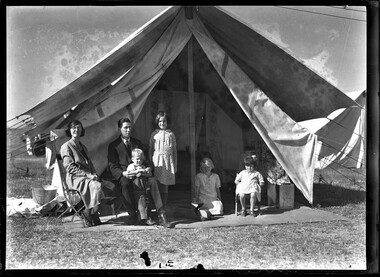 City of Melbourne Libraries
Photograph, Bull, Hugh Jones, 1897-1993, Seventh Day Adventists Camp at Hampton: E. Gane + family
... 1950), p. 21. Retrieved September 9, 2025, from http://nla.gov.au/nla.news-article234426874 Advertising (1947, December 1). The Argus (Melbourne, Vic. : 1848 - 1957), p. 5. Retrieved September 15, 2025, from http://nla.gov.au/nla.news-article22523355 religion health food mini golf 1930-1939 tents churches camps Photographer notations on slide: "Seventh Day Adventists Camp. E Gane + family". Glass plate negative Seventh Day Adventists Camp at Hampton: E. Gane + family Photograph Bull, Hugh Jones, 1897 ...Photographer notations on slide: Seventh Day Adventists Camp. E Gane + family Published: 28 December 1933 Published title: SEVENTH DAY ADVENTISTS. Published caption: “I. — The Annual Camp of the Seventh Day Adventists in Highett-road, Hampton, comprising more than 250 tents and accommodating over a thousand persons. II. —W. J. Westerman (vice-president of Australasian) and Pastor G. G. Stewart (president of Victoria), conversing with Pastor C. H. Watson (world president of the Seventh Day Adventists).- III.— Evangelist E. R. Gane and family.” SEVENTH DAY ADVENTISTS. (1933, December 28). The Age (Melbourne, Vic. : 1854 - 1954), p. 9. Retrieved August 1, 2025, from http://nla.gov.au/nla.news-article203356427 Research by project volunteer, Fiona Collyer: In December 1933, evangelist Mr E.R. Gane and his family gather outside their tent during the ten day Seventh Day Adventist Conference held in Highett Road, Hampton. Description: A woman, man and four small children sit and stand in front of a tent. One child plays with a toy train. In December 1933, delegates from all over Victoria and beyond travelled to Melbourne for the annual Seventh Day Adventists Conference of Victoria, held over ten days on a vacant allotment at Highett Road Hampton. A canvas town of 250 tents for over 1000 campers was created along with large marquees for lectures, devotional services and kitchens. Many daily visitors also attended the lectures and services. The principal speaker was Victorian born world president of the Seventh Day Adventists, Pastor Charles H. Watson (1877-1962), who travelled from Washington DC for the event. The Highett Street campers attended a busy schedule of bible readings, devotional services and health lectures during the ten days of the camp. Lecture subjects included- “Among the Head Hunters of the Solomon Islands”, “ Looking Through the Prophetic Telescope into 1934”, “Soul Surgery”, “Viewing the Celestial Land Through the Prophetic Telescope”and “The Four Horsemen of the Apocalypse”. The Seventh Day Adventist religion was established in the USA in 1863. One of its co-founders was American Ellen G. White whose writings are regarded as divinely inspired and are still adhered to today. Ellen preached on the “Eight Laws of Health”- Nutrition, exercise, water, sunshine, temperance, air, rest and trust in God. Adventists regard their bodies as holy temples and avoid food deemed by the Bible as unclean. They eat a mainly plant based diet with no caffeinated beverages and abstain from alcohol and tobacco. They believe in the observance of Saturday, the seventh day of the week in the Christian (Gregorian) and Hebrew calendars as the sabbath and the literal and imminent second coming of Jesus Christ. New converts are baptised by immersion in water. The Adventists opened the Warburton Sanitarium in 1910 as a health retreat, integrating their holistic health philosophy of physical, mental and spiritual well being. It was a resort in the hills “among picturesque mountain scenery…surrounded by tall forests and deep fern gullies…” where highly strung Melburians could alleviate their digestive maladies, stress and jaded nerves as “…worn down nervous systems mend quickly in this peaceful environment…invigorating air and an abundance of home-grown fruit, vegetables, fresh eggs, milk, and cream help to build healthy bodies”. The resort also offered hydrotherapy, massage and electrical treatments. An advertisement in The Argus- 1 December 1947 assured readers- “EVERYTHING SUNNY AGAIN." “That's how you'll feel when you say farewell to Warburton Sanitarium and Hospital after spending a holiday here. Victoria's Hydro is famous far and wide for wonders worked with sufferers from nervous and digestive disorders. Wholesome food, perfectly cooked; splendid air, regulated exercise, sweet natural sleep; these quickly correct faulty digestion, restore vitality, bring back that sunny optimism natural to healthy people. Massage and curative baths under medical supervision…” Later, after further building work, it became the Warburton Hospital with medical, casualty and obstetrics wards as well as offering strategies to stop smoking, lose weight and for stress management. The hospital ceased operation in 2001. Ellen G. White wrote “God sent me to Australia” and in 1891, accompanied by her son William C. White she arrived in Australia to start a Bible school, spread her health philosophy and for missionary work. At first health food products were imported from America, but it soon became apparent that due to the expense and the food becoming stale over the long journey, that local manufacturing was necessary. In 1898 William secured the services of American Adventist baker Edward C. Halsey, who had worked at Dr Kellogg’s Battle Creek (“Cereal City”), Sanitarium, Michigan, USA. They rented the St George’s bakery in Northcote, Melbourne, producing the first ready to eat breakfast cereal Granola, Caramel Cereal, and peanut butter. The fledgling company relocated to larger premises in Cooranbong, NSW soon after. The Sanitarium Health Food Company opened a factory in Warburton in 1925, manufacturing Granose Biscuits, Cerix Puffed Wheat, San-Bran, Bixies malted wheat flakes, Betta peanut butter, Marmite, “Kwic-Bru - A delicious health “coffee” made from choicest cereals and free from drugs that affect the heart and nerves” In 1928, Sanitarium bought out Grain Products Limited who were manufacturing a sweet cereal biscuit called Weet-Bix which soon became Australia’s favourite breakfast cereal. The Warburton factory closed in 1997, with manufacturing shifting interstate. Sanitarium breakfast cereal boxes offered free collectable cards inside and children could buy albums from grocers for sixpence and mount the cards. Subjects of the albums included- “Aboriginal Tribes, Legends, Customs”, “Australia- Yesterday and Today”, “Marvels of the Great Barrier Reef”, “Advance Australia- a Pageant of the Years”. In 1902 the Adventist’s opened the “Pure Food Vegetarian Cafe” in Sydney (In 1907 the name was changed to “Sanitarium Health Food Cafe”), Eating vegetarian food was definitely a curiosity. “Cristina” reviewed the cafe for The Australasian-27 October 1906. Topics For The Block. “Feeling somewhat like a criminal, and hoping to escape detection, I stealthily made my way into a vegetarian restaurant the other day... If my friends happened to catch me walking in there, I should henceforth be considered a crank, a faddist, and little short of a lunatic! Whom did I find within, seated with the air of habitués at the small tables, but heaps of my friends. They had all this while been pursuing their vegetarian way, layin' low and sayin' nuffin'. Flesh-eaters, now that the Sydney summer has set in apparently in good earnest, are beginning to wonder if the vegetarians are not wiser in their day and generation. Roast beef, hot cornea beef, ragouts, and meat curries, the very thought of them makes one feel hot. Frosted lemon pudding, stewed fruits, wheatmeal rolls, and tomatoes sound nice when you look at their names on the vegetarian menu. Such weird messes are served, square, unintelligible blocks of some brown substance, a few bites of which form a full and satisfying meal. Cold nut foods, granose, nuttose, and jam protose, bromose, with jelly and various "ose" sandwiches, impossible for the unbeliever to diagnose, are put before you. You drink malted nut broth, you eat gluten sticks, stewed beans, lentil patties, with vegetable sauce, any or all of which are distinctly nourishing and filling at the price. A mock (decidedly mock) veal cutlet or a red lentil roast is sufficient lunch, it appears, for anyone. Thus, "you obtain the best working results from your machinery with the least possible expenditure..." In December 1906 the Adventists branched out to Melbourne, opening the Sanitarium Health Food Cafe at 289 Collins Street next to the Royal Bank building. (corner Collins and Elizabeth Streets, demolished in 1939). Their motto was “Quality and Purity”. “Cynthia” of The Leader “Social Circle” column reviewed the cafe in 9 March 1907- “Hundreds of people have a feeling of positive affection for a diet that will be satisfying, appetising and nourishing, without having meat for its backbone. It will come as news that we have in Melbourne a cafe where you can really enjoy yourself without eating anything in the way of meat. Cream, custard, cheese and the like are not cold shouldered out of the menu, and the housewife in search of new dishes will find here ever so much in the way of suggestions. Nuts figure conspicuously in the menu, and lentil and walnut cutlets may be instanced among the delicacies. Beans are cooked in quite alluring fashion, while creamed parsnips are excellent. For sandwiches you could hardly desire anything more appetising than granosi biscuits, and nut cheese. The combination is suggestive of school lunches, and nut meat might well be employed as a variant. A visit to the cafe itself — it is next the Royal Bank in Collins-street — will surprise anyone used to the average vegetarian restaurant. Every thing is fresh, fragrant, and thoroughly modern… It is run, in connection with that curious people the Seventh Day Adventists.” However, “Adele” writing for the Evelyn Observer and Bourke East Record -13 December 1907 had a different experience- CITY RESTAURANTS. “There is no glamour from the outside. We enter the dining room at six and secure a seat at a small table, for this night we are going to dine on vegetables. Some people pride themselves on being vegetarians, and devote a great deal of their spare cash and energy to disseminating vegetarian principles. I shall not in a hurry forget the dinner we tried to get through at this vegetarian restaurant. There was put before us plate after plate of vegetables not soaked, but sodden with water, not an atom of flavouring or dressing; no attempt was made to give the slightest piquancy to potato, cabbage, turnip or carrot. I beg pardon, I am unjust, there were two caterpillars in the cabbage. It is astonishing how persistently ordinary cooks spoil vegetables in the process of cooking and how little they understand the value of vegetables on a menu.” From the extensive menu of 1924, you could order cream of green pea soup, followed by nut meat with Yorkshire pudding, egg timbales, stewed brown lentils, savoury rissoles with piquant sauce. Among the dessert offerings were creamed sago, steamed figs and walnut drops. Washed down with fermented wine and to finish, “Frucerea”, a coffee substitute essence made from fruit and cereal. A four course meal of soup, entree, vegetables and sweets cost 1/6 in 1924. Proving that plant-based food was not just a novelty, 67,000 meals were served at the cafe in 1918, rising to 73,000 in 1921. Later the Sanitarium Cafe moved to 293 Little Collins Street, (opposite Royal Arcade) sharing the building with The Lilliput Golf Course, a miniature golf course of 18 holes. The course was a replica of the fashionable Lido Course in France and was open daily from 10am to midnight with a green fee of one shilling. It featured goldfish, waterfalls and dance music. Lilliput boasted that they were “Melbourne’s coolest indoor course” Miniature golf (mini, minnie, midget, miget, Tom Thumb, Wee golf, putt-putt, pigmy, peewee, crazy golf, obstacle golf) swept the globe in the 1930s, starting in the USA, then Europe. The courses provided affordable recreation during uncertainty at the start of the Great Depression. The craze arrived in Sydney September 1930 with the first mini golf course opening in the basement of the State Theatre. It featured a replica Sydney Harbour Bridge and attracted over 1000 players a day at one shilling per game. The miniature golf bug hit Melbourne hard in 1930-31 with nearly 200 courses springing up in the CBD and suburbs within a few months. The first miniature golf course to open in Melbourne was on 4 October 1930 in the basement of recently built art deco style Wentworth House at 203 Collins Street, designed by architect Cedric Heise Ballantyne, (also designed Regent Theatre, Plaza Ballroom, Athenaeum Club, National Theatre, St Kilda, built in 1930, demolished in 1974 for the City Square) It was managed by J. C. Williamson who advertised for a “Girl Spruiker” who “Must be Young, Attractive Personality, and Able to Talk to the Public” to work at the course. The Age 26 September 1930 reported - “The Wentworth House management have spared no expense in preparing the links. Water hazards, sand bunkers, running streams, ancestral castles, moats and a cunning drawbridge have each been devised to test the skill of players, while the walls and ceiling have been "atmospherically" treated to convey an exterior effect”. Even Melbourne City Council jumped on the bandwagon, leasing the lower hall of Melbourne Town Hall to colourful car dealer and racehorse owner Mr A. G. Barlow for £43 per week for the “Kit Kat Tiny Golf Course”, opening on 11 December 1930. (Turf identity, Mr Alexander George Barlow, (1880-1937) who raced under the nom de course “A. G. Vauxhall”, owned filly Frances Tressady, who in 1923 won the Victoria Derby and Oaks Stakes double and came fifth in the Melbourne Cup. The “Frances Tressady Stakes” is held each March at Flemington Racecourse in honour of the horse, the last filly to win the Derby. Barlow was the proprietor of Barlow Brothers Pty Ltd car dealership at 442 Elizabeth Street, Melbourne. He played 14 games for Carlton Football Club (VFL) on the half-forward line from 1901-1903). Patrons could vie for The Herald Miniature Golf Championship Cup, a gold cup worth £7/7, in an eight week long competition. Sports newspaper The Sporting Globe also offered a Cup and prize money. Many courses offered prizes of theatre tickets, cash and cigarettes. Myer’s department store, hoping to cash in on the fad, advertised in Melbourne’s newspapers that their Sports Department could design and equip complete miniature golf courses using “Fairway” imitation turf at 4/6 a yard. Newspaper cartoonists loved to lampoon the fad. Both Percy Leason, cartoonist for society magazine Table Talk and Syd Miller of Smith’s Weekly depicted “real” golfers causing havoc on a mini golf course, showing that being a “real” golf player was no advantage to playing miniature golf. But bust often follows boom. With such rapid market saturation, expensive novel hazards, waning interest, long opening hours, often to midnight, and price cutting of game fees from one shilling to sixpence and then to threepence amongst some courses, the bubble was bound to burst. The Sporting Globe columnist J.M.Dillon on 20 May 1931 lamented- £100,000 LOST Failure of ‘Minnie’ Golf. “Miniature golf might have provided fun and jokes for thousands of people in Australia, but there were many for whom it panned out a tragedy. It is likely that the dead losses of those who attempted to make money out of the game in Australia were in the vicinity of £100,000. …For a while there was hardly a spare block of land, or a possible “site” in the shape of a hall, or a showroom, in Sydney and Melbourne, that some one was not after to set upon it a “minnie links.” Big amusement firms and private individuals anxious to make money began to run courses. Practically every individual who touched the game had his finger’s financially burnt. …From the approximately £60,000 invested in Melbourne alone, there must have been £25,000 lost. …There are now dozens of courses going to ruin, and many more that the owners would be happy to give away if the takers would remove from them obligations of leases, &c…” The lease on the “Kit Kat Tiny Golf Club” at the Melbourne Town Hall expired on 30 April 1931, with Mr Barlow losing £798 on the venture. The hazards and fittings, which cost £400 and included a large replica of the Town Hall, now worthless. Due to declining patronage, the Little Collins Street cafe closed in 1938, although the adjacent shop continued to sell Sanitarium products. In New Zealand, the first Sanitarium factory opened in Christchurch in 1900, with the company later opening factories in Palmerston North and Auckland. The Adventists opened vegetarian cafes, firstly at 37 Taranaki Street Wellington in 1906, followed by cafes in Auckland, Christchurch and Dunedin. Weet-Bix is also New Zealand’s favourite cereal- there the jingle is “Kiwi kids are Weet-Bix kids.” In 1955, the Australian Women’s Weekly ran an illustrated, full colour advertisement featuring New Zealand born Edmund Hillary (later Sir) 1919-2008, who, along with Sherpa Tenzing Norgay, was the first climber to reach the summit of Mount Everest on 29 March 1953. The Australian Women’s Weekly, 30 March, 1955- “WEET-BIX carried by Hillary on Himalayan adventure! c/- N.Z. Alpine Club Inc., Dunedin, New Zealand. The Manager, Sanitarium Health Food Company, Christchurch, N.Z. Dear Sir. …Weet-Bix was chosen at my special request as I had always felt that some easily prepared form of breakfast was essential to the primitive conditions of high camps. Weet-Bix fulfilled its task very well indeed. We usually had them with hot milk (powdered) and sugar, and even when we were unable to eat anything else, we usually managed to have a little Weet-Bix . . . I regard them as a great success and expect they will be more widely used in the Himalayas in future. Yours faithfully, (Signed) E.P. Hillary. Sanitarium Marmite - motto- “Too much spoils the flavour”- is as beloved with Kiwis as Vegemite is with Australians. In 1966, a fire gutted the Christchurch Marmite factory causing a nation wide shortage. Once the factory was rebuilt, Sanitarium relaunched the yeasty extract in reusable glass tumblers with printed designs such as yachts, New Zealand birds and vintage cars. These popular collectibles can still be found in the kitchen cupboards of many New Zealand baches (holiday homes). After the devastating 2011 earthquake in Christchurch damaged the Marmite factory causing shortages and panic buying, a “Marmageddon” was declared with jars of the “black gold” advertised online for up to NZ$800. Consumers were advised to spread their Marmite sparingly until production resumed. (The Christchurch plant reportedly produces around 640,000kg of Marmite per year). Sanitarium Health and Wellbeing Company is exempt from paying company income tax on their profits due to their ownership by a religious organisation. Although not a compulsory rule for salvation, Adventists are encouraged to pay a tithe of 10% of their income to the church to support the ministry in God’s work. Nowadays, there are over 25 million members of the Seventh Day Adventists Church in 200 countries. ITEMS OF INTEREST (1933, December 22). The Argus (Melbourne, Vic. : 1848 - 1957), p. 8. Retrieved July 21, 2025, from http://nla.gov.au/nla.news-article11723188 SEVENTH DAY ADVENTISTS. (1933, December 28). The Age (Melbourne, Vic. : 1854 - 1954), p. 9. Retrieved July 1, 2025, from http://nla.gov.au/nla.news-article203356427 EVANGELISTS' CAMP (1933, December 20). The Herald (Melbourne, Vic. : 1861 - 1954), p. 30. Retrieved July 1, 2025, from http://nla.gov.au/nla.news-article243213209 Master Butchers Have A Time Pilots FOR School Air Race Charity Golf At Riversdale (1931, May 1). The Sun News-Pictorial (Melbourne, Vic. : 1922 - 1954; 1956), p. 14-15. Retrieved September 4, 2025, from http://nla.gov.au/nla.news-article276159136 2000 ADVENTISTS UNDER CANVAS (1933, December 27). The Herald (Melbourne, Vic. : 1861 - 1954), p. 17. Retrieved July 1, 2025, from http://nla.gov.au/nla.news-article243223698 TOPICS FOR THE BLOCK. (1906, October 27). The Australasian (Melbourne, Vic. : 1864 - 1946), p. 45. Retrieved August 30, 2025, from http://nla.gov.au/nla.news-article139178204 https://en.wikipedia.org/wiki/Seventh-day_Adventist_Church https://www.sanitarium.com/au/about/sanitarium-story/profits-for- ENTERTAINMENT AT MENZIES'. (1906, December 6). Punch (Melbourne, Vic. : 1900 - 1918; 1925), p. 26. Retrieved August 3, 2025, from http://nla.gov.au/nla.news-article175380296 https://encyclopedia.adventist.org/article?id=9HN0&highlight=Conference SOCIAL CIRCLE (1907, March 9). Leader (Melbourne, Vic. : 1862 - 1918, 1935), p. 41. Retrieved August 3, 2025, from http://nla.gov.au/nla.news-article196649677 CITY RESTAURANTS. (1907, December 13). Evelyn Observer and Bourke East Record (Vic. : 1902 - 1917), p. 1 (MORNING.). Retrieved August 3, 2025, from http://nla.gov.au/nla.news-article61133109 Advertising (1924, May 6). The Sun News-Pictorial (Melbourne, Vic. : 1922 - 1954; 1956), p. 9. Retrieved August 3, 2025, from http://nla.gov.au/nla.news-article274271406 1930, December 5). The Herald (Melbourne, Vic. : 1861 - 1954), p. 14. Retrieved August 5, 2025, from http://nla.gov.au/nla.news-page26374135 Thousands Are Still Playing Miniature Golf (1931, January 2). The Herald (Melbourne, Vic. : 1861 - 1954), p. 11. Retrieved August 8, 2025, from http://nla.gov.au/nla.news-article242880087 MINIATURE GOLF. (1930, October 16). The Argus (Melbourne, Vic. : 1848 - 1957), p. 10. Retrieved August 8, 2025, from http://nla.gov.au/nla.news-article4209280 THE REAL GOLFER WHO FORGOT HIMSELF ON THE MINIATURE GOLF COURSE (1930, November 13). Table Talk (Melbourne, Vic. : 1885 - 1939), p. 13. Retrieved August 8, 2025, from http://nla.gov.au/nla.news-article146706596 Advertising (1930, December 5). The Herald (Melbourne, Vic. : 1861 - 1954), p. 14. Retrieved August 8, 2025, from http://nla.gov.au/nla.news-article242761991 Advertising (1931, January 9). The Herald (Melbourne, Vic. : 1861 - 1954), p. 12. Retrieved August 8, 2025, from http://nla.gov.au/nla.news-article242887972 1955, March 30). The Australian Women's Weekly (1933 - 1982), p. 38. Retrieved August 9, 2025, from http://nla.gov.au/nla.news-page4812489 £100,000 LOST (1931, May 20). Sporting Globe (Melbourne, Vic. : 1922 - 1954), p. 1 (Edition1). Retrieved August 14, 2025, from http://nla.gov.au/nla.news-article183023946 1930, December 5). The Herald (Melbourne, Vic. : 1861 - 1954), p. 14. Retrieved August 15, 2025, from http://nla.gov.au/nla.news-page26374135 Advertising (1931, January 23). The Herald (Melbourne, Vic. : 1861 - 1954), p. 14. Retrieved August 15, 2025, from http://nla.gov.au/nla.news-article242887795 MINIATURE GOLF. (1931, February 5). The Dandenong Journal (Vic. : 1927 - 1954), p. 6. Retrieved August 16, 2025, from http://nla.gov.au/nla.news-article201082526 Still Time To Enter Midge (1931, January 16). The Herald (Melbourne, Vic. : 1861 - 1954), p. 12. Retrieved August 16, 2025, from http://nla.gov.au/nla.news-article242888830 WIT OF THE WEEK (1930, October 23). Table Talk (Melbourne, Vic. : 1885 - 1939), p. 23. Retrieved August 29, 2025, from http://nla.gov.au/nla.news-article146455050 Advertising (1930, October 2). Table Talk (Melbourne, Vic. : 1885 - 1939), p. 16. Retrieved August 18, 2025, from http://nla.gov.au/nla.news-article146454620 MIDGET GOLF LINKS. (1930, September 26). The Age (Melbourne, Vic. : 1854 - 1954), p. 6. Retrieved August 18, 2025, from http://nla.gov.au/nla.news-article202235074 https://www.smh.com.au/national/fairfax-archive-mini-golf-20131125-2y608.html TURF NOTES (1923, November 6). The Ballarat Star (Vic. : 1865 - 1924), p. 6. Retrieved September 3, 2025, from http://nla.gov.au/nla.news-article213855201 Advertising (1930, October 4). The Herald (Melbourne, Vic. : 1861 - 1954), p. 10. Retrieved October 14, 2025, from http://nla.gov.au/nla.news-article242937272 LAUGHTER AND TEARS. (1930, November 15). Smith's Weekly (Sydney, NSW : 1919 - 1950), p. 21. Retrieved September 9, 2025, from http://nla.gov.au/nla.news-article234426874 Advertising (1947, December 1). The Argus (Melbourne, Vic. : 1848 - 1957), p. 5. Retrieved September 15, 2025, from http://nla.gov.au/nla.news-article22523355Photographer notations on slide: "Seventh Day Adventists Camp. E Gane + family".religion, health food, mini golf, 1930-1939, tents, churches, camps
