
Showing 15 items matching "1920s wedding dress"
-
 Wodonga & District Historical Society Inc
Clothing - Wedding Dress of Catherine Waite, 1929
... 1920s Wedding dress...A wedding dress from the late 1920s made from peach coloured silk and lace. ...This dress is significant because it was worn by a descendant of two important pioneer families of the Upper Murray Region of Victoria. 1920s Wedding dress Waite family Hore Family A wedding dress from the late 1920s made from peach coloured silk and lace. ...Catherine Waite married Hugh Hyndman in Albury in 1929 at the age of 23 years. She was a great granddaughter of John Waite and Mary Ann Robinson who settled in “Bungil” and became pioneers of the Upper Murray region of Victoria. John Waite was born in 1771 at Gravesend, Kent, England. He arrived in Sydney on 7th May 1804 from Sevenoaks, Kent, England on the convict ship "Coromandel" having been convicted of stealing two sheep. He was assigned to Dr Charles Throsby, surgeon, land holder and inland explorer. John Waite was granted an absolute pardon in 1818. John married Mary Robinson on 14th April 1812 at Windsor, NSW. Mary was the daughter of a member of the NSW Corps and an emancipated convict. John and Mary went on to have 14 children. The family of John Waite formed strong connections with the Hore family which also became prominent in the Upper Murray, Albury and Wodonga. John Hore (Hoare) Snr. of Wexford County, Ireland, was a volunteer in the English Navy for four years before being sentenced to death for mutiny. On appeal this was commuted to seven years’ transportation to Australia. In Australia several marriages occurred between the two families. After the journey of Hume and Hovell to Victoria, John Waite and the Hore family sought pastoral land further south. John Hore Jnr and his brothers Andrew, William, Thomas and Charles all settled in the Upper Murray. John and Elizabeth's son John Hore Jnr married Elizabeth Waite, a daughter of John and Mary Waite. This forged a family connection that would have an influence on the Upper Murray for generations to come. John Waite formed the Bungil run for his son-in-law John Hore, acquiring land through the Robertson Land Act of 1861 which enabled land owners to use relatives as "dummies" to help acquire land. When the “dummy” defaulted on the rent John Hore and other landowners were able to buy the land at reduced prices at auction. In this way the Hore family and their relatives established a large pastoral empire in the Upper Murray, including Bungil, Wagra and Cumberoona. Catherine Waite was born in Albury, NSW in 1905, great granddaughter of John Waite Snr and Mary Robinson. In 1929 she married Hugh Hyndman who before migrating to Australia from Northern Ireland had worked on the construction of the Titanic at the dockyards in Belfast. This dress is significant because it was worn by a descendant of two important pioneer families of the Upper Murray Region of Victoria.A wedding dress from the late 1920s made from peach coloured silk and lace. The bodice and sleeves feature a lace overlay which is repeated from hip length. It is matched with cloche style hat made from matching lace and decorated with ribbon, flowers and a bow.1920s wedding dress, waite family, hore family -
 Orbost & District Historical Society
black and white photograph, July 1922
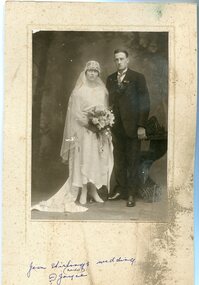
... The bride on the left is wearing a typical 1920s wedding dress. tTe front is short with a hem that is in different length in front than behind. ...The bride on the left is wearing a typical 1920s wedding dress. tTe front is short with a hem that is in different length in front than behind. ...Jean Stirling , born 1901 in Orbost, married Charles Frances Reginald Joyes on 15th July 1922 in Orbost. Jean's father was John Stirling, son of James Stirling and Ann Gray. Her mother was Robina Harvey McNair, Aged 19 James Stirling arrived in Melbourne on January 26, 1842 with his family - parents, three sisters and two brothers. James Stirling moved around a lot to Whittlesea, Ballarat goldfields, Cunninghame, (now Lakes Entrance), then to the Old Station about 36 miles to the east along the coast near the mouth of the Snowy River and for a time settled there with his wife also from Wigton, Scotland, and their family four sons two daughters (James, John, William, George, Margaret and Polly). The first settler to occupy the Marlo township area was James Stirling around the year 1875. He built a bark hut on the bluff that had two rooms, bark walls, earthen floors and a shingle roof. By 1884, this structure had expanded to a 9 roomed accommodation house and in 1886 became the Marlo Hotel when a liquor license was granted. (more information from “Snowy River Mail”, Wednesday, April 13th 1977: MEMORIES OF MARLO by Mrs Elsbeth Conlon (nee Stirling )This photograph is associated with the Stirling family early settlers of Marlo. It is also a pictorial record of styles of wedding dress popular in the 1920s.A black / white studio portrait / photograph of a bridal couple. The bride on the left is wearing a typical 1920s wedding dress. tTe front is short with a hem that is in different length in front than behind. She is wearing a hat in the cloche-style. She is holding a bouquet of flowers and her train is draped to the left. The groom is wearing a three piece morning suit. he has a with a wingtip collar white dress shirt and a cravat tie.on front - hand - written "Jean Stirling's wedding (Marlo) ? Joyce"stirling-jean-wedding melba-&co wedding-clothing-1920s joyes-charles-francis-reginald -
 Orbost & District Historical Society
petticoat, 1930's-1940's
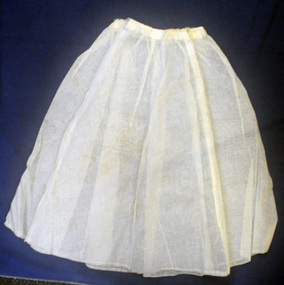
... 1920s, chiffon dresses with several sheer petticoats became fashionable. With the Great Depression in the 1930s, narrow skirts returned and petticoats again were unpopular until the end of the decade when revived for some evening, prom, and wedding gowns. ...1920s, chiffon dresses with several sheer petticoats became fashionable. With the Great Depression in the 1930s, narrow skirts returned and petticoats again were unpopular until the end of the decade when revived for some evening, prom, and wedding gowns. ...This article of clothing is specifically an undergarment to be worn under a skirt or a dress. The petticoat is a separate garment hanging from the waist. In the late 1920s, chiffon dresses with several sheer petticoats became fashionable. With the Great Depression in the 1930s, narrow skirts returned and petticoats again were unpopular until the end of the decade when revived for some evening, prom, and wedding gowns. World War II, with its rationing and general shortage of materials, brought an end to petticoats. Petticoats were revived by Christian Dior in his full-skirted "New Look" of 1947 and tiered, ruffled, stiffened petticoats remained extremely popular during the 1950. Most of the petticoats were netlike crinoline, Worn by Marjorie Burton. It may have been worn underneath dresses with full skirts or may have been designed for a short style wedding dress. Marjorie Burton ( nee Whiteman), born 12 June, in Birmingham, England came to Orbost in 1995. In England she did office work – typing, shorthand and secretarial work - in accountants’ offices and also trained as a comptometrist with Burroughs in London. She came from a middle-class, working, church-going family. Her mother was a milliner who mademany of Marjorie’s clothes, hats and outfits. Marjorie was married in 1938 to a salesman who later became a mechanic in the R.A.F. This item is an example of ahome-made item of clothing and reflects the needlework skills of women in the first half of the twentieth century.A coarse, net, white starched petticoat. It is short and has no bodice. It is home-made, machine stitched and fastens at the waist with metal hooks and eyes. It has four panelspetticoat women's-clothing burton-marjorie -
 Orbost & District Historical Society
petticoat, 1930's - 1940's
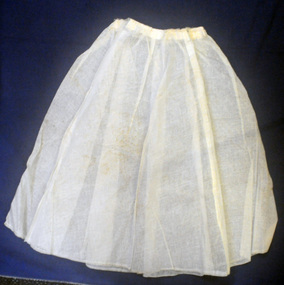
... 1920s, chiffon dresses with several sheer petticoats became fashionable. With the Great Depression in the 1930s, narrow skirts returned and petticoats again were unpopular until the end of the decade when revived for some evening, prom, and wedding gowns. ...1920s, chiffon dresses with several sheer petticoats became fashionable. With the Great Depression in the 1930s, narrow skirts returned and petticoats again were unpopular until the end of the decade when revived for some evening, prom, and wedding gowns. ...This article of clothing is specifically an undergarment to be worn under a skirt or a dress. The petticoat is a separate garment hanging from the waist. In the late 1920s, chiffon dresses with several sheer petticoats became fashionable. With the Great Depression in the 1930s, narrow skirts returned and petticoats again were unpopular until the end of the decade when revived for some evening, prom, and wedding gowns. World War II, with its rationing and general shortage of materials, brought an end to petticoats. Petticoats were revived by Christian Dior in his full-skirted "New Look" of 1947 and tiered, ruffled, stiffened petticoats remained extremely popular during the 1950. Most of the petticoats were netlike crinoline, Worn by Marjorie Burton. It may have been worn underneath dresses with full skirts or may have been designed for a short style wedding dress. Marjorie Burton ( nee Whiteman), born 12 June, in Birmingham, England came to Orbost in 1995. In England she did office work – typing, shorthand and secretarial work - in accountants’ offices and also trained as a comptometrist with Burroughs in London. She came from a middle-class, working, church-going family. Her mother was a milliner who mademany of Marjorie’s clothes, hats and outfits. Marjorie was married in 1938 to a salesman who later became a mechanic in the R.A.F. This item is an example of a home-made item of clothing and reflects the needlework skills of women in the first half of the twentieth century.A coarse, net, white starched petticoat. It is short and has no bodice. It is home-made, machine stitched and fastens at the waist with metal hooks and eyes. It has four panelspetticoat women's-clothing burton-marjorie -
 Orbost & District Historical Society
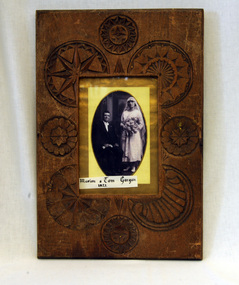
framed photograph, 1923
... This item is a pictorial record of a 1920s wedding. Wedding dresses are a useful way to chart changing fashions. ...The frame was hand carved by Cecil Rice and given to his aunt Mrs Marion Gargan. Cecil Rice ( 1912 - 1985) was the son of Walter Cecil Rice and Ellen Theresa Gargan.This item is a pictorial record of a 1920s wedding. Wedding dresses are a useful way to chart changing fashions. The Gargans were early settlers in the Orbost district.A small black / white wedding photograph of a seated man with a woman standing beside him. He is wearing a dark suit, white bow tie and is holding a pair of white gloves in one hand. She is wearing a dress which finishes above the ankles. She has a veil which is "cloche" style and is holding a large bunch of flowers.The photograph has a yellow frame and is mounted on gold card inside an ornately carved wooden frame.on front - Marion & Tom Gargan 1923gargan-thomas gargan-marion rice-walter wedding-photography -
 Ararat & District Historical Society (operating the Langi Morgala Museum)
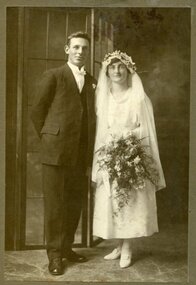
Photograph, 1920
... 1920s wedding portrait helps understand the social and spiritual contexts of the Ararat community at a time when religious ceremonies were of great significance. The clothing helps identify the status of the couple and reflects their economic standing. Representative of the early social and spiritual Western ceremonies in the area of Ararat in the 1900s Wedding Ceremony Photography 1920s Rear: "To Uncle Jim with best wishes / from Tom and Daisy / 11 2 20" / 1627 [cat.nbr] Large, portrait-orientation black and white photograph mounted on card. Two people, dressed ...This 1920s wedding portrait helps understand the social and spiritual contexts of the Ararat community at a time when religious ceremonies were of great significance. The clothing helps identify the status of the couple and reflects their economic standing.Representative of the early social and spiritual Western ceremonies in the area of Ararat in the 1900sLarge, portrait-orientation black and white photograph mounted on card. Two people, dressed in formal wedding attire stand together in a studio. Bride carries a large boquet of flowers and has a ¾ length veil.Rear: "To Uncle Jim with best wishes / from Tom and Daisy / 11 2 20" / 1627 [cat.nbr]wedding, ceremony, photography, 1920s -
 Bendigo Historical Society Inc.
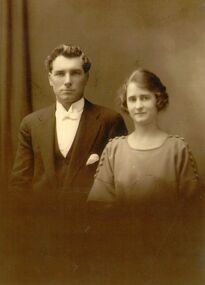
Photograph - Jack Lockett Collection: 'Wedding of Jack Lockett and Maybell ('Doll') Ingwersen in Ouyen, 18th September 1923', 1923
... dress typical of the 1920s era. Life was tough for Mallee farmers and money may not have been available to purchase a wedding dress. ...dress typical of the 1920s era. Life was tough for Mallee farmers and money may not have been available to purchase a wedding dress. ...Jack Lockett was born at Waanyarra on 22 January 1891 to his single mother Mary Lockett. Waanyarra was a gold mining town west of Bendigo but was later abandoned as the gold mining decreased. Jack Lockett grew up on his grandfather's property and later his stepfather's before he left home to work at age thirteen. He survived World War 1 and then went farming with his uncles and later bought land at Linga. Doll Ingwersen was born at Scoresby on 5th July 1897. Her parents relocated to the Mallee in the town of Ouyen which is where Doll married Jack on the 18th of September 1923.Two photographs of the marriage of John Henry (Jack) Lockett and Maybell (Doll) Victoria Ingwersen in Ouyen, on the 18th of September 1923. Jack is dressed in a formal suit with a bowtie. Doll is not dressed in traditional white dress but is attired in a dress typical of the 1920s era. Life was tough for Mallee farmers and money may not have been available to purchase a wedding dress. The bride may have purchased or made a dress that could be worn on later occasions. a Head and shoulders wedding photograph of Jack Lockett to Doll Ingwersen on 18th September 1923. b Photograph of Jack Lockett and Doll Ingwersen on their wedding day in Ouyen, 18th September 1923.a '(Jack) John Henry Lockett, (Doll) Maybell Victoria Ingwersen married in Oyen, 18th September 1923'. b 'Wedding Photo of John Henry "Jack" Lockett and Maybell Victoria ("Doll") Ingwersen. Married 18-9-1923, Ouyen, Victoria'.jack lockett, linga, waaanyarra, ouyen, wedding, 1920s -
 Brighton Historical Society
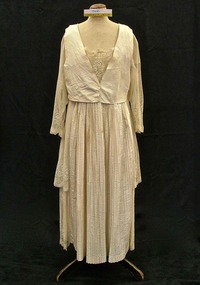
Dress, Wedding dress, 1921
... wedding dress...silk...1920s...Elizabeth was very active in public life and a well-known member of the Book family. wedding dress silk 1920s elizabeth goodwin horace book st andrew's church brighton brighton Wedding dress made from cream silk purchased in China. ...Worn by Elizabeth Goodwin of Liverpool, England, who married Horace Book at St Andrew's Church, Brighton in 1921. The fabric was purchased by her father, a ship's captain, when he was in China. The bride had her dress made in Liverpool and made to a Butterick's pattern. Elizabeth was very active in public life and a well-known member of the Book family. Wedding dress made from cream silk purchased in China. The bodice is made of fine silk embroidered tulle with a vest of cream silk that floats over the top. The skirt has been permanently pleated, has has floating side panels of tulle and features a large butterfly-shaped bow at the back.wedding dress, silk, 1920s, elizabeth goodwin, horace book, st andrew's church brighton, brighton -
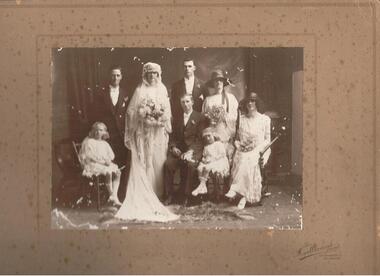 Hume City Civic Collection
Photograph, c 1920s
... wedding photo believed to be of the Evans family. The party is comprised of the bride and groom, 2 female attendants, 2 male attendants & 2 flower girls. The bridesmaids are wearing large hats. The general style of dress is indicative of the mid-1920s...wedding photo believed to be of the Evans family. The party is comprised of the bride and groom, 2 female attendants, 2 male attendants & 2 flower girls. The bridesmaids are wearing large hats. The general style of dress is indicative of the mid-1920s ...Identified in the back row are Charles Kelly, Kathleen Evans, Robert Evans and Vera Kelly. In the front row are Nancy Carlson, Jack Kelly, Irene Carlson and Irene Evans. The photograph is one of a collection of images of some off the early families who settled in Sunbury in the early days of European settlement.Sepia coloured wedding photo believed to be of the Evans family. The party is comprised of the bride and groom, 2 female attendants, 2 male attendants & 2 flower girls. The bridesmaids are wearing large hats. The general style of dress is indicative of the mid-1920s. There is considerable superficial loss due to silverfish damage. The photo is mounted on a brown cardboard matt which is badly foxed.Printed on front: The Marlborough Studios 125 Swanston St Melbourneevans family, weddings, portraits, evans wedding portrait, kelly, charlie, evans, kathleen, robert, vera, carlson, nancy, jack, irene, george evans collection -
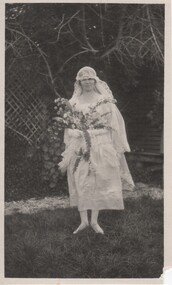 Rutherglen Historical Society
Image, 1920s
... wedding. Ada." Black and white photograph of a woman in 1920s style bridal dress, standing in a garden Image ...Black and white photograph of a woman in 1920s style bridal dress, standing in a gardenOn back of photo: "Ready girls wedding. Ada."ready family, ada ready, wedding photographs -
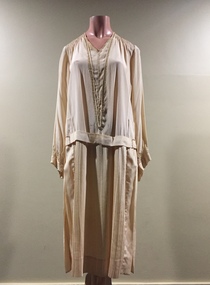 Kew Historical Society Inc
Clothing - Crepe-de-Chine Wedding dress, 1920s
... This wedding dress was worn by Marjorie Don who married Algernon Garlick, 1928 fashion - melbourne - 1920s flapper dresses wedding dresses marjorie Don Algernon garlick Cream coloured crepe-de-chine wedding dress with a dropped waist comprised of a wide band of ribbon. ...The Fashion & Design collection of the Kew Historical Society includes examples of women’s, men’s, children’s and infants’ clothing from the 18th, 19th and 20th centuries. Items in the collection were largely produced for, or purchased by women in Melbourne, and includes examples of outerwear, protective wear, nightwear, underwear and costume accessories. This wedding dress was worn by Marjorie Don who married Algernon Garlick, 1928Cream coloured crepe-de-chine wedding dress with a dropped waist comprised of a wide band of ribbon. The bodice is gathered at the top in narrow bands. Rows of pearl buttons extend to the waist from the neckline. The front of the skirt below the waist is made of a contrasting self patterned striped fabric.fashion - melbourne - 1920s, flapper dresses, wedding dresses, marjorie don, algernon garlick -
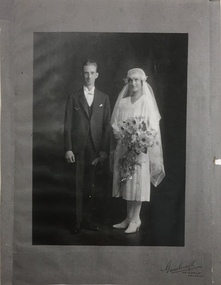 Kew Historical Society Inc
Print, Gainsborough, Bride and Groom, Marjorie Dean & Alg. Garlick, 1928
... Marjorie dean's wedding dress is part of the Society's Fashion & Design collection wedding photographs bridal fashion - 1920s marjorie dean Handwritten text: "February 1928. ...Marjorie dean's wedding dress is part of the Society's Fashion & Design collectionWedding photo of Marjorie Dean & Alg. Garlick. The bride is wearing a knee-length wedding dress and a medium length veil.Handwritten text: "February 1928. Wedding photo of Marjorie Dean and All. Garlick. Gift together with Marjorie's wedding dress, to Kew Historical Soc from their daughter Val Neilson **** on 5/8/98.wedding photographs, bridal fashion - 1920s, marjorie dean -
 Kew Historical Society Inc
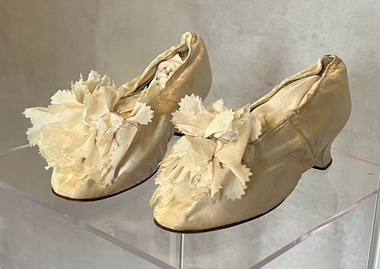
Footwear - Pair of leather soled silk wedding shoes, 1891
... 1920s to the 1940s are of a particularly fine quality, being both rare, representative and intact examples of Australian fashion of the period. The garments in the Weir Collection were donated to the Kew Historical Society by the granddaughter of Edith Weir. edith mary (betteridge) weir 84 princess street (kew) footwear women's shoes wedding shoes Pair of ivory silk shoes, worn by Edith Mary Betteridge at her marriage to George Weir in Broken Hill in 1891. The shoes were worn with her ivory silk wedding dress ...An item forming part of a collection of costumes, photographs and documents relating to the Weir family who lived in the mansion originally named Illapa, 84 Princess Street, Kew, from c.1917 to 1950. This historically significant collection includes items relating to both George Weir (1866-1937) and his wife Edith Mary Weir (1867-1948). George Weir attained national prominence in the mining industry, becoming General Manager of the North Broken Hill Silver Mining Company in 1903 (later renamed North Broken Hill Mining Company 1905-12, and North Broken Hill Ltd 1912-1988), and subsequently President of the Mine Owners Association. He was to remain General Manager of North Broken Hill Ltd until his retirement in 1926.These shoes are significant as they are part of a 30-piece collection of women’s clothing owned by Edith Mary Weir (nee Betteridge), who was born in Clare, South Australia in 1867 and who died in Kew at the age of 81 in 1948. The items of clothing in the collection date from the 1880s to the 1940s and constitute outstanding examples of dressmaker’s skills from each of these decades. The collection includes day dresses, evening dresses, evening coats, capes, shoes and undergarments. As the wife of a mining engineer, and later mine manager, Edith Weir’s clothing has historic significance as examples of clothing worn by upper middle class Australian women in domestic circumstances and at social and civic events. The costumes in the collection represent the periods when Edith Weir lived in Broken Hill, New South Wales, and in Kew, Melbourne. A number of the costumes from the 1920s to the 1940s are of a particularly fine quality, being both rare, representative and intact examples of Australian fashion of the period. The garments in the Weir Collection were donated to the Kew Historical Society by the granddaughter of Edith Weir. Pair of ivory silk shoes, worn by Edith Mary Betteridge at her marriage to George Weir in Broken Hill in 1891. The shoes were worn with her ivory silk wedding dress.edith mary (betteridge) weir, 84 princess street (kew), footwear, women's shoes, wedding shoes -
 Kew Historical Society Inc
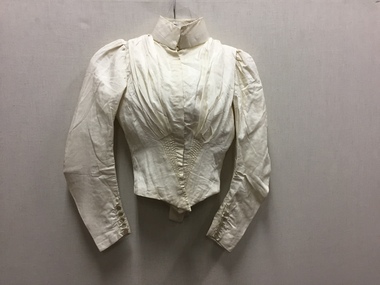
Clothing - Cream silk two piece wedding dress, 1891
... 1920s to the 1930s are of a particularly fine quality, being both rare, representative and intact examples of Australian fashion of the period. The garments in the Weir Collection were donated to the Kew Historical Society by a granddaughter of Edith Weir in 2017. edith mary weir (nee betteridge) illapa -- 84 princess street -- kew (vic.) women's clothing weir collection dresses fashion -- 1890s Cream silk wedding dress consisting of a long sleeved pleated bodice and a very full skirt. ...A wedding dress, forming part of a collection of costumes, photographs and documents relating to the Weir family who lived in a mansion, originally named Illapa, at 84 Princess Street, Kew, from c.1917 to 1950. This historically significant collection includes items relating to both George Weir (1866-1937), his wife Edith Mary Weir (1867-1948) and their children. George Weir attained national prominence in the mining industry, becoming General Manager of the North Broken Hill Silver Mining Company in 1903 (later renamed North Broken Hill Mining Company 1905-12, and North Broken Hill Ltd 1912-1988), and subsequently President of the Mine Owners Association. He was to remain General Manager of North Broken Hill Ltd until his retirement in 1926.This garment is part of a collection of women’s clothing, owned and worn by Edith Mary Weir (nee Betteridge) - born in Clare, South Australia 1867, died Kew 1948 - and also by her daughter. The garments date from the 1880s to the 1930s. The collection includes day dresses, evening dresses, evening coats, capes, and undergarments. As the wife and daughter of a mine manager, the collection includes representative examples of clothing worn by upper middle class Australian women in domestic circumstances, and at social and civic events. A number of the costumes from the 1920s to the 1930s are of a particularly fine quality, being both rare, representative and intact examples of Australian fashion of the period. The garments in the Weir Collection were donated to the Kew Historical Society by a granddaughter of Edith Weir in 2017.Cream silk wedding dress consisting of a long sleeved pleated bodice and a very full skirt. The skirt has a deep exterior pocket. The interior of the bodice exhibits extensive use of baleen to provide structure. The outfit includes a marching pair of cream silk shoes.edith mary weir (nee betteridge), illapa -- 84 princess street -- kew (vic.), women's clothing, weir collection, dresses, fashion -- 1890s -
 Kew Historical Society Inc
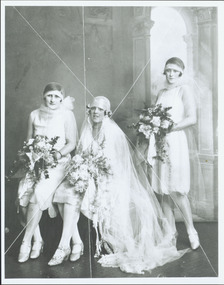
Photograph - Bride and attendants
... 1920s. Wedding photography A photographer's proof of a bride and attendants. The photograph shows a bride in a knee length dress and wearing a cloche hat to which a tulle veil is attached. ...The Kew Historical Society has a large fashion and design collection. This copy of an original photo was given to support accurate depictions of bridal wear in the 1920s.A photographer's proof of a bride and attendants. The photograph shows a bride in a knee length dress and wearing a cloche hat to which a tulle veil is attached. wedding photography
