
Showing 327 items matching "1930 - 1939"
-
 Bendigo Historical Society Inc.
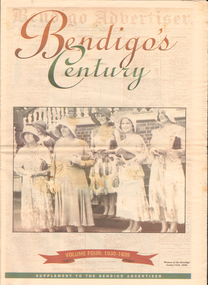
Newspaper - LONG GULLY HISTORY GROUP COLLECTION: BENDIGO'S CENTURY VOLUME FOUR: 1930 - 1939
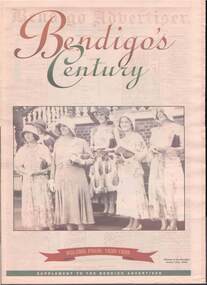
... LONG GULLY HISTORY GROUP COLLECTION: BENDIGO'S CENTURY VOLUME FOUR: 1930 - 1939...The Long Gully History Group - Bendigo's Century - Volume Four: 1930 - 1939...Newspaper supplement titled Bendigo's Century Volume Four: 1930 - 1939. Front page is titled Bendigo's Century and has a photo of some women at the Bendigo Jockey Club, 1930s. ...Newspaper LONG GULLY HISTORY GROUP COLLECTION: BENDIGO'S CENTURY VOLUME FOUR: 1930 - 1939 ...Newspaper supplement titled Bendigo's Century Volume Four: 1930 - 1939. Front page is titled Bendigo's Century and has a photo of some women at the Bendigo Jockey Club, 1930s. Each year has heading of Who's Who, Weather, Sport and Business. First years are 1930 - 1939 titled A look back when. The page has photos of the Eaglehawk Cricket Club's first A Grade cricket premier ship team (1932 - 1933)., The monument to the late Bendigo mining magnate Ernst Mueller in Rosalind Park, The Bendigo Stock Exchange in the early 1930's - pictured are L L Dungey, T Williams, M P Kelly, C Mueller, E Hommoloff, R Kelly, T H Busst, T Hall, R Trembath, E A Woolcock, and C Burridge, the Carshalton mine in 1936 and The Edith and G V Lansell Laboratory at the Bendigo Hospital. 1930 - a photo of St Andrew's Church, the sundial outside the RSL Memorial Hall, The late Monsignor Rooney and The late John Douse Langley. The Ironbark Mine was the top gold producer. 1931 - Radio station goes on air, 1932 - Sir John dies, 1933 Bodyline men come to town, 1934 - Heroic rescues, 1935 - Hospital's new wing opened, 1936 - King mourned, 1937 - Beehive store towers above, 1938 - Mining shows mixed results and 1939 - Outbreak of war sobering.bendigo, history, long gully history group, the long gully history group - bendigo's century - volume four: 1930 - 1939, eaglehawk cricket club, ernst mueller, the bendigo stock exchangel l dungey, t williams, m p kelly, c mueller e hommoloff, r kelly, t h busst, t hall, r tremabath, e a woodcock, c burridge, charshalton mine, edith and g v lansell laboratory, st andrew's church, rsl memorial hall, mr gordon carter, sir john monash, state electricity commission, cr r watson, colonel gt v lansell, empire press congress, bendigo advertiser, mr e j hogan, eppalock weir, lyric theatre, bendigo red cross, mrs george mackay, st andrew's presbyterian church, mrs william hunter, right rev john douse langley, monsignor rooney, bendigo art gallery, the ironbark mine, coliban water, mr w wright, station 3bo, amalgamated wireless of australia ltd, advance bendigo group, the north league, st aidan's orphanage, bendigo freezing works, mr w wright, bendigo advertiser, mr w j stephens, advance bendigo group, north league, garden gully united gold mining company, bendigo football league, sir john quick, john quick snr, ironbark foundry, bendigo evening news, bendigo independent, bendigo advertiser, deakin governmnet, sir charles kingsford smith, southern cross, eppalock weir, bendigo art gallery, the hercules mine, gillies, aids & appliance shop, anne caudle centre, bill woodfull, harold larwood, dr john mccarthy, the hercules, douglas jardine, don bradman, sacred heart cathedral, joseph stapleton, john lynch, bert mcconchie, new red white and blue mine, royal humane society, william james, vernon shaw, south new moon mine, bendigo hospital, bendigo base hospital, duke of gloucester, rsl memorial hall, electricity commission, eaglehawk borough council, the plaza, backhaus estate, amalgamated freezing company, fortuna villa, mrs edith lansell, colonel lansell, the hercules mine, toni riley pharmacy, boardwalk, barkly hyett, the big blue consolidated company, the bendigo hospital, eaglehawk football team, kurmala wing of the bendigo base hospital, sir isaac isaacs, lyric theatre, sir john quick, hanro knitting mills, st luke's toddlers home, st aidan's orphanage, rsl memorial hall, lord and lady huntingfield, cr michelsen, bendigo art gallery, bendigo agricultural show, new blue mine, joseph stapleton, bendigo law association, bendigo hospital committee of management, bendigo rotary club, mr j mcrae, education department, andrew sunstan, sir stanley argyle, bendigo football league, north blue mining company, cr staples, king george v, king edward viii, cr j a michelsen, andrew mclay, bendigo advertiser, cohn bros, mrs wallis simpson, king george vi, capping mine shafts 1936, bendigo art gallery, madge freemen, william john leslie cross, judge wasley, the myer emporium, the baptist church, salvation army, ron masters, the central nell gwyn, sir john quick, leanne mcdonnell, windermere hotel, rev donald baker, john rumbold, central nell gwynne, the beehive building, the beehive store, james buick and co, thomas hope henderson, buick henderson & co, mr goodison, mr r o henderson, lt-col henderson, angus mackay, bendigo sewerage authority, mr s gordon moore, commercial bank of sydney, bendigo advertiser, edward alan morcom, polio, dr gardner kerr, the right rev conald baker, ridley theological college -
 NMIT (Northern Melbourne Institute of TAFE)
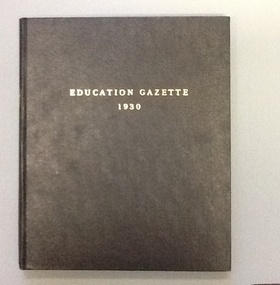
Journal - Education Gazette, Victoria Education Gazette and Teachers' Aid. 1930-1939, 1930-1939
... Victoria Education Gazette and Teachers' Aid. 1930-1939....1930-1939...Victoria Education Gazette and Teachers' Aid. 1930-1939. Journal - Education Gazette ...This educational journal was published monthly from Vol. 1, no. 1 (1900)-v. 91, no. 9 (10 Dec. 1991) . Contains information for teachers and school administrators. This set is bound in annual volumes.A snapshot of Education Department Victoria during this period.Annual volumes bound in black with title on cover in gilt. Various pagings per edition. Cover of each month contains title and contents for that edition.Stamped in gilt on cover "Education Gazette / date e.g.1930". Date stamped on spine.education gazette, education department victoria, educational journals, journals, nmit, -
 Whitehorse Historical Society Inc.
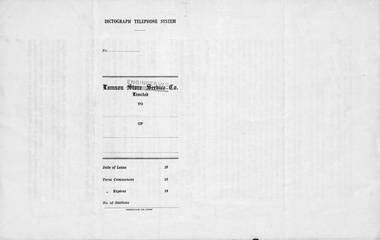
Document, Agreement (1930-1939), 24/05/1937
... Agreement (1930-1939)...Telephones Lamson Engineering Co Ltd Dictograph Interconversing System Shire of Blackburn and Mitcham An agreement between Lamson Engineering Co and Shire of 'Nunawading' {should be Blackburn and Mitcham}, President and Councillors to install and hire an apparatus known as the Dictograph Interconversing System consisting of 8 stations in 1937. Agreement (1930-1939) Document Document ...An agreement between Lamson Engineering Co and Shire of 'Nunawading' {should be Blackburn and Mitcham}, President and Councillors to install and hire an apparatus known as the Dictograph Interconversing System consisting of 8 stations in 1937.telephones, lamson engineering co ltd, dictograph interconversing system, shire of blackburn and mitcham -
 Ringwood and District Historical Society
Book - Minute, Ringwood Bowling Club Minute Book 6-Jan-1930 to 22-Aug-1939, 1930s
... Ringwood Bowling Club Minute Book 6-Jan-1930 to 22-Aug-1939....Black covered book with cloth spine containing hand written minutes of committee meetings from 6-Jan-1930 to 22-Aug-1939 +Additional Keywords: Ibbotson, A M (Chairman)...Minute Book: 6-Jan-1930 to 22-Aug-1939 - Ringwood Bowling Club...Minute Book: 6-Jan-1930 to 22-Aug-1939 - Ringwood Bowling Club Black covered book with cloth spine containing hand written minutes of committee meetings from 6-Jan-1930 to 22-Aug-1939 +Additional Keywords: Ibbotson, A M (Chairman) Ringwood Bowling Club Minute Book 6-Jan-1930 to 22-Aug-1939. ...Black covered book with cloth spine containing hand written minutes of committee meetings from 6-Jan-1930 to 22-Aug-1939 +Additional Keywords: Ibbotson, A M (Chairman)Minute Book: 6-Jan-1930 to 22-Aug-1939 - Ringwood Bowling Club -
 Williamstown High School
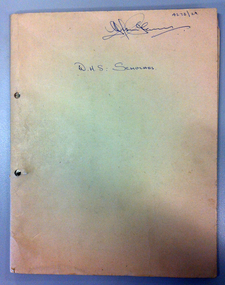
W.H.S. Scholars 1921
... ...1930...1939...Cuttings have been taken from 1921- 1925, 1930, 1932 - 1937, 1939 - 1941, 1944 & 1946. Also includes a clipping about the opening of the new school building in 1945. ...Scholarships Williamstown High School 1921 1922 1923 1924 1925 1932 1933 1934 1935 1936 1937 1930 1939 1940 1941 1944 1946 On cover: 4273/29 Indecipherable signature. ...Newspaper cuttings from local papers announcing scholarship winners from Williamstown High School. Cuttings have been taken from 1921- 1925, 1930, 1932 - 1937, 1939 - 1941, 1944 & 1946. Also includes a clipping about the opening of the new school building in 1945. Folder with buff card cover and single sheets formed into a book with split pins. 17 pages.On cover: 4273/29 Indecipherable signature.scholarships, williamstown high school, 1921, 1922, 1923, 1924, 1925, 1932, 1933, 1934, 1935, 1936, 1937, 1930, 1939, 1940, 1941, 1944, 1946 -
 Mentone Girls' Grammar School Digital Archives
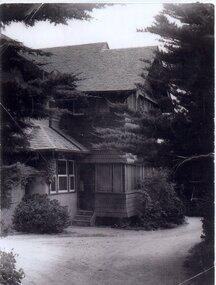
Photograph - Mentone Girls' Grammar Main House
The original building purchased by Jeannie McCowan at 88 Beach Road when the School had to relocate from the current St. Bede's site. When the School increased in size, as promised, a House was named after Miss McCowan in 1969. -
Clunes Museum
Book
... Label on front cover; Minute book Handwritten Clunes & District Tennis Association 1930-1939 ...Record of Clunes Tennis Association clunes tennis association minute book Label on front cover; Minute book Handwritten Clunes & District Tennis Association 1930-1939 Clunes & District Tennis Association Black Minutes book red spine containing minutes for the period 1930-1938 and statement of receipts and expenditure 1931-1932, 1936-1937, 1938, 1940-1941, 1950 189 pages Book BOOK ...Record of Clunes Tennis Association Clunes & District Tennis Association Black Minutes book red spine containing minutes for the period 1930-1938 and statement of receipts and expenditure 1931-1932, 1936-1937, 1938, 1940-1941, 1950 189 pagesLabel on front cover; Minute book Handwritten Clunes & District Tennis Association 1930-1939 clunes tennis association, minute book -
 Bendigo Historical Society Inc.
Newspaper - BELARDINELLI COLLECTION: BENDIGO'S CENTURY SUPPLEMENT TO THE BENDIGO ADVERTISER
... Bendigo's Century a supplement to the Bendigo Advertiser volume four: 1930-1939. On the front a picture of women at the Bendigo Jockey Club, 1930s....NEWSPAPER Bendigo advertiser centenary supplements Bendigo's Century a supplement to the Bendigo Advertiser volume four: 1930-1939. On the front a picture of women at the Bendigo Jockey Club, 1930s. ...Bendigo's Century a supplement to the Bendigo Advertiser volume four: 1930-1939. On the front a picture of women at the Bendigo Jockey Club, 1930s.newspaper, bendigo advertiser, centenary supplements -
Box Hill Historical Society
Book, Raworth, Bryce, Our inter-war houses, 1991
... ...1930-1939...Houses Residential development 1920-1929 1930-1939 National Trust The book, the result of the work of the National Trust Inter-War Housing Steering Committee, informs the reader on how to recognise, restore and extend houses of the 1920s and 1930s. ...The book, the result of the work of the National Trust Inter-War Housing Steering Committee, informs the reader on how to recognise, restore and extend houses of the 1920s and 1930s. The publication was sponsored by the building company A V Jennings, which started and built many houses in the Inter-War period.59 pagesThe book, the result of the work of the National Trust Inter-War Housing Steering Committee, informs the reader on how to recognise, restore and extend houses of the 1920s and 1930s. The publication was sponsored by the building company A V Jennings, which started and built many houses in the Inter-War period.houses, residential development, 1920-1929, 1930-1939, national trust -
 Surrey Hills Historical Society Collection
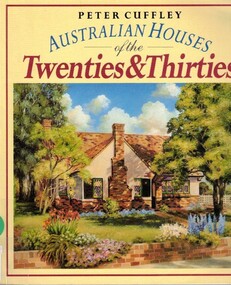
Book, Geoff Hocking, Australian Houses of the Twenties & Thirties, 1993
... ...1930 - 1939...Australian architects travelled to England, Europe and North America bringing back ideas and influences. architecture (mr) peter cuffley dwellings interior decoration 1919 - 1929 1930 - 1939 Front page: Sue Barnett Includes: index, bibliography. ...Australian domestic architecture of the period between the two world wars is a fascinating and complex subject. Our preconceived notions are based on the more obvious styles and impressions, so that visions of bungalows set row upon row spring to mind quickly. Influences in the designs of Australian houses of the 1920s and 1930s were extraordinarily diverse. Apart from their obvious origins, they can be traced to India, Japan, Switzerland, Holland, Germany, Italy, Spain, Mexico and even the American backwoods. Australian architects travelled to England, Europe and North America bringing back ideas and influences.Includes: index, bibliography. Australian domestic architecture of the period between the two world wars is a fascinating and complex subject. Our preconceived notions are based on the more obvious styles and impressions, so that visions of bungalows set row upon row spring to mind quickly. Influences in the designs of Australian houses of the 1920s and 1930s were extraordinarily diverse. Apart from their obvious origins, they can be traced to India, Japan, Switzerland, Holland, Germany, Italy, Spain, Mexico and even the American backwoods. Australian architects travelled to England, Europe and North America bringing back ideas and influences.Front page: Sue Barnettarchitecture, (mr) peter cuffley, dwellings, interior decoration, 1919 - 1929, 1930 - 1939 -
 Surrey Hills Historical Society Collection
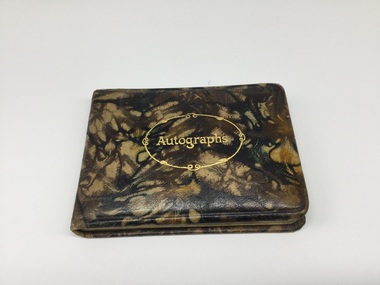
Memorabilia - Autograph book, Beryl Mair's autograph book, C1928
... ...1930-1939...sheahan h mcconville w sandoe 1928 1930-1939 primary schools Front cover: "Autographs" in gold within a gold oval. ...It belonged to Beryl Mair of 20 Barton Street, Surrey Hills and was given to her by Mr W Sandoe on 12.11.1928. There are entries from family members and class mates from Mont Albert Central School (MACS). The first entry is written by her father, Dave Mair. Entries from: D Mair, Lance Young, Norma Dunn, I Goodes, Lorraine Potts, Mary Griffin, L E Jarman, J Stalker, Jean Fowler, Ailsa Hank (with an ink drawing of a cottage), May Leach, Merle Botten, Beryl Skinner, Enid Marro(w ?), Betty (S ?)oule, Fred A Teague, A Mock, Kath Paul, Melva Dare, Marjorie Smith, J Hargreave, Ethel Lillifant. Three entries are quotation only. One page lists teachers of Mont Albert Central School: E C Cairns, E E Holden, Alfred Harley, R Blackburne, R W Campbell, M (?) Sheahan, ------- (undecipherable), H McConville. Those dated are mostly from 1930.The Mair family were resident in Barton Street for several generations. Beryl's father Dave Mair was a keen sportsman and founder of the Kangaroo Social Club of cricketers. Beryl married Lance Young. This is part of a large collection relating to the Mair, Deakin and Young families.In Europe autograph books have a history that can be traced back to 15th century university students. In Australia autograph albums were particularly popular towards the end of the 19th century, although there are known examples as far back as the 1830s. The increase in popularity coincides with printing and book binding becoming more affordable. Autograph books came in many sizes but were typically small with blank pages, usually in pastel colours. The books were often exchanged so the gathering of autographs was a very social pastime. Pages were filled with not only names, signatures and personal details but also poems, limericks, drawings, personal messages, small pieces of verse, and other mementos, such as pressed flowers, locks of hair and even embroidery. Although they could be very personal, unlike a diary they were meant to be viewed as part of the exchange. Autograph books from the 1950s may have a different focus. Although it remained common to collect the autographs of friends it was also highly desirable to collect the signatures of the famous, especially rock and television stars. Autograph books are of social relevance because they reflect the sentiment of the era of creation; they can also be reflective of social change, major political events or new inventions.A small autograph book with a mottled brown cover and faded pastel pages with gold edging. The end pages are detailed in beige and pink. There are multiple entries, those dated are mostly from 1930. Front cover: "Autographs" in gold within a gold oval. Front inside page in black and red ink: "BERYL MAIR / 20 / BARTON / STREET , SURREY HILLS / from / MR W SANDOE / 12/11/28" Embossed in back cover, lower right: "MADE IN ENGLAND" beryl mair, autograph books, dave mair, barton street, ernest lance young, lance young, norma dunn, i goodes, lorraine potts, mary griffin, l e jarman, j stalker, jean fowler, ailsa hank, may leach, merle botten, beryl skinner, enid marro(w)?, betty (s)?oule, fred a teague, a mock, kath paul, melva dare, marjorie smith, j hargreave, ethel lillifant, mont albert central school, e c cairns, e e holden, alfred harley, r blackburne, r w campbell, m (?) sheahan, h mcconville, w sandoe, 1928, 1930-1939, primary schools -
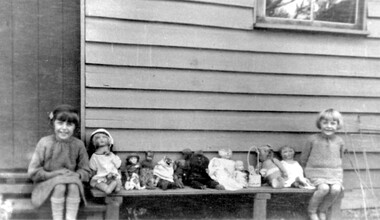 Surrey Hills Historical Society Collection
Photograph, Jocelyn and Lynette Cerini, 1930s
... ...1930-1939...They are in front of their father's 'office' at the rear of the family home at 215 Union Road, Surrey Hills. jocelyn cerini (miss) lynette cerini (miss) dolls toys 1930-1939 clothing and dress 215 Union Road A black and white photograph of two young girls with their dolls lined up between them. ...The girls are Jocelyn and Lynette Cerini. They are in front of their father's 'office' at the rear of the family home at 215 Union Road, Surrey Hills.A black and white photograph of two young girls with their dolls lined up between them.jocelyn cerini (miss), lynette cerini (miss), dolls, toys, 1930-1939, clothing and dress, 215 union road -
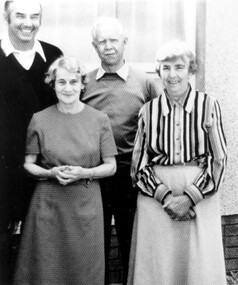 Surrey Hills Historical Society Collection
Photograph, Miss Frances Emerson
... ...1930-1939...See file on her work. clothing and dress emerson, frances (miss) warren, frances (mrs) fintona kent road surrey hills teacher preschools 1930-1939 A black and white photograph of four adults - two male and two female. ...Frances Emerson was born in Elsterwick in 1906 to Thomas James Emerson, a furniture manufacturer, and his wife Selina Sarah (nee Bowen). She had 3 siblings - Thomas George (1908-1977), Melvie Eleanor (1910-1965) and Hulett Moore (1915-1999). They lived at 18 Kent Road, known as 'Sunnybrae' and later as ‘Willacool’. Her mother died at 'Sunnybrae' a few months after the birth of her youngest brother. After attending state school, Frances went to Fintona. She trained as a kindergarten teacher at ‘Mooroolbeek’ Kindergarten Training College in Kew and taught during the 1930s. Her 1st appointment was at the Robert Cochrane Kindergarten in Auburn. She also worked at the City Free Kindergarten on the corner of Exhibition and Little Lonsdale Streets, where children came from very poor dwellings in ‘lanes off lanes’. See file on her work.A black and white photograph of four adults - two male and two female.clothing and dress, emerson, frances (miss), warren, frances (mrs), fintona, kent road, surrey hills, teacher, preschools, 1930-1939 -
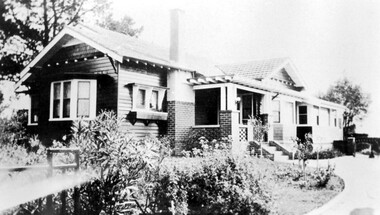 Surrey Hills Historical Society Collection
Photograph, 'Strathmore' 75 Victoria Crescent, Mont Albert
... ...1930-1939...The donor was their daughter. house names californian bungalow style weatherboard victoria crescent surrey hills (mr) joseph sutton crow (mrs) jessie sutton crow purbrick family 1924 herald garden competitions 1930-1939 (miss) jean sutton crow (mr) ray sutton crow 'strathmore' A black and white photograph of a Californian Style weatherboard house, painted in a dark colour. ...‘Strathmore’ Victoria Crescent (dem.) Joseph Sutton Crow and his wife Jessie (nee Temby) bought this property which had belonged to the Purbrick family in 1924. Sutton was an amateur ‘planner and landscape designer’ and had much pleasure in planning the use of their garden of 100 feet by 400 feet. While part remained rural with sheep, an orchard and vegetable garden, he laid out sweeping designs for the front garden which Jessie enjoyed converting into a garden worthy of display and which did gain prizes in the Herald Garden competitions of the 1930s. They entertained friends and often had as guests University Conservatorium staff and visiting musical personnel. They also opened the garden for local church fund-raising functions. Children, Jean and Ray, had areas set out for their recreation with pets and activities areas. The donor was their daughter. A black and white photograph of a Californian Style weatherboard house, painted in a dark colour. There is a well established garden in front. There is a bay window at one side of the house.house names, californian bungalow style, weatherboard, victoria crescent, surrey hills, (mr) joseph sutton crow, (mrs) jessie sutton crow, purbrick family, 1924, herald garden competitions, 1930-1939, (miss) jean sutton crow, (mr) ray sutton crow, 'strathmore' -
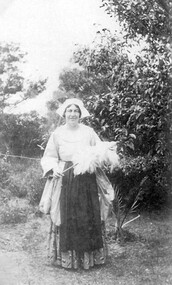 Surrey Hills Historical Society Collection
Photograph - Mrs Ethel Cerini in costume for 'The Quaker Girl'
... ...1930-1939...(mrs) constance clucas holy trinity choir churches surrey hills (ms) marion de saxe (mr) fred mcbeath the surrey hall canterbury road lodge hall (mrs) ethel cerini camberwell town hall Surrey Hills Operatic Society 1930-1939 A sepia coloured photograph of a lady standing in a garden dressed in a peasant looking outfit and holding a (?) ...Mrs Constance Clucas, a talented musician in the Holy Trinity choir, started 'The Surrey Hills Operatic Society' in 1931. She trained members of the Society to concert standard. Mrs Clucas produced operettas for some ten years. Titles included 'The Arcadian', 'Princess Ju Ju', 'The Quaker Girl', and 'Miss Hook of Holland'. Local musicians formed the orchestra which was extended for the concert presentation by a few guest artists among whom were locals Marion de Saxe, a flautist, and Fred McBeath. Rehearsals were held in the Surrey Hall and a small Canterbury Road Lodge Hall with final staging in the Surrey Hall and Camberwell Town Hall. Scores and costumes were hired from J. C. Williamson.The photo is reflective of the cultural life of Surrey Hills in the 1930s.A sepia coloured photograph of a lady standing in a garden dressed in a peasant looking outfit and holding a (?) feather duster. She is wearing a hat in traditional Dutch-style.(mrs) constance clucas, holy trinity choir, churches, surrey hills, (ms) marion de saxe, (mr) fred mcbeath, the surrey hall, canterbury road lodge hall, (mrs) ethel cerini, camberwell town hall, surrey hills operatic society, 1930-1939 -
 Surrey Hills Historical Society Collection
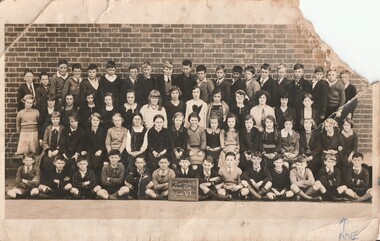
Work on paper - Photograph, Surrey Hills State School 2778, Grade 6, 1935, 1935
... ...1930-1939...Surrey Hills Norma Pryde Norma Cleak Jenny Pomeray Surrey Hills State School 2778 education 1930-1939 1935 Front: In blue ballpoint: An arrow + ME Rear: In grey lead pencil on the LHS: "Miss N Pryde / Kitchener Rd / Croydon / Vic"; a stamp in purple ink on the RHS: "SUZANNE ET CIE PTY. ...Information from the donor by email gives: Norma Pryde is identified as the girl in the second row on the far right. Her parents Norman & Hilda Pryde lived at 50 Broughton Road, Surrey Hills. The home was named 'Strathaven' after the town in Scotland where Norman's father came from. Norman & Hilda were married in 1923. Norma was born in 1924. Norman worked for Moran & Cato so the family moved around a lot for his work and is thought to have rented out the house from time to time. During some time in the 1920s they were listed on electoral rolls in Nyah West and then in 1942 they were listed in Hamilton. When the war ended they came back to Melbourne and in the late 1940s built a home at Blackburn. Norma married John Cleak in 1947 in Camberwell. This photo is representative of the large classes that were common in the interwar period.An original B&W postcard photo of a class taken outside against a brick wall. There are 34 boys in 2 rows. The back row of 20 boys would have been standing on a bench and in the front row the 14 boys are seated on the ground. The girls are standing in 2 rows - 14 girls in the second back row and 16 girls in the second front row. A total of 64 students. There does not appear to be a standard uniform.Front: In blue ballpoint: An arrow + ME Rear: In grey lead pencil on the LHS: "Miss N Pryde / Kitchener Rd / Croydon / Vic"; a stamp in purple ink on the RHS: "SUZANNE ET CIE PTY. LTD. / 357 COLLINS STREET / MELBOURNE." In addition a diagonal blue squiggle.surrey hills, norma pryde, norma cleak, jenny pomeray, surrey hills state school 2778, education, 1930-1939, 1935 -
 Kew Historical Society Inc
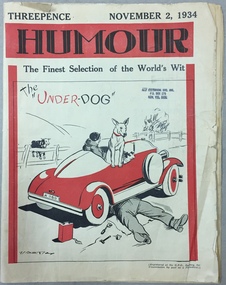
Booklet, Gordon & Gotch Ltd, Humour: The Finest Selection of the World's Wit, 1934
... australian periodicals - 1930-1939...humour australian periodicals - 1930-1939 Cover: "Humour, The Finest Selection of the World's Wit. ...Book of stories, jokes and cartoons sourced from international newspapers and magazines and published locally in 1934.Cover: "Humour, The Finest Selection of the World's Wit. November 2, 1934. Price 'Threepence'. Registered at the GPO Sydney for transmission by post as a Periodical"humour, australian periodicals - 1930-1939 -
 City of Melbourne Libraries
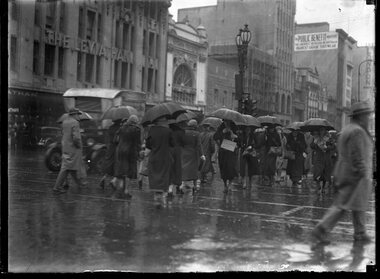
Bull, Hugh Jones, 1897-1993, McKenzie Collection of glass plate negatives
... ...1930-1939...Above all, the McKenzie Collection project has brought about a powerful and sustained sense of engagement, connection and celebration between people across decades and places. glass plate negatives The Age newspaper photography Melbourne 1930-1939 McKenzie Collection of glass plate negatives Bull, Hugh Jones, 1897-1993 The Age (Melbourne, Vic. : 1854 - 1954) McKenzie, Ian, 1939-2012 McKenzie, Ian, 1939-2012 ...In the 1990s, renowned architectural photographer Ian McKenzie OAM (1939-2014) picked up 240 glass plate negatives at a local market. Believed to be from a Victorian news archive, they dated back to the 1930s. The slides lay dormant in a dusty garage until 2020 when Ian’s wife Louise decided it was time to bring them back into the light.Digital reproductionThe McKenzie Collection of glass plate negatives unlocks glimpses of our city not seen for almost 100 years. In the 1990s, renowned architectural photographer Ian McKenzie (1939-2014) picked up 240 glass plate negatives at a local market. Believed to be from a Victorian news archive, they dated back to the 1930s. The slides lay dormant in a dusty garage until 2020 when Ian’s wife Louise decided it was time to bring them back into the light.glass plate negatives, the age newspaper, photography, melbourne, 1930-1939glass plate negatives, the age newspaper, photography, melbourne, 1930-1939 -
 City of Melbourne Libraries
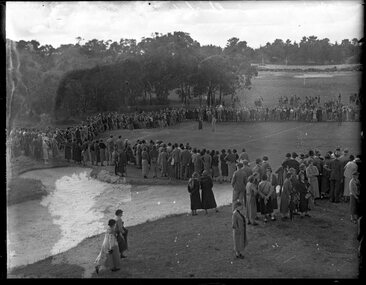
Australian Women's Golf Championship at Royal Melbourne Golf Club, Aug-Sep 1935, Bull, Hugh Jones, 1897-1993
... ...1930-1939...Golf Royal Melbourne Golf Club Women golfers 1930-1939 Australian Women's Golf Championship at Royal Melbourne Golf Club, Aug-Sep 1935 Bull, Hugh Jones, 1897-1993 ...The first international Australian Women's Golf Championship was held August to September 1935 at Royal Melbourne Golf Club in Black Rock, Victoria. Visiting players from England, Scotland and Ireland dominated the competition. British golfers included Pamela Barton, Phyllis Wade, Jessie Anderson, Mrs Walter Greenlees and Mrs J B Walker. Australian competitors included Katherine Rymill, Betty Nankivell, Betty Sale (MBE), Janet Gardiner, Leonora Wray (MBE), Mrs Sloan Morpeth (née Susie Tolhurst), Mrs Clive Robinson (née Christina “Nin” McMaster), Joan Hood Hammond (DBE CMG), Mrs T S McKay (née Odette Lefebvre) and Mona Macleod. Mrs J B Walker of Britain defeated Mrs Sloan Morpeth of Victoria in the final, before a gallery of 2,000, mostly women. golf, royal melbourne golf club, women golfers, 1930-1939golf, royal melbourne golf club, women golfers, 1930-1939 -
 City of Melbourne Libraries
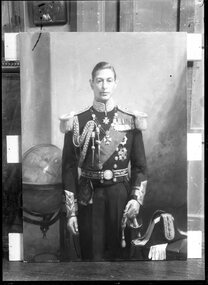
Photograph, Bull, Hugh Jones, 1897-1993, "A Royal Portrait" (Duke of York), 1933
... 1930-1939...McInnes (1889-1939) to paint a portrait of Prince Albert, Duke of York as a companion piece to the portrait of his wife, the Duchess of York, that the gallery had commissioned Australian official war artist James Quinn (1869-1951) to paint in 1930. ...Retrieved April 4, 2025, from http://nla.gov.au/nla.news-article276125581 Castlemaine Art Museum, Portrait of His Royal Majesty the Duke of York, https://collection.castlemaineartmuseum.org.au/objects/181/portrait-of-his-royal-majesty-the-duke-of-york 1930-1939 Aboriginal culture Royal visits Openings (events) Sculpture Land rights Museums Museum displays Photographer notations on slide: "Portrait of Duke of York by W.B. ...Published: The Age, Sat 14 October 1933 Published title: A Royal Portrait Published caption: "Seen at his studio, Alphington, Mr. W. B. Mclnnes's portrait of the Duke of York, which he painted recently on commission from the trustees of the Castlemaine Gallery, at St. John’s Wood, London, impresses as a vital record of one whose natural habitat is a palace, and whose place in life is one of near relationship to the throne of England. The Duke is painted in the uniform of the admiral of the fleet, a highly ornate vesture entailing much elaboration of gold and numerous medals, in dealing with which the artist has not failed to centre his attention on the head, and has succeeded in producing what is undoubtedly a soundly painted portrait and a good likeness. During the five fittings Mr. Mclnnes, apart from the ordinary social amenities, found his Royal sitter little inclined to talk, though he spoke feelingly of his trip to Australia and the pleasure it had given him: but with the Duchess the tendency to be sociable was much more clearly pronounced. She took, and expressed, a keen interest in the social and political matters of the day with a special concern for the supremacy of England and Australia in all questions relating to sport, such as cricket, tennis and golf. She spoke well of her portrait painted by Quinn, and regretted that she would not see the two hung side by side at the Castlemaine Gallery." Description: An unframed painting of a standing, middle-aged man dressed in the uniform of a Royal Navy admiral of the Fleet with medals, sash, ornate belt, cuffs and epaulettes. His left hand rests on the handle of a sword in its scabbard and his bicorn hat and white gloves are on a table beside him. To his right is a globe of the world showing Australia. Research by project volunteer, Fiona Collyer: In 1933, Castlemaine Art Gallery trustees commissioned artist W.B. McInnes (1889-1939) to paint a portrait of Prince Albert, Duke of York as a companion piece to the portrait of his wife, the Duchess of York, that the gallery had commissioned Australian official war artist James Quinn (1869-1951) to paint in 1930. During the First World War, the Duchess’s childhood home, Glamis Castle in Scotland was used as a makeshift military hospital and convalescence home for wounded soldiers. Many servicemen from the Castlemaine area recuperated there and had fond memories of the kindness of the teenage Lady Elizabeth Bowes-Lyon (1900-2002, later Duchess of York) who spent the war years running errands and aiding in the welfare and morale of the patients. In 1927, the Duke and Duchess of York (later King George VI and Queen Elizabeth) came to Australia to formally open the newly built Parliament House in Canberra and to tour the country. While visiting Victoria in April, they embarked on a whistle-stop train journey to Bendigo, stopping at Kyneton for ten minutes and Castlemaine for 15 minutes. At Kyneton, an excited crowd of 10,000 people welcomed the couple with “three cheers and three cheers for Baby Betty” before the Duchess was presented with a bouquet of locally grown roses and the Duke a bound album of photographs of noted beauty spots of the district. Next the Royal Couple stopped at Castlemaine to the cheers of 15,000 people. There the couple were presented with a basket of prime quality Harcourt apples and a pair of cot blankets, manufactured at Castlemaine Woollen Mills, a birthday gift for baby Princess Betty. The Duchess recognised Colonel W.E. James, of the Seventh Battalion, who had convalesced at Glamis Castle in 1917, and they chatted before the train departed, while the Duke shook hands with returned soldiers. Last stop was the town of Bendigo which was colourfully decorated with bunting and flags, arches and flowers. 3000 pigeons were released on their arrival and the liberated birds circled overhead for several minutes as if to welcome the Royal Couple. A crowd of 50,000 cheering people lined the streets in bright sunshine as the couple drove by. From an arch over Hargreaves Street, pretty girls showered the pair with rose petals. The Duke was presented with a gold nugget and an album, handsomely bound in morocco, of a history of the Bendigo mining industry, while the Duchess received a bouquet of prize winning white chrysanthemums. After 75 minutes in Bendigo they journeyed back to Melbourne for a State reception. While the couple were in Melbourne, the Duke often played lawn tennis at the Government House courts with three times Grand Slam champion Norman Brookes, who declared that while he considered the Duke a second class player whose serve lacked sting, he had a fine backhand and with time and practice he could become a first class player. The federal Parliament had previously been situated in Melbourne, but Canberra was chosen as the location for Australia’s capital as a compromise between fierce rival states, Victoria and NSW. It is written in the Constitution that the federal capital would be in “the State of NSW... distant not less than one hundred miles from Sydney.” The word Canberra is thought to derive from the local Ngunnawal word “Kanbarra” meaning “meeting place”. The Provisional Parliament House was a large, white, three storey building facetiously dubbed “The Wedding Cake”, plonked down in a bare, former sheep paddock. It was decorated for the event with Union Jacks and Australian red ensign flags. On 9 May, the day of the opening, the expectant crowd assembled in front of the building. Only two of the spectators were Aboriginal. One was Jimmy Clements (1847-1927, aka Nangar or Yangar, but popularly known as “King Billy”), accompanied by his three dogs. (The title “King” or “Queen” was often given by white settlers to Aborigines who were seen as allies and could maintain good relations between First Nations groups and the colonists. Some were given inscribed brass breastplates or gorgets to wear.) Jimmy was an excellent horse breaker and expert tracker for the police. He was also the nephew of “Queen” Nellie Hamilton (1842-1897) of the Canberra-Queanbeyan region, home of the Ngambri and Ngunnawal people. Nellie was the oldest surviving full-blooded Aboriginal woman in the district. The other was George John Noble (1840s-1928, aka Ooloogan, also “Marvellous” due to his regular use of the word). Both were initiated Wiradjuri walamira elders: “clever men” believed to have the ability to heal physical and spiritual ailments. They were also travelling showmen, skilled at boomerang and spear throwing and often performed at country agricultural shows and football matches. They had walked barefoot for three days from the Brungle Mission, near Gundagai. 11 May 1927, The Argus reported that “King Billy... claims sovereign rights to the Federal Territory” which the National Archives of Australia describes as “possibly the first recorded instance of Aboriginal protest at Parliament House in Canberra.” 10 May 1927, The Argus reported on Jimmy Clements: “During the wait great interest was taken in the appearance near the east stand of an aborigine, a member of the Gundagai tribe, and a well known character in the district. He was very old and grey and ruggedly picturesque. He was determined to go his own way in spite of the arguments of two inspectors and one sergeant of police. Immediately and instinctively the crowd in the stands rallied to his side. There were choruses of advice and encouragement for him to do as he pleased. A well-known clergyman stood up and called out that the aborigine had a better right than any man present to a place on the steps of the House of Parliament and in the Senate during the ceremony. The old man’s persistence and the sympathy of the crowd won him an excellent position and also a shower of small change that must have amounted to 30/ or 40/ [shillings].” At 10.30 am, Australia’s eighth Prime Minister, Mr Stanley Bruce (1923-1929) welcomed the Royal couple onto the crimson carpeted portico. Unfortunately, Dame Nellie Melba’s rendition of “God Save the King” and the greater part of the Duke’s reply was drowned out by the roar of squadrons of aeroplanes circling overhead. A brief religious service followed, conducted by leaders of the Methodist, Presbyterian and Anglican churches. Interestingly, there was no Roman Catholic representation at the ceremony even though around one quarter of Australians were Catholic at the time. The Duke unlocked the front doors with a golden key, then unveiled a statue of his father King George V by sculptor Sir Bertram Mackennal in the King’s Hall. Then the official party, Senators, members of the House of Representatives and invited guests entered the Senate chamber where the Duke read a message from the King, establishing Canberra as the seat of the Federal Government, watched on by Australia’s elite. The conclusion of the ceremony was announced by a gay fanfare of trumpets from the entrance of Parliament House and a 21 gun salute and answered by cheers from the crowd. The dignitaries then feasted on a luncheon of turtle soup, poached schnapper, fillets of beef, roast chicken and ham, straw potatoes, green peas, Canberra Pudding (a pudding made with dripping, dried fruit and jam), fruit, ices, coffee and cheese. They toasted the King with non-alcoholic fruit punch as the Federal Capital Territory (later ACT) was a “dry” area and no speeches were made. The diary entry that day of Ethel Baird, Lady Stonehaven, the wife of the Governor-General, is brief and to the point: “To P.H. & waited for Yorks. Ceremony went off without a hitch. Ghastly Banquet Lunch.” Later that day, the Duke mounted a coal black mare, police horse Number 303 which had been hastily re-named “Black Bess” for the occasion, to receive the final salute from the assembled troops and returned soldiers dressed in mufti. The RAAF squadron were flying overhead in “V” formations when suddenly, one of the planes, piloted by Flying Officer Francis Charles Ewen, left the formation, nose-diving 900 metres from Parliament House and landing behind the Y.W.C.A. refreshment marquee. Francis, aged only 28, tragically died of his wounds later that day. The Federal Capital Commission contracted Sargent’s Pies of Sydney to supply 5000 meals for the event. They supplied pies, sausage rolls, scones and sandwiches with the agreed price of 3 shillings a head. Only 1200 meals were served and the uneaten remainder dumped, with the Commission bearing the cost of the unsold food. An estimated crowd of 20,000 attended the opening, far fewer than the expected 100,000. Many visitors travelled long distances, bringing their own hampers of food and camping in tents as there was very limited accommodation available. Thousands of people around Australia listened to the ceremony broadcast on the wireless, with receiving sets installed in schools, public halls and workplaces and it was also filmed for posterity. The next morning, the Royal couple, along with Prime Minister Bruce and Mrs Bruce held an informal public reception on the steps of Parliament House where early settlers, residents and visitors to Canberra filed past them. The Press widely reported Jimmy Clements’ encounter with the Duke and Duchess. The Sun-Pictorial reported 11 May 1927: "MET THE DUKE. ABORIGINE KING HE APPROVED Sugarbag: Sports Suit. John Clements, otherwise King Billy, a full blooded aborigine king, aged 86, was among the 2000 who filed past the Duke and the Duchess at the public reception at Canberra to day. “How you likem Duke and Duchess Billy?” he was asked afterwards. “I think they are both very nice.” he replied in good English. King Billy was a very bedraggled figure, with tangled locks and a beard which almost hid his wrinkled and black face. He wore an old sports suit and carried a sugarbag. Passing the Duke and Duchess he turned full towards them. The crowd cheered, and the Duke and Duchess smiled. The Duke was particularly amused.” The Canberra Times reported 13 May 1927: "A REAL AUSTRALIAN. A quaint but pathetic figure stood in broad relief in the queue of ranks at the reception. Where his dusky forbears have gathered in native ceremonial for centuries past, a lone representative of a fast vanishing race saluted visiting Royalty. Despite the grotesque garb and untamed mane the aborigine comported himself not without dignity. With his three faithful dogs, he made an immediate target for a battery of cameras.” "The Argus reported 11 May 1927: "...an ancient aborigine who calls himself King Billy and who claims sovereign rights to the federal Territory walked slowly forward alone and saluted the Duke and Duchess. They cheerily acknowledged his greeting. The old aborigine, with his long, matted beard and nondescript clothing, is a popular identity of Canberra, and must be one of the most extraordinary figures who has received a Royal salute.” The Sun (Sydney) reported 10 May 1927: “Suddenly, in the midst of the forest of green and white colored hats of women, appeared a head with a shaggy leonine mane and a patriarchal beard. Jacky, the aboriginal, an identity of the district, who is also known as the King of Canberra, had arrived to testify to his loyalty. He saluted the Duke with an excellent dash, and shambled past with his faithful sheep dog aide-de-camp at his heels. The Duke and Duchess were highly amused at this quaint figure moving along with a sort of bodyguard of shrieking young boys and girls.” The Sydney Morning Herald 11 May 1927 mistook Jimmy for his friend “Marvellous”: “...the appearance of an aged aboriginal widely known in the district as “Marvellous, the uncrowned king of Queanbeyan." His beaming black countenance was almost hidden beneath a shock of hair and beard. Bare-footed and carrying a sugar bag in one hand and a tiny Australian flag in the other, he at first mistook a policeman at the foot of the steps for the Duke. To his great embarrassment and to the vast amusement of the onlookers, the policeman became the object of a hearty salutation. However, "Marvellous" was quickly shepherded back to a position in the procession and as he passed along brought his hand up to an approved military salute for the benefit of their Royal Highnesses. The Duke returned it with a special wave.” The Labor Daily 11 May 1927 irreverently reported on the scene: "People March Past. Some 400 people, old identities of Canberra marched past. They were mostly aged ladies with memories faithfully preserving the traditions of other days and curtsied reverently. The younger generations, who speedily joined the procession, behaved differently however. Surely it was the most motley collection that ever passed before Royalty. Men without collars jostled others well dressed. Fat women, young women, children of all heights and ages were there. The oldest inhabitants, in the persons of the abo, "Marbly", and his companion were present. The poor old fellows evidently were keen to get closer to the Duke than the procession dared go, but they were overawed by the stern glances of military men.” The Canberra Times reported 13 May 1927: "...and towards the end of the procession, a full-blooded aboriginal, bareheaded and barefooted, and carrying an old swag on his back, made a picturesque figure as he several times saluted the Royal couple, his old eyes beaming inexpressible delight.” The Register reported 11 May 1927: "PUBLIC MARCH PAST. Old “Jacky”, an aboriginal identity of the district, who has been following the proceedings of the various ceremonies with apparently great interest, appeared in the march past. He halted in front of the steps and raised his hand to his shaggy grey locks in an attempt at a salute. Smiling, the Duke returned the salute, and the Duchess bestowed a charming smile on the figure of mingled pathos and comedy.” Tweed Daily reported 12 May 1927: “King Billy” WAS THERE. Appropriately enough, the inevitable “King Billy” with his refreshing impression of possum and gum-leaves, was present at the dedication of the Federal capital at Canberra. Bare-footed, in a dingy old suit and battered felt hat, he wandered on to the empty stand after the illustrious assemblage had passed into Parliament House. A desolate figure in all that he stood for, he proved, an amiable representative of the dispossessed race. He cheerfully waved a Union Jack for the camera man, and grinned into the very eye of a movie man’s camera without flinching.” Footage of Jimmy filmed that day features in the film “The Birth Of White Australia” produced in 1928 and shows him enthusiastically waving a small Union Jack flag in front of Parliament House with his three dogs at his feet. The caption reads " "King Billy" calls for cheers for the son of the great white King across the seas. “Mine tinkit that pfellers father budgeree King liket me” supposedly says Jimmy." Jimmy told the Daily Telegraph, 13 May 1927 “I have opened your Parliament House on my own ground, now you can go and look at it." Jimmy died on 28 August 1927, aged 80. The Herald newspaper on 30 August 1927, published an illustration depicting Jimmy’s dog standing on his grave, his customary chimney pot hat leaning on his headstone. The caption reads: “The Dead King — His Only Mourner. Drawn by Will Dyson (King Billy, last of the Canberra aborigines, lived just long enough to see the Duke of York open Australia’s capital on the site where his tribe once roamed. He died in the Queanbeyan Hospital yesterday morning.)” A letter published in the Sydney Morning Herald, 19 September 1927 reported: "Old King Billy... Sir, ...I would like to mention... the passing away of one, if not the last remaining aboriginal chieftains. He may be called “Old King Billy,” and his death occurred here in Queanbeyan a few weeks ago. The removal of this well-known black has left another big gap in all that remains distinctively Australian in character. He was one of the last remaining tribe of the Monaro district, and one of the most predominant personalities throughout the Commonwealth. ...he had lived through 80 years all told. He was on many occasions sought by artists for his splendid physique and personality as a model, and many a journey he has had to make to Sydney on that account. A more striking and pronounced type could not be found. ...A very fine cast in lifelike form is to be seen in the Australian Museum, Sydney ...his last important appearance in public was at the Commonwealth celebrations at Canberra, to which territory he partly belonged. ...we have no aborigine statue chiselled to the memory of their race, a more fitting and lasting memorial could not be undertaken than to have one modelled from this fine figure and erected to the memory of his race at Canberra... It would be a fitting adornment if planted with the Australian gumtrees for any avenue or garden. [King Billy] ...a very intelligent fellow, responding readily to kindness and common sense. Hoping yet to see a befitting testimonial and a lasting memorial to a race that is rapidly and I may say, unfortunately, disappearing, I am etc., SYDNEY R.OAKLEY, Queanbeyan." The “lifelike form” referred to by the correspondent was a sculpture that Jimmy Clements had posed for: “The Wunderlich Aboriginal Group” for The Australian Museum in Sydney. In 1925, Mr Ernest Wunderlich, director of Wunderlich Limited, manufacturer of building materials and President of the Board of Trustees at The Australian Museum, commissioned renowned sculptor George Rayner Hoff (sculptor of the Anzac Memorial in Hyde Park, Sydney, National War Memorial in Adelaide, and “Lion” the original Holden Motor Company car emblem) to sculpt a life sized Aboriginal family group diorama as a gift to the Museum. There was much concern at this time that the Aboriginal population and especially the “full blooded” were fading into oblivion so fast that they may soon become extinct. Three “full blooded” Aborigines were chosen for models. An article in The Australian Museum magazine, July/September 1926 about The Wunderlich Aboriginal Group explained “...it will not be many years before the aborigine, in New South Wales and Victoria at least, will be an entity of the past. Every year sees a shrinkage in their number, and the coastal tribes that once roamed the Sydney district are, unfortunately, no longer with us. ...the man, who is hurling a boomerang, is Yangar, or “Jimmy Clements,” son of Gayan-Bleuet-Galoom, the late “King of Orange,” western New South Wales. “Jimmy” is an old man, but well preserved. He has a very retentive memory and recollects the various tribal customs and initiation ceremonies, but regarding these he is extremely reticent and will not communicate his “honoured secrets.” The female figure is “Nellie Walker,” a daughter of Geri-Bungel, and a native of Bombala, Monaro district, southern New South Wales. The boy is Harold Marsh, aged nine years, who was born at Kinchela, Macleay River, northern New South Wales. He is now living at the Brewarrina settlement... In the selection of aborigines great care had to be taken to ensure that the individuals were pure bloods, and to the Aborigines’ Protection Board and the Police Department of this State thanks are due for the valuable assistance rendered by them.” Ngarigo woman, Nellie Bungil Walker (1867-1932) had five children, two died as babies and her remaining children were taken from her. She worked as a domestic and was living at La Perouse Aboriginal Community, Sydney at the time of her sculpture’s creation. In the years after the sculpture was made, Nellie and Rayner remained friends. Yaegl boy Harold “Harry” Marsh was from the Kinchela Aboriginal Training Home for boys near Kempsey, (1924-1970), an agricultural training institution under the jurisdiction of the Aboriginal Protection Board to house Aboriginal boys forcibly removed from their families “in the interest of the moral or physical welfare” of the boys. The boys at Kinchela were aged 5-15 years old and referred to as numbers, not names and any connection to Aboriginal culture or language was forbidden. Brutal and cruel physical punishment and sexual assaults were rampant. Survivors recall being flogged and chained naked to a huge Morton Bay fig tree overnight or “sent down the line” where every boy was ordered to punch the “wrong doer” as hard as possible for fear that they would be next. The Kinchela children are acknowledged as part of the Stolen Generation. In 1925, Rayner Hoff created a terracotta bust “Harry Marsh” which is in the collection of the Art Gallery of New South Wales. The figures of the trio were modelled in clay before being cast in plaster and hand-coloured by Museum artist Miss Ethel A. King. The finished figures were completed with wigs and fur pelts and with Jimmy hurling a boomerang and Nellie holding a dilly-bag. They were placed in a glass cabinet in the Australian Ethnology Gallery. The subjects were not named. The Sydney Morning Herald 1 July 1926 critiqued the sculptures. "A GROUP OF STATUARY. MUSEUM’S ACQUISITION. Artistically the group is very fine, for the sculptor has caught his subjects in attitudes that reveal all the stalwart athletic lines of their bodies... The man, who is depicted as about 60 years of age, is bearded, immense, and savagely primitive-is throwing a boomerang, and beside him a boy, aged about 11 years is following beneath a shading hand, the flight of birds at which the hunter aims. Behind them, patient, obedient, stand(s) the woman waiting with her dilly bag to gather the spoils.” In 1996, Nellie’s daughter, Victoria Kempsey née Walker, happened to visit The Australian Museum and saw the sculpture of her mother, displayed semi-naked in a glass cabinet, alongside glass cabinets of taxidermied animals. She had last seen her mother 62 years previously when Nellie was dying from tuberculosis. Greatly distressed, Victoria wrote to the Museum requesting that they remove the sculpture, which they did. In 2023, a documentary was produced called “Her Name Is Nanny Nellie” which follows the journey of Nellie Walker’s great-granddaughter Auntie Irene Ridgeway discovering Nellie’s story, honouring her life and restoring her sculpture. Irene told Refinery29 Australia that “It was about reclaiming her life, reclaiming her history and who she really was as a real person. She was not a naked and unnamed lady standing in a museum. It's giving them back their families, they weren't just there to be looked at as flora and fauna or as 'natives'." The documentary was written and directed by Irene’s son Daniel King and premiered at the 2023 Adelaide Film Festival and broadcast on NITV. The restored sculpture of Nellie, dressed in 1920s style clothing was displayed at The Australian Museum, Sydney in The Bayala Nura Gallery in 2023. Irene wanted Nellie to be depicted in the way she actually was when she posed for the sculpture in 1925. The other two sculptures were not displayed due to ongoing conversations with family members and the fragility of the sculptures. It is anticipated that they may be displayed in the future. Melbourne born William Beckwith (Bill) McInnes (1889-1939) studied drawing at National Gallery School in Melbourne from the age of 14 under the tuition of artist Frederick McCubbin before succeeding his former teacher as Master of Drawing at the School from 1916-1934. He was acting Director of the NGV and Head of the National Gallery School from 1934. In 1927, Bill and official war artist H. Septimus Power were commissioned to paint the opening of the new federal Parliament House in Canberra. Septimus painted the general scene of the arrival of the Royal entourage in front of Parliament House, while Bill depicted the ceremony inside the Senate chamber. Bill was widely acclaimed for his landscapes and lauded as the heir to great Australian landscape artist Arthur Streeton. He won the Archibald Prize seven times (including the inaugural, a portrait of architect Desbrowe Annear) which made him a highly sought after portrait painter and he earned kudos for his commission to paint the Duke of York. During the breaks in painting the portrait, the pair chatted and Bill was surprised by the Duke’s wide knowledge of Australian affairs. The Duke was particularly interested to hear how the rabbit crisis was being handled. Bill’s work is held in major Australian galleries including the NGV, which has 12 of his paintings in their collection. Bill was married to fellow artist Violet McInnes and they lived at “The Poplars” in Alphington with their six children. Violet painted still life of flowers and portraits. In 1941, she entered her portrait of fellow artist Sybil Craig into the Archibald Prize and in 1945 Violet was appointed an official war artist. Defending his traditional style Bill said “...we in Australia have not been bitten by Cubism or Futurism or other of the “isms”...and I am glad of it”. References: THE DUCHESS OF YORK. (1931, December 7). The Argus (Melbourne, Vic. : 1848 - 1957), p. 8. Retrieved April 3, 2025, from http://nla.gov.au/nla.news-article4427568 WAR NURSE (1930, March 11). The Sun (Sydney, NSW : 1910 - 1954), p. 1. Retrieved April 3, 2025, from http://nla.gov.au/nla.news-article223714728 The Royal Visit. (1927, April 29). The Age (Melbourne, Vic. : 1854 - 1954), p. 9. Retrieved April 4, 2025, from http://nla.gov.au/nla.news-article205813465 Canberra. (1927, April 30). Advocate (Burnie, Tas. : 1890 - 1954), p. 5. Retrieved January 10, 2025, from http://nla.gov.au/nla.news-article68233606 Australian Dictionary of Biography, Nangar, https://adb.anu.edu.au/biography/nangar-33736 Australian Dictionary of Biography, Jimmy Clements, https://en.wikipedia.org/wiki/Jimmy_Clements Wikipedia, George John Noble, https://en.wikipedia.org/wiki/George_John_Noble PARLIAMENT AT CANBERRA. (1927, May 14). The Australasian (Melbourne, Vic. : 1864 - 1946), p. 37 (METROPOLITAN EDITION). Retrieved December 25, 2024, from http://nla.gov.au/nla.news-article140733921 CANBERRA CEREMONY (1927, May 10). The Argus (Melbourne, Vic. : 1848 - 1957), p. 19. Retrieved November 3, 2024, from http://nla.gov.au/nla.news-article3853643 CANBERRA. (1927, May 11). The Argus (Melbourne, Vic. : 1848 - 1957), p. 20. Retrieved November 24, 2024, from http://nla.gov.au/nla.news-article3853897 THE FINAL SCENES (1927, May 11). The Labor Daily (Sydney, NSW : 1924 - 1938), p. 5. Retrieved January 10, 2025, from http://nla.gov.au/nla.news-article236614453 TWIN SONS (1927, May 10). The Sun (Sydney, NSW : 1910 - 1954), p. 11. Retrieved April 4, 2025, from http://nla.gov.au/nla.news-article223616143 National Archives of Australia, Aboriginal [Jimmy Clements, a Wiradjuri elder] on steps of Parliament House (King Billy), https://recordsearch.naa.gov.au/SearchNRetrieve/Interface/ViewImage.aspx?B=3050026 Sydney Morning Herald, The chant of Jimmy Clements: I’ll do the honours on my ground, thanks, https://www.smh.com.au/national/the-chant-of-jimmy-clements-i-ll-do-the-honours-on-my-ground-thanks-20241023-p5kkt5.html MET THE DUKE (1927, May 11). The Sun News-Pictorial (Melbourne, Vic. : 1922 - 1954; 1956), p. 14. Retrieved November 3, 2024, from http://nla.gov.au/nla.news-article275177101 PUBLIC MARCH PAST. (1927, May 11). The Register (Adelaide, SA : 1901 - 1929), p. 11. Retrieved April 2, 2025, from http://nla.gov.au/nla.news-article54271512 A REAL AUSTRALIAN (1927, May 13). The Canberra Times (ACT : 1926 - 1995), p. 12. Retrieved December 18, 2024, from http://nla.gov.au/nla.news-article1213124 THE PEOPLE'S DAY (1927, May 13). The Canberra Times (ACT : 1926 - 1995), p. 3. Retrieved April 3, 2025, from http://nla.gov.au/nla.news-article1213105 KING BILLY" WAS THERE. (1927, May 12). Tweed Daily (Murwillumbah, NSW : 1914 - 1949), p. 2. Retrieved November 27, 2024, from http://nla.gov.au/nla.news-article190193273 A BUSY DAY. (1927, May 11). The Sydney Morning Herald (NSW : 1842 - 1954), p. 15. Retrieved November 3, 2024, from http://nla.gov.au/nla.news-article16374845 Nothing Wrong With Canberra Opening, Says "King Billy" (1927, May 13). The Daily Telegraph (Sydney, NSW : 1883 - 1930), p. 2. Retrieved November 3, 2024, from http://nla.gov.au/nla.news-article245750627 THIS IS MARVELLOUS! (1927, May 11). The Sun News-Pictorial (Melbourne, Vic. : 1922 - 1954; 1956), p. 16. Retrieved December 9, 2024, from http://nla.gov.au/nla.news-article275177155 Mildenhall's Canberra, Royal Visit, May 1927. Canberra citizens passing the Royal Party on the front steps of Parliament House at the Civic Reception 1927 [photograph], https://mildenhall.moadoph.gov.au/rephoto/62 Australian Dictionary of Biography, 1927 - Jimmy Clements, John Noble, and the Opening of Parliament House, https://adb.anu.edu.au/the-quest-for-indigenous-recognition/jimmy-clements YouTube, The Birth of White Australia (1928), amateurish racism on the big screen [Jimmy Clements at 11.12 minutes in], https://www.youtube.com/watch?v=OByX4iPsTgo YouTube, We Were Just Little Boys, https://m.youtube.com/watch?v=u4Hw9d91k2E WASTE AT CANBERRA. (1927, May 20). The South Eastern Times (Millicent, SA : 1906 - 1954), p. 1. Retrieved April 4, 2025, from http://nla.gov.au/nla.news-article200058308 YouTube, Museum of Australian Democracy at Old Parliament House, Whispers in the Corridors-An Aboriginal Presence, https://www.youtube.com/watch?v=fwifXP61M5Y History Snoop, Air Fatality in Canberra Scars an Historic Day in Australia, https://www.historysnoop.com/air-fatality-in-canberra/ YouTube, NFSA Films, The Opening Of Canberra, Australia's Capital City, https://www.youtube.com/watch?v=pOA8llA0iE0 Pauline Conolly, Pudding & Pies at Parliament House, https://paulineconolly.com/2022/pudding-and-pies-at-parliament-house/ THE MENU (1927, May 5). The Sun (Sydney, NSW : 1910 - 1954), p. 13 (FINAL EXTRA). Retrieved April 2, 2025, from http://nla.gov.au/nla.news-article223623278 PROMISING (1927, May 7). The Sun (Sydney, NSW : 1910 - 1954), p. 2. Retrieved December 15, 2024, from http://nla.gov.au/nla.news-article223616208 The Dead King -- His Only Mourner (1927, August 30). The Herald (Melbourne, Vic. : 1861 - 1954), p. 6. Retrieved November 3, 2024, from http://nla.gov.au/nla.news-article244196114 The VOICE of the CITY (1927, August 31). The Daily Telegraph (Sydney, NSW : 1883 - 1930), p. 4. Retrieved December 26, 2024, from http://nla.gov.au/nla.news-article246406061 THE LAST OF HIS TRIBE. (1927, September 2). Bairnsdale Advertiser and Tambo and Omeo Chronicle (Vic. : 1882 - 1946), p. 6. Retrieved December 24, 2024, from http://nla.gov.au/nla.news-article269318935 GONE WEST. (1927, September 17). The Irwin Index (Mingenew, WA : 1926 - 1956), p. 1. Retrieved December 23, 2024, from http://nla.gov.au/nla.news-article251554113 King Billy Dead. (1927, September 10). The Port Macquarie News and Hastings River Advocate (NSW : 1882 - 1950), p. 5. Retrieved December 1, 2024, from http://nla.gov.au/nla.news-article112534982 DEATH OF KING BILLY OF CANBERRA. (1927, September 16). Huon Times (Franklin, Tas. : 1910 - 1933), p. 5. Retrieved December 23, 2024, from http://nla.gov.au/nla.news-article136428435 OLD KING BILLY. (1927, September 19). The Sydney Morning Herald (NSW : 1842 - 1954), p. 5. Retrieved November 19, 2024, from http://nla.gov.au/nla.news-article16404722 "Marvellous" is Dead. (1928, March 30). The Gundagai Times and Tumut, Adelong and Murrumbidgee District Advertiser (NSW : 1868 - 1931), p. 2. Retrieved December 8, 2024, from http://nla.gov.au/nla.news-article122748136 LAST OF LACHLAN RIVER TRIBE (1926, May 3). Evening News (Sydney, NSW : 1869 - 1931), p. 7. Retrieved December 18, 2024, from http://nla.gov.au/nla.news-article117289515 Coal Strike Effects (1926, June 11). The Daily Telegraph (Sydney, NSW : 1883 - 1930), p. 14. Retrieved November 30, 2024, from http://nla.gov.au/nla.news-article245759732 SBS On Demand, Her name is Nanny Nellie, https://www.sbs.com.au/ondemand/movie/her-name-is-nanny-nellie/2300137539512 The Australian Museum Magazine, Vol. 2, No. 11, July-Sept 1926, The Wunderlich Aboriginal Group, https://shorturl.at/uViTe ABC News, King Billy and Marvellous were not invited to the 1927 opening of Parliament House — but that didn't stop their fight for sovereignty, https://shorturl.at/HGpjC Museum of Australian Democracy at Old Parliament House, The thieving diva: behind the scenes of the opening ceremony at Parliament House, https://www.moadoph.gov.au/explore/stories/heritage/the-thieving-diva-behind-the-scenes-of-the-opening-ceremony-at-parliament Refinery29, Beyond a museum glass case: one First Nations woman's quest to reclaim her ancestors' story, https://www.refinery29.com/en-au/my-name-is-nelly-documentary-irene-ridgeway-interview Sydney Morning Herald, Why it took 100 years to restore the dignity of Nanny Nellie, https://www.smh.com.au/national/why-it-took-100-years-to-restore-the-dignity-of-nanny-nellie-20230719-p5dpjo.html Australian Museum, Meeting Nanny Nellie, https://australian.museum/publications/explore_summer2024/nanny-nellie/ ABORIGINES. (1926, July 1). The Sydney Morning Herald (NSW : 1842 - 1954), p. 14. Retrieved November 29, 2024, from http://nla.gov.au/nla.news-article16302447 Wikipedia, Kinchela Aboriginal Boys Training Home, https://en.wikipedia.org/wiki/Kinchela_Aboriginal_Boys%27_Training_Home Art Gallery NSW, Harry Marsh by Rayner Hoff, https://www.artgallery.nsw.gov.au/collection/works/59.2000/ Art Gallery of South Australia, Lion (produced for the Holden Motor Company) by Rayner Hoff, https://www.agsa.sa.gov.au/collection-publications/collection/works/lion-produced-for-the-holden-motor-company/27253/ Wikipedia, William Beckwith McInnes, https://en.wikipedia.org/wiki/William_Beckwith_McInnes DUKE OF YORK PORTRAIT UNIVEILED IN CASTLEMAINE GALLERY (1933, December 4). The Sun News-Pictorial (Melbourne, Vic. : 1922 - 1954; 1956), p. 18. Retrieved April 4, 2025, from http://nla.gov.au/nla.news-article276125581 Castlemaine Art Museum, Portrait of His Royal Majesty the Duke of York, https://collection.castlemaineartmuseum.org.au/objects/181/portrait-of-his-royal-majesty-the-duke-of-yorkPhotographer notations on slide: "Portrait of Duke of York by W.B. McInnes 1933 B4".1930-1939, aboriginal culture, royal visits, openings (events), sculpture, land rights, museums, museum displays -
 City of Melbourne Libraries
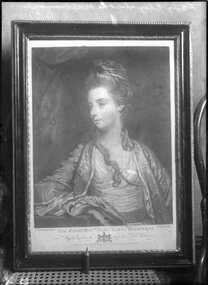
Photograph, Bull, Hugh Jones, 1897-1993, Photo of portrait of Lady Elizabeth Melbourne, 1934
... ...1930-1939...Retrieved June 14, 2024, from http://nla.gov.au/nla.news-article205883518 https://en.wikipedia.org/wiki/Lady_Caroline_Lamb city of melbourne melbourne town hall 1930-1939 portraits Photographer notations on slide: "Lady Elizabeth Melbourne B57". ...Published: The Age, 3 October 1934 Published title: CENTENARY GIFT PORTRAIT. Published caption: A reproduction of the attractive portrait of Lady Melbourne, the mother of Lord Melbourne, which has been presented to the City of Melbourne, and will hang in the Lady Mayoress’s room at the Town Hall. Trove article identifier: https://trove.nla.gov.au/newspaper/article/205879945 Description: A framed mezzotint portrait of a young woman gazing towards her right, with her right arm resting on a table. She is wearing an 18th century style dress and jacket trimmed with ermine tails. A string of pearls is entwined in her upswept hair and through a long lock of hair falling over her shoulder then draping across her bodice. The portrait rests on a cane bottomed chair and a pencil holds it in place. Research by project volunteer, Fiona Collyer: In 1934, Mr Roger Dolbey of London donated to the City of Melbourne a mezzotint engraving of Lady Melbourne, mother of the British Prime Minister after whom the Victorian capital city of Melbourne was named in 1837. The engraving was created in 1771 by John Finlayson after Sir Joshua Reynolds. The gift commemorates the centenary of Melbourne. Elizabeth Milbank, Viscountess Melbourne, 1751-1818 was the wife of wealthy Whig politician, Peniston Lamb, 1st Viscount Melbourne. Lady Melbourne was an ambitious political hostess of the Regency period who cultivated beneficial relationships for her husband’s career. She was beautiful and vibrant and men found her easy going, good humoured company. She had many lovers and it is believed that of her nine children, (three of which did not survive childhood) only her first born, Peniston was fathered by her husband. One of her lovers was George, Prince of Wales, later George IV, believed to be the father of her fourth son George and who was his godfather. Lady Melbourne’s second son William Lamb, 2nd Viscount Melbourne, 1779-1848, was British Prime Minister and a close political confidant and father figure to the young Queen Victoria in the early years of her reign. In 1812, his wife Lady Caroline Lamb, 1785-1828, had a torrid and very public affair with poet Lord Bryon who she described as “Mad, bad and dangerous to know”. As a child, Caroline considered being able to wash a dog as one of her most satisfying accomplishments! The portrait hung in the Lady Mayoress’s room at Melbourne Town Hall. References: CENTENARY GIFT PORTRAIT. (1934, October 3). The Age (Melbourne, Vic. : 1854 - 1954), p. 11. Retrieved June 14, 2024, from http://nla.gov.au/nla.news-article205879945 Presentation of Mezzotint of Lady Melbourne (1934, October 2). The Argus (Melbourne, Vic. : 1848 - 1957), p. 10. Retrieved June 14, 2024, from http://nla.gov.au/nla.news-article10961120 NEWS OF THE DAY. (1934, October 2). The Age (Melbourne, Vic. : 1854 - 1954), p. 8. Retrieved June 14, 2024, from http://nla.gov.au/nla.news-article205883518 https://en.wikipedia.org/wiki/Lady_Caroline_LambPhotographer notations on slide: "Lady Elizabeth Melbourne B57".city of melbourne, melbourne town hall, 1930-1939, portraits -
 City of Melbourne Libraries
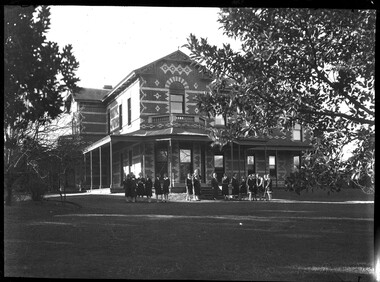
Photograph, Bull, Hugh Jones, 1897-1993, Ruyton Girls School 1933
... ...1930-1939.... : 1862 - 1918, 1935), Saturday 3 June 1876, page 9 – Article on Offington http://www.ohta.org.au/organs/organs/BoxHillUC.html Melb Architecture 1870s - Wikipedia Victorian Collections: Letters of Hilda Daniell https://victoriancollections.net.au/items/65d3e05c5b5e5c61346420a2 schools 1930-1939 architecture Victorian architecture trees architects Photographer notations on slide: "Ruyton Girls School 1933". ...Published: Age (Melbourne, Vic.: 1854- ), 4 August 1933, page 3 Published title: GIRLS’ SCHOOLS – MODEL YACHTING - FOOTBALL Published caption: The headmistress, Miss H. Daniell, and girls at Ruyton, Selbourne Road, Kew, snapped after school hours. Trove article identifier: http://nla.gov.au/nla.news-article204381763 Research by Project Volunteer, Louise McKenzie: Rather than the people, this charming building takes the eye! Originally named “Tarring”, it was built in 1872 by Mr Henry Henty and his wife Mrs Marion Anne Henty (nee McKellar) for their family. Located at 82 Selbourne Road, Kew, it is described by Melbourne’s Open House organisation as “… a two-storey, polychrome brick mansion built for them by prominent Melbourne architect Albert Purchas. The house and nearly four acres of grounds served as their family home until the death of Marian Henty in 1919. “ (See below for further information on Albert Purchas.) In 1920 it was sold to Ruyton Girls School. Ruyton was established in 1878 by its first principal, Charlotte Anderson (1838-1906), who named it in honour of the parish in Shropshire, England, Ruyton-XI-Towns, where her great-great-grandfather David Evans had been vicar. Its motto is Recte et Fideliter, meaning "Upright and Faithful", which is also the name of the school song. The original school, one of Victoria’s oldest independent schools for girls, was located at the home of Mrs Anderson at 63 High Street South, Kew. In 1882 she moved the school to Edgecombe in Studley Park Road. Mrs Anderson retired due to ill health and sold the school to her friend Miss Eliza Bromby. One of Ruyton's four Houses, Anderson, is named for Charlotte Anderson. When Ruyton Girls School was moved to the site in 1920 it established the building as a Boarding House, and renamed the building “Henty House” in honour of its original owners. Today the school remains an all girls’ school, and pays tribute to its founder and the historic significance of Henty House and its magnificent Moreton Bay Fig tree, which still stands today. The building retains many original, Victorian-era features, while also showing the layers of change, made over the decades in order to meet the evolving needs of one of Melbourne’s leading schools. The headmistress mentioned in the caption for MCK016 is Miss Hilda Daniell, shown standing in front of Henty House in the midst of a group of Ruyton girls in their school uniforms, some holding hockey sticks. Miss Daniell was the longest serving Principal of Ruyton 1913-1952. She was originally a student in 1893, then joined the teaching staff in 1898. It was under her leadership that the School purchased and moved to “Tarring”. The boarding house included a flat for Hilda to live onsite. An article in the Ruyton Heritage Collection – Bedford Series, dated 21 May 2021 cites that Miss Daniell “was affectionately known as “Dream” by Ruytonians of her era” apparently due to a tendency to quiet reflection. The article continues, “After her retirement in 1952 Miss Daniell was awarded an Order of the British Empire for her many services to education, an award she received from the hands of the Queen during the 1954 Royal Tour. Also in 1952, the Kew Council honoured her by renaming Brougham Place as ‘Daniell Place’.” Arthur Purchas, architect: The architect responsible for the design of “Tarring”. Arthur Purchas, was extremely active and highly regarded at this time. Born in Wales in 1825, he emigrated to Melbourne in 1851 and soon established a private practice as a surveyor and architect, with offices variously in Little Collins, Queen Street, Chancery Lane, and finally 462 Little Collins Street. Wikipedia notes in an early reference to Purchas that “An early story is that one of his first jobs, when he would have been about 25 years old, was a position under Surveyor-General Robert Hoddle, and disagreeing with him over the line for St Kilda Road, appealed to Governor La Trobe, and successfully got the road diverted around the hill which eventually became the site of the Shrine of Remembrance. There may not be much truth to this, since by 1851 St Kilda Road was already a well worn track running around the hill, the top of which La Trobe had reserved for a Government House in 1840.” The timing of Purchas’s arrival in Melbourne was perfect. The Victorian gold rush of the 1850’s generated enormous wealth in Melbourne, and a building boom followed. The Wikipedia entry continues … that alone, or with his brother in law Charles R Swyer, “Purchas is said to have designed over 140 houses, offices, churches, banks and cemetery buildings in Victoria in his long career. Berkely Hall, St Kilda dating from 1854 is one of his first buildings, and still exists, though the original house is obscured by an early C20th verandah. Another notable early design was the head office of the Melbourne Savings Bank, built on the corner Flinders Lane and Market Street in 1857-58, in an elaborately detailed Renaissance Revival style. His churches were mostly Gothic Revival, built for the Anglican Church, along with some parsonages, while most of the bank buildings were Renaissance Revival designs for the Bank of Australasia. He also designed city buildings in the 1860s and 70s, such as the Mutual Insurance Co, Northern Insurance Co, and the first premises for George & George, destroyed by fire in 1889. One of his most outstanding designs is St George's Presbyterian Church in Chapel Street, St Kilda (1877–80), in a striking polychrome brick Gothic Revival style, unusually carried on through to the interior. Purchas produced one of the few published maps and compilations of the early pastoral settlers runs in Victoria in 1853. In the same year he designed the layout of the Melbourne General Cemetery, the first 'garden' cemetery in Victoria, a curvilinear layout with extensive plantings, as well as the gate lodge and gates (the gates lodge were demolished and the gates relocated to their present position in the 1930s). He was a long time member of the Cemetery Trust, serving as secretary from 1876-1886. He was also Chairman of the Boroondara General Cemetery Board of Trustees 1867 to 1909, and designed many aspects of the cemetery, including the landscape, the cast iron entrance gates (1889), the rotunda (1890) and the surrounding brick wall (1895–6). Purchas was a keen inventor having applied for a patent for an invention for lighting a railway carriage with gas in 1861, and won a competition for a model farm complex, in 1862. This unusual design had the dairy either underground or half underground, to keep it cool, with a 'dry lining' around the outside of the sunken portions. In 1883, with fellow architect Alfred Smith, he took out a patent for fire-proof floors, arches, staircases and other parts of buildings.” Purchas died in his home in Kew in 1909 and, not surprisingly, was buried at Boroondara Cemetery. Henty family history in Australia: Henry Henty (b.1833-d.1912) was a successful businessman, and briefly a MLA for the seat of Grenville, Victoria in 1866. He was one of three sons of James Henty, and nephew of Edward Henty who is considered to be the first permanent European colonist to take up residence in Victoria. The Australian Dictionary of Biography provides a riveting overview of the complex and enthusiastic activities of the Henty family, and its entanglement in the development of mercantile life in WA, Tasmania, SA and Victoria from 1828 onwards. The family had a focussed commitment to creating thriving businesses in Australia, despite being regularly thwarted by legislative pushbacks and law changes, instigated in Britain as the Australian colony developed. Areas of greatest influence were merino sheep, beef and horse breeding, whaling, farm establishment, membership of the legal and political fraternities, sporting prowess, and board directorships in banking and railways. The Dictionary of Biography summarises: “As settlers the Henty men were notable not merely for being the first to settle in Victoria but also for their number and quality: a father and seven educated sons experienced in farming and trading, occupations of prime importance to a new colony, and importers of unusually substantial capital in money, skilled workers and thoroughbred stock.” As well as Tarring, the Henty family Melbourne residences included Findon (in Kew, overlooking Studley Park), Offington (St Kilda Road overlooking Albert Park) and Field Place (Henty Court, Kew), and descriptions of the houses in Wikipedia –Melbourne Architecture 1870s - reflect the development of Melbourne society. References RUYTON (1934, December 15). The Argus (Melbourne, Vic. : 1848 - 1957), p. 18. Retrieved March 12, 2025, from http://nla.gov.au/nla.news-article11001092 https://en.wikipedia.org/wiki/Ruyton_Girls%27_School#:~:text=Ruyton%20Girls'%20School%2C%20commonly%20referred,of%20Melbourne%2C%20Victoria%2C%20Australia. https://www.ruyton.vic.edu.au/our-school#:~:text=With%20an%20international%20reputation%20as,opportunity%20and%20challenge%20for%20girls. https://victoriancollections.net.au/items/5bea06b121ea690bf4eb08ed https://www.ruyton.vic.edu.au/our-school/campus-and-facilities Biography of Edward Henty and family: https://adb.anu.edu.au/biography/henty-edward-2247 Article on Offington House: http://nla.gov.au/nla.news-article196554993 Article on Field Place House : https://vhd.heritagecouncil.vic.gov.au/places/64881 Article on Findon: https://www.facebook.com/KewHistoryGroup/posts/in-the-book-jubilee-history-of-kew-1803-1910-by-fga-barnard-there-is-a-photo-of-/4389837914376555/ Charlotte Anderson/Ruyton: https://victoriancollections.net.au/items/5be4b8c821ea6a039c7a13e3 https://victoriancollections.net.au/items/6179e90da912eb195970bdf8 https://victoriancollections.net.au/items/5bea06b121ea690bf4eb08ed https://victoriancollections.net.au/items/65d3e05c5b5e5c61346420a2 Photo of Charlotte Anderson: https://viewer.slv.vic.gov.au/?entity=IE1515776&mode=browse Photo of Charlotte Anderson: https://victoriancollections.net.au/items/6179e90da912eb195970bdf8 https://victoriancollections.net.au/items/5be4b8c821ea6a039c7a13e3 Wikipedia: Architecture of Melbourne: https://en.wikipedia.org/wiki/Architecture_of_Melbourne Open House Melbourne: Henty House: https://www.universe.com/events/henty-house-ruyton-girls-school-tickets-Z45LYH Albert Purchas: https://en.wikipedia.org/wiki/Albert_Purchas Leader (Melbourne, Vic. : 1862 - 1918, 1935), Saturday 3 June 1876, page 9 – Article on Offington http://www.ohta.org.au/organs/organs/BoxHillUC.html Melb Architecture 1870s - Wikipedia Victorian Collections: Letters of Hilda Daniell https://victoriancollections.net.au/items/65d3e05c5b5e5c61346420a2 Photographer notations on slide: "Ruyton Girls School 1933".schools, 1930-1939, architecture, victorian architecture, trees, architects -
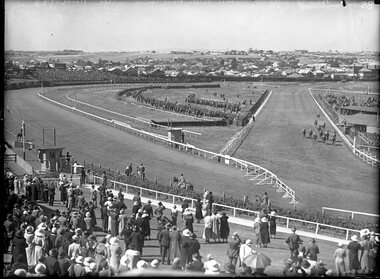 City of Melbourne Libraries
Photograph, Bull, Hugh Jones, 1897-1993, The new straight at Moonee Valley Race Course
... ...1930-1939..._Cox_Plate Austadiums, Moonee Valley, https://www.austadiums.com/stadiums/moonee-valley horseracing race courses moonee valley 1930-1939 Photographer notations on slide: "New straight at Moonee Valley Race Course - Age 11 Dec 1933 B8". ...Published: Age (Melbourne, Vic.: 1854- ), 11 December 1933 Published title: The New Straight Moonee Valley Published caption: Age (Melbourne, Vic. : 1854 - 1954), Monday 11 December 1933, page 6 The finish of the Koombahla Trial Handicap, the first race run on the new and longer straight across the flat at Moonee Valley racecourse. Magoot won, with Affability second and Great Bear third. This picture, taken from the members' reserve, shows the new straight in relation to the old one (the latter will continue to be used for races of less than seven furlongs), with the finishing post on the right and the new Judge's box in front of the old one. In the distance can be seen the starting points for races over nine furlongs and eight furlongs and a half on another course track. Trove article identifier: http://nla.gov.au/nla.news-article203362672 Research by Project Volunteer, Louise McKenzie: This photo, taken from the elevation of the stand in the Members’ Reserve at Moonee Valley Racecourse, has been framed in order to highlight the new straight, the finishing post, and a new Judge’s Box. In the foreground is a crowd of racegoers in the Members area, showing significantly more women in attendance than men. It is a bright, sunny Tuesday afternoon. The women are wearing small or large brimmed hats and are mostly swathed in generously cut coats with long sleeves that are mid calf length. Some women carry umbrellas to protect them from the sun. The men are wearing suits and hats. The women and men are mostly standing in discrete, rather than mixed groups. More spectators are standing on a banked area in the centre of the track, a large crowd is trackside on the left and another crowd is located to the right of the photo along the final straight. There are stewards on horses in front of the members reserve, and a field of 12 horses approaches the winning post. On a slope at the rear of the photo is evidence of a fairly new housing development, evidenced by the small number of trees. Beyond this there is some vacant land to the left and then more dense housing is evidenced to the right. In the photo the white fencing delineating the course and spectator areas creates wonderful lines and curves. It is a very sharp and clear image. The race underway is the Koombahla Trial Handicap, which was won by Magoot by a length from Affability, with half a length back to Great Bear. At this juncture, Magoot won 3 of 4 starts, and subsequently on Saturday 30 December 1933, with a new up and coming young Flemington trainer J M Murphy, and popular mount Harold Skidmore, Magoot was the favourite and winner of the day’s principal event at Moonee Valley. The Weekly Times that day reported that Magoot had been sold to Launceston sportsman Mr W C Learoyd. The winnings from this race, 400 Pounds , was apparently sufficient to offset the cost of the horse, and would be the equivalent of approximately $9,500 in today’s money. The same article describes Magoot as a “Magpie” gelding as his bloodline was Magpie Tullalah from New Zealand. Sadly, on 9 October 1935, the Examiner (Launceston) reported that Magoot had to be destroyed after falling and breaking her shoulder while running in the Grovedale Handicap in Geelong, but such was her reputation that she warranted an accompanying photograph. Moonee Valley Racecourse was established in 1883 on private land by its owner WS (Sam) Cox – after whom the prestigious horserace, the WS Cox Plate is named. It is located 6 km from the Melbourne CBD in the suburb of Moonee Ponds. It became a non-proprietary property in 1935, and today the Cox Plate, run over 2040 m. each October, is the richest weight-for-age race in Australia for 3 year old and over, under Weight for Age conditions.” According to the Austadiums website, Moonee Valley has a “unique amphitheatre track and was the first Australian metropolitan track to conduct night racing.” This amphitheatre style is evident in Hugh Bull’s photo. THE NEW STRAIGHT AT MOONEE VALLEY. (1933, December 11). The Age (Melbourne, Vic. : 1854 - 1954), p. 6. Retrieved July 23, 2025, from http://nla.gov.au/nla.news-article203362672 Age (Melbourne, Vic. : 1854 - 1954), Monday 11 December 1933, page 6 THE NEW MOONEE VALLEY TRACK (1933, December 11). The Argus (Melbourne, Vic. : 1848 - 1957), p. 7. Retrieved September 1, 2025, from http://nla.gov.au/nla.news-article11719604 Argus (Melbourne, Vic. : 1848 - 1957), Monday 11 December 1933, page 7 MAGOOT SOLD (1933, December 23). The Australasian (Melbourne, Vic. : 1864 - 1946), p. 22 (METROPOLITAN EDITION). Retrieved September 1, 2025, from http://nla.gov.au/nla.news-article141384672 Australasian (Melbourne, Vic. : 1864 - 1946), Saturday 23 December 1933, page 22 SMALL BUT GOOD (1933, December 30). Weekly Times (Melbourne, Vic. : 1869 - 1954), p. 48 (FIRST EDITION). Retrieved September 1, 2025, from http://nla.gov.au/nla.news-article223210074 Weekly Times (Melbourne, Vic. : 1869 - 1954), Saturday 30 December 1933, page 48 MOONEE VALLEY RACES. (1933, December 11). The Sydney Morning Herald (NSW : 1842 - 1954), p. 13. Retrieved September 1, 2025, from http://nla.gov.au/nla.news-article17031425 Sydney Morning Herald (NSW : 1842 - 1954), Monday 11 December 1933, p. 13 ACCIDENTS AT GEELONG MAGOOT DESTROYED (1935, October 10). Examiner (Launceston, Tas. : 1900 - 1954), p. 3 (DAILY). Retrieved September 1, 2025, from http://nla.gov.au/nla.news-article51958216 Examiner (Launceston, Tas. : 1900 - 1954), Thursday 10 October 1935, p. 3 Wikipedia, Moonee Valley Racecourse, https://en.wikipedia.org/wiki/Moonee_Valley_Racecourse eMelbourne, the city past and present, https://www.emelbourne.net.au/biogs/EM01003b.htm Wikipedia, Cox Plate, https://en.wikipedia.org/wiki/W._S._Cox_Plate Austadiums, Moonee Valley, https://www.austadiums.com/stadiums/moonee-valleyPhotographer notations on slide: "New straight at Moonee Valley Race Course - Age 11 Dec 1933 B8".horseracing, race courses, moonee valley, 1930-1939 -
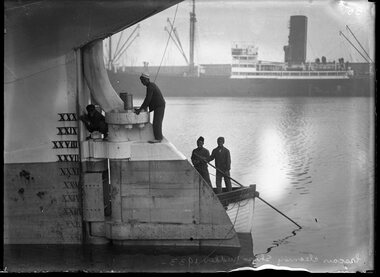 City of Melbourne Libraries
Photograph, Bull, Hugh Jones, 1897-1993, Lascars cleaning ship's rudder
... ...1930-1939...Retrieved July 23, 2025, from http://nla.gov.au/nla.news-article244841163 National Research Institute SPOTLIGHT paper Vol 9, Issue 7, https://pngnri.org/images/Publications/Spotlight_No_9_Vol_7_-_201609_-_Sofe__Odhuno_-_Rice_Import_Quota1.pdf South Asian Heritage Trust, The Lascars: Seafaring Roots of Modern Britain, July 11,2025 : Royal British Legion. https://southasianheritage.org.uk/royal-british-legion/the-lascars-seafaring-roots-of-modern-britain/ lascars ships 1930-1939 employment ethnic communities Photographer notations on slide: "Lascars cleaning ships rudder 1933". ...Published: unknown, however, on 26 June 1935 a similar, but not the exact photo in the McKenzie Collection, was published in The Age: Published title: Shipping Victorian Flour to the East Published Caption: Flour and wheat figure prominently in all cargoes carried by ships trading to Chinese, Japanese and Eastern ports. Victorian millers are eager to extend lids outlet for their produce, and every opportunity is grasped. The pictures show Australian labourers unloading from railway trucks some of the 2300 tons of flour which will go into the hold of the Burns, Philp motor ship Neptuna for shipment to Hong Kong, while Chinese seamen are busy cleaning and painting the rudder post of the ship. Hard by the Neptuna, other ships are taking on flour for the East. Research by Project Volunteer, Louise McKenzie: The image was described by Hugh Bull on the rear of the glass plate as – “Lascars cleaning ships rudder 1933”. Basically, a “lascar” is a seaman. Image No. 032 in the McKenzie Collection shows two lascars perched on the rudder of a ship, with two others standing in a rowboat along side. They are dressed in baggy trousers and jackets and wearing caps. Across a very calm dock area is a single funnel ship with on-deck derricks. The rudder of the ship being cleaned is white, with large black roman numbering denoting the depth at which the ship is sitting, depending on whether it is loaded or empty. Whilst the exact photo in the McKenzie Collection has yet to be located in The Age in 1933, the date when it was taken, there is a photo published in The Age on 25 June 1935 which appears to be one of a series of photos taken on the same day, featuring lascars cleaning a ship’s rudder. It bears a striking resemblance to MCK 032, but it is taken from a slightly different angle. The 1935 published photo is a close up of a ship’s rudder being cleaned, with same style of roman numerals in black on the white of the rudder. One lascar is standing on the rudder, one is standing in a small clinker style rowboat, with its characteristic wooden overlapping hull planks, holding a broom; two more lascars are sitting in the bow and stern of the rowboat. The ship being cleaned is in a dock, as a wharf and warehouses can be seen in the background, the water is very calm, and there are two other ships moored nearby – one across the other side of the dock with a black and white hull and derricks on its deck, and one adjacent, with its mooring lines clearly visible. The lascars are wearing caps, baggy trousers and jackets. Compelling similarities therefore exist between the two images. Whilst it is difficult to positively identify the cultural background of these particular lascars in either photo, the newspaper article dated June 1935 advises they are “Chinese”. This is possibly because the ship they are associated with, the Neptuna, is reported to have sailed from Melbourne on this date, bound for Hong Kong. However, the men are probably from South East Asia. Wikipedia describes the term “Southeast Asia” as covering ” … the people of Southeast Asia from prehistory to the present in two distinct sub-regions: Mainland Southeast Asia (or Indochina) and Maritime Southeast Asia (or Insular Southeast Asia). Mainland Southeast Asia comprises Cambodia, Laos, Myanmar (or Burma), Peninsular Malaysia, Thailand and Vietnam whereas Maritime Southeast Asia comprises Brunei, Cocos (Keeling) Islands, Christmas Island, East Malaysia, East Timor, Indonesia, Philippines and Singapore. Additionally, Wikipedia “Lascars” states that “Lascars were sailors from the Indian subcontinent, South East Asia, the Arab world, British Somaliland and lands east of the Cape of Good Hope, who were employed to work on colonial merchant ships. The practice ran from the 16th century to the mid 20th century”. Indian seamen were used as early as the 16th century by Portuguese explorer Vasgo da Gama in his successful voyage to India, and subsequently by Portuguese ships in the 16th and 17th centuries. “Through the Portuguese and Spanish maritime world empires, some Indian lascars found their way onto English merchant ships, and were among the sailors on the first English East India Company (EIC) ships to sail to India.” In the 17th Century “When the English adopted the term "lascar", they initially used it for all Asian sailors on English-flagged ships, but after 1661 and the Portuguese ceded Bombay to England, the term was used mainly to describe Indian sailors specifically. The term "topaze" was used to describe Indo-Portuguese personnel, especially those from Bombay, Thana, Diu, Dammam and Cochin. The term "sepoy" was used to describe Indian soldiers in European service. The number of lascars employed on EIC East Indiamen was so great that the Parliament of England restricted their employment via the Navigation Acts (in force from 1660 onwards) which required that 75% of the crew onboard English-flagged ships importing goods from Asia be English subjects. The restriction arose due to the high rates of illnesses and death among European sailors on East Indiamen, and their frequent desertions in Asia, which left such ships short of crew for the return voyage. Another reason was the frequent impressment of European sailors from EIC East Indiamen by the Royal Navy in times of war“. The term “impressment” colloquially refers to “the “press gang” …”a type of conscription of people into a military force, especially a naval force, via intimidation and physical coercion, conducted by an organized group (hence “gang”). .. The large size of the British Royal Navy in the Age of Sail meant impressment was most commonly associated with Great Britain.”. (Wikipedia – Impressment). By the 20th century these sailors served on British ships under "lascar agreements", which allowed shipowners more control than was the case in ordinary articles of agreement. The sailors could be transferred from one ship to another and retained in service for up to three years at one time. “Lascars served all over the world in the period leading up to the First World War. Lascars were barred from landing at some ports, such as in British Columbia. At the beginning of World War I, there were 51,616 lascars working on British merchant ships in and around the British Empire. In World War II thousands of lascars served in the war and died on vessels throughout the world, especially those of the British India Steam Navigation Company, P&O and other British shipping companies. The lack of Canadian naval manpower led to the employment of a total of 121 Catholic Goans and 530 Muslim British Indians on the Empress vessels of the Canadian Pacific Railway, such as the Empress of Asia and Empress of Japan. These ships served in the Indian Ocean both as ANZAC convoy ships and in actions at Aden. The ships were placed under the British Admiralty as part of Canada's contribution to the war effort and all of the Indian men were awarded medals by the Admiralty, though none of them were delivered. In the 1950s the use of the term "lascar" declined with the ending of the British Empire. The Indian “Lascar Act” of 1832 was finally repealed in 1963. However, "traditional" Indian deck and Pakistani engine crews continued to be used in Australia until 1986 when the last crew was discharged from the P&O and replaced by a general-purpose crew of Pakistanis. The term lascar has been widely used to engender an element of exoticism in literature eg “Sir Arthur Conan Doyle created a Lascar foil to Sherlock Holmes in "The Man with the Twisted Lip" in 1891. Lascars aboard the ship Patna figure prominently in the early chapters of Joseph Conrad's novel Lord Jim. Frances Hodgson Burnett's novel A Little Princess features a lascar named Ram Dass. Also, Caleb Carr portrays two lascars as bodyguards for a Spanish diplomat near the end of The Angel of Darkness. In Wuthering Heights, it is speculated that Heathcliff, the main character, may be of lascar origin." (Wikipedia – Lascar) And what has become of these “forgotten heroes of the World Wars”? The South Asian Heritage Trust, which seeks to commemorate, mark and celebrate South Asian cultures, stories, and communities, published an article in July 2025 entitled – The Lascars: Seafaring Roots of Modern Britain. It particularly honours the role of the 80,000 lascars who served Britain in WWI, and the over 100,000 who served in the British Merchant Navy in WWII, and concludes: “The hardships faced by Lascars were profound. They were often assigned the most dangerous tasks, lived in substandard conditions aboard ships and, even after their immense contributions to the war efforts, many veterans found it difficult to secure the recognition, pensions and rights afforded to other veterans. Many were employed under ‘Asiatic Articles’, which offered less protection and lower pay than their European counterparts. Yet, their legacy endures. The multicultural fabric of areas like East London owes much to these early seafarers and settlers. The East London Mosque, established in 1910, became an important spiritual and community hub. Today, efforts to bring their stories out of the shadows are growing. The Museum of London Docklands features exhibits on their history. Memorials, such as the P&O headstone in Dover for the 22 Lascar crew members of the SS Maloja sunk in 1916 and the careful restoration of the Lascar War Memorial in Kolkata, serve as important reminders of the sacrifices. The journey of the Lascars – from their homelands, along dangerous wartime shipping routes, to the docklands of Britain – is a story of personal courage and of a rich contribution to Britain’s history and identity.” The ship MV Neptuna, mentioned in the 1935 article, had that year been purchased from a German company by Australian-owned Burns Philp, with Australian Government assistance, and it was instrumental in ensuring the shipment of rice from Vietnam to Papua New Guinea. Rice is still a household staple in PNG. Despite it being introduced into PNG more than 100 years ago, the crop has not been sufficiently integrated into the country’s traditional agricultural production system, and today PNG imports still account for nearly 98% of rice. (Spotlight Magazine Sept. 2016) The 1935 newspaper article states that the Neptuna is involved in moving flour for the East. Australian wheat exports began in 1845, but were not regular until the 1870s. New land clearing methods in Australia allowed large tracts of land to be cleared more efficiently – this included the invention of the iconic ‘stump jump’ plough. With the success of the wheat harvests, flour mills began to spring up around the country. By the 1870s, many large country towns had their own mills, with around 500 mills producing flour across the country. Flour exports were an important part of the wheat industry until around the 1930s. After the Second World War, many of Australia’s export partners (which were mainly in the developing nations of Asia) began setting up their own flour industries and the Australian product was no longer in demand. In 1942 MV Neptuna was being utilised for the war effort, and carrying depth charges and other armaments for Australia, when on 19 February it was sunk in a bombing raid on Darwin, and where part of her hull still lies. References: SHIPPING VICTORIAN FLOUR TO THE EAST. (1935, June 25). The Age (Melbourne, Vic. : 1854 - 1954), p. 11. Retrieved July 23, 2025, from http://nla.gov.au/nla.news-article204357218 Age (Melbourne, Vic. : 1854 - 1954), Tuesday 25 June 1935, page 11 Wikipedia, Clinker (boat building), https://en.wikipedia.org/wiki/Clinker_(boat_building) Wikipedia, Lascar, https://en.wikipedia.org/wiki/Lascar Wikipedia, History of Southeast Asia, https://en.wikipedia.org/wiki/History_of_Southeast_Asia Wikipedia, Impressment, https://en.wikipedia.org/wiki/Impressment NEPTUNA LEAVES FOR CHINA WITH TOURISTS (1935, June 25). The Herald (Melbourne, Vic. : 1861 - 1954), p. 5. Retrieved July 23, 2025, from http://nla.gov.au/nla.news-article244841163 National Research Institute SPOTLIGHT paper Vol 9, Issue 7, https://pngnri.org/images/Publications/Spotlight_No_9_Vol_7_-_201609_-_Sofe__Odhuno_-_Rice_Import_Quota1.pdf South Asian Heritage Trust, The Lascars: Seafaring Roots of Modern Britain, July 11,2025 : Royal British Legion. https://southasianheritage.org.uk/royal-british-legion/the-lascars-seafaring-roots-of-modern-britain/ Photographer notations on slide: "Lascars cleaning ships rudder 1933".lascars, ships, 1930-1939, employment, ethnic communities -
City of Melbourne Libraries
Photograph, The Age (Melbourne, Vic. : 1854 - 1954), The Age, Tue 26 December 1933, 1933
... ...1930-1939...The Age newspaper photography 1930-1939 christmas Digital file The Age, Tue 26 December 1933 Photograph The Age (Melbourne, Vic. : 1854 - 1954) ...The Age: Christmas 1933 weather pictorial Three photographs from the McKenzie Collection appear in this Age Boxing Day pictorial, documenting the weather conditions in Melbourne on Christmas Day, 1933. In the morning, swimmers flocked to the St Kilda foreshore to cool off during a heatwave. By five o’clock, thunder and a hailstorm were breaking over the city, leaving the streets flooded. Also featured on this page: Important visitors at the Children’s Hospital and The Nurses’ Christmas. Large scale prints of all three images feature below. Discovering this page via the digitised newspapers on Trove was a crucial step in unlocking the provenance of the slides. Published: The Age 26 December 1933, page 9 (1933, December 26). The Age (Melbourne, Vic. : 1854 - 1954), p. 9. Retrieved October 10, 2025, from http://nla.gov.au/nla.news-page19054271 Featured in "Newsworthy : Melbourne in photographs 1933-1936" exhibition held at East Melbourne Library from October to December 2023. The Newsworthy exhibition developed out of a local history digitisation project. Fifty images from a collection of 240 glass plate negatives were selected and printed at large scale for public display at East Melbourne Library. The exhibition was very well-received. The McKenzie Collection of glass plate negatives unlocks glimpses of our city not seen for almost 100 years. In the 1990s, renowned architectural photographer Ian McKenzie (1939-2014) picked up 240 glass plate negatives at a local market. Believed to be from a Victorian news archive, they dated back to the 1930s. The slides lay dormant in a dusty garage until 2020 when Ian’s wife Louise decided it was time to bring them back into the light. Louise McKenzie, and two other history-lovers, Ernie Ward and Fiona Collyer, signed up as City of Melbourne volunteers and joined forces with City of Melbourne Libraries Community Heritage Team Leader, Linda Longley and Local History Librarian, Fiona Campbell. Together, the project team has devoted more than three years to unlocking the mysteries of the collection. What began as a simple digitization exercise swiftly morphed into a wild journey of discovery and kismet. Intensive detective sessions and discussions with fellow historical networks ensued, gradually unearthing our photojournalistic history and technologies, the merits of volunteer work, and astonishing stories from 1930s Victoria. From the domestic to the dramatic, the celebratory to the solemn, these fascinating images capture a fleeting yet significant period in Interwar, Depression-era Melbourne. Above all, the McKenzie Collection project has brought about a powerful and sustained sense of engagement, connection and celebration between people across decades and places.the age newspaper, photography, 1930-1939, christmas -
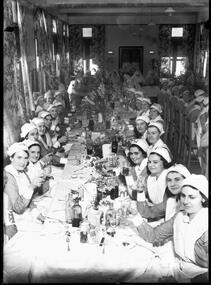 City of Melbourne Libraries
Photograph, Bull, Hugh Jones, 1897-1993, The Nurses' Christmas, Alfred Hospital
... ...1930-1939...She can be seen in the grand panorama documenting this occasion (also featured in this exhibition). nurses christmas 1930-1939 Photographer notations on slide: "The Nurses' Christmas Alfred Hospital Age 1933 B9". ...Published: The Age 26 Dec 1933 page 9 Published title: "THE NURSES' CHRISTMAS." Trove article identifier: http://nla.gov.au/nla.news-article203364946 Description: Group of nurses in uniform enjoying Christmas dinner at the Alfred Hospital. Research by project volunteer Ernie Ward: Alfred Hospital nurses enjoy their Christmas Lunch: The hierarchical system of Nursing and Nurse Training (as indicated by the headwear, armbands and seating positions) is on full display as Alfred Hospital nurses propose a Christmas Lunch toast (strictly non-alcoholic) to The Age photographer, Hugh Bull. Some of the bolder nurses have decorated their headwear in a festive way that would be frowned upon the other 364 days of the year. The soft drinks are Marchants and Elliotts, the flower arrangements feature the highly fashionable gladioli, and the floral patterned curtains have been pulled aside so the summer sunshine can stream in. The sunshine would, in a couple of hours, be replaced by flooding rainstorms which caused havoc on Christmas night. This very Melbourne weather phenomenon was the focus of The Age Boxing Day edition pictorial. At the rear of the room is Matron Grace Wilson C.B.E, already a World War One heroine for setting up and working at Australian military hospitals in Greece, Egypt and France (as seen on the second episode of the 2014 television series Anzac Girls). As Australia’s most highly-ranked peacetime military nurse, Matron Wilson also appears as the only woman in any official capacity at the Dedication of the Shrine of Remembrance in 1934. She can be seen in the grand panorama documenting this occasion (also featured in this exhibition).Photographer notations on slide: "The Nurses' Christmas Alfred Hospital Age 1933 B9".nurses, christmas, 1930-1939 -
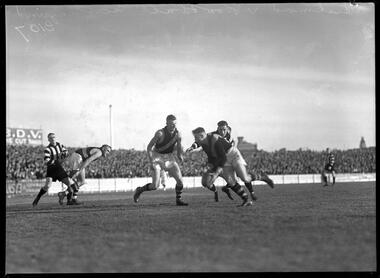 City of Melbourne Libraries
Photograph, Bull, Hugh Jones, 1897-1993, Richmond v Collingwood at Victoria Park 9 May 1936 (3/3)
... ...1930-1939...Exhibition caption by project volunteer, Ernie Ward. football 1930-1939 Photographer notations on slide: "Richmond v Collingwood football B107". ...Tiger Goal-Sneak snags third major DICK HARRIS (548 goals, 5th highest Richmond FC of all time, 196 games) scores a trademark goal from the forward pocket, despite the attentions of JACK REGAN (future fullback on Collingwood Team of the Century). A future Richmond FC Hall of Famer, Harris, described by teammate Jack “Captain Blood” Dyer as the “toughest little player I have ever seen”, is ably assisted by Tiger followers, baker DAVE BASSETT (46 games in 3 seasons until forced to retire with a back injury), and fireman BERT FOSTER (133 games,12 seasons, died on duty in 1941). Accompanying our photograph is a series of five sequential images taken by The Globe High Speed Camera of the same on-field action from the same location. These images appeared four days later on the front page of the midweek Melbourne Sporting Globe (photographer unknown). Featured in "Newsworthy: Melbourne in photographs 1933-1936" exhibition at East Melbourne Library, October to December 2023. Exhibition caption by project volunteer, Ernie Ward. Photographer notations on slide: "Richmond v Collingwood football B107" Collingwood v Richmond at Victoria Park 9 May 1936 Attendance: 25,000-30,000 (capacity); Weather: fine with a light breeze from north to south Collingwood had unfurled their 10th Premiership Flag before the game, and also officially opened their fancy new members only club rooms. After the game, the new rooms were to host a soirée on a polished dance floor larger than the one at Collingwood Town Hall (by invitation - members only). Collingwood had beaten Richmond easily in the previous year’s Preliminary Final. Both teams had come off a good Round One victory. The Sporting Press – and, since betting on football was illegal, the SP Bookies – had Richmond as slight favourites. The scene was set for one of the “games of the season”. But, alas, it was not to be. The Magpies ambushed the Tigers from the very first bounce. The Tigers won most of the aerial battles, but the ‘Pies’ small men dominated all over the ground. Collingwood had kicked eight goals straight by quarter-time. By half-time, they had 14 goals and only two behinds. In his 17th season, legendary full forward GORDON “NUTS” COVENTRY (1901-1968) had bagged seven majors by the long break, scoring an eight before the full-time bell. The contest was over by half-time. The Tigers reportedly battled out the second half as the travelling Tiger Army and the Sporting Press had come to expect! But that’s easy to say when a six-goal flogging is also a 36-point drubbing – especially when it’s the hated Collingwood FC handing out the punishment. After the game, Richmond FC were in for a “good hard look at themselves” (this is known as a “rebuild” in 2023), and missed out playing Finals for the first time since 1926. Collingwood were right on their usual track and would go on to win the 1936 Premiership. The normal order of things was restored! Collingwood 16.12.108 defeated Richmond 10.12.72. EPW Featured in "Newsworthy: Melbourne in photographs 1933-1936" exhibition at East Melbourne Library, October to December 2023. Exhibition caption by project volunteer, Ernie Ward.Photographer notations on slide: "Richmond v Collingwood football B107".football, 1930-1939 -
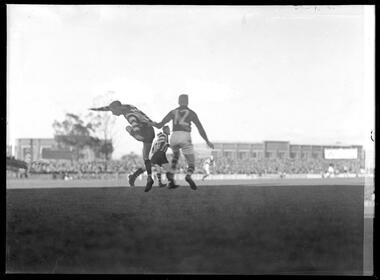 City of Melbourne Libraries
Photograph, Bull, Hugh Jones, 1897-1993, Collingwood v Richmond at Victoria Park 9 May 1936 (1/3)
... ...1930-1939...Exhibition caption by project volunteer, Ernie Ward. football 1930-1939 Photographer notations on slide: "Richmond v Collingwood football B107". ...If ya don’t mind, umpire?? The ball and the umpire are nowhere in sight as Richmond FC’s greatest goal scorer (and champion ballroom dancer), the always chatty publican, JACK “SKINNY” TITUS (970 goals, 294 games), reaches into his bottomless bag of sneaky tricks, and appears to be infringing Collingwood FC fullback, JACK “SNOZZLE” REGAN! It was a bad day at the office for the Tigers, and for the talkative “Skinny”. He scored six of the Tigers’ 10 goals, but Regan was mentioned in every post-game wrap-up as one of the outstanding players afield. “Snozzle” went on to win the Magpies’ 1936 Best and Fairest trophy by the narrowest of margins, no doubt helped by the votes he received in this game. I’m tipping this is one thing you wouldn’t have heard Skinny yapping about! Featured in "Newsworthy: Melbourne in photographs 1933-1936" exhibition at East Melbourne Library, October to December 2023. Exhibition caption by project volunteer, Ernie Ward. Photographer notations on slide: "Richmond v Collingwood football B107" Collingwood v Richmond at Victoria Park 9 May 1936 Attendance: 25,000-30,000 (capacity); Weather: fine with a light breeze from north to south Collingwood had unfurled their 10th Premiership Flag before the game, and also officially opened their fancy new members only club rooms. After the game, the new rooms were to host a soirée on a polished dance floor larger than the one at Collingwood Town Hall (by invitation - members only). Collingwood had beaten Richmond easily in the previous year’s Preliminary Final. Both teams had come off a good Round One victory. The Sporting Press – and, since betting on football was illegal, the SP Bookies – had Richmond as slight favourites. The scene was set for one of the “games of the season”. But, alas, it was not to be. The Magpies ambushed the Tigers from the very first bounce. The Tigers won most of the aerial battles, but the ‘Pies’ small men dominated all over the ground. Collingwood had kicked eight goals straight by quarter-time. By half-time, they had 14 goals and only two behinds. In his 17th season, legendary full forward GORDON “NUTS” COVENTRY (1901-1968) had bagged seven majors by the long break, scoring an eight before the full-time bell. The contest was over by half-time. The Tigers reportedly battled out the second half as the travelling Tiger Army and the Sporting Press had come to expect! But that’s easy to say when a six-goal flogging is also a 36-point drubbing – especially when it’s the hated Collingwood FC handing out the punishment. After the game, Richmond FC were in for a “good hard look at themselves” (this is known as a “rebuild” in 2023), and missed out playing Finals for the first time since 1926. Collingwood were right on their usual track and would go on to win the 1936 Premiership. The normal order of things was restored! Collingwood 16.12.108 defeated Richmond 10.12.72. EPW Featured in "Newsworthy: Melbourne in photographs 1933-1936" exhibition at East Melbourne Library, October to December 2023. Exhibition caption by project volunteer, Ernie Ward.Photographer notations on slide: "Richmond v Collingwood football B107".football, 1930-1939 -
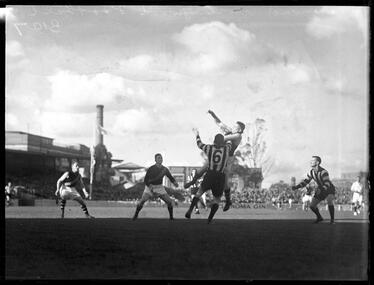 City of Melbourne Libraries
Photograph, Bull, Hugh Jones, 1897-1993, Collingwood v Richmond at Victoria Park 9 May 1936 (2/3)
... ...1930-1939...Collingwood 16.12.108 defeated Richmond 10.12.72. football 1930-1939 Photographer notations on slide: "Richmond v Collingwood football B107". ...GO THE PUNCH, SHEAHAN, YA LEGEND!!! MAURIE SHEAHAN, 121-game Tiger fullback and member of the “Three Musketeers” Defensive Line, tries to punch the ball, preventing Gordon “Nuts” Coventry from marking and scoring another of his eight goals for the afternoon! In his 17th season, “Nuts” was giving a by now familiar hands-on demonstration of why, 87 years later, the Coventry name should be forever emblazoned behind the Northern goal of Docklands Stadium. Another Musketeer, Richmond’s 12-season, 209-game Life Member, tough KEVIN O’NEILL (left), waits hopefully for any crumbs. DANNY GUINAINE, a rugged Tigers utility player who played 10 seasons and 110 games, is also on the scene. Maurie’s son John played 17 games, and Danny’s son Paddy played 146 games at Punt Road in the 1960s, proving again that Tiger blood will always be thicker than water. Featured in "Newsworthy: Melbourne in photographs 1933-1936" exhibition at East Melbourne Library, October to December 2023. Exhibition caption by project volunteer, Ernie Ward. Photographer notations on slide: "Richmond v Collingwood football B107" Collingwood v Richmond at Victoria Park 9 May 1936 Attendance: 25,000-30,000 (capacity); Weather: fine with a light breeze from north to south Collingwood had unfurled their 10th Premiership Flag before the game, and also officially opened their fancy new members only club rooms. After the game, the new rooms were to host a soirée on a polished dance floor larger than the one at Collingwood Town Hall (by invitation - members only). Collingwood had beaten Richmond easily in the previous year’s Preliminary Final. Both teams had come off a good Round One victory. The Sporting Press – and, since betting on football was illegal, the SP Bookies – had Richmond as slight favourites. The scene was set for one of the “games of the season”. But, alas, it was not to be. The Magpies ambushed the Tigers from the very first bounce. The Tigers won most of the aerial battles, but the ‘Pies’ small men dominated all over the ground. Collingwood had kicked eight goals straight by quarter-time. By half-time, they had 14 goals and only two behinds. In his 17th season, legendary full forward GORDON “NUTS” COVENTRY (1901-1968) had bagged seven majors by the long break, scoring an eight before the full-time bell. The contest was over by half-time. The Tigers reportedly battled out the second half as the travelling Tiger Army and the Sporting Press had come to expect! But that’s easy to say when a six-goal flogging is also a 36-point drubbing – especially when it’s the hated Collingwood FC handing out the punishment. After the game, Richmond FC were in for a “good hard look at themselves” (this is known as a “rebuild” in 2023), and missed out playing Finals for the first time since 1926. Collingwood were right on their usual track and would go on to win the 1936 Premiership. The normal order of things was restored! Collingwood 16.12.108 defeated Richmond 10.12.72.Photographer notations on slide: "Richmond v Collingwood football B107".football, 1930-1939 -
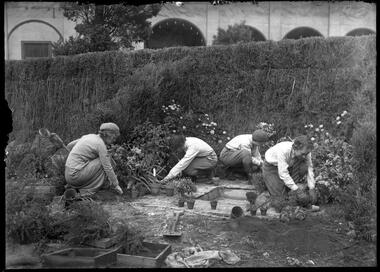 City of Melbourne Libraries
Photograph, Bull, Hugh Jones, 1897-1993, Burnley Ex-Students' Association preparing for Garden Week display, South Melbourne
... ...1930-1939...Alice didn't specify who was who in the photograph but noted: "An earlier cataloguer had thought Alice was the one on the right, but I’m not sure." gardens events 1930-1939 horticulture world war 1 gardening women gardeners jodhpurs clothing and dress Burnley Horticultural College Photographer notations on slide: "B21". ...Photographer notations on slide: B21 Published: 10 April 1934 Published title and caption: Preparing for Garden Week Reference: PREPARING FOR GARDEN WEEK. (1934, April 10). The Age (Melbourne, Vic. : 1854 - 1954), p. 11. Retrieved February 2, 2026, from http://nla.gov.au/nla.news-article203840965 Caption: "Garden Week, which opens to-day at Wirth's Park, will present the best of the Autumn flowers, together with seasonal shrubs and trees, grown by Victorian Horticulturists. Girl students are here seen preparing one of the exhibits. The display will continue until Saturday inclusive." Description: Female gardeners from the School of Horticulture, Burley, preparing an exhibit for Autumn Garden Week located at Wirth's Park on the site of the current Melbourne Arts Centre. A horticultural training establishment commenced at Burnley in 1891. Women were allowed to attend from 1899 under the enlightened leadership of Charles Luffman. By 1934, following the tragic impacts of World War One, women were both required and determined to earn a living and to be paid landscape architects, designers and managers. Wearing trousers and overalls was an outward indicator that should they wish, they could be horticulturalists, not just gardeners. Garden Week was billed as one of the most important floral displays held in Australia, showcasing flowers, fruit and vegetables, bulbs, succulents, garden ornaments, practical appliances and garden literature. There were large display halls and model gardens - designed to provide inspiration to the amateur gardener and showcase Victorian producers. Featured in "Newsworthy: Melbourne in photographs 1933-1936" exhibition at East Melbourne Library, October to December 2023. Exhibition caption by project volunteer, Louise McKenzie. In January 2026, volunteer Fiona Collyer contacted Burnley Campus Archives at University of Melbourne to share the image. Jane Wilson, Manager of the Burnley Campus Archives, University of Melbourne, supplied the following information: "I find that we actually have that photograph as a newspaper cutting, sent in from a former student. This is some additional information: Students are: Evelyn Yule (1932), Betty Holmes (1932), Margaret Doherty (1932) and Alice Glascodine (later Mrs. Tucker) (1933). Alice sent us the newspaper cutting." Alice didn't specify who was who in the photograph but noted: "An earlier cataloguer had thought Alice was the one on the right, but I’m not sure."Photographer notations on slide: "B21".gardens, events, 1930-1939, horticulture, world war 1, gardening, women gardeners, jodhpurs, clothing and dress, burnley horticultural college
