
Showing 6 items matching "1950s local commerce"
-
 Broadmeadows Historical Society & Museum
Document - Receipt, J. & H. Safstrom Pty Ltd, Copy of Receipt – Right of Carriageway, 14 February 1956
... ...1950s local commerce...This receipt provides documentary evidence of local land use arrangements and commercial activity in Glenroy during the 1950s, contributing to an understanding of suburban development and legal practices at the time. Property rights Local governance Glenroy (Vic.) 1950s local commerce ...The receipt documents a mid 20th century property related transaction in Glenroy, reflecting suburban development practices and private agreements relating to access rights.This receipt provides documentary evidence of local land use arrangements and commercial activity in Glenroy during the 1950s, contributing to an understanding of suburban development and legal practices at the time.Paper receipt, blue text on light paper, with handwritten annotations on recto and verso.(Location: printed and handwritten text on recto; additional markings verso): “Copy of Receipt”/“J. & H. Safstrom Pty. Ltd.”/“6–8 Post Office Place, Glenroy, 3046”/“14.2.56”/“Received … the sum of £100 (pounds)”/“Being payment in full for right of Carriageway at rear of Belair Ave.”/“Receipt No. 648”property rights, local governance, glenroy (vic.), 1950s local commerce, city of broadmeadows, northern metropolitan melbourne, safstroms, mcdonald & ray -
The Beechworth Burke Museum
Audio - Oral History, Jennifer Williams, Mrs Helen Jackson, 9th March 2000
... local Beechworth residents which were then published in a book titled: Listen to what they say: voices of twentieth century Beechworth. These cassette tapes were digitised in July 2021 with funds made available by the Friends of the Burke. The oral history record of Mrs. Helen Jackson is a representative insight into life in Beechworth from the 1950s onwards, specifically in the descriptions of commerce ...Mrs. Helen Jackson, originally from Melbourne, moved to Beechworth in the 1950s for the purpose of her husband's employment with the Mayday Hills asylum as a vegetable gardener. Living in Beechworth for over 40 years, Mrs. Jackson spent her time as a devoted full-time mother raising her family of biological and foster children where she has fond memories of Beechworth being a safe and fun place to live - "Oh it was, life was fun!". This oral history recording was part of a project conducted by Jennifer Williams in the year 2000 to capture the everyday life and struggles in Beechworth during the twentieth century. This project involved recording seventy oral histories on cassette tapes of local Beechworth residents which were then published in a book titled: Listen to what they say: voices of twentieth century Beechworth. These cassette tapes were digitised in July 2021 with funds made available by the Friends of the Burke.The oral history record of Mrs. Helen Jackson is a representative insight into life in Beechworth from the 1950s onwards, specifically in the descriptions of commerce, business, family, and leisure activities for residents of the town during the post-war period until the present day. Mrs. Jackson's recollections have a social value to the town of Beechworth as a local perspective on its development and contributes to its cultural and social history. This oral history account is socially and historically significant as it is a part of a broader collection of interviews conducted by Jennifer Williams which were published in the book 'Listen to what they say: voices of twentieth-century Beechworth.' While the township of Beechworth is known for its history as a gold rush town, these accounts provide a unique insight into the day-to-day life of the town's residents during the 20th century, many of which will have now been lost if they had not been preserved.This is a digital copy of a recording that was originally captured on a cassette tape. The cassette tape is black with a horizontal white strip and is currently stored in a clear flat plastic rectangular container. It holds up 40 minutes of recordings on each side.Mrs Helen Jackson /listen to what they say, beechworth, oral history, burke museum, jackson, helen jackson, linda peacock, mayday hills -
 Kiewa Valley Historical Society
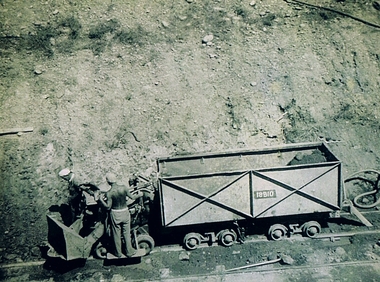
Photograph Shovel Truck, Shovel Loading Rail Truck, circa 1950s
... A visual link or time capsule of the 1950s rural/mining sectors clashing with the established rural industries This photo depicts the time (1950's) and place (Bogong and Mount Beauty) where construction workers had an immense impact, not only on the physical environment but also on the social and economic development of the Victorian Alps region. The fast expansion of smaller settlements brought about increased pressures on the welfare viability of certain subgroups within the region e.g. farming, droving and commerce (caravan hawkers versus static shops). These changes brought about a heightened awareness by both local ...This item shows the excavation of the side of a railway track using a pneumatic shovel and a rail mounted truck by two workmen. The period covered was well before State Health and Safety requirements, such as helmets, became law. It also details that the workmen were from European heritage as their head coverings were a handkerchief knotted at each corner. This was typical for workmen of this heritage, others used caps or hats or no head covering at all (the macho male look)The photograph of this item was one of many depicting great achievements and opening up the region. A visual link or time capsule of the 1950s rural/mining sectors clashing with the established rural industriesThis photo depicts the time (1950's) and place (Bogong and Mount Beauty) where construction workers had an immense impact, not only on the physical environment but also on the social and economic development of the Victorian Alps region. The fast expansion of smaller settlements brought about increased pressures on the welfare viability of certain subgroups within the region e.g. farming, droving and commerce (caravan hawkers versus static shops). These changes brought about a heightened awareness by both local and State Governments to upgrade not only facilities within the region but also access to the region. Black and white photo of two workmen on a rail mounted shovel truck. The photo is of good definition allowing a clear view of the subject matter. The paper is semi gloss.On the back of the photo, paper suppliers etchings are "Kodak XtraLife II paper"mining, hydro electricity, victorian alps, construction camps, earth moving machines -
 Kiewa Valley Historical Society
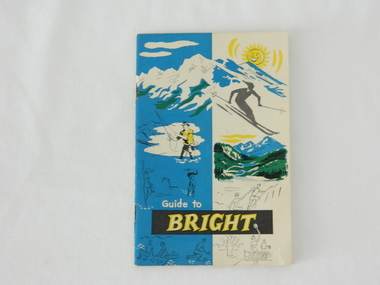
Pamphlet - Bright Tourism, Guide to Bright and District, late 1900s
... This publication was produced in the early 1950s to provide the growing tourism trade (at this time), to the region with a more detailed overview of the facilities available to tourists of the region's attractions. This brochure is a very efficient and effective promotional publication. The increasing level of self promotion by local business and commerce...This publication was produced in the early 1950s to provide the growing tourism trade (at this time), to the region with a more detailed overview of the facilities available to tourists of the region's attractions. This brochure is a very efficient and effective promotional publication. The increasing level of self promotion by local business and commerce ...This publication was produced in the early 1950s to provide the growing tourism trade (at this time), to the region with a more detailed overview of the facilities available to tourists of the region's attractions. This brochure is a very efficient and effective promotional publication. The increasing level of self promotion by local business and commerce sectors of the region the more sought after the region became and the greater the ability of the region to grow (non rural based economy). Some of the regions unique facilities and geological structures are well suited to those tourists who live in cities and "flat land" regional bush areas within Australia. This was a period when the average Australian domestic tourist was more able (finance and transport wise) to see more of their country within the short time they had for "holidays". In the late 1900s, however, with the increase to workers' recreational leave and better transportation (fares, ease of travel to overseas destinations) the local tourism numbers from other domestic locations have been steadily declining. From the 1970s onwards, the increased tourism demand from overseas tourists, for better facilities and easier access to these regional facilities, resulted in better transport, accommodation and communication, which has been a boon for all tourism within Australia. In the 21st century the world is becoming smaller and smaller for the international tourist, especially for those from crowded Asian cities. The greater attraction for "open" spaced locations such as this region are becoming a much sought after change of scenery. This pamphlet which targets the tourist, whether either from other Australian regions or the global tourist, is a good example of self promotion by a relatively small local population. This is especially significant because before the "tourist explosion" in the 1950s onward, these regional areas had a more introspective society with greater emphasis to locally established mores and values. The increased interactions with people from other areas and nations, combined with a greater global communication network is affecting those traditionally established mores to produce a some what unique social transformation which is constantly changing from one generation to the next. One important factor which tourism does bring is that it opens up the region to a wider range of people who look to the region for their own lifestyle changes.This pamphlet has a front cover in colour with the major activities in the region sketched depicting : sunshine, snow skiing, trout fishing, mountain climbing, golfing, swimming, alpine views, tennis, lawn bowls and picnics. The back cover is blank. The pamphlet is fastened together by two staples 30mm from top and bottom, and is folded with the cover slightly thicker than the fifteen pages. Thirteen pages have been printed on both sides. The first page has a black and white photograph of the hotel Alpine and the tall brick constructed Clock Tower. There are another five black and white photographs in the pamphlet.on front cover "Guide to BRIGHT"local tourism, regional information booklet, "time" related brochures, alpine local history -
 Warrnambool and District Historical Society Inc.
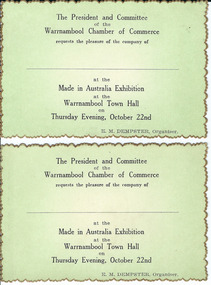
Document, Made in Australia Exhibition, 1950s
... 1950s. The Warrnambool Chamber of Commerce has been operating at various times in the 20th century and was formed by the local businesses to promote Warrnambool as a city for business initiatives, tourism and economic development. ...1950s. The Warrnambool Chamber of Commerce has been operating at various times in the 20th century and was formed by the local businesses to promote Warrnambool as a city for business initiatives, tourism and economic development. ...No information has been found regarding this exhibition in Warrnambool. The card design indicates that the exhibition may have been in the 1950s. The Warrnambool Chamber of Commerce has been operating at various times in the 20th century and was formed by the local businesses to promote Warrnambool as a city for business initiatives, tourism and economic development. These tickets are of some interest as an example of the activities of the Warrnambool Chamber of Commerce in the mid 20th century. These are two identical tickets, with black printing on a green background on one side and blank on the other side. The edges of the cards are gold- tipped in a serrated pattern.‘The President and Committee of the Warrnambool Chamber of Commerce requests the pleasure of the company of ….. at the Made in Australia Exhibition at the Warrnambool Town Hall on Thursday Evening, October 22nd, E. M. Dempster, Organizer’. made in australia exhibition, warrnambool, warrnambool, warrnambool chamber of commerce, e dempster -
 Warrnambool and District Historical Society Inc.
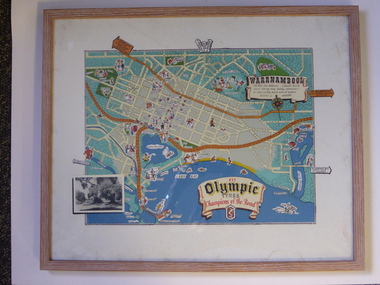
Advertising, Tourist Map of Warrnambool (framed x 2), 1950s
... 1950s and 1960s. The proprietor, Alan Lane, was a successful Warrnambool businessman who operated a Warrnambool and district bus service as well as his travel business. He was heavily involved in local community affairs being a Warrnambool Councillor for 18 years from 1952 to 1970 and President of the Warrnambool Chamber of Commerce for six years. ...1950s and 1960s. The proprietor, Alan Lane, was a successful Warrnambool businessman who operated a Warrnambool and district bus service as well as his travel business. He was heavily involved in local community affairs being a Warrnambool Councillor for 18 years from 1952 to 1970 and President of the Warrnambool Chamber of Commerce for six years. ...These framed tourist maps came from the Lane Foundation so it is presumed that they were from the office of Lane’s Travel Service which operated from 205 Raglan Parade Warrnambool with the known dates, the 1950s and 1960s. The proprietor, Alan Lane, was a successful Warrnambool businessman who operated a Warrnambool and district bus service as well as his travel business. He was heavily involved in local community affairs being a Warrnambool Councillor for 18 years from 1952 to 1970 and President of the Warrnambool Chamber of Commerce for six years. He was a major donor to the Warrnambool Performing Arts Centre, the Warrnambool Art Gallery and the St. John of God Hospital and left the bulk of his estate to the Alan Lane Foundation which has contributed millions of dollars to local organizations and programs. Alan Lane died in 1995. These framed maps are of some interest as examples of the tourism maps used to promote the city and district in the 1950s and 60s. This is a tourist map of the Warrnambool C.B.D. and adjoining streets produced as an advertisement for Olympic Tyres. It is multi-coloured and has cartoon sketches of the main tourist attractions and pointers to attractions outside of the main city area. It includes an inset black and white photograph of the Warrnambool Botanic Gardens and an advertisement for Olympic Tyres. It is printed on a white background and is enclosed behind glass in a wooden frame of a light brown colour. It has a wire at the back for attachment to a wall. ‘Warrnambool – 163 miles from Melbourne – a popular tourist resort offering many holiday attractions – an ideal surfing beach with all modern facilities is avalable’ ‘Fit Olympic Tyres, Champions of the Road’ alan lane foundation, warrnambool tourism
