
Showing 10 items matching "1st australian field hygiene unit"
-
 National Vietnam Veterans Museum (NVVM)
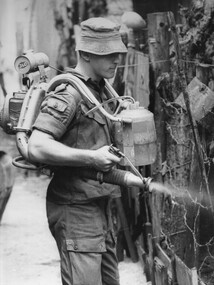
Photograph, Gibbons, Denis, Dengue Fever
... ...1st Australian Field Hygiene Unit...A black and white photograph of Lt Phil Hills, Liverpool, NSW, Officer Commanding 1st Australian Field Hygiene Unit mist spraying a section of Long Dien Village, Phuoc Tuy, during an outbreak of Dengue Fever...1st Australian Task Force in Nui Dat working as a photographer. For almost five years Gibbons toured with nine Australian infantry battalions, posting compelling war images from within many combat zones before being flown out in late November 1970 after sustaining injuries. The images held within the National Vietnam Veterans Museum make up the Gibbons Collection. Photograph Lt Phil Hills 1st Australian Field Hygiene Unit ...Denis Gibbons (1937 – 2011) Trained with the Australian Army, before travelling to Vietnam in January 1966, Denis stayed with the 1st Australian Task Force in Nui Dat working as a photographer. For almost five years Gibbons toured with nine Australian infantry battalions, posting compelling war images from within many combat zones before being flown out in late November 1970 after sustaining injuries. The images held within the National Vietnam Veterans Museum make up the Gibbons Collection. A black and white photograph of Lt Phil Hills, Liverpool, NSW, Officer Commanding 1st Australian Field Hygiene Unit mist spraying a section of Long Dien Village, Phuoc Tuy, during an outbreak of Dengue Feverphotograph, lt phil hills, 1st australian field hygiene unit, phuoc tuy, long dien village, gibbons collection catalogue, dengue fever, denis gibbons -
 National Vietnam Veterans Museum (NVVM)
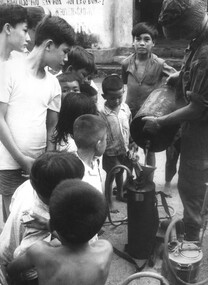
Photograph, Gibbons, Denis, Dengue Fever Outbreak
... ...1st Australian Field Hygiene Unit...A black and white photograph of a digger from 1st Australian Field Hygiene Unit attracts an audience of interested children as he fills his backpack spray unit to spray the general areas at Long Dien Village during an outbreak of Dengue Fever. ...1st Australian Task Force in Nui Dat working as a photographer. For almost five years Gibbons toured with nine Australian infantry battalions, posting compelling war images from within many combat zones before being flown out in late November 1970 after sustaining injuries. The images held within the National Vietnam Veterans Museum make up the Gibbons Collection. Photograph 1st Australian Field Hygiene Unit ...Denis Gibbons (1937 – 2011) Trained with the Australian Army, before travelling to Vietnam in January 1966, Denis stayed with the 1st Australian Task Force in Nui Dat working as a photographer. For almost five years Gibbons toured with nine Australian infantry battalions, posting compelling war images from within many combat zones before being flown out in late November 1970 after sustaining injuries. The images held within the National Vietnam Veterans Museum make up the Gibbons Collection. A black and white photograph of a digger from 1st Australian Field Hygiene Unit attracts an audience of interested children as he fills his backpack spray unit to spray the general areas at Long Dien Village during an outbreak of Dengue Fever. photograph, 1st australian field hygiene unit, long dien village, dengue fever, gibbons collection catalogue, vietnamese children, digger, denis gibbons -
 National Vietnam Veterans Museum (NVVM)
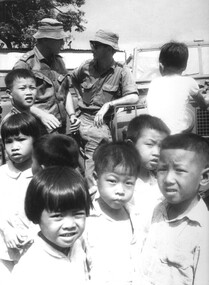
Photograph, Gibbons, Denis, Dengue Fever Outbreak
... ...1st Australian Field Hygiene Unit...A black and white photograph of Lt Phil Hills, Liverpool, NSW, Officer Commanding the 1st Australian Field Hygiene Unit discusses his tactics with an Australian Task Force Intelligence Officer at Long Dien Village, Phuoc Tuy, during an outbreak of Dengue Fever. ...1st Australian Task Force in Nui Dat working as a photographer. For almost five years Gibbons toured with nine Australian infantry battalions, posting compelling war images from within many combat zones before being flown out in late November 1970 after sustaining injuries. The images held within the National Vietnam Veterans Museum make up the Gibbons Collection. Photograph Lt Phil Hills 1st Australian Field Hygiene Unit ...Denis Gibbons (1937 – 2011) Trained with the Australian Army, before travelling to Vietnam in January 1966, Denis stayed with the 1st Australian Task Force in Nui Dat working as a photographer. For almost five years Gibbons toured with nine Australian infantry battalions, posting compelling war images from within many combat zones before being flown out in late November 1970 after sustaining injuries. The images held within the National Vietnam Veterans Museum make up the Gibbons Collection. A black and white photograph of Lt Phil Hills, Liverpool, NSW, Officer Commanding the 1st Australian Field Hygiene Unit discusses his tactics with an Australian Task Force Intelligence Officer at Long Dien Village, Phuoc Tuy, during an outbreak of Dengue Fever. photograph, lt phil hills, 1st australian field hygiene unit, phuoc tuy, long dien village, dengue fever, gibbons collection catalogue, vietnamese children, australian task force, phuoc tuy, denis gibbons -
 National Vietnam Veterans Museum (NVVM)
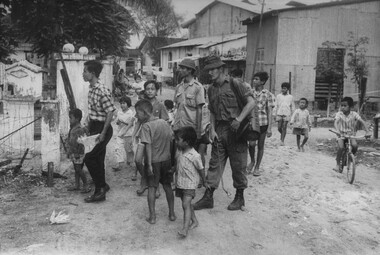
Photograph, Gibbons, Denis, Long Dien Village
... ...1st Australian Field Hygiene Unit...A black and white photograph of a digger from the 1st Australian Field Hygiene Unit accompanies the Phuoc Tuy Province Health Inspector Vu Dien Thien, into a badly contaminated area of Long Dien Village, Phuoc Tuy Province. ...1st Australian Task Force in Nui Dat working as a photographer. For almost five years Gibbons toured with nine Australian infantry battalions, posting compelling war images from within many combat zones before being flown out in late November 1970 after sustaining injuries. The images held within the National Vietnam Veterans Museum make up the Gibbons Collection. Photograph 1st Australian Field Hygiene Unit ...Denis Gibbons (1937 – 2011) Trained with the Australian Army, before travelling to Vietnam in January 1966, Denis stayed with the 1st Australian Task Force in Nui Dat working as a photographer. For almost five years Gibbons toured with nine Australian infantry battalions, posting compelling war images from within many combat zones before being flown out in late November 1970 after sustaining injuries. The images held within the National Vietnam Veterans Museum make up the Gibbons Collection. A black and white photograph of a digger from the 1st Australian Field Hygiene Unit accompanies the Phuoc Tuy Province Health Inspector Vu Dien Thien, into a badly contaminated area of Long Dien Village, Phuoc Tuy Province. Children were always fascinated by the diggers at work.photograph, 1st australian field hygiene unit, phuoc tuy province, vu thien (health inspector), long dien village, gibbons collection catalogue, diggers, vietnamese children, denis gibbons -
 National Vietnam Veterans Museum (NVVM)
Photograph, Gibbons, Denis, Dengue Fever
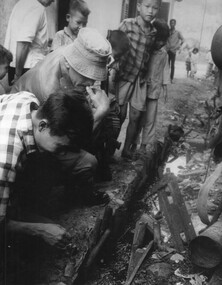
... ...1st Australian Field Hygiene Unit...A black and white photograph of Lt Phil Hills, Liverpool, NSW Officer Cammanding the 1st Australian Field Hygiene Unit along with Vu Dien Thien, the Phuoc Tuy Province Health Inspector inspects a badly infected open drain through the centre of Long Dien village during an outbreak of Dengue Fever...1st Australian Task Force in Nui Dat working as a photographer. For almost five years Gibbons toured with nine Australian infantry battalions, posting compelling war images from within many combat zones before being flown out in late November 1970 after sustaining injuries. The images held within the National Vietnam Veterans Museum make up the Gibbons Collection. Photograph Lt Phil Hills 1st Australian Field Hygiene Unit ...Denis Gibbons (1937 – 2011) Trained with the Australian Army, before travelling to Vietnam in January 1966, Denis stayed with the 1st Australian Task Force in Nui Dat working as a photographer. For almost five years Gibbons toured with nine Australian infantry battalions, posting compelling war images from within many combat zones before being flown out in late November 1970 after sustaining injuries. The images held within the National Vietnam Veterans Museum make up the Gibbons Collection.A black and white photograph of Lt Phil Hills, Liverpool, NSW Officer Cammanding the 1st Australian Field Hygiene Unit along with Vu Dien Thien, the Phuoc Tuy Province Health Inspector inspects a badly infected open drain through the centre of Long Dien village during an outbreak of Dengue Feverphotograph, lt phil hills, 1st australian field hygiene unit, phuoc tuy province, vu thien (health inspector), gibbons collection catalogue, long dien village, dengue fever, officer commanding, vu dien thien, denis gibbons -
 National Vietnam Veterans Museum (NVVM)
Photograph, Gibbons, Denis, Dengue Fever
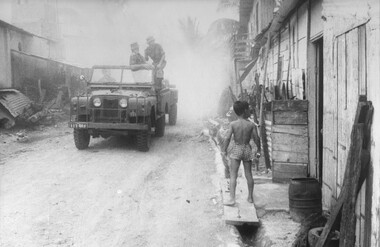
... ...1st Australian Field Hygiene Unit...1st Australian Task Force in Nui Dat working as a photographer. For almost five years Gibbons toured with nine Australian infantry battalions, posting compelling war images from within many combat zones before being flown out in late November 1970 after sustaining injuries. The images held within the National Vietnam Veterans Museum make up the Gibbons Collection. Photograph Lt Phil Hills 1st Australian Field Hygiene Unit ...Denis Gibbons (1937 – 2011) Trained with the Australian Army, before travelling to Vietnam in January 1966, Denis stayed with the 1st Australian Task Force in Nui Dat working as a photographer. For almost five years Gibbons toured with nine Australian infantry battalions, posting compelling war images from within many combat zones before being flown out in late November 1970 after sustaining injuries. The images held within the National Vietnam Veterans Museum make up the Gibbons Collection. A black and white photograph of Lt Phil Hills and his team driving a landrover towing a mist generator to decontaminate the village of Long Dien, Phouc Tuy Province. A severe outbreak of Dengue Fever had occurred in the village and the Province Chief had requested assistance.photograph, lt phil hills, 1st australian field hygiene unit, long dien village, phuoc tuy province, dengue fever, gibbons collection catalogue, denis gibbons, photographer, vietnam war, province chief -
 National Vietnam Veterans Museum (NVVM)
Photograph, Gibbons, Denis, Decontamination Of Drains
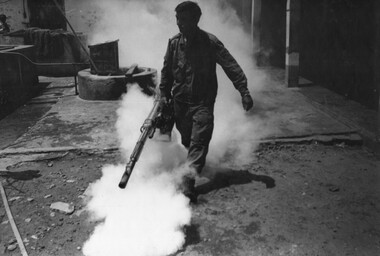
... ...1st Australian Field Hygiene Unit...1st Australian Task Force in Nui Dat working as a photographer. For almost five years Gibbons toured with nine Australian infantry battalions, posting compelling war images from within many combat zones before being flown out in late November 1970 after sustaining injuries. The images held within the National Vietnam Veterans Museum make up the Gibbons Collection. Photograph Cpl Jim Henry 1st Australian Field Hygiene Unit ...Denis Gibbons (1937 – 2011) Trained with the Australian Army, before travelling to Vietnam in January 1966, Denis stayed with the 1st Australian Task Force in Nui Dat working as a photographer. For almost five years Gibbons toured with nine Australian infantry battalions, posting compelling war images from within many combat zones before being flown out in late November 1970 after sustaining injuries. The images held within the National Vietnam Veterans Museum make up the Gibbons Collection. A black and white photograph of Cpl Jim Henry of the 1st Australian Civil Affairs Unit, Nui Dat, Phuoc Tuy Province, carries out decontamination of drains and infected areas at Baria Jail, Phuoc Tuy Province,following a bad outbreak of Malaria and Dengue fever.photograph, cpl jim henry, 1st australian field hygiene unit, nui dat, baria, baria jail, malaria, dengue fever, gibbons collection catalogue, phuoc tuy province, denis gibbons -
 National Vietnam Veterans Museum (NVVM)
Photograph, Gibbons, Denis, Decontamination of Baria Jail
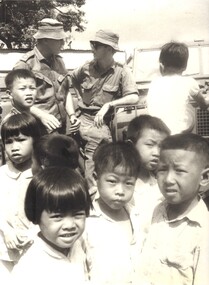
... ...1st Australian Field Hygiene Unit...A black and white photograph of children milling about as Lt Phil Hills OC 1st Australian Task Force Health Officer, Field Hygiene Unit, Nui Dat, discusses the day's work with one of his staff as they prepare to de-louse Baria Jail following a bad outbreak of malaria and dengue fever....1st Australian Task Force in Nui Dat working as a photographer. For almost five years Gibbons toured with nine Australian infantry battalions, posting compelling war images from within many combat zones before being flown out in late November 1970 after sustaining injuries. The images held within the National Vietnam Veterans Museum make up the Gibbons Collection. Photograph Lt Phil Hills 1st Australian Task Force Baria Jail Dengue Fever Malaria 1st Australian Field Hygiene Unit ...Denis Gibbons (1937 – 2011) Trained with the Australian Army, before travelling to Vietnam in January 1966, Denis stayed with the 1st Australian Task Force in Nui Dat working as a photographer. For almost five years Gibbons toured with nine Australian infantry battalions, posting compelling war images from within many combat zones before being flown out in late November 1970 after sustaining injuries. The images held within the National Vietnam Veterans Museum make up the Gibbons Collection. A black and white photograph of children milling about as Lt Phil Hills OC 1st Australian Task Force Health Officer, Field Hygiene Unit, Nui Dat, discusses the day's work with one of his staff as they prepare to de-louse Baria Jail following a bad outbreak of malaria and dengue fever.photograph, lt phil hills, 1st australian task force, baria jail, dengue fever, malaria, 1st australian field hygiene unit, gibbons collection catalogue, health officer, vietnamese children, denis gibbons -
 Returned Nurses RSL Sub-branch
Book - Hardcover book, Rod Searle et al, Call sign Vampire, 2021
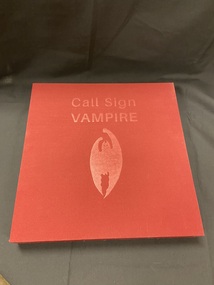
... Units attached to the hospital were the 33rd Dental Unit, 1st Field Medical and Dental Stores, 1st Field Hygiene Company, Chaplains and Australian Red Cross representatives.Our book is a celebration of the dedication, temerity and care of a unique group of Australians, thrown together to get on with the job of treating the injured and wounded. ...This inside story of an Australian Field Hospital during the Vietnam War is told through a compilation of operational facts interspersed with the personal experiences of those who served and the patients who passed through the hospital doors, into their care.Call Sign VAMPIRE provides a window into the frenetic world of a military hospital in a war zone through evocative, sometimes confronting imagery. In this environment time was of the essence and life often hung in the balance.The wounded, "... they were scared, frightened, shocked and they weren't coping. Generally, when the chopper landed, they weren't coping. No. They were in shock, incoherent and it was no good asking them what had happened, or where they'd been, because twenty minutes before they were in contact with the enemy ..." Ron NolanAt the 1st Australian Field Hospital the battle for life and limb was often challenging and intense. Medical services provided by the hospital were of such a high standard that the survival rate, for soldiers arriving at the hospital alive, was 99%.This success rate still stands today as a truly remarkable achievement!The hospital comprised triage, operating theatres, pathology, pharmacy, X-ray, physiotherapy, psychiatry, outpatients, RAP, a six-bed intensive care ward and 50 bed medical and 50 bed surgical ward. It was also supported by a Q-store, an orderly room, messes and accommodation. Units attached to the hospital were the 33rd Dental Unit, 1st Field Medical and Dental Stores, 1st Field Hygiene Company, Chaplains and Australian Red Cross representatives.Our book is a celebration of the dedication, temerity and care of a unique group of Australians, thrown together to get on with the job of treating the injured and wounded. A consequence of Australia's involvement in the Vietnam War.Our hope is that the readers of Call Sign VAMPIRE gain an insight into what it meant to go to a war that polarised public opinion, and impacted the physical and mental well being of so many young soldiers and personnel dealing with the consequential casualties and despair. We also hope that you come to understand why as young Australians we are so proud to have been part of a unit that as Roger Nation remembers, "... welded together to form a team of world class standard" and why our camaraderie has continued to this day. - from Trove record.Hardcover, cloth bound, burgundy book with a white dust jacket. The dust jacket shows an image of six people ducking from the force of the wind coming from the helicopter that is landing behind them, there is blue cloudy sky above. Across the sky is printed the title. The book is housed in a burgundy clth covered slipcase.non-fictionThis inside story of an Australian Field Hospital during the Vietnam War is told through a compilation of operational facts interspersed with the personal experiences of those who served and the patients who passed through the hospital doors, into their care.Call Sign VAMPIRE provides a window into the frenetic world of a military hospital in a war zone through evocative, sometimes confronting imagery. In this environment time was of the essence and life often hung in the balance.The wounded, "... they were scared, frightened, shocked and they weren't coping. Generally, when the chopper landed, they weren't coping. No. They were in shock, incoherent and it was no good asking them what had happened, or where they'd been, because twenty minutes before they were in contact with the enemy ..." Ron NolanAt the 1st Australian Field Hospital the battle for life and limb was often challenging and intense. Medical services provided by the hospital were of such a high standard that the survival rate, for soldiers arriving at the hospital alive, was 99%.This success rate still stands today as a truly remarkable achievement!The hospital comprised triage, operating theatres, pathology, pharmacy, X-ray, physiotherapy, psychiatry, outpatients, RAP, a six-bed intensive care ward and 50 bed medical and 50 bed surgical ward. It was also supported by a Q-store, an orderly room, messes and accommodation. Units attached to the hospital were the 33rd Dental Unit, 1st Field Medical and Dental Stores, 1st Field Hygiene Company, Chaplains and Australian Red Cross representatives.Our book is a celebration of the dedication, temerity and care of a unique group of Australians, thrown together to get on with the job of treating the injured and wounded. A consequence of Australia's involvement in the Vietnam War.Our hope is that the readers of Call Sign VAMPIRE gain an insight into what it meant to go to a war that polarised public opinion, and impacted the physical and mental well being of so many young soldiers and personnel dealing with the consequential casualties and despair. We also hope that you come to understand why as young Australians we are so proud to have been part of a unit that as Roger Nation remembers, "... welded together to form a team of world class standard" and why our camaraderie has continued to this day. - from Trove record. 1st australian field hospital, vietnam war -
 Returned Nurses RSL Sub-branch
Book - Hardcover book, Rod Searle et al, Call sign Vampire, 2021
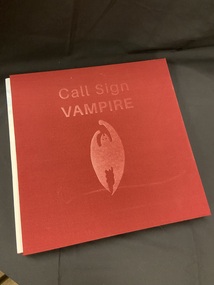
... Units attached to the hospital were the 33rd Dental Unit, 1st Field Medical and Dental Stores, 1st Field Hygiene Company, Chaplains and Australian Red Cross representatives.Our book is a celebration of the dedication, temerity and care of a unique group of Australians, thrown together to get on with the job of treating the injured and wounded. ...This inside story of an Australian Field Hospital during the Vietnam War is told through a compilation of operational facts interspersed with the personal experiences of those who served and the patients who passed through the hospital doors, into their care.Call Sign VAMPIRE provides a window into the frenetic world of a military hospital in a war zone through evocative, sometimes confronting imagery. In this environment time was of the essence and life often hung in the balance.The wounded, "... they were scared, frightened, shocked and they weren't coping. Generally, when the chopper landed, they weren't coping. No. They were in shock, incoherent and it was no good asking them what had happened, or where they'd been, because twenty minutes before they were in contact with the enemy ..." Ron NolanAt the 1st Australian Field Hospital the battle for life and limb was often challenging and intense. Medical services provided by the hospital were of such a high standard that the survival rate, for soldiers arriving at the hospital alive, was 99%.This success rate still stands today as a truly remarkable achievement!The hospital comprised triage, operating theatres, pathology, pharmacy, X-ray, physiotherapy, psychiatry, outpatients, RAP, a six-bed intensive care ward and 50 bed medical and 50 bed surgical ward. It was also supported by a Q-store, an orderly room, messes and accommodation. Units attached to the hospital were the 33rd Dental Unit, 1st Field Medical and Dental Stores, 1st Field Hygiene Company, Chaplains and Australian Red Cross representatives.Our book is a celebration of the dedication, temerity and care of a unique group of Australians, thrown together to get on with the job of treating the injured and wounded. A consequence of Australia's involvement in the Vietnam War.Our hope is that the readers of Call Sign VAMPIRE gain an insight into what it meant to go to a war that polarised public opinion, and impacted the physical and mental well being of so many young soldiers and personnel dealing with the consequential casualties and despair. We also hope that you come to understand why as young Australians we are so proud to have been part of a unit that as Roger Nation remembers, "... welded together to form a team of world class standard" and why our camaraderie has continued to this day. - from Trove record.Hardcover, cloth bound, burgundy book with a white dust jacket. The dust jacket shows an image of six people ducking from the force of the wind coming from the helicopter that is landing behind them, there is blue cloudy sky above. Across the sky is printed the title. The book is housed in a burgundy cloth covered slipcase.non-fictionThis inside story of an Australian Field Hospital during the Vietnam War is told through a compilation of operational facts interspersed with the personal experiences of those who served and the patients who passed through the hospital doors, into their care.Call Sign VAMPIRE provides a window into the frenetic world of a military hospital in a war zone through evocative, sometimes confronting imagery. In this environment time was of the essence and life often hung in the balance.The wounded, "... they were scared, frightened, shocked and they weren't coping. Generally, when the chopper landed, they weren't coping. No. They were in shock, incoherent and it was no good asking them what had happened, or where they'd been, because twenty minutes before they were in contact with the enemy ..." Ron NolanAt the 1st Australian Field Hospital the battle for life and limb was often challenging and intense. Medical services provided by the hospital were of such a high standard that the survival rate, for soldiers arriving at the hospital alive, was 99%.This success rate still stands today as a truly remarkable achievement!The hospital comprised triage, operating theatres, pathology, pharmacy, X-ray, physiotherapy, psychiatry, outpatients, RAP, a six-bed intensive care ward and 50 bed medical and 50 bed surgical ward. It was also supported by a Q-store, an orderly room, messes and accommodation. Units attached to the hospital were the 33rd Dental Unit, 1st Field Medical and Dental Stores, 1st Field Hygiene Company, Chaplains and Australian Red Cross representatives.Our book is a celebration of the dedication, temerity and care of a unique group of Australians, thrown together to get on with the job of treating the injured and wounded. A consequence of Australia's involvement in the Vietnam War.Our hope is that the readers of Call Sign VAMPIRE gain an insight into what it meant to go to a war that polarised public opinion, and impacted the physical and mental well being of so many young soldiers and personnel dealing with the consequential casualties and despair. We also hope that you come to understand why as young Australians we are so proud to have been part of a unit that as Roger Nation remembers, "... welded together to form a team of world class standard" and why our camaraderie has continued to this day. - from Trove record. 1st australian field hospital, vietnam war
