
Showing 6 items matching "20th century house hold items"
-
 Warrnambool and District Historical Society Inc.
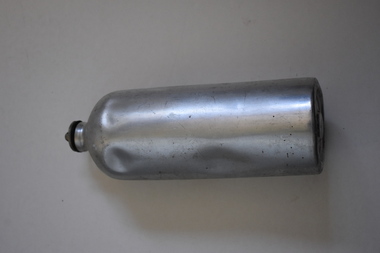
Hot water bottle, Mid 20th century
... 20th century house hold items...A hot water bottle such as this would have been used in the mid 20th century before the advent of rubber ones. This item is retained for display purposes. 20th century house hold items This is a cylindrical aluminium bottle with a detachable metal stopper .The stopper has a metal handle. ...A hot water bottle such as this would have been used in the mid 20th century before the advent of rubber ones.This item is retained for display purposes.This is a cylindrical aluminium bottle with a detachable metal stopper .The stopper has a metal handle. It has traces of adhesive tape on one side to cover a small hole. The body of the cylinder is dinted. 20th century house hold items -
 Warrnambool and District Historical Society Inc.
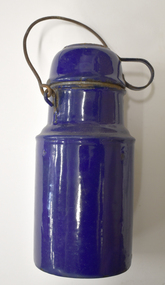
Domestic object - Thermos, c. 1920
... This is a vintage item from the early 20th century. It could have been used in a house hold context or by farmers in the paddocks, by hikers, family picnickers, campers or by workers in factories. ...This is a vintage item from the early 20th century. It could have been used in a house hold context or by farmers in the paddocks, by hikers, family picnickers, campers or by workers in factories. ...This is a vintage item from the early 20th century. It could have been used in a house hold context or by farmers in the paddocks, by hikers, family picnickers, campers or by workers in factories. This item has no known provenance and is kept as an interesting vintage domestic object..Deep blue enamel vacuum flask or thermos with a rusted metal handle and a lid which serves as a cup. There are rust patches on the base, sides and cup. The central section is round.vintage domestic item, vintage vacuum flask, vintage thermos -
 Warrnambool and District Historical Society Inc.
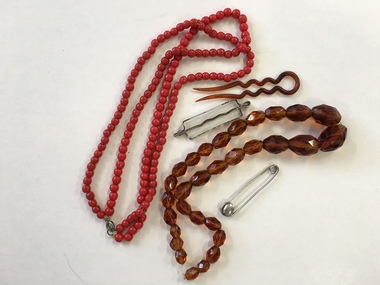
Personal items, Beads, hair clip and safety pin, Early 20th century
... These items would have been worn or used by a woman in the early 20th century for decorative purposes. These items have no known provenance and are retained for display purposes. Beads Hair curler House hold ...These items would have been worn or used by a woman in the early 20th century for decorative purposes.These items have no known provenance and are retained for display purposes.These are two necklaces, one red double stringed and one amber coloured with graduated glass beads. Both are tied together with cotton. Attached to the cotton is one metal pin and one metal hair curler. beads, hair curler, house hold items -
 Warrnambool and District Historical Society Inc.
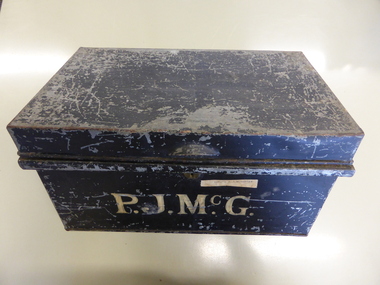
Box, Tin Box McGennan
... house his estate papers after his death. Many of these documents are in the collection of the Warrnambool &District Historical Society. This box is of some importance as it belonged to a prominent Warrnambool businessman and his family. It has social significance as an example of the type of storage items used early in the 20th century to hold ...Peter McGennan (1839-1920) arrived in Warrnambool in the 1870s and established a cooperage in Kepler Street and a boating business on the Hopkins River. He rebuilt the boating establishment after a fire in 1876. In 1896 McGennan established a Box and Case Factory in Davis Street (Merrivale Drive), importing timber from New Zealand, using chartered vessels and his own ships which included the ‘Speculant’. The box factory was a successful venture employing over 30 men until it was destroyed by fire in 1923. Peter McGennan was involved in the establishment of the Warrnambool Cheese and Butter Factory at Allansford and the Warrnambool Woollen Mill. He was a Director of the latter company until his death. Members of the McGennan family were also important business people in Warrnambool, being involved in the hotel business and civic affairs for many years. The tin box may have been used to house family papers or business documents during Peter McGennan’s life and it was used to house his estate papers after his death. Many of these documents are in the collection of the Warrnambool &District Historical Society.This box is of some importance as it belonged to a prominent Warrnambool businessman and his family. It has social significance as an example of the type of storage items used early in the 20th century to hold documents etc.This is a rectangular tin box with the black paint on the outside peeling and yellow paint inside. There is a metal lock which has no key. There is a small handle on the top added to the tin surface. The name ‘P.J.McGennan’ is painted on the front side in yellow paint.‘P.J.McGennan’ A typed label on faded yellow adhesive tape ‘Estate P.J.McGennan’ peter mcgennan, p j mcgennan, peter mcgennan metal box, mcgennan box factory, mcgennan warrnambool -
 Warrnambool and District Historical Society Inc.
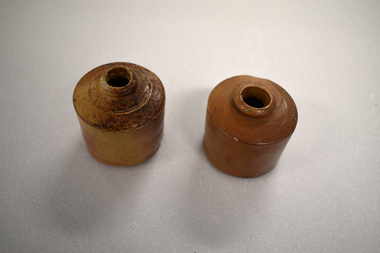
Ink wells, Pottery inkwells x 2, Mid 20th century
... items are typical of the ink wells used in the first half of the 20th century in a home or business. The use of ink wells was superseded by the introduction of fountain pens and ball point pens . These items have no known provenance but are retained for display purposes. ink wells vintage house hold ...These items are typical of the ink wells used in the first half of the 20th century in a home or business. The use of ink wells was superseded by the introduction of fountain pens and ball point pens . These items have no known provenance but are retained for display purposes..1 A round ceramic ink well It is coloured brown and there is some damage on the side. .2 A round, brown ceramic ink well with a little ridged top.There is some damage on the base.ink wells, vintage house hold and business items -
 Brighton Historical Society
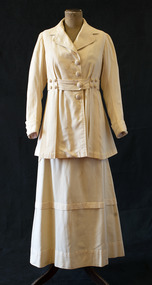
Suit, circa 1908-1914
... The neighbour had offered Margot a selection of her old clothing, dating from the early 20th century, as she wanted somebody to hold onto and care for the items after she died. Before Margot could take the items the neighbour was moved into a nursing home and, while cleaning out the house, the woman's son took the clothing to the tip with a load of rubbish. ...The neighbour had offered Margot a selection of her old clothing, dating from the early 20th century, as she wanted somebody to hold onto and care for the items after she died. Before Margot could take the items the neighbour was moved into a nursing home and, while cleaning out the house, the woman's son took the clothing to the tip with a load of rubbish. ...This ladies suit belonged to an elderly neighbour of the donor, Margot Miller, who lived in Black Street, Brighton in the 1970s. The neighbour had offered Margot a selection of her old clothing, dating from the early 20th century, as she wanted somebody to hold onto and care for the items after she died. Before Margot could take the items the neighbour was moved into a nursing home and, while cleaning out the house, the woman's son took the clothing to the tip with a load of rubbish. Margot happened to see him leave and was able to follow him and retrieve the clothes. They remained in the Miller family for many years; some were worn by Margot's daughters and some were ultimately passed on to others. Based on our research, we believe that the suit's original owner may have been Julia Richards (nee O'Keefe, c. 1882-1976), who lived at 59 Black Street during this time. Born in Ireland, Julia emigrated to Queensland in 1900. She married William Alfred Richards in 1911 and lived with him in Ayr, near Townsville, where they ran a hotel. It is unclear what became of William, but by the mid-1920s Julia and her two children were living in Brighton, where she remained until her death in 1976, aged 94.Cream wool ladies suit consisting of a jacket and skirt. Jacket is partially lined with silk, quilted around shoulders. Fastens with four self-covered buttons, one attached to a belt. Two box pleats at front and back, each featuring four decorative self-covered buttons at the waist. Upturned cuffs, each with two buttons. The skirt features a fabric belt and triangular pockets in each side with decorative self-covered buttons. Hook fastenings at side.1910s, women's suit, julia richards
