
Showing 7 items matching "20th century western suburbs"
-
 Sunshine and District Historical Society Incorporated
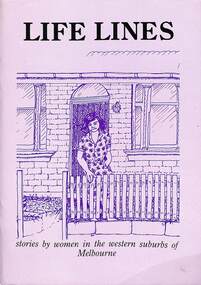
Book - Life Lines - stories by women in the Western Suburbs of Melbourne, Melbourne's Living Museum of the West et al, 1985
... ...20th century western suburbs...Presented to the Sunshine International Women's Committee and came from the donation of Gwenyth "Gwen" Goedecke collection Women diverse cultural backgrounds 20th century western suburbs social history Personal stories of women living in the western suburbs of Melbourne Life Lines - stories by women in the Western Suburbs of Melbourne|Margaret Camilleri|Lesley Purcell|Josie Valente|Judy Grant|January Hope. ...Personal stories of women living in the western suburbs of MelbourneA soft purple covered book with an illustration of a woman in front of her housenon-fictionPersonal stories of women living in the western suburbs of Melbournewomen, diverse cultural backgrounds, 20th century western suburbs, social history -
 Sunshine and District Historical Society Incorporated
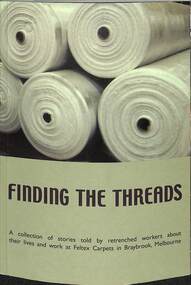
Book - Finding The Threads, Tricia Bowen, 2006
... Feltex Carpets was one of the major employers in Braybrook through the mid to late 20th century, part of the broader textile, clothing and footwear (TCF) industrial base that shaped the western suburbs’ working-class identity. ...Feltex Carpets was one of the major employers in Braybrook through the mid to late 20th century, part of the broader textile, clothing and footwear (TCF) industrial base that shaped the western suburbs’ working-class identity. ...A collection of stories told by retrenched workers about their lives and work at Feltex Carpets in Braybrook, MelbourneSoft cover booknon-fictionA collection of stories told by retrenched workers about their lives and work at Feltex Carpets in Braybrook, Melbourne braybrook, feltex, scotland street -
 Sunshine and District Historical Society Incorporated
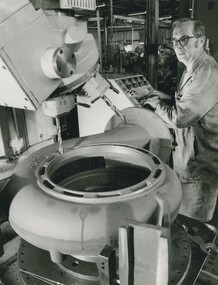
Photograph - Sunshine Road Tottenham - McPhersons Pump Works Photograph
... 20th century that saw manufacturing consolidated into fewer sites, and parts of the Tottenham complex were demolished and the remaining structures suffered vandalism and deterioration. Today, the 1939, 1947, and 1965 sections remain highly intact, making the site one of the most important surviving industrial complexes in the region. The site is significant for its association with McPherson’s, one of Australia’s major industrial firms, its role in wartime and post war manufacturing, Its modernist industrial architecture and contribution to the industrialisation of Tottenham and the western suburbs. ...McPherson’s Pump Works was established in 1939 at 213–221 Sunshine Road, Tottenham, as part of McPherson’s shift from hardware merchandising into Australian manufacturing. The McPherson’s Pump Works operated alongside the Wiltshire Files factory. The Wiltshire Files factory was located at the front, facing Sunshine Road, the McPherson’s Pump Works at the rear. The Ajax Pumps Company was the operational name for McPherson’s pump manufacturing division. The Tottenham plant produced industrial pumps, cast metal components, engineering fittings and wartime industrial supplies. The peak operations of the plant were during the 1950’s to 1970’s period. This was before the decline of the late 20th century that saw manufacturing consolidated into fewer sites, and parts of the Tottenham complex were demolished and the remaining structures suffered vandalism and deterioration.Today, the 1939, 1947, and 1965 sections remain highly intact, making the site one of the most important surviving industrial complexes in the region. The site is significant for its association with McPherson’s, one of Australia’s major industrial firms, its role in wartime and post war manufacturing, Its modernist industrial architecture and contribution to the industrialisation of Tottenham and the western suburbs. The site is now protected by Heritage Overlay HO163.An Ajax International series pump casing being machined at Mcphersons Pump Works at Tottenham, Victoria.ajax pumps, mcphersons pump works, sunshine road, tottenham -
 Sunshine and District Historical Society Incorporated
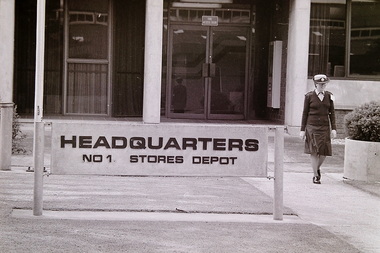
Photograph - RAAF No 1 Stores Depot South Road Braybrook Site Tour 1990 Photograph, C. McGee, 17th June 1991
... 20th‑century defence planning and the functional architectural style of the Department of Works. The depot played a vital role in national logistics, handling equipment, clothing, barracks stores, demobilisation materials, and returned overseas supplies. It was also a major employer in Melbourne’s western suburbs ...No. 1 RAAF Stores Depot in Braybrook (often called the Tottenham RAAF Stores Depot) was one of the most important defence facilities in Melbourne’s west, a massive wartime logistics base built in 1944–45 and operated until 1993. The site expanded significantly after WWII, adding: RAAF Police Dog Training Centre (established 1962), supply‑officer training facilities, accommodation blocks, mess halls, chapels, gyms and sports grounds which transformed the depot into a self‑contained military community. It shaped Braybrook’s industrial landscape, employed hundreds of locals, and played a central role in Australia’s WWII and post‑war supply chain. These photographs capture only a small part of the No. 1 RAAF Stores Depot that one of Australia’s major wartime and post‑war defence logistics centres, representing the scale, organisation, and industrial capability required to support the Royal Australian Air Force from 1945 to 1993. Established during the critical final years of the Second World War, the depot consolidated dozens of scattered storage sites into a single purpose‑built facility, demonstrating the Commonwealth’s shift toward modern, centralised military supply systems. Its extensive warehouses, rail sidings, and specialised training areas illustrate mid‑20th‑century defence planning and the functional architectural style of the Department of Works. The depot played a vital role in national logistics, handling equipment, clothing, barracks stores, demobilisation materials, and returned overseas supplies. It was also a major employer in Melbourne’s western suburbs, shaping the social and economic life of Braybrook, Sunshine, and Tottenham for nearly five decades. The presence of the RAAF Police Dog Training Centre further highlights the site’s operational diversity and long‑term importance to defence readiness. Although most of the depot has been demolished, the surviving guard house and office block on Ashley Street remain as rare physical evidence of a once‑vast military complex. The depot’s legacy endures in the urban form of Braybrook and in the community memory of the thousands who worked there. Its significance lies in its contribution to Australia’s defence history, its impact on the development of Melbourne’s west, and its representation of large‑scale wartime infrastructure.R.A.A.F. Base Tour 285.1raaf no 1 store, south road, braybrook -
 Sunshine and District Historical Society Incorporated
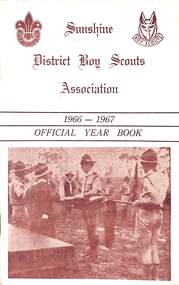
Booklet - Sunshine District Boy Scout Association 1966 - 1967 Official Year Book, Dunhall Production, 1967
... The Sunshine District Scouts Association was the formal coordinating body for all Scout groups in the Sunshine region — covering Sunshine, Tottenham, Albion, Braybrook, Deer Park, and St Albans — from the mid‑20th century until the statewide restructuring of Scout districts in the 1990s–2000s. It acted as the administrative, training, and event organising hub for the western suburbs’ Scout troops and was one of the most active Scout districts in metropolitan Melbourne. ...The Sunshine District Scouts Association was the formal coordinating body for all Scout groups in the Sunshine region — covering Sunshine, Tottenham, Albion, Braybrook, Deer Park, and St Albans — from the mid‑20th century until the statewide restructuring of Scout districts in the 1990s–2000s. It acted as the administrative, training, and event organising hub for the western suburbs’ Scout troops and was one of the most active Scout districts in metropolitan Melbourne. ...The Sunshine District Scouts Association was the formal coordinating body for all Scout groups in the Sunshine region — covering Sunshine, Tottenham, Albion, Braybrook, Deer Park, and St Albans — from the mid‑20th century until the statewide restructuring of Scout districts in the 1990s–2000s. It acted as the administrative, training, and event organising hub for the western suburbs’ Scout troops and was one of the most active Scout districts in metropolitan Melbourne. The District Association was responsible for: Coordinating local Scout groups Managing leaders and training Organising district camps, competitions, and parades Maintaining Scout halls and equipment Representing Sunshine in statewide Scouting governanceThe Sunshine District Scouts Association was made up of the following Troops (As at 1967). 1st Sunshine - Martin Street Sunshine - Scarf Dark Blue with Grey Braid 2nd Sunshine (St. Mark's Own) St. Marks Church Hall Anderson Road Sunshine - Scarf Grey with Maroon Braid 3rd Sunshine - Devonshire Road Street Sunshine - Scarf Maroon with Yellow 4th Sunshine - Ravenhall Street Braybrook - Scarf Navy Blue with Red and White Braid 5th Sunshine - Barclay Reserve King Edward Avenue Albion - Scarf Yellow with Blue Braid and Group Emblem on Back 7th Sunshine (Our Lady's Own) Our lady's own Youth Centre Devonshire Road Sunshine - Scarf Green with Red and Gold Braid 8th Sunshine (1st Deer Park) - Scout Hall Station Road Deer Park - Scarf Grey with Maroon and Grey Braid 10th Sunshine - Scout Hall Errington Reserve Percy Street St. Albans - Scarf (No Details) 12th Sunshine - Dempster Park Hall Phoenix Street Sunshine North - Scarf Heliotrope with Red Braid 14th Sunshine (St. Peter Chanels Own) - Blanche Street Ardeer - Scarf Green with Black Braid 15th Sunshine (1st Greek) - Cubs Castley Hall Glengala Road Sunshine West & Scouts J. R. Parsons Reserve Scout Hall (Temporary) Stanford Street Sunshine - Scarf (No Details)Sunshine District Boy Scout Association 1966 - 1967 Official Year bookscout, scouting -
 Broadmeadows Historical Society & Museum
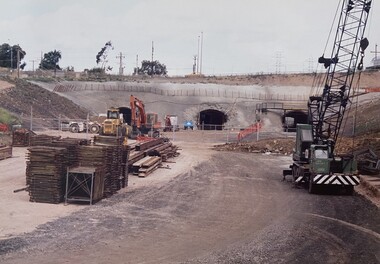
Photograph - Road - Ring Road, Construction of the Jacana Underpass, c. 1990s
... suburbs through major infrastructure development. It provides insight into the construction techniques, site logistics, and material use typical of large-scale tunneling projects in the late 20th century. As part of an archival collection, this image contributes to the historical record of urban growth, transport planning, and engineering innovation in Victoria. It holds enduring value for researchers, historians, and infrastructure professionals studying the evolution of public works in the state. Underpass Jacana Construction 1990's Jacana Underpass Tunnel Western ...This photograph documents the construction of the Jacana Underpass Tunnel, a landmark infrastructure project undertaken to allow Melbourne’s Western Ring Road to pass beneath a complex transport corridor. The corridor included Pascoe Vale Road, Electric Street, and four active railway lines—two broad gauge, one standard gauge, and one commuter line—making traditional tunneling or bridging methods impractical. The tunnel was constructed using a pioneering hydraulic jacking technique, where precast concrete tunnel segments, each weighing approximately 1200 tonnes, were pushed into place through pilot tunnels. This method minimised disruption to the busy transport corridor above, which carried tens of thousands of vehicles and multiple rail services daily. The Jacana Underpass Tunnel was constructed between 1992 and 1993 as part of Melbourne’s Western Ring Road project, a major infrastructure initiative aimed at improving traffic flow and connectivity across the city’s northern suburbs. The underpass was designed to carry the freeway beneath a complex transport corridor that included Pascoe Vale Road, Electric Street, and four active railway lines—two broad gauge, one standard gauge, and one commuter line. Due to the shallow depth of cover—less than one metre in some areas—and the need to maintain uninterrupted road and rail services above, engineers employed an innovative hydraulic jacking technique. This involved pushing precast concrete tunnel segments, each weighing approximately 1200 tonnes, through pilot tunnels using hydraulic rams. The method was one of the largest of its kind in Australia at the time and allowed for the safe and efficient installation of the tunnel without open excavation. The photograph captures a key stage in the construction process, showing the dual tunnel portals, heavy machinery, and construction materials on site. It reflects the scale, complexity, and ingenuity of late 20th-century civil engineering in Victoria and provides valuable insight into the evolution of Melbourne’s transport infrastructure.This photograph documents a pivotal moment in the construction of the Jacana Underpass Tunnel, part of Melbourne’s Western Ring Road infrastructure project undertaken in the early 1990s. The image features two tunnel entrances under construction, surrounded by heavy machinery, construction materials, and temporary fencing, with a dirt access road leading into the site. The Jacana Underpass was constructed using a hydraulic jacking technique, a method that allowed large precast concrete tunnel segments—each weighing approximately 1200 tonnes—to be installed beneath a live transport corridor without disrupting traffic or rail services. This innovative approach was one of the largest of its kind in Australia and addressed significant engineering challenges, including shallow cover and complex geological conditions. The photograph is significant for its documentation of advanced civil engineering practices and the transformation of Melbourne’s northern suburbs through major infrastructure development. It provides insight into the construction techniques, site logistics, and material use typical of large-scale tunneling projects in the late 20th century. As part of an archival collection, this image contributes to the historical record of urban growth, transport planning, and engineering innovation in Victoria. It holds enduring value for researchers, historians, and infrastructure professionals studying the evolution of public works in the state.Colour photo. Construction Site. Jacana underpass tunnel.(Back - blue pen) 'Underpass/Jacana'underpass, jacana, construction, 1990's, jacana underpass tunnel, western ring road -
 Sunshine and District Historical Society Incorporated
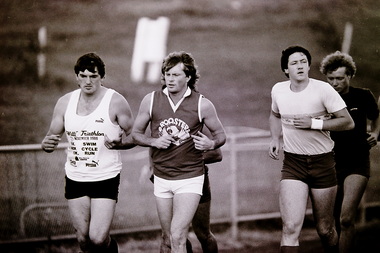
Photograph - Sunshine Football Club Feature 1988 Photographs, Sunshine Advocate, 24th March 1988
... western suburbs. Sunshine had struggled with finances, facilities, and competitive pressure through the 1980s, and by the end of the decade the club was unable to continue. The Sunshine Football Club was a central element of Sunshine’s social fabric. It offered a gathering place for residents, fostered local pride through its participation in the VFA, and provided pathways for youth development and sporting achievement. The club’s membership and supporter base reflected the suburb’s diverse migrant communities, contributing to social cohesion and cultural integration. Its history mirrors the growth and transformation of Sunshine throughout the mid‑20th century ...These photographs, taken by The Advocate in 1988, feature the Sunshine Football Club. The club competed in the Victorian Football Association (VFA) and was based at Skinner Reserve, Churchill Avenue, Braybrook. 1989 marked the end of the club’s participation in the Victorian Football Association (VFA) and the conclusion of its long presence in Melbourne’s western suburbs. Sunshine had struggled with finances, facilities, and competitive pressure through the 1980s, and by the end of the decade the club was unable to continue.The Sunshine Football Club was a central element of Sunshine’s social fabric. It offered a gathering place for residents, fostered local pride through its participation in the VFA, and provided pathways for youth development and sporting achievement. The club’s membership and supporter base reflected the suburb’s diverse migrant communities, contributing to social cohesion and cultural integration. Its history mirrors the growth and transformation of Sunshine throughout the mid‑20th century, and its legacy remains embedded in local memory despite the club’s closure in 1989.7473.01 - Sunshine Football Club Feature 1988 Photographs (Advocate 448.2).JPG 7473.02 - Sunshine Football Club Feature 1988 Photographs (Advocate 448.2).JPG 7473.03 - Sunshine Football Club Feature 1988 Photographs (Advocate 448.2).JPG 7473.04 - Sunshine Football Club Feature 1988 Photographs (Advocate 448.2).JPG 7473.05 - Sunshine Football Club Feature 1988 Photographs (Advocate 448.2).JPG 7473.06 - Sunshine Football Club Feature 1988 Photographs (Advocate 448.2).JPG 7473.07 - Sunshine Football Club Feature 1988 Photographs (Advocate 448.2).JPG 7473.08 - Sunshine Football Club Feature 1988 Photographs (Advocate 448.2).JPG 7473.09 - Sunshine Football Club Feature 1988 Photographs (Advocate 448.2).JPG 7473.10 - Sunshine Football Club Feature 1988 Photographs (Advocate 448.2).JPG 7473.11 - Sunshine Football Club Feature 1988 Photographs (Advocate 448.2).JPG 7473.12 - Sunshine Football Club Feature 1988 Photographs (Advocate 448.2).JPG 7473.13 - Sunshine Football Club Feature 1988 Photographs (Advocate 448.2).JPGsunshine football club, skinner reserve, churchill avenue, braybrook
