
Showing 11 items matching "2nd australian tunneling company"
-
 Charlton RSL Sub Branch
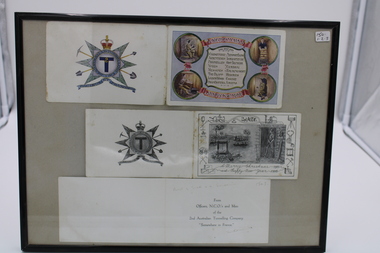
Decorative object - Christmas Cards WW1, Set of 3 Christmas cards
... Glass frame with three(3) Christmas cards with the emblem of the 2nd Australian Tunnelling Company on rear....From Officers and Men of the 2nd Australian Tunneling Company "Somewhere in France"...From Officers and Men of the 2nd Australian Tunneling Company "Somewhere in France" Glass frame with three(3) Christmas cards with the emblem of the 2nd Australian Tunnelling Company on rear. ...Glass frame with three(3) Christmas cards with the emblem of the 2nd Australian Tunnelling Company on rear.From Officers and Men of the 2nd Australian Tunneling Company "Somewhere in France" -
 Bendigo Military Museum
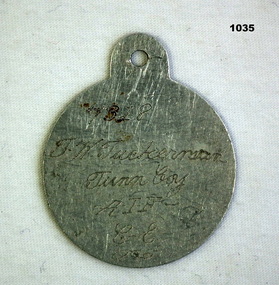
Accessory - IDENTITY DISCS, Post 16.4.17
... ...2nd australian tunneling company...The disc belonged to Thomas William Tuckerman, No 7318, 2nd Australian Tunneling Company AIF. He enlisted on 16.4 1917 aged 38 years, embarked on 4.8.1917. ...The disc belonged to Thomas William Tuckerman, No 7318, 2nd Australian Tunneling Company AIF. He enlisted on 16.4 1917 aged 38 years, embarked on 4.8.1917. ...The disc belonged to Thomas William Tuckerman, No 7318, 2nd Australian Tunneling Company AIF. He enlisted on 16.4 1917 aged 38 years, embarked on 4.8.1917. He was hospitalised twice and wounded in action once. He was discharged from the AIF on 4.5 1919. Refer 935P, 1265.3.Aluminium circular Identity disk with section at the top for attachment to a cord. On one face hand engraved. “7318 T.W.Tuckerman Tunn Coy A.I.F C - E”7318, t w tuckerman, 2nd australian tunneling company -
 Bendigo Military Museum
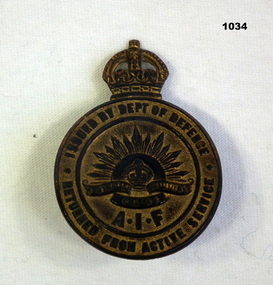
Award - RETURNED FROM ACTIVE SERVICE BADGE, Post WW1
... The badge was issued to Thomas William Tuckerman No 7318, 2nd Australian Tunneling Company AIF. Refer 935P, 1265.3....The badge was issued to Thomas William Tuckerman No 7318, 2nd Australian Tunneling Company AIF. Refer 935P, 1265.3. r.a.s.badge 110680 tuckerman 7318 aif Around the face in raised lettering, ISSUED BY DEPT OF DEFENCE, RETURNED FROM ACTIVE SERVICE. ...The badge was issued to Thomas William Tuckerman No 7318, 2nd Australian Tunneling Company AIF. Refer 935P, 1265.3.Brass circular badge with Kings Crown at the top. Centre is the Rising Sun badge. The rear has two lugs for fixing to clothing.Around the face in raised lettering, ISSUED BY DEPT OF DEFENCE, RETURNED FROM ACTIVE SERVICE. The scroll on the Rising Sun has, AUSTRALIAN MILITARY FORCES. Under the Rising Sun is A.I.F. On the rear is stamped 110680r.a.s.badge 110680, tuckerman 7318, aif -
 Bendigo Military Museum
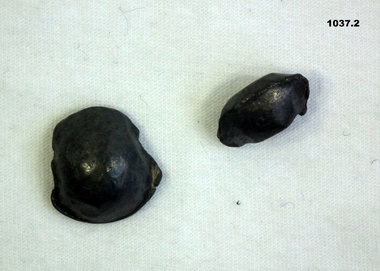
Weapon - SHRAPNEL PIECES, C. 1915 - 18
... The shrapnel belonged to Thomas William Tuckerman, No 7318, 2nd Australian Tunneling Company AIF. Refer 935P, 1265.3....The shrapnel belonged to Thomas William Tuckerman, No 7318, 2nd Australian Tunneling Company AIF. Refer 935P, 1265.3. shrapnel 7318 t.w.tuckerman Small pieces of shrapnel, grey metallic in colour. ...The shrapnel belonged to Thomas William Tuckerman, No 7318, 2nd Australian Tunneling Company AIF. Refer 935P, 1265.3.Small pieces of shrapnel, grey metallic in colour. Both are flatish on one side and dome shaped on the oppositeshrapnel, 7318, t.w.tuckerman -
 Bendigo Military Museum
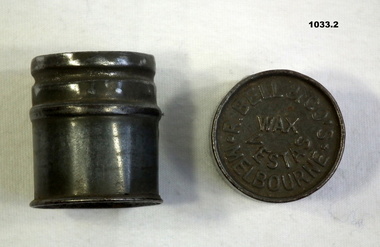
Accessory - TIN, WAX VESTA, C.1914 - 18
... The Wax Vesta tin belonged to Thomas William Tuckerman, No 7318, 2nd Australian Tunneling Company AIF. Refer 935P, 1265.3....The Wax Vesta tin belonged to Thomas William Tuckerman, No 7318, 2nd Australian Tunneling Company AIF. Refer 935P, 1265.3. tin wax vestas 7318 w t tuckerman On the top face in raised lettering, “R BELL & CO's MELBOURNE. ...The Wax Vesta tin belonged to Thomas William Tuckerman, No 7318, 2nd Australian Tunneling Company AIF. Refer 935P, 1265.3.Small round cylindrical metal container in two pieces. The bottom half fits into the top half. Metallic grey in colour.On the top face in raised lettering, “R BELL & CO's MELBOURNE. WAX VESTAS”.tin, wax vestas, 7318 w t tuckerman -
 Victorian Interpretive Projects Inc.
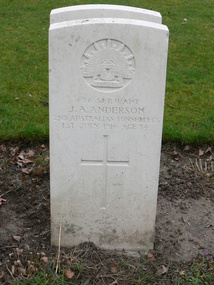
Photograph - Colour, Mark Banning, Photograph of the gravestone of John A. Alexander, 2014, 18/02/2014
... John Anderson was a sergeant with the 2nd Australian Tunnelling Company. He was 34 years of age when he was killed in action in France on 01 July 1916. ...John Anderson was a sergeant with the 2nd Australian Tunnelling Company. He was 34 years of age when he was killed in action in France on 01 July 1916. ...John Austin Anderson was the son of Daniel William and Elizabeth Jane Anderson, and husband of Ethel M. Anderson of 312 Ripon Street South, Ballarat. John Anderson was a sergeant with the 2nd Australian Tunnelling Company. He was 34 years of age when he was killed in action in France on 01 July 1916. Anderson is buried at Cite Bonjean Military Cemetery, Armentieres.Four digital images images of the headstones for J.A. Anderson in the Cite Bonjean Military Cemetery, Armentieres, taken by Mark Banning on 18 February 2014. world war one, wwi, war, cemetery, headstone, alexander, j.a. alexander., mmm -
 Bendigo Military Museum
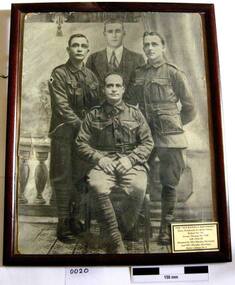
Photograph - PHOTOGRAPH WW1, FRAMED, C.1915 - 16
... Front sitting, Thomas William No 7318, 2nd Australian Tunneling Company AIF. Refer 1265.3 re his service details. ...Front sitting, Thomas William No 7318, 2nd Australian Tunneling Company AIF. Refer 1265.3 re his service details. ...Tuckerman brothers. Rear in the photo. Left Frederick Charles No 4618 enlisted on 28.7.15 in 14th reinforcements 6th Batt AIF age 23 years. Embarked for Egypt 28.1.16, embark for France 29.3.16, transfer to 2nd Pioneer Batt 5.7.16 with rank of Sapper, WIA 5.8.16 remaining on duty, hospital 14.12.16 with trench Feet, hospital 21.6.18 with PUO then Classed Influenza, discharged from the AIF 24.8.19. Centre at rear Victor. Right Robert Samuel No 742 enlisted on 11.3.15 in C Coy 24th Batt AIF age 33 years. Embark for Egypt 8.5.15, embark for Gallipoli 30.8.15, transfer to 2nd Pioneer Batt 4.3.16 with rank of Sapper, embark for France 19.3.16, discharged from the AIF 29.6.19. Front sitting, Thomas William No 7318, 2nd Australian Tunneling Company AIF. Refer 1265.3 re his service details. All 3 brothers were (born in Bendigo) Robert (enlisted Melbourne) the other 2 (enlisted Bendigo)Wooden framed, glass covered black and white photograph of the four Tuckerman brothers. Frederick No 4618, Victor, Robert No 742, Thomas No 7318.photography-photographs, frame accessories, military history -
 Eltham District Historical Society Inc
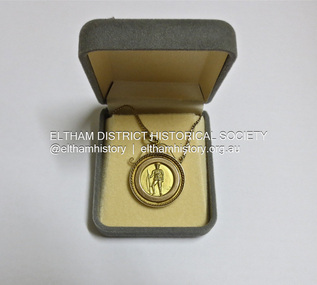
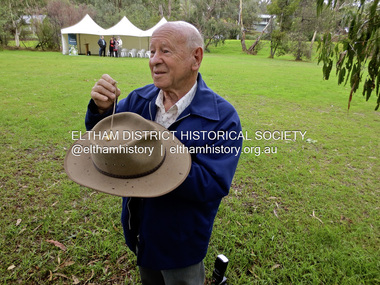
Photograph - Medal, Jim Connor, Welcome Home Medal awarded to Spr. W. H. Orford by Shire of Eltham Welcome Home Committee, 22 April 2014
... The medal shown was presented to Sapper William Henry Orford, of the 2nd Australian Tunnelling Company, an uncle of Doug Orford, one of our members. ...The medal shown was presented to Sapper William Henry Orford, of the 2nd Australian Tunnelling Company, an uncle of Doug Orford, one of our members. ...Awarded to Spr. W. H. Orford by Shire of Eltham Welcome Home Committee Welcome Home Medal The Welcome Home Medal was issued to acknowledge service during World War 1. As groups of servicemen returned and were discharged a local welcome home function was held in their honour. The welcome home committee decided that to commemorate the occasion a medal should be presented to the returned servicemen and also to the nearest relations of those who had fallen during the conflict. The medal shown was presented to Sapper William Henry Orford, of the 2nd Australian Tunnelling Company, an uncle of Doug Orford, one of our members. Sapper Orford participated in an operation where on June 7, 1917, British and Australian tunnellers detonated 19 massive mines beneath German lines at Messines Ridge, Belgium, marking a pivotal moment in WWI underground warfare. The explosions, including those at the heavily contested Hill 60, created craters 60 feet deep, killed roughly 10,000 German troops, and were heard as far away as London. Tunnellers from Australian and British units worked for over a year (since 1916) in treacherous conditions—including quicksand and mud—to dig tunnels beneath German strongpoints. At 3:10 a.m. on June 7, nearly 1,000,000 pounds of explosives (ammonal) were detonated, creating one of the largest pre-atomic explosions in history The explosions shattered German morale and destroyed defences, allowing Allied forces to take the ridge. Specifically, Australian miners placed, at great risk, two massive mines under the German-held Hill 60 and the nearby "Caterpillar" crater. Inscribed on the front of the medal is: SPR W.H. ORFORD FROM ELTHAM WE HONOUR YOU GREAT WAR 1914 – 1919 On the back of the medal is the image of a soldier standing at ease with a rifle. Smaller than originally stated the Eltham Districts medal is midway between a 10 and 20 cent piece in size. The medal is a fine piece of craftsmanship and is understood to have cost £4 to make. On 22nd April 2014 Society members were pleased to attend an announcement by Mr Damien Drum, Victorian Minister for Veterans Affairs and Sport, of funding for installation of signage for the Eltham and Hurstbridge Avenues of Honour. Doug Orford was there and created much interest with his Welcome Home Medal, including from Minister Drum. See also EDHS Newsletter No. 216 May 2014spr. w.h. orford, welcome home committee, welcome home medal, world war 1, avenue of honour, jim connor collection, mr damien drum, victorian minister for veterans affairs and sport, william henry orford -
 Eltham District Historical Society Inc
Photograph - Medal, Jim Connor, Doug Orford with the Welcome Home Medal awarded to Spr. W. H. Orford by Shire of Eltham Welcome Home Committee, 22 April 2014
... The medal shown was presented to Sapper William Henry Orford, of the 2nd Australian Tunnelling Company, an uncle of Doug Orford, one of our members. ...The medal shown was presented to Sapper William Henry Orford, of the 2nd Australian Tunnelling Company, an uncle of Doug Orford, one of our members. ...Awarded to Spr. W. H. Orford by Shire of Eltham Welcome Home Committee Welcome Home Medal The Welcome Home Medal was issued to acknowledge service during World War 1. As groups of servicemen returned and were discharged a local welcome home function was held in their honour. The welcome home committee decided that to commemorate the occasion a medal should be presented to the returned servicemen and also to the nearest relations of those who had fallen during the conflict. The medal shown was presented to Sapper William Henry Orford, of the 2nd Australian Tunnelling Company, an uncle of Doug Orford, one of our members. Sapper Orford participated in an operation where on June 7, 1917, British and Australian tunnellers detonated 19 massive mines beneath German lines at Messines Ridge, Belgium, marking a pivotal moment in WWI underground warfare. The explosions, including those at the heavily contested Hill 60, created craters 60 feet deep, killed roughly 10,000 German troops, and were heard as far away as London. Tunnellers from Australian and British units worked for over a year (since 1916) in treacherous conditions—including quicksand and mud—to dig tunnels beneath German strongpoints. At 3:10 a.m. on June 7, nearly 1,000,000 pounds of explosives (ammonal) were detonated, creating one of the largest pre-atomic explosions in history The explosions shattered German morale and destroyed defences, allowing Allied forces to take the ridge. Specifically, Australian miners placed, at great risk, two massive mines under the German-held Hill 60 and the nearby "Caterpillar" crater. Inscribed on the front of the medal is: SPR W.H. ORFORD FROM ELTHAM WE HONOUR YOU GREAT WAR 1914 – 1919 On the back of the medal is the image of a soldier standing at ease with a rifle. Smaller than originally stated the Eltham Districts medal is midway between a 10 and 20 cent piece in size. The medal is a fine piece of craftsmanship and is understood to have cost £4 to make. On 22nd April 2014 Society members were pleased to attend an announcement by Mr Damien Drum, Victorian Minister for Veterans Affairs and Sport, of funding for installation of signage for the Eltham and Hurstbridge Avenues of Honour. Doug Orford was there and created much interest with his Welcome Home Medal, including from Minister Drum. See also EDHS Newsletter No. 216 May 2014spr. w.h. orford, welcome home committee, welcome home medal, world war 1, avenue of honour, jim connor collection, mr damien drum, victorian minister for veterans affairs and sport, william henry orford -
 Eltham District Historical Society Inc
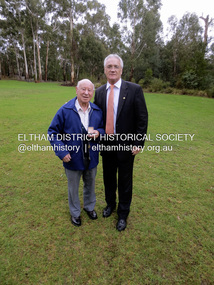
Photograph - Medal, Jim Connor, Doug Orford with Minister Damian Drum, Minister for Veterans' Affairs at Wingrove Park, Eltham, 22 April 2014
... The medal shown was presented to Sapper William Henry Orford, of the 2nd Australian Tunnelling Company, an uncle of Doug Orford, one of our members. ...The medal shown was presented to Sapper William Henry Orford, of the 2nd Australian Tunnelling Company, an uncle of Doug Orford, one of our members. ...Awarded to Spr. W. H. Orford by Shire of Eltham Welcome Home Committee Welcome Home Medal The Welcome Home Medal was issued to acknowledge service during World War 1. As groups of servicemen returned and were discharged a local welcome home function was held in their honour. The welcome home committee decided that to commemorate the occasion a medal should be presented to the returned servicemen and also to the nearest relations of those who had fallen during the conflict. The medal shown was presented to Sapper William Henry Orford, of the 2nd Australian Tunnelling Company, an uncle of Doug Orford, one of our members. Sapper Orford participated in an operation where on June 7, 1917, British and Australian tunnellers detonated 19 massive mines beneath German lines at Messines Ridge, Belgium, marking a pivotal moment in WWI underground warfare. The explosions, including those at the heavily contested Hill 60, created craters 60 feet deep, killed roughly 10,000 German troops, and were heard as far away as London. Tunnellers from Australian and British units worked for over a year (since 1916) in treacherous conditions—including quicksand and mud—to dig tunnels beneath German strongpoints. At 3:10 a.m. on June 7, nearly 1,000,000 pounds of explosives (ammonal) were detonated, creating one of the largest pre-atomic explosions in history The explosions shattered German morale and destroyed defences, allowing Allied forces to take the ridge. Specifically, Australian miners placed, at great risk, two massive mines under the German-held Hill 60 and the nearby "Caterpillar" crater. Inscribed on the front of the medal is: SPR W.H. ORFORD FROM ELTHAM WE HONOUR YOU GREAT WAR 1914 – 1919 On the back of the medal is the image of a soldier standing at ease with a rifle. Smaller than originally stated the Eltham Districts medal is midway between a 10 and 20 cent piece in size. The medal is a fine piece of craftsmanship and is understood to have cost £4 to make. On 22nd April 2014 Society members were pleased to attend an announcement by Mr Damien Drum, Victorian Minister for Veterans Affairs and Sport, of funding for installation of signage for the Eltham and Hurstbridge Avenues of Honour. Doug Orford was there and created much interest with his Welcome Home Medal, including from Minister Drum. See also EDHS Newsletter No. 216 May 2014spr. w.h. orford, welcome home committee, welcome home medal, world war 1, avenue of honour, jim connor collection, mr damien drum, victorian minister for veterans affairs and sport, william henry orford -
 Lara RSL Sub Branch
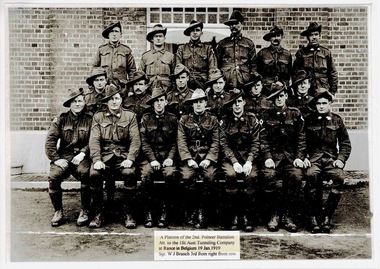
Photograph, A Platoon of the 2nd, Pioneer Battalion Att. to the 1St.Aust. Tunneling Company at Rance in Belgium 19 Jan 1919
... 2nd Pioneer Battalion was an Australian infantry and light engineer unit raised for service during the First World War as part of the all volunteer Australian Imperial Force. Formed in Egypt in March 1916, the battalion subsequently served on the Western Front in France and Belgium, after being transferred to the European battlefields shortly after its establishment. army, rance belgium,australian army, lara r.s.l. !st.australian tunnelling company ...The 2nd Pioneer Battalion was an Australian infantry and light engineer unit raised for service during the First World War as part of the all volunteer Australian Imperial Force. Formed in Egypt in March 1916, the battalion subsequently served on the Western Front in France and Belgium, after being transferred to the European battlefields shortly after its establishment. Rectangular shaped black and white Photograph.A Platoon of the 2nd, Pioneer Battalion Att. to the 1St.Aust. Tunnelling Company at Rance in Belgium 19 Jan 1919 Sgt. W J Branch 3rd from right front row. army, rance belgium,australian army, lara r.s.l., !st.australian tunnelling company, 2nd pioneer battalion.
