
Showing 39 items matching "303 bullets"
-
 Charlton RSL Sub Branch
Uniform - Army Cartridge Belt, Army cartridge belt for .303 bullets
... Army cartridge belt for .303 bullets...Cotton cartridge webbing for .303 bullets...D^D CGCF Aust 11.9.56 1955 BALL .303 Mark 7 Cotton cartridge webbing for .303 bullets Army cartridge belt for .303 bullets Uniform Army Cartridge Belt ...Cotton cartridge webbing for .303 bulletsD^D CGCF Aust 11.9.56 1955 BALL .303 Mark 7 -
 Bendigo Military Museum
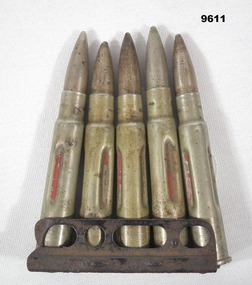
Weapon - AMMUNITION CLIP, Mk6, Unknown
... .303 rifle bullets....Bullets are Mark 6 .303 practice round bullets. Source unidentified....Indentation also in the bottom of each are Mark 6 .303 bullets on a .303 clip....Bullets are Mark 6 .303 practice round bullets. Source unidentified. .303 rifle bullets. ...Bullets are Mark 6 .303 practice round bullets. Source unidentified.Metal clip of 5 practice bullets. Brass colour with 3 indentations on the side marked in red. Indentation also in the bottom of each are Mark 6 .303 bullets on a .303 clip..303 rifle bullets., practice rounds, ammunition -
Charlton RSL Sub Branch
Uniform - Ammunition pouch, Cloth ammunition pouch for .303 bullets
... Cloth ammunition pouch for .303 bullets...V 379/1945 D^D 50 Ball .303 Mark 7 19.559 MF Cotton ammunition pouch Cloth ammunition pouch for .303 bullets Uniform Ammunition pouch ...Cotton ammunition pouchV 379/1945 D^D 50 Ball .303 Mark 7 19.559 MF -
 Merbein RSL Sub Branch
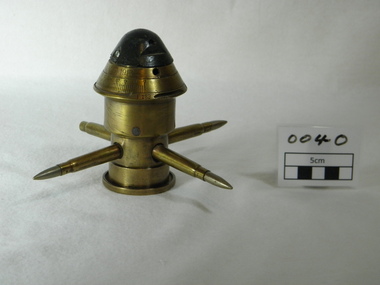
Trench art, 1914/1918
... ...303 bullets...A 1917 brass Artillary fuse with four 303 bullets protruding from the base at right angles to each other...A 1917 brass Artillary fuse with four 303 bullets protruding from the base at right angles to each other Trench art ...A 1917 brass Artillary fuse with four 303 bullets protruding from the base at right angles to each otherOn one side around the top (Rh.M.F. 1917) on the opposite side (Z.s.u.m.W.M.) and on the bottom (5568) and (z in double circle).world war one, artillary fuse brass, 303 bullets -
 Dandenong/Cranbourne RSL Sub Branch
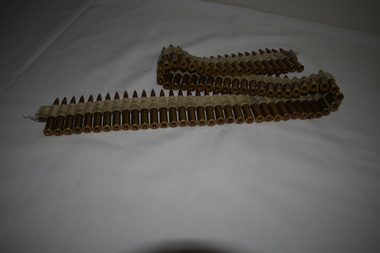
Weapon - Bandolier 303 Bullets (73)
... Bandolier 303 Bullets (73) ...Various Markings---MF 56 7- RG54 7-MF 58.7-1935-K17 ZNA-RAL12.VII-MW.44.VII-MF.1942WI-HG1942 VII-1938-1936-K1931 VII-1935-HG.1942.VII-303MV8Z.PP78-DA44- U1943.VII-1961V2-MF.27.10-DA.1943,VII-MH.1942.VII (Plus) Bullets (Firing Caps removed) Weapon Bandolier 303 Bullets (73) ...Bullets (Firing Caps removed)Various Markings---MF 56 7- RG54 7-MF 58.7-1935-K17 ZNA-RAL12.VII-MW.44.VII-MF.1942WI-HG1942 VII-1938-1936-K1931 VII-1935-HG.1942.VII-303MV8Z.PP78-DA44- U1943.VII-1961V2-MF.27.10-DA.1943,VII-MH.1942.VII (Plus) -
 Running Rabbits Military Museum operated by the Upwey Belgrave RSL Sub Branch
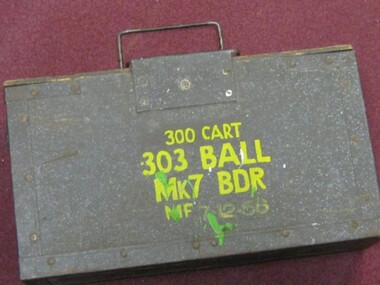
Ammo Box
... Ammunition box for .303 bullets...Equipment 1956 Army Ammunition box for .303 bullets Ammo Box ...Ammunition box for .303 bulletsequipment, 1956, army -
 Running Rabbits Military Museum operated by the Upwey Belgrave RSL Sub Branch
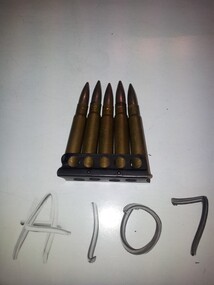
Bullets
... .303 bullets in five round charger...Ammunition WW2 Army .303 bullets in five round charger Bullets ....303 bullets in five round chargerammunition, ww2, army -
 Running Rabbits Military Museum operated by the Upwey Belgrave RSL Sub Branch
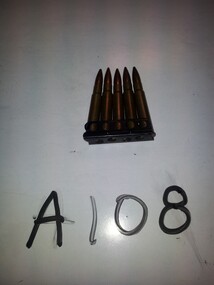
Bullets
... .303 bullets in five round charger...Ammunition WW2 Army .303 bullets in five round charger Bullets ....303 bullets in five round chargerammunition, ww2, army -
 Running Rabbits Military Museum operated by the Upwey Belgrave RSL Sub Branch
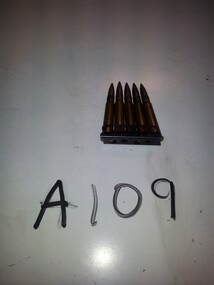
Bullets
... .303 bullets in five round charger...Ammunition WW2 Army .303 bullets in five round charger Bullets ....303 bullets in five round chargerammunition, ww2, army -
 Ballarat RSL Sub-Branch Inc.
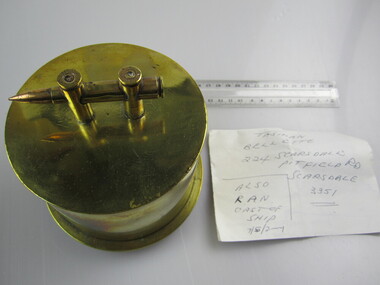
Trench craft - Ornament
... Made from shell case. 3 British 303 bullets on lid & 3 British 303 bullets (parts thereof) on base....Made from shell case. 3 British 303 bullets on lid & 3 British 303 bullets (parts thereof) on base. ...German manufactured in Magdeburg.2 pc - Lid & Base. Made from shell case. 3 British 303 bullets on lid & 3 British 303 bullets (parts thereof) on base.collectables, ballarat rsl, ballarat -
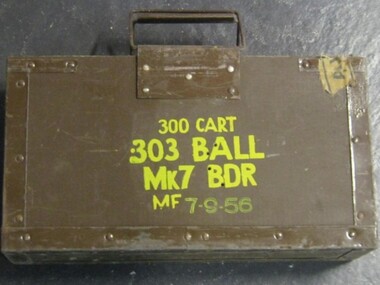 Running Rabbits Military Museum operated by the Upwey Belgrave RSL Sub Branch
Ammo Box
... Ammunition box for .303 bullets - post Korea. 1956...Equipment 1956 Army Ammunition box for .303 bullets - post Korea. 1956 Ammo Box ...Ammunition box for .303 bullets - post Korea. 1956equipment, 1956, army -
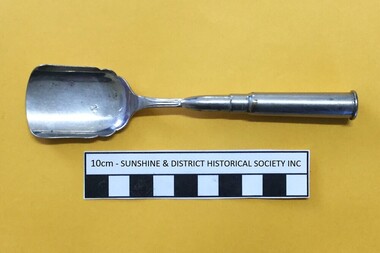 Sunshine and District Historical Society Incorporated
Artwork, other - Bullet Spoon / Trench art, Stewart Noble, Circa 1940
... trench art, bullet spoon, .303 bullet, stewart noble, war souvenier, chrome teaspoon...Chrome plated teaspoon with a discharged .303 bullet for the handle....This particular item indicates that a reasonably high degree of skill was required to make the bullet spoon. trench art, bullet spoon, .303 bullet, stewart noble, war souvenier, chrome teaspoon Chrome plated teaspoon with a discharged .303 bullet for the handle. ...This piece of functional Trench Art was made by Stewart Noble during World War 2 (circa 1940) while serving on a Mine Sweeper among the Pacific Islands. It is believed that the bullet spoon was chrome plated after the war, while he worked at the Government Aircraft Factory. Trench art is described as any decorative item made by soldiers, prisoners of war, or civilians where the manufacture is directly linked to a war. The making of trench art was a popular past time during leisure hours at the front, where skilled military personnel created the items. Common examples of trench art are decorated shell and bullet casings, and items carved from wood and bone. Trench art has been in existence since the Napoleonic wars however it was most common during World War 1, and to a lesser extent during World War 2. This bullet spoon has historic significance because it is an example of the type of functional or artistic small items, that were made from war scrap during spare time by soldiers or other personnel associated with a war. This particular item indicates that a reasonably high degree of skill was required to make the bullet spoon.Chrome plated teaspoon with a discharged .303 bullet for the handle.trench art, bullet spoon, .303 bullet, stewart noble, war souvenier, chrome teaspoon -
Dandenong/Cranbourne RSL Sub Branch
Weapon - Australian rifle bullets 303
... Australian rifle bullets 303...under bullet POF,66, 7 5 Australian rifle bullets brass, Weapon Australian rifle bullets 303 ...5 Australian rifle bullets brass, under bullet POF,66, 7 -
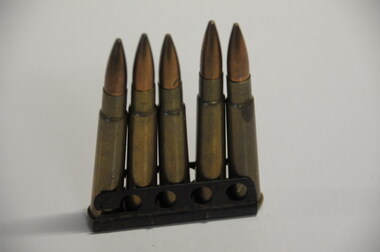 Running Rabbits Military Museum operated by the Upwey Belgrave RSL Sub Branch
Bullets
... 5 Mark 7 .303 Bullets in quick loading clip Made in SAAF No 4 Hendon QLD...Ammunition 1944 Army 5 Mark 7 .303 Bullets in quick loading clip Made in SAAF No 4 Hendon QLD Bullets ...5 Mark 7 .303 Bullets in quick loading clip Made in SAAF No 4 Hendon QLDammunition, 1944, army -
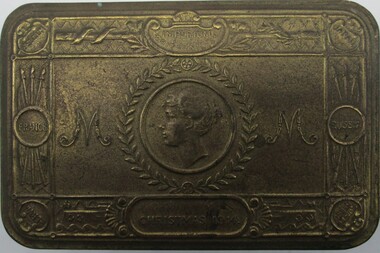 Ringwood RSL Sub-Branch
Souvenir, Princess Mary gift to troops Christmas 1914, 1914
... Also a card and pencil set in a 303 bullet....Also a card and pencil set in a 303 bullet. Princess Mary gift to troops Christmas 1914 Souvenir ...Brass tin with Gilt finish. Given to British Commonwealth Troops for Christmas in 1914. Usually contained cigarettes or tobacco. Also a card and pencil set in a 303 bullet.Imperium Britanicum Christmas 1914. Belgium, France, Serbia, Japan, Russia, Monte Negro. -
 Bendigo Military Museum
Memorabilia - TRENCH ART, VASE, c.1943-45
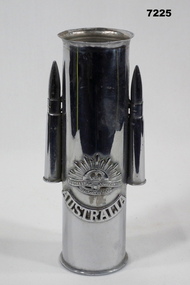
... Trench art based on a chrome plated shell casing. A .303 bullet is attached to each side. A Rising Sun badge and a curved 'AUSTRALIA' shoulder badge are attached to the front of the shell....See Catalogue No. 5942P for details of his service record. trench art souvenir Kevin John Herdman Stamped on the base of the shell casing: “LOT, R, 806, (upwards arrow), N, 1943” Trench art based on a chrome plated shell casing. A .303 bullet is attached to each side. A Rising Sun badge and a curved 'AUSTRALIA' shoulder badge are attached to the front of the shell. ...Part of the Kevin John Herdman, No. 397661, Collection. See Catalogue No. 5942P for details of his service record.Trench art based on a chrome plated shell casing. A .303 bullet is attached to each side. A Rising Sun badge and a curved 'AUSTRALIA' shoulder badge are attached to the front of the shell.Stamped on the base of the shell casing: “LOT, R, 806, (upwards arrow), N, 1943”trench art, souvenir, kevin john herdman -
 Flagstaff Hill Maritime Museum and Village
Bullet
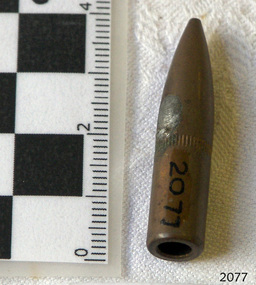
... ...Bullet..."303...Bullet of "303"...flagstaff hill warrnambool shipwrecked-coast flagstaff-hill flagstaff-hill-maritime-museum maritime-museum shipwreck-coast flagstaff-hill-maritime-village Bullet "303" Bullet of "303" Bullet ...Bullet of "303"flagstaff hill, warrnambool, shipwrecked-coast, flagstaff-hill, flagstaff-hill-maritime-museum, maritime-museum, shipwreck-coast, flagstaff-hill-maritime-village, bullet, "303" -
 Dandenong/Cranbourne RSL Sub Branch
Functional object - Letter Opener, Circa 1918
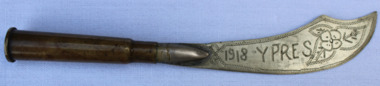
... Small letter opener consisting of a handle made from a .303 bullet and a blade made from an unknown metal. ...Small letter opener consisting of a handle made from a .303 bullet and a blade made from an unknown metal. ...Made by Albert Henry Rogers who served in the British Army during WW1, the grandfather of the donor. It was made as a symbol of hope as receiving letters from home gave them hope. Hence the bullet made into a letter opener is a symbol of something made to kill into something to give hope. (Transcribed from the donor's description)Small letter opener consisting of a handle made from a .303 bullet and a blade made from an unknown metal. The projectile has been split in half lengthways and the blade soldered in. The markings on the cartridge indicate that it is a Mk VII cartridge manufactured by the Royal Laboratory in 1917.Both sides of the blade have decorative engraving on them. The left side has "ARRAS" engraved on it and the right side has "1918 YPRES" engraved on it. The base of the cartridge is marked R^L 17 and VII.ypres, arras, world war 1 -
 Ringwood RSL Sub-Branch
Souvenir - Trench Art, C. 1941
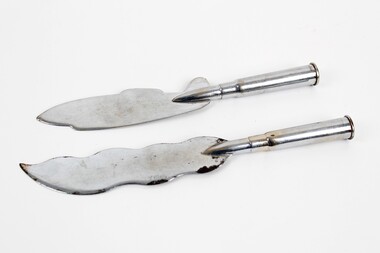
... Two letter openers. 303 chrome bullet handles stamped 1941 with shaped blades attached. 00057.1 plane shaped blade 00057.2 cloud / leaf shaped blade...Two letter openers. 303 chrome bullet handles stamped 1941 with shaped blades attached. 00057.1 plane shaped blade 00057.2 cloud / leaf shaped blade Souvenir Trench Art ...Two letter openers. 303 chrome bullet handles stamped 1941 with shaped blades attached. 00057.1 plane shaped blade 00057.2 cloud / leaf shaped blade -
 Dandenong/Cranbourne RSL Sub Branch
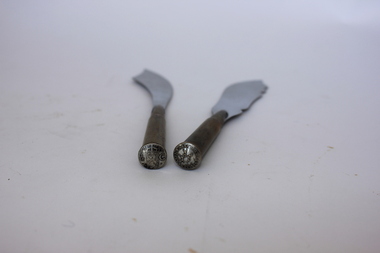
Memorabilia - Knives, hand made, Trench Art during WWII
... Two knives made of stainless steel blades, soldered into what appears to be .303 bullets with shells that are used as handles. ...Hand made knives during WWII One coin has "Nederl Indie 1/10 G 1941" Two knives made of stainless steel blades, soldered into what appears to be .303 bullets with shells that are used as handles. ...Hand made knives during WWIITwo knives made of stainless steel blades, soldered into what appears to be .303 bullets with shells that are used as handles. One knife has a three scallops on the top (blunt part of the knife) with a shaped cutting edge. On the base of the cartridge, a coin is soldered on that covers the primer and entire base of the cartridge. The coin appears to have Arabic writing on it. The other knife is scimitar in shape. At the base of the cartridge a 1941 Netherlands East Indies 1/10 Gulden Colonial Coin is soldered. This coin covers the primer and entire base of the shell.One coin has "Nederl Indie 1/10 G 1941" -
 Bendigo Military Museum
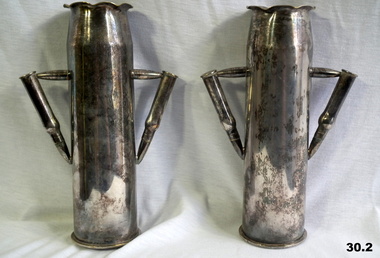
Memorabilia - TRENCH ART, BRASS VASES, Post 1942
... Pair of metal vases made from 2 inch ammunition shells with .303 cartridges and bullets for handles. Silver-plated....Pair of metal vases made from 2 inch ammunition shells with .303 cartridges and bullets for handles. Silver-plated. ...Trench art. Pair of metal vases made from 2 inch ammunition shells with .303 cartridges and bullets for handles. Silver-plated.Faint scratched marks on base, incl "1942".trench art, metalcraft, ornaments, containers, souvenirs -
 Numurkah & District Historical Society
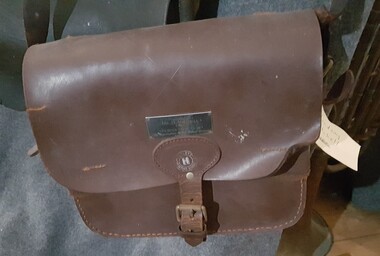
Various items from Mitchell family (see list)
... This ammunition bag was used by Harry Mitchell (son of Lindsay Mitchell) at the Bendigo Rifle Club in 1959, the bag was designed to hold 303 riffle bullets used in target shooting or could hold 7 cartridges for a shotgun. ...This ammunition bag was used by Harry Mitchell (son of Lindsay Mitchell) at the Bendigo Rifle Club in 1959, the bag was designed to hold 303 riffle bullets used in target shooting or could hold 7 cartridges for a shotgun. ...This ammunition bag was used by Harry Mitchell (son of Lindsay Mitchell) at the Bendigo Rifle Club in 1959, the bag was designed to hold 303 riffle bullets used in target shooting or could hold 7 cartridges for a shotgun. The Gladstone bag was very popular in the 1940/50 era, it fitted on the handlebars of a bicycle and it was used by footballers and sportsmen. A couple bottles of beer would fit comfortably in the bag and was.used to take beer home after the hotels closed at 6pm. These two articles were donated by Lindsay Mitchell to the Numurkah Historical Society. The Sunbeam Mixmaster belonged by Marjory Welch, Nana of Margaret Mitchell and would have been used in late 1930 and during 1940's. It was painted and used by Linda Mitchell, (great great grand daughter) when at universitv in 1987 White Sunbeam Mixmaster was purchased by Margaret Mitchell 1965. lt was her first mixmaster after she was married in 1964 The bread bins. The green and white belonged to Mary Mitchell (Lindsay Mitchell's Mother) The colourful bread bin belonged to Lorna Welch (Margaret Mitchell's Mother) 1 x Ammunition bag, (1950's), 1 x Gladstone bag (1950's), 2 x tin bread bins, 1 x White Coloured Sunbeam Mixmaster (1965) , 1 x Cream-coloured Sunbeam Mixmaster (1940's), 1 x Red Fly-spray can (1950's)mitchell family, gladstone bag, mixmaster, school bag, bread bin, kitchen, ammunition bag, sunbeam, flysprayer -
 Flagstaff Hill Maritime Museum and Village
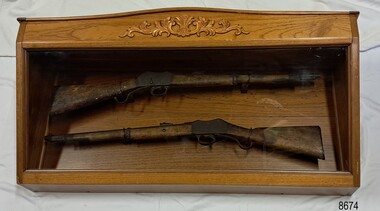
Weapon - Historic Rifles, Royal Small Arms Factory, 1877-1900
... bullets were slightly lighter in weight than those used for the longer rifle. The sight position was adjusted for the shorter gun, and wings were added to the sight on the tip, making it easier to slide the rifle back into a saddle bag. Some of the later Carbines also had leather sight covers screwed to the stock to prevent them from catching on the saddle bags. The Carbines had accessories available, such as barrel extensions with bayonets and swivels for adding slings. The Martini-Henry Carbine designs were later modified to fire the British .303...bullets were slightly lighter in weight than those used for the longer rifle. The sight position was adjusted for the shorter gun, and wings were added to the sight on the tip, making it easier to slide the rifle back into a saddle bag. Some of the later Carbines also had leather sight covers screwed to the stock to prevent them from catching on the saddle bags. The Carbines had accessories available, such as barrel extensions with bayonets and swivels for adding slings. The Martini-Henry Carbine designs were later modified to fire the British .303 ...Martini-Henry Artillery Carbin rifles were made by the Royal Small Arms Factory at Enfield, Britain, from 1877 until 1900. Many were distributed to the British Colonies, including this pair, which was allocated to the Woodford Police, Victoria Police District of Warrnambool, Southwest Victoria. The Carbine model rifles were shorter than the standard rifles and more suited to mounted police and troopers. It is likely that in the early 20th century, Victoria Police replaced the two carbines with more modern firearms, and the outdated guns were stored in the stables. The rifles were left there and likely forgotten about due to changes in police staff. In 1915, police authorities announced that they would be replacing patrol horses with bicycles and would also close some smaller police stations. This affected Woodford Police Station, which closed in 1917. The forgotten firearms remained in the stables and were noticed by schoolboy Robert Jellie in 1940 and seen again in 1946. In 1995, the property was sold by the Education Department to a private owner. The Woodford Community donated the pair of Martini-Henry Carbines to the Victoria Police Museum in the late 1990s for mounting and display, which was funded by the Victoria Police Historical Society Inc. The decorative wood and glass display case and frame were designed to preserve the significant history of the guns. On November 1st 1999, the display was presented to Warrnambool Police and the local community due to the historical significance of the Woodford Police Station. In 2025, these items were formally deaccessioned by the Victoria Police Museum, and ownership was transferred to the Warrnambool Police Station. On March 10th, 2025, the display was transferred to Flagstaff Hill Maritime Museum and Village, where the historical story of the Martini-Henry Carbines could continue to be preserved and accessed by local families, the community, visitors to the area, and online visitors. WOODFORD POLICE: - The small settlement at Woodford was established in the 1840s around the Merri River where there was a ford across the water and a bridge from 1848 to 1851. The area was settled very early in Victoria’s history, and the river crossing provided travellers with access to the early route between Port Fairy (named Belfast at that time), Warrnambool and Melbourne. Occasionally, a Warrnambool police trooper would ride through Woodford and the district. In December 1854, Woodford Police barracks and stables were built on the hill by the Merri River on Bridge Road east, where Jubilee Park now stands. A local mounted trooper kept law and order in the area. In 1856, a lock-up was installed, and the first Woodford Police Station was in action in 1857. By 1871, the police station had been moved from the hill to land across the Merri River bridge, on the southern side of Bridge Road west, near Mill Street. In 1890, the police residence there was replaced by a stone Edwardian-style building with the stables and lock-up behind it and the old police station at the rear. The police continued to have a presence in Woodford until it was closed by the Police Commissioner in July 1917 for economic reasons. The residence was used for government housing until 1923, when it was taken over by the Education Department for the school teacher’s home. In 1995, it became privately owned. THE MARTINI-HENRY ARTILLERY CARBINE: - The Martini-Henry rifles were made in Britain from 1871 at the Royal Small Arms factory at Enfield and were stamped with the symbol of the Royal Cipher (Crown over VR) over ENFIELD to identify their origin. They were named after two of several people who helped design this method: Swiss Friederich von Martini and Scotsman Alexander Henry. The design was breech-loaded, and the inner barrel was rifled. A thumb rest was incorporated into the top right of the bullet receiver’s chamber. The small teardrop lever on the right side of the rifle showed whether the rifle was ready to be shot. In 1877, the shorter, lighter-weight Carbine version of the firearm was produced for mounted troops and artillery. Its official name was “Carbine, B.L., Rifled, Martini-Henry.” The bullets were slightly lighter in weight than those used for the longer rifle. The sight position was adjusted for the shorter gun, and wings were added to the sight on the tip, making it easier to slide the rifle back into a saddle bag. Some of the later Carbines also had leather sight covers screwed to the stock to prevent them from catching on the saddle bags. The Carbines had accessories available, such as barrel extensions with bayonets and swivels for adding slings. The Martini-Henry Carbine designs were later modified to fire the British .303 ammunition. Eventually, by 1900, the Martini-Henry Carbines were replaced by the Lee Enfield gun design. The pair of Martini-Henry Carbine firearms represents policing in the early pre-1900 days of colonial settlement; Woodford was one of the first townships settled in Victoria, and it had a police presence from 1854 until 1917. The rifles and display provide a historic connection between the location of Woodford and relatives and associates. The carbine rifles show a stage in the evolution of weapon design, adapted to suit mounted troops, and adding features to streamline use and storage. The ammunition was also improved during this progression. The carbines are important for their connection to policing law and order in a remote area. They are significant for their association with the township of Woodford, which was important to travel in the southwest Victoria district, providing access across a river for a road between Port Fairy and Melbourne, and later Warrnambool, and supplying food, goods and accommodation for the travellers. A pair of mounted rifles is mounted behind glass in a timer case, accompanied by a framed display of two photographs and an account of the rifles’ history. The case and display each have a horizontal board with a gently curved edge and carved decorations added. The identical firearms are British-made Martini Henry Carbine breach-loaded rifled guns, supplied by Britain to its Colonial troops from around 1877. The rifles are lever-action, single-shot .500 calibre weapons. They have a teardrop lever on their right side. They were used by Victoria Police mounted troops at the Woodford Police Station, Victoria. The black and white photographs were taken in 1946. The left photograph has a circled area; the right photograph is an enlarged view of the circled area, showing the Woodford Police Station in detail. The printed text is on textured paper with the Victoria Police watermark. It gives a summary of the rifle’s history. There is an inscription on the left photograph. Left photograph, handwritten in white pen: “WOODFORD” Document’s print: “During the late 1840s the small town of Woodford grew around the crossing of the Merri River on the Melbourne/Port Fairy Rad. Woodford was proclaimed a township in 1854 and a police quarters was established there in 1857. The police station remained until 1917 when it was closed and police service from then on was provided from Warrnambool. The building was then used as a school residence and is now privately owned. In !940 Robert JELLIE, then a schoolboy, observed two rifles mounted on the wall of the disused stable at the rear of the old police building. Following the devastating flood of 1946 (see photograph above) the rifles were again seen in the room next to the stable but were not seen again until the building was sold by the Education Department many years later. It was a recognition of the historical value of the rifles which led to their donation to the Warrnambool Police Complex. The rifles have been authenticated by the Victoria Police Armoury as being Victoria Police issue some time before 1900. The rifles are an identical pair of the famous British-made Martini Henry, a .500 inch calibre military weapon widely used by British Colonial troops. Victoria Police and the wider community of Warrnambool are indebted to the members of the Woodford community for their fine gesture in donating the rifles for mounting so that their historical importance can be preserved and they can be displayed for generations to come. This display was funded by the Victoria Police Historical Society Incorporated, and presented on the first day of November, 1999.”flagstaff hill maritime museum and village, great ocean road, shipwreck coast, martini henry, victoria police, woodford police station, rifle, carbine, display case, british, martini henry carbine, breech-loaded, rifled, colonial, single-shot, .500 calibre, weapon, gun, 1877, troops, mounted troops, merri river, victoria police woodford, victoria police warrnambool, victoria police melbourne, police quarters, robert jellie, school residence, stable, 1946 flood, victoria police armoury, identical pair, british colonial troops, victoria police historical society incorporated, woodford, bicycles, found by a schoolboy, edwardian-style building, victoria police museum, warrnambool police station -
 Bendigo Military Museum
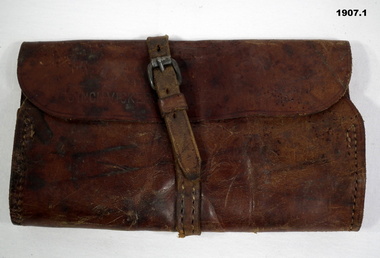
Equipment - VICKERS CLEANING KIT, HERFORDS PTY. LTD, 1941
... 303 VICKERS GUN E.B", rear marked "MADE BY RE BOWDEN & SON LTD. (indistinguishable) ST, NEWTOWN NSW 1942" Cleaning kit for a Vickers Machine Gun 1) Leather "wallet" for the kit 2) Brass inspection mirror, with cap, for the use of checking barrels. 3) Oil can tin 4) Oil brush, set into the brass cap of oil can 5) Gauge tension, with flat blade one end and bullet shape other end 6) Screwdriver, flat blade, wooden handle 7) Leather pouch with strap Equipment VICKERS CLEANING KIT HERFORDS PTY. ...Item belonged to Maxwell Lennox Matheson No 418447 RAAF. Refer Cat No 1959 for his service record.Cleaning kit for a Vickers Machine Gun 1) Leather "wallet" for the kit 2) Brass inspection mirror, with cap, for the use of checking barrels. 3) Oil can tin 4) Oil brush, set into the brass cap of oil can 5) Gauge tension, with flat blade one end and bullet shape other end 6) Screwdriver, flat blade, wooden handle 7) Leather pouch with strap1) Front marked "303 INCH VICKERS" 5) Marked "0 - 20" scale 7) Front marked "D.D 303 VICKERS GUN E.B", rear marked "MADE BY RE BOWDEN & SON LTD. (indistinguishable) ST, NEWTOWN NSW 1942" handcrafts - leatherwork, metalcraft brassware, trades-tools, military history, vickers -
4th/19th Prince of Wales's Light Horse Regiment Unit History Room
Drill rounds, .303 inch, c 1905
... 303" drill rounds in charger. Rounds - brass cases with holes drilled in them to show that they are inert, bullet component made of red gum. ...303" drill rounds in charger. Rounds - brass cases with holes drilled in them to show that they are inert, bullet component made of red gum. ...Used by Victorian Light Horse 1906As used by Australian Light HorseClip of 5 .303" drill rounds in charger. Rounds - brass cases with holes drilled in them to show that they are inert, bullet component made of red gum. Old type Enfield steel charger clip"E" stamped on charger -
4th/19th Prince of Wales's Light Horse Regiment Unit History Room
Presentation display: Manufacturing stages for .303 inch service round, c 1950
... 303 inch round. Top row - samples of the various metals used Centre row - Examples of components at stages of manufacture of cartridge case Bottom row - Examples of components at stages of manufacture of bullet...303 inch round. Top row - samples of the various metals used Centre row - Examples of components at stages of manufacture of cartridge case Bottom row - Examples of components at stages of manufacture of bullet Presentation display: Manufacturing stages for .303 inch service round Ammunition Factory Footscray ...Glass fronted wooden frame in which is mounted examples of components at the various stages of making .303 inch round. Top row - samples of the various metals used Centre row - Examples of components at stages of manufacture of cartridge case Bottom row - Examples of components at stages of manufacture of bulletOn back - 4/19 PWLH Sgts Mess 97 -
Frankston RSL Sub Branch
Munition, Trench Art
... Either side of the case are two Australian .303 spent cartridges vertically mounted and attached by two further cut-down .303 cases. The vertical cartridge cases have bullets inserted...Either side of the case are two Australian .303 spent cartridges vertically mounted and attached by two further cut-down .303 cases. The vertical cartridge cases have bullets inserted Munition, Trench Art ...World War 2 brass munition cases of Japanese and Australian origins. This is an example of 'trench art' having been made into a flower vase. Vase is a Japanese brass 30mm anti-aircraft shell case with a 1938 Territory of New Guinea silver one shilling coin affixed to the side of the shell case. the top of the case is slighltly splayed to form a decorative lip. Either side of the case are two Australian .303 spent cartridges vertically mounted and attached by two further cut-down .303 cases. The vertical cartridge cases have bullets insertedThe 30mm case has several Japanese characters on the base, naval anchors and the English S4/17 The .303 cases are marked M6 VII 1942 -
Frankston RSL Sub Branch
Swagger Stick
... The cane head is topped with chromed crossed British .303 expended cartridges each tipped with unexpended bullets. attached to the side of the crossed cartridge cases is a 1937 British Coronation medalet...The cane head is topped with chromed crossed British .303 expended cartridges each tipped with unexpended bullets. attached to the side of the crossed cartridge cases is a 1937 British Coronation medalet Swagger Stick ...Trench Art WW2 Swagger Stick. wooden stick tipped with chromed expended German cartridge case. The cane head is topped with chromed crossed British .303 expended cartridges each tipped with unexpended bullets. attached to the side of the crossed cartridge cases is a 1937 British Coronation medalet -
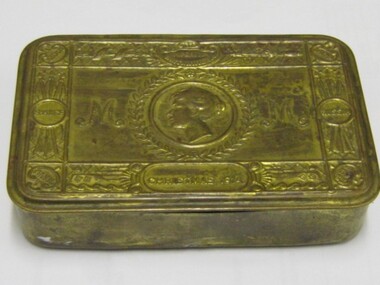 Running Rabbits Military Museum operated by the Upwey Belgrave RSL Sub Branch
Ammunition
... Clip of 5 .303 bulllets = 1 x 1906 blunt point; 1 x copper nickle (c1942); 2 normal (c1942); 1 soft nose hunting bullet....Ammunition Army Clip of 5 .303 bulllets = 1 x 1906 blunt point; 1 x copper nickle (c1942); 2 normal (c1942); 1 soft nose hunting bullet. ...Clip of 5 .303 bulllets = 1 x 1906 blunt point; 1 x copper nickle (c1942); 2 normal (c1942); 1 soft nose hunting bullet.ammunition, army -
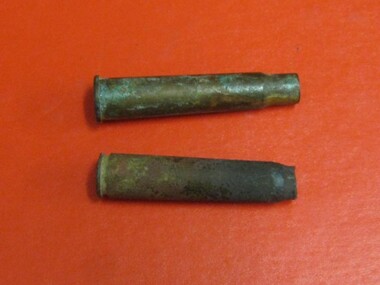 Running Rabbits Military Museum operated by the Upwey Belgrave RSL Sub Branch
Bullets
... Ammunition 1 damaged Japanese 7.7mm; 1 6.5mm .303; Found beside the Kokoda Track. Bullets ...1 damaged Japanese 7.7mm; 1 6.5mm .303; Found beside the Kokoda Track.ammunition
