
Showing 4 items matching "33rd battalion"
-
 Shepparton RSL Sub Branch
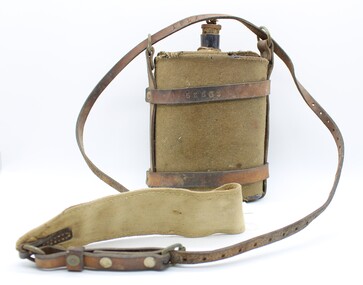
Water Bottle, c. 1918
... ...33rd battalion...Teale was born in Riverstone, New South Wales and enlisted on 20 March 1918 at the age of 18 years and 8 months, joining the 33rd Battalion/1st Infantry Depot Battalion A Company in Liverpool; though interestingly, the stamps on his enlistment certificates predate the date of enlistment. ...Teale was born in Riverstone, New South Wales and enlisted on 20 March 1918 at the age of 18 years and 8 months, joining the 33rd Battalion/1st Infantry Depot Battalion A Company in Liverpool; though interestingly, the stamps on his enlistment certificates predate the date of enlistment. ...This bottle may have belonged to John (Jack) Henry Teale (NX 53563). Teale was born in Riverstone, New South Wales and enlisted on 20 March 1918 at the age of 18 years and 8 months, joining the 33rd Battalion/1st Infantry Depot Battalion A Company in Liverpool; though interestingly, the stamps on his enlistment certificates predate the date of enlistment. Teale's next of kin is listed as his mother, Rebecca; on both enlistment forms, John's father, George's name is crossed out and replaced by his mother. Both parents are confirmed as being alive in a separate attestation document from 22 February, documenting parental permission for enlisted soldiers under 21 years. John Henry Teale sailed from Sydney to Liverpool via HMAS Osterley (also known as RMS or SS Osterley).This bottle was owned by John Henry Teale, a young enlistee from New South Wales. The service number inscriptions provide great research significance, allowing for research into the service history of the owner. The bottle is representative of the uniform and equipment issued to servicemen of the period, the First World War and when compared with other examples, is in comparatively good condition with the casing mostly intact. Dark blue enamelled metal eliptical-cylindrical shaped bottle with flat top and base, fastened at the top with a cork. Cork has metal handle at top with string attached (now broken where attaches to bottle). Bottle is cased in khaki woollen material, hand sewn in places and detached in others. Bottle is carried via a series of leather straps, one of which passes beneath the bottle and runs up the left and right side, ending in a loop attached to a brass metal circle and held in place with a stud/rivet; this strap carries stamped service number. Two leather straps encircle the bottom horizontally and are fastened with studs. Upper strap has service number stamped. Long leather strap passes through metal circles and each end attaches to canvas strap which sits on the shoulder. Canvas strap carries service number also. Strap is adjustable and has several punched holes through which a buckle can pass.Inscribed on canvas strap in ink: "NX53563". On middle of leather strap: "53563". On leather strap under bottle: "53563". On horizontal leather strap: "53563". john henry teale, jack teale, 1st infantry depot battalion, 33rd battalion, world war i, world war one, first world war, the great war, equipment, uniform -
 Returned Nurses RSL Sub-branch
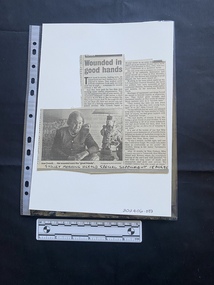
Newspaper - Newspaper clipping, [Sydney Morning Herald], Wounded in good hands, [15 Aug 95]
... ...2/33rd Battalion...World War 2 World War Two WWII 2/33rd Battalion American bomber Turramurra New Guinea Tamworth Morotai Island Borneo 'SYDNEY MORNING HERALD SPECIAL SUPPLEMENT 15 AUG 95'[black ink, along bottom] A newspaper clipping consisting of two columns of text and a black and white photo of a seated older woman Wounded in good hands Newspaper Newspaper clipping [Sydney Morning Herald] ...Joan Crouch began her thirty year career as an army nurse when she signed up at Concord Hospital, May 1942, with only two years experience as a qualified nurse. Of Australia's estimated 11,oo nurses, a third served in World War II. Joan Soon found herself on a boat to Port Moresby and the 2/9 Australian General Hospital. There she cared for soldiers soldiers who were wounded or had contracted diseases on the Kokoda Track.A newspaper clipping consisting of two columns of text and a black and white photo of a seated older woman'SYDNEY MORNING HERALD SPECIAL SUPPLEMENT 15 AUG 95'[black ink, along bottom]world war 2, world war two, wwii, 2/33rd battalion, american bomber, turramurra, new guinea, tamworth, morotai island, borneo -
 Returned Nurses RSL Sub-branch
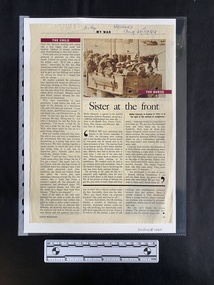
Magazine - Magazine clipping, The nurse: sister at the front, [Aug 26th 1989]
... Mollie goes on to detail her most horrific war experience, in New Guinea, when a bomber laden with bombs and fuel crashed into the 33rd Battalion as it waited on the edge of the airstrip. ...Mollie goes on to detail her most horrific war experience, in New Guinea, when a bomber laden with bombs and fuel crashed into the 33rd Battalion as it waited on the edge of the airstrip. ...The story is mostly a quote from Mollie Edwards, who was a captain in the 2nd/5th Australian General Hospital. She served in a 1200 bed field hospital tent, near the front in the Middle East, Greece, Crete, Syria, New Guinea, and Morotai. Mollie talks about her evacuation from the hospital in Greece. She was one of the forty nurses told to leave, leaving forty to be taken as POWs. Leaving her patients was one of the hardest things she had to do during the war. Mollie goes on to detail her most horrific war experience, in New Guinea, when a bomber laden with bombs and fuel crashed into the 33rd Battalion as it waited on the edge of the airstrip. Eighty men were incinerated with many more horribly burned. Despite her experiences, Mollie says she was privileged to serve, gaining lifelong friendships.An a4 page from a magazine of an inset story that features a medium black and white photo of women in the back of an an army truck above two columns of text.' 'The Age' WEEKEND / Aug 26[carrot]th 1989' [blue ink, along top of page]german, ww2, wwii, athens, hmas voyager -
 Lara RSL Sub Branch
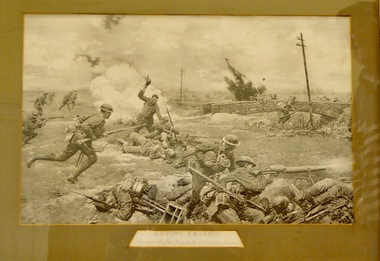
Photograph, Saving Amiens
... Consisting of four infantry battalions - the 33rd, 34th, 35th and 36th Battalions - the 9th Brigade was formed in 1916 and attached to the 3rd Division....Consisting of four infantry battalions - the 33rd, 34th, 35th and 36th Battalions - the 9th Brigade was formed in 1916 and attached to the 3rd Division. ...The battle for Amiens,situated at Picardy, France, began on the 8th August,1918. This was the opening offensive of the "100 DAY Offensive " that ultimately led to the end of WW1. Consisting of four infantry battalions - the 33rd, 34th, 35th and 36th Battalions - the 9th Brigade was formed in 1916 and attached to the 3rd Division.Amiens was one of the first major battles involving armoured warfare and marked the end of trench warfare on the Western Front.Rectangular shaped glass covered photo frame showing the 9th Australian Brigade charging.Saving Amiens. A Brilliant Bayonet Charge by the 9th Australian Brigade.world war 1,photo, saving amiens, lara r.s.l. 9th australian brigade.
