
Showing 15 items matching "5736"
-
 Bendigo Military Museum
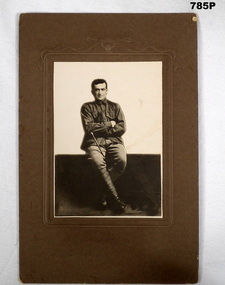
Photograph - PHOTOGRAPH WW1, After 29.2.16 and before 31.12.1916
... 5736...John George Duncan McInnes (Born Lyall Vic, enlisted Bendigo) in the AIF 29.2.1916 as No 5736 in the 6th Batt aged 26 years. He embarked on 3.7.1916 for England. ...John George Duncan McInnes (Born Lyall Vic, enlisted Bendigo) in the AIF 29.2.1916 as No 5736 in the 6th Batt aged 26 years. He embarked on 3.7.1916 for England. ...John George Duncan McInnes (Born Lyall Vic, enlisted Bendigo) in the AIF 29.2.1916 as No 5736 in the 6th Batt aged 26 years. He embarked on 3.7.1916 for England. He then transfered to the 59th Batt AIF. In the field he was hospitalised with Broncho Pneumonia and passed away on 31.12.1916. Refer 782.2, 786P.The outer brown frame has very fine markings in small circle arrangements. The centre photo has a frame edge with a flowing ribbon across the top. The centre photo itself is 100mm wide x 150mm high. The image of McInnes is blurred around the edge of the section in the area with white background. 5736, john george duncan mcinnes, 59th batt, aif -
 Whitehorse Historical Society Inc.
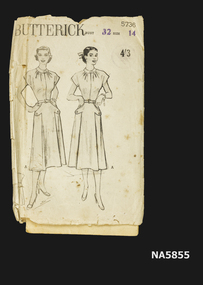
Domestic object - Butterick pattern No.5736, Butterick Publishing, 1951
... Butterick pattern No.5736 Dress pattern in off white sleeve with 2 models in dress outfits Size 14, Bust 32 4'3...Domestic dressmaking Dressmaking Women's dresses Butterick Paper patterns as above Butterick pattern No.5736 Dress pattern in off white sleeve with 2 models in dress outfits Size 14, Bust 32 4'3 Domestic object Butterick pattern No.5736 Butterick Publishing ...Domestic dressmakingButterick pattern No.5736 Dress pattern in off white sleeve with 2 models in dress outfits Size 14, Bust 32 4'3as abovedressmaking, women's dresses, butterick paper patterns -
 Bendigo Military Museum
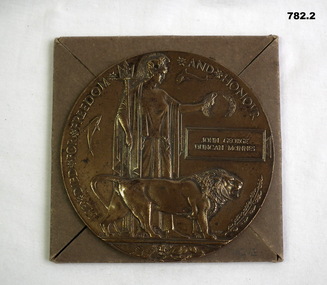
Memorabilia - MEMORIAL PLAQUE, post WWI
... J.G.D Mcinnes Regt No 5736 59th Batt A.I.F. Died of Bronco Pneumonia in the field 31.12.1916. ...J.G.D Mcinnes Regt No 5736 59th Batt A.I.F. Died of Bronco Pneumonia in the field 31.12.1916. ...J.G.D Mcinnes Regt No 5736 59th Batt A.I.F. Died of Bronco Pneumonia in the field 31.12.1916. Refer 785P for his service history also 786P..1) Plaque, Bronze, round with raised relief of Brittania, Lion & Seals, Rectangular section for individual names .2) Cardboard envelope for postage of the plaques, dark brown in colour“HE DIED FOR FREEDOM & HONOUR” “John George Duncan McInnes”military history, documents - envelopes, commeration, memorial plaques -
 Bendigo Military Museum
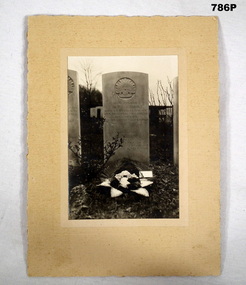
Photograph - GRAVE PHOTOGRAPH, Post WW1
... John George Duncan Mcinnes Regt No 5736 - 59th Batt A.I.F Died of Bronco Pneumonia in the Field 31.12.1916. ...John George Duncan Mcinnes Regt No 5736 - 59th Batt A.I.F Died of Bronco Pneumonia in the Field 31.12.1916. ...John George Duncan Mcinnes Regt No 5736 - 59th Batt A.I.F Died of Bronco Pneumonia in the Field 31.12.1916. Refer 785P for his service history also 782.2.Photograph on yellow card backing of the grave of McINNES, John George Duncan.war graves, photographs, ww1 aif -
 Greensborough Historical Society
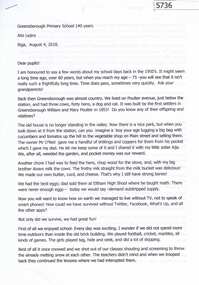
Leaflet, Atis Lejins, Greensborough Primary School 140 years, by Atis Lejins, 2018_08
Former resident of Greensborough, Lejins wrote to the pupils of Greensborough Primary on the occasion of the school's 140th anniversary.2 p. typescriptgreensborough primary school -
 Glenelg Shire Council Cultural Collection
Photograph - Photograph - Dutton Way, n.d
Black and white photo taken from glass plate negative, attached to heavy card. Dutton Way looking towards Whalers Bluff, road with fence above beach and a horse tied up to post.Front: 'Dutton Way 1900' - black texta -
 Flagstaff Hill Maritime Museum and Village
Domestic object - Spoon, circa 1878
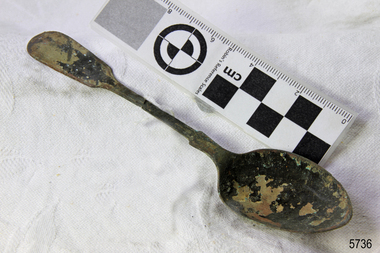
This tea spoon is from the wreck of the LOCH ARD, a Loch Line ship of 1,693 tons which sailed from Gravesend, London, on 2 March 1878 with 17 passengers and a crew of 36 under Captain George Gibbs. “The intention was to discharge cargo in Melbourne, before returning to London via the Horn with wool and wheat”. Instead, on 1 June 1878, after 90 days at sea, she struck the sandstone cliffs of Mutton Bird Island on the south west coast of Victoria, and sank with the loss of 52 lives and all her cargo. The manifest of the LOCH ARD listed an array of manufactured goods and bulk metals being exported to the Colony of Victoria, with a declared value of £53,700. (202 bills of lading show an actual invoice value of £68, 456, with insurance underwriting to £30,000 of all cargo). Included in the manifest is the item of “Tin hardware & cutlery £7,530”. This teaspoon is one of 482 similar items of electro-plated cutlery from the LOCH ARD site, comprising spoons and forks of various sizes but all sharing the same general shape or design and metallic composition. 49 of these pieces display a legible makers’ mark — the initials “W” and “P” placed within a raised diamond outline, which is in turn contained within a sunken crown shape — identifying the manufacturer as William Page & Co of Birmingham. An electroplater’s makers’ marks, unlike sterling silver hallmarks, are not consistent identifiers of quality or date and place of manufacture. A similar line of five impressions was usually made to impress the consumer with an implication of industry standards, but what each one actually signified was not regulated and so they varied according to the whim of the individual foundry. In this case, the maker’s marks are often obscured by sedimentary accretion or removed by corrosion after a century of submersion in the ocean. However sufficient detail has survived to indicate that these samples of electro-plated cutlery probably originated from the same consignment in the LOCH ARD’s cargo. The following descriptions of maker’s marks are drawn from 255 tea spoons, 125 dessert spoons, and 99 table forks. These marks are clearly visible in 66 instances, while the same sequence of general outlines, or depression shapes, is discernible in another 166 examples. 1. A recessed Crown containing a raised Diamond outline and the initials “W” and “P” (the recognised trademark of William Page & Co) 2. An impressed Ellipse containing a raised, pivoted, Triangle in its lower part and bearing a Resurrection Cross on its upper section (a possible dissenting church symbol reflecting religious affiliation); OR a rounded Square impression containing a raised, ‘lazy’, letter “B” (possibly mimicking sterling silver hallmark signifying city of manufacture i.e. Birmingham) 3. An impressed rounded Square filled with a raised Maltese Cross (the base metal composite of nickel silver was also known as ‘German silver’ after its Berlin inventors in 1823) 4. A recessed Circle containing a Crab or Scarab Beetle image; OR a recessed Circle containing a rotated ‘fleur de lys’ or ‘fasces’ design 5. A depressed Diamond shape enclosing a large raised letter “R” and a small raised letter “D” (mimicking the U.K. Patent Office stamp which abbreviated the term ‘registered’ to “RD”, but also included date and class of patent) Suggested trade names for William Page & Co’s particular blend of brass plating are ‘roman silver’ or ‘silverite’. This copper alloy polishes to a lustrous gold when new, discolouring to a murky grey with greenish hue when neglected. HISTORY OF THE LOCH ARD The LOCH ARD belonged to the famous Loch Line which sailed many ships from England to Australia. Built in Glasgow by Barclay, Curdle and Co. in 1873, the LOCH ARD was a three-masted square rigged iron sailing ship. The ship measured 262ft 7" (79.87m) in length, 38ft (11.58m) in width, 23ft (7m) in depth and had a gross tonnage of 1693 tons. The LOCH ARD's main mast measured a massive 150ft (45.7m) in height. LOCH ARD made three trips to Australia and one trip to Calcutta before its final voyage. LOCH ARD left England on March 2, 1878, under the command of Captain Gibbs, a newly married, 29 year old. She was bound for Melbourne with a crew of 37, plus 17 passengers and a load of cargo. The general cargo reflected the affluence of Melbourne at the time. On board were straw hats, umbrella, perfumes, clay pipes, pianos, clocks, confectionary, linen and candles, as well as a heavier load of railway irons, cement, lead and copper. There were items included that intended for display in the Melbourne International Exhibition in 1880. The voyage to Port Phillip was long but uneventful. At 3am on June 1, 1878, Captain Gibbs was expecting to see land and the passengers were becoming excited as they prepared to view their new homeland in the early morning. But LOCH ARD was running into a fog which greatly reduced visibility. Captain Gibbs was becoming anxious as there was no sign of land or the Cape Otway lighthouse. At 4am the fog lifted. A man aloft announced that he could see breakers. The sheer cliffs of Victoria's west coast came into view, and Captain Gibbs realised that the ship was much closer to them than expected. He ordered as much sail to be set as time would permit and then attempted to steer the vessel out to sea. On coming head on into the wind, the ship lost momentum, the sails fell limp and LOCH ARD's bow swung back. Gibbs then ordered the anchors to be released in an attempt to hold its position. The anchors sank some 50 fathoms - but did not hold. By this time LOCH ARD was among the breakers and the tall cliffs of Mutton Bird Island rose behind the ship. Just half a mile from the coast, the ship's bow was suddenly pulled around by the anchor. The captain tried to tack out to sea, but the ship struck a reef at the base of Mutton Bird Island, near Port Campbell. Waves broke over the ship and the top deck was loosened from the hull. The masts and rigging came crashing down knocking passengers and crew overboard. When a lifeboat was finally launched, it crashed into the side of LOCH ARD and capsized. Tom Pearce, who had launched the boat, managed to cling to its overturned hull and shelter beneath it. He drifted out to sea and then on the flood tide came into what is now known as LOCH ARD Gorge. He swam to shore, bruised and dazed, and found a cave in which to shelter. Some of the crew stayed below deck to shelter from the falling rigging but drowned when the ship slipped off the reef into deeper water. Eva Carmichael had raced onto deck to find out what was happening only to be confronted by towering cliffs looming above the stricken ship. In all the chaos, Captain Gibbs grabbed Eva and said, "If you are saved Eva, let my dear wife know that I died like a sailor". That was the last Eva Carmichael saw of the captain. She was swept off the ship by a huge wave. Eva saw Tom Pearce on a small rocky beach and yelled to attract his attention. He dived in and swam to the exhausted woman and dragged her to shore. He took her to the cave and broke open case of brandy which had washed up on the beach. He opened a bottle to revive the unconscious woman. A few hours later Tom scaled a cliff in search of help. He followed hoof prints and came by chance upon two men from nearby Glenample Station three and a half miles away. In a state of exhaustion, he told the men of the tragedy. Tom returned to the gorge while the two men rode back to the station to get help. By the time they reached LOCH ARD Gorge, it was cold and dark. The two shipwreck survivors were taken to Glenample Station to recover. Eva stayed at the station for six weeks before returning to Ireland, this time by steamship. In Melbourne, Tom Pearce received a hero's welcome. He was presented with the first gold medal of the Royal Humane Society of Victoria and a £1000 cheque from the Victorian Government. Concerts were performed to honour the young man's bravery and to raise money for those who lost family in the LOCH ARD disaster. Of the 54 crew members and passengers on board, only two survived: the apprentice, Tom Pearce and the young woman passenger, Eva Carmichael, who lost all of her family in the tragedy. Ten days after the LOCH ARD tragedy, salvage rights to the wreck were sold at auction for £2,120. Cargo valued at £3,000 was salvaged and placed on the beach, but most washed back into the sea when another storm developed. The wreck of LOCH ARD still lies at the base of Mutton Bird Island. Much of the cargo has now been salvaged and some was washed up into what is now known as LOCH ARD Gorge. Cargo and artefacts have also been illegally salvaged over many years before protective legislation was introduced. One of the most unlikely pieces of cargo to have survived the shipwreck was a Minton porcelain peacock - one of only seven in the world. The peacock was destined for the Melbourne International Exhibition in 1880. It had been well packed, which gave it adequate protection during the violent storm. Today, the Minton peacock can be seen at the Flagstaff Hill Maritime Museum in Warrnambool. From Australia's most dramatic shipwreck it has now become Australia's most valuable shipwreck artefact and is one of very few 'objects' on the Victorian State Heritage Register. The LOCH ARD shipwreck is of State significance – Victorian Heritage Register S 417. Flagstaff Hill’s collection of artefacts from LOCH ARD is significant for being one of the largest collections of artefacts from this shipwreck in Victoria. It is significant for its association with the shipwreck, which is on the Victorian Heritage Register (VHR S417). The collection is significant because of the relationship between the objects, as together they have a high potential to interpret the story of the LOCH ARD. The LOCH ARD collection is archaeologically significant as the remains of a large international passenger and cargo ship. The LOCH ARD collection is historically significant for representing aspects of Victoria’s shipping history and its potential to interpret sub-theme 1.5 of Victoria’s Framework of Historical Themes (living with natural processes). The collection is also historically significant for its association with the LOCH ARD, which was one of the worst and best known shipwrecks in Victoria’s history. Unrestored tea spoon from the wreck of the LOCH ARD. The spoon design has a flattened fiddle-back handle, with a thin stem or shank, flared collar, and elongated bowl. The spoons metallic composition is a thin layer of brass alloy which has partially corroded back to a nickel-silver base metal. Some verdigris. Impressions of five makers marks are visible but details are obscured.flagstaff hill, warrnambool, shipwrecked coast, flagstaff hill maritime museum, maritime museum, shipwreck coast, flagstaff hill maritime village, great ocean road, loch line, loch ard, captain gibbs, eva carmichael, tom pearce, glenample station, mutton bird island, loch ard gorge, electroplated cutlery, loch ard shipwreck, nickel silver, william page & co, birmingham, brass plating, makers marks -
 Ringwood and District Historical Society
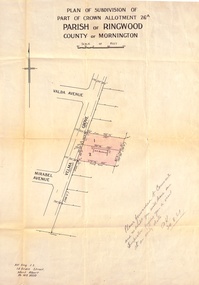
Document, Plan of Subdivision - Part of Crown Allotment 26A, Parish of Ringwood, County of Mornington - Circa 1961
Map showing layout of 2 allotments coloured red in Velma Grove, adjacent to Valda Avenue and Mirabel Avenue, Ringwood East, Vic.Handwritten notation dated 29/8/1961 by Alf King, Licensed Surveyor, 14 Grace Street, Mont Albert (Phone) WX2020 regarding plans being forwarded to Council for inspection visit. -
 Bendigo Historical Society Inc.
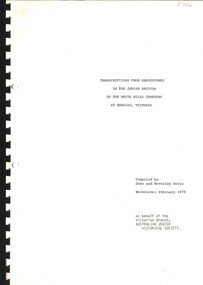
Book - TRANSCRIPTIONS FROM GRAVESTONES IN THE JEWISH SECTION OF THE WHITE HILLS CEMETERY AT BENDIGO, VICTORIA, 1978
Transcriptions from Gravestones in the Jewish section of the White Hills cemetery at Bendigo Victoria. Compiled by John and Beverley Davis on behalf of the Victorian branch, Australian Jewish Historical Society; February 1978John & Beverley Davisbendigo, history, cemetery -
 National Wool Museum
Photograph
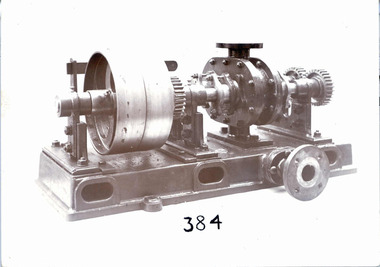
Photograph probably for promotional purposes, probably of part of the mechanism of a "David Sowden & Sons" loom No384 . Photograph was among items from Yarra Falls Mill.Photograph, black and white, probably of part of the mechanism of a "David Sowden & Sons" loom No384.384textile machinery weaving, yarra falls mill david sowden & sons, weaving looms, weaving machinery, textile machinery, weaving -
 Ballarat Tramway Museum
Photograph - Tram trailers - Railway Picnic day Mitchell St, Cyril White, 14/09/1906
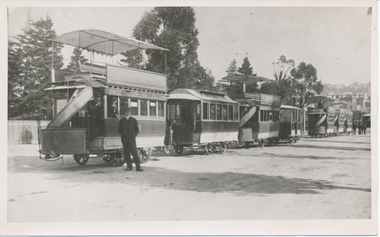
Photo of 7 Bendigo Tram trailers - both single and double deck in Mitchell St for the Railway Picnic Day 1906. In the far distance can be seen an electric tram.Yields information about trams used for the Railway Picnic day in 1906.Black and White copy print contained within the Wal Jack Bendigo and Geelong Album, see Reg Item 5003 for more details..1 - On the rear in pencil, "Bendigo Tramway Railway Picnic Day, 14-9-06, Nos. 1st car 9, 14, ?13, ?14", Has Ken Magor stamp in the bottom right-hand corner with the number "3784". On the rear in pencil of second copy from the Ken Magor collection- "Bendigo Victoria, Railway Picnic Day, 14 September 1906. Photo by Cyril White, Mundy St Bendigo. DD Nos. 9, S deck 14, DD No.13, Open and Seat, S deck D No. 12" - see rear image.trams, tramways, bendigo, mitchell st, trailers -
 Sunshine and District Historical Society Incorporated
Booklet - Back In Your Own Backyard, Living Museum of the West, October 1988
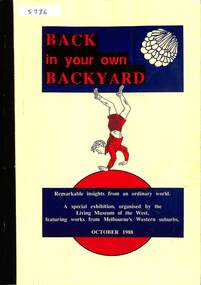
The Back In Your Own Backyard exhibition was a series of pieces from several groups and individuals who live and work in the Western Suburbs. The exhibition did not claim to be an "Art" exhibition although it may look something like it, but perhaps it could be called an exhibition of "Perceptions".Back In Your Own Backyard remarkable insights from an ordinary world A special exhibition, organised by the Living Museum of the West featuring works from Melbourne's Western suburbs October 1988living museum of the west, peter haffenden, bernard smith, peter somerville, a.r.c., keilor cake decorating group, fred pase, west side detailing, frank beattie, jack myers, ronald guy, newport senior citizens, tony hicks, john williams, deer park high school, essendon choral society, 1st melton brownie pack -
 Melbourne Tram Museum
Negative, Wal Jack, 1955-56
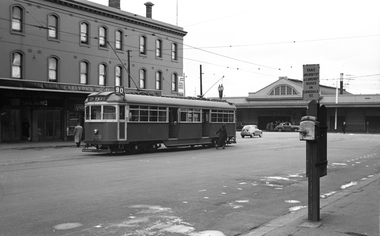
Black and white negative, by Wal Jack, of W7 1006 at the Spencer St terminus for the then new tramway to East Preston, route 90. The Conductress has changed the rear pole and is walking towards Spencer St. In the background is Spencer St Station and Carlyon's Hotel. On the post on the right hand side of the image is a Bundy clock, a track telephone and a sign "Take Nicholn (Nicholson) St and E. Brunswick (Brunswick) buses in Lonsdale St" There is a sign on the hotel advertising the Prince Henry's Hospital appeal. Photo not in Wal Jack Melbourne album.trams, tramways, bourke st, w7 class, new tramway, buses, bundy clock, route 90, tram 1006 -
 Allan Doney Collection, Bendigo Historical Society Inc.
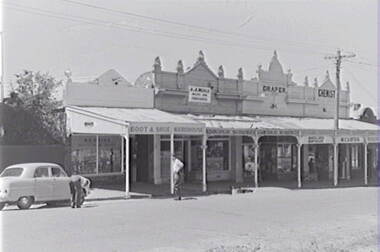
Negative - Street Bendigo - Businesses - Herlo - Furnisher, Allan Doney, 1950 -1970
In the years of Allan Doney’s photography, landmark buildings succumbed to fire, neglect and redevelopment. He photographed the grey sand hills from Bendigo’s mining past, the streetscapes, poppet heads, miners’ cottages, gracious homes with ornate verandahs, trams and much more. Above all, his photographs show how much of the city has survived from the 19th century – and how much has not. Through two decades of great change, Allan Doney was there to capture ways people interacted with it. Although he travelled to many other places in Northern Victoria and beyond in search of subjects for his art, he seemed to always return to Bendigo for inspiration. -
 Montmorency–Eltham RSL Sub Branch
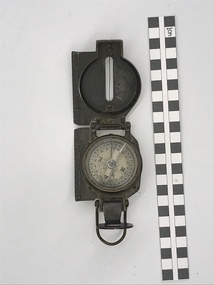
Instrument - Compass, Magnetic
... DA23-195-AMC-00906(T) (lid open; distance scale on edge - see Media item #5) 1000 2000 3000 1:25000 METERS (underside) RADIOISOTOPE H3 A.E.C. LICENSE NO. 8-5736-3 CONTAIN 75 MS. RADIOACTIVE H3 DO NOT OPEN DISPOSE OF PER AR 755-380 IF FOUND RETURN TO MILITARY AUTHORITY...DA23-195-AMC-00906(T) (lid open; distance scale on edge - see Media item #5) 1000 2000 3000 1:25000 METERS (underside) RADIOISOTOPE H3 A.E.C. LICENSE NO. 8-5736-3 CONTAIN 75 MS. RADIOACTIVE H3 DO NOT OPEN DISPOSE OF PER AR 755-380 IF FOUND RETURN TO MILITARY AUTHORITY US Magnetic Compass: Made in 1966; used in Vietnam War (Sometimes referred to as a Surveyor's Compass or, less accurately, a prismatic compass). ...US Magnetic Compass: Made in 1966; used in Vietnam War (Sometimes referred to as a Surveyor's Compass or, less accurately, a prismatic compass). When unfolded, the user puts a thumb through the wire loop, holds the lens in front of the eye, and aims the wire 'aiming line' at the required object or direction. While held, the user then looks down towards the dial to read the compass direction. The engraving underneath includes a reference to radioactive material ('H3' – the tritium isotope of Hydrogen) and is used in the luminous paintings that mark principal compass directions.(with lid closed) U.S. COMPASS MAGNETIC FSN 6605-846 7618 UNION INSTRUMENT CORP. PLAINFIELD, N.J. DA23-195-AMC-00906(T) (lid open; distance scale on edge - see Media item #5) 1000 2000 3000 1:25000 METERS (underside) RADIOISOTOPE H3 A.E.C. LICENSE NO. 8-5736-3 CONTAIN 75 MS. RADIOACTIVE H3 DO NOT OPEN DISPOSE OF PER AR 755-380 IF FOUND RETURN TO MILITARY AUTHORITY
