
Showing 495 items matching "8 light horse"
-
 4th/19th Prince of Wales's Light Horse Regiment Unit History Room
Photograph, AIF, RHQ Troop of 8 Light Horse Regiment, abt 1918
... RHQ Troop of 8 Light Horse Regiment......8 light horse...Black & white photo, 195 x 147 mm of RHQ Troop of 8 Light Horse Regiment. Photo shows 36 mounted members formed up on a beach...photo 8 light horse ww1 Stamp on back: Official photograph AIF in Egypt Copyright Reserved Black & white photo, 195 x 147 mm of RHQ Troop of 8 Light Horse Regiment. ...Black & white photo, 195 x 147 mm of RHQ Troop of 8 Light Horse Regiment. Photo shows 36 mounted members formed up on a beachStamp on back: Official photograph AIF in Egypt Copyright Reservedphoto, 8 light horse, ww1 -
4th/19th Prince of Wales's Light Horse Regiment Unit History Room
Photograph, AIF, Horses that left with original 8 Light Horse Regiment, abt 1918
... Horses that left with original 8 Light Horse Regiment......8 light horse...Black and white photo, 195 x 147 mm, notated "Horses that left with original 8 Light Horse Regiment". Photo shows group of horses with mounted soldiers each with about three unsaddled horses. ...photo 8 light horse ww1 Stamp on back: Official Photograph AIF in Egypt Copyright Reserved Black and white photo, 195 x 147 mm, notated "Horses that left with original 8 Light Horse Regiment". ...Black and white photo, 195 x 147 mm, notated "Horses that left with original 8 Light Horse Regiment". Photo shows group of horses with mounted soldiers each with about three unsaddled horses. Camp and motor transport lines in backgroundStamp on back: Official Photograph AIF in Egypt Copyright Reservedphoto, 8 light horse, ww1 -
4th/19th Prince of Wales's Light Horse Regiment Unit History Room
Photograph, AIF, 8 Light Horse Regiment bodyguard to Divisional Headquarters, abt 1918
... 8 Light Horse Regiment bodyguard to Divisional Headquarters...Black & white photo, 195 x 147 mm, 8 Light Horse Regiment bodyguard to Divisional Headquarters. ...On back: Official Photograph AIF in Egypt Copyright Reserved Black & white photo, 195 x 147 mm, 8 Light Horse Regiment bodyguard to Divisional Headquarters. ...Black & white photo, 195 x 147 mm, 8 Light Horse Regiment bodyguard to Divisional Headquarters. Photo shows troop formed up on road with camp in the back ground On back: Official Photograph AIF in Egypt Copyright Reserved -
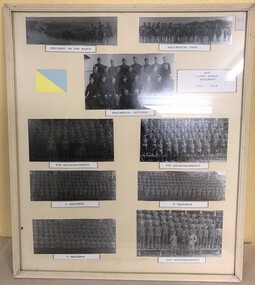 8th/13th Victorian Mounted Rifles Regimental Collection
Artwork, other - 8 Light Horse
... 8 Light Horse ...light horse World War One WWI Framed collection of black and white photographs of 8th Light Horse c. 1915. Artwork, other 8 ...Framed collection of black and white photographs of 8th Light Horse c. 1915.light horse, world war one, wwi -
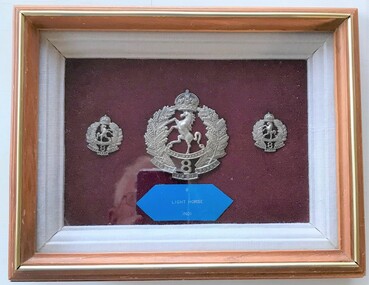 8th/13th Victorian Mounted Rifles Regimental Collection
Badge - 8th Light Horse badges
... 8 / Light Horse / Indi...Light Horse (Indi) Citizen Military Forces, superseded 16th (Indi) Light Horse in 1920. It had its headquarters at Benalla with sub-units throughout the Upper Murray and Northeast Victoria. In December 1941, the regiment converted from horse to mechanised, initially as 8th Reconnaissance Battalion then in July 1942 it became 8th Cavalry Regiment and served in Northern Territory. As Japanese threat to the mainland declined the regiment was disbanded. Well presented set of regimental badges relating to citizen soldiers of North East Victoria. badge light horse 8th 8 ...The 8th Light Horse (Indi) Citizen Military Forces, superseded 16th (Indi) Light Horse in 1920. It had its headquarters at Benalla with sub-units throughout the Upper Murray and Northeast Victoria. In December 1941, the regiment converted from horse to mechanised, initially as 8th Reconnaissance Battalion then in July 1942 it became 8th Cavalry Regiment and served in Northern Territory. As Japanese threat to the mainland declined the regiment was disbanded.Well presented set of regimental badges relating to citizen soldiers of North East Victoria.Framed set of one hat badge and pair of collar badges of 8th (Indi) Light Horse Regiment8 / Light Horse / Indibadge, light horse, 8th -
4th/19th Prince of Wales's Light Horse Regiment Unit History Room
Photograph, AIF, C Squadron 8th Light Horse Regiment, abt 1918
... ...8 light horse...photo 8 light horse ww1 Stamp on back: Official Photograph AIF in Egypt Copyright Reserved Black & white photo, 195 x 147 mm, of C Squadron 8th Light Horse Regiment. ...Black & white photo, 195 x 147 mm, of C Squadron 8th Light Horse Regiment. Squadron is formed up by troops. Three tents and a long line of camels in background.Stamp on back: Official Photograph AIF in Egypt Copyright Reservedphoto, 8 light horse, ww1 -
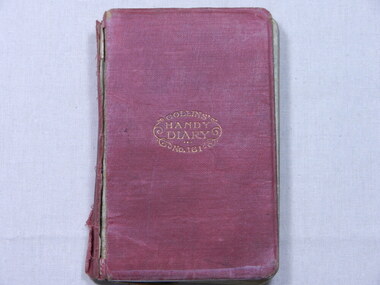 RSL Victoria - Anzac House Reference Library and Memorabilia Collection
Diary of Charles John Mullins - (Item held at Monash Memorial Defence Library), 25 February 1915 to 11 September 1915
... ...8 light horse regiment...Diary covers the period from departure from Port Melbourne on Thursday 25 February 1915 until Saturday 11 September 1915 (by which time Charles Mullins had returned to Melbourne after being wounded at Gallipoli). ww1 gallipoli diaries 8 light horse regiment charles john mullins WW1 hardcover diary of Charles John Mullins (420 - 8th Light Horse Regiment, C Squadron). ...Diary covers the period from departure from Port Melbourne on Thursday 25 February 1915 until Saturday 11 September 1915 (by which time Charles Mullins had returned to Melbourne after being wounded at Gallipoli).WW1 hardcover diary of Charles John Mullins (420 - 8th Light Horse Regiment, C Squadron).ww1, gallipoli, diaries, 8 light horse regiment, charles john mullins -
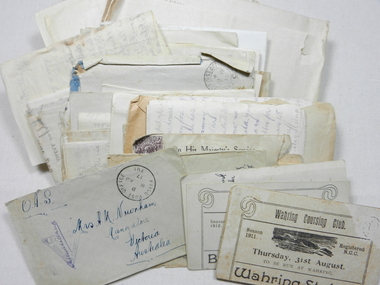 RSL Victoria - Anzac House Reference Library and Memorabilia Collection
Letters of John Edward & William James Newnham - (Items held by Monash Memorial Defence Library), John & William Newnham, 1915 to 1919
... ...8 light horse regiment...Sister Ada Newnham served with the Australian Army Nursing Service. ww1 letters 24 battalion 8 light horse regiment william james newnham john edward newnham WW1 letters and cards (approx. 100) sent to family by John Newnham (682 - 24th Battalion, C Company) and William Newnham (430 - 8th Light Horse Regiment, C Squadron) - letters mostly written by William. ...John Newnham embarked from Melbourne 10/5/1915 and returned on 21/5/1917. William left Melbourne on 25/2/1915 and returned on 3/7/1919. Sister Ada Newnham served with the Australian Army Nursing Service.WW1 letters and cards (approx. 100) sent to family by John Newnham (682 - 24th Battalion, C Company) and William Newnham (430 - 8th Light Horse Regiment, C Squadron) - letters mostly written by William. ww1, letters, 24 battalion, 8 light horse regiment, william james newnham, john edward newnham -
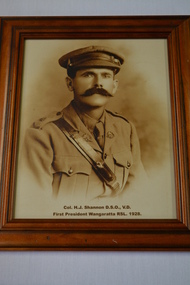 Wangaratta RSL Sub Branch
Photograph - Framed Photograph, Col. H J SHANNON D.S.O.,V.D, C1915
... ...8 Light Horse...Light Horse and served in Gallipoli, Sinai, Palestine and Syria where he commanded the 8th Squadron. Later he was promoted to Lieutenant Colonel and commanded the Regiment. During the Amman raids, he was awarded the D.S.O at El Salt. This award was presented to him by the Duke of Clarence. In post war period he commanded the 8th Australian Light Horse and later as Colonel of the 3rd Cavalry Brigade During the second world war Colonel Shannon came out from retirement to organise the Volunteer Defence Corp (VDC) in North East Victoria. wangaratta rsl h j shannon DSO WW1 8 Light Horse Col. ...Colonel Herbert James Shannon DSO, VD., became the 1st President of the Wangaratta RSL in 1928 when it was organised under Anzac House and the present constitution. He was born at Bowman's Forest in 1874 and died in Wangaratta in 1960. He served in the Victorian Mounted Rifles at the turn of the century, rose to the rank of Captain and commanded the Wangaratta Detachment and Company - this later became the 8th Light Horse Regiment. In 1915 he embarked as Major in the 8th Light Horse and served in Gallipoli, Sinai, Palestine and Syria where he commanded the 8th Squadron. Later he was promoted to Lieutenant Colonel and commanded the Regiment. During the Amman raids, he was awarded the D.S.O at El Salt. This award was presented to him by the Duke of Clarence. In post war period he commanded the 8th Australian Light Horse and later as Colonel of the 3rd Cavalry Brigade During the second world war Colonel Shannon came out from retirement to organise the Volunteer Defence Corp (VDC) in North East Victoria.Brown timber frame containing sepia photograph of Army OfficerCol. J. J. Shannon D.S.O., V.D. - First President Wangaratta RSL. 1928 wangaratta rsl, h j shannon, dso, ww1, 8 light horse -
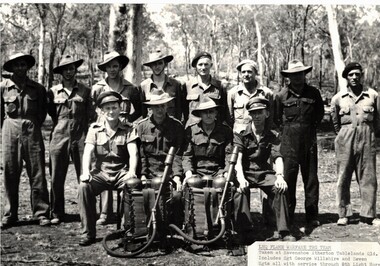 8th/13th Victorian Mounted Rifles Regimental Collection
Photograph - Flame Warfare Training
... ...8 light horse...Includes Sgt George Wiltshire and seven sgts all with service through 8th Light Horse Regiment, 8 Recce Bn, and finally 8 Cav Regt A.I.F....Light Horse. It had its headquarters at Benalla with sub-units throughout the Upper Murray and Northeast Victoria. In December 1941, the regiment converted from horse to mechanised, initially as 8th Reconnaissance Battalion then in July 1942 it became 8th Cavalry Regiment and served in Northern Territory. As Japanese threat to the mainland declined the regiment was disbanded and men transferred to a variety of other units. A small number were trained in the use of Flame thrower equipment in preparation for service in the landings at Balikpapan and Tarakan . military 8 ...The 8th Light Horse Regiment AIF was raised at Broadmeadows Victoria in September 1914 under the command of Lieutenant Colonel Alexander White and formed part of the 3rd Light Horse Brigade. The regiment served at Gallipoli where in a courageous but ill-fated charge at the Nek on 7 August 1915 it suffered horrendous casualties including Lieutenant Colonel White. Rebuilt in Egypt under the command of Lieutenant Colonel Leslie Maygar VC the regiment went on the serve throughout the Middle East Campaign. Colonel Maygar died of wounds at Beersheba when the regiment was attacked by enemy aircraft while waiting to follow up the successful charge of the 4th LH Brigade on 30 October 1917. The 8th Light Horse AIF was disbanded in 1919, but soon after re-raised as the 8th (Indi) Light Horse in the Citizen Military Forces, superseding 16th (Indi) Light Horse. It had its headquarters at Benalla with sub-units throughout the Upper Murray and Northeast Victoria. In December 1941, the regiment converted from horse to mechanised, initially as 8th Reconnaissance Battalion then in July 1942 it became 8th Cavalry Regiment and served in Northern Territory. As Japanese threat to the mainland declined the regiment was disbanded and men transferred to a variety of other units. A small number were trained in the use of Flame thrower equipment in preparation for service in the landings at Balikpapan and Tarakan .Black and white photograph of 12 soldiers dressed in khaki drill uniforms and wearing slouch hats and peak caps posed with two flame thrower devices. LHQ Flame Warfare Training Team. Taken at Ravenshoe Atherton Tablelands QLD. Includes Sgt George Wiltshire and seven sgts all with service through 8th Light Horse Regiment, 8 Recce Bn, and finally 8 Cav Regt A.I.F.military, 8 light horse, flame thrower, flame warfare, wwii, world war two -
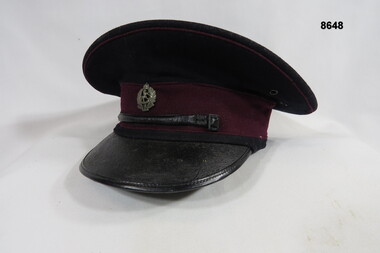 Bendigo Military Museum
Headwear - DRESS HAT/CAP, 8th Light Horse Regiment, WW1
... Unit Badge, 8 LIGHT HORSE Button, AUSTRALIAN MILITARY FORCES....LIGHT HORSE REGIMENT. Passchendaele Barracks Trust Headwear Dress Hat 8th Light Horse PBT 1. Unit Badge, 8 LIGHT HORSE Button, AUSTRALIAN MILITARY FORCES. ...JAMES KNOPP Regimental No. 1515. 8th AUSTRALIAN LIGHT HORSE REGIMENT.WW1 Military dress Hat with peak, black in colour with designated maroon stripe above the peak which circles the cap. The unit badge on the front of the cap is an 8th Light Horse Badge.Unit Badge, 8 LIGHT HORSE Button, AUSTRALIAN MILITARY FORCES.passchendaele barracks trust, headwear, dress hat, 8th light horse, pbt 1. -
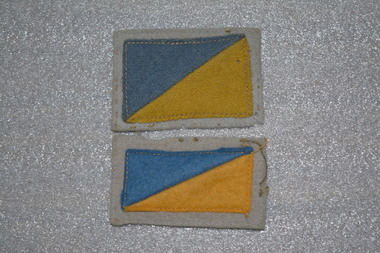 Wangaratta RSL Sub Branch
Uniform - Colour Patches, 8th Light Horse
... Horizontally aligned rectangular colour patch for 8 Light Horse Regiment, AIF, divided diagonally yellow (left) below light blue....Light Horse Regiment was established at the Broadmeadows Training Camp in Melbourne, Victoria. The Army Unit Colour Patches (UCP) were orginally designed in a simple manner,allowing other member to easily identify the member's unit, division and battalion. A UCP is worn on the puggaree of the slouch hat whilst the Unit Shoulder Patch will incorporate the UCP normally with a border showing the unit's superior HQ. wwi world war 1 light horse 8th regiment Nil Horizontally aligned rectangular colour patch for 8 Light Horse Regiment, AIF, divided diagonally yellow (left) below light blue. 8th Light Horse Uniform Colour Patches ...Army Unit Colour Patches were worn as a distinguishing unit indication at the top of each sleeve from 1916.The 8th Light Horse Regiment was formed as part of the 3rd Australian Light Horse Brigade, 3rd Contingent and attached to the Australian Division. Made up of men drawn from the 3rd Military District [Victoria], the 8th Light Horse Regiment was established at the Broadmeadows Training Camp in Melbourne, Victoria. The Army Unit Colour Patches (UCP) were orginally designed in a simple manner,allowing other member to easily identify the member's unit, division and battalion. A UCP is worn on the puggaree of the slouch hat whilst the Unit Shoulder Patch will incorporate the UCP normally with a border showing the unit's superior HQ. Horizontally aligned rectangular colour patch for 8 Light Horse Regiment, AIF, divided diagonally yellow (left) below light blue.Nilwwi, world war 1, light horse, 8th regiment -
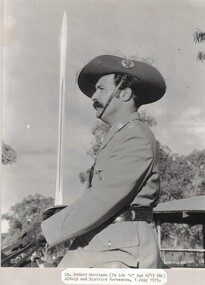 8th/13th Victorian Mounted Rifles Regimental Collection
Photograph - Lt Robert Morrison
... 8/13 VMR...light horse...Photograph of Lieutenant Robert Morrison, Light Horse Heritage Troop A Squadron 8 13 Victorian Mounted Rifles at the Albury and District Horseshow 1 July 1979....Morrison Albury 8/13 VMR light horse Black and white photograph of light horse officer holding sword. ...Photograph of Lieutenant Robert Morrison, Light Horse Heritage Troop A Squadron 8 13 Victorian Mounted Rifles at the Albury and District Horseshow 1 July 1979.Black and white photograph of light horse officer holding sword.morrison, albury, 8/13 vmr, light horse -
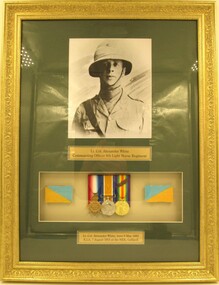 8th/13th Victorian Mounted Rifles Regimental Collection
Mixed media - Lt Col AH White, April 2024
... On plaque under portrait 'Lt Col Alexander White / Commanding Officer 8 Light Horse Regiment' and under medals 'Lt. Col. ...Light Horse. He was killed in action and his body never identified. His name is recorded on Lone Pine Memorial, Gallipoli Peninsula. He was posthumously mentioned in dispatches for his leadership in commanding the 8th Light Horse. Gallipoli White WWI 8LH Ballarat On plaque under portrait 'Lt Col Alexander White / Commanding Officer 8 ...Alexander Henry White, born 9 May 1882 was educated at Greenville College Ballarat. He enlisted in the Victorian Mounted rifles in 1899 and continued to serve in the Light Horse followinh Federation. Following the outbreak of World War One he applied for a commission in the AIF 19 November 1914 and was appointed as Commanding Officer 8th Light Horse regiment. He was 32 yers of age, married with one child. He sailed with the regiment to Egypt in December 1914, and in May 1915 landed at Gallipoli. Lieutenant Colonel received a shrapnel wound to the scalp 27June, was treated at the Casualty Clearing Station, and returned to duty 4 July. In the Charge at the Nek, 7 August, White chose to lead the first wave of the 8th Light Horse. He was killed in action and his body never identified. His name is recorded on Lone Pine Memorial, Gallipoli Peninsula. He was posthumously mentioned in dispatches for his leadership in commanding the 8th Light Horse. Framed case containing portrait of Lieutenant Colonel Alexander Henry White, together with his medals (replica) and colour patches of 8th Light Horse.On plaque under portrait 'Lt Col Alexander White / Commanding Officer 8 Light Horse Regiment' and under medals 'Lt. Col. Alexander White borne 9 May 1882 / K.I.A. 7 August 1915 at the NEK Gallipoli'gallipoli, white, wwi, 8lh, ballarat -
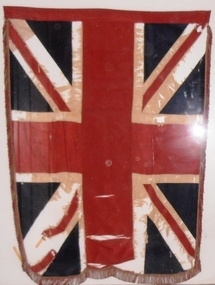 8th/13th Victorian Mounted Rifles Regimental Collection
Flag - Kings banner, Flag: 1904; case: 1976
... Light Horse in 1904 for service in South Africa. It, together with the 1920 Colour, was laid up in the Anglican Church Benalla. In 1976 both colours were found in a cupboard at the church. The 8th/13th Victorian Mounted Rifles Regiment arranged for a case for the colours to be mounted on the wall at the church. In the early eighties it became necessary to remove the case to allow building work at the church and the case and colours were donated to the 8...On plaque under flag: "The King's Colour presented to 8 Light Horse Regiment (Victorian Mounted Rifles) November 1904 For service in the Boer War". ...Light Horse Regiment with a close connection to regional Victoria. It is well provenanced, and mounted together with the 1920 Colour making it a rare object indeed. flag king's colour On plaque under flag: "The King's Colour presented to 8 Light Horse Regiment (Victorian Mounted Rifles) November 1904 For service in the Boer War". ...The King's Colour was presented to 8th Light Horse in 1904 for service in South Africa. It, together with the 1920 Colour, was laid up in the Anglican Church Benalla. In 1976 both colours were found in a cupboard at the church. The 8th/13th Victorian Mounted Rifles Regiment arranged for a case for the colours to be mounted on the wall at the church. In the early eighties it became necessary to remove the case to allow building work at the church and the case and colours were donated to the 8/13 Victorian Mounted Rifles Regimental Collection. Representative example of a King's Colour dating from 1904 presented to a Light Horse Regiment with a close connection to regional Victoria. It is well provenanced, and mounted together with the 1920 Colour making it a rare object indeed.Rectangular Union Jack flag (King's Colour) fringed with maroon and gold cord and mounted in a stained timber, glass fronted case, together with a second flag of similar appearance; The case has three engraved metal plaques affixed to the lower case.On plaque under flag: "The King's Colour presented to 8 Light Horse Regiment (Victorian Mounted Rifles) November 1904 For service in the Boer War". Plaque in the lower right corner of case: "This case was presented by the 8th/13th Victorian Mounted Rifles 1976".flag, king's colour -
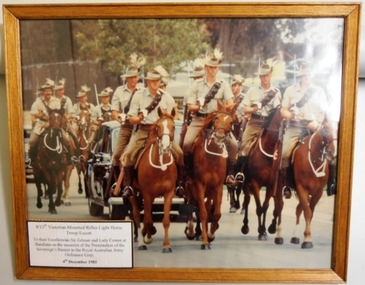 8th/13th Victorian Mounted Rifles Regimental Collection
Photograph - Light horse escort for GG Cowan, 1982 circa
... Sir Zelman Cowan was Governor General of Australia, December 1977-July 1982. The 8/13 VMR Light Horse Heritage Troop was an extra curricular activity of the 8/13th VMR. ...Card panel " 8/13 VMR Light Horse / Troop Escort / to their Excellencies Sir Zelman and Lady Cowan at / Bandiana on the occasion of the / Presentation of the Sovereign's Banner to the Royal Australian Army / Ordnance Corps / 4 Dec 1981"...Sir Zelman Cowan was Governor General of Australia, December 1977-July 1982. The 8/13 VMR Light Horse Heritage Troop was an extra curricular activity of the 8/13th VMR. ...Sir Zelman Cowan was Governor General of Australia, December 1977-July 1982. The 8/13 VMR Light Horse Heritage Troop was an extra curricular activity of the 8/13th VMR. Captain (later Major) Robert Morrison, a keen horseman, was the prime mover in raising the troop. All riders were serving soldiers.Representative example of activities of a Heritage Troop of a serving Royal Australian Armoured Corps regiment providing a vice regal escort at a rare and historic event for the Royal Australian Army Ordnance Corps (RAAOC) and the Australian Army.Framed coloured photograph of mounted troops with drawn sabres being an escort from 8/13th Victorian Mounted Rifles Heritage Troop escorting the Governor General Sir Zelman and Lady Cowan at Bandiana 4 December 1981. Escort is commanded by Captain Robert Morrison riding to the right of the official car..Card panel " 8/13 VMR Light Horse / Troop Escort / to their Excellencies Sir Zelman and Lady Cowan at / Bandiana on the occasion of the / Presentation of the Sovereign's Banner to the Royal Australian Army / Ordnance Corps / 4 Dec 1981"cowan zelman sir, 8/13 vmr, heritage troop, morrison robert captain, royal australian army ordnance corps (raaoc), sovereign's banner, raaoc -
 Orbost & District Historical Society
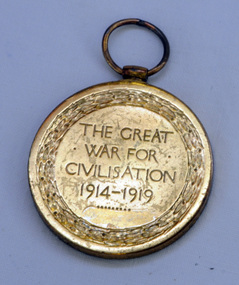
medal, After 1 September 1919
... This one belonged to James Pullar Cameron 8 Light Horse Regiment AIF. He was killed in action at Lone pine....This one belonged to James Pullar Cameron 8 Light Horse Regiment AIF. He was killed in action at Lone pine. ...This campaign medal (the Victory Medal) was issued to all those who received the 1914 or 1915 Star and to most of those who received the British war medal. Recipientss had to be mobilised in any service between 5 August 1914 and 11 November 1918. This one belonged to James Pullar Cameron 8 Light Horse Regiment AIF. He was killed in action at Lone pine.James Pullar Cameron was the son of Robert Cameron one of the earliest settlers on the Orbost flats. He was a trooper in the 8 Light Horse Regiment and died at Gallipoli on 7 August 1915.A circular bronze medal. One side shows the winged figure of Victory with her left arm extended and holding a palm branch in her right hand. On the other side are the words "THE GREAT WAR FOR CIVILISATION 1914-1919" surrounded by a laurel wreath. There is a circular attachment. There is no ribbon.THE GREAT WAR FOR CIVILISATION 1914-1919medal military cameron military victory-medal -
 8th/13th Victorian Mounted Rifles Regimental Collection
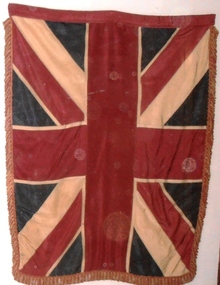
Flag - King's banner, 1920; case 1976
... Light Horse in 1920 for service in the Great War. It, together with the 1904 Colour, was laid up in the Anglican Church Benalla. In 1976 both colours were found in a cupboard at the church. The 8th/13th Victorian Mounted Rifles Regiment arranged for a case for the colours to be mounted on the wall at the church. In the early eighties it became necessary to remove the case to allow building work at the church and the case and colours were donated to the 8...On plaque under flag: "The King's Colour presented to 8 Indi Light Horse August 1920 For service in the Great War". ...Light Horse Regiment with a close connection to regional Victoria. It is well provenanced, and mounted together with the 1904 Colour making it a rare object indeed. king's colour flag 8th light horse regiment On plaque under flag: "The King's Colour presented to 8 Indi Light Horse August 1920 For service in the Great War". ...The King's Colour was presented to 8th Indi Light Horse in 1920 for service in the Great War. It, together with the 1904 Colour, was laid up in the Anglican Church Benalla. In 1976 both colours were found in a cupboard at the church. The 8th/13th Victorian Mounted Rifles Regiment arranged for a case for the colours to be mounted on the wall at the church. In the early eighties it became necessary to remove the case to allow building work at the church and the case and colours were donated to the 8/13 Victorian Mounted Rifles Regimental Collection.Representative example of a King's Colour dating from 1920 presented to a Light Horse Regiment with a close connection to regional Victoria. It is well provenanced, and mounted together with the 1904 Colour making it a rare object indeed.Rectangular Union Jack flag (King's Colour) fringed with maroon and gold cord and mounted in a stained timber, glass fronted case, together with a second flag of similar appearance; The case has three engraved metal plaques affixed to the lower case.On plaque under flag: "The King's Colour presented to 8 Indi Light Horse August 1920 For service in the Great War". Plaque in the lower right corner of case: "This case was presented by the 8th/13th Victorian Mounted Rifles 1976".king's colour, flag, 8th light horse regiment -
Wangaratta RSL Sub Branch
Audio - Oral history interview, Joyce Barry
... Her husband Richard Barry served with the RAN during WW2 and her father John “Jack” Poulter 1296, born in Wangaratta served with the 8 Light Horse during WW1. He was wounded in action on 2/11/1917 receiving a gunshot wound to the thigh. ...Her husband Richard Barry served with the RAN during WW2 and her father John “Jack” Poulter 1296, born in Wangaratta served with the 8 Light Horse during WW1. He was wounded in action on 2/11/1917 receiving a gunshot wound to the thigh. ...Joyce Barry served in the Women's Auxiliary Air Force during the Second World War. In her interview, Joyce shares what inspired her to join the services and what training was like for a young woman living in Victoria. Joyce was born on 1/5/1922 and passed away on the 26/10/2025 at the age of 103. She enlisted in the Women’s Auxiliary Australian Air Force at the age of 19 years and 11 months on April 8 1942 and was discharged on November 11 1946. Her service number was 95156 and performed duty as a Clerk Stores Assistant. Her husband Richard Barry served with the RAN during WW2 and her father John “Jack” Poulter 1296, born in Wangaratta served with the 8 Light Horse during WW1. He was wounded in action on 2/11/1917 receiving a gunshot wound to the thigh. He was discharged on 25/10/1919 and later became a policeman. Joyce passed away in October 2025 at the age of 103.This digital oral history interview was conducted at Wangaratta RSL Sub Branch on March 21, 2018 as part of the Veterans Heritage Project.joyce barry, waaf, ww2, oral history, wangaratta -
4th/19th Prince of Wales's Light Horse Regiment Unit History Room
DVD, Laying Up of the Guidons 7 August 2005, 2005
... DVD of ceremonial parade at Shrine of Remembrance on 7 Aug 2005 to lay up Guidons of 8, 13,17,19 and 20 Light Horse Regiments...DVD Laying up Guidons DVD of ceremonial parade at Shrine of Remembrance on 7 Aug 2005 to lay up Guidons of 8, 13,17,19 and 20 Light Horse Regiments Laying Up of the Guidons 7 August 2005 DVD ...DVD of ceremonial parade at Shrine of Remembrance on 7 Aug 2005 to lay up Guidons of 8, 13,17,19 and 20 Light Horse Regimentsdvd, laying up guidons -
 Bendigo Military Museum
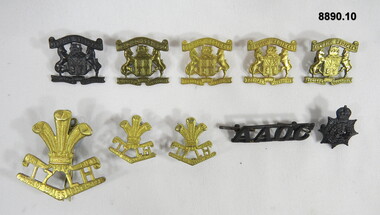
Badge - VARIOUS MILITARY BADGES, Unknown
... Sizes vary. 1. 38th Infantry Battalion collar, anodised. 2. 38th Infanttry Battalion collar (a). 3. 38th Infantry Battalion collar (b). 4. 38th Infantry Battalion collar (c). 5. 38th Infantry Battalion collar (d). 6. 17th Light Horse hat. 7. 17th Light Horse collar. 8. 17th Light Horse collar (a). 9. ...Sizes vary. 1. 38th Infantry Battalion collar, anodised. 2. 38th Infanttry Battalion collar (a). 3. 38th Infantry Battalion collar (b). 4. 38th Infantry Battalion collar (c). 5. 38th Infantry Battalion collar (d). 6. 17th Light Horse hat. 7. 17th Light Horse collar. 8. 17th Light Horse collar (a). 9. ...Military Badges either gold, silver or brass colour with or without a backing mounting plate, pins. Sizes vary. 1. 38th Infantry Battalion collar, anodised. 2. 38th Infanttry Battalion collar (a). 3. 38th Infantry Battalion collar (b). 4. 38th Infantry Battalion collar (c). 5. 38th Infantry Battalion collar (d). 6. 17th Light Horse hat. 7. 17th Light Horse collar. 8. 17th Light Horse collar (a). 9. Australian Army Ordnance Corps Brass shoulder circa WW1. 10. Army Service Corps collar anodised. passchendaele barracks trust, pbt451to460, badges -
 Flagstaff Hill Maritime Museum and Village
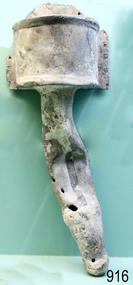
Functional object - Urinal, circa 1825
... On the 11th of January 1839, the Children sailed from Launceston for Adelaide, with 24 passengers, 14 crew, and an awkward mixed cargo, including 1500 sheep, 8 bullocks, 7 horses, farming implements, and six whaleboats with associated whaling gear. One account states that when the Children was “put out from port, she was light and badly ballasted”. ...On the 11th of January 1839, the Children sailed from Launceston for Adelaide, with 24 passengers, 14 crew, and an awkward mixed cargo, including 1500 sheep, 8 bullocks, 7 horses, farming implements, and six whaleboats with associated whaling gear. One account states that when the Children was “put out from port, she was light and badly ballasted”. ...The urinal was probably situated in the forward part of the ship rather than the stern, being one of two placed on either side of the deck and housed immediately adjacent to the doors into the forward castle, or crew sleeping quarters. The toilets on maritime vessels were (and still are) called the ‘heads’, after the sanitation arrangements common until the end of the eighteenth century. The name was given to the ‘head’ of the ship, forward of the forecastle and around the beak or bowsprit. These first lavatories were floored with grating or nets so the force of the sea could wash them clean, and they were always used on the lee or non-weather side so the effluent fell directly into the water rather than back on board. The Children's wrecking: The barque Children was one of the first vessels to be lost in the Western District. The vessel was wrecked to the east of Warrnambool on 14th January 1838. When it ran ashore in hurricane-force winds, 22 passengers and crew were fortunate to escape being battered to death on the rocks. The Children broke up within 20 minutes, sweeping sixteen of those on board to their deaths. After eleven days, the rescued survivors, all of whom were injured, had been taken to Portland. According to Lloyd's Shipping Register 1837-1839, the Children was built in 1825 at Liverpool and operated by owners Gordon & Co, of London. Registration number 123/1837, James Henty then bought her in 1837 as a three-masted barque of 254 tons, with a hull of “part pitch pine, felt sheathed” and “coppered in 1837” at Launceston, registered number 6/1837. In 1838, the Children, under her master Captain H. Browne, completed a successful round trip from Launceston to London (carrying wool and whale oil loaded in Portland), returning in late November of that year carrying a general cargo including house bricks used for ballast. On the 11th of January 1839, the Children sailed from Launceston for Adelaide, with 24 passengers, 14 crew, and an awkward mixed cargo, including 1500 sheep, 8 bullocks, 7 horses, farming implements, and six whaleboats with associated whaling gear. One account states that when the Children was “put out from port, she was light and badly ballasted”. The vessel immediately encountered four days of hurricane-force storms, eventually clearing on the early morning of the 14th. However, it was too late to take accurate measurements of the sun or stars to establish their position relative to the coast. The Children collided with a limestone stack at the entrance of what is now Childers Cove, and the seas smashed the vessel into pieces within half an hour. All the cargo and 16 lives were lost, including 9 children. The Henty brothers contributed £150 towards a fund for the 22 survivors at a memorial service held in Launceston later that year. It was a major financial setback for James Henty and his brothers, but one from which they recovered. In a submission to the Governor of New South Wales dated 24 March 1840, the Henrys summarised their work over the previous six years of establishing the Portland settlement, stating “Six stations have been occupied, one at Portland Bay three at the open country about 60 miles inland called ‘Merino Downs’ They have erected two houses at Portland Bay and two others at Merino Downs”.The urinal recovered from the Children's wreck is significant as part of the original fittings of the early 19th-century barque. The 1839 wreck and recovered artefacts are examples of the construction methods and materials used in that era and can be used to study the evolution of shipbuilding methods and principles. The wreck of the Children is of state significance as one of colonial Victoria’s earliest and most significant maritime disasters, and one of the first vessels lost in the Western District. This is recognised by its inclusion on the Victorian Heritage Register, VHR No. S116. Little is left on the seabed to mark the tragedy, apart from some of the house bricks intended for the Henty settlement. A lead urinal with a rounded back at the top splash plate with an attached semi-circular receptacle or basin (20cm deep and projecting forward 30cm). At the sides are flanges with bolt holes connecting to a ship's wall. The urinal is drained by a funnel-shaped outlet also made of lead, reducing from a 10cm radius to a joined 5 cm pipe. The urinal was recovered from the wreck of the CHILDREN.flagstaff hill, warrnambool, flagstaff-hill, flagstaff-hill-maritime-museum, shipwreck-coast, shipwreck artefact, the children, lead ship’s plumbing, crew urinal, the ‘heads’, ship plumbing, james henty, portland bay, urinal, ship's urinal, ship’s fitting, ship’s lead plumbing, ship’s toilet, ship’s urinal, children, childer’s cove, port campbell, 1839 shipwreck, james henty and co, henty brothers, captain h. browne, portland -
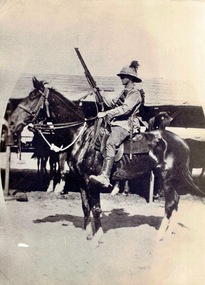 Lara RSL Sub Branch
Service Gear, Trooper Patrick Nolan, Picture on his horse "Jack Ordeal" with his googles, stirrups, Registration of membership to R. S..S. I. L .A. dated 6/2/1917, badge "Rising Sun"
... horse "Jack Ordeal" taken at Port Said. Accompanied by items: stirrups, badge "Raising Sun, Registration of membership to R. S..S. I. L .A. dated 6/2/1917. Patrick Nolan Joined as a labourer aged 21 on 5/8/1915. Attached to Reinforcements, the 8th Australian Light...Light Horse Egypt 1st World War 1914/1918 Photograph of Trooper Patrick Nolan on his horse "Jack Ordeal" taken at Port Said. Accompanied by items: stirrups, badge "Raising Sun, Registration of membership to R. S..S. I. L .A. dated 6/2/1917. Patrick Nolan Joined as a labourer aged 21 on 5/8 ...Details relating to Trooper Patrick NolanWW1 8th Light HorsePhotograph of Trooper Patrick Nolan on his horse "Jack Ordeal" taken at Port Said. Accompanied by items: stirrups, badge "Raising Sun, Registration of membership to R. S..S. I. L .A. dated 6/2/1917. Patrick Nolan Joined as a labourer aged 21 on 5/8/1915. Attached to Reinforcements, the 8th Australian Light Horse. Also known as Maygar's Boys. Suffering shell shock and deafness at Bir El Abd, Sinai, 8/9/1916. Discharged in Melbourne, 8/12/1916, rejoined Home Service 6/2/1917. Discharged at own request 21/6/1917. Rejoined 26/7/1917. Discharged 5/5/1918Dust/sand goggles, leather with brown lens for desert warfare. Lens 4.5 cm round, Badge "Rising Sun" Australian Military ArmedForces L 6.00 cm H. 4.5 cm. 1904 blackened copper. Left and Right strips. Markings stamped inside C. Greatnfk & Son Ld, solid nickel. The righthand strip has a broken foot strap mounting. Paper receipt for membership to Returned Sailors & Soldiers Imperial League dated 6/2/1917. Number 965. Group Photo * light bHorse Inscription on Back - mBack Row @nd from Left Patrick Nolan Dad 8th Light Horse Egypt 1st World War 1914/1918 nolan patrick 8th light horse world war one trooper stirrups goggles rising sun -
 Flagstaff Hill Maritime Museum and Village
Functional object - Nail, circa 1825
... On the 11th of January 1839, the Children sailed from Launceston for Adelaide, with 24 passengers, 14 crew, and an awkward mixed cargo, including 1500 sheep, 8 bullocks, 7 horses, and farming implements, and six whaleboats with associated whaling gear. One account states that when the Children were “put out from port she was light and badly ballasted”. ...On the 11th of January 1839, the Children sailed from Launceston for Adelaide, with 24 passengers, 14 crew, and an awkward mixed cargo, including 1500 sheep, 8 bullocks, 7 horses, and farming implements, and six whaleboats with associated whaling gear. One account states that when the Children were “put out from port she was light and badly ballasted”. ...Nails such as this solid copper nail were forged by blacksmiths. A nail of this length could have been used for the ship's decking. It was recovered from the shipwreck of the barque Children. The Children wrecking: The barque Children was one of the first vessels to be lost in the Western District the vessel was wrecked to the east of Warrnambool on 14th January 1838. When it ran ashore in hurricane-force winds, 22 passengers and crew were fortunate to escape being battered to death on the rocks. The Children broke up within 20 minutes, sweeping sixteen of those on board to their deaths. After eleven days, the survivors, all of whom were injured, were rescued and taken to Portland. According to Lloyd's Shipping Register 1837-1839, the Children was built in 1825 at Liverpool and operated by owners Gordon & Co, of London. Registration number 123/1837, James Henty then bought her in 1837 as a three-masted barque of 254 tons, with a hull of “part pitch pine, felt sheathed” and “coppered in 1837” at Launceston registered number 6/1837. In 1838 the Children, under her master Captain H. Browne, completed a successful round trip from Launceston to London (carrying wool and whale oil loaded in Portland), returning in late November of that year carrying a general cargo including house bricks used for ballast. On the 11th of January 1839, the Children sailed from Launceston for Adelaide, with 24 passengers, 14 crew, and an awkward mixed cargo, including 1500 sheep, 8 bullocks, 7 horses, and farming implements, and six whaleboats with associated whaling gear. One account states that when the Children were “put out from port she was light and badly ballasted”. The vessel immediately encountered four days of hurricane-force storms, eventually clearing on the early morning of the 14th. However, it was too late to take accurate measurements of the sun or stars to establish their position relative to the coast. The Children collided with a limestone stack at the entrance of Childers Cove, and the seas smashed her into pieces within half an hour. All the cargo and 16 lives were lost including 8 children. The Henty brothers contributed £150 towards a fund for the 22 survivors at a memorial service held in Launceston later that year. It was a major financial setback for James Henty and his brothers, but one from which they recovered. In a submission to the Governor of New South Wales dated 24 March 1840, the Henty’s summarised their work over the previous six years of establishing the Portland settlement stating. “Six stations have been occupied, one at Portland Bay three at the open country about 60 miles inland called ‘Merino Downs’ They have erected two houses at Portland Bay and two others at Merino Downs”.This nail is significant as part of the vessels original fixtures. The Children was delivering cargo intended for the Portland Bay settlement of her owners the James Henty brothers The wreck is also significant as one of the first vessels to have been lost in the Western District of Warrnambool. As a result the shipwreck of the Children is registered with the Victorian Heritage Register S116. Ship's nail, copper, with a washer attached. The nail has a round head, solid round shank and a flat end. It is bent, twisted and has indentations in the centre section. The nail was recovered from the wreck of the CHILDREN.warrnambool, flagstaff-hill-maritime-museum, shipwreck-coast, shipwreck artefact, the children, nail, copper nail, ship's nail, children shipwreck -
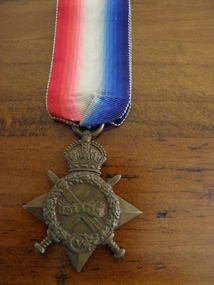 Geelong RSL Sub Branch
Medal - 1319 E E Cork, Early 1900s
... Light Horse Regiment, AIF. The archives record shows him as posted to 4th Light Horse, the 1914-1915 Star has 8th Light Horse. This Medal is the original that was issued to 1319 E E Cork 1319 e e cork ww1 light horse geelong On the reverse 1319 Pte E E Cork, 8/LH Rgt, AIF 1914-1915 Star with ribbon - red white blue stripe - bronze colour. ...1319 E E Cork enlisted in Geelong 26 July 1915 and served during WW1 with Light Horse Regiment, AIF. The archives record shows him as posted to 4th Light Horse, the 1914-1915 Star has 8th Light Horse.This Medal is the original that was issued to 1319 E E Cork1914-1915 Star with ribbon - red white blue stripe - bronze colour.On the reverse 1319 Pte E E Cork, 8/LH Rgt, AIF1319 e e cork, ww1, light horse, geelong -
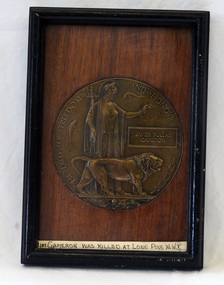 Orbost & District Historical Society
medallion, Memorial Plaque Factory, after WW1
... He was a trooper in the 8 Light Horse Regiment and died at Gallipoli on 7 August 1915. ww1 gallipoli cameron medallion military Around the picture- He died for freedom and honour. ...These medallions were issued after the First World war to the next-of-kin of all British and Commonwealth(Empire) service personnel who were killed as a result of the war. The plaques were made of bronze aand hence popularly known as the "Dead Man's Penny". James Pullar Cameron was killed at Lone Pine during WW1. James Pullar Cameron (Service No 605) enlisted in the 8th Light Horse at Orbost on September 11, 1914 aged 23 years 5 months. His medical was done by Dr James Kerr. He was 6 ft 1 in tall, 11 st 6 lbs, of dark complexion with dark eyes and hair and a chest measurement of 34 ½ / 38 inches. After training, he embarked the Armadale on February 12, 1915. He was shot in the chest at the Dardanelles on May 29, 1915 and taken aboard the HT Neuralia for transfer to Malta. He was admitted to the military hospital ‘Cootenara’ and after 10 days treatment, he re-embarked for Gallipoli aboard the HMT Southland on June 14, 1915. He returned to duty at Gallipoli on June 20, 1915. On August 7, 1915 he was killed in action. His body was not recovered. His name is on the memorial at Lone Pine. His memorial plaque has a wide H and a number behind the back paw of the lion, indicating that this plaque was made at the Acton Factory, one of the later ones cast there.James Pullar Cameron was the son of Robert Cameron one of the earliest settlers on the Orbost flats. He was a trooper in the 8 Light Horse Regiment and died at Gallipoli on 7 August 1915.A bronze commemorative medallion in a wooden frame. The token has an image of Britannia holding trident and standing with a lion. The designer's initials E.Cr.P appear above the front paw. In her left outstretched hand she holds an oak wreath with the name James Pullar Cameron in a rectangle. His memorial plaque has a wide H and a number behind the back paw of the lion, indicating that this plaque was made at the Acton Factory, one of the later ones cast there.Around the picture- He died for freedom and honour.ww1 gallipoli cameron medallion military -
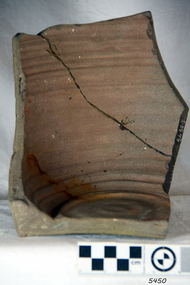 Flagstaff Hill Maritime Museum and Village
Bowl
... On the 11th January 1839, the CHILDREN sailed from Launceston for Adelaide, with 24 passengers, 14 crew, and an awkward mixed cargo, including 1500 sheep, 8 bullocks, 7 horses, and farming implements, and six whaleboats with associated whaling gear. One account states that when the CHILDREN “put out from port she was light and badly ballasted”. ...On the 11th January 1839, the CHILDREN sailed from Launceston for Adelaide, with 24 passengers, 14 crew, and an awkward mixed cargo, including 1500 sheep, 8 bullocks, 7 horses, and farming implements, and six whaleboats with associated whaling gear. One account states that when the CHILDREN “put out from port she was light and badly ballasted”. ...According to Lloyd's Shipping Register 1837-1839, the CHILDREN was built in 1825 at Liverpool and operated by owners Gordon & Co, of London. London registered number 123/1837. James Henty then bought her in 1837 as a three-masted barque of 254 tons, with a hull of “part pitch pine, felt sheathed” and “coppered 1837”. Launceston registered number 6/1837. In 1838 the CHILDREN, under her master Captain H. Browne, completed a successful round trip from Launceston to London (carrying wool and whale oil loaded in Portland), returning in late November of that year (carrying a general cargo including the house bricks). On the 11th January 1839, the CHILDREN sailed from Launceston for Adelaide, with 24 passengers, 14 crew, and an awkward mixed cargo, including 1500 sheep, 8 bullocks, 7 horses, and farming implements, and six whaleboats with associated whaling gear. One account states that when the CHILDREN “put out from port she was light and badly ballasted”. The vessel immediately encountered four days of hurricane force storms, eventually clearing on the early morning of the 14th to “west force 10”, but too late to take accurate measurements of the sun or stars to establish their position relative to the coast. The CHILDREN collided with a limestone stack at the entrance of Childers Cove, and the seas smashed her into pieces within half an hour. All the cargo and 16 lives were lost (including 8 children). The Henty’s contributed £150 towards a fund for the 22 survivors at a memorial service held in Launceston later that year. It was a major financial setback for the Henty’s, but one from which they recovered. In a submission to the Governor of New South Wales dated 24 March 1840, the Henty’s summarised their work over the previous six years of settlement: “Six stations have been occupied, one at Portland Bay…three at the open country about 60 miles inland called ‘Merino Downs’…They have erected two houses at Portland Bay and two others at Merino Downs”. The shipwreck of the CHILDREN is of State significance ― Victorian Heritage Register S116Part of terracotta bowl from the wreck of the Children, 2 segments have been glued together.flagstaff hill, warrnambool, shipwrecked-coast, flagstaff-hill, flagstaff-hill-maritime-museum, maritime-museum, shipwreck-coast, flagstaff-hill-maritime-village, children -
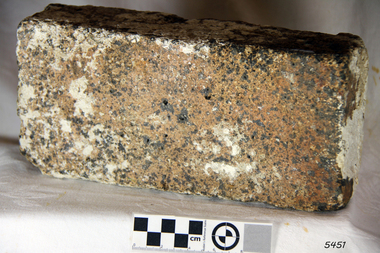 Flagstaff Hill Maritime Museum and Village
Ceramic - Clay Brick, ca 1837
... On the 11th January 1839, the CHILDREN sailed from Launceston for Adelaide, with 24 passengers, 14 crew, and an awkward mixed cargo, including 1500 sheep, 8 bullocks, 7 horses, farming implements, and six whaleboats with associated whaling gear, and house bricks for the Hentys' settlement in Portland. One account states that when the CHILDREN “put out from port, it was light and badly ballasted”. ...On the 11th January 1839, the CHILDREN sailed from Launceston for Adelaide, with 24 passengers, 14 crew, and an awkward mixed cargo, including 1500 sheep, 8 bullocks, 7 horses, farming implements, and six whaleboats with associated whaling gear, and house bricks for the Hentys' settlement in Portland. One account states that when the CHILDREN “put out from port, it was light and badly ballasted”. ...According to Lloyds Shipping Register 1837-1839, the CHILDREN was built in 1825 at Liverpool and operated by owners Gordon & Co, of London. London registered number 123/1837. James Henty then bought the vessel in 1837 as a three-masted barque of 254 tons, with a hull of “part pitch pine, felt sheathed” and “coppered 1837”. Launceston registered number 6/1837. In 1838, the CHILDREN, under her master Captain H. Browne, completed a successful round trip from Launceston to London carrying wool and whale oil loaded in Portland, returning in late November of that year carrying a general cargo including the house bricks. On the 11th January 1839, the CHILDREN sailed from Launceston for Adelaide, with 24 passengers, 14 crew, and an awkward mixed cargo, including 1500 sheep, 8 bullocks, 7 horses, farming implements, and six whaleboats with associated whaling gear, and house bricks for the Hentys' settlement in Portland. One account states that when the CHILDREN “put out from port, it was light and badly ballasted”. The vessel immediately encountered four days of hurricane force storms, eventually clearing on the early morning of the 14th to “west force 10”, but too late to take accurate measurements of the sun or stars to establish their position relative to the coast. The CHILDREN collided with a limestone stack at the entrance of what is now called Childers Cove, and the seas smashed it into pieces within half an hour. All the cargo and 16 lives were lost, including 9 children. The Hentys contributed £150 towards a fund for the 22 survivors at a memorial service held in Launceston later that year. It was a major financial setback for the Henrys, but one from which they recovered. In a submission to the Governor of New South Wales dated 24 March 1840, the Henty’s summarised their work over the previous six years of settlement: “Six stations have been occupied, one at Portland Bay…three at the open country about 60 miles inland called ‘Merino Downs’…They have erected two houses at Portland Bay and two others at Merino Downs”. The London house bricks recovered from the Children's wreck are significant as part of the cargo of the early 19th-century barque. The bricks were intended for the owner of the Children, the Henty family, for their Portland settlement. The 1839 wreck and recovered artefacts are examples of the construction methods and materials used in that era and can be used to study the evolution of shipbuilding methods and principles. The wreck of the Children is of state significance as one of colonial Victoria’s earliest and most significant maritime disasters, and one of the first vessels lost in the Western District. This is recognised by its inclusion on the Victorian Heritage Register, VHR No. S116. Little is left on the seabed to mark the tragedy, apart from some of the house bricks intended for the Henty settlement. Clay brick: house brick from London, with some with white marine encrustation, recovered from the wreck of the ship CHILDREN. The brick is an oblong shape and is constructed of a coarse-grained conglomerate. flagstaff hill, flagstaff hill maritime museum and village, warrnambool, maritime museum, maritime village, great ocean road, shipwreck coast, shipwreck artefact, children, barque, three-masted, liverpool, childer’s cove, port campbell, 1839 shipwreck, 1939 wreck, james henty and co, henty brothers, captain h. browne, first mate t. gay, second mate w. wentworth, portland, portland bay, 1939, bricks, london house bricks, clay bricks -
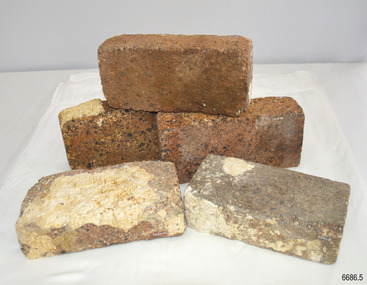 Flagstaff Hill Maritime Museum and Village
Ceramic - Clay Bricks, Circa 1838
... On the 11th of January 1839, the CHILDREN sailed from Launceston for Adelaide, with 24 passengers, 14 crew, and an awkward mixed cargo, including 1500 sheep, 8 bullocks, 7 horses, farming implements, and six whaleboats with associated whaling gear. One account states that when the CHILDREN “put out from port, it was light and badly ballasted”. ...On the 11th of January 1839, the CHILDREN sailed from Launceston for Adelaide, with 24 passengers, 14 crew, and an awkward mixed cargo, including 1500 sheep, 8 bullocks, 7 horses, farming implements, and six whaleboats with associated whaling gear. One account states that when the CHILDREN “put out from port, it was light and badly ballasted”. ...These bricks are a sample of “5000 house bricks from London” carried by the CHILDREN as ballast, and intended for the Portland Bay settlement of her owners, Henty Bros. Flagstaff Hill divers recovered the bricks from Childers Cove in February 1974 and noted, “These bricks are the major feature of the wreck site. Subsequent notes indicate “The hull structure has broken up, leaving few visible remains, except for piles of house bricks intended for the Hentys of Portland”. According to Lloyds Shipping Register 1837-1839, the CHILDREN was built in 1825 at Liverpool and operated by owners Gordon & Co, of London, London registered number 123/1837; James Henty then bought her in 1837 as a three-masted barque of 254 tons, with a hull of “part pitch pine, felt sheathed” and “coppered 1837”. Launceston registered number 6/1837. In 1838, the CHILDREN, under her master Captain H. Browne, completed a successful round trip from Launceston to London carrying wool and whale oil loaded in Portland, returning in late November of that year carrying general cargo, including house bricks. On the 11th of January 1839, the CHILDREN sailed from Launceston for Adelaide, with 24 passengers, 14 crew, and an awkward mixed cargo, including 1500 sheep, 8 bullocks, 7 horses, farming implements, and six whaleboats with associated whaling gear. One account states that when the CHILDREN “put out from port, it was light and badly ballasted”. The vessel immediately encountered four days of hurricane-force storms, eventually clearing on the early morning of the 14th to “west force 10”, but too late to take accurate measurements of the sun or stars to establish their position relative to the coast. The CHILDREN collided with a limestone stack at the entrance of Childers Cove, and the seas smashed her into pieces within half an hour. All the cargo and 16 lives were lost (including 9 children). The Hentys contributed £150 towards a fund for the 22 survivors at a memorial service held in Launceston later that year. It was a major financial setback for the Hentys, but one from which they recovered. In a submission to the Governor of New South Wales dated 24 March 1840, the Hentys summarised their work over the previous six years of settlement: “Six stations have been occupied, one at Portland Bay…three at the open country about 60 miles inland called ‘Merino Downs’…They have erected two houses at Portland Bay and two others at Merino Downs”.These bricks are significant as a sample of 5000 house bricks carried from London as ballast by the Children and were intended for the Portland Bay settlement of her owners, James Henty & Co. The 1839 wreck and recovered artefacts are examples of the construction methods and materials used in that era and can be used to study the evolution of shipbuilding methods and principles. The wreck of the Children is of state significance as one of colonial Victoria’s earliest and most significant maritime disasters, and one of the first vessels lost in the Western District. This is recognised by its inclusion on the Victorian Heritage Register, VHR No. S116. Little is left on the seabed to mark the tragedy, apart from some of the house bricks intended for the Henty settlement. Five ‘house bricks from London’, some with white marine encrustation, recovered from the wreck of the ship CHILDREN. The bricks are oblong shaped and constructed of a blue-coloured and coarse-grained conglomerate. One brick is higher, shorter and narrower, than the other four bricks.flagstaff hill, flagstaff hill maritime museum and village, warrnambool, maritime museum, maritime village, great ocean road, shipwreck coast, shipwreck artefact, children, barque, three-masted, liverpool, childer’s cove, port campbell, 1839 shipwreck, 1939 wreck, james henty and co, henty brothers, captain h. browne, first mate t. gay, second mate w. wentworth, portland, portland bay, 1939, bricks, london house bricks, clay bricks -
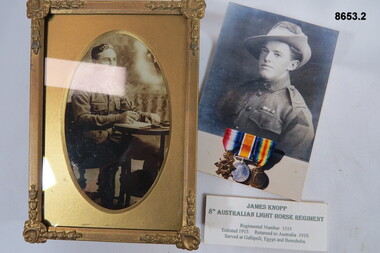 Bendigo Military Museum
Photograph - FRAMED PHOTOGRAPH OF JAMES KNOPP + PHOTOGRAPH, WW1
... LIGHT HORSE REGIMENT. r/n 1515. Enlisted 1915, Served at Gallipoli, Egypt and Beersheba. Returned to Australia 1919. Passchendaele Barracks Trust PBT 7 8 ...James Knopp - 8th AUSTRALIAN LIGHT HORSE REGIMENT. r/n 1515. Enlisted 1915, Served at Gallipoli, Egypt and Beersheba. Returned to Australia 1919.1. Photograph of James Knopp in uniform with medals. 2. Photograph in frame of James Knopp sitting at a writing desk.1. On rear of photograph - Passchendaele Barracks Trust.passchendaele barracks trust, pbt 7 8, photographs, james knopp
