
Showing 9 items matching "8-day clock"
-
 The Beechworth Burke Museum
Decorative object - Clock, New Haven Clock Company, 1881
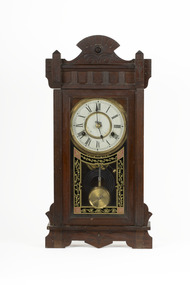
... 8-Day Clock...Their 'Duna' model was created circa 1881 and features a solid walnut cabinet with ornate carvings and a glass door decorated in gold, black, and red detail. The 8-day clock is designed to be wound once per week with a key; the clock features instructions on the reverse side should the timing need adjustment....Engraving on rim above clock face: PATD FEB.11.1879 Engraving on pendulum: PAT'D MCH.1st 1881 Reverse label: 8 Day Duna / STRIKING./ New Haven Clock Co., / NEW HAVEN, CONN. / NOTICE. / If the Clock should go too fast, lower the ball ; / if too slow, raise it. ...Their 'Duna' model was created circa 1881 and features a solid walnut cabinet with ornate carvings and a glass door decorated in gold, black, and red detail. The 8-day clock is designed to be wound once per week with a key; the clock features instructions on the reverse side should the timing need adjustment. ...The New Haven Clock Company from Connecticut, USA, was incorporated by clockmaker Hiram Camp (1811-1893) in 1853. Camp studied clockmaking under his uncle Chauncey Jerome (1793-1868) from the age of 17. New Haven Clock Company supplied brass clock movements to Chauncey Jerome's own business, Jerome Manufacturing Company, until that company declared bankruptcy two years later. New Haven Clock Company acquired Jerome Manufacturing Company and continued to manufacture clocks for over a century. They grew to such a scale that they were outproducing all other clockmakers in the state of Connecticut. Their 'Duna' model was created circa 1881 and features a solid walnut cabinet with ornate carvings and a glass door decorated in gold, black, and red detail. The 8-day clock is designed to be wound once per week with a key; the clock features instructions on the reverse side should the timing need adjustment.This object is part of the Burke Museum Collection and represents the detailed craftmanship of one of the leading clock manufacturers of the late nineteenth and early twentieth centuries.Decoratively carved and etched wooden eight day striking mantle clock with a white face and black roman numerals.Engraving on rim above clock face: PATD FEB.11.1879 Engraving on pendulum: PAT'D MCH.1st 1881 Reverse label: 8 Day Duna / STRIKING./ New Haven Clock Co., / NEW HAVEN, CONN. / NOTICE. / If the Clock should go too fast, lower the ball ; / if too slow, raise it. The minute hand may be / moved at any time forward, but never backward / further than the figure XII. / Should the Clock strike wrong, lift the wire / under the figure VII until it strikes right. Markings on reverse: 2496 / 3526 / 4190 / 4873 / 5936 / 71078-day clock, new haven clock company, mantel clock, hiram camp -
 Flagstaff Hill Maritime Museum and Village
Clocks, 1939-1946
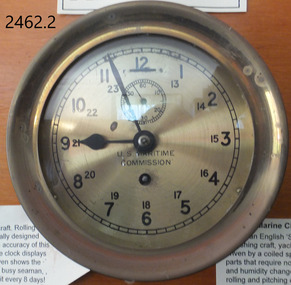
... American Clock is an 8-day marine clock made by the Chelsea clock Co for the “US Maritime Commission” . ...The clock is an 8 day marine clock with US Maritime Commission inscribed on face in black lettering. ...American Clock is an 8-day marine clock made by the Chelsea clock Co for the “US Maritime Commission” . ...Chelsea Clock Company History: The Chelsea Clock Company is an American clock manufacturing company that started before 1880 with Joseph Henry Eastman who founded the Harvard Clock Company and produced 800 clocks of marine, carriage, shelf and banjo types. He went on to change the company name to the Boston Clock Company in 1884. After several name changes in 1897, the Chelsea Clock Company was finally founded. Clocks produced by Chelsea Clock Company have been found in the White House, on US Naval Ships, and in homes and offices around the world. After the company first began life as the Harvard Clock Company, it was named the Boston Clock Company, the Eastman Clock Company before finally becoming the Chelsea Clock Company in July of 1897. The company had developed many patents and innervations over these years and between 1939 and 1946 during World War II they were awarded contracts by the U.S Maritime Commission and produced vast numbers of clocks for both merchant and naval ships. U.S Maritime Commission History: The United States Maritime Commission (MARCOM) was an independent executive agency of the U.S. federal government that was created by the Merchant Marine Act of 1936, and replaced the United States Shipping Board which had existed since World War I. It was intended to formulate a merchant shipbuilding program to design and build five hundred modern merchant cargo ships to replace the World War I vintage vessels that comprised the bulk of the United States Merchant Marine, and to administer a subsidy system authorized by the Act to offset the cost differential between building in the U.S. and operating ships under the American flag. It also formed the United States Maritime Service for the training of seagoing ship's officers to man the new fleet. The purpose of the Maritime Commission was to formulate a merchant shipbuilding program to design and then have built over a ten-year period 900 modern fast merchant cargo ships which would replace the World War I-vintage vessels Those ships were intended to be then leased to U.S. shipping companies for their use in the foreign seagoing trades the aim was to offer better and more economical freight services. The ships were also intended to serve as a reserve naval auxiliary force in the event of armed conflict which was a duty the U.S. merchant fleet had often filled throughout the years since the Revolutionary War. From 1939 through the end of World War II, the Maritime Commission funded and administered the largest and most successful merchant shipbuilding effort in world history, producing ships for both navy and merchant marine. By the end of the war, U.S. shipyards working under Maritime Commission contracts had built a total of 5,777 ocean-going merchant and naval ships. In early 1942 both the training and licensing was transferred to the U.S. Coast Guard for administration, then later to the Maritime Service final responsibility was conveyed to the newly created War Shipping Administration which was created to oversee the operation of merchant ships being built by the Emergency Program to meet the needs of the U.S. Armed Services. With the end of World War II, both the Emergency and Long Range shipbuilding programs were terminated as there were far too many merchant vessels now for the Nation's peacetime needs. In 1946, the Merchant Ship Sales Act was passed to sell off a large portion of the ships built during the war to commercial buyers, both domestic and foreign. The U.S Maritime Commission was officially disbanded on May 24th 1950. These clocks were to be found on all ships made in American for the war effort between 1939 and 1946. They are a significant reminder of the sacrifice by those who served in the merchant marine and the navy’s during the Second World War. The item is a part of our social history that reminds us of these dark times. The loses of family members, along with the trauma that many sailors had endured and had to live with for the rest of their lives once they were released from service and allowed to go home.American Clock is an 8-day marine clock made by the Chelsea clock Co for the “US Maritime Commission” . There is a second smaller dial for the seconds and 24-hour markings. Also a fast-slow adjuster to the top of the dial. The clock is an 8 day marine clock with US Maritime Commission inscribed on face in black lettering. flagstaff hill, warrnambool, shipwrecked-coast, flagstaff-hill, flagstaff-hill-maritime-museum, maritime-museum, shipwreck-coast, flagstaff-hill-maritime-village, clock, us maritime commission, chelsea clock company, horology, maratime clock -
 Bendigo Historical Society Inc.
Domestic Object - GERTRUDE PERRY COLLECTION: MANTLE CLOCK, 1941
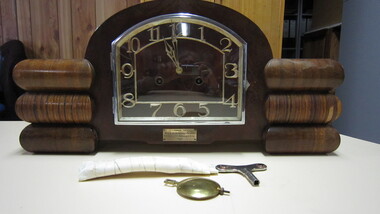
... Object. Mantle Clock. 1940's 8 day time and strike clock. Veneered case with chrome bezel, silvered hands and numerals. ...PERSON Bendigo mantle clock Gertrude Perry Collection Mantle Clock Bendigo Easter Fair Object. Mantle Clock. 1940's 8 day time and strike clock. Veneered case with chrome bezel, silvered hands and numerals. ...Object. Mantle Clock. 1940's 8 day time and strike clock. Veneered case with chrome bezel, silvered hands and numerals. Cathedral gong, chimes once on 1/2 hour and number of hours. Complete with pendulum and key. Presentation plaque on front reads Presented to Miss Gertrude Perry, Mitchell St, Popular Girl 1941'. Modified key for easy winding.person, bendigo, mantle clock, gertrude perry collection, mantle clock, bendigo easter fair -
 Flagstaff Hill Maritime Museum and Village
Instrument - Clock, 1900's
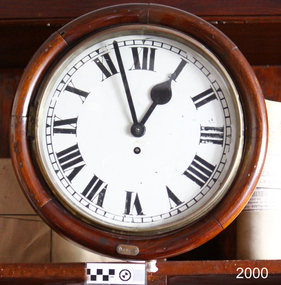
... Fusee type gallery wall clock made by Tame Side with an 8-day mechanical fusee movement. ...(If the clock had been made after 1912 it would have had a trade mark "Limit") Fusee type gallery wall clock made by Tame Side with an 8-day mechanical fusee movement. ...In August 1884, Alfred Hirst who had started his trade as a watch repairer and was described as a watchmaker extraordinaire established Hirst Brothers and Company, on Union Street in Oldham Manchester. He took his two stepbrothers into the business and the company was set up to produce timepieces and jewellery as well as importing “Limit company” Swiss watches and precision machine tools for the watch and clock trade. By 1902 Hirst Brothers. had become a limited company and was still growing, adding other businesses in Manchester in 1904 and at Birmingham in 1907. The quality of the clocks and watches was such that Alfred Hirst realised his greatest ambition in 1912 with a range of watches which carried the "Limit" trademark. These watch movements had originally been made in Switzerland and shipped to Hirst Bros. to be put into British made “Dennison” cases. This trade brought even more growth with additional sales offices opening in London and Glasgow. At the outbreak of the First World War in 1914 found them manufacturing aircraft parts including revolution counters and optical instruments. The firm had been tasked by the Ministry of Munitions to solve the problem of pilots dropping bombs by hand and as a result, they effectively created the first bomb rack. After the war, the company once again began to prosper and with the demand for their products increasing they looked to build a new purpose-built factory to manufacture their products. In 1917 they purchased a seven-acre field site at Tame Side Dobcross, the designing of the new factory was passed onto local architect AJ Howcroft. His brief for the design of the clockworks would have been prompted by Alfred Hirst who having visited modern factories in the United States was inspired by the latest factory designs providing as much daylight as possible during working hours. The factory was eventually completed in 1920, by the mid-1920s there were cheap clock imports from Germany and production turned to radio sets and other components as well as counter and gas meters for the "Parkinson and Cowan" company who was later to take over the business. In 1926 came the cotton crash and the District Bank who had loans with the company foreclosed on the Hirst loan. The company did survive and throughout the second World, War II were involved in munitions work at the factory as well as making instruments for various aircraft. In the 1950’s they were producing meters and high grade measuring equipment but by the 1970's the business had closed and the factory was demolished in the mid-1980 "s The item is a good example of the later use of an early mechanism “Fusee” that was originally invented around 1525 in Prague. This type of clock mechanism was replaced as watchmakers looked for mechanisms that could reduce the size of clocks and watches, it appears England was the only country to continue making clocks with a Fusee device until around 1900,s of which our clock is an example. The use of a Fusee movement eventually became obsolete in 1970,s. The item is significant for the collection as it is a clock with a movement that has long since been made obsolete. Fusee type gallery wall clock made by Tame Side with an 8-day mechanical fusee movement. The white enamel dial is a little crazed and some of the Roman Numeral numbers are fading due to over-cleaning. The movement has a hexagonal iron pendulum bob hooking onto a pendulum rod with a spring-wound anchor escapement.Only mark is stamped on the movement believed to be a production number "13490" and made in Tame Side. (If the clock had been made after 1912 it would have had a trade mark "Limit")flagstaff hill, warrnambool, shipwrecked-coast, flagstaff-hill, flagstaff-hill-maritime-museum, maritime-museum, shipwreck-coast, flagstaff-hill-maritime-village, clock, wall clock, fusee, gallery clock, alfred hirst, tame side -
 Flagstaff Hill Maritime Museum and Village
Instrument - Clock, c. 1860s
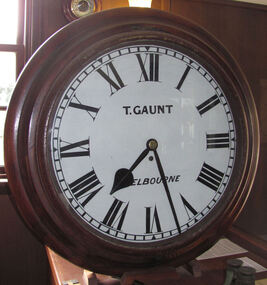
... clock face. The key winds a fusee chain mechanism, attached to the brass mainspring barrel that powers the pendulum with an 8-day movement. ...clock face. The key winds a fusee chain mechanism, attached to the brass mainspring barrel that powers the pendulum with an 8-day movement. ...The clock was either made or sold by T. Gaunt & Co. of Melbourne, a manufacturer, importer and retailer of a wide variety of goods including jewellery, clocks and watches, navigational and measuring instruments, dinnerware, glassware and ornaments. Thomas Gaunt photograph was included in an album of security identity portraits of members of the Victorian Court, Centennial International Exhibition, Melbourne, 1888. Thomas Gaunt History: Thomas Gaunt established Melbourne's leading watchmaking, optical and jewellery business during the second half of the 19th century. Gaunt arrived in Melbourne in 1852, and by 1858 had established his own business at 14 Little Bourke Street. Around 1869 he moved to new premises in Bourke Street on the corner of Royal Arcade, Gaunt's shop quickly became a Melbourne institution. Gaunt proudly advertised that he was 'The only watch manufacturer in the Australian colonies'. While many watches and clocks may have had Gaunt's name on the dial, few would have been made locally. Gaunt did make some watches for exhibitions, and perhaps a few expensive watches for wealthy individuals. Gaunt's received a telegraph signal from Melbourne Observatory each day to correct his main clock and used this signal to rate and repair ship's chronometers and good quality watches. His main horological manufacturing was directed at turret clocks for town halls, churches and post offices. These tended to be specific commissions requiring individualised design and construction. He made the clock for the Melbourne Post Office lobby, to a design by Government Astronomer Robert Ellery, and won an award at the 1880-81 Melbourne International Exhibition for his turret clock for the Emerald Hill Town Hall. He became well known for his installation of a chronograph at Flemington Racecourse in 1876, which showed the time for the race, accurate to a quarter of a second. The firm also installed the clockwork and figures for Gog and Magog in the Royal Arcade. Thomas Gaunt also developed a department that focused on scientific instrumentation, making thermometers and barometers (from imported glass tubes), telescopes, surveying instruments and microscopes. Another department specialised in electroplating for trophies, awards and silverware, and the firm manufactured large amounts of ecclesiastical gold ware and silverware, for the church including St Patrick's Cathedral. There are no records that disclose the number of employees in the firm, but it was large enough for Gaunt to hold an annual picnic for the watchmakers and apprentices at Mordialloc from 1876; two years previously they had successfully lobbied Gaunt to win the eight hour day. Gaunt's workforce was reportedly very stable, with many workers remaining in the business for 15 to 30 years. Gaunt's wife Jane died on September 1894, aged 64. They had one son and six daughters, but only three daughters survived to adulthood. Two became nuns at the Abbotsford Convent and one daughter, Cecelia Mary Gaunt (died 28 July 1941), married William Stanislaus Spillane on 22 September 1886 and had a large family. Gaunt died at his home in Coburg, Victoria, leaving an estate valued at ₤41,453. The business continued as T. Gaunt & Co. after his death. Post Office and Clock History: Warrnambool’s Post Office has been in existence since 1857, when it was originally situated on the corner of Timor and Gilles Street. In March 1864 the Warrnambool Borough Council purchased this clock from Henry Walsh Jnr. for the sum of £25, “to be put up in front of the Post Office”. Henry Walsh Jnr was the eldest son of Melbourne’s Henry Walsh, maker and retailer of clocks, watches, thermometers and jewellery. In 1854 Henry Walsh Jnr. began business in Warrnambool as a watchmaker and jeweller later becoming a Councillor with now a local street named after him. The Post Office was extensively remodelled in 1875-76. Early photographs of this building show that the clock was installed on the northern outside wall, Timor Street, under the arches and between the 2 centre windows, where it could be seen by passers-by. Although spring loaded clocks date back to the 15th century, and fob and pocket watches evolving from these date to the 17th century, personal pocket watches were only affordable to the very fortunate. Public clocks such as this Post Office clock provided opportunity for all to know the time, and for those in possession of a personal watch to check and set their own timepieces to the correct time. During post office reservations during the 1970s the clock was removed and was eventually donated to the Flagstaff Collection. The Clock’s maker Thomas Gaunt, is historically significant and was an established and well renowned scientific instrument and clock maker in Melbourne during the 1860s. He was at that time the only watchmaker in the Australian colonies. In the 1870’s and 1880’s he won many awards for his clocks and was responsible for sending time signals to other clocks in the city and rural areas, enabling many businesses and organisations to accurate set their clocks each day. Warrnambool Borough Council purchased this clock from Henry Walsh Jnr. for the sum of £25 and the clock used to stand in front of the Warrnambool post office to allow ordinary citizens to set their time pieces as they walked by. The item is not only important because it was made by a significant early colonial clock maker and retailed by a locally known clock maker and jeweler but also that it was installed in the Warrnambool Post Office a significantly historical building in it's own right. Built in 1857 and regarded as one of the oldest postal facilities in Australia, with a listing on the National Heritage Database, (ID 15656). This 1864 hall clock originates from the Warrnambool Post Office. The clock glass is hinged to the top of the clock face and has a catch at the bottom. The metal rim of the glass is painted black. The clock face is metal, painted white, with black Roman numerals and markings for minutes and five minutes. The tip of the small hour hand is shaped like a leaf. "T. GAUNT / MELBOURNE" is printed in black on the clock face. The winding key hole is just below the centre of the clock face. The key winds a fusee chain mechanism, attached to the brass mainspring barrel that powers the pendulum with an 8-day movement. The speed of the clock can be adjusted by changing the position of the weight on the pendulum, lengthening or shortening the swing; raising the pendulum shortens its swing and speeds up the clock. The metal fusee mechanism has an inscription on it. The rectangular wooden casing is with a convex curve at the bottom that has a hinged door with a swivel latch. The original stained surface has been painted over with a matte black. There are two other doors that also allow access to the clock’s workings. The case fits over the pendulum and workings at the rear and attaches to the clock by inserting four wooden pegs into holes in the sides of the case then into the back of the clock. A flat metal plate has been secured by five screws onto the top of the case and a hole has been cut into it for the purpose of hanging up the clock. There is a nail inside the case, possibly used for a place to the key."T. GAUNT MELBOURNE" is printed on the clock face. “6 1 3” embossed on the back of the fusee mechanism behind the clock. warrnambool, shipwrecked coast, flagstaff hill, flagstaff hill maritime museum, maritime museum, shipwreck coast, flagstaff hill maritime village, shipwrecked artefact, clock, warrnambool post office, fusee, henry walsh jnr, thomas gaunt, t gaunt & co, post office clock -
 Bendigo Historical Society Inc.
Functional object - BLACK MANTLE CLOCK
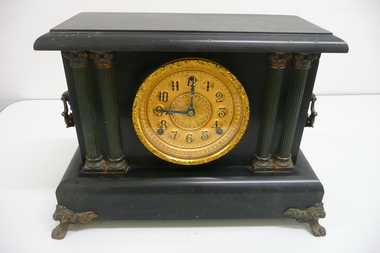
... Black wooden mantle clock with pendulum bob, made in U.S.A. by the Sessions Clock Company, mounted on ornate metal feet with metal handles on each end, four faux marble columns in green with metal tops & bases. Round gold dial with black numerals and hands, brass bezel with flat glass. 8 day time and strike, chiming the hours on a gong and half hour on a bell. ...HOROLOGY Clocks mantle The Sessions Clock Co Black wooden mantle clock with pendulum bob, made in U.S.A. by the Sessions Clock Company, mounted on ornate metal feet with metal handles on each end, four faux marble columns in green with metal tops & bases. Round gold dial with black numerals and hands, brass bezel with flat glass. 8 day time and strike, chiming the hours on a gong and half hour on a bell. ...Black wooden mantle clock with pendulum bob, made in U.S.A. by the Sessions Clock Company, mounted on ornate metal feet with metal handles on each end, four faux marble columns in green with metal tops & bases. Round gold dial with black numerals and hands, brass bezel with flat glass. 8 day time and strike, chiming the hours on a gong and half hour on a bell. Original paper label on back with manufacturers details and operating instructions.The Sessions Clock Cohorology, clocks, mantle -
 Bendigo Historical Society Inc.
Functional object - WIEGARD COOPER COLLECTION: BLACK MANTLE CLOCK, 1926
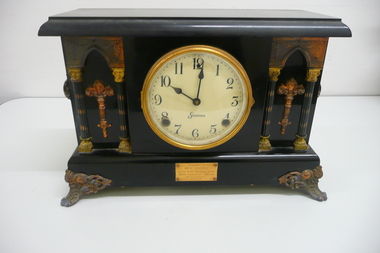
... Black wooden mantle clock with pendulum bob made in U.S.A by the Sessions Clock Company, mounted on ornate metal feet, and decorated with four columns supporting Gothic arches, with torch like ornamentation between them and an ornate handle on each end. Round white enamel dial with black numerals & hands, a brass bezel with convex glass. 8 day...Black wooden mantle clock with pendulum bob made in U.S.A by the Sessions Clock Company, mounted on ornate metal feet, and decorated with four columns supporting Gothic arches, with torch like ornamentation between them and an ornate handle on each end. Round white enamel dial with black numerals & hands, a brass bezel with convex glass. 8 day ...Object. Black wooden mantle clock with pendulum bob made in U.S.A by the Sessions Clock Company, mounted on ornate metal feet, and decorated with four columns supporting Gothic arches, with torch like ornamentation between them and an ornate handle on each end. Round white enamel dial with black numerals & hands, a brass bezel with convex glass. 8 day running with gong strike on hour & half hour. Brass plaque on front reads presented to Mr.P.Cooper by his fellow employees of the Water Commission Bendigo on his retirement 30.6.1926.Sessions Made in U.S.Ahorology, clocks, mantle -
 Bendigo Historical Society Inc.
Domestic Object - GRAYDON COLLECTION: TRAVELLING CLOCK, 1880's
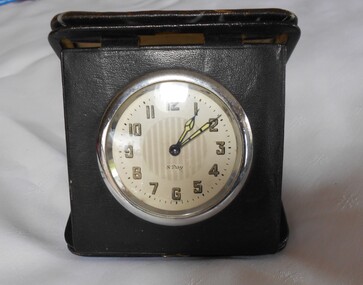
... day travelling clock in brown leather case lined with satin fabric. Top of case has embossed pattern of brown and white flowers. Clock face has numbers 1-12 and black and yellow hands. Centre of clock face has decorative striped circle. Written on clock face ''8...clock section ''Made in Germany''. Engraved ''D92633'' Object. Eight day travelling clock in brown leather case lined with satin fabric. Top of case has embossed pattern of brown and white flowers. Clock face has numbers 1-12 and black and yellow hands. Centre of clock face has decorative striped circle. Written on clock face ''8 ...Object. Eight day travelling clock in brown leather case lined with satin fabric. Top of case has embossed pattern of brown and white flowers. Clock face has numbers 1-12 and black and yellow hands. Centre of clock face has decorative striped circle. Written on clock face ''8 Day''.Imprinted on back of clock section ''Made in Germany''. Engraved ''D92633''horology, clocks, travelling clock -
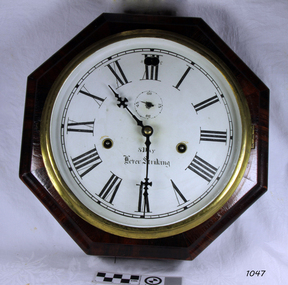 Flagstaff Hill Maritime Museum and Village
Functional object - Clock, 1867-1870
... Clock, marine, in octagonal rosewood veneer case. Roman numerals to dial, has a seconds dial. 2 key-winding holes slow-to-Fast adjustment pin through dial. Small lever in lower edge of case activates a chime. "8 day...Clock, marine, in octagonal rosewood veneer case. Roman numerals to dial, has a seconds dial. 2 key-winding holes slow-to-Fast adjustment pin through dial. Small lever in lower edge of case activates a chime. "8 day ...Chauncey Jerome (1793–1868) was an American clock maker in the early to mid 19th century. He made a fortune selling his clocks, and his business grew quickly. Jerome was born in Canaan USA in 1793 son of a blacksmith and nail-maker. He began his career in Plymouth, making dials for long-case clocks where he learned all he could about clocks, particularly clock cases, and then went to New Jersey to make seven-foot cases for clocks mechanisms. In 1816 he went to work for Eli Terry making "Patent Shelf Clocks," learning how to make previously handmade cases using machinery. Deciding to go into business for himself, Jerome began to make cases, trading them to Terry for wooden movements. In 1822 Jerome moved his business to Bristol New Haven, opening a small shop with his brother Noble and began to produce a 30-hour and eight-day wooden clocks. By 1837 Jerome's company was selling more clocks than any of his competitors. A one-day wood-cased clock, which sold for six dollars had helped put the company on the map. A year later his company was selling that same clock for four dollars. The company also sold one line of clocks at a wholesale price of 75 cents and by 1841 the company was showing an annual profit of a whopping $35,000, primarily from the sale of its brass movements. In 1842 Jerome moved his clock-case manufacturing operation to St. John Street in New Haven. Three years later, following a fire that destroyed the Bristol plant, Jerome relocated the entire operation to Elm City factory. Enlarging the plant, the company soon became the largest industrial employer in the city, producing 150,000 clocks annually. In 1850 Jerome formed the Jerome Manufacturing Co. as a joint-stock company with Benedict & Burnham, brass manufacturers of Waterbury. In 1853 the company then became known as the New Haven Clock Co, producing 444,000 clocks and timepieces annually, then the largest clock maker in the world. Jerome's future should have been secure but in 1855 he bought out a failed Bridgeport clock company controlled by P.T. Barnum, which wiped him out financially, leaving the Jerome Manufacturing Co. bankrupt. Jerome never recovered from the loss. By his admission, he was a better inventor than a businessman. When Jerome went bankrupt in 1856 the New Haven Clock Company purchased the company. One of the primary benefits of Jerome purchasing New Haven in the first place was the good reputation of the Jerome brand and the network of companies that remained interested in selling its clocks. In England, Jerome & Co. Ltd. sold Jerome clocks for the New Haven company until 1904, when New Haven purchased the English firm outright. After his involvement with the New Haven Company in 1856, Jerome traveled from town to town, taking jobs where he could, often working for clock companies that had learned the business of clock making using Jerome's inventions. On returning to New Haven near the end of his life, he died, penniless, in 1868 at the age of 74. The company struggled on after Jerome's bankruptcy until after World War II, when the company endeavored to continue through disruptions caused by a takeover along with poor sales, finally having to fold its operations in 1960 a little more than 100 years after it had been founded. The item is significant as it is associated with Chauncey Jerome who had made a historic contribution to the clock making industry during the 19th century when he began to substitute brass mechanisms for wooden mechanisms in his clocks. This was said to be the greatest and most far-reaching contribution to the clock industry. Because of his discovery of stamping out clockwork gears rather than using castings, Jerome was producing the lowest-priced clocks in the world. That can only add to his significance as the major clock manufacture of the 19th century. Jerome may have made and lost, a fortune selling his clocks but was perhaps the most influential and creative person associated with the American clock business during the mid-19th century. Also, he had served his community as a legislator in 1834, a Presidential elector in 1852 and mayor of New Haven, Connecticut from 1854 to 1855.Clock, marine, in octagonal rosewood veneer case. Roman numerals to dial, has a seconds dial. 2 key-winding holes slow-to-Fast adjustment pin through dial. Small lever in lower edge of case activates a chime. "8 day, 8 inch, Lever Striking escarpment " Paper label on the back of the clock "Jerome & Co, New Haven, Conn" "Manufacturers of every variety of Office and Home Clocks and Time Pieces".flagstaff hill, warrnambool, shipwrecked-coast, flagstaff-hill, flagstaff-hill-maritime-museum, maritime-museum, shipwreck-coast, flagstaff-hill-maritime-village, clock, jerome & co, new haven, clock maker, chauncey jerome
