
Showing 4 items matching "a century of women's migration"
-
 Whitehorse Historical Society Inc.
Newsletter - Whitehorse Historical Society Newsletters 1968, 1968
... ...A Century of Women's Migration...Produced by Nunawading & District Historical Society in 1968 Dr LL Smith's Model Farm Village of Springfield Early Melbourne 1901-1910 Cr and Mrs WG Manifold Preserving a Heritage at Swan Hill A Century of Women's Migration Frayed Tempers in Donvale Nunawading National School 1910 Subdivision of Blackburn Sylvan Glades Paddock Fruit Growing Local History History of Victorian Education Department 1873-1972 Steam Cars Newsletters 8-17, published in 1968 Copies of typed newsletters Foolscap Whitehorse Historical Society Newsletters 1968 Newsletter Whitehorse Historical Society Newsletters 1968 ...Newsletters 8-17, published in 1968Copies of typed newsletters Foolscapnon-fictionNewsletters 8-17, published in 1968dr ll smith's model farm, village of springfield, early melbourne 1901-1910, cr and mrs wg manifold, preserving a heritage at swan hill, a century of women's migration, frayed tempers in donvale, nunawading national school, 1910 subdivision of blackburn, sylvan glades paddock, fruit growing, local history, history of victorian education department 1873-1972, steam cars -
 The Beechworth Burke Museum
Photograph, Between 1946 and 1961
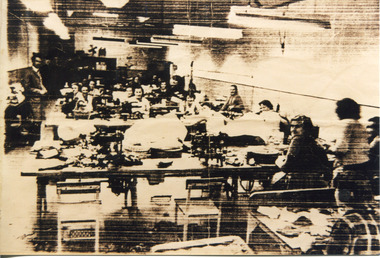
... women...post-war migration...factory...white australia policy...mid-twentieth century...Pitman Shoe Factory Elgin Shoe Company industry shoe factory shoemaking working women post-war migration factory white australia policy mid-twentieth century women's working conditions twentieth-century working conditions Pitman Elgin shoe sewing machine leather Pittman Reverse: 14 / AFGA / 6982 / Sepia rectangular photograph printed on matte photographic paper Photograph Photograph ...Elgin Shoes Pty., Ltd., established a branch shoe factory in Beechworth in 1946. Managing director, Mr T Nagle Pitman, selected Beechworth as a suitable location for the factory due to the availability of labour in the town, particularly girls under sixteen years of age. At its peak, the shoe factory employed thirty six women and girls, which also included post-war migrants. After the Second World War, Australia admitted increasing numbers of immigrants in order to fulfil labour requirements for a rapidly inflating demand of consumer goods. These migrants were largely from European Countries in line with the ‘White Australia Policy’. In 1954 Beechworth had 170 migrants from the UK, 102 from Hungary, and 63 from Germany. The factory closed in 1961 as increased centralisation of both populations and industry in the larger nearby towns of Wangaratta and Wodonga lead to the closure of many factories in small towns in the 1960s and 1970s. This photograph is historically significant as it shows the working conditions in a factory primarily staffed by women at some point between the late 1940s and early 1960s. Sepia rectangular photograph printed on matte photographic paperReverse: 14 / AFGA / 6982 / pitman shoe factory, elgin shoe company, industry, shoe factory, shoemaking, working women, post-war migration, factory, white australia policy, mid-twentieth century women's working conditions, twentieth-century working conditions, pitman, elgin, shoe, sewing machine, leather, pittman -
 Ithacan Historical Society
Photograph, Governing Council of Greek Women, Melbourne 1917, 1917
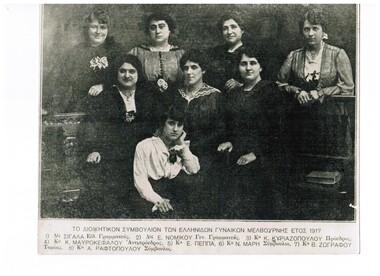
... women who had settled in Australia in the early years of the twentieth century and was part of the Greek Orthodox Community of Melbourne and Victoria. Back row L-R: Mrs. A Raftopoulou, Miss Sigala, Mrs. E. Peppa. Middle row L-R: Miss E. Nomikou, Mrs. K. Kyriazopoulou, (President), Mrs. K Mavrokefalou (Vice-president), Mrs. N. Mari. Front: Mrs. B. Zografou. Up until the 1900s very few women left Ithaca and more broadly Greece, to migrate to Australia. During the early 1900s and emergence of chain migration ...The photograph is of members of the Governing Council of Greek Women in Melbourne in 1917. A number of the women were from Ithaca. The organisation was created to offer social interaction for Greek women who had settled in Australia in the early years of the twentieth century and was part of the Greek Orthodox Community of Melbourne and Victoria. Back row L-R: Mrs. A Raftopoulou, Miss Sigala, Mrs. E. Peppa. Middle row L-R: Miss E. Nomikou, Mrs. K. Kyriazopoulou, (President), Mrs. K Mavrokefalou (Vice-president), Mrs. N. Mari. Front: Mrs. B. Zografou. A black and white portrait style photograph of eight young women. The translated caption is printed below the photograph in Greek: THE GOVERNING COUNCIL OF GREEK WOMEN, MELBOURNE 1917 gocv, committee, auxilliary -
 Kew Historical Society Inc
Decorative object - Cotton chintz applique on linen wall hanging [Broderie Perse], 19th Century
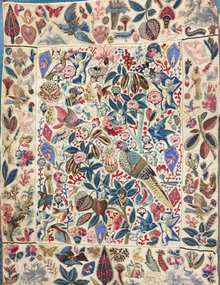
... On another level, the wall hanging is a fine example of 'women's work' in the first half of the nineteenth century. textiles applique broderie perse amy grigg wall hangings migration Small wall hanging, comprised of five panels that are each appliquéd by hand in herringbone stitch using a range of decorative figurative motifs including flora and fauna. ...This broderie perse' wall hanging was donated to the Kew Historical Society in 1980 by Mrs Joy Ivory. The hanging had belonged to her mother - Amy Grigg - and was used by the latter to demonstrate skills in darning (the red stitching). Provenance includes a certificate dating from 1889 which records an award to Amy Grigg of Pakington Street (Kew) for skills in needlework, issued by the Kew Floral Industrial & Art Society. Amy Grigg later married Albert Watson, the son of John Watson. The latter was an early pastor of the Kew Methodist Church in Highbury Grove, Kew. Both the Watson and Grigg families were early pioneers of Kew. While the hanging was modified by Amy Grigg in 1889, the original textile dates from an earlier period when 'Broderie Perse' (Persian embroidery) was used to create quilts and wall hangings. It is estimated that the hanging dates from the first half of the 19th century. An exact dating will require a detailed examination of the cotton chintz fabrics used to embroider the hanging. This appliquéd wall hanging is one of the earliest textiles in the Kew Historical Society's fashion & textiles collection. Similar examples are held in major international collections such as the Victoria & Albert Museum. This example of broderie perse is significant for the cross-cultural influence of Indian textiles on European taste, not unusual given the English foothold in India during this period. Additional interest is due to the mixing of Indian and European textiles in the design, while staying true to the derivation of the design. The textile is both well-provenanced and rare. While it is unlikely to be Australian-made, it is probably an example of a textile brought to Australia during the colonial period that indicates a desire to decorate interiors using items created in and for the English home. On another level, the wall hanging is a fine example of 'women's work' in the first half of the nineteenth century.Small wall hanging, comprised of five panels that are each appliquéd by hand in herringbone stitch using a range of decorative figurative motifs including flora and fauna. The design is based on an Indian palimpore representing a tree of life design. The base textile is a cream linen while the appliquéd figures or shapes are cut from cotton chintz. These additions are probably a mix of Indian and European designs. The quality of the herringbone stitching is very fine. Later stitching in red wool was added in the 1890s to demonstrate skill in darning. The main panel is bordered by a narrow green and ecru braid. It has a narrow tan braid at the top and bottom of the two side panels. A surrounding tan braid around the entire textile is missing in some places. textiles, applique, broderie perse, amy grigg, wall hangings, migration
