
Showing 50 items matching "a footnote to history"
-
 Flagstaff Hill Maritime Museum and Village
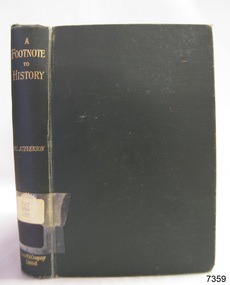
Book, A Footnote To History
... A Footnote To History......A Footnote To History...A Footnote To History Eight Years of Trouble in Samoa Author: Robert Louis Stevenson Publisher: Cassell & Co Date: 1892...Warrnambool Shipwrecked-coast Flagstaff-Hill Flagstaff-Hill-Maritime-Museum Maritime-Museum Shipwreck-coast Flagstaff-Hill-Maritime-Village Shipwrecked-artefact Book Warrnambool Mechanics’ Institute Pattison Collection Warrnambool Library Ralph Eric Pattison Warrnambool City Librarian Mechanics’ Institute Library Victorian Library Board Warrnambool books and records Warrnambool Children’s Library A Footnote To History Robert Louis Stevenson Label on spine with typed text PAT 996 STE Inside front cover has a sticker from Warrnambool Mechanics Institute and Free Library Front endpaper has a sticker from Corangamite Regional Library Service A Footnote To History Eight Years of Trouble in Samoa Author: Robert Louis Stevenson Publisher: Cassell & Co Date: 1892 A Footnote To History Book ...This item is from the ‘Pattison Collection’, a collection of books and records that was originally owned by the Warrnambool Mechanics’ Institute, which was founded in Warrnambool in 1853. By 1886 the Warrnambool Mechanics’ Institute (WMI) had grown to have a Library, Museum and Fine Arts Gallery, with a collection of “… choice productions of art, and valuable specimens in almost every branch and many wonderful national curiosities are now to be seen there, including historic relics of the town and district.” It later included a School of Design. Although it was very well patronised, the lack of financial support led the WMI in 1911 to ask the City Council to take it over. In 1935 Ralph Pattison was appointed as City Librarian to establish and organise the Warrnambool Library as it was then called. When the WMI building was pulled down in 1963 a new civic building was erected on the site and the new Warrnambool Library, on behalf of the City Council, took over all the holdings of the WMI. At this time some of the items were separated and identified as the ‘Pattison Collection’, named after Ralph Pattison. Eventually the components of the WMI were distributed from the Warrnambool Library to various places, including the Art Gallery, Historical Society and Flagstaff Hill. Later some were even distributed to other regional branches of Corangamite Regional Library and passed to and fro. It is difficult now to trace just where all of the items have ended up. The books at Flagstaff Hill Maritime Village generally display stamps and markings from Pattison as well as a variety of other institutions including the Mechanics’ Institute itself. RALPH ERIC PATTISON Ralph Eric Pattison was born in Rockhampton, Queensland, in 1891. He married Maude Swan from Warrnambool in 1920 and they set up home in Warrnambool. In 1935 Pattison accepted a position as City Librarian for the Warrnambool City Council. His huge challenge was to make a functional library within two rooms of the Mechanics’ Institute. He tirelessly cleaned, cleared and sorted a disarrayed collection of old books, jars of preserved specimens and other items reserved for exhibition in the city’s museum. He developed and updated the library with a wide variety of books for all tastes, including reference books for students; a difficult task to fulfil during the years following the Depression. He converted all of the lower area of the building into a library, reference room and reading room for members and the public. The books were sorted and stored using a cataloguing and card index system that he had developed himself. He also prepared the upper floor of the building and established the Art Gallery and later the Museum, a place to exhibit the many old relics that had been stored for years for this purpose. One of the treasures he found was a beautiful ancient clock, which he repaired, restored and enjoyed using in his office during the years of his service there. Ralph Pattison was described as “a meticulous gentleman whose punctuality, floorless courtesy and distinctive neat dress were hallmarks of his character, and ‘his’ clock controlled his daily routine, and his opening and closing of the library’s large heavy doors to the minute.” Pattison took leave during 1942 to 1942 to serve in the Royal Australian Navy, Volunteer Reserve as Lieutenant. A few years later he converted one of the Museum’s rooms into a Children’s Library, stocking it with suitable books for the younger generation. This was an instant success. In the 1950’s he had the honour of being appointed to the Victorian Library Board and received more inspiration from the monthly conferences in Melbourne. He was sadly retired in 1959 after over 23 years of service, due to the fact that he had gone over the working age of council officers. However he continued to take a very keen interest in the continual development of the Library until his death in 1969. The Pattison Collection, along with other items at Flagstaff Hill Maritime Village, was originally part of the Warrnambool Mechanics' Institute’s collection. The Warrnambool Mechanics’ Institute Collection is primarily significant in its totality, rather than for the individual objects it contains. Its contents are highly representative of the development of Mechanics' Institute libraries across Australia, particularly Victoria. A diversity of publications and themes has been amassed, and these provide clues to our understanding of the nature of and changes in the reading habits of Victorians from the 1850s to the middle of the 20th century. The collection also highlights the Warrnambool community’s commitment to the Mechanics’ Institute, reading, literacy and learning in the regions, and proves that access to knowledge was not impeded by distance. These items help to provide a more complete picture of our community’s ideals and aspirations. The Warrnambool Mechanics Institute book collection has historical and social significance for its strong association with the Mechanics Institute movement and the important role it played in the intellectual, cultural and social development of people throughout the latter part of the nineteenth century and the early twentieth century. The collection of books is a rare example of an early lending library and its significance is enhanced by the survival of an original collection of many volumes. The Warrnambool Mechanics' Institute’s publication collection is of both local and state significance. A Footnote To History Eight Years of Trouble in Samoa Author: Robert Louis Stevenson Publisher: Cassell & Co Date: 1892Label on spine with typed text PAT 996 STE Inside front cover has a sticker from Warrnambool Mechanics Institute and Free Library Front endpaper has a sticker from Corangamite Regional Library Service warrnambool, shipwrecked-coast, flagstaff-hill, flagstaff-hill-maritime-museum, maritime-museum, shipwreck-coast, flagstaff-hill-maritime-village, shipwrecked-artefact, book, warrnambool mechanics’ institute, pattison collection, warrnambool library, ralph eric pattison, warrnambool city librarian, mechanics’ institute library, victorian library board, warrnambool books and records, warrnambool children’s library, a footnote to history, robert louis stevenson -
 Southern Sherbrooke Historical Society Inc.
Book - Local History, Sassafras-Ferny Creek Fire Brigade, Hills Of Fire, 1992
... pp viii, 76; 6 appendices & bibliography, footnotes, 1 map, photographs. A history of bushfires in the Dandenong Ranges and the Sassafras-Ferny Creek CFA Brigade....Southern Sherbrooke Historical Society Inc. 127 Colby Drive Belgrave Heights 3160 yarra-valley-and-the-dandenong-ranges sassafras-ferny creek fire brigade dandenong ranges bushfires pp viii, 76; 6 appendices & bibliography, footnotes, 1 map, photographs. A history of bushfires in the Dandenong Ranges and the Sassafras-Ferny Creek CFA Brigade. ...pp viii, 76; 6 appendices & bibliography, footnotes, 1 map, photographs. A history of bushfires in the Dandenong Ranges and the Sassafras-Ferny Creek CFA Brigade.sassafras-ferny creek fire brigade, dandenong ranges, bushfires -
 Uniting Church Archives - Synod of Victoria
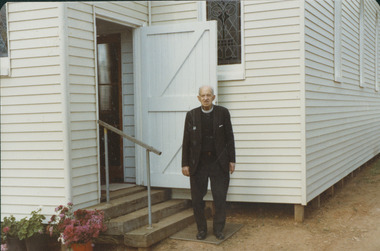
Photograph, Mitiamo UC Centenary & Rev. V. Raymond Hicks 11/11/1984, 11/11/1984
... Mrs Thirza Phelan has researched and written the church history. FOOTNOTE: The first minister, Mitiamo's the Rev. ...Mrs Thirza Phelan has researched and written the church history. FOOTNOTE: The first minister, Mitiamo's the Rev. ...Victor Raymond Hicks (11/8/1903–19/11/1995) born at Ballarat. Trained at Otira and accepted as candidate for the ministry in 1927. Ordained 1934. Married Lillian Harvey, 4 children. Appointments to Mitiamo, Matimuk, Woomelang, Wodonga, Kerang, Springvale, Brunswick, North Fitzroy, Geelong West, Kyneton and Brown Hill (Ballarat). Chaplaincy in WW2 and at Box Hill hospital. The article about the Mitiamo church: "Fifty years ago the Rev. Raymond Hicks was minister at Mitiamo as it celebrated its Golden Jubilee. He returned for the centenary this year and powerfully preached on 'Lengthen your cords, and strengthen your stakes' (Isaiah 54:2). He spoke of the great need of the church today to have a passion to lead men and women to Christ. Also sharing in the service were the Rev. Ray Scholl, a Mitiamo member before entering the ministry, and present minister, the Rev. M. Thalheimer. The centenary weekend began with an old fashioned tea meeting and concert. The Sunday school hall housed a comprehensive display of photos and historical records dating back to the Bible Christian days of 1884. Mrs Thirza Phelan has researched and written the church history. FOOTNOTE: The first minister, Mitiamo's the Rev. Daniel Daley, preached at the Golden Jubilee service—Mr Hicks has followed an ancient tradition."Colour photograph of Rev. V. Raymond Hicks standing outside the front of a wooden church porch.C&N identification.rev raymond hicks, home missionary, methodist ministry, otira -
 Bendigo Historical Society Inc.
Article - Michele Matthews Collection: PHD Research - Taylor Family Transcript of Audio Interview, 1930s
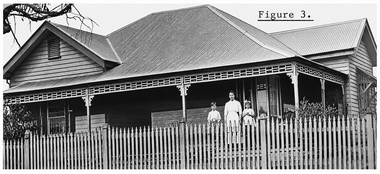
... Rather than simply recording genealogical facts, the narrative places the Taylor family's experiences within the broader history of Bendigo's growth from a gold mining settlement into a well-established regional city. The final pages consist of detailed footnotes referencing the original oral history recordings from which many of the quotations were drawn....Rather than simply recording genealogical facts, the narrative places the Taylor family's experiences within the broader history of Bendigo's growth from a gold mining settlement into a well-established regional city. The final pages consist of detailed footnotes referencing the original oral history recordings from which many of the quotations were drawn. ...Dr Michele Matthews has been a local and social historian for nearly three decades since she first used correspondence held by the then Bendigo City Council for her Honours thesis. She is an ardent advocate for the use of local history records to tell Victorian and Australian history from a grassroots perspective. Michele’s MA thesis, ‘A forgotten “Father” of Federation: Sir John Quick 1852‑1911’ (2003), and her PhD thesis, ‘Survivors, schemes, Samaritans and shareholders: the impact of the Great Depression on Bendigo and District 1925‑1935’ (2007), both drew heavily on Bendigo and district records. Michele Matthews Collection: PHD Research - Taylor Family Transcript of Audio Tape Interview This item includes the following document: 8672.91a Black and White photo of the Taylor house in Panton Street - Scanned from the transcript - Only a representation of the original photo. 8672.91b The document presents the early history of the Taylor family of Bendigo, tracing several generations from the arrival of John William Taylor in Victoria during the gold rush through to the childhood and early adulthood of Howard Johnson Taylor. Drawing heavily on oral history interviews, it describes how the family's experiences reflected the broader social and economic development of Bendigo, from the goldfields to the Depression era. Historical photographs of family members, homes and possessions accompany the narrative. The story begins around 1860, when John William Taylor emigrated from England and walked from Melbourne to Bendigo carrying his belongings. Attracted by the gold rush, he acquired a miner's right and built a timber home on Specimen Hill near Chum Street. Although he initially pursued gold, he later secured work as a pattern maker in one of Bendigo's foundries before becoming a house builder as mining declined. He married Susanna Johnson, and together they raised nine children, establishing a family whose descendants remained closely connected with Bendigo for generations. The narrative then focuses on Henry Johnson Taylor, the youngest son, and his wife Elva May Hartin, whose son Howard Johnson Taylor was born on 9 September 1912 in a weatherboard house on Specimen Hill. Howard's early childhood was marked by tragedy when his mother died in childbirth while expecting another child. The account reflects on the limitations of rural medical care at the time, suggesting that faster transport may have saved her life. Following her death, the family moved to Golden Square, and Henry later remarried May Whitcombe, who became Howard's stepmother. Howard's childhood provides an insight into everyday life in early twentieth-century Bendigo. The family experienced the influenza epidemic that followed the First World War, although Henry survived despite lasting health effects. Howard recalled living in several homes built or renovated by his father, including properties in Panton Street and later Echuca Street, Quarry Hill. The document describes domestic life in detail, including wood-fired bath heaters, heating and cooking with timber, and the pride taken in maintaining weatherboard houses. Education forms another important theme. Howard attended Specimen Hill State School, Golden Square State School, Quarry Hill State School, and later Bendigo High School. He remembered strict discipline, small class sizes in the primary years, and a strong interest in mathematics, particularly algebra and geometry. Despite enjoying school and performing well academically, the economic pressures of the Great Depression forced him to leave after obtaining his Merit Certificate so he could work alongside his father in the building trade. He later attended night classes to improve his building and bookkeeping skills. The memoir also captures changing technology and transport during Howard's youth. The family initially travelled by horse and buggy before purchasing a Chevrolet touring car in 1925, a significant financial investment at the time. Howard developed a lifelong enthusiasm for motor vehicles, learning to drive as a teenager and eventually owning numerous cars. He also briefly owned a B.S.A. motorcycle before replacing it with a Ford V8 Roadster, illustrating the rapid shift from horse-drawn transport to motor vehicles during the interwar years. Throughout the document, Howard's recollections provide valuable insight into family life, housing, education, employment, transport and community in Bendigo between the 1860s and the 1930s. Rather than simply recording genealogical facts, the narrative places the Taylor family's experiences within the broader history of Bendigo's growth from a gold mining settlement into a well-established regional city. The final pages consist of detailed footnotes referencing the original oral history recordings from which many of the quotations were drawn.bendigo, michele matthews collection, taylor transcript of audio tape interview -
 Flagstaff Hill Maritime Museum and Village
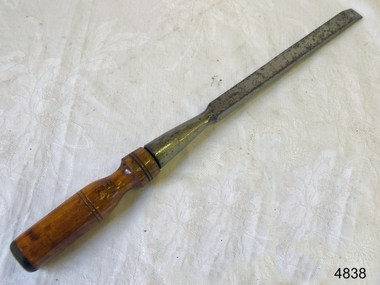
Tool - Chisel, 1940-1962
... footnote, William Marples was the uncle of Robert Marples and Joseph Marples, both of whom established competing tool making businesses in Sheffield. The Robert Marples firm disappeared early in the 20th century. After several changes in the company's ownership tools are now made under the Ridgway name but in China. A tool made by a company with a long family history ...William Marples junior joined his father's joinery making business in 1821. In 1860 William's sons joined him and the firm became William Marples and sons. Over the years they acquired John Moseley & Sons a London plane maker and Thomas Ibbotson & Co a Sheffield edge tool maker. Growing to become the most prolific and best known Sheffield tool maker. Their large factory was known as the Hibernia Works. Their trademark was a shamrock that appeared on some of their tools, in 1961 they had about 400 employees. In 1962 the record Tool Company and William Ridgway acquired a fifty percent interest in the company and in 1972 the companies merged with several others to form Ridgway Tools Ltd. After 116 years at its Hibernia Works, the company was moved to Dronfield. A 1982 takeover by A G Bahco of Sweden was short-lived and in 1985 Record Ridgway returned to British ownership first as Record Marples Woodworking Tools Ltd. In 1988 then as Record Holdings PLC in 1993. In 1998 the company accepted a bid from American Tool Corporation, subsequently trading as Record Irwin. The Irwin company itself was acquired by Newell Rubbermaid in 2002 and renamed Irwin Industrial Tool Co. Both the Marples and Record names were re-branded "Irwin" However the name has since been resurrected as Irwin/Marples and applied to wood chisels and table saw blades now made at their new facility in Udine, Italy. As a footnote, William Marples was the uncle of Robert Marples and Joseph Marples, both of whom established competing tool making businesses in Sheffield. The Robert Marples firm disappeared early in the 20th century. After several changes in the company's ownership tools are now made under the Ridgway name but in China.A tool made by a company with a long family history of tool making in Sheffield England, with a member of the Marples family, Joseph Marples establishing a competing tool company which continues today to manufacture quality products for the joinery and shipwrights trades.Socket chisel with 1/2" blade."Marples & Son" stamped on bladeflagstaff hill, warrnambool, flagstaff-hill, flagstaff-hill-maritime-museum, maritime-museum, shipwreck-coast, flagstaff-hill-maritime-village, hand tool, ward chisel, woodwork chisel, marples and sons, cabinet makers tools, william marples and sons -
 Eltham District Historical Society Inc
Newsletter, Newsletter, No. 229 August 2016
... Contents: • The Society's 50th Anniversary 2017 by Russell Yeoman • Our Next Meeting - Wednesday 10th August; 'Creators, Makers and Shakers' • Heritage Excursion - Maroondah Aqueduct Walk - Saturday 3rd September • Eltham District's Early History • The Eltham Barrel by Jim Allen • Eltham Taps Run Dry • A Footnote on Shoestring • Membership Subscriptions • The Little Church in St Helena by Maureen Smith • St Katherine's Church in St Helena • Beauty Spots • ... and also • Contacts for the Eltham District Historical Society ...Eltham District Historical Society Inc 728 Main Rd Eltham melbourne Contents: • The Society's 50th Anniversary 2017 by Russell Yeoman • Our Next Meeting - Wednesday 10th August; 'Creators, Makers and Shakers' • Heritage Excursion - Maroondah Aqueduct Walk - Saturday 3rd September • Eltham District's Early History • The Eltham Barrel by Jim Allen • Eltham Taps Run Dry • A Footnote on Shoestring • Membership Subscriptions • The Little Church in St Helena by Maureen Smith • St Katherine's Church in St Helena • Beauty Spots • ... and also • Contacts for the Eltham District Historical Society The Shire of Eltham Historical Society was formed in October 1967. ...Contents: • The Society's 50th Anniversary 2017 by Russell Yeoman • Our Next Meeting - Wednesday 10th August; 'Creators, Makers and Shakers' • Heritage Excursion - Maroondah Aqueduct Walk - Saturday 3rd September • Eltham District's Early History • The Eltham Barrel by Jim Allen • Eltham Taps Run Dry • A Footnote on Shoestring • Membership Subscriptions • The Little Church in St Helena by Maureen Smith • St Katherine's Church in St Helena • Beauty Spots • ... and also • Contacts for the Eltham District Historical Society The Shire of Eltham Historical Society was formed in October 1967. The first newsletter of the Society was issued May 1978 and has been published continuously ever since on a bi-monthly basis. With the cessation of the Shire of Eltham in late 1994, the Society's name was revised to Eltham District Historical Society and this name first appeared with issue No. 103, July 1995. The collection of the Society's newsletters provides a valuable resource on the history of the Society's activities, office bearers and committee members, guest speakers and subjects of historical interest pertinent to the former Shire of Eltham and the Eltham District.A4 photocopied newsletter distributed to membersnewsletter, eltham district historical society, shire of eltham historical society -
Port Melbourne Historical & Preservation Society
Book, Amanda Scardamaglia, Printed on Stone, The Lithographs of Charles Troedel, 2020
... footnote to her PhD thesis. From the interest came her first book 'From Stone to Print'. this book, 'Printed on Stone', covers the history of lithography as well as that of Charles, company from 1863 to 2013. ...footnote to her PhD thesis. From the interest came her first book 'From Stone to Print'. this book, 'Printed on Stone', covers the history of lithography as well as that of Charles, company from 1863 to 2013. ...The book is an account of the Charles TROEDEL & Co and their lithograph production. The author, Amanda SCARDAMAGLIA, mentioned the company in a footnote to her PhD thesis. From the interest came her first book 'From Stone to Print'. this book, 'Printed on Stone', covers the history of lithography as well as that of Charles, company from 1863 to 2013. In 1887 Edward COOPER joined the business & in 1890 he and Charles formed a partnership until the 1890's depression forced the temporary closure of the business in 1895. The book is lavishly illustrated with examples of the work.Hard cover book of 234 pages with its spine bound in red. Images on the pale yellow cover are two of Empire Dandelion Cocoa; one of Harper Oriental Coffee and one of R. Harper & Co's Pearl Rice .Presented to the Port Melbourne Historical Society August 2022 Amandabuilt environment - commercial, charles troedel, chas troedel & co, amanda scardamaglia, lithography, troedel & cooper -
 Bendigo Historical Society Inc.
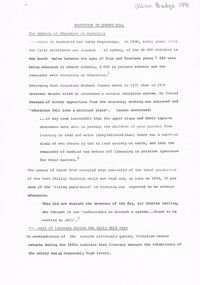
Document - PAPER BY ALLAN BUDGE 1991: 'EDUCATION IN QUARRY HILL'
... Sections within paper - The Genesis of Education in Australia; Early Education in Bendigo; Education comes to Quarry Hill; Today's schools in Quarry Hill; The role of Quarry Hill in teacher training; Achievements and frustrations; Snippets of social history; Early Catholic Schools in Bendigo; Secondary Education in Quarry Hill; Other Schools in Quarry Hill; Footnotes (pages 24 & 25). ...Sections within paper - The Genesis of Education in Australia; Early Education in Bendigo; Education comes to Quarry Hill; Today's schools in Quarry Hill; The role of Quarry Hill in teacher training; Achievements and frustrations; Snippets of social history; Early Catholic Schools in Bendigo; Secondary Education in Quarry Hill; Other Schools in Quarry Hill; Footnotes (pages 24 & 25). ...'Education in Quarry Hill', research document prepared by Allan Budge, dated 1991, titled 'Education in Quarry Hill' ''Education in Quarry Hill'' - 25 paged paper by Allan Budge. 1991. Sections within paper - The Genesis of Education in Australia; Early Education in Bendigo; Education comes to Quarry Hill; Today's schools in Quarry Hill; The role of Quarry Hill in teacher training; Achievements and frustrations; Snippets of social history; Early Catholic Schools in Bendigo; Secondary Education in Quarry Hill; Other Schools in Quarry Hill; Footnotes (pages 24 & 25). Many references include Young Men's Mutual Improvement Society; James Rae; Sandhurst Athenaeum; A Notebook; 1st Battalion Cadet Corps, Sandhurst Detachment (first cadet corps in Colony); St Joseph's Primary School; Bendigo Girl's High School of Domestic Arts; Quarry Hill Preparatory School.Allan Budgeeducation, bendigo, quarry hill, young mens mutual improvement society, early catholic schools, st joseph's primary, 1st battalion cadets corps, sir charles darling, michael cannon. -
 Bendigo Historical Society Inc.
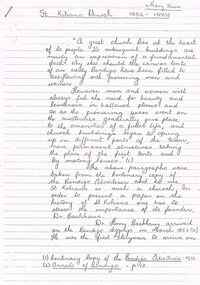
Document - ESSAY: ''ST. KILIANS CHURCH 1852 TO1888''
... Handwritten 20 page document (no date) concerning the history of the early Catholic church in Bendigo, the history of the St Kilians church and the influence and works of Dr Henry Backhaus over that period. The essay is referenced with numerous footnotes (manuscripts in addition to books, newspapers etc) and final page bibliography. ...Handwritten 20 page document (no date) concerning the history of the early Catholic church in Bendigo, the history of the St Kilians church and the influence and works of Dr Henry Backhaus over that period. The essay is referenced with numerous footnotes (manuscripts in addition to books, newspapers etc) and final page bibliography. ...Round top Essay by Mary Kerr - ''St. Kilian's Church 1852 -1888''. Handwritten 20 page document (no date) concerning the history of the early Catholic church in Bendigo, the history of the St Kilians church and the influence and works of Dr Henry Backhaus over that period. The essay is referenced with numerous footnotes (manuscripts in addition to books, newspapers etc) and final page bibliography. Extensive coverage of history including references to first baptism, first marriage, the 'Mass Tent', 'Consecrated Flat', the 'Bark Chapel', the stone church, the organ, retirement and death of Dr Backhaus.Mary Kerrchurch, history, st. kilian's catholic church, bendi, mass tent, bark chapel, dr hanry backhaus, consecrated flat, mary kerr. -
 Bendigo Historical Society Inc.
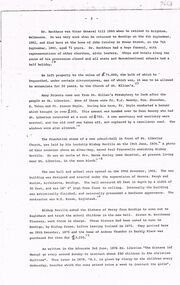
Document - TYPEWRITTEN PAPER: HISTORY OF ST. LIBORIUS, EAGLEHAWK
... Detailed history incl ref to: Design and erection; Sisters of Mercy; Franciscan Order of Friars Minor; chalice; weddings, baptism and font; school; convent; the ''relic of St Liborius''; current personnel and church population. Footnotes...Detailed history incl ref to: Design and erection; Sisters of Mercy; Franciscan Order of Friars Minor; chalice; weddings, baptism and font; school; convent; the ''relic of St Liborius''; current personnel and church population. Footnotes ...Typewritten loose-leaf Paper re: history of St. Liborius, Eaglehawk (no title page, no author, incidental ref to date on page 8 ie 1982). Detailed history incl ref to: Design and erection; Sisters of Mercy; Franciscan Order of Friars Minor; chalice; weddings, baptism and font; school; convent; the ''relic of St Liborius''; current personnel and church population. Footnotes (36) and possibly a separate non-stapled.''Select Bibliography?church, history, st liborius church eaglehawk, sisters of mercy, franciscan order of friars minor, history and relic of st liborius. dr backhaus. st kilian's.bishop reville. w. e. brown. eaglehawk. bishop cane. st. marys college. sistewrs of st. joseph. -
 Flagstaff Hill Maritime Museum and Village
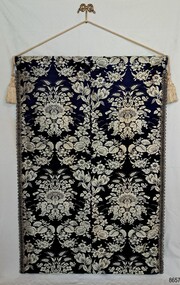
Textile - Wall Hanging, curtain, 1854-1855
... history. She had collected and recorded information that dates back to pre-1341. A footnote included in a handwritten letter dated April 20, 1959, from the late Arthur William Rudd, OBE, MA, LLB, husband of another of the donor’s aunts, states, “The curtains you mentioned came from the Schomberg. ...history. She had collected and recorded information that dates back to pre-1341. A footnote included in a handwritten letter dated April 20, 1959, from the late Arthur William Rudd, OBE, MA, LLB, husband of another of the donor’s aunts, states, “The curtains you mentioned came from the Schomberg. ...The striking fabric of this wall hanging was recovered from the sinking Schomberg. It was originally one of the many curtains adorning the captain’s cabin and ladies’ saloons that attracted first-class passengers to this luxury vessel, built for comfort and speed. The clipper ship was on its maiden voyage, full of passengers emigrating to Australia in 1855. Its commander was Captain James Nicol Forbes, who had been selected by James Baine & Co for his navigation skills, experience, and reputation for breaking sailing records. However, on December 26th, 1855, the vessel became stranded and sank west of Cape Otway, not quite reaching its destination of Melbourne. A reporter explored the Schomberg before its journey; the following detailed description is an excerpt of his article published in a newspaper after the disastrous voyage was announced. “ … descending by a flight of stairs, covered with carpet of a very rich pattern, we came to the saloon passengers’ cabin. This is a noble place, and all that refined taste would suggest has been done to make each berth a miniature palace. The bedding is of the very best material, and the fittings are replete with every convenience. The carpets are of various coloured velvet pile, and the curtains are of satin damask, lined with white satin … The fronts of the berths are highly decorated, and festoons of flowers are painted on the panels … No two berths are furnished with the same-coloured material … the visitor is, therefore, much pleased with the variety which he has to inspect….” (Trove: Shipping Gazette and Sydney General Trade, 31 Dec 1955, p. 283) The curtain material, ‘folded into a single piece and parcelled for protection’, has been passed down through generations of Captain Forbes’ relatives, starting with his half-sister Isabella Jeffrey Nicol. The curtain has remained with the family, although some transition details are incomplete. About a century later, Isabella and Blakiston Robinson’s great-grandson and his wife had the fabric professionally mounted as a wall hanging to showcase the beauty of the woven brocade. Eventually, the custodianship of the curtain was transferred to the donor, who is also a great-grandson of Isabella and Blakiston. He and his wife hung the curtain on the wall of a high-ceilinged room in their home, away from direct light, making it visible for all to appreciate its beauty and significance. In 2024, they donated the curtain for inclusion among the collection of artefacts that help tell the story of the Schomberg and those who sailed on its first and last voyage. The donor’s aunt was highly involved in the family’s history. She had collected and recorded information that dates back to pre-1341. A footnote included in a handwritten letter dated April 20, 1959, from the late Arthur William Rudd, OBE, MA, LLB, husband of another of the donor’s aunts, states, “The curtains you mentioned came from the Schomberg. AWR.” CAPTAIN JAMES NICOL FORBES (1821-1874) and the donor’s family: - Captain Forbes was born in Aberdeen. In his late teens, he moved to Liverpool, a hub for international trade and an emigration port. By the age of 25, he was master of the Prince of Waterloo and later, the Wakefield. He then commanded the Cleopatra for the James Baines Co., which, two years later, transferred him to command the Maria, providing fast and lucrative passage to the gold fields in Ballarat, Australia. James Baines Co. and shipbuilder Thomas Mackay formed the Black Ball Line of clipper ships in 1852. Forbes was appointed master of the largest ship in the fleet, the marvellous Marco Polo. He broke the record time for the passage to Australia, taking only 68 days at sea, and the return journey in only 76 days, a total of 5 months and 21 days. On his second voyage to Melbourne in the Marco Polo the following year, he took 75 days, and 95 days on the return trip. His accomplishment made him famous. James Baines reported that the Marco Polo was the only ship, sail or steam, to do the round trip within 6 months, and it had done it twice. Captain Forbes then took command of the American-built clipper Lightning, one of four built for the Black Ball line. His 19-year-old half-sister, Isabella Jaffray Nicol, was also onboard when he sailed for Melbourne in 1854. During the 77-day voyage, Isabella met Blakiston Robinson, and not long after the ship arrived in Melbourne on July 31, the couple married, with James Nicol Forbes as a witness, on August 16. When Forbes returned to Liverpool, he took a record-breaking 63 days, which has never been bettered. James Baines Co. ordered a new luxury emigrant ship from Alexander Hall of Aberdeen; the Schomberg was the largest sailing ship ever built in Britain. On October 6, 1855, the vessel departed Liverpool commanded by Captain Forbes, with 430 passengers on board, 54 of whom were First Class. It had almost completed its voyage to Melbourne when, on the night of December 26, it ran aground west of Cape Otway. Captain Doran, master of the steamer Queen, responded to the distress signal while on its way to Portland and, with the agreement of his passengers, rescued as many as possible from the Schomberg and returned to Melbourne with them. Captain Helpman, master of the steamer Champion, rescued most of the remaining Schomberg passengers on December 27. On Friday, 28th, Captain James Lawrence was on his way to Adelaide in the steamer Burra Burra, and called past the Schomberg. He reported that the remaining crew were all doing their duties, but the Schomberg was deteriorating on a sand spit and had about 16 feet of water in its hold. That same day, the schooner Jane Elizabeth collected 220 packages of passengers’ luggage to deliver to Melbourne on the 29th. Two steamers also arrived on the 29th with 20 men to collect passengers’ luggage and valuable ship’s cargo items. They were accompanied by water police, customs agents, company representatives and a Lloyds agent. The decision was made to abandon ship on the 30th due to rough and unsafe conditions. The officials and Captain Forbes voyaged to Melbourne, while the seamen remained behind awaiting rescue. Evacuation by sea became too risky, so on January 2, 1856, while the first Mate and Steward remained at the wreck site, the rest of the crew began the 70-mile march to Warrnambool, led by the band. They arrived on January 5th and left for Melbourne on the steamer Champion on January 10th. Parts of the Schomberg wreck ended up in New Zealand. The curtain is important for its connection to the Schomberg, which was unique for being designed and built in Aberdeen, and commanded by an Aberdonian who was the most celebrated clipper captain of the age. The ship was the largest sailing ship ever built in Britain, and reported as the largest vessel that sailed to Australia. The curtain is an example of the rich decorative furnishings available in 1855. The preservation and respect the donor and his family have shown towards the curtain over many decades reflect its important role in telling the family’s history; the journey, the romantic attachment, the family connection to the sea, and travel in gold rush times. The curtain is significant for its connection to James Nocol Forbes, a famous sailing ship commander who broke several sailing records, one of which has never been bettered. This wall hanging, also known as the Schomberg Curtain, was created from a curtain recovered from the stranded luxury ship Schomberg in December 1855. The woven satin damask fabric in blue and cream has been meticulously joined to blend the intricate pattern. The reverse features a soft cream lining. The hems at the top and bottom of the fabric hold wooden rods. The side edges feature decorative braid that has been hand-stitched in place. On the reverse, the bottom hem includes the same braid, which remains unseen from the front, and the centre of the top hem has a hand-worked, unused buttonhole. Each of the hems varies in depth. The curtain was tastefully mounted later to highlight the beauty of the original saloon curtain. A decorative twisted cord of cream silk threads, accented with gold highlights and decorative tassels, was coiled and attached to the ends of the top rod. The elegant display was completed with an ornate gold hook, chosen to complement the wall hanging.flagstaff hill maritime museum and village, great ocean road, shipwreck coast, shipwreck artefact, memorabilia, curtain, saloon curtain, schomberg, wall hanging, decorative object, domestic item, warrnambool, flagstaff hill, maritime museum, maritime village, maritime history, shipwreck, stranding, schomberg curtain, schomberg wall hanging, luxury ship, 1855, damask, silk damask, blue and cream, captain’s cabin, ladies’ saloon, clipper ship, migrant, emigrant, liverpool to australia, captain james nicol forbes, james forbes, captain forbes, bully forbes, james baines & co, james baines, cape otway, aberdeen, prince of waterloo, wakefield, cleopatra, maria, thomas mackay, black ball line, marco polo, sailing record, lightning, isabella jaffray nocol, blakiston robinson, alexander hall, steamer queen, captain helpman, james lawrence, steamer burra burra, steamer jane elizabeth, water police, customs agents, lloyds agent, ship’s band, walk to warrnambool, march to warrnambool, steamer champion, agnes nicol robinson, arthur william rudd obe ma llb -
 Flagstaff Hill Maritime Museum and Village
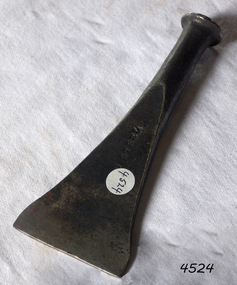
Tool - Caulking Tool, William Marple & Sons, Early 20th century
... footnote, William Marples was the uncle of Robert Marples and Joseph Marples, both of whom established competing tool making businesses in Sheffield. The Robert Marples firm disappeared early in the 20th century. After several changes in the company's ownership tools are now made under the Ridgway name but in China. A tool made by a company with a long family history ...Caulking is the traditional technique used on wooden vessels built with butted or clinker-built planks to fill the gaps between these planks while still allowing the wood to flex and move. This involved driving the irons, hammered in with the mallet, deep into the seams to open them up. After this, spun yarn, oakum (hemp) or cotton was driven deep into the gaps. The hemp or cotton was soaked in creosote or pine tar to make the joins watertight. Caulking also played a structural role in tightening up the hull or deck by reducing the longitudinal movement of the neighbouring planks. William Marples junior joined his father's joinery making business in 1821. In 1860 William's sons joined him and the firm became William Marples and sons. Over the years they acquired John Moseley & Sons a London plane maker and Thomas Ibbotson & Co a Sheffield edge tool maker. Growing to become the most prolific and best known Sheffield tool maker. Their large factory was known as the Hibernia Works. Their trademark was a shamrock that appeared on some of their tools, in 1961 they had about 400 employees. In 1962 the record Tool Company and William Ridgway acquired a fifty percent interest in the company and in 1972 the companies merged with several others to form Ridgway Tools Ltd. After 116 years at its Hibernia Works, the company was moved to Dronfield. A 1982 takeover by A G Bahco of Sweden was short-lived and in 1985 Record Ridgway returned to British ownership first as Record Marples Woodworking Tools Ltd. In 1988 then as Record Holdings PLC in 1993. In 1998 the company accepted a bid from American Tool Corporation, subsequently trading as Record Irwin. The Irwin company itself was acquired by Newell Rubbermaid in 2002 and renamed Irwin Industrial Tool Co. Both the Marples and Record names were re-branded "Irwin" However the name has since been resurrected as Irwin/Marples and applied to wood chisels and table saw blades now made at their new facility in Udine, Italy. As a footnote, William Marples was the uncle of Robert Marples and Joseph Marples, both of whom established competing tool making businesses in Sheffield. The Robert Marples firm disappeared early in the 20th century. After several changes in the company's ownership tools are now made under the Ridgway name but in China. A tool made by a company with a long family history of tool making in Sheffield England, with a member of the Marples family, Joseph Marples establishing a competing tool company which continues today to manufacture quality products for the joinery and shipwrights trades.Caulking tool straight wide blade, Stamped "W Marples & Sons" & James S Steele tool box.flagstaff hill, warrnambool, shipwrecked coast, flagstaff hill maritime museum, maritime museum, shipwreck coast, flagstaff hill maritime village, great ocean road, caulking tool, caulking iron, james s steele -
 Flagstaff Hill Maritime Museum and Village
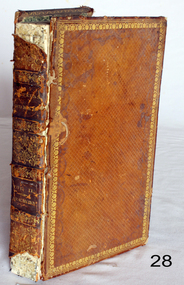
Literary work - Book, G. Sidney, Book of sermons by The Right Reverend Beilby Porteus Vol 2. Additional notes on authors life by Rev. Robert Hodgson, A.M.F.R.S, 1811 Published
... His sermons continued to be read by many, and his legacy as a foremost abolitionist was such that his name was almost as well known in the early 19th century as those of Wilberforce and Thomas Clarkson but 100 years later he had become one of the 'forgotten abolitionists', and today his role has largely been ignored and his name has been consigned to the footnotes of history. His primary claim to fame in the 21st century is for his poem on Death and, possibly unfairly, as the supposed prototype for the pompous Mr. ...Rev Robert Hodgson: His father was Robert Hodgson Snr, of Congleton, and Mildred (née Porteus) in early 1773. He was baptised on 22 September 1773 at St Peter's Church, Congleton. Hodgson was a close relative (by marriage on his father's side and by blood on his mother's side) of Beilby Porteus, Bishop of London of whom Hodgson wrote a biography of Porteus. On his mother's side, he was a descendant of Augustine Warner Jnr., who presided as the Speaker of the Virginia House of Burgesses during the time of Bacon's Rebellion (Warner served before the Rebellion in 1676, and after the Rebellion in 1677.) Hodgson was educated at Macclesfield School and Peterhouse, Cambridge, where he graduated with a BA as 14th Wrangler in 1795. He was appointed rector of St George's, Hanover Square for over forty years, from 1803 until his death in 1844. Bishop Beilby Porteus: Beilby Porteus 8 May 1731 – 13 May 1809), successively Bishop of Chester and London was a Church of England reformer and a leading abolitionist in England. He was the first Anglican in a position of authority to seriously challenge the Church's position on slavery. Porteus was born in York on 8 May 1731, the youngest of the 19 children of Elizabeth Jennings and Robert Porteus ( 1758/9), a planter. Although the family was of Scottish ancestry, his parents were Virginian planters who had returned to England in 1720 as a result of the economic difficulties in the province and for the sake of his father's health. Educated at York and Ripon Grammar School, he was a classics scholar at Christ's College, Cambridge, becoming a fellow in 1752. In 1759 he won the Seatonian Prize for his poem Death: A Poetical Essay, a work for which he is still remembered. He was ordained as a priest in 1757, and in 1762 was appointed as domestic chaplain to Thomas Secker, Archbishop of Canterbury, acting as his assistant at Lambeth Palace for six years. It was during these years that it is thought he became more aware of the conditions of the enslaved Africans in the American colonies and the British West Indies. He corresponded with clergy and missionaries, receiving reports on the appalling conditions facing the slaves from Rev James Ramsay in the West Indies and from Granville Sharp, the English lawyer who had supported the cases of freed slaves in England. In 1769 Beilby Porteus was appointed as chaplain to King George III. He was also Rector of Lambeth (a living shared between the Archbishop of Canterbury and the Crown) from 1767 to 1777, and later Master of St Cross, Winchester (1776–77). He was concerned about trends within the Church of England towards what he regarded as the watering-down of the truth of Scripture and stood for doctrinal purity. He was, however, happy to work with Methodists and dissenters and recognised their major contributions in evangelism and education. In 1776, Porteus was nominated as Bishop of Chester, taking up the appointment in 1777. He was Renowned as a scholar and a popular preacher, it was in 1783 that the young bishop was to first come to national attention by preaching his most famous and influential sermon. In 1787, Porteus was translated to the bishopric of London on the advice of Prime Minister William Pitt, a position he held until his death in 1809. As is customary, he was also appointed to the Privy Council, and Dean of the Chapel Royal. In 1788, he supported Sir William Dolben's Slave Trade Bill from the bench of bishops, and over the next quarter-century, he became the leading advocate within the Church of England for the abolition of slavery, lending support to such men as Wilberforce, Granville Sharp, Henry Thornton, and Zachary Macaulay to secure the eventual passage of the Slave Trade Act in 1807.Beilby Porteus was one of the most significant, albeit under-rated church figures of the 18th century. His sermons continued to be read by many, and his legacy as a foremost abolitionist was such that his name was almost as well known in the early 19th century as those of Wilberforce and Thomas Clarkson but 100 years later he had become one of the 'forgotten abolitionists', and today his role has largely been ignored and his name has been consigned to the footnotes of history. His primary claim to fame in the 21st century is for his poem on Death and, possibly unfairly, as the supposed prototype for the pompous Mr. Collins in Jane Austen's novel ”Pride and Prejudice”. But, ironically, Porteus' most lasting contribution was one for which he is little-known, the Sunday Observance Act of 1781 (a response to what he saw as the moral decay of England), which legislated how the public were allowed to spend their recreation time at weekends these laws continued for the following 200 years until the passing of the Sunday Trading Act of 1994.Book of sermons cover is brown with gold border and decoration Beilby Porteus (or Porteous; 8 May 1731 – 13 May 1809), successively Bishop of Chester and of London, was a Church of England reformer and a leading abolitionist in England. He was the first Anglican in a position of authority to seriously challenge the Church's position on slavery. The Works of The Right Reverend Beilby Porteus Vol 2” . Spine has “Porteus’ Works, Vol. II Sermons”. The works of the Right Reverend Beilby Porteus, D.D., late Bishop of London; with his life, by the Rev. Robert Hodgson, A.M.F.R.S. and one of the Chaplains in Ordinary to His Majesty. A New Edition in Six Volumes. Vol. II – Sermons. Published in 1811 for T. Cadell and W., Davies, in The Strand, London. Printed by G. Sidney, Northumberland-street. flagstaff hill, warrnambool, shipwrecked coast, flagstaff hill maritime museum, maritime museum, shipwreck coast, flagstaff hill maritime village, great ocean road, right reverend beilby porteous, sermons, london reverend -
 City of Melbourne Libraries
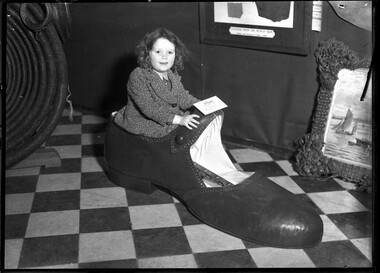
Photograph, Bull, Hugh Jones, 1897-1993, Leather Exhibition, Melbourne Town Hall
... It gives a quick history and overview of the Australian leather industry and its unprecedented, and possibly unexpected, development and success, and states with pride: “Though Victoria is the largest leather producer in the Commonwealth all tanners in the Commonwealth can look back with pride on the long march of progress.” Footnotes...It gives a quick history and overview of the Australian leather industry and its unprecedented, and possibly unexpected, development and success, and states with pride: “Though Victoria is the largest leather producer in the Commonwealth all tanners in the Commonwealth can look back with pride on the long march of progress.” Footnotes ...Photographer notations on slide: At the Leather Exhib. at T. Hall Melb 1933 Age Published: Age (Melbourne, Vic.: 1854- ), 1933 THE EXHIBITS. (1933, September 20). The Age (Melbourne, Vic. : 1854 - 1954), p. 16. Retrieved January 25, 2026, from http://nla.gov.au/nla.news-article205109730 Published title: THE EXHIBITS. A COMPREHENSIVE RANGE. Curios, Novelties, Working Displays Published Caption: ONE OF THE NOVELTIES – AN OUTSIZE IN SHOES Research by Project Volunteer, Louise McKenzie: Our photo is dated 20 September 1933, and shows a happy, chubby-faced young girl sitting in a very over-sized girl’s shoe. It is labelled – “Shoe, An Out Size, loaned by Messrs Blackman & Rose”. (1) It is an effective way to capture the attention of the readership and alert them to the Melbourne Leather Show 1933. This show was designed to be a drawcard of extraordinary proportion, and there is no doubt that this leather exhibition was a really big deal for Melbourne. It completely took over the Melbourne Town Hall, and was open from 10.30 am until 10.30 pm. It seemed to contain something for everyone – the military, the man about town, the home handyman, the housewife, the child, the sporting types, the domestic workers, the outdoor enthusiasts, the horseracing fans, car enthusiasts, those wishing to show off the latest fashion – both men and women - and those just intrigued by a lot of fascinating and wide ranging exhibits. One of the most comprehensive descriptions of the Exhibition accompanies the photograph, and is worth quoting in full: “PROMINENT among exhibits which first attract attention in the foyer of the Town Hall is a comprehensive display of leather articles used by the defence forces. A conspicuous legend states that leather plays an important part in national defence, being used for saddlery, tool containers, holdalls, range-finding, surveying and signalling equipment, explosives factories, harness accoutrement, bandsmen's equipment and clothing. Three models of horses and several figures of soldiers wearing leather equipment illustrate the lesson, and a great range of leather goods used in military training and work variegate the display. Nearby are Texas cowboy, buckjumping and breaking-in saddles; whips, a walking stick, made of leather and numerous other curios. The general exhibition occupies the whole floor space of the main Town Hall, and is subdivided by partitions running most of the length of the hall. A bewildering variety, of leather goods presses for close and leisured inspection. Here and there operatives in charge of working machinery give practical demonstrations of factory processes in the production of footwear. Polishing materials are well represented. One attractive exhibit includes two bush huts constructed of leather, with wattle bark for roofing. Opossums, rosellas and a kookaburra add touches of bush realism. Adjacent exhibits include bags, fishing boots, leggings, leather covers in all colours. Factory Processes. One exhibitor has installed an automatic cinema apparatus and screen, which projects various factory processes in making a shoe, the operator being shown at work. Elsewhere an interesting exhibit depicts the five stages in the manufacture of sole leather, and the tanning materials employed. "Very handsome effects are achieved in the interior appointments of motor cars, which are attended by figures of smart chauffeurs in leather coats. Motor-trimming leather is said to be more durable and hygienic than fabric materials, and cheaper. The neat finish of the material, its excellent appearance, certainly make a very favourable impression. It takes the hides of three beasts to cover the cushions, squabs and door panels of a full-sized sedan, while to finish the entire interior, including quarter-panels and head linings would take four or even five. Special Exhibits. Amongst the special sections the display arranged by the handicrafts and home industries- committee of the Country Women's Association of Victoria is a notable one. In all there are about 130 entries which are in four classifications, viz., hand-tooled or embossed leathers, suede, hand-made gloves and undecorated leather. The glove section attracted the most numerous entries, a number being the work of members and craft subscribers of the Country Women's Association. In the leathercraft competition, organised by the Country Women's Association, the judges yesterday awarded the first prize for bookbinding (the only prize given in this division) to Miss M. Alston, of South Yarra. There is also a creditable display of exhibits submitted by boys of the orthopaedic section of the Children's Hospital at Frankston. Amongst the novelties on view in other portions of the exhibition were the following: — Leather coats worn by Sir C. Kingsford Smith on his Atlantic flight. Model Wellington boot, Phar Lap's saddle. Melbourne Cup winner's saddle. Longest whip in world, 108 feet long. (33 metres) [See our photo, to left of Girl in Shoe] Diminutive shoes. Pair of shoes 65 years old. Pair of men's working boots 75 years old. Larwood's, Tate’s and Pataudi’s cricket boots. [Three internationally revered cricketers of the day] (2) Picture frame made of leather bought 63 years ago. [See our photo, to right of Girl in Shoe] Leather frame, powder bowl, &c. Saddle used by world's champion buckjumper in U.S.A. Mexican cowboy outfit. Miniature saddle and bridle. A fireman's helmet made of sole leather. (3) Sample of the leather hat worn by porters at the Billingsgate Fish Market, London. (4) From South Australia there have been obtained sets of harness for donkeys, goats and camels, the equipment being displayed to good advantage on stuffed representations of the animals mentioned. Close to the platform is a glass case containing snow shoes and coats which have been used in Antarctic exploration work. Trade Display. Amongst the trade exhibits may be seen in operation a slipper turn shoe sewing machine, with heeling and channelling facilities, and the various stages in the production of ladies' sandals are shown. There is a wide contrast between sole leather of varying degrees of thickness on view in one stall and the choice samples of ladies' footwear in another — footwear, by the way, which could almost be used as ornaments, so dainty in colour and production are they. Again, there are displays of upholstering leathers of such soft texture that they could he readily mistaken for some of the finest cloth. Those who may be particularly interested in the production of chamois leather may gain an insight into the materials and chemicals used in the "working up” of this variety of leather. Supplies of glace kid (5) are tastefully arranged, and there may also be seen bags of all shapes and sizes, including satchels, suit cases and "sporting" cases, and bags for tennis players and golfers. Further variety is given to the exhibition by the display of antique hides, brightly coloured, with punching balls, boxing gloves and batsman's pads. There are crocodile skins and snake skins so cleverly "Worked up" that one could be almost pardoned for betraying an affection for such unpopular creatures.” “ Another wonderful article on this Exhibition, published the same day in one of the opposition daily newspapers, The Argus, is in the weekly article “Women to Women”, entitled “A Great Victorian Industry: Many Uses for Leather”. This weekly column was penned by Vesta, and she writes, with much purpose: “Yesterday afternoon I paid a hurried visit to the Leather Exhibition now being held in the Melbourne Town Hall and I was disappointed to find that the early visitors to the main exhibition were almost all men. Women, I think, should make a point of seeing every exhibition of our great industries, for women are the buyers of household requisites and goods for their own use and their tastes, and opinion influence also, to a large extent, the purchases of men. So, the welfare of industries is more or less in their hands and it becomes a duty for them to inform themselves fully of the extent and the quality of the manufacturing that is done here. The value of the output of the Australian boot and shoe factories alone was in 1930-31, the latest year for which the figures are given, Stg 3,750,000. Fully two thirds of that amount must have been spent by women on boots and shoes for themselves and their children. In a host of other directions, in the purchase of handbags, travelling bags, belts and straps, cushions, furniture coverings, purses, notebooks, spectacle cases, their annual expenditure must be very high. Their interest, therefore, in this industry is practical, and their support of it should be governed by knowledge of comparable values and qualities of the goods they buy. From the point of view of women, however, the exhibition itself is rather disappointing. There is an amazing collection of good stuff on show, but most of it is not displayed in a fashion that attracts attention. I was surprised, for example, at the range and quality of the leathers displayed, the suppleness of the finer qualities, and the varied range of colours and designs. But they are shown in such a fashion that if one set out deliberately to look for them it would be quite easy to miss most of them.” …It was surprising, too, that no one seemed to have taken advantage of the present fashion of wearing coloured gloves, or the cult of glove making, which the Country Women’s Association has fostered so successfully. Outside the collection of chamois leathers I saw no skins which were suitable to glove making. (6) However, it is perhaps a little unfair to be highly critical of the exhibition, inasmuch as it is the first of its kind. The material is there, undoubtedly, for a splendid show of every phase of this enterprising industry, and I am confident that experience will prove to those concerned that it will be worth while next time to devote a great deal of attention of the method of display.” With further research, it transpires that “Vera” is in fact NZ born Stella May Allen (nee Henderson) (1871-1962), a journalist, the first woman in NZ to begin a law course, in 1890-91). She later worked at a law firm while she completed her degree. Study of the law had always been open to women in NZ, but its practice was still barred to them. Her case “…led to amending legislation in 1896 allowing women to practise as barristers or solicitors. However, on gaining her LL.B. in November 1897 she did not apply for admission to the Bar. Instead, she became the Wellington-based correspondent and leader-writer for the Lyttelton Times. Her appointment, the first for a woman, was not welcomed by the all-male Press Gallery, and special permission had to be obtained from a subcommittee of the House before her presence was accepted. In 1900 she married Edwin Allen, a senior leader-writer for the Wellington Evening Post, and they moved to Australia in 1903 when Edwin Allen took up the post of foreign affairs leader-writer and parliamentary man for the Melbourne Argus. As Patricia Keep notes in her excellent entry of Stella Allan in the Australian Dictionary of Biography: “In 1907 The Argus commissioned her to write a series of articles on the first Australian Women's Work Exhibition held in October. They aroused much interest and next year The Argus invited her to join its full-time staff and begin a weekly section on the particular interests of women. She adopted the nom de plume 'Vesta' and called the column 'Women to Women'. Her work was unique in an Australian daily paper at that time. Her pages extended to cover every aspect of women's affairs, children's interests and community welfare, and 'Vesta' became a household word for authoritative information and advice on such matters. An excellent needlewoman and first-rate cook herself, she thoroughly tutored her staff in the work and needs of women in both country and city, as well as providing the usual training for cadet journalists. She conducted interviews and also visited the country to see at first hand the results of bushfires, mouse plagues, droughts and floods. In 1910 she was one of three women foundation members of the Australian Journalists' Association. “…she found time to become deeply involved in community affairs. She was an original committee-member of the Victorian Association of Crèches and of the Free Kindergarten Union of Victoria, and had much to do with the early days of the Victorian Bush Nursing Association, the Baby Health Centres Association and the Queen Victoria Hospital. She was a member of the National Council of Women, first in New Zealand and then in Melbourne, and of the Country Women's Association from its inception. … in 1924 she was appointed substitute delegate for Australia to the fifth assembly of the League of Nations at Geneva and was a delegate to the second Pan Pacific Women's Conference in Hawaii in 1930. A meeting held in the Melbourne Town Hall in 1938 by representatives of all the main Victorian women's organizations paid special tribute to her work and influence. She retired next year to England where she continued to write for the Argus, contributing articles on the experiences of women and children in wartime.” It is little wonder that “Vesta” was unafraid to take to task both the women of Victoria, and those who created the exhibition! One item which appears to have gone unnoticed, or at least unreported, is a framed article in the background of the photo of the chubby girl in the shoe. The display frame is labelled “Leather from the Human Skin, Tanned and Dressed by French artists.” The exhibition was certainly a cabinet of curiosities! A charming article in The Argus is a nice note on which to end. It gives a quick history and overview of the Australian leather industry and its unprecedented, and possibly unexpected, development and success, and states with pride: “Though Victoria is the largest leather producer in the Commonwealth all tanners in the Commonwealth can look back with pride on the long march of progress.” Footnotes: (1) “Blackman and Rose”. Messrs Blackman and Rose were shoe manufacturers, from 1927 located at 200 Noone Street, Clifton Hill. The Melbourne Circle describes their building as a “fine-looking building in the Federation ‘blood and bandage’ style.” It was built around 1912 for Puttifoot and Bloom, boot manufacturers, and today the building is apartments. (2) These cricketers were household names in the day: Tate: Maurice Tate, “English cricketer of the 1920s and 1930s, and leader of England’s Test bowling attack for a long time during this period. The founder of modern seam bowling. “ Larwood: Harold Larwood, “English right-arm fast bowler and the main exponent of the bowling style known as “bodyline”. Used to considerable effect in the 1932-33 Test series in Australia. Pataudi: Iftikhar A K Pataudi, “an Indian prince who in the 1930s played Test cricket for England, and in the 1940s played Test cricket for India (as Captain) – the only test cricketer to have played for both India and England. (3) “sole” leather “… is the thickest and most resistant material existing in the tanning industry … made from vegetable tanned leathers, usually bovine butts, processed in a special way to make them the hardest type of leather in existence.” (4) The hats worn by porters at Billingsgate Fish Market were also known as a “Bobbin” and look quite squat and rather unsophisticated. They were made of wood and tarred leather, with a “flat, hardened top designed to support large rectangular boxes of fish. The upturned brim protected the porter’s head against fish juice draining from the boxes of fish which would be carried on top of the hat. Some hats featured a small drain hole at the rear to allow this collected juice to drain down the back of the carrier. The hats were made using the ‘cuir bouilli’ technique. The leather was immersed in water which was heated until the leather began to shrink. It was then removed and put on a wooden former. The leather was stitched together to make the hat while still wet, and then held in place until dry.” (See article and photo on the London Museum website) (5) Glace kid – described on the Boston Museum of Fine Arts’ Cameo database as “A smooth glossy leather originally prepared from goat or sheepskin. Early glace kid had a shiny surface that was originally prepared by tawing the skin in a mixture of alum, table salt, flour, and egg yolk. Today, glace kid is prepared from many types of vegetable or chrome tanned leathers. The smooth polished surface is obtained mechanically by shaving, glazing, ironing, and/or rolling the dry leather.” (6) In the 1930s, Melbourne’s glovemaking industry was characterised by local manufacturing, with key producers like Simpson’s Gloves Pty Ltd in Richmond and the Stagg Glove Company in Clifton Hill leading the market. These factories produced high-quality leather gloves, handbags, and specialty gear, often employing a clear gendered division of labour and training young, local women. Museum Victoria holds the Simpson’s Gloves Collection, comprising over 1200 items, and the University of Melbourne Archives holds the company’s business records. References: THE EXHIBITS. (1933, September 20). The Age (Melbourne, Vic. : 1854 - 1954), p. 16. Retrieved January 25, 2026, from http://nla.gov.au/nla.news-article205109730 EXPORT LEATHER. (1929, September 17). The Argus (Melbourne, Vic. : 1848 - 1957), p. 17. Retrieved January 19, 2026, from http://nla.gov.au/nla.news-article4037647 LEATHER EXHIBITION (1933, September 18). The Argus (Melbourne, Vic. : 1848 - 1957), p. 10. Retrieved January 19, 2026, from http://nla.gov.au/nla.news-article11693362 (1933, September 23). The Argus (Melbourne, Vic. : 1848 - 1957), p. 21. Retrieved January 19, 2026, from http://nla.gov.au/nla.news-page522766 WOMEN TO WOMEN (1933, September 20). The Argus (Melbourne, Vic. : 1848 - 1957), p. 13. Retrieved January 19, 2026, from http://nla.gov.au/nla.news-article11694034 Australian Dictionary of Biography, Stella May Allan (1871–1962) https://adb.anu.edu.au/biography/allan-stella-may-4998 WOMEN TO WOMEN (1930, January 22). The Argus (Melbourne, Vic. : 1848 - 1957), p. 13. Retrieved January 19, 2026, from http://nla.gov.au/nla.news-article4063888 Museums Victoria, Simpson’s Gloves, 486-496 Victoria Street, North Richmond, VIC, Australia https://collections.museumsvictoria.com.au/articles/2702 The Argus. (1927, October 31). The Argus (Melbourne, Vic. : 1848 - 1957), p. 20. Retrieved February 7, 2026, from http://nla.gov.au/nla.news-article3888451 Melbourne Circle: stories from the suburbs: “Boots and all in Clifton Hill” https://melbournecircle.net/2015/11/20/bootmakers-of-clifton-hill/ Wikipedia, Maurice Tate, https://en.wikipedia.org/wiki/Maurice_Tate Wikipedia, Harold Larwood, https://en.wikipedia.org/wiki/Harold_Larwood Wikipedia, Iftikhar Ali Khan Pataudi, https://en.wikipedia.org/wiki/Iftikhar_Ali_Khan_Pataudi Buy Leather Online Italy, Sole leather: https://buyleatheronline.com/en/blog/outsole-and-insole-leather-n7 London Museum, Porters hats, https://www.londonmuseum.org.uk/collections/v/object-731122/hat-porters-hat/ Cameo Database, Museum of Fine Arts, Boston, Glace Kid, https://cameo.mfa.org/wiki/Glac%C3%A9_kid VICTORIAN LEATHER HAS WON RENOWN (1937, September 22). The Argus (Melbourne, Vic. : 1848 - 1957), p. 31 (March of Progress Supplement). Retrieved February 7, 2026, from http://nla.gov.au/nla.news-article1108704 Photographer notations on slide: "At the Leather Exhib. at T. Hall Melb 1933 Age B5".displays, melbourne town hall, leather, children, shoes, 1930-1939, industry, hats, gloves -
 Returned Nurses RSL Sub-branch
Book - Paperback book, Peter Stanley, 'Health and history': Military medicine: special issue, 2004
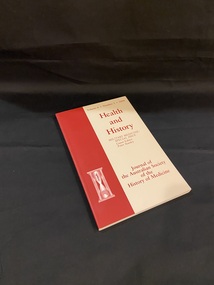
... Mc Carthy, Please find enclosed a copy of the journal 'Health and History', as a token of my thanks for your help with the article. / (I have referred to your assistance in footnote 59, page 31.) / I hope that it will prove a useful addition to the library./ kindest regards Janet Butler' [Handwritten note written in blue ink on a Latrobe University Postgraduate History Program letterhead and inserted into the book]...Mc Carthy, Please find enclosed a copy of the journal 'Health and History', as a token of my thanks for your help with the article. / (I have referred to your assistance in footnote 59, page 31.) / I hope that it will prove a useful addition to the library./ kindest regards Janet Butler' [Handwritten note written in blue ink on a Latrobe University Postgraduate History Program letterhead and inserted into the book] Thin paperback book with red and bone coloured cover. ...Peer reviewed research journal carries papers on all aspects of the history of medicine and health with focus on Australia, New Zealand, and the Pacific region; book reviews; includes Australian Indigenous health and history. [From Trove] This special edition focuses on military medicine.Thin paperback book with red and bone coloured cover. There is a red panel running down the left side of the cover that wraps around the spine, at the bottom of the panel is an hour glass. To the right of the panel the cover is a bone colour with red writing that reads : Volume 6. Number 2. 2004 /Health and History / Military Medicine: / Special issue / Guest editor / Peter Stanley / Journal of the Australian Society of the History of Medicinenon-fictionPeer reviewed research journal carries papers on all aspects of the history of medicine and health with focus on Australia, New Zealand, and the Pacific region; book reviews; includes Australian Indigenous health and history. [From Trove] This special edition focuses on military medicine.world war two, wwii, world war 2, ww2, military nursing, australian navy, rehabilitation of disabled soldiers, army health -
Clunes Museum
Newspaper - NEWSPAPER CUTTING
... Clunes Museum 36 Fraser Street enter building through Collins Place Clunes goldfields ORIGINALLY PUBLISHED IN "AUSTRALIAN POST" JUNE 4.1970 local history document newspaper cutting mining TWO NEWSPAPER REPORTS (LAMINATED) REGARDING WILLIAM CAMPBELL'S DISCOVERY OF GOLD IN CLUNES IN 1851. THERE IS ALSO A HANDPRINTED FOOTNOTE ...ORIGINALLY PUBLISHED IN "AUSTRALIAN POST" JUNE 4.1970TWO NEWSPAPER REPORTS (LAMINATED) REGARDING WILLIAM CAMPBELL'S DISCOVERY OF GOLD IN CLUNES IN 1851. THERE IS ALSO A HANDPRINTED FOOTNOTE.local history, document, newspaper cutting, mining -
Box Hill Historical Society
Journal, Ms. Lorraine Mitchell, A tale of two churches - Box Hill Baptist Church: Celebrating 50 Years, 2021
... The history of Baptists in Victoria and the early history of families and Methodists in Box Hill. pp 36-193. Includes black & white photos and footnotes. ...Research paper on the history of the Box Hill Baptist Church from 1901 to 1951. The history of Baptists in Victoria and the early history of families and Methodists in Box Hill.pp 36-193. Includes black & white photos and footnotes. non-fictionResearch paper on the history of the Box Hill Baptist Church from 1901 to 1951. The history of Baptists in Victoria and the early history of families and Methodists in Box Hill.churches, box hill baptist church, baptist churches, box hill wesleyan church, aspinall> joseph, ellingworth family -
Ballarat Tramway Museum
Document - Photocopy, Ballarat Tramway Preservation Society (BTPS), BTPS "Submission to the Victorian Government for Financial Assistance", May. 1982
... Gives details of each project, including a quotation from Wormald International dated 4/6/1980, a history of ESCo No. 12, including photos and the basis of costing for the reconstruction of Wendouree Parade trackwork. Footnote...Gives details of each project, including a quotation from Wormald International dated 4/6/1980, a history of ESCo No. 12, including photos and the basis of costing for the reconstruction of Wendouree Parade trackwork. Footnote ...Twenty Two page photocopy of a typed document titled "Submission to the Victorian Government for Financial Assistance", prepared by the BTPS, in May 1982. Document has been punched on the left hand side for a plastic comb binder. Has been stapled in the top left hand corner. Contains a request to the Victorian Government for assistance for the a fire sprinkler system ($38,000), rebuilding ESCo tram No. 12 and relaying of the Wendouree Parade track for $165,000. Gives details of each project, including a quotation from Wormald International dated 4/6/1980, a history of ESCo No. 12, including photos and the basis of costing for the reconstruction of Wendouree Parade trackwork. Footnote: The BTPS was not successful in any item.trams, tramways, btps, submissions, victorian government, trackwork, fire sprinkler -
 Surrey Hills Historical Society Collection
Book, Box Hill, 1978
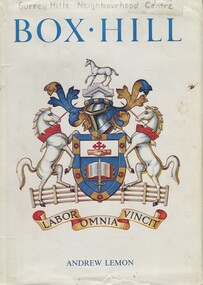
... It covers the rural depression in the 1860s, the land boom of the 1880s and the collapse in the 1890s, the bitter days of two World Wars and the Depression, and the 'dry' suburb of Box Hill. box hill dry area temperance movement mayors councillors agriculture railways "SURREY HILLS / NEIGHBOURHOOD CENTRE - HISTORY" on top of title page; "Surrey Hills Neighbourhood Centre" on top of front of jacket. Hardback book of 270 pages, indexed and footnoted, with some photos and plans; it is divided into chronological periods rather than themes. ...This book looks at Box Hill as it grew from a rural backwater to a country town amid farms and orchards, then to an outer suburb, and then to an almost inner suburb. It covers the rural depression in the 1860s, the land boom of the 1880s and the collapse in the 1890s, the bitter days of two World Wars and the Depression, and the 'dry' suburb of Box Hill.Hardback book of 270 pages, indexed and footnoted, with some photos and plans; it is divided into chronological periods rather than themes."SURREY HILLS / NEIGHBOURHOOD CENTRE - HISTORY" on top of title page; "Surrey Hills Neighbourhood Centre" on top of front of jacket.box hill, dry area, temperance movement, mayors, councillors, agriculture, railways -
 Surrey Hills Historical Society Collection
Book, Educating Surrey Hills - School No 2778, 1886-1986, 1986
... A 59 page informal history of Surrey Hills State School, No 2778. To quote the authors: "we have not used footnotes, nor a bibliography; and we have used reminiscence without always ensuring that facts and dates are strictly accurate." ...A second lesser copy was donated at a much earlier date. wekworth - (miss) reardon edith lauchlan thelma grant mavis higgins nancy kellan coster joyce parker marjorie dyson joy sutton phyllis cadmar gwennyth mclaughlin maurine wendorf winifred broadbent doreen hawes hilda powell crocker beatrix triggs dorothy peers ker pryde norma clemson kathleen owen doris glasscock elaine lovering w b (mr) dyer e a (mr) gamble william brown j k (mr) raw whitfield t doyle annie st stephens presbyterian church cadets bennett george t brigadier general gordon cottingham r v (mr) day george greaves arthur servan alice renkin anne lutheran peace memorial home gourlay education schools doney - (mr) collins fyfe alexander fire brigades maypoles duck lorraine hendy ives alfred reaburn john walduck gwyneth world war 1914-1918 breeden horace horrie wise amy (miss) blogg john kendrick newington lily (miss) parents clubs brookes - (mrs) lancashire deans johnson herbert -(mrs) travancore jamieson welch mcdonald harley mclean jack rex theatre surrey hills progress association gamer ernest southall ivan influenza barbara ross poliomyelitis scott moroney daniel thwaites jean constable oswell frank large gifford a e (rev) gillies j (rev) buxton porter jill morgan jan 1939-1945 williamson joan cargill jackson van ernst cooke tyrell's milkbar plaw graeme dairies chenu a h rutzou peter bowie heymann megan wilson ritter alan martyn dawson l (mrs) mcgregor d (mrs) e (mrs) fiedler wheeler lewis marsh rhyll slater games gangell pam barrow ford henry mcewan marion conlon kathy canterbury recreation reserve surrey park chatham oval mooney neil kitson surrey dive monk kay saldineri macqueen lyndy thomson daley susan discombe diane hanson robert mulvey albers angela tucker david glover bright lynette mcinnes jeanette nethercott turnball eric smith roberts chasemore lyle chislett miss capon program k n (mr) fuller i d (mr) henwood j w (mr) g (mr) veitch g (mrs) m (mrs) cheetham j (mr) gardner l (mr) d (mr) sepitka lorna balfe win wells bob keith ian kett mr elizabeth liney bruce macarthur rob kelly paula neil b sydenham shirley dixon o'hagan ros van someren fred norman burns roberta harry christine barker henry j t nutt ernest h richards benjamin lievesley john h knight gabriel clough john s hepburn james tinney arthur h blanchen bernard j somerwell elizabeth j john t john m caldicott howard t A 59 page informal history of Surrey Hills State School, No 2778. To quote the authors: "we have not used footnotes, nor a bibliography; and we have used reminiscence without always ensuring that facts and dates are strictly accurate." ...Donation made on behalf of Surrey Hills Primary School. A second lesser copy was donated at a much earlier date.A 59 page informal history of Surrey Hills State School, No 2778. To quote the authors: "we have not used footnotes, nor a bibliography; and we have used reminiscence without always ensuring that facts and dates are strictly accurate." The book is richly illustrated with photos, excerpts of student work and other ephemera. It is not indexed. Headings are: Beginnings, The Cadet Corps, Head Teacher Bennett, School Days 1900-1925, War Time & Beyond, The Mothers' Club, Childhood Illness, School Days in '30s, Expansion, PWD Problems, Depression and Wartime, Post War Crowding, memories, Mr Wheeler, Migrants, Royal Tours, Pedestrian Crossings, The Canteen, Craft Room, Sports Days, Acquisition of Mr Prior's House, Parents Right to Know, Social Service, School Committee, Concerts & Balls, Mothers' Club to Parents' Club, Library, More PWD Problems, Changes, Camps, Recent Principals. This copy includes a copy of the Centenary Weekend Programme which has been stuck inside the front cover.wekworth, - (miss), reardon, edith, lauchlan, thelma, grant, mavis, higgins, nancy, kellan, coster, joyce, parker, marjorie, dyson, joy, sutton, phyllis, cadmar, gwennyth, mclaughlin, maurine, wendorf, winifred, broadbent, doreen, hawes, hilda, powell, crocker, beatrix, triggs, dorothy, peers, ker, pryde, norma, clemson, kathleen, owen, doris, glasscock, elaine, lovering, w b (mr), dyer, e a (mr), gamble, william, brown, j k (mr), raw, whitfield t, doyle, annie, st stephens presbyterian church, cadets, bennett, george t, brigadier general gordon, cottingham, r v (mr), day, george, greaves, arthur, servan, alice, renkin, anne, lutheran peace memorial home, gourlay, education, schools, doney, - (mr), collins, fyfe, alexander, fire brigades, maypoles, duck, lorraine, hendy, ives, alfred, reaburn, john, walduck, gwyneth, world war, 1914-1918, breeden, horace, horrie, wise, amy (miss), blogg, john kendrick, newington, lily (miss), parents clubs, brookes, - (mrs), lancashire, deans, johnson, herbert, -(mrs), travancore, jamieson, welch, mcdonald, harley, mclean, jack, rex theatre, surrey hills progress association, gamer, ernest, southall, ivan, influenza, barbara, ross, poliomyelitis, scott, moroney, daniel, thwaites, jean, constable, oswell, frank, large, gifford, a e (rev), gillies, j (rev), buxton, porter, jill, morgan, jan, 1939-1945, williamson, joan, cargill, jackson, van ernst, cooke, tyrell's milkbar, plaw, graeme, dairies, chenu, a h, rutzou, peter, bowie, heymann, megan, wilson, ritter, alan, martyn, dawson, l (mrs), mcgregor, d (mrs), e (mrs), fiedler, wheeler, lewis, marsh, rhyll, slater, games, gangell, pam, barrow, ford, henry, mcewan, marion, conlon, kathy, canterbury recreation reserve, surrey park, chatham oval, mooney, neil, kitson, surrey dive, monk, kay, saldineri, macqueen, lyndy, thomson, daley, susan, discombe, diane, hanson, robert, mulvey, albers, angela, tucker, david, glover, bright, lynette, mcinnes, jeanette, nethercott, turnball, eric, smith, roberts, chasemore, lyle, chislett, miss, capon program, k n (mr), fuller, i d (mr), henwood, j w (mr), g (mr), veitch, g (mrs), m (mrs), cheetham, j (mr), gardner, l (mr), d (mr), sepitka, lorna, balfe, win, wells, bob, keith, ian, kett, mr, elizabeth, liney, bruce, macarthur, rob, kelly, paula, neil b, sydenham, shirley, dixon, o'hagan, ros, van someren, fred, norman, burns, roberta, harry, christine, barker, henry j t, nutt, ernest h, richards, benjamin, lievesley, john h, knight, gabriel, clough, john s, hepburn, james, tinney, arthur h, blanchen, bernard j, somerwell, elizabeth j, john t, john m, caldicott, howard t -
Kew Historical Society Inc
Archive (series) - Subject File, Victoria Park : Concept Management Plan, Research Papers, 2004, 2004
... footnoted in the research. The Butler papers provide an important, and increasingly significant body of heritage research relating to Kew. graeme butler - heritage architect victoria park - kew (vic) heritage studies - kew (vic.) Red cardboard wallet containing historical research by Graeme Butler, heritage architect, into the history ...Graeme Butler & AssociatesProject FilesProvenance OrderRed cardboard wallet containing historical research by Graeme Butler, heritage architect, into the history of Victoria Park, Kew. The file also includes a draft Victoria Park Concept Master Plan, 2004. The research includes memoranda, maps, photocopies of plans, forms, notes, aerial photos, and sundry references.graeme butler - heritage architect, victoria park - kew (vic), heritage studies - kew (vic.)graeme butler - heritage architect, victoria park - kew (vic), heritage studies - kew (vic.) -
Koorie Heritage Trust
Book, C. E. Sayers (Original edition edited by Bride, Thomas Francis), Letters from Victorian pioneers : a series of papers on the early occupation of the colony, the Aborigines, etc. addressed by Victorian pioneers to His Excellency Charles Joseph La Trobe, Esq., Lieutenant-Governor of the Colony of Victoria, 1983
... History -- 1834-1900 -- Sources. | Victoria -- Description and travel -- 1851-1900. Brief notes on the contributors and incidents have been included in this edition although the above-mentioned items have been left out, some marginal notes made by Governor La Trobe have been dealt with in the footnotes. ...Brief notes on the contributors and incidents have been included in this edition although the above-mentioned items have been left out, some marginal notes made by Governor La Trobe have been dealt with in the footnotes. "From the original edition edited for the Trustees of the Public Library by Thomas Francis Bride'. Previously published: Melbourne : Heinemann, 1969. Originally published: Melbourne : Government Printer for the Trustees of the Public Library, Museums and National Gallery of Victoria, 1898.xiv, 455 p., 31 p. of plates : map ; 26 cm.Brief notes on the contributors and incidents have been included in this edition although the above-mentioned items have been left out, some marginal notes made by Governor La Trobe have been dealt with in the footnotes. "From the original edition edited for the Trustees of the Public Library by Thomas Francis Bride'. Previously published: Melbourne : Heinemann, 1969. Originally published: Melbourne : Government Printer for the Trustees of the Public Library, Museums and National Gallery of Victoria, 1898.pioneering, 1836-1854. victoria. correspondence, diaries, etc. | victoria. description & travel, 1836-1854. correspondence, diaries, etc. | frontier and pioneer life -- victoria. | victoria -- history -- 1834-1900 -- sources. | victoria -- description and travel -- 1851-1900. -
Koorie Heritage Trust
Document - Printed Sheets, Public Interest Advocacy Centre, Submission to the Senate Inquiry into the Stolen Generation, 2000
... history and effects of forcible removal. It examines issues central to the nature and structure of the proposed Tribunal, including who should be entitled to reparations, the basis of liability, forms of reparations and procedures of the Tribunal. 35 P.; bib.; footnotes; 30 cm. ...PIAC's submission proposers the establishment of a Stolen Generations Reparations Tribunal as an essential response to the history and effects of forcible removal. It examines issues central to the nature and structure of the proposed Tribunal, including who should be entitled to reparations, the basis of liability, forms of reparations and procedures of the Tribunal.35 P.; bib.; footnotes; 30 cm.PIAC's submission proposers the establishment of a Stolen Generations Reparations Tribunal as an essential response to the history and effects of forcible removal. It examines issues central to the nature and structure of the proposed Tribunal, including who should be entitled to reparations, the basis of liability, forms of reparations and procedures of the Tribunal.stolen generations, australia-reparations tribunal., reparations tribunal, australia-stolen generation-senate inquiry - submission -
Koorie Heritage Trust
Journal - Serials, Department of Pacific and Southeast Asian History, Australian National University, Aboriginal History - Volume 17.1-2 1993, 1993
... .; refs; footnotes; reviews; bib; 25 cm. Aboriginal History - Volume 17.1-2 1993. ...Under the title " John Piper, "Conqueror of the Interior", the article deals with the Aboriginal who accompanied Major Mitchell on his 1836 expedition. The article relates the whole journey with an extensive picture of his travels through Victoria.194 P.; refs; footnotes; reviews; bib; 25 cm.Under the title " John Piper, "Conqueror of the Interior", the article deals with the Aboriginal who accompanied Major Mitchell on his 1836 expedition. The article relates the whole journey with an extensive picture of his travels through Victoria.aboriginal australians -- periodicals. | ethnology -- australia -- periodicals. | settlement and contacts - colonisation - 1788-1850 | race relations - violent - massacres, murders, poisonings etc. - to 1900 | settlement and contacts - explorers | occupations - domestic servants | social organisation - kinship - systems | occupations - pastoral industry workers | race relations - racism - stereotyping | -
Koorie Heritage Trust
Journal - Serials, Aboriginal History Inc, Aboriginal History - Volume 32. 2008, 2008
... A series of articles by leading writers on Aboriginal History. 217 P. fac. ill. notes; footnotes; refs. photographs. ...A series of articles by leading writers on Aboriginal History.217 P. fac. ill. notes; footnotes; refs. photographs.A series of articles by leading writers on Aboriginal History.aboriginal australians -- periodicals. | ethnology -- australia -- periodicals. | aboriginal circus performers, australia. | honorary correspondence scheme. victoria 1860-1868 and 1869-1904 | andrew porteus honorary correspondent, northern wathaurung, reports - mt. emu tribe. | edward stone parker - protector loddon aboriginal station. | dja dja wurrung, loddon protectorate. | aboriginal oral histories - childhood and playlore australian childhood folklore collection, museum victoria. -
Koorie Heritage Trust
Book, Roberts, Stephen H, The squatting age in Australia, 1835-1847, 1935
... Gipps policy, p.89; Faithfull party massacre; p.157; depredations and attacks by natives at Ovens; p.159; Murders by Werribee natives; 316317; Attacks on Pee Dee Station on the Macleay; 329-337; Early history of missions, govt. policy, murders etc., natives as shepherds; Early types of employment for natives in Queensland. ix, 378 p. : maps. ; appendices; footnotes; 22 cm. ...Brief mention of Aborigines throughout; p.87-217; Gov. Gipps policy, p.89; Faithfull party massacre; p.157; depredations and attacks by natives at Ovens; p.159; Murders by Werribee natives; 316317; Attacks on Pee Dee Station on the Macleay; 329-337; Early history of missions, govt. policy, murders etc., natives as shepherds; Early types of employment for natives in Queensland.ix, 378 p. : maps. ; appendices; footnotes; 22 cm.Brief mention of Aborigines throughout; p.87-217; Gov. Gipps policy, p.89; Faithfull party massacre; p.157; depredations and attacks by natives at Ovens; p.159; Murders by Werribee natives; 316317; Attacks on Pee Dee Station on the Macleay; 329-337; Early history of missions, govt. policy, murders etc., natives as shepherds; Early types of employment for natives in Queensland.squatters - australia. -
Koorie Heritage Trust
Article - Paper, Bryant, Jennifer J, The Robinvale Aboriginal and Islander community : transition to independence, 1981
... Survey of Aboriginal housing in Robinvale and surrounding area; includes history of European settlement and consequent demographic upheaval for Aborigines; contemporary data on employment, incomes and expenditure, seasonal work, education, health and Murray Valley Aboriginal Co-operative; housing survey looks at structures, rents, number and duration of occupancy, maintenance and suitability of design. 113 p. : maps ; tables; footnotes; 30 cm. -- (Working paper ; no. 13.) ...An in-depth study of this community to be used as part of a major thesis on Aboriginal housing in Victoria. Survey of Aboriginal housing in Robinvale and surrounding area; includes history of European settlement and consequent demographic upheaval for Aborigines; contemporary data on employment, incomes and expenditure, seasonal work, education, health and Murray Valley Aboriginal Co-operative; housing survey looks at structures, rents, number and duration of occupancy, maintenance and suitability of design.113 p. : maps ; tables; footnotes; 30 cm. -- (Working paper ; no. 13.)An in-depth study of this community to be used as part of a major thesis on Aboriginal housing in Victoria. Survey of Aboriginal housing in Robinvale and surrounding area; includes history of European settlement and consequent demographic upheaval for Aborigines; contemporary data on employment, incomes and expenditure, seasonal work, education, health and Murray Valley Aboriginal Co-operative; housing survey looks at structures, rents, number and duration of occupancy, maintenance and suitability of design.robinvale-aboriginal community. | housing-aborignal, victoria.| statistics- robinvale-aboriginal community | cooperatives-aboriginal-robinvale | latje latje tribe. i. monash university. dept. of geography. -
Koorie Heritage Trust
Book, Beavis, Margery et al, Pioneers of the Pyrenees, 1984
... Koorie Heritage Trust Levels 1 & 3, Yarra Building Federation Square, Melbourne melbourne Avoca Shire - History - Pyrenees - Natte Yallock - Homebush - Lamplough - Mountain Creek - Moonambel - Percydale - Redback 12-149; maps; figs; index; footnotes; 27 cm. ...12-149; maps; figs; index; footnotes; 27 cm.avoca shire - history - pyrenees - natte yallock - homebush - lamplough - mountain creek - moonambel - percydale - redback -
Koorie Heritage Trust
Journal - Serials, Department of Pacific and Southeast Asian History, Australian National University, Aboriginal History - Volume 03. 1-2 1979, 1979
... . | Defence - World War II | Religions - Christianity - Lutheran Church | Religions - Christianity - Missions | Settlement and contacts - Colonisation - 1851- | Settlement and contacts - Colonisation - 1851- | Government policy - Initial period and protectionism - 1851-1900 | Government policy - State and territory - Queensland | Animals - Invertebrates - Crustacea and molluscs - Beche-de-mer / Trepang | A series of articles on Aboriginal History by well-known historians. 166p.; footnotes; bib.; ports.; facsimiles; 25 cm. ...A series of articles on Aboriginal History by well-known historians.166p.; footnotes; bib.; ports.; facsimiles; 25 cm.A series of articles on Aboriginal History by well-known historians.aboriginal australians -- periodicals. | ethnology -- australia -- periodicals. | aboriginal australians -- missions -- new south wales | religions - christianity - missions | religions - christianity - missionaries | music - vocal | literature and stories - story telling and story tellers | language - texts and translations - aboriginal to non-aboriginal language | art - rock art - painting | photography - ethnographic | ceremonies | literature and stories - story telling and story tellers | world war, 1939-1945 -- participation, aboriginal australian. | aboriginal australian soldiers. | aboriginal australians -- northern territory -- arnhem land. | defence - world war ii | religions - christianity - lutheran church | religions - christianity - missions | settlement and contacts - colonisation - 1851- | settlement and contacts - colonisation - 1851- | government policy - initial period and protectionism - 1851-1900 | government policy - state and territory - queensland | animals - invertebrates - crustacea and molluscs - beche-de-mer / trepang | -
Koorie Heritage Trust
Journal - Serials, Department of Pacific and Southeast Asian History, Australian National University, Aboriginal History - Volume 05. 1-2 1981, 1981
... . | Settlement and contacts - Chinese | Language - Change | Mining industry - Gold | Settlement and contacts - Afghans | Animals - Mammals - Camels | Race relations - Racism - Stereotyping | Language - Texts and translations - Aboriginal to non-Aboriginal language | Art - Drawing | Art - Artists | Settlement and contacts - Macassans and Indonesians | Language - Kriol | Language - Linguistics - Language classification | Language - Semantics | Settlement and contacts - Explorers | Articles on various aspects of Australian History articles. 178 p.; ill.; tables; footnotes; bibs.; maps; 25 cm. ...Articles on various aspects of Australian History articles.178 p.; ill.; tables; footnotes; bibs.; maps; 25 cm.Articles on various aspects of Australian History articles.aboriginal australians -- periodicals. | ethnology -- australia -- periodicals. | settlement and contacts - chinese | language - change | mining industry - gold | settlement and contacts - afghans | animals - mammals - camels | race relations - racism - stereotyping | language - texts and translations - aboriginal to non-aboriginal language | art - drawing | art - artists | settlement and contacts - macassans and indonesians | language - kriol | language - linguistics - language classification | language - semantics | settlement and contacts - explorers |
