
Showing 34 items matching "abnormal or forced landings"
-
 Moorabbin Air Museum
Manual - Ansett Boeing 727 operating manuals, Boeing 727 Operating Manual Section 4 Emergency & Abnormal Procedures April 1988
... Boeing 727 Operating Manual Section 4 Emergency & Abnormal Procedures April 1988 ...Landing Gear...Pneumatics...Air conditioning & pressurization...Fuselage fires...Cockpit window failure...Door lights...Abnormal or forced...Ansett Boeing 727 operations manual Engine failure & fires Fuel Electrical Hydraulics Flight controls Landing Gear Pneumatics Air conditioning & pressurization Fuselage fires Cockpit window failure Door lights Abnormal or forced landings Passenger evacuation Ditching Emergency descent & landing Emergency equipment Overview of emergency & abnormal flight procedures in Boeing 727, circa 1988 Spiral bound book type manual Boeing 727 Operating Manual Section 4 Emergency & Abnormal Procedures April 1988 Manual Ansett Boeing 727 operating manuals ...Overview of emergency & abnormal flight procedures in Boeing 727, circa 1988Spiral bound book type manual non-fictionOverview of emergency & abnormal flight procedures in Boeing 727, circa 1988engine failure & fires, fuel, electrical, hydraulics, flight controls, landing gear, pneumatics, air conditioning & pressurization, fuselage fires, cockpit window failure, door lights, abnormal or forced landings, passenger evacuation, ditching, emergency descent & landing, emergency equipment -
Moorabbin Air Museum
Manual (Item) - Ansett W.A. Fokker F28 Fellowship operating manuals, Ansett W.A. Fokker F28 Operating Manual Section 8 Abnormal Operations
... Fokker F28 Operating Manual Section 8 Abnormal Operations...Fokker F28 Operating Manual Section 8 Abnormal Operations Manual Ansett W.A. Fokker F28 Fellowship operating manuals ...Ansett WA -
Moorabbin Air Museum
Manual (Item) - BAE 146-300 Manufacturers Operations Manual Vol 3 Part 2 Abnormal and Emergency Check List National Jet Systems Pty Ltd A/C E3194
... BAE 146-300 Manufacturers Operations Manual Vol 3 Part 2 Abnormal and Emergency Check List National Jet Systems Pty Ltd A/C E3194...BAE 146-300 Manufacturers Operations Manual Vol 3 Part 2 Abnormal and Emergency Check List National Jet Systems Pty Ltd A/C E3194...BAE 146-300 Manufacturers Operations Manual Vol 3 Part 2 Abnormal and Emergency Check List National Jet Systems Pty Ltd A/C E3194 Manual BAE 146-300 Manufacturers Operations Manual Vol 3 Part 2 Abnormal and Emergency Check List National Jet Systems Pty Ltd A/C E3194 ... -
Moorabbin Air Museum
Manual - Sikorsky S76 helicopters, Jayrow VH-JRD S76A Model Emergency/ Abnormal Procedures Pilot Checklist
... Jayrow VH-JRD S76A Model Emergency/ Abnormal Procedures Pilot Checklist...Sikorsky S76 helicopters Fire & smoke Engine Power train Hydraulics Electrical Ice & rain Landing gear Helli - pilot Sperry/ AFCS Schematics Pilot check list for emergencies and/or abnormal flight, circa 2012 Spiral bound book type manual with plastic cover Jayrow VH-JRD S76A Model Emergency/ Abnormal Procedures Pilot Checklist Manual Sikorsky S76 helicopters ...Pilot check list for emergencies and/or abnormal flight, circa 2012Spiral bound book type manual with plastic covernon-fictionPilot check list for emergencies and/or abnormal flight, circa 2012fire & smoke, engine, power train, hydraulics, electrical, ice & rain, landing gear, helli - pilot sperry/ afcs, schematics -
Moorabbin Air Museum
Manual (Item) - TAA - Emergency And Abnormal Checklists B727
... TAA - Emergency And Abnormal Checklists B727...TAA - Emergency And Abnormal Checklists B727...TAA - Emergency And Abnormal Checklists B727 Manual TAA - Emergency And Abnormal Checklists B727 ... -
Moorabbin Air Museum
Book - Aviation training, Flight Training
... ...Forced landings......Forced landings...Aviation training Flight training Flight preparation & familiarisation Effects of controls Straight & level Climbing Descending Turns Stalling Take offs & landings Low flying Forced landings Instrument flying Pilot navigation & map reading Night flying Flight instructor's briefing notes & student's guide to flight training, circa 1977 Flight Training Book Aviation training ...Flight instructor's briefing notes & student's guide to flight training, circa 1977non-fictionFlight instructor's briefing notes & student's guide to flight training, circa 1977flight training, flight preparation & familiarisation, effects of controls, straight & level, climbing, descending, turns, stalling, take offs & landings, low flying, forced landings, instrument flying, pilot navigation & map reading, night flying -
Moorabbin Air Museum
Book - Flight briefings, Flight Briefing for Pilots 1
... ...Forced landings......Forced landings...Flight training Familiarization with aircraft Preparation Air experience Effects of controls Taxying Straight & level flight Climbing Descending Turning Stalling Spinning Take off & ciruits Forced landings Navigation Instrument approach Introductory manual of flying training with air instruction, circa 1978 Flight Briefing for Pilots 1 Book Flight briefings ...Introductory manual of flying training with air instruction, circa 1978non-fictionIntroductory manual of flying training with air instruction, circa 1978familiarization with aircraft, preparation, air experience, effects of controls, taxying, straight & level flight, climbing, descending, turning, stalling, spinning, take off & ciruits, forced landings, navigation, instrument approach -
Moorabbin Air Museum
Booklet - Private pilot training, Flying Training (Pre-flight Briefings to Cover the Complete Private Pilot Syllabus)
... ...Forced landings......Forced landings...Private pilot training Preparation Handling the propeller Taxying Controls Straight & level flight Climbing Descending Turning Stalling Circuits Forced landings Glide approach Crosswind circuits Fire drill Instrument flying Study reference for private pilots circa 1977 Flying Training (Pre-flight Briefings to Cover the Complete Private Pilot Syllabus) Booklet Private pilot training ...Study reference for private pilots circa 1977non-fictionStudy reference for private pilots circa 1977preparation, handling the propeller, taxying, controls, straight & level flight, climbing, descending, turning, stalling, circuits, forced landings, glide approach, crosswind circuits, fire drill, instrument flying -
Moorabbin Air Museum
Manual - Ansett Boeing 767 operating manuals, Boeing 767 Operating Manual Chapter 3 Non-Normal Procedures February 1986
... ...Abnormal flight patterns & maneuvers...Ansett Boeing 767 operating manuals Engine failure & fires Air conditioning/pressurisation & pneumatics APU & engines Autoflight Communications Flight instruments & navigation Cargo fire Evacuation Bomb threats & unlawful seizure Forced landings & ditching Fuel Ice & rain Warning systems Abnormal flight patterns & maneuvers Overview of procedures for dealing with abnormal situations, circa 1986 Spiral bound book form manual Boeing 767 Operating Manual Chapter 3 Non-Normal Procedures February 1986 Manual Ansett Boeing 767 operating manuals ...Overview of procedures for dealing with abnormal situations, circa 1986Spiral bound book form manualnon-fictionOverview of procedures for dealing with abnormal situations, circa 1986engine failure & fires, air conditioning/pressurisation & pneumatics, apu & engines, autoflight, communications, flight instruments & navigation, cargo fire, evacuation, bomb threats & unlawful seizure, forced landings & ditching, fuel, ice & rain, warning systems, abnormal flight patterns & maneuvers -
Moorabbin Air Museum
Manual - Boeing 767 operating manuals, Boeing 767 Operating Manual Volume 1 Chapter 3 Non-Normal Procedures December 1993
... ...Abnormal flight patterns & maneuvers...Boeing 767 operating manuals Engine failure & fires Air conditioning/pressurisation & pneumatics APU & engines Autoflight Communications Flight instruments & navigation Bomb threats & unlawful seizure Forced landings & ditching Electrical Ice & rain protection Abnormal flight patterns & maneuvers Overview of procedures for coping with abnormal situations , circa 1993 Spiral bound book type manual Boeing 767 Operating Manual Volume 1 Chapter 3 Non-Normal Procedures December 1993 Manual Boeing 767 operating manuals ...Overview of procedures for coping with abnormal situations , circa 1993Spiral bound book type manualnon-fictionOverview of procedures for coping with abnormal situations , circa 1993engine failure & fires, air conditioning/pressurisation & pneumatics, apu & engines, autoflight, communications, flight instruments & navigation, bomb threats & unlawful seizure, forced landings & ditching, electrical, ice & rain protection, abnormal flight patterns & maneuvers -
Moorabbin Air Museum
Book - Flight briefings, Flight Briefing for Pilots Volume 1
... landing...First solo...Advanced turning...Operation at minimum level...Forced...Flight briefings Fundamentals of flight Aircraft familiarization Flight preparation Air experience Effects of controls Taxying Straight & level flight Climbing Descending Turning Stalling Spinning Approach and landing First solo Advanced turning Operation at minimum level Forced landings with & without power Air Navigation Introduction to flying training, with air instruction, circa 1970 Flight Briefing for Pilots Volume 1 Book Flight briefings ...Introduction to flying training, with air instruction, circa 1970non-fictionIntroduction to flying training, with air instruction, circa 1970fundamentals of flight, aircraft familiarization, flight preparation, air experience, effects of controls, taxying, straight & level flight, climbing, descending, turning, stalling, spinning, approach and landing, first solo, advanced turning, operation at minimum level, forced landings with & without power, air navigation -
Moorabbin Air Museum
Book - Flight training - general aviation, The Flying Training Manual
... landing...First solo...Steep turns & unusual attitudes...Forced...Flight training - general aviation Aircraft familiarization Flight preparation & communications Engine operations / taxiing & post flight actions Aircraft control Straight & level flight Climbing Descending Turning Low speed flight & stalling Spinning Approach and landing First solo Steep turns & unusual attitudes Forced landings & side slipping Advanced take off & landing Low level flying Navigation Precautionary search & landing Instrument flight Flight training overview , circa 2004 The Flying Training Manual Book Flight training - general aviation ...Flight training overview , circa 2004non-fictionFlight training overview , circa 2004aircraft familiarization, flight preparation & communications, engine operations / taxiing & post flight actions, aircraft control, straight & level flight, climbing, descending, turning, low speed flight & stalling, spinning, approach and landing, first solo, steep turns & unusual attitudes, forced landings & side slipping, advanced take off & landing, low level flying, navigation, precautionary search & landing, instrument flight -
Moorabbin Air Museum
Book - Flight training, Let's Learn to Fly
... ...Forced landings...landing...Control of the approach path...Spinning...Forced...Flight training The sea of air The four forces Turning Climbing & descending Straight & level flight Stalling Air speed & ground speed Take off & landing Control of the approach path Spinning Forced landings The first solo flight Overview of the principles of flight for pupils, circa 1956 Let's Learn to Fly Book Flight training ...Overview of the principles of flight for pupils, circa 1956non-fictionOverview of the principles of flight for pupils, circa 1956the sea of air, the four forces, turning, climbing & descending, straight & level flight, stalling, air speed & ground speed, take off & landing, control of the approach path, spinning, forced landings, the first solo flight -
 Royal Australian and New Zealand College of Obstetricians & Gynaecologists (RANZCOG)
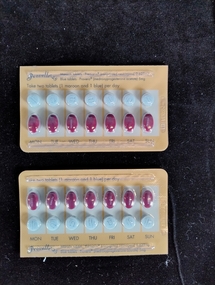
Unknown - Two strips of Provelle 28 medication, c.1995-1996
... Used for the treatment of secondary amenorrhea and abnormal uterine bleeding, endometriosis....Used for the treatment of secondary amenorrhea and abnormal uterine bleeding, endometriosis. Obstetrics Two strips of Provelle 28 tablets. ...Used for the treatment of secondary amenorrhea and abnormal uterine bleeding, endometriosis.Two strips of Provelle 28 tablets. Each strip contains a row of 7 blue tablets, and a row of 7 maroon tablets. Blue tablets are imprinted with a 'U' design on one side. Maroon tablets are printed with the text 'PREMARIN' on one side. Text printed on tablet packaging reads 'Provelle 28/Maroon tablets - Premarin (conjugated oestrogens) 0.625 mg/Blue tablets - Provera (medroxyprogesterone acetate) 5mg/Take two tablets (1 maroon and 1 blue) per day'. Abbreviations for days of the week are printed below the tablets. Background of packaging is yellow, with vertical white bands behind the tablets, each band covering one blue and one maroon tablet. Back of packaging contains listing of ingredients, and contact details for manufacturer/distributer 'Upjohn'. Back of one strip is imprinted with the text '(B)AD931'. Back of second strip is imprinted with the text 'EXPAUG96'.obstetrics -
 Alfred Hospital Nurses League - Nursing History Collection
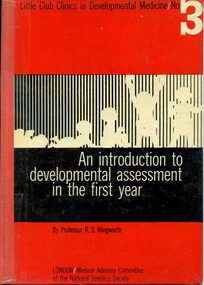
Book - Illustrated Booklet, Ronald Stanley Illingworth 1909-1990, An introduction to developmental assessment in the first year, 1962
... An early introductory text for paediatricians and general practitioners to identify developmental or neuro;ogical abnormalities during a child's firsr year. Author was a paediatrician...An early introductory text for paediatricians and general practitioners to identify developmental or neuro;ogical abnormalities during a child's firsr year. Author was a paediatrician Insight into paediatric practice in the 1960's neonatal reflexes paediatric medicine infant development infant examination Vintage textbook focusing on clinical guidelines for assessing infants during their first year of life Inside front cover at base is a green sticker with white print [bookseller]. ...Vintage textbook focusing on clinical guidelines for assessing infants during their first year of lifeIllustrated book with red binding. On front cover series name at top in black print '3' in white print Title is printed in white on a black rectangle, Above this is another rectangle of wertical balack and white stripes on which is superimposed 5 white figures of a baby progressing from lying to standing indepentanly. Author and publisher printed in blsck underneath these rectanglesnon-fictionVintage textbook focusing on clinical guidelines for assessing infants during their first year of lifeneonatal reflexes, paediatric medicine, infant development, infant examination -
 Melbourne Tram Museum
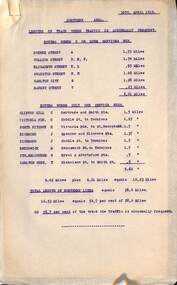
Document - Report, Tramway Board, "Northern Area - Lengths of track where traffic is abnormally frequent", 30/04/1919 12:00:00 AM
... Report - single sheet, typed, titled, "Northern Area - Lengths of track where traffic is abnormally frequent", listing: 1 - Routes where 2 or more services run - giving the length in miles. 2 - route where only one service runs. ..."Northern Area - Lengths of track where traffic is abnormally frequent" Document Report Tramway Board ...Report - single sheet, typed, titled, "Northern Area - Lengths of track where traffic is abnormally frequent", listing: 1 - Routes where 2 or more services run - giving the length in miles. 2 - route where only one service runs. Gives an analysis of the results. Two copies held.trams, tramways, cable trams, track, services -
 Royal Australian and New Zealand College of Obstetricians & Gynaecologists (RANZCOG)
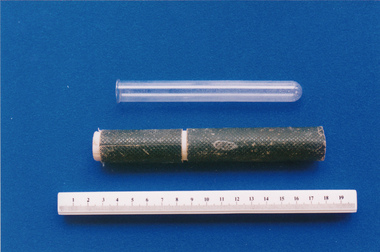
Test tube and case associated with midwife Mary Howlett, c. 1866 - 1920
... IT may also have been used to boil urine to identify the presence of urinary abnormalities such as sugar albumen acetone or bile....IT may also have been used to boil urine to identify the presence of urinary abnormalities such as sugar albumen acetone or bile. ...This type of test tube would have been used to collect blood or other bodily fluids. IT may also have been used to boil urine to identify the presence of urinary abnormalities such as sugar albumen acetone or bile.Mary Howlett (1840-1922) began practising as a country midwife in 1866 in the western district of Victoria. She qualified as a 'ladies monthly nurse' in 1887 and continued to practise as a nurse and midwife until 1920.She began her six months training at the Melbourne Lying-In Hospital. She was known by many as 'Auntie', and her career spanned more than 50 years. Mrs Howlett's midwifery box and contents were given to Dr Frank Forster, and he donated them to the museum collection in 1993.Glass test tube with a thin glass lip in original cylinder cardboard case. Case is in two section, lid and body - lid is lined with white cardboard.diagnostic testing, midwifery -
 Royal Australian and New Zealand College of Obstetricians & Gynaecologists (RANZCOG)
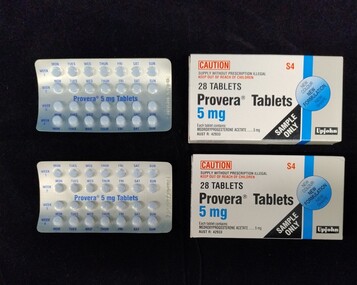
Unknown - Two boxes of Provera 5mg medication, Upjohn, c. 1997
... Provera is used to treat endometriosis, the absence of menstrual periods (not due to pregnancy), abnormal bleeding from the uterus, certain types of cancer including cancer of the breast, kidney and endometrium, and in combination with an estrogen containing medicine to relieve symptoms of menopause in women with an intact uterus. ...Provera is used to treat endometriosis, the absence of menstrual periods (not due to pregnancy), abnormal bleeding from the uterus, certain types of cancer including cancer of the breast, kidney and endometrium, and in combination with an estrogen containing medicine to relieve symptoms of menopause in women with an intact uterus. ...Provera is used to treat endometriosis, the absence of menstrual periods (not due to pregnancy), abnormal bleeding from the uterus, certain types of cancer including cancer of the breast, kidney and endometrium, and in combination with an estrogen containing medicine to relieve symptoms of menopause in women with an intact uterus. (NPS MedicineWise)Two rectangular cardboard boxes containing strips of Provera 5mg tablets. Front of each box is printed with supply and use warnings, as well as the text '28 TABLETS/Provera Tablets/5 mg/Each tablet contains: MEDROXYPROGESTERONE ACETATE 5mg. Front of box is also labelled 'SAMPLE ONLY' and 'NEW/COLOUR/NEW FORMULATION/NEW SHAPE'. Manufacturer logo (Upjohn) at bottom right hand corner of the front of each box. Back of box is printed with dosage instructions, storage instructions, and tablet contents. Manufacturer logo (Upjohn) at bottom left on back of box. one end of box is imprinted with a batch number and an expiry date. Expiry date is 12/97. Tablet strips each contain 28 tablets, in four rows of seven. Front of tablet strip printed with the text 'Provera 5mh Tablets' at centre. Left hand side of tablet strip is printed with the text 'WEEK 1', 'WEEK 2', "WEEK 3', and 'WEEK 4', with each week label corresponding to a row of seven tablets. Abbreviations for the days of the week are printed on tablet strip next to each tablet. Right hand side of tablet strip is stamped with a batch number and an expiry date. Expiry date is 12/97. Tablet strip has silver foil on top surface, and blue foil on bottom surface. Blue foil on bottom of tablet strip printed with the repeated text 'Upjohn/Provera Tablets/MEDROXYPROGESTERONE/ ACETATE 5mg'.endometriosis, menopause -
 Federation University Historical Collection
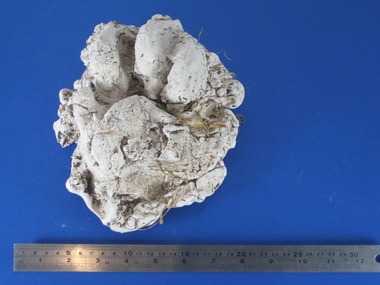
Plaster cast, David Pepper-Edwards, Plaster Cast of a Lion Footprint, 04/2004
... This cast was taken in deep mud to demonstrate the abnormal shape of such casts. Sometimes cats claws are clearly visible from such casts and so being confused with that of a large dog. ...This cast was taken in deep mud to demonstrate the abnormal shape of such casts. Sometimes cats claws are clearly visible from such casts and so being confused with that of a large dog. ...The cast of a captive African Lion was made by David Pepper-Edwards at Taronga Zoo, Sydney, NSW. This cast was taken in deep mud to demonstrate the abnormal shape of such casts. Sometimes cats claws are clearly visible from such casts and so being confused with that of a large dog. David Pepper-Edwards used a number of plaster cast footprints for comparison of unidentified field casts.Plaster cast of a Lion footprint. These casts were used in the identification of photographs and sightings of large cats in the Australian Bush. The plaster has remnant straw like material attached. Australian Animal Folklore Collectionaustralian animal folklore collection, pepper edwards, david pepper edwards, big cats, mythical, myth, folklore -
 City of Moorabbin Historical Society (Operating the Box Cottage Museum)
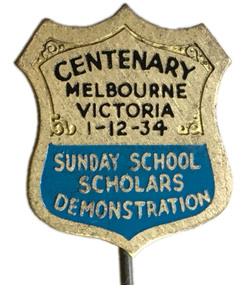
Badge - Sunday School Scholars Demonstration Pin, 1934
... The Sunday School Scholars Anniversary Celebration was to be held on 1 December 1934, but due to an abnormal storm on the day before it was postponed to 8th December 1934. 15000 Sunday school scholars and teachers marched through the streets of Melbourne to demonstrate the strength of youth organisations associated with the Churches. ...The Sunday School Scholars Anniversary Celebration was to be held on 1 December 1934, but due to an abnormal storm on the day before it was postponed to 8th December 1934. 15000 Sunday school scholars and teachers marched through the streets of Melbourne to demonstrate the strength of youth organisations associated with the Churches. ...The Sunday School Scholars Anniversary Celebration was to be held on 1 December 1934, but due to an abnormal storm on the day before it was postponed to 8th December 1934. 15000 Sunday school scholars and teachers marched through the streets of Melbourne to demonstrate the strength of youth organisations associated with the Churches. The march ended at the Treasury Gardens where a thanksgiving service was held, more than 35,000 people attended. Some of the families of the City of Moorrabbin would have attended this march.Silver pin in the shape of a shieldCentenary Melbourne Victoria 1-12-34 - Sunday School Scholars Demonstrationsunday school, religion, melbourne, treasury gardens -
 Kiewa Valley Historical Society
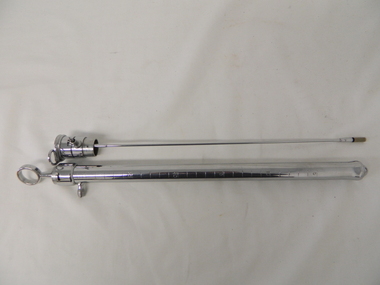
Sigmoidoscope Rigid, Mid to late 1900s
... The ability to visually see what was happening within the human body (in real time) provided greater analysis about certain biological abnormalities during a greater time elapse than before. ...The ability to visually see what was happening within the human body (in real time) provided greater analysis about certain biological abnormalities during a greater time elapse than before. ...This item was used before the flexible sigmoidoscope (1996) and before the introduction of fibre optics late 1900s. The 1900s saw an incredible leap forward in the field of medical procedures. The ability to visually see what was happening within the human body (in real time) provided greater analysis about certain biological abnormalities during a greater time elapse than before. This procedure involved less trauma to the patient and greater flexibility to the Physician in treatment schemes. The rigid signoidscope, however provided the first visual of the colon in situ, but was highly invasive to the patient.This item was used in the Mount Beauty Hospital for qualified Physicians to use in their diagnostic evaluation of patients. This would not be an instrument used by a General Physician. This item is still a internal observatory method which may, in some instances, cause some minor complications. This item does point to the level of medical diagnostics, equivalent to those available in larger towns and cities, which brings this rural area (once considered to be an isolated region) to a higher level of medical care.This rigid 35 cm long sigmoidoscope (internal probe) is made of stainless steel outer hollowed rounded rod, which permits the use of both a fixed (very thin) lighting rod and two flexible cord lights access. Both the lighting rod and the flexible lights can be lowered within the main rod to allow the physician to see the colon at the bottom of the rod.These items are all contained within a specifically inlaid wooden box. The box has separate open compartments for the main instruments and a small lidded compartment containing replacement light bulbs. The hollowed tube permits the physician to visually observe the signoid (an S shaped part) of the colon.On the stainless steel main rod body are engraved the lengths of the body,in centimetres ,with numbers starting at the five centimeter mark and then every five centimetres up to the thirty centimetre mark. On the front inside rim of the box are two inlaid white plastic strips with black print, "ALLEN & HANBURYS Ltd" and the other "LONDON"medical diagnostics, sigmoidoscope examinations, medical examinations, hospital equipment -
 Melbourne Tram Museum
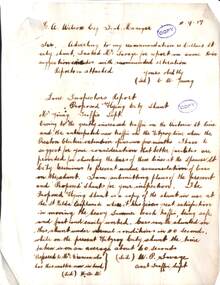
Document - Report, Tramway Board, "Proposed Flying City Shunt", 11/09/1917 12:00:00 AM
... Notes cars can be shunted in abnormal conditions in 40 seconds. Normal shunting was 60secs it appears. ...Notes cars can be shunted in abnormal conditions in 40 seconds. Normal shunting was 60secs it appears. ...Report - hand made on very thin paper, almost rice paper, 3 pages + cover note of 2/11/1921 to Mr. Wilcox, General Manager from Mr. C. W. Young and W. A. Savage, Assist Traffic Manager titled "Proposed Flying City Shunt". Report suggests that improved shunting arrangements are needed at Collins and Spencer St due to increased traffic. Notes cars can be shunted in abnormal conditions in 40 seconds. Normal shunting was 60secs it appears. Report gives details of the costs and the shunting times taken to turn cable sets around. The cover note of 2/11/1921, re-submits the report to Mr Dix from a person (can read the signature) from the Fitzroy Power House. Last page was scanned separately as a jpg file. Dated 11/9/1917Has been stamped "Copy" in two places.trams, tramways, cable trams, track, collins st, shunting -
 National Wool Museum
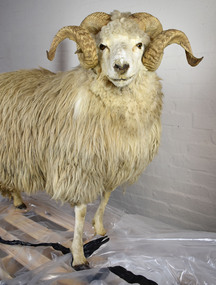
Taxidermy Sheep, Bilby Bill, c1980
... First imported to Australia in 1975, the Drysdale, due to a genetic abnormality, produces coarse, long staple fleece. ...First imported to Australia in 1975, the Drysdale, due to a genetic abnormality, produces coarse, long staple fleece. ...Originating in New Zealand, the Drysdale, represented by Bilby Bill, was developed in the 1930s at Massey University (Canterbury) by crossing a coarse haired Romney and the hardy Cheviot breed. First imported to Australia in 1975, the Drysdale, due to a genetic abnormality, produces coarse, long staple fleece. This same gene also gives them their horns, something that generally does not occur in the parent breeds. Their fleece grows very fast, up to 25cm every six months; as such shearing is carried out twice a year. The coarse and hard wearing wool is mostly used for the manufacture of carpets. The Drysdale is a medium to large stocky sheep, weighing approximately 55kg and produces about 6 to 8kg of fleece per animal annually, which is 35 to 45 microns in diameter. The yarn used on the National Wool Museum’s Axminster Gripper Loom to make the Manor House Rug is spun from the wool of Drysdale sheep.Taxidermied male Drysdale sheep. Medium sized animal with white body coloration. Large horns protruding from the top of the skull. drysdale, sheep, new zealand -
 Vision Australia
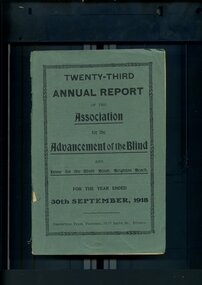
Administrative record - Text, Twenty Third Annual Report of the Association for the Advancement of the Blind 1918, 1918
... Annual report of the Association for the Advancement of the Blind outlined activities and events over the year, including continued support through donations despite abnormal conditions caused by the war, less attendances at Country Concert Party events however it remains in a sound financial position, a bequest of 200 pounds was received from Jean Bickford for the purpose of accommodating blinded soldiers at Brighton, the work of the Association has largely been limited in area however with the Secretary's visit to both Bendigo and Ballarat it is hoped that more is possible, a new trade of plaiting bark to make small floral baskets has been added, a near miss was incurred at the 'Re-union' at Woodburn after the hot afternoon helped generate a violent tornado which fortunately missed the Home but created havoc a few hundred metres away, and the loss of several members and supporters, including Mr Young who was killed in a tram accident and Mrs G W Paterson, who along with her husband W Paterson, an active supporter of the Home....Annual report of the Association for the Advancement of the Blind outlined activities and events over the year, including continued support through donations despite abnormal conditions caused by the war, less attendances at Country Concert Party events however it remains in a sound financial position, a bequest of 200 pounds was received from Jean Bickford for the purpose of accommodating blinded soldiers at Brighton, the work of the Association has largely been limited in area however with the Secretary's visit to both Bendigo and Ballarat it is hoped that more is possible, a new trade of plaiting bark to make small floral baskets has been added, a near miss was incurred at the 'Re-union' at Woodburn after the hot afternoon helped generate a violent tornado which fortunately missed the Home but created havoc a few hundred metres away, and the loss of several members and supporters, including Mr Young who was killed in a tram accident and Mrs G W Paterson, who along with her husband W Paterson, an active supporter of the Home. ...Annual report of the Association for the Advancement of the Blind outlined activities and events over the year, including continued support through donations despite abnormal conditions caused by the war, less attendances at Country Concert Party events however it remains in a sound financial position, a bequest of 200 pounds was received from Jean Bickford for the purpose of accommodating blinded soldiers at Brighton, the work of the Association has largely been limited in area however with the Secretary's visit to both Bendigo and Ballarat it is hoped that more is possible, a new trade of plaiting bark to make small floral baskets has been added, a near miss was incurred at the 'Re-union' at Woodburn after the hot afternoon helped generate a violent tornado which fortunately missed the Home but created havoc a few hundred metres away, and the loss of several members and supporters, including Mr Young who was killed in a tram accident and Mrs G W Paterson, who along with her husband W Paterson, an active supporter of the Home.1 volume of printed material with some illustrationsassociation for the advancement of the blind, annual reports -
 City of Moorabbin Historical Society (Operating the Box Cottage Museum)
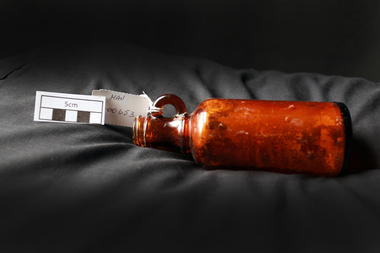
Manufactured Glass, brown bottle, 20thC
... Working with products containing asbestos - including the building material known as "Fibro" - caused people to develop various pleural abnormalities such as asbestosis and malignant mesothelioma. ...Working with products containing asbestos - including the building material known as "Fibro" - caused people to develop various pleural abnormalities such as asbestosis and malignant mesothelioma. ...This bottle may have held medicine used by a local early settler family. A local resident discovered it when digging his garden in McKinnon 2013. James Hardie immigrated to Australia in 1888 from Linlithgow, Scotland, and created a business importing oils and animal hides. Andrew Reid, also from Linlithgow, came to join Hardie in Melbourne, and became a full partner in 1895. When Hardie retired in 1911, he sold his half of the business to Reid. James Hardie Industries Ltd first listed on the Australian Stock Exchange in 1951 and is an industrial building materials company headquartered in Ireland which specialises in fibre cement products. James Hardie manufactures and develops technologies, materials and processes for the production of building materials. For over 20 years, Hardie has also operated a research and development facility devoted solely to fibre-cement technology. The company was a key player in asbestos mining and manufacturing in Australia through most of the twentieth century. Working with products containing asbestos - including the building material known as "Fibro" - caused people to develop various pleural abnormalities such as asbestosis and malignant mesothelioma. In December 2001, the company shareholders unanimously voted to restructure and relocate the company in the Netherlands as a parent company. This was part of a strategy to separate the company from the stigma of its asbestos liabilities. February 2010, James Hardie moved its corporate domicile from The Netherlands to Ireland, In May 2012 the High Court of Australia found that seven former James Hardie non-executive directors misled the stock exchange over the asbestos victims compensation fundA brown glass bottle, with finger grip handlearound bottom " THIS BOTTLE ALWAYS REMAINS THE PROPERTY OF JAMES HARDIE PTY. LTD. SYDNEY' on base 'IS985 / 7early settlers, pioneers, market gardeners, moorabbin, bentleigh, ormond, mvkinnon, glass bottles, medine containers, medical supplies, james hadie pty ltd. hardie -
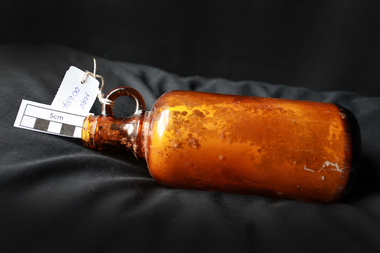 City of Moorabbin Historical Society (Operating the Box Cottage Museum)
Manufactured Glass, brown bottle, 20th C
... Working with products containing asbestos - including the building material known as "Fibro" - caused people to develop various pleural abnormalities such as asbestosis and malignant mesothelioma. ...Working with products containing asbestos - including the building material known as "Fibro" - caused people to develop various pleural abnormalities such as asbestosis and malignant mesothelioma. ...This bottle may have held medicine used by a local early settler family. A local resident discovered it when digging his garden in McKinnon 2013. James Hardie immigrated to Australia in 1888 from Linlithgow, Scotland, and created a business importing oils and animal hides. Andrew Reid, also from Linlithgow, came to join Hardie in Melbourne, and became a full partner in 1895. When Hardie retired in 1911, he sold his half of the business to Reid. James Hardie Industries Ltd first listed on the Australian Stock Exchange in 1951 and is an industrial building materials company headquartered in Ireland which specialises in fibre cement products. James Hardie manufactures and develops technologies, materials and processes for the production of building materials. For over 20 years, Hardie has also operated a research and development facility devoted solely to fibre-cement technology. The company was a key player in asbestos mining and manufacturing in Australia through most of the twentieth century. Working with products containing asbestos - including the building material known as "Fibro" - caused people to develop various pleural abnormalities such as asbestosis and malignant mesothelioma. In December 2001, the company shareholders unanimously voted to restructure and relocate the company in the Netherlands as a parent company. This was part of a strategy to separate the company from the stigma of its asbestos liabilities. February 2010, James Hardie moved its corporate domicile from The Netherlands to Ireland, In May 2012 the High Court of Australia found that seven former James Hardie non-executive directors misled the stock exchange over the asbestos victims compensation fund' A brown glass bottle with finger ring hold at neck that may have been used by a local home owner to hold medicine c1900around base ' THIS BOTTLE ALWAYS REMAINS THE PROPERTY OF JAMES HARDIE PTY LTD SYDNEY ' on base ' IS 994 ' pioneers, market gardeners, moorabbin, bentleigh, ormond, mvkinnon, glass bottles, medine containers, medical supplies, james hadie pty ltd. hardie, early settlers -
Northern District School of Nursing. Managed by Bendigo Historical Society Inc.
Tool - Northern District School of Nursing Graduates Association - Combistik Urine Test strips, 1950s
... Proteinuria is a key indicator of renal abnormalities, vascular disease, or pre-eclampsia. ...Proteinuria is a key indicator of renal abnormalities, vascular disease, or pre-eclampsia. ...The Northern District School of Nursing in Victoria, Australia Graduates Association: History of the School Managed by a committee including hospital administrators, medical professionals, and nursing leaders from several regional hospitals. Associated with major hospitals in the Northern District, including Bendigo Base, Mildura Base, Castlemaine, Echuca, Swan Hill, St. Arnaud, and Kyneton District Hospitals. Provide high-quality theoretical and practical nursing training. Raise the standard of nursing education in the region. Maintain the highest principles of nursing practice. Applicants must be at least 17 years old and hold a Proficiency Certificate or higher educational qualification. Application involves submitting forms, certificates, an interview, an aptitude test, and a medical examination. A three-month probationary period follows initial acceptance. Preliminary Training School: Four-week introductory course covering basic nursing, anatomy, hygiene, and practical skills. Practical experience in various hospital departments, guided by senior staff. Study Block Plan: Includes several blocks of theoretical and practical instruction throughout the three-year program. Regular school exams and two state exams (First Professional and Final State) are required for progression and graduation. Nurses work a 40-hour week with at least one or two days off per week and three weeks of annual leave. Accommodation is provided in comfortable hostels with good facilities. Uniforms are supplied free; nurses provide their own shoes and stockings. Salaries and allowances are regulated, with deductions for board and free medical care. Additional Information Post-Graduate Opportunities. Senior positions require further experience and additional certificates (e.g., Midwifery, Infant Welfare).Diploma courses available in administration, teaching, and specialized nursing fields. Bursaries are available for advanced study.Career Prospects: Graduates can pursue roles in administration, teaching, ward and departmental leadership, district and visiting nursing, industrial and school nursing, and more. Opportunities existed both within hospitals and in community or specialized settings.FAQs and Practical Details. Minimal training costs (mainly exam fees and personal items).Living out allowances and travel expenses are covered. Four training intakes per year; waiting periods are short if qualifications are met.Northern District School of Nursing Graduates Association - Combistik Urine Test strips - instruction booklet - 4 pages by the Ames Compant 65 Queens Road Melbourne This item contains the following document: 3792.11a Northern District School of Nursing Graduates Association - Combistik Urine Test strips - coloured instruction booklet Here are the key points from the document on Combistix urine test strips: Clinical Importance of UrinalysisUrinalysis is often underestimated but provides valuable diagnostic information.Simple to perform, yet highly informative for detecting urinary and metabolic conditions.Combistix is a combination test strip that rapidly screens for glucose, protein, and pH in urine. The test requires only one dip and 10 seconds to deliver three results, with no need for urine pre-treatment. Suitable for routine hospital urinalysis and large-scale screening, even by non-specialists due to its simplicity. Helps optimize laboratory workflow by allowing ancillary staff to perform basic tests, freeing technologists for more complex tasks. Useful for diagnosing and managing urinary tract infections, metabolic conditions, and monitoring therapy (e.g., sulphonamide therapy, chemotherapy for genito-urinary infections). Glucose: Essential for diabetes screening and management; Combistix is specific for glucose and does not react to lactose, making it reliable during pregnancy. Proteinuria is a key indicator of renal abnormalities, vascular disease, or pre-eclampsia. Its absence is reassuring. The test is sensitive and can be performed accurately by inexperienced users. The strip has three color-coded, reagent-impregnated areas separated by barriers for clear results.Simple procedure: dip, wait 10 seconds, and compare colors to a chart. Packaged in air-tight bottles of 100 strips, available through standard medical supply channels. Combistix offers a fast, reliable, and easy-to-use method for routine urine screening, supporting both clinical diagnosis and efficient laboratory operations.nurse training, lister house, ames company, combistix -
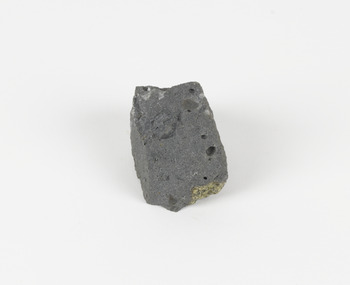 The Beechworth Burke Museum
Geological specimen - Basalt (igneous-volcanic) containing Olivine, unknown
... As magma cools, the crystals begin to form and settle on the bottom of the lava and form basalts that are abnormally enriched in olivine in the lower part of lava flows. ...As magma cools, the crystals begin to form and settle on the bottom of the lava and form basalts that are abnormally enriched in olivine in the lower part of lava flows. ...This particular geological specimen was found in Mount Franklin or Lalgambook in Djadjawurrung, located between Daylesford and Newstead, approximately ninety minutes drive from Melbourne. The mountain is an example of a breached scoria cone (a steep conical hill of loose pyroclastic fragments) which was created by a volcanic eruption about 470,000 years ago, a date which may indicate the age of this geological specimen. The volcanic eruptions of Mount Franklin were most likely witnessed by members of the Dja Dja Wurrung Aboriginal tribe, who referred to this country as the 'smoking grounds'. Mount Franklin and the surrounding area appears to have been a place of considerable religious significance to Aboriginal people, there is evidence which indicates that frequent large ceremonial gatherings took place in the area. Basalt is the most common rock on Earth’s surface, more than 90% of all volcanic rock on Earth is basalt. Basalt is an aphanitic extrusive igneous rock formed from the rapid cooling of low-viscosity lava exposed at or very near the surface of a rocky planet or moon. Specimens are black in colour and weather to dark green or brown. Basalt is rich in iron and magnesium and is mainly composed of olivine, pyroxene, and plagioclase. Olivine is the name of a group of rock-forming silicate minerals with compositions ranging between Mg2SiO4 and Fe2SiO4. Unlike other minerals, Olivine has a very high crystallisation temperature which makes it the first of the minerals to crystallise from magma. As magma cools, the crystals begin to form and settle on the bottom of the lava and form basalts that are abnormally enriched in olivine in the lower part of lava flows. According to H. M. King (on geology.com) "Olivine is thought to be an important mineral in Earth's mantle. Its presence as a mantle mineral has been inferred by a change in the behaviour of seismic waves as they cross the boundary between Earth's crust and mantle". Lava from Mount Franklin and other volcanoes in the area filled valleys and buried the gold bearing streams that became the renowned ‘deep leads’ of the gold mining era. In 1852, as part of the Victorian gold rush, gold was discovered in the immediate area, this gold was created by lava flows during the Newer Volcanic period, which were mined intensively during the nineteenth century. Around 1865 the presence of a deep lead in Mount Franklin was established. Deep lead mining was initially unsuccessful, and it was not until the late 1870s that the Franklinford Gold Mining Company mined at Mount Franklin on a significant scale. A few years later the Mount Franklin Estate Gold Mining Company also struck gold, followed by the Shakespeare and Great Western companies in the mid-1880s. By the late 1880s, however, deep lead mining had ceased in the area. Soon after gold was discovered in 1851, Victoria’s Governor La Trobe wrote to the Colonial Office in London, urging ‘the propriety of selecting and appointing as Mineral Surveyor for this Colony a gentleman possessed of the requisite qualifications and acquaintance with geological science and phenomena’. Alfred Selwyn was appointed geological surveyor in Australia in 1852 which began the Geological Survey of Victoria. In 1853-69 the Geological Survey issued under Selwyn's direction sixty-one geological maps and numerous reports; they were of such high standard that a writer in the Quarterly Journal of the Geological Society of London bracketed the survey with that of the United States of America as the best in the world. During his years spent in Australia, Selwyn collected numerous significant geological specimens, examples of which are held in collections such as the Burke Museum.This geological specimen is an example of basalt and olivine which shows the volcanic lava activity and geographical specific nature of Mt Franklin as a significant volcanic site. According to Agriculture Victoria 'The crater is one of the deepest in the Central Highlands area. It is a major megacryst site with some of the largest known Victorian examples of megacrysts of augite and an orthoclase. The small parasitic mound of Lady Franklin on the western flanks adds to the geological interest of the site'. This specimen also highlights the locality as a significant place for both indigenous activity and Victorian gold rush era mining practices. This specimen is part of a larger collection of geological and mineral specimens collected from around Australia (and some parts of the world) and donated to the Burke Museum between 1868-1880. A large percentage of these specimens were collected in Victoria as part of the Geological Survey of Victoria that begun in 1852 (in response to the Gold Rush) to study and map the geology of Victoria. Collecting geological specimens was an important part of mapping and understanding the scientific makeup of the earth. Many of these specimens were sent to research and collecting organisations across Australia, including the Burke Museum, to educate and encourage further study.An angular, solid hand-sized piece of grey volcanic Basalt with green/brown Olivine phenocrysts along one flat edge.Olivine in basalt / - label is probably / correct. / C. Willman / 15/4/21burke museum, beechworth, indigo shire, beechworth museum, geological, geological specimen, mineralogy, basalt, igneous rock, igneous-volcanic, volcanic geology, volcanic, olivine, olivine specimen, basaltoid -
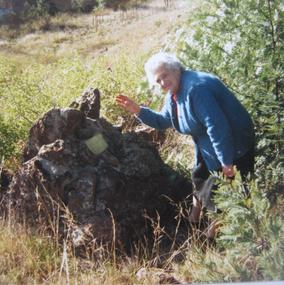 Melton City Libraries
Photograph, The Cairn- Jimmy Melrose's plane crash site, 1988
... The engine noise increased abnormally and eye witnesses saw the machine fall out of control from the cloud base about 800 feet and then disintegrate, fragments were scattered for 1½ miles and both occupants were killed. ...The engine noise increased abnormally and eye witnesses saw the machine fall out of control from the cloud base about 800 feet and then disintegrate, fragments were scattered for 1½ miles and both occupants were killed. ...Edna Barrie at the cairn, photo received from Graeme Minns in 1988. The cairn marks the site of Jimmy Melrose's plane crash in Melton South. The accident which happened on July 5th 1936. In 1934 Melrose made headlines with a series of spectacular flights. In July of that year, he set around Australia record and in that year established a new solo Australia England record when he flew to England to compete in the MacRoberston race with a De Havilland Puss Moth VH- YQO. The only Australian and the only solo pilot to complete the course within the time limit. He was seventh in finishing order and third in the handicap section making news again during the race with a dramatic landing in Darwin with empty fuel tanks. Late in 1935 Melrose imported the Phoenix for his “Adelaide to Anywhere” Charter Service. The previous year the Heston Aircraft Company had taken over the interests of the well known Comper Aircraft Company, and the first production of the new firm was the Phoenix, a single-engined all wooden five seater machine of sesquiplane configuration. The forward half of the fuselage was a streamlined rectangular section and the rear portion was a monocogue shell; the whole was of plywood fabric covered. The wing was built up of spruce box spars and lattice ribs, ply covered from the leading edge to the front spar and the fabric covered over the remainder. The tail surfaces were of similar construction. The most notable feature of the design was the lower stub wing which ran right across the fuselage embodying two box spars, plywood covered it housed the main undercarriage wheels when retracted and provided a substantial anchorage for the Nu form wing struts. The Dowty undercarriage retracted inwards, operated manually by hydraulic packs, Dual control fitted, with side by side seating for the pilots and three passenger seats behind. Power was a 200 h.p. De Havilland Gipsy VI 6 cylinder inverted in-line air-cooled engine. Six Phoenix were built; five of them registered in Great Britain and one of those was later sold abroad the remaining four were impressed into the R.A.F. in 1940. Specifications were: 40 feet 4 inches length 30 ft 2 ins height, 9ft 7ins, wing area 270 sq ft, Tare weight 2,600lbs loaded weight 3,300lbs; cruising speed 360 m.p.h. landing 50mph ceiling 14,000 ft range 700 miles. Melrose’s machine the first production aircraft was built early in 1936 and test flown of the 24th March. Painted green it carries the words “South Australian Centenary 1936” in silver of the fuselage and the name “Billing on the engine cowling in honor of Melrose’s uncle Noel Pemberton Billing, pioneer designer and founder of the Supermarine Aviation Company. The delivery flight was planned as a goodwill mission to publicise the forthcoming South Australian Centenary celebrations. Melrose left Dympne on the 9th April 1936, and flying via Marseilles, Naples, Athens, Baghdad, Basra, Karachi, Jodphur, Calcutta, Akyab, Penang, Singapore, Lombok, Darwin, Newcastle Waters and Alice Springs reached Adelaide on the 25th of April. Continuing the goodwill flight to other States, he visited Melbourne, Sydney, Newcastle, Grafton, Brisbane, Coff’s Harbour, Sydney again, Launceston, Hobart and Mount Gambier before returning to Adelaide on the 13th May. During June Jimmy made some charter flights and early in July was engaged by Mr. A.J. Campbell a director of several mining companies from Melbourne to Darwin to commence at Essendon on the4th July. However on that day low cloud and steady rain caused the postponement. There was little improvement and Melrose was advised to delay the departure again. However he wished to reach Oodnadatta that night, and when he observed the break in the clouds decided to leave. He planned to climb above the cloud and fly to Adelaide at 3,000 feet. The aircraft was airborne about 8.10 a.m. and was last seen from Essendon climbing above the clouds. At 8.45 people at Melton (30 miles West of Melbourne) heard an approaching aircraft. The engine noise increased abnormally and eye witnesses saw the machine fall out of control from the cloud base about 800 feet and then disintegrate, fragments were scattered for 1½ miles and both occupants were killed. Hand written carbon copy by Edna Barrie.Typed by Wendy Barrie March 2014 Last Flight of Jimmy Melrose by John Burke Parade Magazine July 1972 Page 2 –4 This article gives the take off time of 7.50 am from Essendon Airport Eyewitness account at the time Maisie Arthur’s description. Newspaper article. Edna Barrie at the site of the 'Cairn'local identities, local significant events -
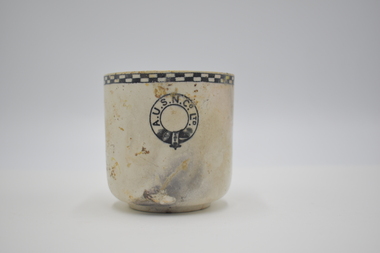 Geelong Naval and Maritime Museum
Teacup
... A Court of Inquiry later found that the wreck was caused by an abnormal set of current to the north-west and cleared the officers and crew of neglect of duty. ...A Court of Inquiry later found that the wreck was caused by an abnormal set of current to the north-west and cleared the officers and crew of neglect of duty. ...The Orungal was originally built in Glasgow in 1923 for the Khedival Mail Steamship & Graving Dock Company of Egypt and named the S.S. Fezara. Due to the effects on steamship companies of the Great Depression including the steep costs of building new ships and increases in running costs and port charges, no new passenger ships had been ordered in Australia since before World War One. To meet demand for passenger berths, the Fezara (5826 tons) along with its sister ship the Famaka (5856 tons, renamed Ormiston), were chartered by the Australasian United Steam Navigation Company Ltd (A.U.S.N.Co.) in 1927. Both the A.U.S.N.Co and the Khedival Mail Steamship Co. were part of the P&O Group. The Orungal operated in this role as an interstate passenger and mail steamer between 1927 and 1940, being used mainly on the Melbourne to Queensland and Western Australian runs, with 240 single class berths. Following the outbreak of World War Two six of the nine large passenger liners servicing mainland Australian passenger and mail trades were requisitioned by the Government to ferry equipment, troops and supplies. Some of them were converted to armed merchant cruisers and used for patrol work and escort duties in the Indian and Pacific Oceans. The Orungal had originally been requisitioned by the government along with the Zealandia on 25 June 1940, to transport troops to Darwin, but was returned to commercial service because "of her unsuitability", perhaps too slow for the demands of the work. Despite being rejected for patrol and convoy duties the Orungal still had a vital role as one of only three passenger liners left to service the mainland Australian trade. Following its requisitioning by the Government shortly after war broke out, it had been fitted out with defensive armament. On its final voyage arriving at Port Phillip Heads from Sydney, Captain Gilling was attempting to enter the Heads ahead of a worsening south-westerly storm and, with a minefield known to have been laid in the area, had been warned by the Navy not to deviate from the swept channel. The captain and crew held fears that in the stormy seas a mine may have been carried away. In the worsening weather a blur of lights at Barwon Heads was mistaken for Port Lonsdale, and the Orungal steamed ashore onto Formby Reef, just east of the entrance of the Barwon River - instead of passing safely through the middle of the Rip. At the Marine Board Inquiry Capt. Gilling - who had been master of the Orungal since 1926 - stated that after becoming uneasy about his position and changing course to starboard one point: " At 10.21 pm I ordered the engine room to stand by and gave instructions for the patent log to be hauled in and for the sounding-gear to be got ready. Approximately two minutes later, in a flash of lightning, I saw land off the port beam. I immediately recognised it as Barwon Heads, and ordered the helm to be put hard to starboard, but the vessel struck before she had time to answer the helm" Barwon Heads and Ocean Grove residents were startled to hear the shrill blast of the ship's whistle, followed by the bright flares and explosions of signal rockets. The Queenscliff lifeboat crew, who had responded to the tragic collision between the Goorangai and another passenger liner the Duntroon in Port Phillip Bay less than 24 hours earlier, were later praised for their efforts in safely taking off all the passengers and crew. Most of the passengers were asleep at the time of the wreck, and were woken up by the commotion, the ship shaking "from stem to stern" and stewards ordering them to lifeboat stations in driving rain. It was a dramatic time with the ship siren wailing and distress rockets being fired. It was reported that "When it was found the ship was safe, the passengers all went to the music room. There they sang and danced for several hours. The ship's orchestra played merrily, and amateur performers among the passengers clowned, danced and sang to keep the laughter going. In the early hours of the morning passengers went to their cabins, most of them to sleep soundly while the keel grated on the rocks". At dawn the Queenscliff lifeboat arrived at the scene having been launched at 2.30am, and cautiously approached the ship which was being "battered by mountainous seas". By 5am oil from a burst oil line was helping to calm seas around the Orungal sufficiently enough for the lifeboat to approach, and all the passengers and crew were taken off in several trips by the lifeboat. A Court of Inquiry later found that the wreck was caused by an abnormal set of current to the north-west and cleared the officers and crew of neglect of duty. The sight of a huge liner almost on the beach saw an unprecedented amount of traffic as people drove an estimated 10,000 cars, using some 60,000 gallons of fuel in a time of strict petrol rationing, to see the spectacle. Salvage operations began in an attempt to refloat the vessel, scheduled for the high tide on 15 December 1940. However, during these operations, at 2.30 am on 13 December 1940, a major fire broke out, believed to have been caused by spontaneous combustion in the boiler room. The ship was soon ablaze, with smoke pouring from its hatches and ventilators, and at mid-morning the magazine exploded fiercely. Of the 60 men working aboard the vessel two were severely burned and had to be taken to Geelong Hospital. The gathered spectators witnessed the eerie sight of the ship's hull glowing red when night fell. The well-known building demolition contractor Whelan the Wrecker bought the salvage rights, and methodically proceeded to dismantle the ship and its fittings. The drama was not yet over for the wreckers when - without warning - the burnt-out hulk was 'attacked' by RAAF for strafing practice. Salvage rights were transferred to another private owner in 1963. By 1945 the combined effects of the exposed location, fire and salvage had seen what was left of the wreck disappear beneath the waves. The site today is marked by two of the four Scotch type boilers sitting upright and exposed at low tide, just north-east of the small boats channel at the entrance to Barwon Heads. Large sections of steel hull plating and framing, and impressively large pieces of ships structure and machinery including masts, booms, deck winches, propeller shaft, flywheel, and a thrust block lie scattered about and make the site an interesting shallow dive. It is interesting to compare the site of the Orungal with the intact remains of similar large passenger ships scuttled in deep water in the Ships' Graveyard, such as the Milora and Malaita. The site is subject to waves and surge, and is best dived on flat calm days The teacup originated from the SS Orungal and was likely used heavily in the ship's life as a passenger, mail and cargo carrier around Australia. The teacup is significant for its connections to SS Orungal and of this ships connected story of being sunk in extraordinary circumstances in the local region. A.U.S.N. Co. Ltd. Teacup salvaged from SS Orungal ss orungal, fezara, world war two, barwon heads, ocean grove
