
Showing 294 items matching "aboriginal communities"
-
 Lakes Entrance Historical Society
Book, Mullett Collon, Consultation with Victorian Coastal Aboriginal Communities, 1994
... Consultation with Victorian Coastal Aboriginal Communities...Lakes Entrance Historical Society 4 Marine Parade Lakes Entrance gippsland Aboriginals A report commissioned by the Land Conservation Council for the Marine and Coastal special investigation, funded by the contract employment program for Aboriginals in natural and cultural recourse management Consultation with Victorian Coastal Aboriginal Communities Book Mullett Collon ...A report commissioned by the Land Conservation Council for the Marine and Coastal special investigation, funded by the contract employment program for Aboriginals in natural and cultural recourse managementaboriginals -
Koorie Heritage Trust
Document - Report, Bambrook, Anne, Report on the status of Victorian Aboriginal communities in enterprise and economic development, 1993
... Report on the status of Victorian Aboriginal communities in enterprise and economic development...Report on the status of Victorian Aboriginal communities in enterprise and economic development Document Report Bambrook, Anne Northern Metropolitan College of TAFE, Preston ...The Committee commissioned the research and reportas part of a process leading to a statewide economic development conference and the development of a draft strategy plan for action.p.127; glossary; appendices; figs.; 30 cm.The Committee commissioned the research and reportas part of a process leading to a statewide economic development conference and the development of a draft strategy plan for action.aboriginal communites - retail management; tourism; business development. -
Marysville & District Historical Society
THE TRIANGLE NEWS-VOL 37 NO 46-DECEMBER 10 2010
... ...aboriginal communities...Marysville & District Historical Society 39 Darwin Street Marysville yarra-valley-and-the-dandenong-ranges marysville victoria australia murray-darling basin authority mdba native fish awareness week catchment management authorities aboriginal communities fishing clubs welcome to country local primary schools lions club gallipoli park management committee victorian bushfires reconstruction & recovery authority vbrra THE TRIANGLE NEWS-VOL 37 NO 46-DECEMBER 10 2010 ...marysville, victoria, australia, murray-darling basin authority, mdba, native fish awareness week, catchment management authorities, aboriginal communities, fishing clubs, welcome to country, local primary schools, lions club, gallipoli park management committee, victorian bushfires reconstruction & recovery authority, vbrra -
 Victorian Aboriginal Corporation for Languages
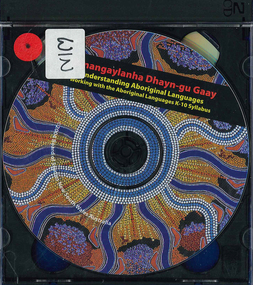
CD-ROM, Board of Studies New South Wales, Winangaylanha Dhayn-gu Gaay : understanding Aboriginal languages : working with the Aboriginal languages K-10 syllabus : a guide for Aboriginal community collaboration for school based languages programs, 2004
... Winangaylanha Dhayn-gu Gaay : understanding Aboriginal languages : working with the Aboriginal languages K-10 syllabus : a guide for Aboriginal community collaboration for school based languages programs...A guide for Aboriginal community collaboration for school-based programs. ...Supporting the Aboriginal languages K-10 syllabus, this resource assists Aboriginal community participation in the teaching of Aboriginal languages in schools. ...A guide for Aboriginal community collaboration for school-based programs. Supporting the Aboriginal languages K-10 syllabus, this resource assists Aboriginal community participation in the teaching of Aboriginal languages in schools. Technical Details System requirements (PC): 64 Mb RAM; Windows 98; 800x600 screen; thousands of colours.CD-ROMmulticultural education, multilingualism -
Lakes Entrance Historical Society
Book, Ingrid Drysdale author, The End of Dreaming by Ingrid Drysdale, 1974
... The author tells the story of life for herself, husband and family in remote Aboriginal communities in Northern Australia from late 1920s to the 1970s...Lakes Entrance Historical Society 4 Marine Parade Lakes Entrance gippsland Aboriginals Settlement The author tells the story of life for herself, husband and family in remote Aboriginal communities in Northern Australia from late 1920s to the 1970s The End of Dreaming by Ingrid Drysdale Book Ingrid Drysdale author ...The author tells the story of life for herself, husband and family in remote Aboriginal communities in Northern Australia from late 1920s to the 1970saboriginals, settlement -
Lakes Entrance Historical Society
Book, Harrison, Eileen and Landan, Carolyn, Black Swan, 2011
... A moving account of the changes and disruptions to the Aboriginal communities of Gippsland seen through the life story of Eileen Harrison, a Kurnai woman and artist....Lakes Entrance Historical Society 4 Marine Parade Lakes Entrance gippsland Aboriginals A moving account of the changes and disruptions to the Aboriginal communities of Gippsland seen through the life story of Eileen Harrison, a Kurnai woman and artist. ...A moving account of the changes and disruptions to the Aboriginal communities of Gippsland seen through the life story of Eileen Harrison, a Kurnai woman and artist.aboriginals -
 Victorian Aboriginal Corporation for Languages
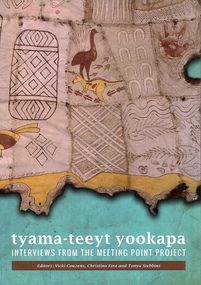
Book, Vicki Couzens, tyama-teeyt yookapa : interviews from the Meeting Point Project, 2014
... This book is a collection of stories, reflections and hopes abuot Language revival in Australian Aboriginal communities, extracted from a series of interviews carried out during 2009-2010....Victorian Aboriginal Corporation for Languages 33 Saxon Street Brunswick melbourne language revival interviews Indigenous language Victoria Indigenous language NSW Parkes Gumbaynggirr Wiradjuri B&w photographs This book is a collection of stories, reflections and hopes abuot Language revival in Australian Aboriginal communities, extracted from a series of interviews carried out during 2009-2010. tyama-teeyt yookapa : interviews from the Meeting Point Project Book Vicki Couzens Christina Eira Tonya Stebbins ...This book is a collection of stories, reflections and hopes abuot Language revival in Australian Aboriginal communities, extracted from a series of interviews carried out during 2009-2010.B&w photographslanguage revival, interviews, indigenous language victoria, indigenous language nsw, parkes, gumbaynggirr, wiradjuri -
Victorian Aboriginal Corporation for Languages
Book, Mrs James Smith, The Booandik tribe of South Australian Aborigines : a sketch of their habits, customs, legends, and language : also an account of the efforts made by Mr. and Mrs. James Smith to Christianise and civilise them, 1880
... Stories from the early days of South Australia from an adventurous woman, recounting her experiences with the local Aboriginal community. Much detail of early encounters with domestic animals and mission folk....Victorian Aboriginal Corporation for Languages 33 Saxon Street Brunswick melbourne Booandik Boandik Buandig Word lists, b&w illustrations Stories from the early days of South Australia from an adventurous woman, recounting her experiences with the local Aboriginal community. Much detail of early encounters with domestic animals and mission folk. ...Stories from the early days of South Australia from an adventurous woman, recounting her experiences with the local Aboriginal community. Much detail of early encounters with domestic animals and mission folk.Word lists, b&w illustrationsbooandik, boandik, buandig -
 Lilydale RSL Sub Branch
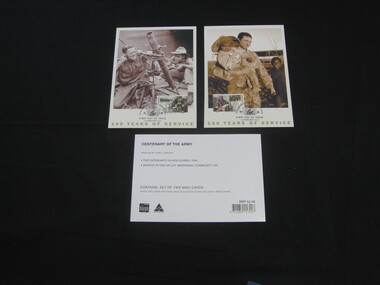
Stamp maxi cards, 100 Years of Service
... One depicting two Sergeants in New Guinea in 1944 and one depicting service in Oak Valley Aboriginal Community, SA. First day of issue 15 Feb 2001 ...One depicting two Sergeants in New Guinea in 1944 and one depicting service in Oak Valley Aboriginal Community, SA. First day of issue 15 Feb 2001 100 Years of Service Stamp maxi cards ...Set of two maxi cards each with 45 stamp. One depicting two Sergeants in New Guinea in 1944 and one depicting service in Oak Valley Aboriginal Community, SA. First day of issue 15 Feb 2001 -
 Lilydale RSL Sub Branch
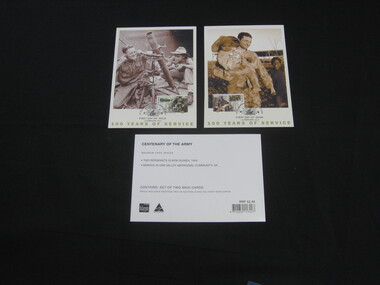
Postcards Stamps
... Service in Oak Valley Aboriginal Community South Australia - First day of issue 15 Feb 2001 (2 sets)...Service in Oak Valley Aboriginal Community South Australia - First day of issue 15 Feb 2001 (2 sets) Postcards Stamps ...Depicting two Sergeants in New Guinea 1944 with historical stamp - First day of issue 15 Feb 2001. Service in Oak Valley Aboriginal Community South Australia - First day of issue 15 Feb 2001 (2 sets) -
 Victorian Aboriginal Corporation for Languages
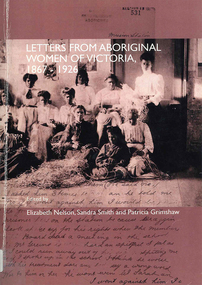
Book, Elizabeth Nelson, Letters from Aboriginal women of Victoria, 1867-1926, 2002
... In particular the letters are valuable for the insight they offer into the impact on Aboriginal communities of government legislation and mission policies and the women's assertion of their entitlement to freedom and agency. ...In particular the letters are valuable for the insight they offer into the impact on Aboriginal communities of government legislation and mission policies and the women's assertion of their entitlement to freedom and agency. ...This edited collection of women's correspondence constitutes an important historical record of the experiences of Aboriginal women during a crucial period of social change. In particular the letters are valuable for the insight they offer into the impact on Aboriginal communities of government legislation and mission policies and the women's assertion of their entitlement to freedom and agency. Written by 81 different women, the letters cover such issues as children, family, religion, land, housing and material assistance.maps, b&w photographsvictorian aboriginal women, correspondence, government policy -
 Orbost & District Historical Society
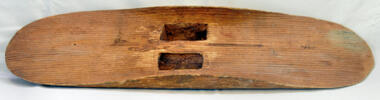
shield
... Parrying shields have long been used within Aboriginal communities not only for protection, but as a symbolic implement used in rituals. ...Orbost & District Historical Society Ruskin Street Orbost gippsland Parrying shields have long been used within Aboriginal communities not only for protection, but as a symbolic implement used in rituals. ...Parrying shields have long been used within Aboriginal communities not only for protection, but as a symbolic implement used in rituals. Aboriginal men using very basic tools made them. They were designed to be mainly used in battle but were also used in ceremonies. Many shields have traditional designs or fluting on them whilst others are just smooth. The necessary tools and equipment for hunting, fishing and warfare were one of the very few items that Aboriginals carried with them from place to place. Most were used for a multiplicity of purposes. Because many were made from raw natural materials, such as wood, generally only partial remains are found today. This is a good example of a wooden Indigenous artefact from Eastern Australia.An Aboriginal shield of roughly carved wood. Has a square shaped hollowed out hand grip. -
 RMIT Design Archives
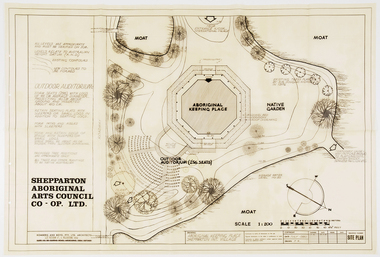
Work on paper - Architectural drawings, Aboriginal Keeping Place, Shepparton International Village
... The building is located in the Parkside Gardens, formerly the Shepparton International Village, and is the first Aboriginal cultural museum developed and managed by the Aboriginal community. The building is part of the Victorian Heritage Register. ...The building is located in the Parkside Gardens, formerly the Shepparton International Village, and is the first Aboriginal cultural museum developed and managed by the Aboriginal community. The building is part of the Victorian Heritage Register. ...Site plan drawing of the Shepparton Aboriginal Arts Council building, now known as the Bangerang Cultural Centre. The building is located in the Parkside Gardens, formerly the Shepparton International Village, and is the first Aboriginal cultural museum developed and managed by the Aboriginal community. The building is part of the Victorian Heritage Register. Romberg designed the building in conjunction with project instigator and Bangerang Elder, John Sandy Atkinson, OAM. At the request of Romberg, Atkinson created some concept sketches for the building from which Romberg designed the finished structure.Site PlanInitialed in grey pencil, bottom right: 'F.R'architecture, museum -
 City of Ballarat
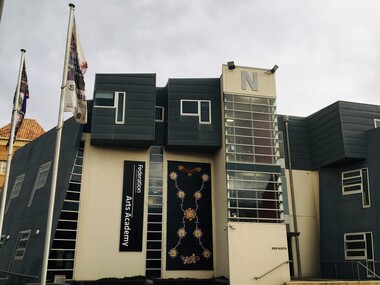
Artwork, other - Public Artwork, Marley Smith et al, Campsite by Marley Smith and Billy Blackall, 2020
... The Baarlijan (platypus) is a representation of the local Aboriginal community who have come from different Aboriginal nations and have made Ballaarat their home. ...The Baarlijan (platypus) is a representation of the local Aboriginal community who have come from different Aboriginal nations and have made Ballaarat their home. ...The Campsite mural features Bunjil (wedge-tailed eagle) the creator and spiritual leader for Aboriginal people of this land. The Baarlijan (platypus) is a representation of the local Aboriginal community who have come from different Aboriginal nations and have made Ballaarat their home. The circular motifs represent campsites of different sizes located across Ballaarat, indicating that Ballaarat was and continues to be an important meeting place. Campsite (2020) is a re-commissioned artwork based on the original Campsite Mural installed in Alfred Deakin Place for the Commonwealth Games in 2006. The Campsite mural features Bunjil (wedge-tailed eagle) the creator and spiritual leader for Aboriginal people of this land. The Baarlijan (platypus) is a representation of the local Aboriginal community who have come from different Aboriginal nations and have made Ballaarat their home. The circular motifs represent campsites of different sizes located across Ballaarat, indicating that Ballaarat was and continues to be an important meeting place. Commissioned by the City of Ballarat. Painted mural on six weatherproof sheetsbunjil, baarlijan, aboriginal history, ballarat history, wadawurrung -
 Federation University Art Collection
Painting, Searle, Ken, 'Ballarat' by Ken Searle, 1998
... From 1998 to 2001 Searle worked as a consultant at the school in the Aboriginal community of Papunya, Central Australia. ...From 1998 to 2001 Searle worked as a consultant at the school in the Aboriginal community of Papunya, Central Australia. ...Ken SEARLE (1951- ) Born Sydney, New South Wales Ken Searle worked on this commission through 1997 and 1998. Further works and sketches relating to this commission are held by the Art Gallery of Ballarat. Searle is a self-taught artist who first exhibited his paintings and drawings in the mid-1970s and is known for large, and often whimsical, paintings, of suburban and industrial areas in several Australian cities. From 1998 to 2001 Searle worked as a consultant at the school in the Aboriginal community of Papunya, Central Australia. This item is part of the Federation University Art Collection. The Art Collection features over 2000 works and was listed as a 'Ballarat Treasure' in 2007.Framed painting highlighting the artist's favoured aspects of Ballarat. Interested with scenes of suburbia for over twenty years, Ballarat is his first portrayal of a whole city. Searle’s view of Ballarat presents a deliberately untidy city seen from a number of viewpoints. Local scenes are portrayed no matter how pretty or garish, the subject matter providing a snap shot in time. Funded through the Commissions Program of the Visual Arts/Craft Fund, 1998 art, artwork, ken searle, ballarat -
Victorian Aboriginal Corporation for Languages
Book, Richard Broome, Fighting hard : the Victorian Aborigines Advancement League, 2015
... As both a welfare and activist body, the League is the "mother" of all Aboriginal Victorian community organisations, having spawned a diverse range of them...Over the years the League has proven that despite the pervasive mythology, Aboriginal people are able to successfully govern their own organisations. ...Victorian Aboriginal Corporation for Languages 33 Saxon Street Brunswick melbourne aborigines advancement league, history, government, social relations As both a welfare and activist body, the League is the "mother" of all Aboriginal Victorian community organisations, having spawned a diverse range of them...Over the years the League has proven that despite the pervasive mythology, Aboriginal people are able to successfully govern their own organisations. ...As both a welfare and activist body, the League is the "mother" of all Aboriginal Victorian community organisations, having spawned a diverse range of them...Over the years the League has proven that despite the pervasive mythology, Aboriginal people are able to successfully govern their own organisations. In particular, the League has proven its capacity for managing good governance while maintaining Aboriginal cultural values. aborigines advancement league, history, government, social relations -
 Yarra City Council
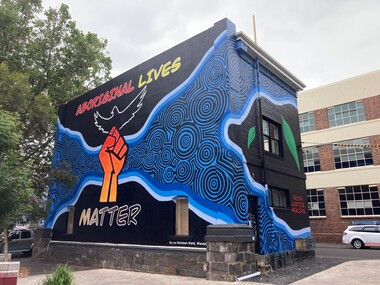
Artwork, other - Mural, Ky-ya Nicholson-Ward, Aboriginal Lives Matter, 2021
... A welcoming environment for Aboriginal and non-Aboriginal communities....A welcoming environment for Aboriginal and non-Aboriginal communities. It is a celebration of the local Aboriginal and Torres Strait Islander community; the significant Aboriginal history of Fitzroy, Collingwood and surrounds; and community's continuing cultural connection to the area. ..."The fist references the Black Lives Matter movement and also represents the strength of Indigenous peoples all over the world and symbolises solidarity and justice for everyone affected by systematic racism. Bunjil (wedge-tailed eagle) is flying high on the building. He is the creator spirit for Wurundjeri people who looks over us and protects us. Bunjil represents healing and power to our people. The blue circles and lines represent revival and waterways; in particular, they depict the Birrarung (Yarra River), which is very significant for the Wurundjeri people. Our people are known as the Manna Gum people. The leaves in the artwork highlight Wurundjeri people and their Country. These leaves also represent the cleansing of negative spirits. The Manna Gum leaf is also an important symbolic offering in our traditional Welcome to Country ceremony. Leaves are offered to visitors as they are granted safe passage through our land. They are made welcome to everything from the tops of the trees to the roots of the earth. We ask that they take care of the land, plants and animals and to respect the protocols and rules of the Traditional Owners whilst on our Country."In 2020 Council declared its support for the global Black Lives Matter (BLM) movement. In consultation with Yarra City Council's Yana Ngargna advisory group a motion was prepared and passed unanimously by all Councillors. A number of actions were generated from this decision; one of which was for Council to commission a large-scale mural that aligned with the movement. Emerging artist Ky-ya Nicholson-Ward, a proud Wurundjeri, Dja Dja Wurrung, Nguarai Illam-Wurrung, German and Irish woman, created the mural installed on a building in Peel Street Park, Collingwood. Selected by Council's Yana Ngargna, Black Lives Matter Working Group the artwork identifies the cultural importance of the local area to the Wurundjeri Woi Wurrung people as the Traditional Owners. With a strong focus on Aboriginal identity the mural outlines the local context of the Black Lives Matter movement, which is connected to racism, policing of Aboriginal and Torres Strait Islander peoples and associated deaths in custody. The artwork acknowledges the ongoing challenges faced by Aboriginal community members and their struggle to survive white systems, policies and institutions. Ky-ya's mural tells the story of Aboriginal resilience, strength and self-determination; and will support the process of healing. It is a celebration of the local Aboriginal and Torres Strait Islander community; the significant Aboriginal history of Fitzroy, Collingwood and surrounds; and community's continuing cultural connection to the area. Importantly, this artwork provides a platform to educate a broader audience about the local context of the Black Lives Matter movement and Aboriginal deaths in custody. The mural will activate this site, enliven the area, promote inclusion, incite conversation and contribute to the creative capital of this locale. A welcoming environment for Aboriginal and non-Aboriginal communities.Aboriginal Lives Matter Ky-ya Nicholson WardOn a black background a hand fist (strength, solidarity and justice) is placed at the centre of the building; Bunjil (wedge-tailed eagle) is depicted flying high on the building; blue circles and lines represent revival and waterways (Birrarung-Yarra River) and the leaves in the artwork highlight Wurundjeri people (cleansing of spirit and welcome to Country)The artist name 'Ky-ya Nicholson Ward' painted in white, low right of the wall facing into Peel Street Park. black lives matter (blm) movement, wurundjeri woi wurrung, bunjil, identity, birrarung, country -
Victorian Aboriginal Corporation for Languages
DVD, Suzy Bates, Nothing rhymes with Ngapartji, 2010
... Nothing Rhymes with Ngapartji follows the journey of acclaimed Pitjantjatjara actor Trevor Jamieson, as he returns to his traditional country to perform his hit stage show Ngapartji Ngapartji to an all-Indigenous audience in the remote Australian Aboriginal community of Ernabella, South Australia. ...Victorian Aboriginal Corporation for Languages 33 Saxon Street Brunswick melbourne Pitjantjatjara theatre music performance Big hART DVD, online study guide Nothing Rhymes with Ngapartji follows the journey of acclaimed Pitjantjatjara actor Trevor Jamieson, as he returns to his traditional country to perform his hit stage show Ngapartji Ngapartji to an all-Indigenous audience in the remote Australian Aboriginal community of Ernabella, South Australia. ...Nothing Rhymes with Ngapartji follows the journey of acclaimed Pitjantjatjara actor Trevor Jamieson, as he returns to his traditional country to perform his hit stage show Ngapartji Ngapartji to an all-Indigenous audience in the remote Australian Aboriginal community of Ernabella, South Australia. Nothing Rhymes with Ngapartji is a film about performing a multi-faceted drama to audiences who speak different languages, who are of different cultures and who have varying expectations. Offers an insight into Indigenous perspectives on the consequences of white settlement for Aboriginal cultures. In presenting the material in both Pitjantjatjara and English, it raises the important issue of stories needing to be told in languages that are central to different Australians' understanding of the world. The film is part of Big hART?s Ngapartji Ngapartji project, which is a collaborative work in progress between Indigenous and white Australians that pools their skills, experiences and resources to tell an important story about Indigenous history, culture, language and the experience of several generations.DVD, online study guidepitjantjatjara, theatre, music performance, big hart -
 Port Fairy Historical Society Museum and Archives
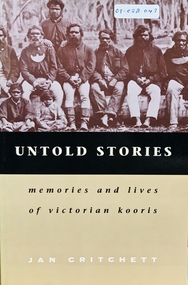
Book, Melbourne University Press, Untold stories : memories and lives of Victorian Kooris, 1998
... Few were aware that his father had been a white lad working as a boundary rider on the Western District frontier; and only the Aboriginal community knew that Wilmot had barely escaped with his life from the violent seizure of his mother's people's country. ...Few were aware that his father had been a white lad working as a boundary rider on the Western District frontier; and only the Aboriginal community knew that Wilmot had barely escaped with his life from the violent seizure of his mother's people's country. ...'I'm your half-brother and I'm here to stay. This is my home.' With these words Wilmot Abraham sought refuge with his white relations. 'Did you ever read your history?': Mrs. Mary Clarke remembers p. 1 'An old hand': Jim Cain p. 12 'I'm your half-brother, and I'm here to stay': Wilmot Abraham p. 36 The Three Pompeys The Written Record p. 48 Banjo Clarke's Stories p. 62 'Why did they take them away?': Lizzie and Henry McCrae p. 74 In Defence of Framlingham: Collin Hood p. 79 Double Dispossession: King David p. 107 James Dawson's Informants p. 137 'Why are we kept prisoners here?': Ernest and Maggie Mobourne p. 148 'The old ones, they wouldn't tell us nothing': Mrs. Connie Hart's memories p. 181 'Breaking the cycle is the hard thing to do': Geoff Rose, a stolen child p. 200 Epilogue: James Dawson, Camperdown George and the Obelisk p. 220 The Hood Family p. 238 The Mobourne Letters p. 241 Abbreviations p. 252 Notes p. 252 Bibliography p. 264 Index p. 274xxi, 283 p. : ill., facsims., map, ports. ; 23 cm. Includes index and bibliographical references: p. 264-273.non-fiction'I'm your half-brother and I'm here to stay. This is my home.' With these words Wilmot Abraham sought refuge with his white relations. 'Did you ever read your history?': Mrs. Mary Clarke remembers p. 1 'An old hand': Jim Cain p. 12 'I'm your half-brother, and I'm here to stay': Wilmot Abraham p. 36 The Three Pompeys The Written Record p. 48 Banjo Clarke's Stories p. 62 'Why did they take them away?': Lizzie and Henry McCrae p. 74 In Defence of Framlingham: Collin Hood p. 79 Double Dispossession: King David p. 107 James Dawson's Informants p. 137 'Why are we kept prisoners here?': Ernest and Maggie Mobourne p. 148 'The old ones, they wouldn't tell us nothing': Mrs. Connie Hart's memories p. 181 'Breaking the cycle is the hard thing to do': Geoff Rose, a stolen child p. 200 Epilogue: James Dawson, Camperdown George and the Obelisk p. 220 The Hood Family p. 238 The Mobourne Letters p. 241 Abbreviations p. 252 Notes p. 252 Bibliography p. 264 Index p. 274 western district (vic.) -- colonization., aboriginal australians -- victoria -- western district -- history., aboriginal australians -- victoria -- western district -- interviews, race relations - racial discrimination., child welfare - child / parent separation - stolen generations., history - biographies - indigenous., book -
 Federation University Historical Collection
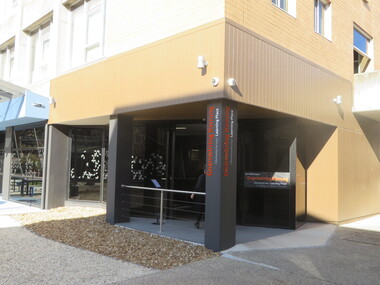
Photograph, Clare Gervasoni, Gnarrwirring Karung (Learning Place), Federation University Mt Helen Campus, 2018, 22/06/2018
... Jasmine Graham, Manager of the Aboriginal Education Centre, said the re-naming was a milestone for the local Aboriginal community. “The University is committed to greater recognition of Aboriginal heritage and culture throughout all of its campuses,” Ms Graham said. ...Jasmine Graham, Manager of the Aboriginal Education Centre, said the re-naming was a milestone for the local Aboriginal community. “The University is committed to greater recognition of Aboriginal heritage and culture throughout all of its campuses,” Ms Graham said. ...Federation University Australia’s Student Commons Area at the Mt Helen Campus was the first FedUni building to be officially given an Aboriginal name, Gnarrwirring Karung. Meaning Learning Place in the local Wadawurrung language, the re-named centre (pronounced Narrowing Ker Ung) will provide recognition of the area’s cultural heritage and increase the vibrancy, diversity and rich culture throughout the campus. The re-naming ceremony was held at the Gnarrwirring Karung Student Commons Area, S Building, Mt Helen Campus. “The choice of name follows an extensive process of seeking suggestions from the student body, the University’s Aboriginal Education Centre and local Aboriginal custodians,” Geoff Lord, Chairman of the University’s Reconciliation Action Plan (RAP) Committee, said. “The official naming meets many elements recognised within the FedUni RAP such as enhancing community, embedding culture, providing opportunity and, most importantly, respect. “The ceremony is a fine example of putting Aboriginal culture at the centre of our daily lives.” Jasmine Graham, Manager of the Aboriginal Education Centre, said the re-naming was a milestone for the local Aboriginal community. “The University is committed to greater recognition of Aboriginal heritage and culture throughout all of its campuses,” Ms Graham said. “Gnarrwirring Karung will be an impressive landmark throughout the Mt Helen Campus and a welcoming learning place.” A number of photographs taken at the naming of a Federation University space in the Mt Helen Campus 'S' Building. The space has been named Gnarrwirring Karung, Waddawurrung for Learning Place. waddawurrung, gnarrwirring karung, aboriginal, mt helen campus, reconciliation action plan, s building, waddawurrung language, place names -
 The Beechworth Burke Museum
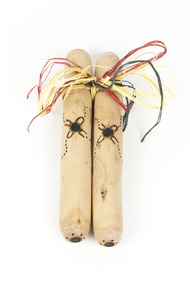
Ceremonial object - Message Sticks, Dja Dja Wurrung
... The Burke Museum is continuing to build relationships and collaborate with traditional owners, Aboriginal communities and the museum sector to ensure culturally appropriate outcomes for the collection, including repatriation of objects to communities of origin. ...The Burke Museum is continuing to build relationships and collaborate with traditional owners, Aboriginal communities and the museum sector to ensure culturally appropriate outcomes for the collection, including repatriation of objects to communities of origin. ...These Message Sticks acknowledge the return of Dja Dja Wurrung Cultural material held by the Burke Museum. The Burke Museum is the current custodian of a significant collection of First Peoples’ cultural material from across South-Eastern Australia. These objects were sold to the Museum by Reynold Everly Johns in 1868. We recognise the harm caused by dispossession of cultural material, and by any inappropriate display and interpretation of this collection over the past 150 years. The Burke Museum is continuing to build relationships and collaborate with traditional owners, Aboriginal communities and the museum sector to ensure culturally appropriate outcomes for the collection, including repatriation of objects to communities of origin. Message sticks are a form of communication between Aboriginal nations, clans and language groups even within clans. Traditional message sticks were made and crafted from wood and were generally small and easy to carry (between 10 and 20 cm). They were carved, incised and painted with symbols and decorative designs conveying messages and information. Some were prepared hastily, like you might create a note left on a friend’s desk or a quick text message; others were prepared with more time to make the markings neat and ornate. There were always marks that were distinctive to the particular group or nation sending the message and often marks identifying the relationship of the carrier to their group. This way it could be identified and authenticated by neighboring groups and by translators when the message stick was taken long distances. Two solid cylindrical shaped pieces of wood bound together with black, red and yellow string. Each stick has etchings with angular lines and dots. dja dja wurrung, message sticks, burke museum, beechworth, beechworth museum, repatriation, reynold everly johns -
 Federation University Art Collection
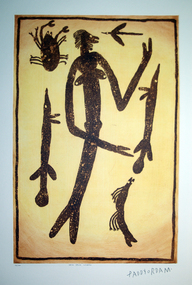
Work on paper - Artwork - printmaking, Lytlewode Press, A suite of limited edition prints by Paddy Fordham Wainburranga, 2003, 2003
... Paddy Fordham Wainburranga (1932-2006) Area: Arnhem Land Country: Bamdibu (Bumdubu) near Bulman Station As a child, Paddy grew up in Maningrida an Aboriginal community on the top end of the Northern Territory. ...Federation University Art Collection Artworks are displayed at Federation University Australia campuses at Ballarat, Gippsland (Churchill), Stawell and Horsham. goldfields Paddy Fordham Wainburranga (1932-2006) Area: Arnhem Land Country: Bamdibu (Bumdubu) near Bulman Station As a child, Paddy grew up in Maningrida an Aboriginal community on the top end of the Northern Territory. ...Paddy Fordham Wainburranga (1932-2006) Area: Arnhem Land Country: Bamdibu (Bumdubu) near Bulman Station As a child, Paddy grew up in Maningrida an Aboriginal community on the top end of the Northern Territory. He started working as a boy around cattle yards, which finally led him to working as a stockman for 20 years. Before this, he spent much of his time hunting and learning culture and customs from his father and uncles. He could remember being taken to a sacred location where he was told many Dreamtime stories of how customs came to be and why Aboriginal people practice them. Paddy was part of the movement for equal rights for all Aborigines, actively involved in claiming Bumdibu as his traditional land for his clan. He resided over this land as Jungai (caretaker, policeman). Paddy was taught to paint by his father but did not begin to paint seriously until the early 1970s. He was also recognized as a story teller, bark painter, sculpture, dancer, singer and musician. He was familiar with Central Arnhem Land rock and bark painting traditions; however he developed an idiosyncratic style which fused the figurative schema of western Arnhem Land with the narrative capacities of the north-east producing dense pictorial paintings divided into sequential segments. A suite of seven limited edition prints using the sugar lift aquatint technique. .1) Yalk Yalk Woman Sugar Lift Aquatint Plate 75.0cm (H) x 49.0cm (W) Paper 1110cm (H) x 76.0cm (W) 2003 Edition: 73/100 .2) Walga Walga Sugar Lift Aquatint Plate 75.0cm (H) x 49.0cm (W) Paper 1110cm (H) x 76.0cm (W) 2003 Edition: 73/100 .3) Nammooroddoo Sugar Lift Aquatint Plate 75.0cm (H) x 49.0cm (W) Paper 1110cm (H) x 76.0cm (W) 2003 Edition: 73/100 Nammooroddoo Sugar Lift Aquatint Plate 75.0cm (H) x 49.0cm (W) Paper 1110cm (H) x 76.0cm (W) 2003 Edition: 73/100 .3) Nammooroddoo Sugar Lift Aquatint Plate 75.0cm (H) x 49.0cm (W) Paper 1110cm (H) x 76.0cm (W) 2003 Edition: 73/100 .4) Mun Gruk Gruk Woman Sugar Lift Aquatint Plate 75.0cm (H) x 49.0cm (W) Paper 1110cm (H) x 76.0cm (W) 2003 Edition: 73/100 .5 Mun Gruk Gruk Man Sugar Lift Aquatint Plate 75.0cm (H) x 49.0cm (W) Paper 1110cm (H) x 76.0cm (W) 2003 Edition: 73/100 .6) Mun Gruk Gruk Sugar Lift Aquatint Plate 75.0cm (H) x 49.0cm (W) Paper 1110cm (H) x 76.0cm (W) 2003 Edition: 73/100 .7) Lightning Man Sugar Lift Aquatint Plate 75.0cm (H) x 49.0cm (W) Paper 1110cm (H) x 76.0cm (W) 2003 Edition: 73/100 Donated through the Australian Government Cultural Gifts Programme by Katherine N. Littlewood, 2014artist, artwork, paddy fordham wainburranga, paddy fordham, wainburranga, printmaking, aboriginal, indigenous, churchill, dreaming -
Canterbury History Group
Book, Public Record Office of Victoria et al, 'My heart is breaking' : a joint guide to records about Aboriginal people in the Public Record Office of Victoria and the Australian Archives, Victorian Regional Office, 1993
... The object of this guide is to improve public knowledge of these records and to promote their use in the Aboriginal and general community. ...The object of this guide is to improve public knowledge of these records and to promote their use in the Aboriginal and general community. Aboriginal peoples Australian archives Part 1 is a Guide to relevant holdings about aboriginal people of the PRO and Australian Archives. ...Part 1 is a Guide to relevant holdings about aboriginal people of the PRO and Australian Archives. Part 2 is a compilation of material to illustrate the "richness and variety of the surviving record as well as the complementary nature of the two holdings".191 pages; Includes black and white photographs, indexes and bibliographynon-fictionPart 1 is a Guide to relevant holdings about aboriginal people of the PRO and Australian Archives. Part 2 is a compilation of material to illustrate the "richness and variety of the surviving record as well as the complementary nature of the two holdings".aboriginal peoples, australian archives -
 Victorian Aboriginal Corporation for Languages
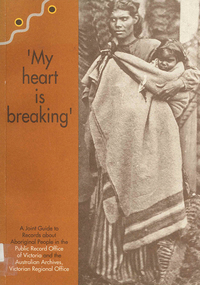
Book, Australian Archives et al, 'My heart is breaking' : a joint guide to records about Aboriginal people in the Public Record Office of Victoria and the Australian Archives, Victorian Regional Office, 1993
... The object of this guide is to improve public knowledge of these records and to promote their use in the Aboriginal and general community....The object of this guide is to improve public knowledge of these records and to promote their use in the Aboriginal and general community. 'My heart is breaking' : a joint guide to records about Aboriginal people in the Public Record Office of Victoria and the Australian Archives, Victorian Regional Office Book Australian Archives Public Record Office Victoria ...The records covered by this guide relate to Victoria's Aboriginal people until 1975 when the Commonwealth assumed the State's then responsibility for Aboriginal affairs. One result of the transfer of responsibility was that the official documents became separated. For the early period, 1836-1859, the records are held in the Public Record Office of Victoria, and for the period 1860-1975, a substantial proportion are in the Australian Archives, Victorian Regional Office. The object of this guide is to improve public knowledge of these records and to promote their use in the Aboriginal and general community.b&w photographs, index, listsaustralian archives, public record office victoria, history sources -
 Uniting Church Archives - Synod of Victoria
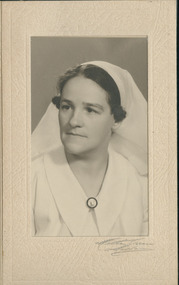
Photograph, C1947
... Born and raised in suburban Melbourne, she had been inspired by stories told to her by other missionaries about the fulfilment to be gained working amongst Aboriginal communities. Given her religious faith and nursing skills, she believed she could make a difference. ...Born and raised in suburban Melbourne, she had been inspired by stories told to her by other missionaries about the fulfilment to be gained working amongst Aboriginal communities. Given her religious faith and nursing skills, she believed she could make a difference. ...Hilda Charlotte Foster, 1902 - 1990, was a Double Certified Nurse when, at the age of 35, she successfully applied to the board of the Australian Inland Mission (AIM) to work at an outback field centre in South Australia. Born and raised in suburban Melbourne, she had been inspired by stories told to her by other missionaries about the fulfilment to be gained working amongst Aboriginal communities. Given her religious faith and nursing skills, she believed she could make a difference. She worked in Oodnadatta in South Australia for two years (1937-1939), followed by a stint in Innamincka in New South Wales in 1940 -1942. Before she became a nurse, Hilda Foster trained to be a Sunday School teacher and was a member of the Sunday School Council of Victoria. She completed first aid courses run through the Presbyterian Deaconesses Institute in Carlton, Victoria, and in 1930 successfully applied to become a trainee nurse at the Austin Hospital for Incurables, in Heidelberg. She commenced her training there in 1931, before moving to the Women's Hospital in 1933. In 1934 she had six months at the Fairfield Infectious Diseases Hospital, before returning to the Austin, where she was employed when she sat her final exams in November 1934. Her combined skills made her a most attractive option for the Australian Inland Mission. As well as being multi-skilled as a nurse, she provided religious instruction and spiritual ministry to members of the community. https://trove.nla.gov.au/people/762093?c=people Sister Foster nursed at Toora Bush Hospital prior to leaving for the Paton Memorial Hospital, Vila, New Hebrides in 1944. She left the New Hebrides in 1946.Matt, black and white, head and shoulders, studio portrait of Sister Hilda Charlotte Foster on card.australian inland mission, presbyterian deaconess, sister hilda charlotte foster, paton memorial hospital vila new hebrides -
 Victorian Aboriginal Corporation for Languages
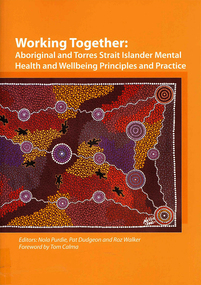
Book, Nola Purdie, Working Together: Aboriginal and Torres Strait Islander Mental Health and Wellbeing Principles and Practice, 2010
... Reviewing psychiatric assessment in remote Aboriginal communities 16. Promoting perinatal mental health wellness in Aboriginal and Torres Strait Islander communities Pt 4 Working with specific groups: models, programs and services: 17. ...Reviewing psychiatric assessment in remote Aboriginal communities 16. Promoting perinatal mental health wellness in Aboriginal and Torres Strait Islander communities Pt 4 Working with specific groups: models, programs and services: 17. ...Pt 1 History and contexts: 1. Australian Aboriginal and Torres Strait Islander mental health: an overview 2. A history of psychology in Aboriginal and Torres Strait Islander mental health 3. The social, cultural and historical context of Aboriginal and Torres Strait Islander Australians 4. The policy context of Aboriginal and Torres Strait Islander mental health Pt 2 Issues of Aboriginal and Torres Strait Islander mental health and wellbeing: 5. Mental illness in Aboriginal and Torres Strait Islander peoples 6. Social determinants of Aboriginal and Torres Strait Islander social and emotional wellbeing 7. Preventing suicide among Indigenous Australians 8. Anxiety and Aboriginal and Torres Strait Islander young people 9. Substance misuse and mental health among Aboriginal Australians 10. Trauma, transgenerational transfer and effects on community wellbeing 11. Indigenous family violence: pathways forward Pt 3 Mental health practice: 12. Working as a culturally competent mental health practitioner 13. Communication and engagement: urban diversity 14. Issues in mental health assessment with Indigenous Australians 15. Reviewing psychiatric assessment in remote Aboriginal communities 16. Promoting perinatal mental health wellness in Aboriginal and Torres Strait Islander communities Pt 4 Working with specific groups: models, programs and services: 17. Ngarlu: a cultural and spiritual strengthening model 18. Principled engagement: Gelganyem youth and community well being program 19. Dealing with loss, grief and trauma: seven phases to healing 20. The Marumali program: an Aboriginal model of healing 21. Mental health programs and services.colour photographs, tablesmental health -
 Victorian Aboriginal Corporation for Languages
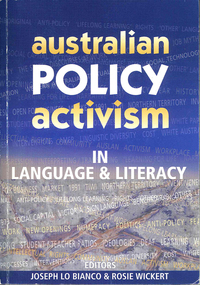
Book, Joseph Lo Bianco, Australian policy activism in language and literacy, 2001
... Sing out that song: the textual activities of social technologies in an Aboriginal community /? Jack Frawley....Sing out that song: the textual activities of social technologies in an Aboriginal community /? Jack Frawley. Australian policy activism in language and literacy Book Joseph Lo Bianco Rosie Wickert ...Australian Policy Activism in Language and Literacy presents the dynamics of language and literacy policy activism in Australia by capturing accounts of many of those most deeply engaged in Australia?s distinctive practice of Language and Literacy policy-making and its effects. This book describes how policy texts came about. 1. From policy to anti-policy: how fear of language rights took policy-making out of community hands /? Joseph Lo Bianco 2. Australia's language /? Paul Brock 3. Politics, activism and processes of policy production: adult literacy in Australia /? Rosie Wickert 4. Although it wasn't broken, it certainly was fixed: interventions in the Australian Adult Migrant English Program 1991-1996 /? Helen Moore 5. Advocating the sustainability of linguistic diversity /? Michael Singh 6. The cost of literacy for some /? Anthea Taylor 7. (E)merging discourses at work: bringing together new and old ways to account for workplace literacy policy /? Geraldine Castleton 8. The melody changes but the dance goes on - tracking adult literacy education in Western Australia from 'learning for life' to 'lifelong learning': policy impacts on practice 1973-1999 /? Margaret McHugh, Jennifer Nevard and Anthea Taylor 9. Sleight of hand: job myths, literacy and social capital /? Ian Falk 10. National literacy benchmarks and the outstreaming of ESL learners /? Penny McKay 11. Open for business: the market, the state and adult literacy in Australia up to and beyond 2000 /? Peter Kell 12. Inventiveness and regression: interpreting/?translating and the vicissitudes of Australian language policy /? Uldis Ozolins 13. Deafness and sign language in government policy documents 1983-1990 /? Des Power 14. Imprisoned by a landmark narrative? Student/?teacher ratios and the making of policy /? Merilyn Childs 15. Ideologies, languages, policies: Australia's ambivalent relationship with learning to communicate in 'other' languages /? Angela Scarino and Leo Papademetre 16. Reconciled to what? Reconciliation and the Norther Territory's bilingual education program, 1973-1998 /? Christine Nicholls 17. Sing out that song: the textual activities of social technologies in an Aboriginal community /? Jack Frawley.language activism, linguistic diversity, adult literacy, education, sign language, reconciliation, esl programs -
 Merri-bek City Council
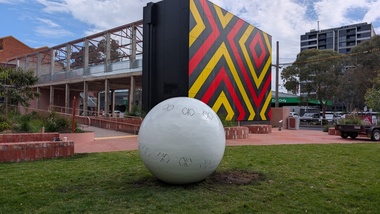
Sculpture - Aluminium, Aunty Kim Wandin et al, Balam Balam, 2025
... Grounded in a deep relationship with Country and a commitment to creating culturally rich artwork, Murrup Biik's 'Balam Balam' honours Aboriginal knowledge, ceremony, and community connection....Grounded in a deep relationship with Country and a commitment to creating culturally rich artwork, Murrup Biik's 'Balam Balam' honours Aboriginal knowledge, ceremony, and community connection. Merri-bek Public Art Collection Balam Balam Sculpture Aluminium Aunty Kim Wandin Chris Joy ...'Balam Balam', by Aunty Kim Wandin and Christine Joy’s (Murrup Biik) is located at Balam Balam Place. This artwork responds to the name of the site and represents the earth and the extraordinary migratory journeys that butterflies make around our planet, referencing their resilience and strength. It recognises that butterflies as pollinators are an important food source for birds and other vertebrates, and are a part of a living, interconnected planetary system. They are indicator species for healthy environments. Grounded in a deep relationship with Country and a commitment to creating culturally rich artwork, Murrup Biik's 'Balam Balam' honours Aboriginal knowledge, ceremony, and community connection.merri-bek public art collection -
 Sunshine and District Historical Society Incorporated
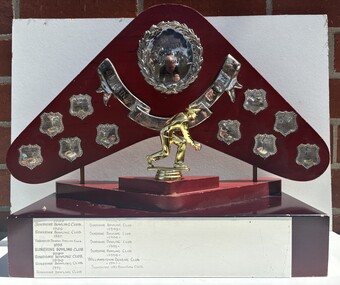
Memorabilia - Sunshine Bowling Club Cooinda Bowls Championship Shield
... The event was part of the Cooinda Festival, which was a multicultural community celebration held in Sunshine, Victoria, during the 1970s, with strong ties to local Aboriginal and migrant communities. ...The event was part of the Cooinda Festival, which was a multicultural community celebration held in Sunshine, Victoria, during the 1970s, with strong ties to local Aboriginal and migrant communities. ...The Cooinda Bowls Championship was a notable regional event held across various clubs in Melbourne’s west, particularly involving Sunshine Bowling Club. The event was part of the Cooinda Festival, which was a multicultural community celebration held in Sunshine, Victoria, during the 1970s, with strong ties to local Aboriginal and migrant communities. The name Cooinda, an Aboriginal word meaning “happy place” or “meeting place” reflects the festival’s inclusive and celebratory spirit. The Sunshine Bowling club was founded around 1910, and is closely tied to the development of Sunshine as a company town under H.V. McKay, the industrialist behind the Sunshine Harvester Works. The club was located in the Sunshine Gardens, Andersons Road, Sunshine. In 2007, the club folded. Later the club rooms were demolished, and the former bowling rink was converted into a lawn area, and which is now part of the H.V. McKay Memorial Gardens. A wooden shield with inscription plaques attached. The shield comes apart into two sections, top & base. Sunshine Bowling Club Cooinda Bowls Championship Sunshine Bowling Club 1974 Sunshine Bowling Club 1975 Sunshine Bowling Club 1976 Rosamond Bowling Club 1977 Avenue Bowling Club 1978 Sunshine Bowling Club 1979 Rosamond Bowling Club 1980 Rosamond Bowling Club 1981 Rosamond Bowling Club 1982 Footscray Bowling Club 1983 Maribyrnong Park Bowling Club 1984 Sunshine Bowling Club 1985 Sunshine Bowling Club 1986 Yarraville Seddon Bowling Club 1987 Sunshine Bowling Club 1988 Sunshine Bowling Club 1989 Sunshine Bowling Club 1990 Sunshine Bowling Club 1991 Sunshine Bowling Club 1992 Sunshine Bowling Club 1993 Sunshine Bowling Club 1994 Sunshine Bowling Club 1995 Williamstown Bowling Club 1996 Sunshine VRI Bowling Club 1997 sunshine bowling club, rosamond bowling club, avenue bowling club, footscray bowling club, maribyrnong park bowling club, yarraville seddon bowling club, williamstown bowling club, sunshine vri bowling club, bowls, lawn bowls, rosamond bowls club -
![Book, Chris Cunneen et al, Keeping Aboriginal and Torres Strait Islander people out of custody : an evaluation of the implementation of the recommendations of the Royal Commission in [ie. into] Aboriginal Deaths in Custody, 1997](/media/collectors/52f0758a9821f40464f742c1/items/56c69101400d0c3518d1512f/item-media/56c69101400d0c3518d15130/item-fit-380x285.jpg?cb=6) Victorian Aboriginal Corporation for Languages
Victorian Aboriginal Corporation for LanguagesBook, Chris Cunneen et al, Keeping Aboriginal and Torres Strait Islander people out of custody : an evaluation of the implementation of the recommendations of the Royal Commission in [ie. into] Aboriginal Deaths in Custody, 1997
... Contents: 1: Introduction 2: Data on Aboriginal and Torres Strait Islander over-representation in the criminal justice system 3: Explanations for Aboriginal and Torres Strait Islander over-representation in the criminal justice system PART TWO : CASE STUDIES 4 : Poor Practice Case Studies - 5 : Best Practice Case Studies PART THREE: ANALYSIS OF THE RECOMMENDATIONS AND THEIR IMPLEMENTATION 6: Adequacy of Information -7: Aboriginal and Police Community Relations 8: Responding to Public Drunkenness 9: Police Practices and Procedures 10: Imprisonment as a Last Resort 11: Court Processes, Legislation and Aboriginal Legal Representation 12: Aboriginal Young People and the Juvenile Justice System PART FOUR 13: Conclusion APPENDIXES Appendix 1: The recommendations of the Royal Commission most proximate to reducing the over-representation of Aboriginal people in custody Appendix 2: Methodological issues in determining over-representation Appendix 3: Details of Federal funding related to State agencies for the implementation of the Royal Commission into Aboriginal Deaths in Custody recommendations....Victorian Aboriginal Corporation for Languages 33 Saxon Street Brunswick melbourne Aboriginal deaths in custody criminal justice system b&w illustrations, tables Contents: 1: Introduction 2: Data on Aboriginal and Torres Strait Islander over-representation in the criminal justice system 3: Explanations for Aboriginal and Torres Strait Islander over-representation in the criminal justice system PART TWO : CASE STUDIES 4 : Poor Practice Case Studies - 5 : Best Practice Case Studies PART THREE: ANALYSIS OF THE RECOMMENDATIONS AND THEIR IMPLEMENTATION 6: Adequacy of Information -7: Aboriginal and Police Community Relations 8: Responding to Public Drunkenness 9: Police Practices and Procedures 10: Imprisonment as a Last Resort 11: Court Processes, Legislation and Aboriginal Legal Representation 12: Aboriginal Young People and the Juvenile Justice System PART FOUR 13: Conclusion APPENDIXES Appendix 1: The recommendations of the Royal Commission most proximate to reducing the over-representation of Aboriginal people in custody Appendix 2: Methodological issues in determining over-representation Appendix 3: Details of Federal funding related to State agencies for the implementation of the Royal Commission into Aboriginal Deaths in Custody recommendations. ...Contents: 1: Introduction 2: Data on Aboriginal and Torres Strait Islander over-representation in the criminal justice system 3: Explanations for Aboriginal and Torres Strait Islander over-representation in the criminal justice system PART TWO : CASE STUDIES 4 : Poor Practice Case Studies - 5 : Best Practice Case Studies PART THREE: ANALYSIS OF THE RECOMMENDATIONS AND THEIR IMPLEMENTATION 6: Adequacy of Information -7: Aboriginal and Police Community Relations 8: Responding to Public Drunkenness 9: Police Practices and Procedures 10: Imprisonment as a Last Resort 11: Court Processes, Legislation and Aboriginal Legal Representation 12: Aboriginal Young People and the Juvenile Justice System PART FOUR 13: Conclusion APPENDIXES Appendix 1: The recommendations of the Royal Commission most proximate to reducing the over-representation of Aboriginal people in custody Appendix 2: Methodological issues in determining over-representation Appendix 3: Details of Federal funding related to State agencies for the implementation of the Royal Commission into Aboriginal Deaths in Custody recommendations.b&w illustrations, tablesaboriginal deaths in custody, criminal justice system
