
Showing 13 items matching "aboriginal services unit"
-
 Koorie Heritage Trust
Book, Aboriginal Services Unit: Northern Metropolitan College of TAFE, Victorian Aboriginal Community Meeting, December 4th : Royal Commission into Aboriginal Deaths in Custody : implementation and monitoring, 1991
... Aboriginal Services Unit: Northern Metropolitan College of TAFE....Preston : ABORIGINAL SERVICES UNIT NORTHERN METROPOLITAN COLLEGE OF T.A.F.E. ...General Directions: 1/ Considerations of the families whose relations have died in custody is of paramount importance. 2/ The issue of justice/ retribution/ compensation is an on-going concern which has not been adequately addressed by the Royal Commission. 3/ Ongoing consultations about implementing and monitoring the recommendations need to recognise Koorie meeting styles. The Meeting Overwhelmingly Endorsed These Statements.62 p. : 30 cm. General Directions: 1/ Considerations of the families whose relations have died in custody is of paramount importance. 2/ The issue of justice/ retribution/ compensation is an on-going concern which has not been adequately addressed by the Royal Commission. 3/ Ongoing consultations about implementing and monitoring the recommendations need to recognise Koorie meeting styles. The Meeting Overwhelmingly Endorsed These Statements.australia. | royal commission into aboriginal deaths in custody. | aboriginal australians -- victoria. -
NMIT (Northern Melbourne Institute of TAFE)
Booklet: The Mabo decision information workshop: discussion summary 1993
... ...Aboriginal Services Unit...Northern Metropolitan College of TAFE Aboriginal Services Unit NMIT A4 size spiral bound booklet of nineteen pages, prepared by Northern Metropolitan College of TAFE in 1993. ...A4 size spiral bound booklet of nineteen pages, prepared by Northern Metropolitan College of TAFE in 1993. On cover: 'Aborigines Advancement League / Thursday Feb 18th 1993 / Presented by: The Victorian Aboriginal Legal Service. Cover title. Speakers: Alf Bamblett, Bryan Keon-Cohen, Terry Garwood.northern metropolitan college of tafe, aboriginal services unit, nmit -
NMIT (Northern Melbourne Institute of TAFE)
Report: on the training needs of Aboriginal health workers in Victoria, 1992
... Undertaken by the Aboriginal Services Unit of Northern Metropolitan College of TAFE (NMCOT). ...Undertaken by the Aboriginal Services Unit of Northern Metropolitan College of TAFE (NMCOT). ...Fifty-eight page report, A4 size. On the training needs of Aboriginal health workers in Victoria, 27th May 1992. The project was requested by the Victorian Tripartite Council of Koorie Health (VTCKH). Undertaken by the Aboriginal Services Unit of Northern Metropolitan College of TAFE (NMCOT). Spiral bound with white cover with Aboriginal design. northern metropolitan college of tafe, nmcot, victorian tripartite council of koorie health, reports, nmit -
Federation University Historical Collection
Correspondence, Ballarat School of Mines Koorie Support Unit Officer, 1989, 1989
... In discussions on August 22nd with representatives of the Ballarat Aboriginal Education Committee, the Acting Administrator of the Ballarat and District Aboriginal Cooperative and the ASsistant Director Arts and Community Studies, and the Aboriginal Studies Teacher Coordinator at the Ballarat School of Mines, it was agreed that attempts be made to seek funding for and Aboriginal Education Support Unit, to be staffed by Aboriginal persons and to be responsible for policy, Aboriginal liaison and student support services. ...In discussions on August 22nd with representatives of the Ballarat Aboriginal Education Committee, the Acting Administrator of the Ballarat and District Aboriginal Cooperative and the ASsistant Director Arts and Community Studies, and the Aboriginal Studies Teacher Coordinator at the Ballarat School of Mines, it was agreed that attempts be made to seek funding for and Aboriginal Education Support Unit, to be staffed by Aboriginal persons and to be responsible for policy, Aboriginal liaison and student support services. ...In discussions on August 22nd with representatives of the Ballarat Aboriginal Education Committee, the Acting Administrator of the Ballarat and District Aboriginal Cooperative and the ASsistant Director Arts and Community Studies, and the Aboriginal Studies Teacher Coordinator at the Ballarat School of Mines, it was agreed that attempts be made to seek funding for and Aboriginal Education Support Unit, to be staffed by Aboriginal persons and to be responsible for policy, Aboriginal liaison and student support services. On September Eleven pieces of correspondence relating to the appointment of a Ballarat School of Mines Koorie Support Unit Coordinator and Support Person. Note: Some aspects of this correspondence is closed to comply with the Privacy Act.koorie support unit, aboriginal education unit, tony lovett, ian pimblett, letterhead, ballarat and district aboriginal co-operative ltd, daryl vea vea, ballarat aboriginal education committee, aboriginal education support unit, peter shiells, kerrie cross, cordell kent, bev lovett, dianne nikkleson, wayne muir, victorian aboriginal education associaiton incorporated, lionel bamblett, aboriginal education centre -
 Monbulk RSL Sub Branch
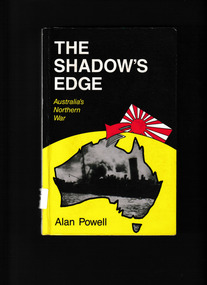
Book, Alan Powell, The shadow's edge : Australia's northern war, 1988
... world war 1939-1945 - campaigns - australia darwin - bombing Account of the Second World War as viewed and experienced in northern Australia ; includes references to Aboriginal people as coast watchers and rescuers, in army service, as trackers, in the Special Reconaissance Unit ; W.E.H. ...Account of the Second World War as viewed and experienced in northern Australia ; includes references to Aboriginal people as coast watchers and rescuers, in army service, as trackers, in the Special Reconaissance Unit ; W.E.H. Stanner and the North Australia Observer Unit ; Protectors of women ; results of war experiences ; white attitudes towards Aboriginal people.Index, bibliography, notes, ill, maps, p.346.non-fictionAccount of the Second World War as viewed and experienced in northern Australia ; includes references to Aboriginal people as coast watchers and rescuers, in army service, as trackers, in the Special Reconaissance Unit ; W.E.H. Stanner and the North Australia Observer Unit ; Protectors of women ; results of war experiences ; white attitudes towards Aboriginal people. world war 1939-1945 - campaigns - australia, darwin - bombing -
 National Vietnam Veterans Museum (NVVM)
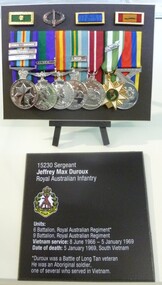
Medal - Medal, Replica
... 15230 Sergeant Jeffrey Max Duroux, Royal Australian Infantry, Units:6 Battalion, Royal Australian Regiment* 9 Battalion, Royal Australian Regiment Vietnam service: 8 June 1966- 5 January 1969 Date of death: 5 January 1969, South Vietnam. *Duroux was a Battle of Long Tan veteran. He was an Aboriginal...15230 Sergeant Jeffrey Max Duroux, Royal Australian Infantry, Units:6 Battalion, Royal Australian Regiment* 9 Battalion, Royal Australian Regiment Vietnam service: 8 June 1966- 5 January 1969 Date of death: 5 January 1969, South Vietnam. *Duroux was a Battle of Long Tan veteran. He was an Aboriginal ...15230 Sergeant Jeffrey Max Duroux, Royal Australian Infantry, Units:6 Battalion, Royal Australian Regiment* 9 Battalion, Royal Australian Regiment Vietnam service: 8 June 1966- 5 January 1969 Date of death: 5 January 1969, South Vietnam. *Duroux was a Battle of Long Tan veteran. He was an Aboriginal soldier, one of several who served in Vietnam.1x Australian Active Service Medal (clasps Thai-Malaya, Malaya, Vietnam) 1x General Service Medal (clasp Malaya) 1x Vietnam Medal 1x Australian Service Medal 1945-75 S.E. Asia 1x Australian Defence Medal 1x Republic of Vietnam Campaign Medal 1960- 1x Malaysia Medal 1x Infantry Combat Badge 3x Presidential Unit Citation Badgessgt. jeffrey max duroux, aboriginal, long tan, 6 rar, 9 rar, medal, badge, killed in action -
 Uniting Church Archives - Synod of Victoria
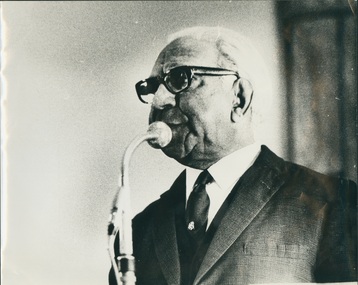
B&W photo of another photo or newspaper photograph of Pastor Sir Douglas Nicholls, Undated
... services. Their house soon overflowed with people in need or visitors to Melbourne. Nicholls also hosted inspiring African American visitors such as the pianist Winifred Attwell and the singer Harry Belafonte. His ministry extended to Aboriginal country communities. Gladys taught Sunday school, undertook endless fund-raising and welfare work beside her husband, and became his greatest supporter and financial manager. They formed an Aboriginal Girls’ Hostel in 1956, for which they acted as house parents, and bought holiday units...services. Their house soon overflowed with people in need or visitors to Melbourne. Nicholls also hosted inspiring African American visitors such as the pianist Winifred Attwell and the singer Harry Belafonte. His ministry extended to Aboriginal country communities. Gladys taught Sunday school, undertook endless fund-raising and welfare work beside her husband, and became his greatest supporter and financial manager. They formed an Aboriginal Girls’ Hostel in 1956, for which they acted as house parents, and bought holiday units ...Sir Douglas Ralph Nicholls (1906-1988), footballer, pastor, activist and governor, was born on 9 December 1906 at Cummeragunja Aboriginal mission, New South Wales, fifth child of Herbert Nicholls, seasonal worker, and his wife Florence, née Atkinson. Doug grew up at Cummeragunja, on the Murray River near Barmah, in its golden years of Aboriginal autonomy. Thomas Shadrach James gave him and other Yorta Yorta children a sound primary education, reinforcing the pride and self-assurance gained from their parents. As Doug grew, so too did the powers of the State’s Aboriginal Protection Board. Doug’s elder sister Hilda was removed about 1915. When Doug reached 14, he was moved off under the Aborigines Protection Act (1909) to find work. He took a job with dredging teams constructing levees on the Murray. Like other youths in the region Nicholls played Australian rules football, emulating kinsmen who had won local premierships since the 1890s. Doug and his brother Herbert (‘Dowie’) played with Tongala in the mid-1920s. Melbourne football beckoned, Doug trying out unsuccessfully for Carlton in 1927. He signed with the Northcote Victorian Football Association team, despite his nervousness about his Aboriginality, and was given a job with Northcote City Council. ‘Dowie’ joined him for a season. Doug was short at 5 ft 2 ins (158 cm), but muscular and lightning fast. He competed regularly during a boom in professional running, winning many heat and place prizes. In 1929 he won the Nyah and Warracknabeal gifts, earning a sash and £100 in each, together with a case of cutlery in the latter. Using his speed on the wing for Northcote, he produced great spring and agility from his compact body. The Sporting Globe reported in 1929 that ‘he flashes through packs of big men, whisks around small men . . . and attempts marks at the back of any six-footer’. In front-on clashes he was flattened only to rise again. The sole Aborigine in the VFA, he was known affectionately as the ‘flying Abo’ but called worse by his opponents’ barrackers. He competed for five seasons, being named ‘best and fairest’ twice, appearing in three association grand finals and winning in 1929. Keen to earn more than a seasonal wage, in 1931 Nicholls accepted a three-year contract with Jimmy Sharman’s travelling boxing show. The bouts matched opposites, local against tent boxer, white against black, and sometimes men of different sizes. He faced stiff competition from those who wanted to best the noted Melbourne black footballer, the crowd adding racial abuse. A far better footballer than boxer, he copped some punishment. Fighting in the Melbourne Stadium in December 1931, he was described by Truth as ‘slow and awkward’, but packing a ‘good wallop’. In 1932 Sharman, who treated his boxers fairly, released Nicholls to join the Fitzroy Victorian Football League team, which agreed to employ him as its groundsman. He played fifty-four games for Fitzroy over six seasons until knee trouble forced him out in 1937. Winning cups in 1934 and 1935, he played alongside Haydn Bunton and Wilfred (‘Chicken’) Smallhorn. Grand finals eluded him but he represented Victoria twice. Following his mother’s death, Nicholls revisited the Church of Christ chapel in Northcote, where they had worshipped together. On 17 July 1932 he experienced a conversion. He was soon baptised and witnessed openly, leading his fellow footballers to occasional church parades. Nicholls exhibited leadership qualities. William Cooper, founder of the Australian Aborigines’ League and Nicholls’ Yorta Yorta kinsman and fellow Christian, encouraged the young footballer. In February 1935 Cooper, Nicholls and others lobbied Thomas Paterson, the Commonwealth minister for the interior, over the need for Federal control of Aboriginal affairs. Nicholls attended the Day of Mourning protest for Aborigines held in Sydney on 26 January 1938, declaring: ‘after 150 years our people are still influenced and bossed by white people. I know we can proudly hold our own with others if given the chance’. When Cooper retired in November 1940 Nicholls became secretary of the AAL. On 2 June 1941 Nicholls enlisted in the Citizen Military Forces. He trained at Seymour and Bonegilla before being posted to the 29th Battalion. As Major Frank Corr’s batman, he was popular with other soldiers who tolerated his preaching and Bible reading. His army service was brief, however, and he was discharged in Melbourne on compassionate grounds on 22 January 1942. His biographer claimed that the Fitzroy police requested his return to mediate in the racial tensions developing between servicemen and the mostly respectable Aboriginal families living in crowded and dilapidated Fitzroy housing; Aboriginal people maintain that they requested his release. Nicholls began welfare work and religious services from an Aboriginal home in Gertrude Street, Fitzroy. In April 1942, ‘Dowie’ died of road accident trauma, leaving his wife, Gladys, née Bux, and three children. On 26 December 1942 at Moama Methodist Church, New South Wales, Nicholls married her, a caring gesture which developed into a loving partnership. In January 1943 he initiated ‘Aboriginal Sunday’, featuring a gum leaf orchestra and choir. By 1955 this service had moved to July and later evolved into National Aborigines and Islanders Day Observance Committee (NAIDOC) week. Ordained a Churches of Christ pastor in 1945, Nicholls conducted a vigorous ministry from a chapel in Gore Street, Fitzroy. His work survived on donations, a small honorarium, and his employment as team coach (1947) and curator at the Northcote Football Ground. In the 1950s Gladys established grocery and opportunity shops to earn income and provide services. Their house soon overflowed with people in need or visitors to Melbourne. Nicholls also hosted inspiring African American visitors such as the pianist Winifred Attwell and the singer Harry Belafonte. His ministry extended to Aboriginal country communities. Gladys taught Sunday school, undertook endless fund-raising and welfare work beside her husband, and became his greatest supporter and financial manager. They formed an Aboriginal Girls’ Hostel in 1956, for which they acted as house parents, and bought holiday units for Aborigines at Queenscliff. Persistently advocating Aboriginal rights, Nicholls protested about the impact of the Woomera rocket range on the people of the Warburton Ranges, co-ordinated the production of a concert, Out of the Dark, scripted by Jean Campbell, to rectify the omission of Aborigines from Victoria’s Commonwealth jubilee celebrations, and criticised the Victorian Aboriginal Protection Board. In 1957 when the board was transformed into the Aborigines’ Welfare Board, he and Harold Blair were appointed as Aboriginal representatives. Maintaining the stance of a political moderate, he did not bear grudges and sought to build bridges between black and white. He co-operated with any group that aided the cause, including the Council of Aboriginal Rights, whose executive were members of the Communist Party of Australia. This association attracted the attention of the Australian Security Intelligence Organization, which in 1957 began to keep a file on Nicholls. In May 1957 Nicholls formed the Victorian Aborigines Advancement League with Doris Blackburn and Gordon Bryant, a Federal parliamentarian. As its paid field officer and spokesman, Nicholls contested assimilation policies and used film to raise awareness of issues. When the Welfare Board attempted to close Lake Tyers reserve, Gippsland, he resigned in disgust and led a protest march on parliament in May 1963. The AAL also petitioned the United Nations on land rights in June, perhaps the first indigenous body to do so. He argued for new premises at 58 Cunningham Street, Northcote, opened in 1966 as the ‘Doug Nicholls Centre’. In 1958 Nicholls was a foundation member of the Federal Council for Aboriginal Advancement (Federal Council for the Advancement of Aboriginal and Torres Strait Islanders after 1964), which he served as national field officer (1961) and Victorian secretary (1962-63). While an innovator in tactics, he was alarmed by the influence of confrontational ‘black power’ politics in the AAL and resigned as a director amid turmoil on this issue in 1969, claiming the concept was a ‘bitter word’, not needed in Australia. Similar tensions in FCAATSI led him to join with Kath Walker (Oodgeroo Noonuccal) in establishing the short-lived National Tribal Council as an alternative forum. As the AAL leadership moderated their stance, he returned as president (1969-74) of the new all-Aboriginal organisation. He was also a keen patron of the National Aboriginal Sports Foundation, founded in 1969. Many honours were conferred on Nicholls: he was appointed MBE (1957) and OBE (1968) and knighted (1972). In 1962 he was named Victorian ‘Father of the Year’ and the State’s second Aboriginal justice of the peace. Crowned Melbourne’s 1973 King of Moomba, he was declared Bapu Mamus (a Torres Strait term for ‘headman’) by the NTC. On 1 December 1976 Sir Douglas was appointed Governor of South Australia, but his health deteriorated within weeks, making it difficult for him to perform his official duties. In March 1977 he hosted Queen Elizabeth during her royal tour and was appointed KCVO. He relinquished his governorship on 30 April 1977 following a stroke. Ill health continued to dog him during retirement, but he played his Nelson Eddy records, enjoyed his expanding family, and when able, ministered to the Aboriginal Church at the League’s premises. Sir Douglas Nicholls died on 4 June 1988 at Mooroopna, predeceased (1981) by his wife and survived by his five children. He was given a state funeral and buried in tribal ground at Cummeragunja cemetery. Among the many tributes to him are an oval at Northcote, handed to the AAL in 1982, a Canberra suburb gazetted in 1991, and a fellowship for Indigenous leadership established in 2003, all in his name, and a statue of Sir Doug and Lady Nicholls by Louis Laumen, unveiled in 2007 in Parliament Gardens, Melbourne. Sir Douglas Nicholls is shown speaking at a microphone; head and shoulders; dressed in a suit.Pastor Douglas Nicholls -
Koorie Heritage Trust
Book, Bolger, Audrey, Aboriginal Women and Violence : a report for the Criminology Research Council and the Northern Territory Commissioner of Police, 1991
... Study of violence against Aboriginal women in selected towns, town camps, communities and outstations in Northern Territory; examines incidence, causes of violence, particularly role of alcohol, methods of dealing with violent situations, and responses of police , courts, health and welfare workers, Aboriginal legal services, womens refuges and alcohol agencies; sees positive aspects in Aboriginal womens use of refuges, new domestic violence laws and campaigns against alcohol; confusion over role of violence in traditional societies. vi, 104 p. : tables. ; 25 cm. Aboriginal Women and Violence : a report for the Criminology Research Council and the Northern Territory Commissioner of Police Book Bolger, Audrey Australian National University North Australia Research Unit ...Study of violence against Aboriginal women in selected towns, town camps, communities and outstations in Northern Territory; examines incidence, causes of violence, particularly role of alcohol, methods of dealing with violent situations, and responses of police , courts, health and welfare workers, Aboriginal legal services, womens refuges and alcohol agencies; sees positive aspects in Aboriginal womens use of refuges, new domestic violence laws and campaigns against alcohol; confusion over role of violence in traditional societies.vi, 104 p. : tables. ; 25 cm.Study of violence against Aboriginal women in selected towns, town camps, communities and outstations in Northern Territory; examines incidence, causes of violence, particularly role of alcohol, methods of dealing with violent situations, and responses of police , courts, health and welfare workers, Aboriginal legal services, womens refuges and alcohol agencies; sees positive aspects in Aboriginal womens use of refuges, new domestic violence laws and campaigns against alcohol; confusion over role of violence in traditional societies.abused women -- northern territory. | wife abuse -- northern territory. | family violence -- northern territory. | women, aboriginal australian -- northern territory. | aboriginal australians -- northern territory -- social conditions. | aboriginal australians -- northern territory -- wife abuse. -
Koorie Heritage Trust
Document - Printed Sheets, Auty, Kate & Victorian TAFE Off-Campus Network, Royal Melbourne Institute of Technology, Aboriginal Program - field officers course, 1988
... Aboriginal Australians -- Legal status laws etc -- Victoria. | Legal aid -- Victoria. | Law -- Study and teaching -- Victoria. | Legal services -- Victoria. Supplement to Course for the training of feild officers. The coursework covers 10 units ...Supplement to Course for the training of feild officers. The coursework covers 10 units, covering communication, introduction to the law, the role of a field officer, Koories and the law, family law, children and the law, tenancy law, consumer law, and equal opportunity. Written in consultation with Jim Berg and Jan Muir from the Victorian Aboriginal Legal Service, and Alf Bamblett of the Victorian Aboriginal Education Association Incorporated.11p.; 30 cm.Supplement to Course for the training of feild officers. The coursework covers 10 units, covering communication, introduction to the law, the role of a field officer, Koories and the law, family law, children and the law, tenancy law, consumer law, and equal opportunity. Written in consultation with Jim Berg and Jan Muir from the Victorian Aboriginal Legal Service, and Alf Bamblett of the Victorian Aboriginal Education Association Incorporated.aboriginal australians -- legal status, laws, etc -- victoria. | legal aid -- victoria. | law -- study and teaching -- victoria. | legal services -- victoria. -
Koorie Heritage Trust
Journal - Serials, Aboriginal Law Research Unit in association with the Legal Service Bulletin Co-operative Ltd., 1981-1997, Aboriginal Law Bulletin, 1981
... Aboriginal Law Research Unit in association with the Legal Service Bulletin Co-operative Ltd., 1981-1997.... -- Periodicals | Race discrimination -- Law and legislation -- Australia | Discrimination in law enforcement -- Australia -- Periodicals | Government policy | Law - Indigenous | Law - International law - Human rights | Law - Legal system | Law - Legal aid services | Race relations - Racial discrimination - Legislative | Politics and Government - Social justice Aboriginal Law Bulletin began in 1981 as one of the first projects of the Aboriginal Law Research Centre at the University of NSW. The Centre became the Aboriginal Law Centre in 1986 and the Indigenous Law Centre in 1997; journal title changed to Indigenous law bulletin from Vol. 4 no. 1 (Apr. 1997) v. ; 29cm. Aboriginal Law Bulletin Journal Serials Aboriginal Law Research Unit ...Aboriginal Law Bulletin began in 1981 as one of the first projects of the Aboriginal Law Research Centre at the University of NSW. The Centre became the Aboriginal Law Centre in 1986 and the Indigenous Law Centre in 1997; journal title changed to Indigenous law bulletin from Vol. 4 no. 1 (Apr. 1997)v. ; 29cm.Aboriginal Law Bulletin began in 1981 as one of the first projects of the Aboriginal Law Research Centre at the University of NSW. The Centre became the Aboriginal Law Centre in 1986 and the Indigenous Law Centre in 1997; journal title changed to Indigenous law bulletin from Vol. 4 no. 1 (Apr. 1997)law -- australia -- periodicals | aboriginal australians -- legal status, laws, etc. -- periodicals | torres strait islanders -- legal status, laws, etc. -- periodicals | race discrimination -- law and legislation -- australia | discrimination in law enforcement -- australia -- periodicals | government policy | law - indigenous | law - international law - human rights | law - legal system | law - legal aid services | race relations - racial discrimination - legislative | politics and government - social justice -
 Wangaratta RSL Sub Branch
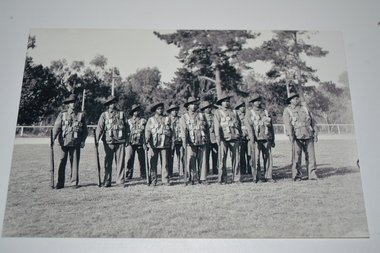
Photograph
... Aboriginal Unit formed in 1940. The soldiers were all volunteers mainly from Lake Tyers in Victoria. In addition to normal army training they performed guard duty at the Army Hospital and Camp. They formed the Gum Leaf Band and led the troops at community singing and assisted in Methodist Church services ...Aboriginal soldiers formed a special all volunteer platoon at No 9 Camp Wangaratta in Victoria from late 1940 until February 1941. No 9 Camp was set up at the Wangaratta Showgrounds to allow the formation of the 2/24th Australian Infantry Battalion prior to leaving for Egypt. Major Joseph Albert Wright a WW1 Light Horse veteran was in charge of this platoon the only Aboriginal squad in the Australian Military Forces at that time. The soldiers from Lake Tyers enlisted at Caulfield between June and July 1940 include Harold Cornelius HAYES VX 48217 DOB 2/4/1916 Enlisted 25/7/40 Discharged 22/3/1941 Edward FOSTER VX48218 DOB 25/5/1921 Enlisted 25/7/1940 Discharged 22/3/1941 Noel Ernest HOOD VX48194 DOB 3/1/1919 Enlisted 25/7/1940 Discharged 22/3/1941 Edward Leslie MULLETT VX48199 DOB 30/6/1910 Enlisted 25/7/1940 Discharged 22/3/1941 Samuel Richard RANKIN VX48201 DOB 23/7/1910 Enlisted 25/7/1940 Discharged 22/3/1941 Stewart HOOD VX47351 DOB 23/1/1903 Enlisted 18/7/1940 Discharged 22/3/1941 William GORRIE VX48208 DOB 22/11/1921 Enlisted 25/7/1940 Discharged 22/3/1941 David John MULLETT VX48195 DOB 10/6/1919 Enlisted 25/7/1940 Discharged 22/3/1941 Arthur Alexander (Tom?) MULLETT VX48198 DOB 25/11/1914 Enlisted 25/7/1940 Discharged 22/3/1941 Image relates to a "special platoon" based at No 9 Camp Wangaratta as being the Australian Army's first all Aboriginal Unit formed in 1940. The soldiers were all volunteers mainly from Lake Tyers in Victoria. In addition to normal army training they performed guard duty at the Army Hospital and Camp. They formed the Gum Leaf Band and led the troops at community singing and assisted in Methodist Church services.Black and white photograph of 11 aboriginal soldiers with rifles in two rows standing 'at ease'Typed on Rear - Aboriginal Guard Wangno 9 camp wangaratta, aboriginal platoon -
 Wangaratta RSL Sub Branch
Newspaper - Newspaper Articles, 1940
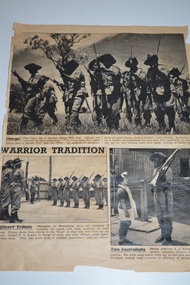
... Aboriginal Unit formed in 1940. The soldiers were all volunteers mainly from Lake Tyers in Victoria. In addition to normal army training they performed guard duty at the Army Hospital and Camp. They formed the Gum Leaf Band and led the troops at community singing and assisted in Methodist Church services ...Article One - Charge! - image of members of the aboriginal group carrying out a baton charge Article Two - Officer's Tribute - image of aborigines at Wangaratta carry out ceremony of changing of the guard Article Three - Two Australians - image of Shirley Anderson, 8, of Wangaratta frequently entertains Diggers, singing and dancing. She visits camp nearly every day to chat with guard on duty. Aboriginal soldiers formed a special all volunteer platoon at No 9 Camp Wangaratta in Victoria from late 1940 until February 1941. No 9 Camp was set up at the Wangaratta Showgrounds to allow the formation of the 2/24th Australian Infantry Battalion prior to leaving for Egypt. Major Joseph Albert Wright a WW1 Light Horse veteran was in charge of this platoon the only Aboriginal squad in the Australian Military Forces at that time. The soldiers from Lake Tyers enlisted at Caulfield between June and July 1940 include Harold Cornelius HAYES VX 48217 DOB 2/4/1916 Enlisted 25/7/40 Discharged 22/3/1941 Edward FOSTER VX48218 DOB 25/5/1921 Enlisted 25/7/1940 Discharged 22/3/1941 Noel Ernest HOOD VX48194 DOB 3/1/1919 Enlisted 25/7/1940 Discharged 22/3/1941 Edward Leslie MULLETT VX48199 DOB 30/6/1910 Enlisted 25/7/1940 Discharged 22/3/1941 Samuel Richard RANKIN VX48201 DOB 23/7/1910 Enlisted 25/7/1940 Discharged 22/3/1941 Stewart HOOD VX47351 DOB 23/1/1903 Enlisted 18/7/1940 Discharged 22/3/1941 William GORRIE VX48208 DOB 22/11/1921 Enlisted 25/7/1940 Discharged 22/3/1941 David John MULLETT VX48195 DOB 10/6/1919 Enlisted 25/7/1940 Discharged 22/3/1941 Arthur Alexander (Tom?) MULLETT VX48198 DOB 25/11/1914 Enlisted 25/7/1940 Discharged 22/3/1941 Images relates to the "special platoon" based at No 9 Camp Wangaratta as being the Australian Army's first all Aboriginal Unit formed in 1940. The soldiers were all volunteers mainly from Lake Tyers in Victoria. In addition to normal army training they performed guard duty at the Army Hospital and Camp. They formed the Gum Leaf Band and led the troops at community singing and assisted in Methodist Church services. Three black and white newspaper articles adhered to cream paperWarrior Tradition Written in blue ink 28/12/1940no 9 camp wangaratta, aboriginal platoon -
 Wangaratta RSL Sub Branch
Article - Newspaper Articles
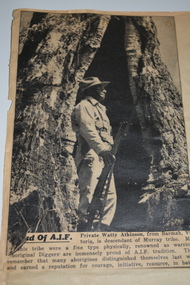
... Aboriginal Unit formed in 1940. The soldiers were all volunteers mainly from Lake Tyers in Victoria. In addition to normal army training they performed guard duty at the Army Hospital and Camp. They formed the Gum Leaf Band and led the troops at community singing and assisted in Methodist Church services ...Article One - Image of Private Wally Atkinson from Barmah, Victoria a descendant of Murray tribe. Article Two - Mealtime - image of aborigines at meal time Article Three - Swingtime - image of aborigines practisiing latest hits on gum leaves - members of gum leaf band have raised much money for local hospital,comfort funds. Article Four - Goanna Soup? image of Pte E Foster and Cook H L Harvey with "Myrtleford Mary" camp mascot (goanna) Article Five (on rear) - Canteen - image of aborignal squad at canteen. Aboriginal soldiers formed a special all volunteer platoon at No 9 Camp Wangaratta in Victoria from late 1940 until February 1941. No 9 Camp was set up at the Wangaratta Showgrounds to allow the formation of the 2/24th Australian Infantry Battalion prior to leaving for Egypt. Major Joseph Albert Wright a WW1 Light Horse veteran was in charge of this platoon the only Aboriginal squad in the Australian Military Forces at that time. The soldiers from Lake Tyers enlisted at Caulfield between June and July 1940 include Harold Cornelius HAYES VX 48217 DOB 2/4/1916 Enlisted 25/7/40 Discharged 22/3/1941 Edward FOSTER VX48218 DOB 25/5/1921 Enlisted 25/7/1940 Discharged 22/3/1941 Noel Ernest HOOD VX48194 DOB 3/1/1919 Enlisted 25/7/1940 Discharged 22/3/1941 Edward Leslie MULLETT VX48199 DOB 30/6/1910 Enlisted 25/7/1940 Discharged 22/3/1941 Samuel Richard RANKIN VX48201 DOB 23/7/1910 Enlisted 25/7/1940 Discharged 22/3/1941 Stewart HOOD VX47351 DOB 23/1/1903 Enlisted 18/7/1940 Discharged 22/3/1941 William GORRIE VX48208 DOB 22/11/1921 Enlisted 25/7/1940 Discharged 22/3/1941 David John MULLETT VX48195 DOB 10/6/1919 Enlisted 25/7/1940 Discharged 22/3/1941 Arthur Alexander (Tom?) MULLETT VX48198 DOB 25/11/1914 Enlisted 25/7/1940 Discharged 22/3/1941 Images relates to the "special platoon" based at No 9 Camp Wangaratta as being the Australian Army's first all Aboriginal Unit formed in 1940. The soldiers were all volunteers mainly from Lake Tyers in Victoria. In addition to normal army training they performed guard duty at the Army Hospital and Camp. They formed the Gum Leaf Band and led the troops at community singing and assisted in Methodist Church services. Four black and white newspaper articles adhered to cream paperno 9 camp wangaratta, aboriginal platoon, 1940
