
Showing 5 items matching "achromatic telescope"
-
 Flagstaff Hill Maritime Museum and Village
Telescope
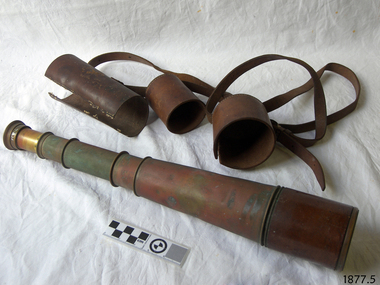
... ...achromatic telescope...Achromatic Telescope, 4 fold, brass, with leather optical covers attached to each end by leather straps....flagstaff hill warrnambool shipwrecked coast flagstaff hill maritime museum maritime museum shipwreck coast flagstaff hill maritime village great ocean road achromatic telescope looking glass Achromatic Telescope, 4 fold, brass, with leather optical covers attached to each end by leather straps. ...Achromatic Telescope, 4 fold, brass, with leather optical covers attached to each end by leather straps.flagstaff hill, warrnambool, shipwrecked coast, flagstaff hill maritime museum, maritime museum, shipwreck coast, flagstaff hill maritime village, great ocean road, achromatic telescope, looking, glass -
 Flagstaff Hill Maritime Museum and Village
Instrument - Telescope, Mid-18th Century
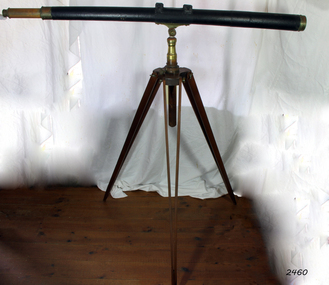
... ...achromatic telescope...John Dollond (1707–1761), of London, was a maker of optical, scientific and astronomical instruments best known for developing the achromatic refracting telescope. He also introduced a practical heliometer, a telescope fitted with a divided lens that could be used to measure the Sun’s diameter and the angular distance between celestial bodies. ...John Dollond (1707–1761), of London, was a maker of optical, scientific and astronomical instruments best known for developing the achromatic refracting telescope. He also introduced a practical heliometer, a telescope fitted with a divided lens that could be used to measure the Sun’s diameter and the angular distance between celestial bodies. ...This Day or Night telescope, made by John Dollond, was designed for use in a range of lighting conditions, as its name suggests. Telescopes are optical instruments that make distant objects appear larger and closer, thereby extending the range of what the human eye can observe. The development of the telescope was gradual, shaped by a series of important advances in optical science. In 1608, the Dutch spectacle-maker Hans Lippershey discovered that when two lenses were held apart in a particular way, distant objects appeared closer. He applied for a patent for this invention, creating the first documented telescope. In 1668, Isaac Newton produced the first successful reflecting telescope, using a two-inch concave spherical mirror. This marked a major step forward, demonstrating that mirrors could overcome some of the limitations of lenses and greatly improve magnification. Further progress followed in the eighteenth century. In 1729, Chester Moor Hall developed the achromatic lens by combining two types of glass with different refractive properties. This reduced colour distortion and produced a sharper image, although some edge distortion remained. That same year, the Scottish instrument maker James Short developed parabolic and elliptical mirrors that were better suited to reflecting telescopes because they reduced optical distortion. Building on these advances, John Dollond improved the achromatic objective lens by placing a concave flint-glass lens between two convex crown-glass lenses, considerably enhancing image quality. Maker’s information. John Dollond (1707–1761), of London, was a maker of optical, scientific and astronomical instruments best known for developing the achromatic refracting telescope. He also introduced a practical heliometer, a telescope fitted with a divided lens that could be used to measure the Sun’s diameter and the angular distance between celestial bodies. The son of Huguenot refugees, Dollond first learned the family trade of silk weaving before turning his attention to optics and astronomy, in which he became highly skilled. In 1753, Dollond patented his improved lenses, the same year he had introduced the heliometer. In 1761, John Dollond was appointed as optician to George III and the Duke of York. He was also elected a Fellow of the Royal Society in May 1761, but died suddenly later that year in November. His share of the patent then passed to his eldest son, Peter. In later disputes between Peter Dollond and rival London opticians who challenged the patent, Peter consistently argued that, whatever earlier precedents may have existed, his father had independently developed a practical method for producing achromatic lenses through his command of Newtonian optics. By successfully defending the patent, the Dollond firm became one of the leading manufacturers of optical instruments. During the eighteenth and nineteenth centuries, the name ‘Dollond’ was at times used almost generically to mean ‘telescope,’ reflecting the firm’s reputation. Genuine Dollond telescopes were regarded as among the finest available. Peter Dollond (1731–1820) was the driving force behind the family business. He had founded a small optical business in 1750 on Vine Street, Halton Garden, with his father's guidance. The success of the business led to his father joining him in partnership in 1752. In 1959, J Dollond and Son opened a shop on The Strand, London. Dollonds appear to have produced both reflecting and refracting telescopes, and they possessed the technical skill to manufacture significant numbers of lenses largely free from chromatic aberration. In 1766, Peter went into partnership with his younger brother, John, and they traded under the name P and J Dollond. They supplied optical instruments for Captain Cook and George Hadley, an English lawyer and Meteorologist. In 1769, Captain Cook travelled with a Dollond telescope on the voyage to observe the Transit of Venus. Other notable customers included Thomas Jefferson and Admiral Lord Nelson. In 1781, Peter Dollond made bifocal spectacles. In 1804, young John Dollond passed away. The following year, Peter Dollond went into partnership with his nephew, George Huggins, and Huggins legally changed his surname to Dollond, and the firm remained P and J Dollond. In the early 20th century, the company sold film cameras. The firm remained in the hands of Dollond family members until 1927, when Dollond & Co. merged with James Aitchison & Co. to form Dollond & Aitchison, the well-known high street chain of opticians, which continued making and selling prescription spectacles. Now fully part of Boots Opticians, the company no longer manufactures instruments and operates exclusively as a retail business. The telescope in the collection is an excellent example of one of Dollond’s early library telescopes. Its association with one of eighteenth-century England’s leading innovators in optical development gives it considerable historical significance and makes it an important object within the collection. John Dollond’s experiments in optics advanced the understanding of the divergent properties of lenses and made a lasting contribution to the development of practical optical science. His work helped lay the foundation for major improvements in the design and performance of optical instruments. In his own time, Dollond was celebrated as the “Father of practical optics” and received widespread recognition for his achievements in the field. Dollond telescopes were associated with the renowned mariners, Captain James Cook and Admiral Lord Nelson Telescope: Dollond's Telescope, Day or Night model navigational instrument. Telescope is mounted on wooden tripod stand that has folding legs. Brass telescope with leather sheath over barrel, adjustable angle fitting with brass wing nuts that join the legs to the top frame, which is then joined to the telescope pole by an adjustable screw fitting. Manufactured by Dollond, London. Inscription reads "Dollond London, Day or Night" and "DOLLOND LONDON"flagstaff hill maritime museum and village, maritime museum, maritime village, great ocean road, warrnambool, optical instrument, achromatic telescope, heliometer, light refraction, instrument maker, lens, transit of venus, astronomical telescope, concave lens, scientific instrument, navigation, navigational instrument, astronomy, dollond, dollond london, john dollond, peter dollond, dollond telescope, day or night telescope, floor-standing telescope, library telescope, hans lippershey, isaac newton, chester moor hall, james short, captain cook, thomas jefferson, admiral lord nelson, dollond & co, aitchison & co, dollond & aitchison, boots opticians, george iii, duke of york, george huggins, george dollond, p and j dollond, j dollond and son, spectacles, cameras -
 Flagstaff Hill Maritime Museum and Village
Instrument - Drainage Level, 1750-1795
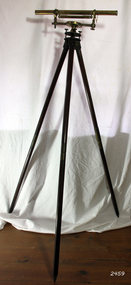
... A brass surveying instrument with Achromatic telescope, bubble level and dial fitted to the Tribrach or footplate that has leveling screws. ...A brass surveying instrument with Achromatic telescope, bubble level and dial fitted to the Tribrach or footplate that has leveling screws. ...Adams jnr wrote many elementary scientific works, as well as on the use of mathematical instruments. He often combined in his written works with religious themes and scientific content, often against the prevailing thoughts of the time. According to one popular magazine of the time (Gentleman's Magazine), his works were often accused of "growing errors of materialism, infidelity, and anarchy". He started writing at a young age and developed a love for it, his main interests included math and science, these subjects he often expressed in his written essay's. Notable works from Adams are. An Essay on Electricity, and Magnetism (1784). Essays on the Microscope (1787). An Essay on Vision, briefly explaining the fabric of the eye (1789). Astronomical and Geographical Essays (1790). A Short Dissertation on the Barometer (1790). Geometrical and Graphical Essays, containing a description of the mathematical instruments used in geometry, civil and military surveying, leveling and perspective (1790). Lectures on Natural and Experimental Philosophy, in five volumes (1794).George Adams Sr and Jnr were both notable opticians and scientific instrument makers of the 18th century. Their contribution to scientific innovation and optical development cannot be underestimated. Having one of their early drainage levels in the collection and in extremely good condition is an asset to the Flagstaff collection.Drainage level or optical level. A brass surveying instrument with Achromatic telescope, bubble level and dial fitted to the Tribrach or footplate that has leveling screws. Tripod is wood and brass with adjustable and unscrewable legs (for ease of transportation). Made by "G. Adams Fleet St, London". Used in surveying and building to transfer, measure and/or set horizontal levels."G. Adams - London".flagstaff hill, warrnambool, shipwrecked-coast, flagstaff-hill, flagstaff-hill-maritime-museum, maritime-museum, shipwreck-coast, flagstaff-hill-maritime-village, george adams fleet street london, optical instrument, scientific instrument, technical instrument, surveyors level, george adams snr, projection microscope -
 Flagstaff Hill Maritime Museum and Village
Instrument - Optical, Telescope, 1869
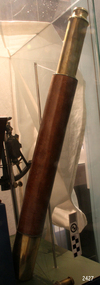
... telescope using a two-inch diameter concave spherical mirror. This opened the door to magnifying objects millions of times far beyond what could ever be obtained with a lens. It wasn’t until 1729 that Chester Moor Hall develops an achromatic...telescope using a two-inch diameter concave spherical mirror. This opened the door to magnifying objects millions of times far beyond what could ever be obtained with a lens. It wasn’t until 1729 that Chester Moor Hall develops an achromatic ...The discovery of the first telescope in 1608 can be attributed to Hans Lippershey of the Netherlands when he discovers that holding two lenses up some distance apart bring objects closer. He applies for a patent on his invention and this becomes the first documented creation of a telescope. Then in 1668, Newton produces the first successful reflecting telescope using a two-inch diameter concave spherical mirror. This opened the door to magnifying objects millions of times far beyond what could ever be obtained with a lens. It wasn’t until 1729 that Chester Moor Hall develops an achromatic lens (two pieces of glass with different indices of light refraction combined produce a lens that can focus colours to almost an exact point resulting in much sharper images but still with some distortion around the edges of the image. Then in 1729 Scottish instrument maker James Short invents the first parabolic and elliptic, distortion-less mirror ideal for reflecting telescopes. We now come to John Dollond who improves upon the achromatic objective lens by placing a concave flint glass lens between two convex crown glass lenses. This had the effect of improving the image considerably. Makers Information: John Dollond (1707-1761) London England he was a maker of optical and astronomical instruments who developed an achromatic (non-colour distorting) refracting telescope and practical heliometer. A telescope that used a divided lens to measure the Sun’s diameter and the angles between celestial bodies. The son of a Huguenot refugees Dollond learned the family trade of silk weaving. He became proficient in optics and astronomy and in 1752 his eldest son, Peter joined his father in an optical business, in 1753 he introduced the heliometer. In the same year, he also took out a patent on his new lenses. He was elected a fellow of the Royal Society in May 1761 but died suddenly in November and his share in the patent passed to his son Peter. In subsequent squabbles between Peter and the many London opticians who challenged his patent, Peter’s consistent position was that, whatever precedents there may have been to his achromatic lenses, his father had independently reached his practical technique on the basis of his theoretical command of Newtonian optics. As a result of maintaining his fathers patent, Dollond s became the leading manufacturer of optical instruments. For a time in the eighteenth and nineteenth century the word 'Dollond' was almost a generic term for telescope rather like 'Hoover; is to vacuum cleaner. Genuine Dollond telescopes were considered to be amongst the best. Peter Dollond (1731-1820) was the business brain behind the company which he founded in Vine Street, Spitalfields in 1750 and in 1752 moved the business to the Strand London. The Dollonds seem to have made both types of telescopes (reflecting and refracting), possessing the technology to produce significant numbers of lenses free of chromatic aberration for refracting telescopes. A Dollond telescope sailed with Captain Cook in 1769 on his voyage to observe the Transit of Venus. Thomas Jefferson and Admiral Lord Nelson were also customers of the Dollonds. Dollond & Co merged with Aitchison & Co in 1927 to form Dollond & Aitchison, the well-known high street chain of opticians, now fully part of Boots Opticians. They no longer manufacture but are exclusively a retail operation. John Dollond's experiments in optics and how different combinations of lenses refract light and colour gave a better understanding of the divergent properties of lenses. That went on to inform and pave the way for the improvement of our understanding of optics that are represented today. Dollond was referred to in his time as the "Father of practical optics" as a leader in his field he received many prestigious awards. The telescope in the collection is a good example of one of Dollonds early library telescopes and its connection with one of England's 18th-century pioneers in optical development is in itself a significant and an important item to have within the collection. Telescope: one tube ships Day and Night telescope, with a brass inner tube and a timber main tube covered in leather. Made in 1869 by Dolland, London."Dolland London" "Day or Night" "Royal National Life Boat Institution" "1869"flagstaff hill, shipwreck coast, warrnambool, maritime museum, maritime village, telescope, dolland, night and day, royal national life boat instution -
 Flagstaff Hill Maritime Museum and Village
Instrument - Telescope lens, circa 1870's
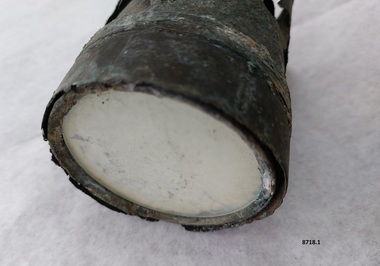
... telescope, using a two-inch concave spherical mirror. This marked a major step forward, demonstrating that mirrors could overcome some of the limitations of lenses and greatly improve magnification. Further progress followed in the eighteenth century. In 1729, Chester Moor Hall developed the achromatic...telescope, using a two-inch concave spherical mirror. This marked a major step forward, demonstrating that mirrors could overcome some of the limitations of lenses and greatly improve magnification. Further progress followed in the eighteenth century. In 1729, Chester Moor Hall developed the achromatic ...Telescopes are optical instruments that make distant objects appear larger and closer, thereby extending the range of what the human eye can observe. The development of the telescope was gradual, shaped by a series of important advances in optical science. In 1608, the Dutch spectacle-maker Hans Lippershey discovered that when two lenses were held apart in a particular way, distant objects appeared closer. He applied for a patent for this invention, creating the first documented telescope. In 1668, Isaac Newton produced the first successful reflecting telescope, using a two-inch concave spherical mirror. This marked a major step forward, demonstrating that mirrors could overcome some of the limitations of lenses and greatly improve magnification. Further progress followed in the eighteenth century. In 1729, Chester Moor Hall developed the achromatic lens by combining two types of glass with different refractive properties. This reduced colour distortion and produced a sharper image, although some edge distortion remained. That same year, the Scottish instrument maker James Short developed parabolic and elliptical mirrors that were better suited to reflecting telescopes because they reduced optical distortion. Building on these advances, John Dollond improved the achromatic objective lens by placing a concave flint-glass lens between two convex crown-glass lenses, considerably enhancing image quality. Telescopes were used by astronomers to observe planets and stars however they were also used for military and nautical purposes. Telescopes from the mid 1700 onwards consisted of anywhere between two and five brass sections, one sliding inside another to make the instrument's size more manageable when not in use. The brass tubes were called "draws" because they were drawn out of the main barrel. Our two artefacts appear to be two different sized "draws". It is not possible to say if they belonged to the same telescope or were from different instruments and nor is it possible to identify a maker. Both telescopic "draws" were recovered from the wreck of the Loch Ard, on the southwest coast of Victoria and donated by a friend of the diver. The ship Loch Ard was built on the River Clyde in Scotland in 1873 for the prestigious Loch Line of colonial clipper ships, designed for the Australian run. It sailed from England on 1st March 1878 carrying 37 crew, 17 passengers and a load of cargo. The general cargo reflected the affluence of Melbourne at the time. On board were straw hats, umbrellas, perfumes, clay pipes, pianos, clocks, confectionary, linen and candles, as well as a heavier load of railway irons, cement, lead and copper. There were items included that were intended for display in the Melbourne International Exhibition in 1880 - a diverse general cargo ranging from luxury items to bulk railway iron. On 1 June 1878, emerging from fog and hearing too late the sound of breakers against the tall limestone cliffs, the vessel struck the southern foot of Mutton Bird Island and sank in 23 metres of water. Of the fifty-four people on board only two survived, one young male crewman, Tom Pearce, and one young female passenger, Eva Carmichael. Ten days after the Loch Ard tragedy, salvage rights to the wreck were sold at auction for £2,120. Cargo valued at £3,000 was salvaged and placed on the beach, but most washed back into the sea when another storm developed. The wreck of Loch Ard still lies at the base of Mutton Bird Island. Much of the cargo has now been salvaged and some was washed up into what is now known as Loch Ard Gorge. Cargo and artefacts have also been illegally salvaged over many years before protective legislation was introduced. One of the most unlikely pieces of cargo to have survived the shipwreck was a Minton porcelain peacock - one of only seven in the world. The peacock was destined for the Melbourne International Exhibition in 1880. It had been well packed, which gave it adequate protection during the violent storm. Today, the Minton peacock can be seen at the Flagstaff Hill Maritime Museum in Warrnambool. From Australia's most dramatic shipwreck it has now become Australia's most valuable shipwreck artefact and is one of very few 'objects' on the Victorian State Heritage Register.Flagstaff Hill’s collection of artefacts from LOCH ARD is significant for being one of the largest collections of artefacts from this shipwreck in Victoria. It is significant for its association with the shipwreck, which is on the Victorian Heritage Register (VHR S417). The collection is significant because of the relationship between the objects, as together they have a high potential to interpret the story of the LOCH ARD. The LOCH ARD collection is archaeologically significant as the remains of a large international passenger and cargo ship. The LOCH ARD collection is historically significant for representing aspects of Victoria’s shipping history and its potential to interpret sub-theme 1.5 of Victoria’s Framework of Historical Themes (living with natural processes). The collection is also historically significant for its association with the LOCH ARD, which was one of the worst and best known shipwrecks in Victoria’s history.Two metal (possibly brass) cylinders that appear to be parts of a telescope salvaged from the wreck of the Loch Ard. The larger cylinder 8718.1 has a smaller cylinder sitting inside the larger outer cylinder with a circular piece of opaque glass in one end. The metal on both inner and outer cylinders are very thin, fragile and brittle. The outside has verdigris oxidation. One end has a thin track of fine threads where another part would have been screwed on. The smaller cylinder, 8718.2, is in better condition. It appears to be a brass cylinder with a circular opening (one small and one larger) at each end. Inside the cylinder (about halfway down) is a pane of opaque glass. One end of the cylinder had a slightly flared cap screwed into it. An indistinct "8" appears to be printed in the casing."8"flagstaff hill maritime museum and village, warrnambool, great ocean road, loch ard, wreck of the loch ard, loch ard salvage, telescope, loch ard artefact, telescopic draw
