
Showing 106 items matching "adams street"
-
 Bright & District Historical Society operating the Bright Museum
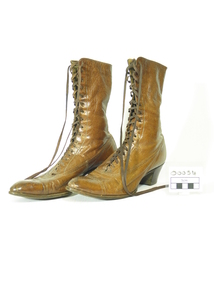
Boots Ladies, Lasalle's & Koch Co, 1930
... 513 Adams Street, Toledo, Ohio, 43603, United States of America ...Boots made in U.S.A//imported by store owner Antonio Mascorini/owned by Mrs Mascorini of Bright/donated by her great,great granddaughter Josie CassarottoThe significance of these boots ' they were owned by Mrs. Fanny Augusta Masciorini, wife of Antonio, owner of the Fashion store London House in Gavan Street Bright00054,1 : left boot; 00054.2 : right boot Caramel-brown ladies leather boots, mid-calf, lace-up front, 36 eyelets with laces. Stitching near toes and around heels. Worn left heel with nails heads showing. Foam inside boots.Under left heel "THE LASALLE & KOCH CO." $11.00 inside boots "MADE IN U.S.A"ladies apparel, boots, leather, masciorini, cassarotto, london house bright -
 Bendigo Historical Society Inc.
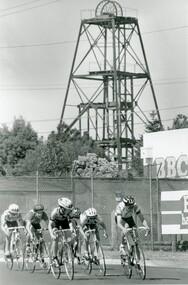
Photograph - BENDIGO ADVERTISER COLLECTION: BIKES, 1990s
... Photograph: Group of bike racers in Adams Street Bendigo On rear: Adams Street...RECREATIONS Sports Cycling Bendigo Advertiser Photograph: Group of bike racers in Adams Street Bendigo On rear: Adams Street Photograph BENDIGO ADVERTISER COLLECTION: BIKES ...Photograph: Group of bike racers in Adams Street Bendigo On rear: Adams Streetrecreations, sports, cycling, bendigo advertiser -
 Linton and District Historical Society Inc
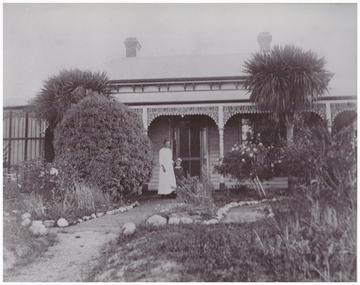
Photograph, Adams House, Grey Street, Linton
... Adams House, Grey Street, Linton...Adams house, afterwards used as Shire Engineer's house, in Grey Street, Linton...Adams house, afterwards used as Shire Engineer's house, in Grey Street, Linton Adams House, Grey Street, Linton Photograph ...From the "Walk-Drive Tour of Linton", p. 22: ". . . this large Victorian house was originally the home of Hubert Adams, the proprietor of the Grenville Standard from about 1895 until 1909. It was subsequently purchased by the Shire of Grenville and was for many years the Shire Engineer's home." The inscription on the front of one of the copies says the photo was taken c. 1890.Photograph of a timber Victorian style house with a corrugated iron roof. The house has two chimneys and wrought iron decoration on the verandah. An unidentified woman and a young girl are standing in the garden at the front. Adams house, afterwards used as Shire Engineer's house, in Grey Street, LintonOn front of both copies: Shire Engineer's House, Grey St. Linton". On front of copy (a): "c. 1890". On back of copy (b): Shire Engineer's House Grey St Linton".houses, buildings, adams house, shire engineer's house -
 Sunshine and District Historical Society Incorporated
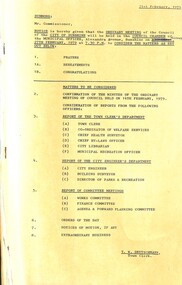
Administrative record - City of Sunshine - Commissioner Mr Alexander Alex George Gillon Collection 1976 - 1982 - Notice of ordinary meeting of the council 27th February 1979, City of Sunshine, 27th February 1979
... ...Adams Street...Albans Siting of Building Lot 26 Adams Street St. Albans Report of the Director of Parks & Recreation International Year of the Child Playground Killeen Street Sunshine West Orders of the Day Accounts Submitted for Payment as at 15th February 1979 Submission to Local Government Advisory Board Re Boundaries...Albans Station Place Highpoint West Library Rosamond Road Maribyrnong Derrimut Saleyards Sunshine Road Evans Street Hawthorn Avenue Dover Street Albanvale Comley Street Maidstone Thomson Street Jackson Street Aycliffe Drive Aycliffe Drive Infant Welfare Centre Neale Road Clarke Street Dickson Street Cornhill Street Warrs Road Sunshine Swimming Pool Kennedy Street Ballarat Road Infant Welfare Centre Oakwood Road Adams Street Killeen Street Notice of Ordinary Meeting of the Council 27th February 1979 Report of the Town Clerk's Department Report of the Town Clerk Sale of Land Adjacent to Deer Park Hotel Ballarat Road Deer Park to Carlton & United Breweries Ltd Lease of Part Land G.U.D. ...Notice of Ordinary Meeting of the Council 27th February 1979 Report of the Town Clerk's Department Report of the Town Clerk Sale of Land Adjacent to Deer Park Hotel Ballarat Road Deer Park to Carlton & United Breweries Ltd Lease of Part Land G.U.D. Burton Crescent Lease of Cricket Club Premises Dempster Park Municipal Offices Extensions Rate Statistics Tottenham Technical School 27 Duke Street Lease Swimming Pool Instruction Contract Report of the Co-Ordinator of Welfare Service Community Directory Welwyn Street Kindergarten Deer Park Visiting Kindergarten Teacher Family Day Care Volunteer Training Family and Community Services Programme Problems of Regional Office of Social Welfare Department Visiting Kindergarten Teacher Report Proposal for Voluntary Youth Community Service Scheme Walk for the Child Report of the Chief Health Officer Nuisance 177 Ridgeway Parade Sunshine West Removal of Dwelling Outside the Municipality McDonald Road Sunshine to Skenes Creek North Garbage By-Law No 123 Removal of Dwelling Outside the Municipality 7 Norma Street Sunshine to Government Road Warrong Shire of Minhamite Report of the Chief By-Laws Officer Proposed Limited Parking St. Albans Road Near Princess Street St. Albans Increase in Sustenance Fee Dog Act Method of Dog Destruction Proposed No Parking Right of Way Rear of Station Place Report of the City Librarian Australia Council Public Lending Right Survey Melton Library Book Stock Children's Library Holiday Programme Highpoint West Library Interior Report of the Municipal Recreation Officer Rainbow Workshop Child Care Position Ground Allocation for the Winter Season 1979 School Holiday Programme January 1979 Report of the City Engineer & Planner Derrimut Saleyards Change in Government Proposals Planning Permit Application Storage of Fencing Material Paramount Road Tottenham Planning Permit Application Widening of Existing Access Sunshine Road Amendment No 1 Part 1A to the Melbourne Metropolitan Planning Scheme Planning Permit Application Factory or Workshop Extension 19 Evans Street Braybrook Planning Permit Application Warehouse and Factory Hawthorn Avenue Sunshine North Planning Permit Application Warehouse and Retail Timber Outlet Lot 9 Ballarat Road Albion Planning Permit Application Service Premise and Caretaker's Dwelling Lots 317 & 318 Dover Street Albanvale Standard Planning Permit Conditions and Standard Grounds of Refusal Plan of Subdivision Lot 1 & 2 Comley Street Sunshine North Plan of Subdivision 101 Ballarat Road Maidstone Plan of Subdivision St. Albans Road St. Albans Plan of Subdivision Thomson Street and Jackson Street Maidstone Plan of Subdivision Kentucky Fried Chicken Ballarat Road Sunshine Plan of Subdivision Westerngate Estate Stage 6A Consolidation of Title Lots 327 & 328 Aycliffe Drive Deer Park for Aycliffe Drive Infant Welfare Centre Neale Road Construction Stage 2 Purchase of surplus Motor Mowers Tenders Westerngate Project Proposed Surcharge drain Clarke Street Car Park Extension Corner Dickson Street Right of Way Main Road West at Cornhill Street Private Street Construction Part of Warrs Road Declaration of Sewage Areas No 3680 & 3685 Sewerage Facilities Deer Park Health Act Drain Creation of Easement Sunshine Swimming Pool Variations Extensions & Additions Ballarat Road Infant Welfare Centre Deer Park Report of the Building Surveyor Building Over Easement 33 Oakwood Road St. Albans Siting of Building Lot 26 Adams Street St. Albans Report of the Director of Parks & Recreation International Year of the Child Playground Killeen Street Sunshine West Orders of the Day Accounts Submitted for Payment as at 15th February 1979 Submission to Local Government Advisory Board Re Boundariesdeer park hotel, ballarat road, deer park, sunshine cricket club, dempster park, phoenix street, sunshine north, tottenham technical school, duke street, braybrook, welwyn street kindergarten, welwyn street, ridgeway parade, sunshine west, mcdonald road, norma street, sunshine, st. albans road, princess street, st. albans, station place, highpoint west library, rosamond road, maribyrnong, derrimut saleyards, sunshine road, evans street, hawthorn avenue, dover street, albanvale, comley street, maidstone, thomson street, jackson street, aycliffe drive, aycliffe drive infant welfare centre, neale road, clarke street, dickson street, cornhill street, warrs road, sunshine swimming pool, kennedy street, ballarat road infant welfare centre, oakwood road, adams street, killeen street -
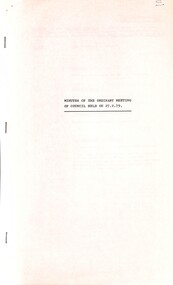 Sunshine and District Historical Society Incorporated
Administrative record - City of Sunshine - Commissioner Mr Alexander Alex George Gillon Collection 1976 - 1982 - Minutes of the ordinary meeting of council held on 27th February 1979, City of Sunshine, 27th February 1979
... ...Adams Street...Albans Siting of Building Lot 26 Adams Street St. Albans Report of the Director of Parks & Recreation International Year of the Child Playground Killeen Street Sunshine West Orders of the Day Accounts Submitted for Payment as at 15th February 1979 Submission to Local Government Advisory Board Re Boundaries Extraordinary Business Planning Permit Application Clothes Manufacturing Main Road West Planning Permit Application Car and Caravan Sales Ballarart Road Sunshine...Albans Station Place Highpoint West Library Rosamond Road Derrimut Saleyards Paramount Road Tottenham Sunshine Road Evans Street Hawthorn Avenue Albion Dover Street Albanvale Comley Street Maidstone Thomson Street Jackson Street Kentucky Fried Chicken Aycliffe Drive Aycliffe Drive Infant Welfare Centre Neale Road Clarke Street Dickson Street Main Road West Cornhill Street Warrs Road Sunshine Swimming Pool Kennedy Street Ballarat Road Infant Welfare Centre Oakwood Road Adams Street Killeen Street Minutes of the Ordinary Meeting of Council held on 27th February 1979 Report of the Town Clerk's Department Report of the Town Clerk Sale of Land Adjacent to Deer Park Hotel Ballarat Road Deer Park to Carlton & United Breweries Ltd Lease of Part Land G.U.D. ...Minutes of the Ordinary Meeting of Council held on 27th February 1979 Report of the Town Clerk's Department Report of the Town Clerk Sale of Land Adjacent to Deer Park Hotel Ballarat Road Deer Park to Carlton & United Breweries Ltd Lease of Part Land G.U.D. Burton Crescent Lease of Cricket Club Premises Dempster Park Municipal Offices Extensions Rate Statistics Tottenham Technical School 27 Duke Street Lease Swimming Pool Instruction Contract Report of the Co-Ordinator of Welfare Service Community Directory Welwyn Street Kindergarten Deer Park Visiting Kindergarten Teacher Family Day Care Volunteer Training Family and Community Services Programme Problems of Regional Office of Social Welfare Department Visiting Kindergarten Teacher Report Proposal for Voluntary Youth Community Service Scheme Walk for the Child Report of the Chief Health Officer Nuisance 177 Ridgeway Parade Sunshine West Removal of Dwelling Outside the Municipality McDonald Road Sunshine to Skenes Creek North Garbage By-Law No 123 Removal of Dwelling Outside the Municipality 7 Norma Street Sunshine to Government Road Warrong Shire of Minhamite Report of the Chief By-Laws Officer Proposed Limited Parking St. Albans Road Near Princess Street St. Albans Increase in Sustenance Fee Dog Act Method of Dog Destruction Proposed No Parking Right of Way Rear of Station Place Report of the City Librarian Australia Council Public Lending Right Survey Melton Library Book Stock Children's Library Holiday Programme Highpoint West Library Interior Report of the Municipal Recreation Officer Rainbow Workshop Child Care Position Ground Allocation for the Winter Season 1979 School Holiday Programme January 1979 Report of the City Engineer & Planner Derrimut Saleyards Change in Government Proposals Planning Permit Application Storage of Fencing Material Paramount Road Tottenham Planning Permit Application Widening of Existing Access Sunshine Road Amendment No 1 Part 1A to the Melbourne Metropolitan Planning Scheme Planning Permit Application Factory or Workshop Extension 19 Evans Street Braybrook Planning Permit Application Warehouse and Factory Hawthorn Avenue Sunshine North Planning Permit Application Warehouse and Retail Timber Outlet Lot 9 Ballarat Road Albion Planning Permit Application Service Premise and Caretaker's Dwelling Lots 317 & 318 Dover Street Albanvale Standard Planning Permit Conditions and Standard Grounds of Refusal Plan of Subdivision Lot 1 & 2 Comley Street Sunshine North Plan of Subdivision 101 Ballarat Road Maidstone Plan of Subdivision St. Albans Road St. Albans Plan of Subdivision Thomson Street and Jackson Street Maidstone Plan of Subdivision Kentucky Fried Chicken Ballarat Road Sunshine Plan of Subdivision Westerngate Estate Stage 6A Consolidation of Title Lots 327 & 328 Aycliffe Drive Deer Park for Aycliffe Drive Infant Welfare Centre Neale Road Construction Stage 2 Purchase of surplus Motor Mowers Tenders Westerngate Project Proposed Surcharge drain Clarke Street Car Park Extension Corner Dickson Street Right of Way Main Road West at Cornhill Street Private Street Construction Part of Warrs Road Declaration of Sewage Areas No 3680 & 3685 Sewerage Facilities Deer Park Health Act Drain Creation of Easement Sunshine Swimming Pool Variations Extensions & Additions Ballarat Road Infant Welfare Centre Deer Park Report of the Building Surveyor Building Over Easement 33 Oakwood Road St. Albans Siting of Building Lot 26 Adams Street St. Albans Report of the Director of Parks & Recreation International Year of the Child Playground Killeen Street Sunshine West Orders of the Day Accounts Submitted for Payment as at 15th February 1979 Submission to Local Government Advisory Board Re Boundaries Extraordinary Business Planning Permit Application Clothes Manufacturing Main Road West Planning Permit Application Car and Caravan Sales Ballarart Road Sunshinedeer park hotel, ballarat road, deer park, sunshine cricket club, dempster park, phoenix street, sunshine north, tottenham technical school, duke street, braybrook, burton crescent, maribyrnong, welwyn street kindergarten, welwyn street, ridgeway parade, sunshine west, mcdonald road, norma street, sunshine, st. albans road, princess street, st. albans, station place, highpoint west library, rosamond road, derrimut saleyards, paramount road, tottenham, sunshine road, evans street, hawthorn avenue, albion, dover street, albanvale, comley street, maidstone, thomson street, jackson street, kentucky fried chicken, aycliffe drive, aycliffe drive infant welfare centre, neale road, clarke street, dickson street, main road west, cornhill street, warrs road, sunshine swimming pool, kennedy street, ballarat road infant welfare centre, oakwood road, adams street, killeen street -
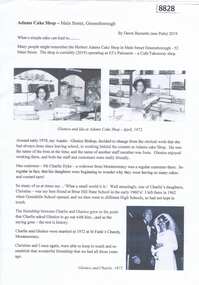 Greensborough Historical Society
Article, Dawn Bennetts, Adams Cake Shop - Main Street Greensborough, 2019
... Adams Cake Shop - Main Street Greensborough...A short story about Adams Cake Shop in Main Street Greensborough in the 1970s and some coincidences about a member of staff....Adams Cake Shop Greensborough glenice dyke dawn petts dawn bennetts Article, 1 p.,text and illus. Adams Cake Shop - Main Street Greensborough Article Article Dawn Bennetts ...A short story about Adams Cake Shop in Main Street Greensborough in the 1970s and some coincidences about a member of staff.Article, 1 p.,text and illus.adams cake shop greensborough, glenice dyke, dawn petts, dawn bennetts -
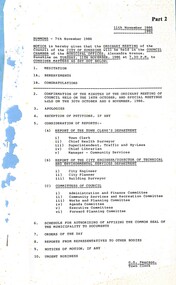 Sunshine and District Historical Society Incorporated
Administrative record - City of Sunshine Council Meetings 1986 - 1994 - Notice of Ordinary Meeting 11th November 1986 Part 2, City of Sunshine, 7th November 1986
... ...Adams Street...Albans Plan of Proposed Subdivision 261 - 267 Ballarat Road Braybrook Plan of Proposed Strata Subdivision 22 Adams Street St. Albans Plan of Proposed Strata Subdivision 24 Adams Street St. ...Albans Plan of Proposed Subdivision 261 - 267 Ballarat Road Braybrook Plan of Proposed Strata Subdivision 22 Adams Street St. Albans Plan of Proposed Strata Subdivision 24 Adams Street St. ...Notice of Ordinary Meeting 11th November 1986 Part 2 Report of the City Planner Planning Permit Application Shops Lots 939 to 962 Glengala Road North West Corner Evelyn Crescent Ardeer Planning Permit Application Dual Occupancy Lot 161 Quinn Street North West Corner Lee Street Deer Park Planning Permit Application Extended Christmas Period Trading Hours Sunshine Plaza, Highpoint City Shopping Centre, Deer Park Shopping Centre and Sunshine Market Place Melbourne Metropolitan Planning Scheme Amendment No 275 Part 3B Planning Permit Application Three Business and Promotion Signs 66 Glengala Road Sunshine West Deer Park Shopping Centre Study Western Highway (Ballarat Road) Deer Park Planning Permit Application Lot 140 Rothray Avenue Sunshine North Planning Permit Application Transport Depot Lot 5 Boundary Road Laverton North Planning Permit Application Retail Shops & Entertainment Centre (Amusement Parlour) 817 Western Highway (Ballarat Road) Deer Park Planning Permit Application Consulting Rooms 293 Main Road East St. Albans Planning Permit Application Wholesale Nursery Sunshine Avenue Sunshine North Electrification of Railway to Sydenham Shopping Centre Improvement Project St. Albans Plan of Subdivision Corner Rita Street and Vule Street St. Albans Plan of Proposed Subdivision 261 - 267 Ballarat Road Braybrook Plan of Proposed Strata Subdivision 22 Adams Street St. Albans Plan of Proposed Strata Subdivision 24 Adams Street St. Albans Plan of Proposed Consolidation Corner Diamond Avenue and Sutherland Street Albanvale Plan of Proposed Consolidation North East Corner Burnside Street and Christie Street Deer Park Plan of Proposed Consolidation 483 - 485 Ballarat Road Sunshine for Red Rooster Store Plan of Proposed Strata Subdivision 16 Forrest Street Albion Plan of Proposed Transfer and Consolidation 5 - 9 Navigator Street Maribyrnong Plan of Proposed Consolidation 66 Mitchell Street Maidstone Plan of Subdivision Opie Road (West Side) Stage 27 Albanvale Plan of Proposed Subdivision Boral Resources Corner Ballarat Road and Hulett Street Plan of Proposed Consolidation 5 - 7 Richards Street Maidstone Plan of Subdivision Opie Road (West Side) Stage 27 & 28 Albanvale Report of Building Surveyor Show Cause Notice 81 Denton Avenue St. Albans Show Cause Notice Lot 2 Sunshine Road Tottenham Show Cause Notice Shop 25 Sunshine Plaza Shopping Centre 304 - 308 Hampshire Road Sunshine Show Cause Notice 15 Beech Court Sunshine Show Cause Notice 36 Swansea Parade St. Albans Show Cause Notice 34 Harris Street St. Albans Show Cause Notice 24 Chicago Street Maribyrnong Show Cause Notice 38 Couch Street Sunshine Show Cause Notice 34 Monash Street Sunshine Show Cause Notice 6 Duffy Street Maribyrnong Show Cause Notice 1 The Esplanade Maribyrnong Show Cause Notice 228 Ballarat Road Braybrook Show Cause Notice 48 Mawson Avenue Deer Park Show Cause Notice 13 Oakwood Road Albanvale Show Cause Notice 191 Station Road Deer Park Show Cause Notice 32 Knight Avenue Sunshine North Show Cause Notice 12 Nottingham Street Sunshine North Show Cause Notice 155 St. Albans Road St. Albans Siting of Open Garage 7 Marcia Street Sunshine West Show Cause Notice 7 Nova Avenue Deer Park Dangerous Building 6 Chester Crescent Deer Park Show Cause Notice 32 Holt Street Ardeer Show Cause Notice 6 The Mews Sunshine West Show Cause Notice 126A Mitchell Street Maidstone Statistical information Building Permits Schedule for Authorising of Affixing the Common Seal of the Municipality to Documents Orders of the Day Proposal to Construct the Right of Way Rear of Furlong Road Private Street Scheme Under the Provisions of Division 10 of Part XIX of the local Government Act 1958 Interim Advisory Committees Sunshine West Community Centre and Marie Hill Community Centre Victorian Model Aeronautical Association Consideration of a Petition Presented on Behalf of 551 Members of the Albion Turk Gucu Soccer Club Incorporated (Formerly Albion Rovers Soccer & Athletic Club) Notice of Motions Motion No 76/86 Freedom of the City Try Youth Club Cadet Corps Motion No 82/86 Question Time Abandon During the Administrator's Control of the Municipality Motion No 83/86 Recording of all Interstate and Overseas Conferences in Town Clerk's Report for the Ordinary Meeting Motion No 84/86 35 Hour Weerk Fringe Benefit Legistration Motion No 85/86 City of Sunshine Signs of Salutation Motion No 86/86 Albion Explosive Factory Site Committee Motion No 87/86 Use of Sunshine Logo Motion No 88/86 Proposed Visit Governor of Victoria Dr. John Davis McCaughey Sunshine Nursing Home Motion No 89/86 Sunshine Railway Station Subway glengala road, evelyn crescent, ardeer, sunshine west, quinn street, lee street, deer park, sunshine plaza, highpoint city shopping centre, deer park shopping centre, sunshine market place, rothray avenue, sunshine north, boundary road, laverton north, western highway, ballarat road, main road east, st. albans, sunshine avenue, rita street, vule street, adams street, diamond avenue, sutherland street, albanvale, burnside street, christie street, forrest street, albion, navigator street, maribyrnong, mitchell street, maidstone, opie road, boral resources, hulett street, richards street, denton avenue, sunshine road, tottenham, sunshine plaza shopping centre, hampshire road, beech court, swansea parade, harris street, chicago street, couch street, monash street, duffy street, the esplanade, braybrook, mawson avenue, oakwood road, station road, knight avenue, nottingham street, st. albans road, marcia street, nova avenue, chester crescent, holt street, the mews, furlong road, sunshine west community centre, kermeen street, marie hill community centre, randall street, albion turk gucu soccer club, albion rovers soccer & athletic club, city try youth club cadet corps, albion explosive factory, sunshine railway station -
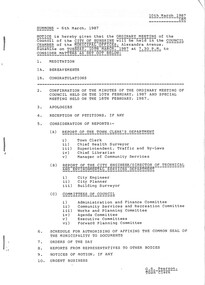 Sunshine and District Historical Society Incorporated
Administrative record - City of Sunshine Council Meetings 1986 - 1994 - Notice of Ordinary Meeting 10th March 1987, City of Sunshine, 6th March 1987
... ...Adams Street...Transport Amanda Road Tottenham Plan of Consolidation Smogan Consolidated Industries Somerville Road Footscray West Plan of Consolidation Lots 5 & 6 McIntyre Road Sunshine North Plan of Consolidation Lots 1 & 2 Adams Street South East Corner Disraeli Street St. ...Transport Amanda Road Tottenham Plan of Consolidation Smogan Consolidated Industries Somerville Road Footscray West Plan of Consolidation Lots 5 & 6 McIntyre Road Sunshine North Plan of Consolidation Lots 1 & 2 Adams Street South East Corner Disraeli Street St. ...Notice of Ordinary Meeting 10th March 1987 Report of the Town Clerk's Department Report of the Town Clerk Accounts for Payment as at 15th February 1987 The New Western Independent Newspaper to Replace the Now Closed Western Independent Newspaper Request to Use Roadways Essendon District Tri-Antulas Triathlon Club Chifley Drive and Coulson Gardens Heart Health Awareness Programme National Hearth Foundation of Australia Lease of Council Land to Sunshine & District Helping Hand Association Furlong Road Australia Post Municipal Association of Victoria (M.A.V.) Chief Executive Officer St. John Ambulance Land for Headquarters Notice of Motion Possible Locations Fraser Street Bus Depot, Land Adjacent to Deer Park Club, Land Adjacent to Sunshine Ambulance Station Westmoreland Road, Sassella Park & George Street Ports & Harbour Development Notice of Motion Rate Recovery Sale Lot 204 George Street Maidstone Nuclear Free Zone Local Authorities Conference Perugia Italy October 1986 Loan 177 Refinancing of Loan 163 Sunshine Community Committee Bicentenary 1988 Municipal Representation on the Melbourne & Metropolitan Board of Works Vesting of Crown Land Reserves in Council More Park & Pennell Reserve Roads & Streets Trading Occupational Health and Safety Domiciliary Workers Workcare Family Day Care Scheme Loan 179 Discontinued Road Reserve and Right of Way East of Beachley Street North of Turner Crescent Braybrook Discontinued Right of Way Between Anderson Road, Durham Road, Derby Road and Graham Street Sunshine Report of Chief Health Surveyor Registration of Premises Health Act & Food Act Registration Transfers Health Act & Food Act Prosecution Proceedings Sunshine Magistrates Court Use of Property 11 Davey Street Sunshine West Report of the Superintendent Traffic & By-Laws Court Proceedings Sunshine Magistrates Court ANZAC Commemoration March Change of Name St. Albans Special School to Furlong Park School & Pre-School Centre Change of Name Highpoint West Post Office to Highpoint City Post Office Proposed Procession Scout Association of Australia by Sunshine District Report of the Chief Librarian History of Sunshine by Prue McGoldrick Commonwealth Assistance for Public Libraries (CAPLS) Campaign Sunshine Art Collection 3WRB Community Radio Station Report of the Acting Manager Community Services Disability Services Programme Bridging the Gap Project Change in Method of Calculation CEP DEIR Region sponsor Contribution Fresh start in the Park Braybrook - Maidstone Community Health Centre Neighborhood Watch Appeal Against Council Decision Regarding Holiday Programme West Sunshine Castley Hall Redevelopment Committee Marie Mill Community Centre Purchase of Equipment Marie Mill Community Centre Sunshine West Community Centre Sunshine West Community Centre Management Committee Marie Mill Community Centre Minutes of Meeting Home & Community Care Program Home Help Grant Ceiling 1986/87 Report of the City Engineer Smorgan Consolidated Industries New Development Waste Disposal Proposed New Tip Jones Road Brooklyn Braybrook - Maidstone Public Tenants Union Community Bus Maintenance House of Sunshine Additions & Alterations Corio Street and Watt Street Portable Changerooms Chaplin Reserve Anderson Road Sunshine Development of Billingham Reserve Deer Park Notice of Motion Proposed Footscray Institute of Technology Sciences Park Renovations and Restoration of The Hunt Club Ballarat Road Deer Park Maribyrnong Viaduct Fencing Pedestrian Operated Signals Ballarat Road (East of Leonard Street) Sunshine Installation of Audio Tactile Pedestrian Facility Quinn Street Private Street Scheme Variations Deer Park Certificate of Completion Quinn Street Private Street Scheme Deer Park Metropolitan Street Name Signing Programme Traffic Control Items Tenders Two Amenities Caravan Proposed Alterations to Existing Separators and Medians in Geelong Road Between Holmwood Road and Somerville Road Brooklyn New Sunshine Fire Station McIntyre Road (East & West) Parking Prohibition Sunshine North Stanford Street (East Side) 90 Degree Angle Parking Sunshine Quinn Street Private Street Scheme Stage 2 Deer Park Proposed Lease of Railway Land off Anderson Road Sunshine Tenders for Fencing Station Road Deer Park Proposed Car Park on Railway Land Lot 2 St. Albans Road St. Albans Station Road Widening Gladstone Street to Furlong Road St. Albans Paramount Road / Somerville Road Intersection Fairbairn Road Private Street Scheme Sunshine West Report of the City Planner Enforcement of Metropolitan Planning Scheme Inspection of Use of Property 11 Davey Street Ardeer Planning Permit Application Truck Parking 18 Baynton Avenue Sunshine North Planning Permit Application Truck Parking 22 Baynton Avenue Sunshine North Planning Permit Application Truck Parking 24 Baynton Avenue Sunshine North Planning Permit Application Factory Lot 10 Tottenham Parade Brooklyn Planning Permit Application Enforcement of the Planning Scheme Amusement Parlour 113 Durham Road Sunshine Maribyrnong Advisory Committee Rezoning Land West of Kororoiit Creek and North of the Western Highway Shire of Melton Planning Permit Application Car Park Lot 53 Cromer Avenue Sunshine North Planning Permit Application Extension of Place of Assembly Dutch Australian Community Council 96 Cromer Avenue Sunshine North Planning Permit Application Health Centre 57 Dickson Street Sunshine Planning Permit Recreation Centre Lot 2 McKechnie Street North East Corner of Gratz Street St. Albans Planning Permit Application Double Sided Promotional Panel Sign Sunshine Road Tottenham Planning Permit Application Double Sided Promotional Panel Sign Sunshine Road Tottenham Planning Permit Application Double Sided Promotional Panel Sign Tilburn Road Deer Park Planning Permit Application Extension to Existing Shops 87 - 89 McIntyre Road Sunshine North Planning Permit Application Convenience Shop, Petrol Filling Station Restaurant, 10 Cinema Complex and Medical Centre 2/72 Neale Road Deer Park Planning Permit Application Alterations to Flats Lot 4 to 8 The Gables Albion Planning Permit Application Motel / Restaurant and Caretaker's Residence Lots 3 & 4 Ballarat Road North West Corner Miles Street Deer Park Planning Permit Application Motor Repair Station 58 Omar Street Maidstone Sunshine District Centre Road Works Planning Permit Application Livestock Sale Yards 690 Geelong Road North East Corner Old Geelong Road Brooklyn Planning Permit Application Private Rubbish Tip Associated Quarries Pty Ltd Market Road Quarry Market Road Sunshine Delegated Matters Removal of Easement Lot 21 Camperdown Avenue and Lot 22 Cary Street Sunshine North Plan of Subdivision Corner Robinsons Road and Ballarat Road Deer Park Plan of Proposed Strata Subdivision 1 White Street Maribyrnong Plan of Consolidation F.B. Transport Amanda Road Tottenham Plan of Consolidation Smogan Consolidated Industries Somerville Road Footscray West Plan of Consolidation Lots 5 & 6 McIntyre Road Sunshine North Plan of Consolidation Lots 1 & 2 Adams Street South East Corner Disraeli Street St. Albans Plan of Consolidation lots 4 & 5 Jefferson Street South West Corner Disraeli Street St. Albans Plan of Strata Subdivision lot 2 Corner McKechnie Street and Gratz Street St. Albans Plan of Surrender of Easement 592 Western Highway (Ballarat Road) Albion Report of the Building Surveyor Show Cause Notice 24 Chicago Street Maribyrnong Above Ground Tank Grain Elevators Board Sunshine Terminal Wright Street Sunshine Show Cause Notice 15 Beech Court Sunshine West Beech Court 32 Knight Avenue Sunshine North Siting of Open Garage 8 Diamond Avenue Albanvale Show Cause Notice Beech Court 9 Apollo Place Ardeer Show Cause Notice 154 Neale Road Deer Park Show Cause Notice 28 Cleveland Street St. Albans Show Cause Notice 1D Bell Street Sunshine West Show Cause Notice 7 Nova Avenue Deer Park Dangerous Building 16 Cypress Avenue Brooklyn Show Cause Notice 25 Chatsworth Avenue Ardeer Show Cause Notice 11 Concord Circuit Albanvale Show Cause Notice 50 Ford Avenue Sunshine North Show Cause Notice 553 Geelong Road Brooklyn Show Cause Notice 40 Joan Street Ardeer Show Cause Notice 49 Denton Avenue St. Albans Show Cause Notice 41 Mulhall Drive St. Albans Show Cause Notice 1 White Street Maribyrnong Show Cause Notice 74 Ford Avenue Sunshine North Show Cause Notice 11 Davey Street Sunshine West Schedule for Authorising of Affixing the Common Seal of the Municipality to Documents Orders of the Day West Sunshine Community Centre Show Cause Notice 19 Second Avenue Sunshine Show Cause Notice 34 Harris Street St. Albans Confidential Report Council Polices Consideration of a Petition on behalf of 45 Residents of Maribyrnong in Relation to Objecting to the Establishment of a Night Club at the Angler's Hotel Notice of Motions Sunshine Leisure Centre Contingency Account Cleaning Kerb & Channel and Drainage Pits Referendum Ceding of Brooklyn to Altona Road Surface Maintenance Management of Child Care Centres Financial Return Child Care Centres Finance Manager Council Auspiced Services Removal of Rubbish 2 Derrimut Street Albion Slogan Sunshine Multicultural City of Victoria Sand & Dust Menace Corner Sunshine Avenue and McIntyre Road Sunshine North 125 Durham Road Sunshine Traffic lights Corner McIntyre Road, Furlong Road and Berkshire Road Sunshine North Deer Park Football Club Pavilion Nuclear Free Zones Palm Sunday Peace Celebrations Seed Patenting and Plant Variety Rights Toxic Waste Disposal Facilityessendon district tri-antulas triathlon club, chifley drive, coulson gardens, maribyrnong, sunshine & district helping hand association, furlong road, sunshine north, fraser street, deer park club, westmoreland road, sassella park, george street, sunshine, ballarat road, deer park, more park, esmond street, ardeer, pennell reserve, burke street, braybrook, beachley street, turner crescent, anderson road, durham road, derby road, graham street, davey street, st. albans special school, furlong park school & pre-school centre, highpoint west post office, highpoint city post office, 3wrb community radio station, braybrook - maidstone community health centre, marie mill community centre, randall street, sunshine west community centre, kermeen street, sunshine west, smorgan consolidated industries, jones road, brooklyn, braybrook - maidstone public tenants union, house of sunshine, corio street, watt street, chaplin reserve, billingham reserve, the hunt club, leonard street, the hunt club hotel, quinn street, holmwood road, somerville road, sunshine fire station, mcintyre road, stanford street, station road, st. albans road, st. albans, paramount road, fairbairn road, baynton avenue, tottenham parade, kororoiit creek, western highway, cromer avenue, dutch australian community council, dickson street, mckechnie street, gratz street, sunshine road, tottenham, tilburn road, neale road, the gables, albion, miles street, omar street, maidstone, geelong road, old geelong road, associated quarries, market road, camperdown avenue, cary street, robinsons road, white street, amanda road, adams street, disraeli street, jefferson street, chicago street, wright street, beech court, knight avenue, diamond avenue, albanvale, apollo place, cleveland street, bell street, nova avenue, cypress avenue, chatsworth avenue, concord circuit, ford avenue, joan street, denton avenue, mulhall drive, second avenue, harris street, angler's hotel, anglers way, derrimut street, sunshine avenue, berkshire road, deer park football club, john mcleod reserve -
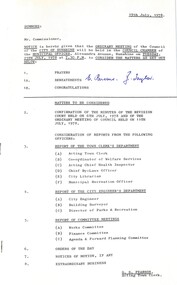 Sunshine and District Historical Society Incorporated
Administrative record - City of Sunshine - Commissioner Mr Alexander "Alex" George Gillon Collection 1976 - 1982 - Notice of Ordinary Meeting of to be held on Tuesday 25th July 1978, City of Sunshine, 19th July 1978
... ...Adams Street...Albans Report of the Building Surveyor Ruinous and Dangerous Building Lots 6 & 7 Furlong Road Sunshine North Ruinous and Dangerous Building 28 - 30 Ridley Street Albion Relocation of Housee to Lot 26 Adams Street St. Albans Flats Lots 3 & 4 Ballarat Road Deer Park Seminar Residential Slab Construction 31st August 1978 Report of the Director of Parks & Recreation Reserves Development Reserves Active Usage Patterns Bon Thomas Reserve Development Orders of the Day Accounts Submitted for Payment as at 3rd July 1978...Albans Report of the Building Surveyor Ruinous and Dangerous Building Lots 6 & 7 Furlong Road Sunshine North Ruinous and Dangerous Building 28 - 30 Ridley Street Albion Relocation of Housee to Lot 26 Adams Street St. Albans Flats Lots 3 & 4 Ballarat Road Deer Park Seminar Residential Slab Construction 31st August 1978 Report of the Director of Parks & Recreation Reserves Development Reserves Active Usage Patterns Bon Thomas Reserve Development Orders of the Day Accounts Submitted for Payment as at 3rd July 1978 Foolscap sized document. ...Notice of Ordinary Meeting of to be held on Tuesday 25th July 1978 Report of the Town Clerk's Department Report of the Town Clerk Lease Italo-Australian Co-Operative Social Club Ltd Supplementary Valuations Overseas Study Tours 1979 Municipal Association of Victoria Appointments Metropolitan Sectional Council Municipal Association of Victoria The Hub Sports Centre Prices Western Region Commission Report of the Co-Ordinator of Welfare Services Special Bus Replacement Willis Street Pre-School Centre Proposal for the Funding of Emergency Relief in the Western Region Family Day Care Family Day Care conference Tenancy Issues Use of Midway Hostel for Emergency Accommodation Home Help Designated Officer's Register Community Youth Support Scheme Deer Park Report of the Acting Chief Health Inspector Prosecutions Proceedings Sunshine Magistrates Court Immunisation Health Act Food Analyses Head Lice Infant Welfare Officers Western Region Environmental Committee Food Poisoning (Oysters) Butcher Shops Extended Opening Report of the Medical Officer of Health Report of the Chief By-Laws Officer Prohibited Parking Withers Street Supervision of School Crossings Main Road East / St. Albans High School and Rosamond Road / Maribyrnong High School Report of the City Librarian Children's Book Night Report of the Municipal Recreation Officer Albion Rovers Soccer Club Hours Club may use Selwyn Park for the Playing of Soccer Department of Youth, Sport and Recreation Commonwealth Games Appeal week Report of the Manager of the Sunshine Swimming Pool and the Deer Park Swimming Pool Report of the City Engineer Town Planning Car Parking Policy Melbourne Metropolitan Parking Study Planning Permit Application Factory Lot 37 Western Avenue Planning Permit Application Single Storey Units Lots 39, 40, 41, 42 & 44 Madden Street Maidstone Planning Permit Application Panel Beating Lot 4 McIntyre Road Planning Permit Application Petrol Filling Station, Bank, Child Minding Centre and Library Highpoint West Shopping Centre Rosamond Road Planning Permit Application Illuminated Facia Sign 29A Sun Crescent Planning Permit Application Extension to Existing Factory Warehouse and Caretaker's Dwelling and Addition of Offices McIntyre Road and Cromer Avenue Planning Permit Application Illuminated Facia Sign Sun Crescent C.S.C. Homes Pty Ltd, Sun Crescent Planning 7 C.S.C. Estate Agency Planning Permit Application Service Premises & Caretaker's Dwelling Lot 1 Ballarat Road Planning Permit Application Extension to Existing Warehouse Lot 13 McIntyre Road Planning Permit Application Re-building of Existing Shop 105 Anderson Road West Corner of Fraser Street Planning Permit Application Warehouse Corner McIntyre Road and Balwin Avenue Planning Permit Application Extension to Existing Car Sales Yard and Motor Repair Station 31 St. Albans Road Planning Permit Application Car Sales Yard Ballarat Road South West Corner Hampshire Road Planning Permit Application 3 Factories Market Road Brooklyn Consolidation of Title Station Road and Main Road West Shell Co of Australia Drainage Construction Subdivision Plantation Street and The Esplanade Plan of Consolidation Hulett Street Boral Albion Reid Strata Subdivision of 2 Carter Street Consolidation of Title Rosamond Road and White Street Contract Playground Equipment Various Reserves Tenders for Surplus Vehicles Tender for Tractor Mower Use of Asphalt Plant Melbourne City Council Hulett Street Private Street Scheme Declaration of Sewage Areas No 3513 & 3499 Sewage Facilities to Premises St. Albans Report of the Building Surveyor Ruinous and Dangerous Building Lots 6 & 7 Furlong Road Sunshine North Ruinous and Dangerous Building 28 - 30 Ridley Street Albion Relocation of Housee to Lot 26 Adams Street St. Albans Flats Lots 3 & 4 Ballarat Road Deer Park Seminar Residential Slab Construction 31st August 1978 Report of the Director of Parks & Recreation Reserves Development Reserves Active Usage Patterns Bon Thomas Reserve Development Orders of the Day Accounts Submitted for Payment as at 3rd July 1978 city of sunshine, alexander "alex" george gillon, italo-australian co-operative social club, furlong road, st. albans, the hub, sun crescent, sunshine, willis street pre-school centre, willis street, midway hostel, williamson road, maribyrnong, main road east, st. albans high school, rosamond road, maribyrnong high school, albion rovers soccer club, selwyn park, selwyn street, albion, sunshine swimming pool, kennedy street, deer park swimming pool, deer park, western avenue, madden street, maidstone, mcintyre road, sunshine north, highpoint west shopping centre, cromer avenue, ballarat road, anderson road, fraser street, balwin avenue, st. albans road, hampshire road, market road, main road west, station road, plantation street, the esplanade, hulett street, carter street, white street, ridley street, adams street, bon thomas reserve, quinn street, boral albion reid -
 Sunshine and District Historical Society Incorporated
Administrative record - City of Sunshine - Commissioner Mr Alexander "Alex" George Gillon Collection 1976 - 1982 - Minutes of the ordinary meeting of council held on 25th July 1978, City of Sunshine, 25th July 1978
... ...Adams Street...Albans Report of the Building Surveyor Ruinous and Dangerous Building Lots 6 & 7 Furlong Road Sunshine North Ruinous and Dangerous Building 28 - 30 Ridley Street Albion Relocation of Housee to Lot 26 Adams Street St. Albans Flats Lots 3 & 4 Ballarat Road Deer Park Seminar Residential Slab Construction 31st August 1978 Report of the Director of Parks & Recreation Reserves Development Reserves Active Usage Patterns Bon Thomas Reserve Development Orders of the Day Accounts Submitted for Payment as at 3rd July 1978 Extraordinary Business Report of the City Engineer Ex G.U.D. ...Albans Road Hampshire Road Market Road Brooklyn Main Road West Plantation Street The Esplanade Hulett Street Boral Albion Reid Carter Street White Street Ridley Street Adams Street Bon Thomas Reserve Quinn Street G.U.D. ...Minutes of the meeting of the sunshine city council held on 25th July 1978 Report of the Town Clerk's Department Report of the Town Clerk Lease Italo-Australian Co-Operative Social Club Ltd Supplementary Valuations Overseas Study Tours 1979 Municipal Association of Victoria Appointments Metropolitan Sectional Council Municipal Association of Victoria The Hub Sports Centre Prices Western Region Commission Report of the Co-Ordinator of Welfare Services Special Bus Replacement Willis Street Pre-School Centre Proposal for the Funding of Emergency Relief in the Western Region Family Day Care Family Day Care conference Tenancy Issues Use of Midway Hostel for Emergency Accommodation Home Help Designated Officer's Register Community Youth Support Scheme Deer Park Report of the Acting Chief Health Inspector Prosecutions Proceedings Sunshine Magistrates Court Immunisation Health Act Food Analyses Head Lice Infant Welfare Officers Western Region Environmental Committee Food Poisoning (Oysters) Butcher Shops Extended Opening Report of the Medical Officer of Health Report of the Chief By-Laws Officer Prohibited Parking Withers Street Supervision of School Crossings Main Road East / St. Albans High School and Rosamond Road / Maribyrnong High School Report of the City Librarian Children's Book Night Report of the Municipal Recreation Officer Albion Rovers Soccer Club Hours Club may use Selwyn Park for the Playing of Soccer Department of Youth, Sport and Recreation Commonwealth Games Appeal week Report of the Manager of the Sunshine Swimming Pool and the Deer Park Swimming Pool Report of the City Engineer Town Planning Car Parking Policy Melbourne Metropolitan Parking Study Planning Permit Application Factory Lot 37 Western Avenue Planning Permit Application Single Storey Units Lots 39, 40, 41, 42 & 44 Madden Street Maidstone Planning Permit Application Panel Beating Lot 4 McIntyre Road Planning Permit Application Petrol Filling Station, Bank, Child Minding Centre and Library Highpoint West Shopping Centre Rosamond Road Planning Permit Application Illuminated Facia Sign 29A Sun Crescent Planning Permit Application Extension to Existing Factory Warehouse and Caretaker's Dwelling and Addition of Offices McIntyre Road and Cromer Avenue Planning Permit Application Illuminated Facia Sign Sun Crescent C.S.C. Homes Pty Ltd, Sun Crescent Planning 7 C.S.C. Estate Agency Planning Permit Application Service Premises & Caretaker's Dwelling Lot 1 Ballarat Road Planning Permit Application Extension to Existing Warehouse Lot 13 McIntyre Road Planning Permit Application Re-building of Existing Shop 105 Anderson Road West Corner of Fraser Street Planning Permit Application Warehouse Corner McIntyre Road and Balwin Avenue Planning Permit Application Extension to Existing Car Sales Yard and Motor Repair Station 31 St. Albans Road Planning Permit Application Car Sales Yard Ballarat Road South West Corner Hampshire Road Planning Permit Application 3 Factories Market Road Brooklyn Consolidation of Title Station Road and Main Road West Shell Co of Australia Drainage Construction Subdivision Plantation Street and The Esplanade Plan of Consolidation Hulett Street Boral Albion Reid Strata Subdivision of 2 Carter Street Consolidation of Title Rosamond Road and White Street Contract Playground Equipment Various Reserves Tenders for Surplus Vehicles Tender for Tractor Mower Use of Asphalt Plant Melbourne City Council Hulett Street Private Street Scheme Declaration of Sewage Areas No 3513 & 3499 Sewage Facilities to Premises St. Albans Report of the Building Surveyor Ruinous and Dangerous Building Lots 6 & 7 Furlong Road Sunshine North Ruinous and Dangerous Building 28 - 30 Ridley Street Albion Relocation of Housee to Lot 26 Adams Street St. Albans Flats Lots 3 & 4 Ballarat Road Deer Park Seminar Residential Slab Construction 31st August 1978 Report of the Director of Parks & Recreation Reserves Development Reserves Active Usage Patterns Bon Thomas Reserve Development Orders of the Day Accounts Submitted for Payment as at 3rd July 1978 Extraordinary Business Report of the City Engineer Ex G.U.D. Premise Burton Crescent Maribyrnong Intersection Ballarat Road / Station Street Statcon Signal Programme Deferred Payment of Costs city of sunshine, alexander "alex" george gillon, italo-australian co-operative social club, furlong road, st. albans, the hub, sun crescent, sunshine, willis street pre-school centre, willis street, midway hostel, williamson road, maribyrnong, withers street, main road east, st. albans high school, rosamond road, maribyrnong high school, albion rovers soccer, selwyn park, selwyn street, albion, sunshine swimming pool, kennedy street, deer park swimming pool, deer park, western avenue, madden street, maidstone, mcintyre road, highpoint west shopping centre, cromer avenue, sunshine north, ballarat road, anderson road, fraser street, balwin avenue, st. albans road, hampshire road, market road, brooklyn, main road west, plantation street, the esplanade, hulett street, boral albion reid, carter street, white street, ridley street, adams street, bon thomas reserve, quinn street, g.u.d., burton crescent -
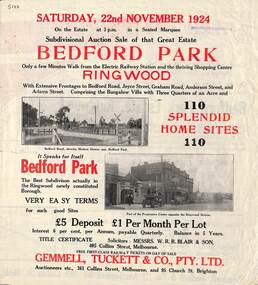 Ringwood and District Historical Society
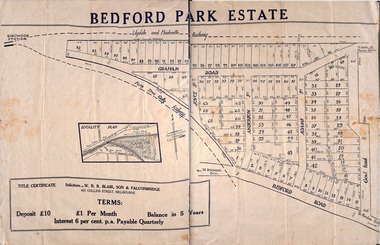
Pamphlet, Subdivisional Auction Sale, Bedford Park, Ringwood - 1924
... Subdivision plan includes Bedford Road, Graham Road, Joyce Street, Anderson Street, and Adams Street...Subdivision plan includes Bedford Road, Graham Road, Joyce Street, Anderson Street, and Adams Street Double sided bifolded auction sale advertisement including subdivision features and local facilities Subdivisional Auction Sale, Bedford Park, Ringwood - 1924 Pamphlet ...Bedford Park subdivisional development did not eventuate. The land adjoining the railway line became parkland with provision for sporting facilities and the remainder was purchased by the Education Department as the site for Ringwood High School/Secondary College. Double sided bifolded auction sale advertisement including subdivision features and local facilitiesSubdivision plan includes Bedford Road, Graham Road, Joyce Street, Anderson Street, and Adams Street -
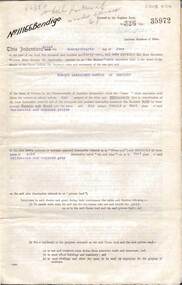 Bendigo Historical Society Inc.
Document - MCCOLL, RANKIN AND STANISTREET COLLECTION: INDENTURE, GOLD MINING LEASE CROWN AND RONALD ALEXANDER RANKIN, BENDIGO, 24th June 1941
... ... Adams Street...BENDIGO Mining North Deborah lease Belle Vue Road Adams Street Griston Street Golden Gully Ronald Alexander Rankin North Deborah Mine. 6 page document, Gold Mining Lease 11166, plus map. ...6 page document, Gold Mining Lease 11166, plus map. Indenture between Crown (King George VI) and Ronald Alexander Rankin of Bendigo, dated 24th June, 1941. Map No. 11166 Bendigo, Mining District of Bendigo, Parish of Sandhurst, County of Bendigo. Map shows lease 11166 marked in yellow with shaft, ore bins and tramway marked. Belle Vue Road , Adam Street and Griston Street shown on map. ( Golden Gully area) Dams indicated on lease holdings. Other lease holdings: 1675 T.L.9858, 10990, 11013, 11062, 11165, 11063 (void) 1172 W.R. (dam thereon) 9882 (void). Some residential lots marked along Belle Vue Road, and Adam Street. On bottom of map 21.8.41 in pencil. On last page of document : North Deborah Mining Company now the proprietor of the within described estate by transfer registered on 11th November 1914.bendigo, mining, north deborah lease, belle vue road, adams street, griston street, golden gully, ronald alexander rankin, north deborah mine. -
 Ringwood and District Historical Society
Plan - Sub-division, Bedford Park Estate, Ringwood, Victoria - 1924
... Subdivision plan includes Bedford Road, Graham Road, Joyce Street, Anderson Street, and Adams Street. Solicitors - W.R.R. Blair, Son & Falconbridge, 405 Collins Street, Melbourne....Subdivision plan includes Bedford Road, Graham Road, Joyce Street, Anderson Street, and Adams Street. Solicitors - W.R.R. Blair, Son & Falconbridge, 405 Collins Street, Melbourne. ...Bedford Park subdivisional development did not eventuate. The land adjoining the railway line became parkland with provision for sporting facilities and the remainder was purchased by the Education Department as the site for Ringwood High School/Secondary College. Poster size land sale advertisement.Subdivision plan includes Bedford Road, Graham Road, Joyce Street, Anderson Street, and Adams Street. Solicitors - W.R.R. Blair, Son & Falconbridge, 405 Collins Street, Melbourne. -
 Flagstaff Hill Maritime Museum and Village
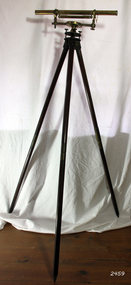
Instrument - Drainage Level, 1750-1795
... ...george adams fleet street london...Having one of their early drainage levels in the collection and in extremely good condition is an asset to the Flagstaff collection. flagstaff hill warrnambool shipwrecked-coast flagstaff-hill flagstaff-hill-maritime-museum maritime-museum shipwreck-coast flagstaff-hill-maritime-village george adams fleet street london optical instrument scientific instrument technical instrument surveyors level george adams snr projection microscope "G. ...Adams jnr wrote many elementary scientific works, as well as on the use of mathematical instruments. He often combined in his written works with religious themes and scientific content, often against the prevailing thoughts of the time. According to one popular magazine of the time (Gentleman's Magazine), his works were often accused of "growing errors of materialism, infidelity, and anarchy". He started writing at a young age and developed a love for it, his main interests included math and science, these subjects he often expressed in his written essay's. Notable works from Adams are. An Essay on Electricity, and Magnetism (1784). Essays on the Microscope (1787). An Essay on Vision, briefly explaining the fabric of the eye (1789). Astronomical and Geographical Essays (1790). A Short Dissertation on the Barometer (1790). Geometrical and Graphical Essays, containing a description of the mathematical instruments used in geometry, civil and military surveying, leveling and perspective (1790). Lectures on Natural and Experimental Philosophy, in five volumes (1794).George Adams Sr and Jnr were both notable opticians and scientific instrument makers of the 18th century. Their contribution to scientific innovation and optical development cannot be underestimated. Having one of their early drainage levels in the collection and in extremely good condition is an asset to the Flagstaff collection.Drainage level or optical level. A brass surveying instrument with Achromatic telescope, bubble level and dial fitted to the Tribrach or footplate that has leveling screws. Tripod is wood and brass with adjustable and unscrewable legs (for ease of transportation). Made by "G. Adams Fleet St, London". Used in surveying and building to transfer, measure and/or set horizontal levels."G. Adams - London".flagstaff hill, warrnambool, shipwrecked-coast, flagstaff-hill, flagstaff-hill-maritime-museum, maritime-museum, shipwreck-coast, flagstaff-hill-maritime-village, george adams fleet street london, optical instrument, scientific instrument, technical instrument, surveyors level, george adams snr, projection microscope -
 Ringwood and District Historical Society
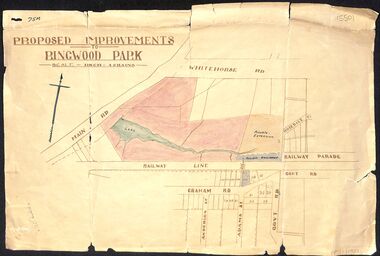
Map, Proposed Improvements to Ringwood Park (Ringwood Lake) dated 14 January 1927
... On the bottom of the map, south of the railway line, showing proposed streets - Graham Road, Anderson Street and Adams Street - in preparation for the sale of the Theo Anderson property. ...On the bottom of the map, south of the railway line, showing proposed streets - Graham Road, Anderson Street and Adams Street - in preparation for the sale of the Theo Anderson property. ...Proposed Improvements to Ringwood Park (Ringwood Lake) dated 14 January 1927, signed Cr McCaskill. Main Road is Whitehorse Road (Maroondah Highway), and Mt Dandenong Road is incorrectly labelled Whitehorse Road. The map shows Rosedale Crescent and Railway Parade, both of which exist in 2024. On the bottom of the map, south of the railway line, showing proposed streets - Graham Road, Anderson Street and Adams Street - in preparation for the sale of the Theo Anderson property. That area is now Bedford Park. -
 Eltham District Historical Society Inc
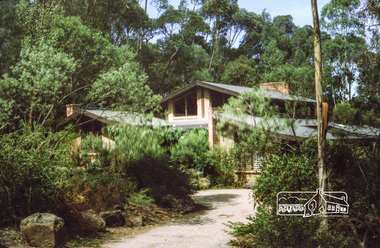
Negative - Photograph, Probably John Street, Eltham, c.Mar. 1983
... Colin and Mary (Adams?) Family house, John Street, Eltham...Colin and Mary (Adams?) Family house, John Street, Eltham john street eltham houses Kodak Safety 5035 Roll of 35mm colour negative film, 4 strips Probably John Street, Eltham Negative Photograph ...Colin and Mary (Adams?) Family house, John Street, ElthamRoll of 35mm colour negative film, 4 stripsKodak Safety 5035john street, eltham, houses -
 Bendigo Historical Society Inc.
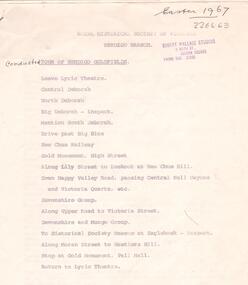
Document - ALBERT RICHARDSON COLLECTION: TOUR OF BENDIGO GOLDFIELD 1967
... Document lists the names and details of mines covered on the tour, including the : Central Deborah, corner Violet and Creek Street North Deborah, Breen Street, Quarry Hill The Deborah, off Adams Street, Quarry Hill The New Chum Railway, Breen Street, Golden Square Eureka Extended South Belle Vue. ...Document lists the names and details of mines covered on the tour, including the : Central Deborah, corner Violet and Creek Street North Deborah, Breen Street, Quarry Hill The Deborah, off Adams Street, Quarry Hill The New Chum Railway, Breen Street, Golden Square Eureka Extended South Belle Vue. ...Seven page printed document. On top 'Royal Historical Society of Victoria, Bendigo Branch. Conducted tour of Bendigo Goldfields.' Easter 1967. Document lists the names and details of mines covered on the tour, including the : Central Deborah, corner Violet and Creek Street North Deborah, Breen Street, Quarry Hill The Deborah, off Adams Street, Quarry Hill The New Chum Railway, Breen Street, Golden Square Eureka Extended South Belle Vue. The Hustlers Hill area history. New Chum Hill history Mines on the New Chum Hill and vicinity: Lansell's 180 New Chum and Victoria The Lazarus New Chum United New Chum consolidated Garibaldi Long Gully mines The Ironbark Carlisle United Hercules Document is signed by A. Richardson.bendigo, mining, mine tour 1967 -
 Bendigo Historical Society Inc.
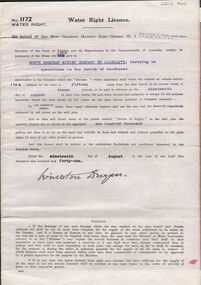
Document - MCCOLL, RANKIN AND STANISTREET COLLECTION: WATER RIGHT LICENCE NORTH DEBORAH MINING COMPANY NO LIABILITY, 19th August, 1941
... Plan has dam area coloured in red, with pipe line drawn in red, leading from Battery marked on lease 11145 across lease 9988 to dam. Streets marked: Adams Road, Honeybone Street, Griston Street. ...Plan has dam area coloured in red, with pipe line drawn in red, leading from Battery marked on lease 11145 across lease 9988 to dam. Streets marked: Adams Road, Honeybone Street, Griston Street. ...4 page document plus map, Water Right Licence No. 1172, between King George VI ( the Crown ) and North Deborah Mining Company No Liability, Parish of Sandhurst., dated 19th August 1941. "to take and divert water at the points marked 'source of supply' on the said plan the quantity thereof not to exceed in the aggregate one hundred thousand gallons per diem' Plan: 'Mining District of Bendigo No. 1172 W.R., County of Bendigo, Parish of Sandhurst. Plan has dam area coloured in red, with pipe line drawn in red, leading from Battery marked on lease 11145 across lease 9988 to dam. Streets marked: Adams Road, Honeybone Street, Griston Street. (Golden Square area)bendigo, mining, north deborah mining company, north deborah mining company, adams, honeybone, and griston streets. (golden square) -
 Ringwood and District Historical Society
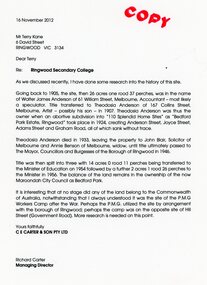
Document - Folder, Brief history of the Ringwood Secondary College site in Bedford Road, Ringwood, Victoria, since 1905 and subdivision in 1924
... Theodosia Anderson was thus the owner when on abortive subdivision Into "110 Splendid Home Sites" as "Bedford Park Estate, Ringwood" took place In 1924, creating Anderson Street, Joyce Street, Adams Street and Graham Road, all of which sank without trace. ...Theodosia Anderson was thus the owner when on abortive subdivision Into "110 Splendid Home Sites" as "Bedford Park Estate, Ringwood" took place In 1924, creating Anderson Street, Joyce Street, Adams Street and Graham Road, all of which sank without trace. ...Terry Kane and Richard Carter were the authors of the short historyType written notes and plans pertaining to the land titles and history of the Ringwood Secondary College site from 1905, prior to the land being sold by the Borough of Ringwood in 1954 to the Education Department. Transcript of covering letter from Richard Carter to Mr T Kane dated 16 November 2012 - "Re: Ringwood Secondary College As we discussed recently, I have done some research into the history of the site. Going back to 1905, the site, then 26 acres one rood 37 perches, was in the name of Walter James Anderson of 61 William Street, Melbourne, Accountant - most likely a speculator. Title transferred to Theodosia Anderson of 167 Collins Street, Melbourne, Artist - possibly his son - In 1907. Theodosia Anderson was thus the owner when on abortive subdivision Into "110 Splendid Home Sites" as "Bedford Park Estate, Ringwood" took place In 1924, creating Anderson Street, Joyce Street, Adams Street and Graham Road, all of which sank without trace. Theodosia Anderson died In 1933, leaving the property to John Blair, Solicitor of Melbourne and Annie Benson of Melbourne, widow, until title ultimately passed to The Mayor, Councillors and Burgesses of the Borough of Ringwood In 1946. Title was then spilt Into three with 14 acres 0 rood 11 perches being transferred to the Minister of Education on 1954 followed by a further 2 acres 1 rood 26 perches to the Minister In 1956. The balance of the land remains In the ownership of the now Maroondoh City Council as Bedford Park. It Is Interesting that at no stage did any of the land belong to the Commonwealth of Australia, notwithstanding that I always understood It was the site of the P.M.G. Workers Camp after the War. Perhaps the P.M.G. utilized the site by arrangement with the borough of Ringwood; perhaps the camp was on the opposite site of Hill Street (Government Road). More research Is needed on this point. Yours faithfully, CE CARTER & SON PTY LTD Richard Carter Managing Director" -
 Bendigo Historical Society Inc.
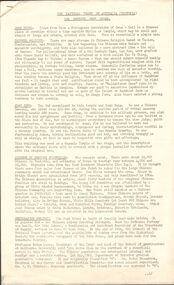
Document - THE BENDIGO JOSS HOUSE: NATIONAL TRUST OF AUSTRALIA (VICTORIA)
... Mrs R. R. Adams 39 Barkly Street Bendigo (Secretary)....Mrs R. R. Adams 39 Barkly Street Bendigo (Secretary). Document THE BENDIGO JOSS HOUSE: NATIONAL TRUST OF AUSTRALIA (VICTORIA) ...''The Bendigo Joss House'' - National Trust of Australia (Victoria) - 2 pages incl - origin of term 'Joss'; basic information about ''Chinese Religion'' and Kwan Gung; synopsis on ''Chinese on Bendigo Goldfields''; details of the restoration project - including costs to date and list of people and bodies assisting. Names on second sheet ; Bendigo Chinese Society, Family of H. E. McGowan, D. O'Hoy, Mr W. Mitchell, Apex Club, Sandhurst Boys' Centre, Mr John Ball, Ordinance Factory, Bendigo Advertiser, b. C. V. 8, 3 B. O. Mrs H. Vellacott, Mrs B. Mullins, S. E. C., contractors and other workmen. Mrs R. R. Adams 39 Barkly Street Bendigo (Secretary).National Trust of Australiabuildings, church, chinese joss house -
 Ringwood and District Historical Society
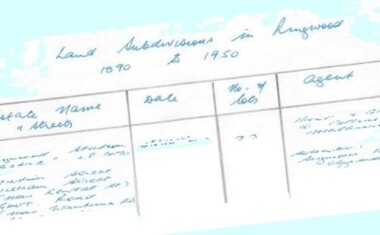
Document - Research Notes, Richard Carter, Land Subdivisions in Ringwood 1890-1950
... (1924) Bedford Road, Adams Street, Anderson Street, Joyce Street, Graham Road Pg26 CROWN JEWEL ESTATE LP11645 (Private sales after 1924) Mount Dandenong Road, Mirabel Avenue, Valda Avenue, Evon Avenue, Velma Grove Pg27 GRAND CENTRAL ESTATE LP10917 (1925) Heathmont Road, Great Ryrie Street, Douglas Street, Garden Street, Bellevue Avenue Pg28 RINGWOOD (unnamed estate - 1926) Nelson Street, Seymour Street, Whitehorse Road Pg29 EAST RINGWOOD RAILWAY STATION ESTATE (YEAR? ...(1924) Bedford Road, Adams Street, Anderson Street, Joyce Street, Graham Road Pg26 CROWN JEWEL ESTATE LP11645 (Private sales after 1924) Mount Dandenong Road, Mirabel Avenue, Valda Avenue, Evon Avenue, Velma Grove Pg27 GRAND CENTRAL ESTATE LP10917 (1925) Heathmont Road, Great Ryrie Street, Douglas Street, Garden Street, Bellevue Avenue Pg28 RINGWOOD (unnamed estate - 1926) Nelson Street, Seymour Street, Whitehorse Road Pg29 EAST RINGWOOD RAILWAY STATION ESTATE (YEAR? ...Handwritten table listing main local pre-1950s subdivisions in the Ringwood area, with estate names, streets, number of allotments for sale, and where known, vendor agent, LP (Lodged Plan) title registration number, and auction/sale date, some with sale price.Pg1 RINGWOOD STATION ESTATE LP3070 (Year?) Station Street, William Street (now Kendall Street), Wantirna Road, Station Street Pg1 RINGWOOD TOWNSHIP ESTATE LP5577 (1913) Station Road (now Warrandyte Road), Pratt Street (part now Aird Street), Whitehorse Road Pg2 RINGWOOD ORCHARD ESTATE LP4315 (1914) Brysons Road, Hillcrest Road, Anzac Avenue, Sulva Road Pg3 RINGWOOD RAILWAY ESTATE LP7522 (1918) Whitehorse Road (now Mount Dandenong Road), Dublin Road, Freeman Street, Patterson Street, Bona Street Pg4 THE RINGWOOD ESTATE LP7578 (1919) Warrandyte Road, Hobart Street, Paxton Street, Arnold Street Pg5 GARDEN FARMS ESTATE (LP?) (1919) Canterbury Road, Armstrong Road, Bungalook Road, Orchard Road, Bayswater Road (now Mountain Highway) Pg6 THE RINGWOOD ESTATE (SECOND SUB-DIVISION) LP7604 (1919) Warrandyte Road, Tamar Street, Derwent Street, Mersey Street Pg7 RINGWOOD STATION ESTATE LP7703 (1919) Bedford Road, Williams Grove (now Lena Grove) Pg8 RINGWOOD TOWNSHIP ESTATE LP8198 (1919) Wantirna Road, Ellison Street, Haig Street, Greenwood Avenue Pg9 EASTFIELD ESTATE (LP?) (1920) Eastfield Road, Longview Road, Pleasant Rise, The Mount Pg10 ELECTRIC RAILWAY ESTATE RINGWOOD LP9473 (1922) Campbell Street, Myrtle Avenue, George Street (now Tudor Court), Henry Street (now Myrtle Avenue), Williams Grove (now Lena Grove) Pg11 RINGWOOD PARK ESTATE LP7884 (1922 - two stages) Wonga Road (now Loughnan Road), William Street, Andrew Street, Harrison Street Pg12 HEATHMONT STATION ESTATE LP11009 (Date? - after 1922) Lisgoold Street, Viviani Crescent, Balrour Avenue, Station Street (now part Heathmont Road and part Wainui Street) Pg13 RINGWOOD RAILWAY ESTATE LP10507 (1923) Whitehorse Road, Sherbrooke Avenue, Burwood Avenue, Bonview Avenue, Heatherbrae Avenue, Grant Crescent Pg14 GARDEN HOMES ESTATE (LP?) (1923) Mullum Road, The Centreway, Wattle Crescent (now Wattle Avenue) Reserve Crescent (now Reserve Road) Pg15 DUBLIN ROAD ESTATE LP11993 (1923) Alexandra Road, Vonadawn Avenue, Green Street, Wood Street, Howard Avenue, Bedford Road, Dublin Road Pg16 CARLINGA ESTATE RINGWOOD LP9620 (1923) Bourke Street, Bond Street, Ringwood Street Pg17 PRATT'S JUNCTION ESTATE (LP?) (1923) Junction Street, Georges Road, Oliver Street, Whitehorse Road Pg18 EAST RINGWOOD ESTATE LP10492 (1923) Bona Street, Patterson Street, Miller Grove, Fairview Avenue, Eastfield Road, Whitehorse Road (now Mount Dandenong Road) Pg19 COLEMAN'S HEATHMONT ESTATE LP9974 (1923) Canterbury Road, Bedford Road, Alvena Crescent, Coleman Street, Leonard Street (now Royal Avenue) Pg20 RINGWOOD HEIGHTS ESTATE LP10506 (1924) Whitehorse Road, Bonview Avenue, Grant Crescent, Hillcrest Avenue, Heatherbrae Avenue, Margaret Street, Mary Street Pg21 EAST RINGWOOD STATION ESTATE LP10551 (1924) Knaith Road, Wenwood Street, Lois Street, Victoria Street, Station Street (now Railway Avenue) Pg22 GRAND VIEW ESTATE LP11019 (1924) Whitehorse Road, Rupert Street, Herbert Street, Leonard Street Pg23 RINGWOOD RAILWAY ESTATE & RINGWOOD HEIGHTS ESTATE - FINAL SECTIONS LP10506 & LP10507 (1924) Whitehorse Road, Sherbrooke Avenue, Burwood Avenue, Bonview Avenue, Heatherbrae Avenue, Margaret Street, Mary Street, Grant Crescent Pg24 RINGWOOD EAST ELECTRIC STATION ESTATE (LP?) (1924) Railway Parade (now Patterrson Street), Federal Road, Howship Avenue (part now French Street), Dublin Road, Rosedale Crescent Pg25 BEDFORD PARK (now Ringwood Secondary College) (LP?) (1924) Bedford Road, Adams Street, Anderson Street, Joyce Street, Graham Road Pg26 CROWN JEWEL ESTATE LP11645 (Private sales after 1924) Mount Dandenong Road, Mirabel Avenue, Valda Avenue, Evon Avenue, Velma Grove Pg27 GRAND CENTRAL ESTATE LP10917 (1925) Heathmont Road, Great Ryrie Street, Douglas Street, Garden Street, Bellevue Avenue Pg28 RINGWOOD (unnamed estate - 1926) Nelson Street, Seymour Street, Whitehorse Road Pg29 EAST RINGWOOD RAILWAY STATION ESTATE (YEAR? - 25 shops 60 villas) Railway Avenue, Dublin Road, Lawrence Grove, Stanley Avenue, Knaith Road Pg30 CHARM VIEW ESTATE (LP?) (year? - after 1926) Canterbury Road, Heathmont Road, Dickasons Road, Bennjett Avenue, Orchid Street Pg31 SUNBEAM ESTATE LP12150 (Circa 1925) Govt Road (now Old Lilydale Road), Sunbeam Avenue, Holland Road, Everard Street (now Everard Road) Pg32 FAIRVIEW ESTATE EAST RINGWOOD LP10853 (Circa 1924) Eastfield Road, Patterson Street, Margaret Street (now Short Street) Pg33 EAST RINGWOOD TOWNSHIP ESTATE LP3025 (Circa 1924 - 35 allotments) Mount Dandenong Road, Grey Street, Eastfield Road Pg34 EAST RINGWOOD TOWNSHIP ESTATE LP3025 (Circa 1924 - 49 allotments) and STATE SCHOOL ESTATE (26 allotments) and EAST RINGWOOD STATION ESTATE (14 shop sites) Mount Dandenong Road, Grety Street, Dunn Street, Eastfield Road, King Street, Holland Road, Dublin Road, Patterson Street, Bona Street Pg35 EAST RINGWOOD CENTRAL ESTATE LP17004 (1948) Knaith Road, Shasta Avenue, Talofa Avenue, Russet Road, Dublin Road Pg36 WARE ESTATE LP43360 (1958) Ware Crescent, Davey Drive, Grey Road (now Grey Street), Mount Dandenong Road Pg37 Lot 57 Kendall Street LP3070 (1939) £75.0.0 Pg37 Lot 14 LP7346 (year?) £225 Pg37 Lot 8 WHITE HORSE ESTATE LP14010 (year?) Maroondah Hwy, Seymour Street £98.9.0 Pg37 Lots 4-14 incl. LP10902 (year?) £300 Pg37 Lots 69&70 LP2216 (1939) Bedford Road, Pitt Street £500 Pg37 Lots 60&70 LP2216 (year?) £460 Pg37 MOUNTAIN VIEW ESTATE LP10902 (1936) Lots 1&2, 19-22 Wantirna Road, Daisy Street £50 Pg38 RAILWAY STATION ESTATE RINGWOOD EAST LP7522 (1925) Lots 16 to 19 £250 Pg38 RINGWOOD PARK ESTATE (LP?) (1924) Lot 112 Munro Street £230 Pg38 RINGWOOD TOWNSHIP ESTATE (LP?) (1925) Lot 57 Wantirna Road £850 Pg38 ELECTRIC RAILWAY ESTATE LP9473 (1925) Lot 98 & 99 £180 (30/- foot) Pg38 ELECTRIC RAILWAY ESTATE LP9473 (year?) Lot 100 £233.12.6 incl improvements (£2.12.6 foot) Pg38 Lot 22&23 Bedford Road Heathmont (LP & year?) £675 incl improvements Pg39 Lot 9 Mullum Mullum Road LP8221 (1923) £150 Pg39 Lot 27 Haig Street LP8198 (1925) £825 Pg39 Lot 56 Haig Street cnr Wantirna Road LP8198 (1923) £171 Pg39 Lots 3 & 4 Loughnan Road LP9626 (192?) £147 Pg39 Lots 98 & 99 Myrtle Avenue LP9473 (1925) £180 Pg39 Lots 80 & 81 Myrtle Avenue LP9473 (1929) £150 Pg39 Lot 30 Sherbrooke Avenue LP10507 (1926) £700 incl improvements Pg40 Lot 10 (year?) LP7703 £750 Pg40 Lot 36 (year?) LP7522 £25 Pg40 Lot 38 Pitt Street LP2216 (year?) £350 Pg40 Lot 7 Dublin Road cnr Green Street LP11993 (year?) £300 -
 Flagstaff Hill Maritime Museum and Village
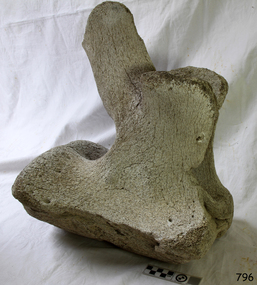
Animal specimen - Whale bone, Undetermined
... Adams, keen to promote the New England whaling industry, was trying to convince the British to import spermaceti sold by American whalers, which the British could use to fuel street lamps. ...Adams, keen to promote the New England whaling industry, was trying to convince the British to import spermaceti sold by American whalers, which the British could use to fuel street lamps. ...Prior to carrying out a detailed condition report of the cetacean skeletons, it is useful to have an understanding of the materials we are likely to encounter, in terms of structure and chemistry. This entry invites you to join in learning about the composition of whale bone and oil. Whale bone (Cetacean) bone is comprised of a composite structure of both an inorganic matrix of mainly hydroxylapatite (a calcium phosphate mineral), providing strength and rigidity, as well as an organic protein ‘scaffolding’ of mainly collagen, facilitating growth and repair (O’Connor 2008, CCI 2010). Collagen is also the structural protein component in cartilage between the whale vertebrae and attached to the fins of both the Killer Whale and the Dolphin. Relative proportions in the bone composition (affecting density), are linked with the feeding habits and mechanical stresses typically endured by bones of particular whale types. A Sperm Whale (Physeter macrocephalus Linnaeus, 1758) skeleton (toothed) thus has a higher mineral value (~67%) than a Fin Whale (Balaenoptera physalus Linnaeus, 1758) (baleen) (~60%) (Turner Walker 2012). The internal structure of bone can be divided into compact and cancellous bone. In whales, load-bearing structures such as mandibles and upper limb bones (e.g. humerus, sternum) are largely composed of compact bone (Turner Walker 2012). This consists of lamella concentrically deposited around the longitudinal axis and is permeated by fluid carrying channels (O’Connor 2008). Cancellous (spongy) bone, with a highly porous angular network of trabeculae, is less stiff and thus found in whale ribs and vertebrae (Turner Walker 2012). Whale oil Whales not only carry a thick layer of fat (blubber) in the soft tissue of their body for heat insulation and as a food store while they are alive, but also hold large oil (lipid) reserves in their porous bones. Following maceration of the whale skeleton after death to remove the soft tissue, the bones retain a high lipid content (Higgs et. al 2010). Particularly bones with a spongy (porous) structure have a high capacity to hold oil-rich marrow. Comparative data of various whale species suggests the skull, particularly the cranium and mandible bones are particularly oil rich. Along the vertebral column, the lipid content is reduced, particularly in the thoracic vertebrae (~10-25%), yet greatly increases from the lumbar to the caudal vertebrae (~40-55%). The chest area (scapula, sternum and ribs) show a mid-range lipid content (~15-30%), with vertically orientated ribs being more heavily soaked lower down (Turner Walker 2012, Higgs et. al 2010). Whale oil is largely composed of triglycerides (molecules of fatty acids attached to a glycerol molecule). In Arctic whales a higher proportion of unsaturated, versus saturated fatty acids make up the lipid. Unsaturated fatty acids (with double or triple carbon bonds causing chain kinks, preventing close packing (solidifying) of molecules), are more likely to be liquid (oil), versus solid (fat) at room temperature (Smith and March 2007). Objects Made From the Whaling Industry We all know that men set forth in sailing ships and risked their lives to harpoon whales on the open seas throughout the 1800s. And while Moby Dick and other tales have made whaling stories immortal, people today generally don't appreciate that the whalers were part of a well-organized industry. The ships that set out from ports in New England roamed as far as the Pacific in hunt of specific species of whales. Adventure may have been the draw for some whalers, but for the captains who owned whaling ships, and the investors which financed voyages, there was a considerable monetary payoff. The gigantic carcasses of whales were chopped and boiled down and turned into products such as the fine oil needed to lubricate increasing advanced machine tools. And beyond the oil derived from whales, even their bones, in an era before the invention of plastic, was used to make a wide variety of consumer goods. In short, whales were a valuable natural resource the same as wood, minerals, or petroleum we now pump from the ground. Oil From Whale’s Blubber Oil was the main product sought from whales, and it was used to lubricate machinery and to provide illumination by burning it in lamps. When a whale was killed, it was towed to the ship and its blubber, the thick insulating fat under its skin, would be peeled and cut from its carcass in a process known as “flensing.” The blubber was minced into chunks and boiled in large vats on board the whaling ship, producing oil. The oil taken from whale blubber was packaged in casks and transported back to the whaling ship’s home port (such as New Bedford, Massachusetts, the busiest American whaling port in the mid-1800s). From the ports it would be sold and transported across the country and would find its way into a huge variety of products. Whale oil, in addition to be used for lubrication and illumination, was also used to manufacture soaps, paint, and varnish. Whale oil was also utilized in some processes used to manufacture textiles and rope. Spermaceti, a Highly Regarded Oil A peculiar oil found in the head of the sperm whale, spermaceti, was highly prized. The oil was waxy, and was commonly used in making candles. In fact, candles made of spermaceti were considered the best in the world, producing a bright clear flame without an excess of smoke. Spermaceti was also used, distilled in liquid form, as an oil to fuel lamps. The main American whaling port, New Bedford, Massachusetts, was thus known as "The City That Lit the World." When John Adams was the ambassador to Great Britain before serving as president he recorded in his diary a conversation about spermaceti he had with the British Prime Minister William Pitt. Adams, keen to promote the New England whaling industry, was trying to convince the British to import spermaceti sold by American whalers, which the British could use to fuel street lamps. The British were not interested. In his diary, Adams wrote that he told Pitt, “the fat of the spermaceti whale gives the clearest and most beautiful flame of any substance that is known in nature, and we are surprised you prefer darkness, and consequent robberies, burglaries, and murders in your streets to receiving as a remittance our spermaceti oil.” Despite the failed sales pitch John Adams made in the late 1700s, the American whaling industry boomed in the early to mid-1800s. And spermaceti was a major component of that success. Spermaceti could be refined into a lubricant that was ideal for precision machinery. The machine tools that made the growth of industry possible in the United States were lubricated, and essentially made possible, by oil derived from spermaceti. Baleen, or "Whalebone" The bones and teeth of various species of whales were used in a number of products, many of them common implements in a 19th century household. Whales are said to have produced “the plastic of the 1800s.” The "bone" of the whale which was most commonly used wasn’t technically a bone, it was baleen, a hard material arrayed in large plates, like gigantic combs, in the mouths of some species of whales. The purpose of the baleen is to act as a sieve, catching tiny organisms in sea water, which the whale consumes as food. As baleen was tough yet flexible, it could be used in a number of practical applications. And it became commonly known as "whalebone." Perhaps the most common use of whalebone was in the manufacture of corsets, which fashionable ladies in the 1800s wore to compress their waistlines. One typical corset advertisement from the 1800s proudly proclaims, “Real Whalebone Only Used.” Whalebone was also used for collar stays, buggy whips, and toys. Its remarkable flexibility even caused it to be used as the springs in early typewriters. The comparison to plastic is apt. Think of common items which today might be made of plastic, and it's likely that similar items in the 1800s would have been made of whalebone. Baleen whales do not have teeth. But the teeth of other whales, such as the sperm whale, would be used as ivory in such products as chess pieces, piano keys, or the handles of walking sticks. Pieces of scrimshaw, or carved whale's teeth, would probably be the best remembered use of whale's teeth. However, the carved teeth were created to pass the time on whaling voyages and were never a mass production item. Their relative rarity, of course, is why genuine pieces of 19th century scrimshaw are considered to be valuable collectibles today. Reference: McNamara, Robert. "Objects Made From the Whaling Industry." ThoughtCo, Jul. 31, 2021, thoughtco.com/products-produced-from-whales-1774070.Whale bone was an important commodity, used in corsets, collar stays, buggy whips, and toys.Whale bone vertebrae. Advanced stage of calcification as indicated by deep pitting. Off white to grey.Noneflagstaff hill, warrnambool, shipwrecked-coast, flagstaff-hill, flagstaff-hill-maritime-museum, maritime-museum, shipwreck-coast, flagstaff-hill-maritime-village, whales, whale bone, corsets, toys, whips, whalebone -
 Flagstaff Hill Maritime Museum and Village
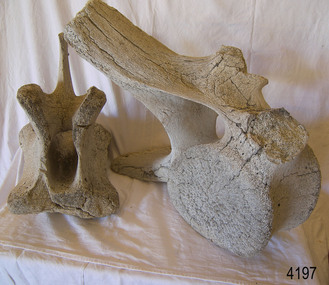
Animal specimen - Whale bone, Undetermined
... Adams, keen to promote the New England whaling industry, was trying to convince the British to import spermaceti sold by American whalers, which the British could use to fuel street lamps. ...Adams, keen to promote the New England whaling industry, was trying to convince the British to import spermaceti sold by American whalers, which the British could use to fuel street lamps. ...Prior to carrying out a detailed condition report of the cetacean skeletons, it is useful to have an understanding of the materials we are likely to encounter, in terms of structure and chemistry. This entry invites you to join in learning about the composition of whale bone and oil. Whale bone (Cetacean) bone is comprised of a composite structure of both an inorganic matrix of mainly hydroxylapatite (a calcium phosphate mineral), providing strength and rigidity, as well as an organic protein ‘scaffolding’ of mainly collagen, facilitating growth and repair (O’Connor 2008, CCI 2010). Collagen is also the structural protein component in cartilage between the whale vertebrae and attached to the fins of both the Killer Whale and the Dolphin. Relative proportions in the bone composition (affecting density), are linked with the feeding habits and mechanical stresses typically endured by bones of particular whale types. A Sperm Whale (Physeter macrocephalus Linnaeus, 1758) skeleton (toothed) thus has a higher mineral value (~67%) than a Fin Whale (Balaenoptera physalus Linnaeus, 1758) (baleen) (~60%) (Turner Walker 2012). The internal structure of bone can be divided into compact and cancellous bone. In whales, load-bearing structures such as mandibles and upper limb bones (e.g. humerus, sternum) are largely composed of compact bone (Turner Walker 2012). This consists of lamella concentrically deposited around the longitudinal axis and is permeated by fluid carrying channels (O’Connor 2008). Cancellous (spongy) bone, with a highly porous angular network of trabeculae, is less stiff and thus found in whale ribs and vertebrae (Turner Walker 2012). Whale oil Whales not only carry a thick layer of fat (blubber) in the soft tissue of their body for heat insulation and as a food store while they are alive, but also hold large oil (lipid) reserves in their porous bones. Following maceration of the whale skeleton after death to remove the soft tissue, the bones retain a high lipid content (Higgs et. al 2010). Particularly bones with a spongy (porous) structure have a high capacity to hold oil-rich marrow. Comparative data of various whale species suggests the skull, particularly the cranium and mandible bones are particularly oil rich. Along the vertebral column, the lipid content is reduced, particularly in the thoracic vertebrae (~10-25%), yet greatly increases from the lumbar to the caudal vertebrae (~40-55%). The chest area (scapula, sternum and ribs) show a mid-range lipid content (~15-30%), with vertically orientated ribs being more heavily soaked lower down (Turner Walker 2012, Higgs et. al 2010). Whale oil is largely composed of triglycerides (molecules of fatty acids attached to a glycerol molecule). In Arctic whales a higher proportion of unsaturated, versus saturated fatty acids make up the lipid. Unsaturated fatty acids (with double or triple carbon bonds causing chain kinks, preventing close packing (solidifying) of molecules), are more likely to be liquid (oil), versus solid (fat) at room temperature (Smith and March 2007). Objects Made From the Whaling Industry We all know that men set forth in sailing ships and risked their lives to harpoon whales on the open seas throughout the 1800s. And while Moby Dick and other tales have made whaling stories immortal, people today generally don't appreciate that the whalers were part of a well-organized industry. The ships that set out from ports in New England roamed as far as the Pacific in hunt of specific species of whales. Adventure may have been the draw for some whalers, but for the captains who owned whaling ships, and the investors which financed voyages, there was a considerable monetary payoff. The gigantic carcasses of whales were chopped and boiled down and turned into products such as the fine oil needed to lubricate increasing advanced machine tools. And beyond the oil derived from whales, even their bones, in an era before the invention of plastic, was used to make a wide variety of consumer goods. In short, whales were a valuable natural resource the same as wood, minerals, or petroleum we now pump from the ground. Oil From Whale’s Blubber Oil was the main product sought from whales, and it was used to lubricate machinery and to provide illumination by burning it in lamps. When a whale was killed, it was towed to the ship and its blubber, the thick insulating fat under its skin, would be peeled and cut from its carcass in a process known as “flensing.” The blubber was minced into chunks and boiled in large vats on board the whaling ship, producing oil. The oil taken from whale blubber was packaged in casks and transported back to the whaling ship’s home port (such as New Bedford, Massachusetts, the busiest American whaling port in the mid-1800s). From the ports it would be sold and transported across the country and would find its way into a huge variety of products. Whale oil, in addition to be used for lubrication and illumination, was also used to manufacture soaps, paint, and varnish. Whale oil was also utilized in some processes used to manufacture textiles and rope. Spermaceti, a Highly Regarded Oil A peculiar oil found in the head of the sperm whale, spermaceti, was highly prized. The oil was waxy, and was commonly used in making candles. In fact, candles made of spermaceti were considered the best in the world, producing a bright clear flame without an excess of smoke. Spermaceti was also used, distilled in liquid form, as an oil to fuel lamps. The main American whaling port, New Bedford, Massachusetts, was thus known as "The City That Lit the World." When John Adams was the ambassador to Great Britain before serving as president he recorded in his diary a conversation about spermaceti he had with the British Prime Minister William Pitt. Adams, keen to promote the New England whaling industry, was trying to convince the British to import spermaceti sold by American whalers, which the British could use to fuel street lamps. The British were not interested. In his diary, Adams wrote that he told Pitt, “the fat of the spermaceti whale gives the clearest and most beautiful flame of any substance that is known in nature, and we are surprised you prefer darkness, and consequent robberies, burglaries, and murders in your streets to receiving as a remittance our spermaceti oil.” Despite the failed sales pitch John Adams made in the late 1700s, the American whaling industry boomed in the early to mid-1800s. And spermaceti was a major component of that success. Spermaceti could be refined into a lubricant that was ideal for precision machinery. The machine tools that made the growth of industry possible in the United States were lubricated, and essentially made possible, by oil derived from spermaceti. Baleen, or "Whalebone" The bones and teeth of various species of whales were used in a number of products, many of them common implements in a 19th century household. Whales are said to have produced “the plastic of the 1800s.” The "bone" of the whale which was most commonly used wasn’t technically a bone, it was baleen, a hard material arrayed in large plates, like gigantic combs, in the mouths of some species of whales. The purpose of the baleen is to act as a sieve, catching tiny organisms in sea water, which the whale consumes as food. As baleen was tough yet flexible, it could be used in a number of practical applications. And it became commonly known as "whalebone." Perhaps the most common use of whalebone was in the manufacture of corsets, which fashionable ladies in the 1800s wore to compress their waistlines. One typical corset advertisement from the 1800s proudly proclaims, “Real Whalebone Only Used.” Whalebone was also used for collar stays, buggy whips, and toys. Its remarkable flexibility even caused it to be used as the springs in early typewriters. The comparison to plastic is apt. Think of common items which today might be made of plastic, and it's likely that similar items in the 1800s would have been made of whalebone. Baleen whales do not have teeth. But the teeth of other whales, such as the sperm whale, would be used as ivory in such products as chess pieces, piano keys, or the handles of walking sticks. Pieces of scrimshaw, or carved whale's teeth, would probably be the best remembered use of whale's teeth. However, the carved teeth were created to pass the time on whaling voyages and were never a mass production item. Their relative rarity, of course, is why genuine pieces of 19th century scrimshaw are considered to be valuable collectibles today. Reference: McNamara, Robert. "Objects Made From the Whaling Industry." ThoughtCo, Jul. 31, 2021, thoughtco.com/products-produced-from-whales-1774070.Whale bone was an important commodity, used in corsets, collar stays, buggy whips, and toys.Whale bone in two pieces. Advanced stage of calcification as indicated by deep pitting. Off white to grey.None.flagstaff hill, warrnambool, shipwrecked-coast, flagstaff-hill, flagstaff-hill-maritime-museum, maritime-museum, shipwreck-coast, flagstaff-hill-maritime-village, whale bones, whale skeleton, whales, whale bone, corsets, toys, whips -
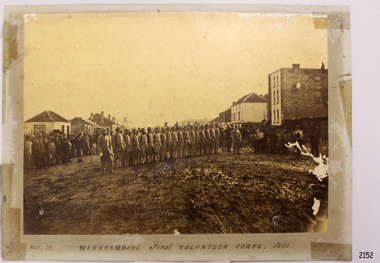 Flagstaff Hill Maritime Museum and Village
Photograph - Military group, Warrnambool First Volunteer Corps 1860, Taken May 24th, 1860, presented to Mayor in 1887
... Adams, Barnes (road contractor) and James Mason (Bootmaker). On the right of the picture is The Band. This is one of a collection of photographs showing the development of the Warrnambool Militia from its inception as the First Volunteer Corps in 1855. The collection is of local significance as it parallels the development of the town and includes images of significant local people. A number of Warrnambool streets ...This Photograph is one of a number of photographs of the Warrnambool Militia. The photograph entitled "Warrnambool First Volunteer Corps" is dated 24th May 1860. (The First Volunteer Corps began in 1855.) It was presented by James Astley Bromfield (former Mayor of Warrnambool) to Major Walter Helpmann, head of Warrnambool’s 1st Volunteer Corps in 1887. The photograph shows the Corps lined up for inspection in Timor Street, Warrnambool. The location is outside what is now the Archie Graham Centre and the camera is looking west towards Liebig Street. The town band is in the right rear corner and spectators surround the Corps. The names listed on the back of the photograph are "1. R.Bushe (Captain in command), 2. Basil Spence, 3. Thomas Mickle, 4. Alfred Davies (Sergeant), 5. Cawthray, 6. Andrew Kerr, 7. Charles Scoborio, 8. Lacy, 9. James Hider, 10. D. O’Mullane, 11. William Norman, 12. Crouthers (or Cowthers ?), 13. Francis Breckon, 14. Russ, 15. Benjamin Wycherley, 16. C. A. Cramer (Sergeant), 17. James Coulstock, 18. Robert Newton (Sergeant), 19. J.A. Bromfield, 20. Singleton (supernumery), 21. Mostyn (Drill Instructor)," On the left of the picture is Billy Adams, Barnes (road contractor) and James Mason (Bootmaker). On the right of the picture is The Band. This is one of a collection of photographs showing the development of the Warrnambool Militia from its inception as the First Volunteer Corps in 1855. The collection is of local significance as it parallels the development of the town and includes images of significant local people. A number of Warrnambool streets are named after members of the Militia. It is also historically significant because of its connection to the unrest that was taking place in Europe at this time. Photograph of Warrnambool First Volunteer Corps 1860, sepia coloured, mounted on cream card. The photograph shows the Corps lined up for inspection in Timor Street Warrnambool. The location is outside what is now the Archie Graham Centre and the camera is looking west towards Liebig Street. The town band is in the right rear corner and spectators surround the Corps. Photograph taken 24th May 1860. Has names listed on reverse side. The protograph was presented to Mayor Helpman, by Bromfield, May 1887. Title printed below base of photo on the mounting board "May. 24. WARRNAMBOOL First VOLUNTEER CORPS. 1860" On the back of the photograph is a numbered list of names, handwritten in ink. Also on the back are presentation details "Presented to Mayor Helpman, by Bromfield, May 1887". warrnambool, wolunteer corps, militia, helpmann, bromfield, flagstaff hill, shipwrecked coast, flagstaff hill maritime museum, maritime museum, shipwreck coast, flagstaff hill maritime village, great ocean road -
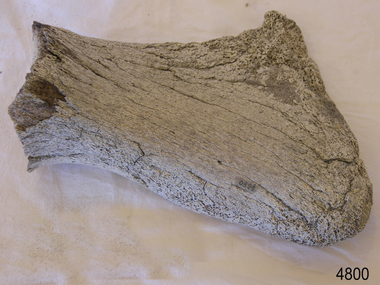 Flagstaff Hill Maritime Museum and Village
Animal specimen - Whale bone, Undetermined
... Adams, keen to promote the New England whaling industry, was trying to convince the British to import spermaceti sold by American whalers, which the British could use to fuel street lamps. ...Adams, keen to promote the New England whaling industry, was trying to convince the British to import spermaceti sold by American whalers, which the British could use to fuel street lamps. ...Prior to carrying out a detailed condition report of the cetacean skeletons, it is useful to have an understanding of the materials we are likely to encounter, in terms of structure and chemistry. This entry invites you to join in learning about the composition of whale bone and oil. Whale bone (Cetacean) bone is comprised of a composite structure of both an inorganic matrix of mainly hydroxylapatite (a calcium phosphate mineral), providing strength and rigidity, as well as an organic protein ‘scaffolding’ of mainly collagen, facilitating growth and repair (O’Connor 2008, CCI 2010). Collagen is also the structural protein component in cartilage between the whale vertebrae and attached to the fins of both the Killer Whale and the Dolphin. Relative proportions in the bone composition (affecting density), are linked with the feeding habits and mechanical stresses typically endured by bones of particular whale types. A Sperm Whale (Physeter macrocephalus Linnaeus, 1758) skeleton (toothed) thus has a higher mineral value (~67%) than a Fin Whale (Balaenoptera physalus Linnaeus, 1758) (baleen) (~60%) (Turner Walker 2012). The internal structure of bone can be divided into compact and cancellous bone. In whales, load-bearing structures such as mandibles and upper limb bones (e.g. humerus, sternum) are largely composed of compact bone (Turner Walker 2012). This consists of lamella concentrically deposited around the longitudinal axis and is permeated by fluid carrying channels (O’Connor 2008). Cancellous (spongy) bone, with a highly porous angular network of trabeculae, is less stiff and thus found in whale ribs and vertebrae (Turner Walker 2012). Whale oil Whales not only carry a thick layer of fat (blubber) in the soft tissue of their body for heat insulation and as a food store while they are alive, but also hold large oil (lipid) reserves in their porous bones. Following maceration of the whale skeleton after death to remove the soft tissue, the bones retain a high lipid content (Higgs et. al 2010). Particularly bones with a spongy (porous) structure have a high capacity to hold oil-rich marrow. Comparative data of various whale species suggests the skull, particularly the cranium and mandible bones are particularly oil rich. Along the vertebral column, the lipid content is reduced, particularly in the thoracic vertebrae (~10-25%), yet greatly increases from the lumbar to the caudal vertebrae (~40-55%). The chest area (scapula, sternum and ribs) show a mid-range lipid content (~15-30%), with vertically orientated ribs being more heavily soaked lower down (Turner Walker 2012, Higgs et. al 2010). Whale oil is largely composed of triglycerides (molecules of fatty acids attached to a glycerol molecule). In Arctic whales a higher proportion of unsaturated, versus saturated fatty acids make up the lipid. Unsaturated fatty acids (with double or triple carbon bonds causing chain kinks, preventing close packing (solidifying) of molecules), are more likely to be liquid (oil), versus solid (fat) at room temperature (Smith and March 2007). Objects Made From the Whaling Industry We all know that men set forth in sailing ships and risked their lives to harpoon whales on the open seas throughout the 1800s. And while Moby Dick and other tales have made whaling stories immortal, people today generally don't appreciate that the whalers were part of a well-organized industry. The ships that set out from ports in New England roamed as far as the Pacific in hunt of specific species of whales. Adventure may have been the draw for some whalers, but for the captains who owned whaling ships, and the investors which financed voyages, there was a considerable monetary payoff. The gigantic carcasses of whales were chopped and boiled down and turned into products such as the fine oil needed to lubricate increasing advanced machine tools. And beyond the oil derived from whales, even their bones, in an era before the invention of plastic, was used to make a wide variety of consumer goods. In short, whales were a valuable natural resource the same as wood, minerals, or petroleum we now pump from the ground. Oil From Whale’s Blubber Oil was the main product sought from whales, and it was used to lubricate machinery and to provide illumination by burning it in lamps. When a whale was killed, it was towed to the ship and its blubber, the thick insulating fat under its skin, would be peeled and cut from its carcass in a process known as “flensing.” The blubber was minced into chunks and boiled in large vats on board the whaling ship, producing oil. The oil taken from whale blubber was packaged in casks and transported back to the whaling ship’s home port (such as New Bedford, Massachusetts, the busiest American whaling port in the mid-1800s). From the ports it would be sold and transported across the country and would find its way into a huge variety of products. Whale oil, in addition to be used for lubrication and illumination, was also used to manufacture soaps, paint, and varnish. Whale oil was also utilized in some processes used to manufacture textiles and rope. Spermaceti, a Highly Regarded Oil A peculiar oil found in the head of the sperm whale, spermaceti, was highly prized. The oil was waxy, and was commonly used in making candles. In fact, candles made of spermaceti were considered the best in the world, producing a bright clear flame without an excess of smoke. Spermaceti was also used, distilled in liquid form, as an oil to fuel lamps. The main American whaling port, New Bedford, Massachusetts, was thus known as "The City That Lit the World." When John Adams was the ambassador to Great Britain before serving as president he recorded in his diary a conversation about spermaceti he had with the British Prime Minister William Pitt. Adams, keen to promote the New England whaling industry, was trying to convince the British to import spermaceti sold by American whalers, which the British could use to fuel street lamps. The British were not interested. In his diary, Adams wrote that he told Pitt, “the fat of the spermaceti whale gives the clearest and most beautiful flame of any substance that is known in nature, and we are surprised you prefer darkness, and consequent robberies, burglaries, and murders in your streets to receiving as a remittance our spermaceti oil.” Despite the failed sales pitch John Adams made in the late 1700s, the American whaling industry boomed in the early to mid-1800s. And spermaceti was a major component of that success. Spermaceti could be refined into a lubricant that was ideal for precision machinery. The machine tools that made the growth of industry possible in the United States were lubricated, and essentially made possible, by oil derived from spermaceti. Baleen, or "Whalebone" The bones and teeth of various species of whales were used in a number of products, many of them common implements in a 19th century household. Whales are said to have produced “the plastic of the 1800s.” The "bone" of the whale which was most commonly used wasn’t technically a bone, it was baleen, a hard material arrayed in large plates, like gigantic combs, in the mouths of some species of whales. The purpose of the baleen is to act as a sieve, catching tiny organisms in sea water, which the whale consumes as food. As baleen was tough yet flexible, it could be used in a number of practical applications. And it became commonly known as "whalebone." Perhaps the most common use of whalebone was in the manufacture of corsets, which fashionable ladies in the 1800s wore to compress their waistlines. One typical corset advertisement from the 1800s proudly proclaims, “Real Whalebone Only Used.” Whalebone was also used for collar stays, buggy whips, and toys. Its remarkable flexibility even caused it to be used as the springs in early typewriters. The comparison to plastic is apt. Think of common items which today might be made of plastic, and it's likely that similar items in the 1800s would have been made of whalebone. Baleen whales do not have teeth. But the teeth of other whales, such as the sperm whale, would be used as ivory in such products as chess pieces, piano keys, or the handles of walking sticks. Pieces of scrimshaw, or carved whale's teeth, would probably be the best remembered use of whale's teeth. However, the carved teeth were created to pass the time on whaling voyages and were never a mass production item. Their relative rarity, of course, is why genuine pieces of 19th century scrimshaw are considered to be valuable collectibles today. Reference: McNamara, Robert. "Objects Made From the Whaling Industry." ThoughtCo, Jul. 31, 2021, thoughtco.com/products-produced-from-whales-1774070.Whale bone was an important commodity, used in corsets, collar stays, buggy whips, and toys.Whale bone piece. Advanced stage of calcification as indicated by deep pitting. Off white to grey.None.flagstaff hill, warrnambool, shipwrecked-coast, flagstaff-hill, flagstaff-hill-maritime-museum, maritime-museum, shipwreck-coast, flagstaff-hill-maritime-village, whales, whale bone, corsets, toys, whips -
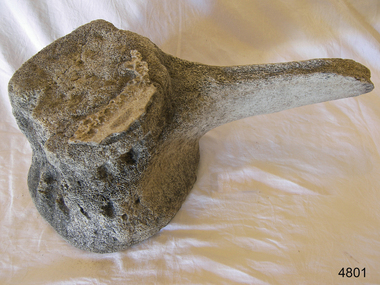 Flagstaff Hill Maritime Museum and Village
Animal specimen - Whale bone, Undetermined
... Adams, keen to promote the New England whaling industry, was trying to convince the British to import spermaceti sold by American whalers, which the British could use to fuel street lamps. ...Adams, keen to promote the New England whaling industry, was trying to convince the British to import spermaceti sold by American whalers, which the British could use to fuel street lamps. ...Prior to carrying out a detailed condition report of the cetacean skeletons, it is useful to have an understanding of the materials we are likely to encounter, in terms of structure and chemistry. This entry invites you to join in learning about the composition of whale bone and oil. Whale bone (Cetacean) bone is comprised of a composite structure of both an inorganic matrix of mainly hydroxylapatite (a calcium phosphate mineral), providing strength and rigidity, as well as an organic protein ‘scaffolding’ of mainly collagen, facilitating growth and repair (O’Connor 2008, CCI 2010). Collagen is also the structural protein component in cartilage between the whale vertebrae and attached to the fins of both the Killer Whale and the Dolphin. Relative proportions in the bone composition (affecting density), are linked with the feeding habits and mechanical stresses typically endured by bones of particular whale types. A Sperm Whale (Physeter macrocephalus Linnaeus, 1758) skeleton (toothed) thus has a higher mineral value (~67%) than a Fin Whale (Balaenoptera physalus Linnaeus, 1758) (baleen) (~60%) (Turner Walker 2012). The internal structure of bone can be divided into compact and cancellous bone. In whales, load-bearing structures such as mandibles and upper limb bones (e.g. humerus, sternum) are largely composed of compact bone (Turner Walker 2012). This consists of lamella concentrically deposited around the longitudinal axis and is permeated by fluid carrying channels (O’Connor 2008). Cancellous (spongy) bone, with a highly porous angular network of trabeculae, is less stiff and thus found in whale ribs and vertebrae (Turner Walker 2012). Whale oil Whales not only carry a thick layer of fat (blubber) in the soft tissue of their body for heat insulation and as a food store while they are alive, but also hold large oil (lipid) reserves in their porous bones. Following maceration of the whale skeleton after death to remove the soft tissue, the bones retain a high lipid content (Higgs et. al 2010). Particularly bones with a spongy (porous) structure have a high capacity to hold oil-rich marrow. Comparative data of various whale species suggests the skull, particularly the cranium and mandible bones are particularly oil rich. Along the vertebral column, the lipid content is reduced, particularly in the thoracic vertebrae (~10-25%), yet greatly increases from the lumbar to the caudal vertebrae (~40-55%). The chest area (scapula, sternum and ribs) show a mid-range lipid content (~15-30%), with vertically orientated ribs being more heavily soaked lower down (Turner Walker 2012, Higgs et. al 2010). Whale oil is largely composed of triglycerides (molecules of fatty acids attached to a glycerol molecule). In Arctic whales a higher proportion of unsaturated, versus saturated fatty acids make up the lipid. Unsaturated fatty acids (with double or triple carbon bonds causing chain kinks, preventing close packing (solidifying) of molecules), are more likely to be liquid (oil), versus solid (fat) at room temperature (Smith and March 2007). Objects Made From the Whaling Industry We all know that men set forth in sailing ships and risked their lives to harpoon whales on the open seas throughout the 1800s. And while Moby Dick and other tales have made whaling stories immortal, people today generally don't appreciate that the whalers were part of a well-organized industry. The ships that set out from ports in New England roamed as far as the Pacific in hunt of specific species of whales. Adventure may have been the draw for some whalers, but for the captains who owned whaling ships, and the investors which financed voyages, there was a considerable monetary payoff. The gigantic carcasses of whales were chopped and boiled down and turned into products such as the fine oil needed to lubricate increasing advanced machine tools. And beyond the oil derived from whales, even their bones, in an era before the invention of plastic, was used to make a wide variety of consumer goods. In short, whales were a valuable natural resource the same as wood, minerals, or petroleum we now pump from the ground. Oil From Whale’s Blubber Oil was the main product sought from whales, and it was used to lubricate machinery and to provide illumination by burning it in lamps. When a whale was killed, it was towed to the ship and its blubber, the thick insulating fat under its skin, would be peeled and cut from its carcass in a process known as “flensing.” The blubber was minced into chunks and boiled in large vats on board the whaling ship, producing oil. The oil taken from whale blubber was packaged in casks and transported back to the whaling ship’s home port (such as New Bedford, Massachusetts, the busiest American whaling port in the mid-1800s). From the ports it would be sold and transported across the country and would find its way into a huge variety of products. Whale oil, in addition to be used for lubrication and illumination, was also used to manufacture soaps, paint, and varnish. Whale oil was also utilized in some processes used to manufacture textiles and rope. Spermaceti, a Highly Regarded Oil A peculiar oil found in the head of the sperm whale, spermaceti, was highly prized. The oil was waxy, and was commonly used in making candles. In fact, candles made of spermaceti were considered the best in the world, producing a bright clear flame without an excess of smoke. Spermaceti was also used, distilled in liquid form, as an oil to fuel lamps. The main American whaling port, New Bedford, Massachusetts, was thus known as "The City That Lit the World." When John Adams was the ambassador to Great Britain before serving as president he recorded in his diary a conversation about spermaceti he had with the British Prime Minister William Pitt. Adams, keen to promote the New England whaling industry, was trying to convince the British to import spermaceti sold by American whalers, which the British could use to fuel street lamps. The British were not interested. In his diary, Adams wrote that he told Pitt, “the fat of the spermaceti whale gives the clearest and most beautiful flame of any substance that is known in nature, and we are surprised you prefer darkness, and consequent robberies, burglaries, and murders in your streets to receiving as a remittance our spermaceti oil.” Despite the failed sales pitch John Adams made in the late 1700s, the American whaling industry boomed in the early to mid-1800s. And spermaceti was a major component of that success. Spermaceti could be refined into a lubricant that was ideal for precision machinery. The machine tools that made the growth of industry possible in the United States were lubricated, and essentially made possible, by oil derived from spermaceti. Baleen, or "Whalebone" The bones and teeth of various species of whales were used in a number of products, many of them common implements in a 19th century household. Whales are said to have produced “the plastic of the 1800s.” The "bone" of the whale which was most commonly used wasn’t technically a bone, it was baleen, a hard material arrayed in large plates, like gigantic combs, in the mouths of some species of whales. The purpose of the baleen is to act as a sieve, catching tiny organisms in sea water, which the whale consumes as food. As baleen was tough yet flexible, it could be used in a number of practical applications. And it became commonly known as "whalebone." Perhaps the most common use of whalebone was in the manufacture of corsets, which fashionable ladies in the 1800s wore to compress their waistlines. One typical corset advertisement from the 1800s proudly proclaims, “Real Whalebone Only Used.” Whalebone was also used for collar stays, buggy whips, and toys. Its remarkable flexibility even caused it to be used as the springs in early typewriters. The comparison to plastic is apt. Think of common items which today might be made of plastic, and it's likely that similar items in the 1800s would have been made of whalebone. Baleen whales do not have teeth. But the teeth of other whales, such as the sperm whale, would be used as ivory in such products as chess pieces, piano keys, or the handles of walking sticks. Pieces of scrimshaw, or carved whale's teeth, would probably be the best remembered use of whale's teeth. However, the carved teeth were created to pass the time on whaling voyages and were never a mass production item. Their relative rarity, of course, is why genuine pieces of 19th century scrimshaw are considered to be valuable collectibles today. Reference: McNamara, Robert. "Objects Made From the Whaling Industry." ThoughtCo, Jul. 31, 2021, thoughtco.com/products-produced-from-whales-1774070. Whale bone was an important commodity, used in corsets, collar stays, buggy whips, and toys.Whale bone vertebrae. Advanced stage of calcification as indicated by deep pitting. Off white to grey.None.flagstaff hill, warrnambool, shipwrecked-coast, flagstaff-hill, flagstaff-hill-maritime-museum, maritime-museum, shipwreck-coast, flagstaff-hill-maritime-village, whales, whale bone, corsets, toys, whips -
 The Beechworth Burke Museum
Photograph, 1994
... Adams and Leila Doig. Nola (Nettie) Maher, who donated this photograph to the museum in 2001, was born in Beechworth on the twenty-first of December 1935. She is one of the many - primarily women - workers employed by the Beechworth Shoe Factory (also known as Pitman's Shoe Factory). Once located on Ford Street...Adams and Leila Doig. Nola (Nettie) Maher, who donated this photograph to the museum in 2001, was born in Beechworth on the twenty-first of December 1935. She is one of the many - primarily women - workers employed by the Beechworth Shoe Factory (also known as Pitman's Shoe Factory). Once located on Ford Street ...Taken in 1994, this photograph depicts the reunion of four women, all of whom were former workers at the Beechworth Shoe Factory. Pictured from left to right are: Nettie Maher, Beryl Pope, Alice Adams and Leila Doig. Nola (Nettie) Maher, who donated this photograph to the museum in 2001, was born in Beechworth on the twenty-first of December 1935. She is one of the many - primarily women - workers employed by the Beechworth Shoe Factory (also known as Pitman's Shoe Factory). Once located on Ford Street, the factory was established by Mr T. Nagle Pitman as a branch of the company Elgins Shoes, and was in operation from the first of July 1947 to the twenty-eighth of August 1961. In an interview given in 2000, Nettie recalls the close trust and friendships that were built amongst the factory workers. A sense of this bond is reflected in this reunion photograph, taken several decades later. This photograph is historically significant as it provides insight into the experiences of women factory workers in Beechworth during the twentieth century. Colour rectangular photograph printed on matte photographic paperReverse: 13 / 6981 /beechworth shoe factory, pitman shoe factory, t. nagle pitman, reunion, female friendships, nola maher, nettie maher, beryl pope, alice adams, leila doig, beechworth shoe factory reunion 1994, elgin shoes, women factory workers, beechworth factories -
 Federation University Historical Collection
Book, Dianne Campbell, Ballarat Rate Book Extracts, c2004
... street...edward A'Beckett...thomas a'beckett...augustus abraham...robert adams...Dianne Campbell Goldfields Lawyers Collection ballarat rate books Lydiard Street Armstrong street Doveton Street lyons street errard street mair street webster street creswick street Drummond Street Dana Street eureka street sturt street hotham street hill street grenville street urquhart street ligar street seymour crescent eyre street neil street dawson street skipton street edward A'Beckett thomas a'beckett augustus abraham robert adams david aherne henry archer butler aspinall herbert barrett john bethune John bindon richard Birnie arthur blackwood john box frederick brown charles browning hugh macdermott john ogier robert le poer trench This book idetifies the street locations of Ballarat lawyers. ...This book idetifies the street locations of Ballarat lawyers. dianne campbell goldfields lawyers collection, ballarat rate books, lydiard street, armstrong street, doveton street, lyons street, errard street, mair street, webster street, creswick street, drummond street, dana street, eureka street, sturt street, hotham street, hill street, grenville street, urquhart street, ligar street, seymour crescent, eyre street, neil street, dawson street, skipton street, edward a'beckett, thomas a'beckett, augustus abraham, robert adams, david aherne, henry archer, butler aspinall, herbert barrett, john bethune, john bindon, richard birnie, arthur blackwood, john box, frederick brown, charles browning, hugh macdermott, john ogier, robert le poer trench -
Federation University Historical Collection
Book - Book - Scrapbook, Ballarat School of MInes: Scrapbook of Newspaper Cuttings, Book 24, April 1985 to October 1985
... adams...tracey foley...tammy lench...maxine cloks...ministry for arts visit...lydiard street...The papers concerned are The Courier, Ballarat, The Australian, The Age over the period of 8 April 1985 to 10 October 1985. teaching positions advertised pre-employment courses courses available industrial electrical engineers society trevor henderson wins award geoffrey blainey launches history of the school of mines wendouree tech high wins football six-day tree seminar at old ballarat east gardens ian duggan wins welding award smb facing big changes challenges writing workshops give pleasure ania walwicz - writer artist smb's famous head - r w richards antarctic hero dies - 92 jim bell head of engineering lee wallis head of plumbing and sheet metal ballarat council to replace statue of malcolm fraser staff farewelled captain moonlight slept here carpentary at smb will be moved dick richard's obituary hairdressing seminar flagstaff college of tafe smb kim odgers first woman - certificate of technology in surveying apprentices compete in work skill finals peter brown - carpentry ricky hains - engineering drawing craig haintz - fitting and turning lynn wheeler - hairdressing brendan mceldrew - fitter daryl edwards - electrical wiring phillip smith - construction steelworker dr murray gillan former smb student now dean - faculty of engineering - swinburne institute of technology tom walsh top farm apprentice for 1984 andrew gibbs top sheetmetal apprentice ballarat unique educational centre steven smith top motor mechanic for 1984 ricky hains selected fo skill olympics in japan lynne wheeler wins silver medal in hairdressing lynne kirkpatrick - most outstanding apprentice of 1985 lynne kirkpatrick - certificate of woolclassing david brown motor mechanic apprentice vacc award smb level one apprentice central highlands/wimmera regional tafe awards lynne kirkpatrick wool classer leigh gillbert building trade darrenhumphris automotive trades ian duggan metal trades peter flett electrical trades e j tippett resigns from smb council courses for young job-seekers $7 million project takes shape ballarat municipal observatory being restored breaking down more barriers disabled employment support smb grant for job training in modern office skills ricky hains receives smb's centenary medallion when centres for disabled will be redundant nursing aide girls' award jenny westin bronwyn fleming sharon rook leanne adams tracey foley tammy lench maxine cloks ministry for arts visit lydiard street closed between grant and dana streets dangers that lurk at work ministry of employment and training forgotten hero is resurrected baldwin spencer barry hill blackburn report on post-compulsory schooling schools - what changes are needed gifts for ballarat gardens michael taffe presenting rose to smb heritage roses in australia courier 10/9/85 meri gracin smbfood services department chokkie vegetable learning the skills of hospitality courier gardening seminar at smb kevin heinze smb redevelopment on target eating their way to health trevor mckenzie helen schaper steven marsden farmer lynne kirkpatrick outstanding silvana faulkner equal opportunities officer women try non-traditional jobs Book with beige cover, front, spiral bound. ...Collection of newspaper articles related to Ballarat School Of Mines.They cover activities and advertisements for staff. The papers concerned are The Courier, Ballarat, The Australian, The Age over the period of 8 April 1985 to 10 October 1985.Book with beige cover, front, spiral bound. teaching positions advertised, pre-employment courses, courses available, industrial electrical engineers society, trevor henderson wins award, geoffrey blainey launches history of the school of mines, wendouree tech high wins football, six-day tree seminar at old ballarat east gardens, ian duggan wins welding award, smb facing big changes, challenges, writing workshops give pleasure, ania walwicz - writer artist, smb's famous head - r w richards, antarctic hero dies - 92, jim bell head of engineering, lee wallis head of plumbing and sheet metal, ballarat council to replace statue of malcolm fraser, staff farewelled, captain moonlight slept here, carpentary at smb will be moved, dick richard's obituary, hairdressing seminar, flagstaff college of tafe, smb, kim odgers first woman - certificate of technology in surveying, apprentices compete in work skill finals, peter brown - carpentry, ricky hains - engineering drawing, craig haintz - fitting and turning, lynn wheeler - hairdressing, brendan mceldrew - fitter, daryl edwards - electrical wiring, phillip smith - construction steelworker, dr murray gillan, former smb student now dean - faculty of engineering - swinburne institute of technology, tom walsh top farm apprentice for 1984, andrew gibbs top sheetmetal apprentice, ballarat unique educational centre, steven smith top motor mechanic for 1984, ricky hains selected fo skill olympics in japan, lynne wheeler wins silver medal in hairdressing, lynne kirkpatrick - most outstanding apprentice of 1985, lynne kirkpatrick - certificate of woolclassing, david brown motor mechanic apprentice, vacc award smb level one apprentice, central highlands/wimmera regional tafe awards, lynne kirkpatrick, wool classer, leigh gillbert building trade, darrenhumphris automotive trades, ian duggan metal trades, peter flett electrical trades, e j tippett resigns from smb council, courses for young job-seekers, $7 million project takes shape, ballarat municipal observatory being restored, breaking down more barriers, disabled employment support, smb grant for job training in modern office skills, ricky hains receives smb's centenary medallion, when centres for disabled will be redundant, nursing aide girls' award, jenny westin, bronwyn fleming, sharon rook, leanne adams, tracey foley, tammy lench, maxine cloks, ministry for arts visit, lydiard street closed between grant and dana streets, dangers that lurk at work, ministry of employment and training, forgotten hero is resurrected, baldwin spencer, barry hill, blackburn report on post-compulsory schooling, schools - what changes are needed, gifts for ballarat gardens, michael taffe presenting rose to smb, heritage roses in australia, courier 10/9/85, meri gracin smbfood services department, chokkie vegetable, learning the skills of hospitality, courier gardening seminar at smb, kevin heinze, smb redevelopment on target, eating their way to health, trevor mckenzie, helen schaper, steven marsden, farmer lynne kirkpatrick outstanding, silvana faulkner equal opportunities officer, women try non-traditional jobs -
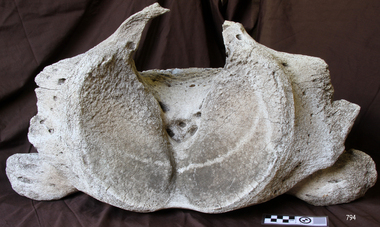 Flagstaff Hill Maritime Museum and Village
Animal specimen - Whale Vertebrae, Undetermined
... Adams, keen to promote the New England whaling industry, was trying to convince the British to import spermaceti sold by American whalers, which the British could use to fuel street lamps. ...Adams, keen to promote the New England whaling industry, was trying to convince the British to import spermaceti sold by American whalers, which the British could use to fuel street lamps. ...Prior to carrying out a detailed condition report of the cetacean skeletons, it is useful to have an understanding of the materials we are likely to encounter, in terms of structure and chemistry. This entry invites you to join in learning about the composition of whale bone and oil. Whale bone (Cetacean) bone is comprised of a composite structure of both an inorganic matrix of mainly hydroxylapatite (a calcium phosphate mineral), providing strength and rigidity, as well as an organic protein ‘scaffolding’ of mainly collagen, facilitating growth and repair (O’Connor 2008, CCI 2010). Collagen is also the structural protein component in cartilage between the whale vertebrae and attached to the fins of both the Killer Whale and the Dolphin. Relative proportions in the bone composition (affecting density), are linked with the feeding habits and mechanical stresses typically endured by bones of particular whale types. A Sperm Whale (Physeter macrocephalus Linnaeus, 1758) skeleton (toothed) thus has a higher mineral value (~67%) than a Fin Whale (Balaenoptera physalus Linnaeus, 1758) (baleen) (~60%) (Turner Walker 2012). The internal structure of bone can be divided into compact and cancellous bone. In whales, load-bearing structures such as mandibles and upper limb bones (e.g. humerus, sternum) are largely composed of compact bone (Turner Walker 2012). This consists of lamella concentrically deposited around the longitudinal axis and is permeated by fluid carrying channels (O’Connor 2008). Cancellous (spongy) bone, with a highly porous angular network of trabeculae, is less stiff and thus found in whale ribs and vertebrae (Turner Walker 2012). Whale oil Whales not only carry a thick layer of fat (blubber) in the soft tissue of their body for heat insulation and as a food store while they are alive, but also hold large oil (lipid) reserves in their porous bones. Following maceration of the whale skeleton after death to remove the soft tissue, the bones retain a high lipid content (Higgs et. al 2010). Particularly bones with a spongy (porous) structure have a high capacity to hold oil-rich marrow. Comparative data of various whale species suggests the skull, particularly the cranium and mandible bones are particularly oil rich. Along the vertebral column, the lipid content is reduced, particularly in the thoracic vertebrae (~10-25%), yet greatly increases from the lumbar to the caudal vertebrae (~40-55%). The chest area (scapula, sternum and ribs) show a mid-range lipid content (~15-30%), with vertically orientated ribs being more heavily soaked lower down (Turner Walker 2012, Higgs et. al 2010). Whale oil is largely composed of triglycerides (molecules of fatty acids attached to a glycerol molecule). In Arctic whales a higher proportion of unsaturated, versus saturated fatty acids make up the lipid. Unsaturated fatty acids (with double or triple carbon bonds causing chain kinks, preventing close packing (solidifying) of molecules), are more likely to be liquid (oil), versus solid (fat) at room temperature (Smith and March 2007). Objects Made From the Whaling Industry We all know that men set forth in sailing ships and risked their lives to harpoon whales on the open seas throughout the 1800s. And while Moby Dick and other tales have made whaling stories immortal, people today generally don't appreciate that the whalers were part of a well-organized industry. The ships that set out from ports in New England roamed as far as the Pacific in hunt of specific species of whales. Adventure may have been the draw for some whalers, but for the captains who owned whaling ships, and the investors which financed voyages, there was a considerable monetary payoff. The gigantic carcasses of whales were chopped and boiled down and turned into products such as the fine oil needed to lubricate increasing advanced machine tools. And beyond the oil derived from whales, even their bones, in an era before the invention of plastic, was used to make a wide variety of consumer goods. In short, whales were a valuable natural resource the same as wood, minerals, or petroleum we now pump from the ground. Oil From Whale’s Blubber Oil was the main product sought from whales, and it was used to lubricate machinery and to provide illumination by burning it in lamps. When a whale was killed, it was towed to the ship and its blubber, the thick insulating fat under its skin, would be peeled and cut from its carcass in a process known as “flensing.” The blubber was minced into chunks and boiled in large vats on board the whaling ship, producing oil. The oil taken from whale blubber was packaged in casks and transported back to the whaling ship’s home port (such as New Bedford, Massachusetts, the busiest American whaling port in the mid-1800s). From the ports it would be sold and transported across the country and would find its way into a huge variety of products. Whale oil, in addition to be used for lubrication and illumination, was also used to manufacture soaps, paint, and varnish. Whale oil was also utilized in some processes used to manufacture textiles and rope. Spermaceti, a Highly Regarded Oil A peculiar oil found in the head of the sperm whale, spermaceti, was highly prized. The oil was waxy, and was commonly used in making candles. In fact, candles made of spermaceti were considered the best in the world, producing a bright clear flame without an excess of smoke. Spermaceti was also used, distilled in liquid form, as an oil to fuel lamps. The main American whaling port, New Bedford, Massachusetts, was thus known as "The City That Lit the World." When John Adams was the ambassador to Great Britain before serving as president he recorded in his diary a conversation about spermaceti he had with the British Prime Minister William Pitt. Adams, keen to promote the New England whaling industry, was trying to convince the British to import spermaceti sold by American whalers, which the British could use to fuel street lamps. The British were not interested. In his diary, Adams wrote that he told Pitt, “the fat of the spermaceti whale gives the clearest and most beautiful flame of any substance that is known in nature, and we are surprised you prefer darkness, and consequent robberies, burglaries, and murders in your streets to receiving as a remittance our spermaceti oil.” Despite the failed sales pitch John Adams made in the late 1700s, the American whaling industry boomed in the early to mid-1800s. And spermaceti was a major component of that success. Spermaceti could be refined into a lubricant that was ideal for precision machinery. The machine tools that made the growth of industry possible in the United States were lubricated, and essentially made possible, by oil derived from spermaceti. Whalebone The bones and teeth of various species of whales were used in a number of products, many of them common implements in a 19th century household. Whales are said to have produced “the plastic of the 1800s.” The bone of the whale which was most commonly used wasn’t technically a bone, it was baleen, a hard material arrayed in large plates, like gigantic combs, in the mouths of some species of whales. The purpose of the baleen is to act as a sieve, catching tiny organisms in sea water, which the whale consumes as food. As baleen was tough yet flexible, it could be used in a number of practical applications. And it became commonly known as whalebone. Perhaps the most common use of whalebone was in the manufacture of corsets, which fashionable ladies in the 1800s wore to compress their waistlines. One typical corset advertisement from the 1800s proudly proclaims, “Real Whalebone Only Used.” Whalebone was also used for collar stays, buggy whips, and toys. Its remarkable flexibility even caused it to be used as the springs in early typewriters. The comparison to plastic is apt. Think of common items which today might be made of plastic, and it's likely that similar items in the 1800s would have been made of whalebone. Baleen whales do not have teeth. But the teeth of other whales, such as the sperm whale, would be used as ivory in such products as chess pieces, piano keys, or the handles of walking sticks. Pieces of scrimshaw, or carved whale's teeth, would probably be the best remembered use of whale's teeth. However, the carved teeth were created to pass the time on whaling voyages and were never a mass production item. Their relative rarity, of course, is why genuine pieces of 19th century scrimshaw are considered to be valuable collectibles today. Reference: McNamara, Robert. "Objects Made From the Whaling Industry." ThoughtCo, Jul. 31, 2021, thoughtco.com/products-produced-from-whales-1774070.Whale bone during the 17th, 18th, 19th and early 20th centuries was an important industry providing an important commodity. Whales from these times provided everything from lighting & machine oils to using the animal's bones for use in corsets, collar stays, buggy whips, and many other everyday items then in use.Whale bone Vertebrae with advanced stage of calcification as indicated by deep pitting. Off white to grey.None.warrnambool, flagstaff-hill, flagstaff-hill-maritime-museum, maritime-museum, shipwreck-coast, flagstaff-hill-maritime-village, whale bones, whale skeleton, whales, whale bone, corsets, toys, whips, whaleling industry, maritime fishing, whalebone
