
Showing 13 items matching "admella medals"
-
 Glenelg Shire Council Cultural Collection
Photograph - Photograph - William Melrose McDonnell and George Edwards, n.d
... ... Admella medals...Head and shoulders photograph, wearing hats, dark jackets, Admella medals on McDonell's left breast, on Edwards right breast....Head and shoulders photograph, wearing hats, dark jackets, Admella medals on McDonell's left breast, on Edwards right breast. ...Portland Lifeboat crew and part of the team that rescued survivors from the wreck of the AdmellaDigital photograph of William Melrose McDonnell (Ladybird crew, and Portland Lifeboat crew in 2nd Admella rescue attempt) and George Edwards (Ladybird crew). Head and shoulders photograph, wearing hats, dark jackets, Admella medals on McDonell's left breast, on Edwards right breast.admella, portland lifeboat, portland portrait photography, admella medals -
 Glenelg Shire Council Cultural Collection
Medal - Medal - Admella Shipwreck - awarded to John Dusting, Brush and MacDonnell, 1859
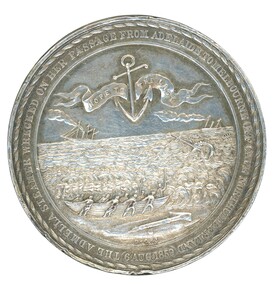
... Medal - Admella Shipwreck - awarded to John Dusting......Admella medals...Admella wrecked off the South Australian Coast in 1859. This silver medal was one of only 39 silver medals awarded. ...Text around the edge of the medal reads 'The Admella Steamer wrecked on her passage from Adelaide to Melbourne off Cape Northumberland'. ...Portland Lifeboat Admella shipwrecks Admella Shipwreck Admella medals Dusting Glenelg Shire Council Cultural Collection Portland Obverse: Scene of shipwreck near the coastline. ...On Friday 5 August 1859, the steamship, Admella, left Adelaide bound for Melbourne. IT carried 82 passengers, a crew of 31 and 4 racehorses. he Admella was a 395 ton screw steamer built at Port Glasgow, Scotland in 1857. Her name is said to be derived from the ports she served - Adelaide, Melbourne and Launceston. It took her 42 hours to travel between Adelaide and Melbourne, usually stopping at Portland, Port Fairy and Warrnambool, making her the fastest ship to travel this route. The Admella’s final journey was her 36th voyage. Admella had been built with watertight bulkheads, riveted to the hull. These were designed as a special safety feature, but when the ship grounded on Carpenters Rocks it took only 15 minutes for the hull to break in three along the rivet lines. Many people were drowned immediately, and six horses stabled on deck tried to swim to shore. At least one of them made it alive. On Saturday August 6 1859, at 5am, Admella struck a reef. The three onboard lifeboats were washed away as were the four cork lifebelts kept on deck. Rubber lifebelts kept below deck were instantly lost. Cape Northumberland Lighthouse near Port McDonnell was about 24 km away so Captain McEwan ordered rocket flares to be fired to gain attention. However, all the ship’s rockets were damp. Only one ignited but soon fizzled out. The Captain attempted to make a raft but was unsuccessful and nearly drowned in the process. The ship was only about a kilometre from shore, but the surf, currents, cold water and sharks resulted in five men dying trying to reach safety. It wasn’t until Sunday afternoon that two sailors, managed to get to shore using a raft. It took them three hours and they then had to walk about 32 kilometres along the shore in the dark to Northumberland Lighthouse without shoes. They were met by Ben Germein the lighthouse keeper. His horse had died so he had to walk to a nearby station to borrow a horse. The horse he chose threw him off so in the end the station owner, Peter Black, rode the 24 km to the Mount Gambier telegraph station to share the news of the disaster. After several unsuccessful rescue attempts, eight days after the initial disaster, 19 people were rescued by the Portland Lifeboat and three people, including Captain McEwan were rescued in one of Admella’s lifeboats which had been found on the shore and fixed. It was captained by Ben Germein with six volunteer oarsmen. This was Germain’s sixth attempt to reach the wreck in the damaged boat. Of the 113 people on board Admella at the time of her wreck only 24 survived. At the official enquiry into the disaster, fog, lightning, compasses and bad mapping were all considered as the cause, but finally the swift and unpredictable currents which run between Cape Jaffa and Cape Northumberland were given the official blame. This medal is associated with one of Australia's worst maritime disasters, the wreck of SS Admella. This incident is significant to Portland because the Portland Lifeboat and its crew took part in a heroic rescue. 19 people were rescued by the crew of the Lifeboat. The Portland Lifeboat is listed on Victoria's State Heritage Register.Round silver medal awarded to John Dusting by the Victorian Colonists for his heroic efforts as part of the crew of the Portland Lifeboat in the rescue of survivors of the Admella Shipwreck. Admella wrecked off the South Australian Coast in 1859. This silver medal was one of only 39 silver medals awarded. There were 3 gold medals awarded. The medal is presented in a blue box. The box has beveled edges. Inside the lid is a fabric insert with details of the silversmith printed. The medal sits in a circular insert with a blue ribbon for taking the medal out with ease.Obverse: Scene of shipwreck near the coastline. In the foreground there is the Portland Lifeboat with crew. Above is an anchor with ribbon. Text around the edge of the medal reads 'The Admella Steamer wrecked on her passage from Adelaide to Melbourne off Cape Northumberland'. Across the ribbon - Hope to the last Reverse: Wreath around the edge. Beams of light from the sky. Text reads: Awarded to John Dusting/ By the Victorian Colonists / For / Heroic Exertions / In Saving Life / (Under divine providence) / From the wreck of the Admellaportland lifeboat, admella, shipwrecks, admella shipwreck, admella medals, dusting, glenelg shire council cultural collection, portland -
 Glenelg Shire Council Cultural Collection
Medal - Box for Medal - Admella Shipwreck - awarded to John Dusting, Brush and MacDonnell, 1859
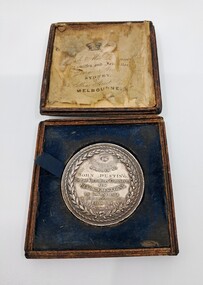
... Box for Medal - Admella Shipwreck - awarded to John Dusting......Admella medals...Medal Box for Medal - Admella Shipwreck - awarded to John Dusting Brush and MacDonnell Royal Mint, Sydney ...On Friday 5 August 1859, the steamship, Admella, left Adelaide bound for Melbourne. IT carried 82 passengers, a crew of 31 and 4 racehorses. he Admella was a 395 ton screw steamer built at Port Glasgow, Scotland in 1857. Her name is said to be derived from the ports she served - Adelaide, Melbourne and Launceston. It took her 42 hours to travel between Adelaide and Melbourne, usually stopping at Portland, Port Fairy and Warrnambool, making her the fastest ship to travel this route. The Admella’s final journey was her 36th voyage. Admella had been built with watertight bulkheads, riveted to the hull. These were designed as a special safety feature, but when the ship grounded on Carpenters Rocks it took only 15 minutes for the hull to break in three along the rivet lines. Many people were drowned immediately, and six horses stabled on deck tried to swim to shore. At least one of them made it alive. On Saturday August 6 1859, at 5am, Admella struck a reef. The three onboard lifeboats were washed away as were the four cork lifebelts kept on deck. Rubber lifebelts kept below deck were instantly lost. Cape Northumberland Lighthouse near Port McDonnell was about 24 km away so Captain McEwan ordered rocket flares to be fired to gain attention. However, all the ship’s rockets were damp. Only one ignited but soon fizzled out. The Captain attempted to make a raft but was unsuccessful and nearly drowned in the process. The ship was only about a kilometre from shore, but the surf, currents, cold water and sharks resulted in five men dying trying to reach safety. It wasn’t until Sunday afternoon that two sailors, managed to get to shore using a raft. It took them three hours and they then had to walk about 32 kilometres along the shore in the dark to Northumberland Lighthouse without shoes. They were met by Ben Germein the lighthouse keeper. His horse had died so he had to walk to a nearby station to borrow a horse. The horse he chose threw him off so in the end the station owner, Peter Black, rode the 24 km to the Mount Gambier telegraph station to share the news of the disaster. After several unsuccessful rescue attempts, eight days after the initial disaster, 19 people were rescued by the Portland Lifeboat and three people, including Captain McEwan were rescued in one of Admella’s lifeboats which had been found on the shore and fixed. It was captained by Ben Germein with six volunteer oarsmen. This was Germain’s sixth attempt to reach the wreck in the damaged boat. Of the 113 people on board Admella at the time of her wreck only 24 survived. At the official enquiry into the disaster, fog, lightning, compasses and bad mapping were all considered as the cause, but finally the swift and unpredictable currents which run between Cape Jaffa and Cape Northumberland were given the official blame. This medal is associated with one of Australia's worst maritime disasters, the wreck of SS Admella. This incident is significant to Portland because the Portland Lifeboat and its crew took part in a heroic rescue. 19 people were rescued by the crew of the Lifeboat. The Portland Lifeboat is listed on Victoria's State Heritage Register.The medal is presented in a blue box. The box has beveled edges. Inside the lid is a fabric insert with details of the silversmith printed. The medal sits in a circular insert with a blue ribbon for taking the medal out with ease.portland lifeboat, admella, shipwrecks, admella shipwreck, admella medals, dusting, glenelg shire council cultural collection, portland -
Glenelg Shire Council Cultural Collection
Photograph, n.d
... Head and shoulders photo, short hair, beard and moustache, dark jacket, white shirt, string bow tie. Admella medal on left breast....Head and shoulders photo, short hair, beard and moustache, dark jacket, white shirt, string bow tie. Admella medal on left breast. Photograph Photograph ...Digital photograph of William Melrose McDonell / Ladybird Crew, Portland Lifeboat Crew, 2nd attempt at Admella rescue. Head and shoulders photo, short hair, beard and moustache, dark jacket, white shirt, string bow tie. Admella medal on left breast. -
Glenelg Shire Council Cultural Collection
Souvenir - Souvenir Fridge Magnet - Admella Festival - Admella Gold Medal, c. 2009
... Souvenir Fridge Magnet - Admella Festival - Admella Gold Medal...Circlar magnet to back. Image of Admella Gold medal attached to front, covered by clear plastic....Circlar magnet to back. Image of Admella Gold medal attached to front, covered by clear plastic. ...Circular white plastic fridge magnet. Circlar magnet to back. Image of Admella Gold medal attached to front, covered by clear plastic.souvenir, admella, shipwreck, admella 150th anniversary -
Glenelg Shire Council Cultural Collection
Painting, Captain James Fawthrop, n.d
... Small oil on paper painting of Captain James Fawthrop, wearing his gold Admella medal. He is wearing a dark-coloured uniform jacket & cap with letters "HD" in gold. ...Small oil on paper painting of Captain James Fawthrop, wearing his gold Admella medal. He is wearing a dark-coloured uniform jacket & cap with letters "HD" in gold. ...Small oil on paper painting of Captain James Fawthrop, wearing his gold Admella medal. He is wearing a dark-coloured uniform jacket & cap with letters "HD" in gold. Blue sky & clouds in background. The painting is covered with glass and is set in an oval, dark wooden frame, that has a gold inner line. The painting is bordered by three mat boards, dark grey, light grey and gold. The back is covered in brown paper, with cord between the two metal 'eyes' for hanging. -
 Glenelg Shire Council Cultural Collection
Medal - Silver Medal - James Kean for saving life, Admella Shipwreck, 1859
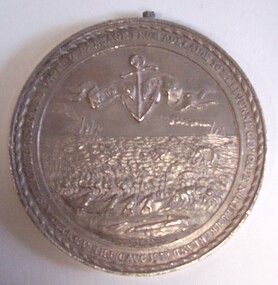
... Silver Medal - James Kean for saving life, Admella Shipwreck...Silver Medal awarded to James Kean by Victorian Colonists for Heroic Exertions, in saving life.. from the wreck of the Admella Silver Medal with detailed relief designs on both sides. ...Admella shipwreck Admella Portland Lifeboat Front: Inverse: The Admella Steamer wrecked on her passage from Adelaide to Melbourne of Cape Northumberland/ 6 August 1859 (around edge) Back: Obverse: Awarded to/James Kean/by the Victorian Colonists/for/heroic exertions,/in saving life/(under divine providence)/from the/wreck of the Admella. Silver Medal awarded to James Kean by Victorian Colonists for Heroic Exertions, in saving life.. from the wreck of the Admella Silver Medal with detailed relief designs on both sides. ...Displayed in History House and Maritime Discovery Centre.Admella shipwreckSilver Medal awarded to James Kean by Victorian Colonists for Heroic Exertions, in saving life.. from the wreck of the Admella Silver Medal with detailed relief designs on both sides. Broken silver loop on top. Inverse: Detailed scene of a manned rowboat being launched to rescue a foundering ship. On horizon line are two ships with smoke stacks. A large banner and anchor design in the sky bears the words "Hope to the Last". Obverse: Laurel wreath and a braid motif encircle the central text. At top of design is a depiction of an eye and eyebrow with stylised rays radiating in semi-circle.Front: Inverse: The Admella Steamer wrecked on her passage from Adelaide to Melbourne of Cape Northumberland/ 6 August 1859 (around edge) Back: Obverse: Awarded to/James Kean/by the Victorian Colonists/for/heroic exertions,/in saving life/(under divine providence)/from the/wreck of the Admella.admella, portland lifeboat -
Glenelg Shire Council Cultural Collection
Medal - Medal - presented to James Kean for the rescue of Lewis Lyne at Cape Grant, 1899, 1899
... James Kean was also part of the Portland Lifeboat crew that helped in the Admella shipwreck James Kean Portland Lifeboat Admella In Grateful Recognition of the Brave Rescue of Lewis S. Lyne at Cape Grant, March 7th, 1899, by James R. Kean Medal ...Displayed at History House.James Kean was also part of the Portland Lifeboat crew that helped in the Admella shipwreckIn Grateful Recognition of the Brave Rescue of Lewis S. Lyne at Cape Grant, March 7th, 1899, by James R. Keanjames kean, portland lifeboat, admella -
 Glenelg Shire Council Cultural Collection
Certificate - Draft certificate of reward - Admella Relief and Reward Fund, 1859
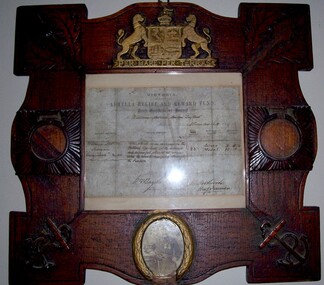
... Centre of each side has a cavity for the medals. At the bottom centre is the Admella Relief and Reward Fund Draft certificate of reward to William Melrose Seaman 'Lady Bird' Melbourne Nov 12th 1859. ...Admella Relief and Reward Fund Draft certificate of reward to William Melrose Seaman 'Lady Bird' Melbourne Nov 12th 1859. Services rendered - volunteered as an oarsman in the Portland Lifeboat on the second and successfil attempt at rescue when he rowed manfully through the breakers. He was awarded a Silver Medal...Centre of each side has a cavity for the medals. At the bottom centre is the Admella Relief and Reward Fund Draft certificate of reward to William Melrose Seaman 'Lady Bird' Melbourne Nov 12th 1859. ...William Melrose volunteered as an oarsman in the Portland Lifeboat on the second and successfil attempt at rescue when he rowed manfully through the breakers. He was awarded a Silver Medal and [pound mark]12.10.0.Paper certificate mounted under glass and framed. Frame is carved wood, stained brown. Top corner is a carved scotch thistle, bottom corner has carved anchors. Centre of each side has a cavity for the medals. At the bottom centre is the Admella Relief and Reward Fund Draft certificate of reward to William Melrose Seaman 'Lady Bird' Melbourne Nov 12th 1859. Photograph of William Melrose in uniform with his two medals pinned to his jacket. A coat of arms is carved at the top centre with the motto "PER-MARE-PER-TERRAS".Front: Admella Relief and Reward Fund Draft certificate of reward to William Melrose Seaman 'Lady Bird' Melbourne Nov 12th 1859. Services rendered - volunteered as an oarsman in the Portland Lifeboat on the second and successfil attempt at rescue when he rowed manfully through the breakers. He was awarded a Silver Medal and [pound mark]12.10.0. Back: (no inscriptions)admella, shipwreck, portland lifeboat, rescue, reward -
 Glenelg Shire Council Cultural Collection
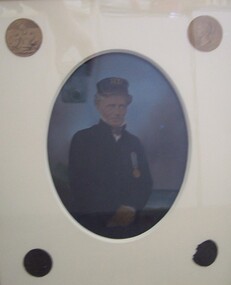
Photograph - Daguerreotype, Captain James Fawthrop, c. 1967
... Photograph of Captain James Fawthrop in Harbour Master's uniform wearing the gold medal awarded for his role in the rescue of surviviors from the Admella wreck....Photograph of Captain James Fawthrop in Harbour Master's uniform wearing the gold medal awarded for his role in the rescue of surviviors from the Admella wreck. ...UnknownColour photograph on glass. Oval mount in rectangular frame, gold paint under glass. Four seals in each corner of the mount. Photograph of Captain James Fawthrop in Harbour Master's uniform wearing the gold medal awarded for his role in the rescue of surviviors from the Admella wreck.Front: (no inscriptions) Back: (no inscriptions) -
 Glenelg Shire Council Cultural Collection
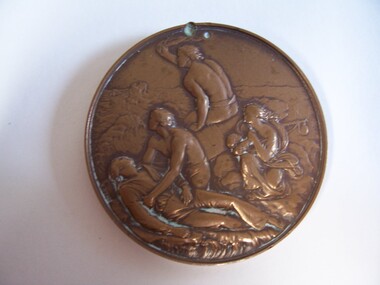
Medal - Medal - Board of Trade Award for Gallantry in Saving Life, c. 1860
... Bronze medal presented to James Kean for his part in the rescue of the survivors from the wreck of the Admella on Carpenter's Rock, August 1859. ...Wyon SC (under portrait) Back: (no inscriptions) Bronze medal presented to James Kean for his part in the rescue of the survivors from the wreck of the Admella on Carpenter's Rock, August 1859. ...Bronze medal presented to James Kean for his part in the rescue of the survivors from the wreck of the Admella on Carpenter's Rock, August 1859. Inverse: Profile portrait of a young woman with har in a Grecian bun, wearing a wreath of laurel leaves. Text around the edge. Obverse: relief depiction of five figures on surface of a ship deck. Man at the top of the image waving a cloth to attract the attention of a lifeboat in the background left.Front: AWARDED BY THE BOARD OF TRADE FOR GALLANTRY IN SAVING LIFE/ V.R. (around edge) B. Wyon SC (under portrait) Back: (no inscriptions) -
 Hymettus Cottage & Garden Ballarat
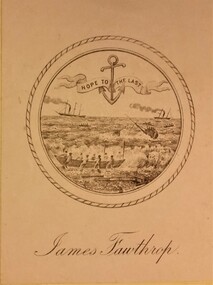
Work on paper - Bookplate, Captain James Fawthrop Bookplate
... Captain James Fawthrop was presented with a gold medal for his leadership and seamanship in captaining the rescue lifeboat from Portland in the rescue of survivors of the Admella in 1859. ...Bookplate in book from Fawthrop collection of maritime works. Captain James Fawthrop was presented with a gold medal for his leadership and seamanship in captaining the rescue lifeboat from Portland in the rescue of survivors of the Admella in 1859. His bookplate carries the image of the medal.portland, fawthrop, rescue, lifeboat -
 Glenelg Shire Council Cultural Collection
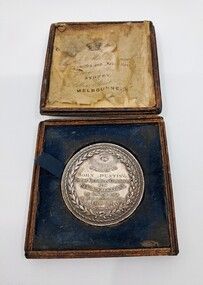
Medal - Medal - Admella Shipwreck - awarded to John Dusting, Brush and MacDonnell, 1859
... Medal - Admella Shipwreck - awarded to John Dusting...Admella wrecked off the South Australian Coast in 1859. This silver medal was one of only 39 silver medals awarded. ...Text around the edge of the medal reads 'The Admella Steamer wrecked on her passage from Adelaide to Melbourne off Cape Northumberland'. ...The medal sits in a circular insert with a blue ribbon for taking the medal out with ease. Medal Medal - Admella Shipwreck - awarded to John Dusting Brush and MacDonnell Royal Mint, Sydney ...On Friday 5 August 1859, the steamship, Admella, left Adelaide bound for Melbourne. IT carried 82 passengers, a crew of 31 and 4 racehorses. he Admella was a 395 ton screw steamer built at Port Glasgow, Scotland in 1857. Her name is said to be derived from the ports she served - Adelaide, Melbourne and Launceston. It took her 42 hours to travel between Adelaide and Melbourne, usually stopping at Portland, Port Fairy and Warrnambool, making her the fastest ship to travel this route. The Admella’s final journey was her 36th voyage. Admella had been built with watertight bulkheads, riveted to the hull. These were designed as a special safety feature, but when the ship grounded on Carpenters Rocks it took only 15 minutes for the hull to break in three along the rivet lines. Many people were drowned immediately, and six horses stabled on deck tried to swim to shore. At least one of them made it alive. On Saturday August 6 1859, at 5am, Admella struck a reef. The three onboard lifeboats were washed away as were the four cork lifebelts kept on deck. Rubber lifebelts kept below deck were instantly lost. Cape Northumberland Lighthouse near Port McDonnell was about 24 km away so Captain McEwan ordered rocket flares to be fired to gain attention. However, all the ship’s rockets were damp. Only one ignited but soon fizzled out. The Captain attempted to make a raft but was unsuccessful and nearly drowned in the process. The ship was only about a kilometre from shore, but the surf, currents, cold water and sharks resulted in five men dying trying to reach safety. It wasn’t until Sunday afternoon that two sailors, managed to get to shore using a raft. It took them three hours and they then had to walk about 32 kilometres along the shore in the dark to Northumberland Lighthouse without shoes. They were met by Ben Germein the lighthouse keeper. His horse had died so he had to walk to a nearby station to borrow a horse. The horse he chose threw him off so in the end the station owner, Peter Black, rode the 24 km to the Mount Gambier telegraph station to share the news of the disaster. After several unsuccessful rescue attempts, eight days after the initial disaster, 19 people were rescued by the Portland Lifeboat and three people, including Captain McEwan were rescued in one of Admella’s lifeboats which had been found on the shore and fixed. It was captained by Ben Germein with six volunteer oarsmen. This was Germain’s sixth attempt to reach the wreck in the damaged boat. Of the 113 people on board Admella at the time of her wreck only 24 survived. At the official enquiry into the disaster, fog, lightning, compasses and bad mapping were all considered as the cause, but finally the swift and unpredictable currents which run between Cape Jaffa and Cape Northumberland were given the official blame.This medal is associated with one of Australia's worst maritime disasters, the wreck of SS Admella. This incident is significant to Portland because the Portland Lifeboat and its crew took part in a heroic rescue. 19 people were rescued by the crew of the Lifeboat. The Portland Lifeboat is listed on Victoria's State Heritage Register. Only 39 silver medals were awarded after the incident. Three gold medals were awarded.Round silver medal awarded to John Dusting by the Victorian Colonists for his heroic efforts as part of the crew of the Portland Lifeboat in the rescue of survivors of the Admella Shipwreck. Admella wrecked off the South Australian Coast in 1859. This silver medal was one of only 39 silver medals awarded. There were 3 gold medals awarded. The medal is presented in a blue box. The box has beveled edges. Inside the lid is a fabric insert with details of the silversmith printed. The medal sits in a circular insert with a blue ribbon for taking the medal out with ease.Obverse: Scene of shipwreck near the coastline. In the foreground there is the Portland Lifeboat with crew. Above is an anchor with ribbon. Text around the edge of the medal reads 'The Admella Steamer wrecked on her passage from Adelaide to Melbourne off Cape Northumberland'. Across the ribbon - Hope to the last Reverse: Wreath around the edge. Beams of light from the sky. Text reads: Awarded to John Dusting/ By the Victorian Colonists / For / Heroic Exertions / In Saving Life / (Under divine providence) / From the wreck of the Admellaadmella, portland, glenelg shire council cultural collection, portland lifeboat, admella shipwreck, shipwreck
