
Showing 19 items matching "aesthetic movement"
-
 Villa Alba Museum
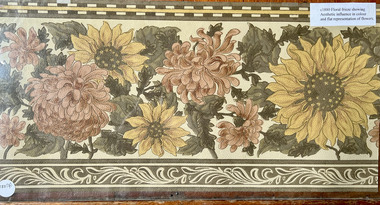
Wallpaper sample - Textured floral frieze, c.1880
... ...Aesthetic movement...Textured floral frieze showing the influence of the Aesthetic Movement in the colour and flattened representation of the flowers. ...Heritage interiors Wallpapers 19th century design borders 1880s Aesthetic movement P. F11 (f) Textured floral frieze showing the influence of the Aesthetic Movement in the colour and flattened representation of the flowers. ...Part of a collection of historic wallpapers collected by Phyllis Murphy, most of whose wallpapers were donated to the collection of Historic Houses Sydney. This wallpaper sample, annotated and encased in mylar was used by Phyllis for educational purposes, and donated by her son to Villa Alba Museum's collection in 2025.Textured floral frieze showing the influence of the Aesthetic Movement in the colour and flattened representation of the flowers. The design features prominent sunflowers and chrysanthemums set against a textured background. 1880s.P. F11 (f)heritage interiors, wallpapers, 19th century design, borders, 1880s, aesthetic movement -
 Villa Alba Museum
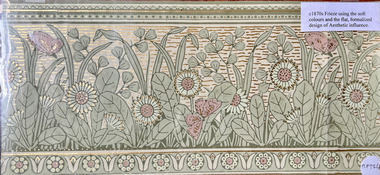
Wallpaper sample - Floral frieze, 1870s
... ...Aesthetic movement...A wallpaper frieze from the 1870s that exemplifies the Aesthetic Movement's design principles. The design is possibly based on one by Walter Crane around 1875. ...Heritage interiors Wallpapers 19th century design Aesthetic movement 1870s wallpaper borders P. F72 (f) A wallpaper frieze from the 1870s that exemplifies the Aesthetic Movement's design principles. ...Part of a collection of historic wallpapers collected by Phyllis Murphy, most of whose wallpapers were donated to the collection of Historic Houses Sydney. This wallpaper sample, annotated and encased in mylar was used by Phyllis for educational purposes, and donated by her son to Villa Alba Museum's collection in 2025.A wallpaper frieze from the 1870s that exemplifies the Aesthetic Movement's design principles. The design is possibly based on one by Walter Crane around 1875. It features soft colours and flat, formalised botanical motifs, including butterflies and flowers. Friezes like this were common decorative elements in the later Victorian period. P. F72 (f)heritage interiors, wallpapers, 19th century design, aesthetic movement, 1870s, wallpaper borders -
 Villa Alba Museum
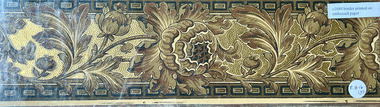
Wallpaper sample - Floral and foliate border design on embossed paper, 1880
... ...Aesthetic movement...Heritage interiors Wallpapers 19th century design borders 1880s Aesthetic movement P. B. 16 (f) Wallpaper border printed on embossed paper, circa 1880. ...Part of a collection of historic wallpapers collected by Phyllis Murphy, most of whose wallpapers were donated to the collection of Historic Houses Sydney. This wallpaper sample, annotated and encased in mylar was used by Phyllis for educational purposes, and donated by her son to Villa Alba Museum's collection in 2025.Wallpaper border printed on embossed paper, circa 1880. Background gilded and embossed to achieve a raised textured appearance. Features a detailed floral and acanthus leaf motifs with a geometric border. This kind of design was popular during the Aesthetic and Victorian design movements. The gilded finish was common to high-end interior decoration of the 1880s. P. B. 16 (f)heritage interiors, wallpapers, 19th century design, borders, 1880s, aesthetic movement -
 Villa Alba Museum
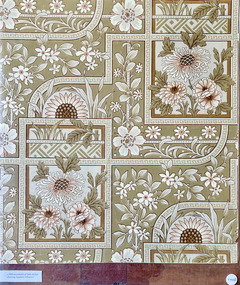
Wallpaper sample - Dado, c.1880
... ...Aesthetic movement...c.1880 Asymmetrical dado design showing Japanese influence featuring stylised floral motifs including chrysanthemums and geometric borders in the "Aesthetic" style. This style was part of the 19th-century artistic movement that incorporated nature-inspired elements in structured, layered compositions. ...Heritage interiors Wallpapers 19th century interior design Dado borders Aesthetic movement P.D9 (f) c.1880 Asymmetrical dado design showing Japanese influence featuring stylised floral motifs including chrysanthemums and geometric borders in the "Aesthetic" style. ...Part of a collection of historic wallpapers collected by Phyllis Murphy, most of whose wallpapers were donated to the collection of Historic Houses Sydney. This wallpaper sample, annotated and encased in mylar was used by Phyllis for educational purposes, and donated by her son to Villa Alba Museum's collection in 2025.c.1880 Asymmetrical dado design showing Japanese influence featuring stylised floral motifs including chrysanthemums and geometric borders in the "Aesthetic" style. This style was part of the 19th-century artistic movement that incorporated nature-inspired elements in structured, layered compositions. A strong Japanese/Chinoiserie influence was a hallmark of the era's decorative arts. P.D9 (f)heritage interiors, wallpapers, 19th century interior design, dado borders, aesthetic movement -
 Flagstaff Hill Maritime Museum and Village
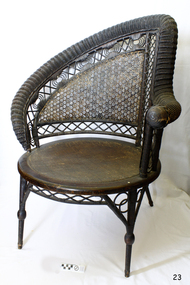
Furniture - Chair, 1855-1900
... The wicker styles drew on the Aesthetic Movement and Japanese influences simpler designs arose in the wake of the Arts and Crafts Movement. ...The wicker styles drew on the Aesthetic Movement and Japanese influences simpler designs arose in the wake of the Arts and Crafts Movement. ...Heywood & Wakefield Furniture Co: The Heywood-Wakefield Company is an American furniture manufacturer established in 1897 that went on to become a major presence in the US. Its older products are considered collectibles and have been featured on television antique programs. The Heywood brothers established themselves in 1826, as furniture makers and the Wakefield Company began in 1855 as a separate company. Both firms produced wicker and rattan furniture, and as these products became increasingly popular towards the end of the century, they became serious rivals. In 1897 the companies merged as Heywood Brothers & Wakefield Company (this name was changed to Heywood-Wakefield Company in 1921), purchasing Washburn-Heywood Chair Company in 1916, Oregon Chair Company in 1920, and Lloyd Manufacturing Company in 1921. While its wooden furniture plant in Gardner, Massachusetts closed in 1979, a branch in Menominee, Michigan continued to manufacture metal outdoor seats, auditorium seats, and school furniture. The Heywood-Wakefield Company Complex in Gardner was added to the National Historic Register in 1983. The South Beach Furniture Company acquired the rights to the name in 1994 and reproduces its wooden furniture. Both founding companies produced wicker and rattan furniture in the late 19th century. The wicker styles drew on the Aesthetic Movement and Japanese influences simpler designs arose in the wake of the Arts and Crafts Movement. The merged entity stayed abreast of wicker furniture trends by hiring designers such as Paul Frankl and Donald Deskey during the 1920s. Its furniture was exhibited at the 1933 Century of Progress exhibition and the 1964 New York World's Fair. During the 1930s and 1940s, Heywood-Wakefield began producing furniture using sleek designs based on French Art Deco.The chair has social significance at a local level, because it illustrates the level of material support the Warrnambool community gave to Flagstaff Hill when the village and Museum was established. The wicker nursing chair is a fine example of late 19th century light weight domestic furniture that today are very collectible items and quite rare and valuable.Nurse wicker chair, wood, cane and rattan with round rushed seat. The one left arm being that to support the infant during feeding. 1870s-1890s. Believed to have been made by Heywood Brothers & Wakefield Company, USA. flagstaff hill, warrnambool, flagstaff hill maritime museum, shipwreck coast, great ocean road, 19th century furniture, rolled serpentine wicker work, cane armchair, classic wicker furniture, victorian style furniture, domestic furniture late 19th century, heywood-wakefield company, feeding chair, nursing chair, mother's chair, nursery furniture -
 Flagstaff Hill Maritime Museum and Village
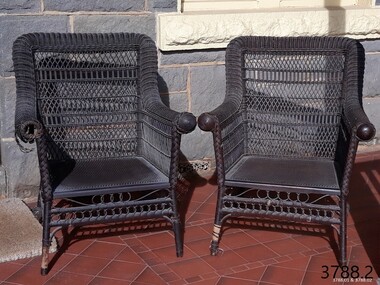
Furniture - Armchair, 1897-1921
... The wicker styles drew on the Aesthetic Movement and Japanese influences simpler designs arose in the wake of the Arts and Crafts Movement. ...The wicker styles drew on the Aesthetic Movement and Japanese influences simpler designs arose in the wake of the Arts and Crafts Movement. ...These cane chairs are one of many 19th-century items of furniture, linen and crockery donated to Flagstaff Hill Maritime Village by Vera and Aurelin Giles. The items are associated with Warrnambool and the Giles Family history. Items donated by the family have come to be known as the Giles Collection. Many items in the Lighthouse Keeper’s Cottage were donated by Vera and Aurelin Giles and mostly came from the home of Vera’s parents-in-law, Henry Giles and his wife Mary Jane (nee Freckleton), who married in 1880 and whose photos are on display in the parlour. Henry was born at Tower Hill in 1858 and was a labourer on the construction of the Warrnambool Breakwater before leaving in 1895 for around seven years to build bridges in NSW. Mary Jane was born in 1860 at Cooramook, and she attended Mailor’s Flat State School and where she eventually became a student teacher. After which she became a governess at “Injemiara”, where her grandfather, Francis Freckleton, had once owned land. Henry and Mary’s family consisted of six; some of the children were born at Mailor’s Flat, and later, some children were born at Wangoom. They lived with their parents at Wangoom and Purnim west, and this is where Henry died in 1933 and Mary Jane in 1940. Heywood & Wakefield Furniture Co: - The Heywood-Wakefield Company is an American furniture manufacturer established in 1897. It went on to become a major presence in the US. Its older products are considered collectibles and have been featured on television antique programs. The Heywood brothers established themselves in 1826 as furniture makers, and the Wakefield Company began in 1855 as a separate company. Both firms produced wicker and rattan furniture, and as these products became increasingly popular towards the end of the century, they became serious rivals. In 1897, the companies merged as Heywood Brothers & Wakefield Company (this name was changed to Heywood-Wakefield Company in 1921), purchasing Washburn-Heywood Chair Company in 1916, Oregon Chair Company in 1920, and Lloyd Manufacturing Company in 1921. While its wooden furniture plant in Gardner, Massachusetts, closed in 1979, a branch in Menominee, Michigan, continued to manufacture metal outdoor seats, auditorium seats, and school furniture. The Heywood-Wakefield Company Complex in Gardner was added to the National Historic Register in 1983. The South Beach Furniture Company acquired the rights to the name in 1994 and reproduces its wooden furniture. Both founding companies produced wicker and rattan furniture in the late 19th century. The wicker styles drew on the Aesthetic Movement and Japanese influences simpler designs arose in the wake of the Arts and Crafts Movement. The merged entity stayed abreast of wicker furniture trends by hiring designers such as Paul Frankl and Donald Deskey during the 1920s. Its furniture was exhibited at the 1933 Century of Progress exhibition and the 1964 New York World's Fair. During the 1930s and 1940s, Heywood-Wakefield began producing furniture using sleek designs based on French Art Deco.The Giles family collection has social significance at a local level because it illustrates the level of material support the Warrnambool community gave to Flagstaff Hill when the village and museum were established. The wicker furniture is a fine example of late 19th and early 20th century lightweight domestic furniture that is today a very collectible item and quite rare and valuable.Armchair: pair of wicker armchairs, painted dark brown. The open wicker weave pattern of a traditional Asian design extends from the seat up to the armrests and completely over the backrest, plus across the front of the chair below the seat. The seat is very firmly woven and fitted into a timber frame. A reinforcing pattern of wicker work covers the top edges of the armrests and backrest in one piece and folds around to the underside, referred to as rolled serpentine arms and back. The hollow ends of the armrests are filled with a circular knob of wicker work. The back legs are also completed with decorative wicker knobs. The frames are constructed from bamboo. One chair base (3788.1) has been strengthened with metal bracing. The other chair (3788.2) has the remnants of an orange manufacturer’s tag fixed to the base. The chairs were made from 1897 to 1921 by Heywood Brothers & Wakefield Company, USA. These chairs are part of the Giles Collection.Tag, orange with black print: “MANUFA - Heywood B – GARDNE”flagstaff hill, warrnambool, shipwrecked coast, flagstaff hill maritime museum, shipwreck coast, great ocean road, giles collection, giles family, henry and mary jane giles, tower hill, cooramook, warrnambool breakwater, mailor’s flat, wangoom, 19th century furniture, wicker armchairs, rolled serpentine wicker work, cane armchair, classic wicker furniture, victorian style furniture, domestic furniture late 19th century, chair, armchair, woven cane, wicker, rolled serpentine, manufa - heywood b – gardne, heywood brothers & wakefield company, usa -
 Flagstaff Hill Maritime Museum and Village
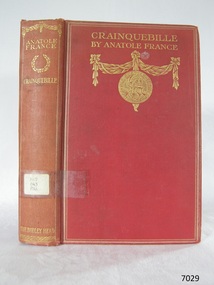
Book - Collection of Fictional Stories, Anatole France, Crainquebille Putois Riquet, 1915
... It was famous as the publisher of The Yellow Book and associated with Aubrey Beardsley, Oscar Wilde, and the aesthetic movement of the 1890s. By the 1910s, it was Anatole France's principal English-language publisher. ...It was famous as the publisher of The Yellow Book and associated with Aubrey Beardsley, Oscar Wilde, and the aesthetic movement of the 1890s. By the 1910s, it was Anatole France's principal English-language publisher. ...The story "Crainquebille" is the title piece and the book's best-known story; it follows an elderly Parisian street peddler wrongly accused of insulting a policeman. The court examination is characterised by the accused's silence in the face of an intimidating judicial system, with the president answering his own questions. It's a sharp satire of French justice and how the poor are treated by the legal system arguably France's most famous piece of social criticism. "Putois" is a lighter, whimsical fable. It's about a family that invents a fictional handyman as a convenient excuse, and the lie takes on a life of its own, spreading through the town until it seems poised to become real a wry meditation on how rumours and convenient lies can calcify into truth. "Riquet" concerns the philosophical dog belonging to the character Monsieur Bergeret, who appears to be a recurring figure in France's fiction, presented here along with "The Meditations of Riquet" as connected pieces. The volume also gathers several shorter tales: "The Necktie," "The Montil Manœuvres," "Émile," "Adrienne Buquet," "The Intaglio," "La Signora Chiara," "Upright Judges," "The Ocean Christ," and the "Jean Marteau" sequence, among others.Hard cover book. Crainquebille Putois Riquet Author: Anatole France Editor: Frederic Chapman Publisher: The Bodley Head/John Lane Translation : Winifred Stephens Date: 1915 Further Information: Red Cloth hardcover with lettering and patterning to spine in gilt. The spine has a Library label with an inscription. fictionThe story "Crainquebille" is the title piece and the book's best-known story; it follows an elderly Parisian street peddler wrongly accused of insulting a policeman. The court examination is characterised by the accused's silence in the face of an intimidating judicial system, with the president answering his own questions. It's a sharp satire of French justice and how the poor are treated by the legal system arguably France's most famous piece of social criticism. "Putois" is a lighter, whimsical fable. It's about a family that invents a fictional handyman as a convenient excuse, and the lie takes on a life of its own, spreading through the town until it seems poised to become real a wry meditation on how rumours and convenient lies can calcify into truth. "Riquet" concerns the philosophical dog belonging to the character Monsieur Bergeret, who appears to be a recurring figure in France's fiction, presented here along with "The Meditations of Riquet" as connected pieces. The volume also gathers several shorter tales: "The Necktie," "The Montil Manœuvres," "Émile," "Adrienne Buquet," "The Intaglio," "La Signora Chiara," "Upright Judges," "The Ocean Christ," and the "Jean Marteau" sequence, among others.warrnambool, shipwrecked-coast, flagstaff-hill, flagstaff-hill-maritime-museum, maritime-museum, shipwreck-coast, flagstaff-hill-maritime-village, shipwrecked-artefact, book, crainquebille putois riquet, anatole france -
 Flagstaff Hill Maritime Museum and Village
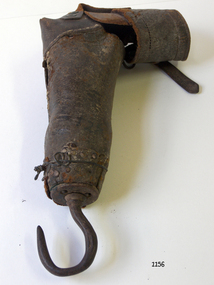
Functional object - Prosthetic Arm, Early 20th century
... Further development in the 20th century included lightweight, durable materials and electronic robotic movement of the hook, along with a more aesthetic appearance....Further development in the 20th century included lightweight, durable materials and electronic robotic movement of the hook, along with a more aesthetic appearance. This prosthetic arm is an example of an aid used to assist people with missing limbs, whether born that way or as a result of injury. flagstaff hill warrnambool shipwrecked coast flagstaff hill maritime museum maritime museum shipwreck coast flagstaff hill maritime village great ocean road prosthetic artificial arm artificial limb prosthetic arm false arm hook hand amputee's aid medical equipment medical assistive aid assistive aid rotating hook fake arm Prosthetic or artificial arm. ...This prosthetic arm has been made to assist a person who has part of his or her arm missing. The hook fixed to the end is an attempt to give the wearer extra assistance in replacing some of the functions of a hand. Prosthetic hook arms like this one have existed for centuries. Archaeological evidence shows that prosthetic limbs have been designed and used since almost 6000 years ago. Hooks for seafarers were made from whatever materials were readily available onboard the ship., such as metal, wood and leather. Often the prosthetic arms were simple lock-jointed pieces with basic hand positions. During the 19th century, advanced technology led to improved appearance and movement of prosthetics. Further development in the 20th century included lightweight, durable materials and electronic robotic movement of the hook, along with a more aesthetic appearance.This prosthetic arm is an example of an aid used to assist people with missing limbs, whether born that way or as a result of injury. Prosthetic or artificial arm. Brown leather cylinder with elbow pad and straps with buckles. A single rotating metal hook has been fixed to the end.flagstaff hill, warrnambool, shipwrecked coast, flagstaff hill maritime museum, maritime museum, shipwreck coast, flagstaff hill maritime village, great ocean road, prosthetic, artificial arm, artificial limb, prosthetic arm, false arm, hook hand, amputee's aid, medical equipment, medical assistive aid, assistive aid, rotating hook, fake arm -
 Eltham District Historical Society Inc
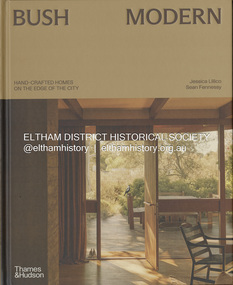
Book, Jessica Lillico, Bush Modern: Hand-crafted homes on the edge of the city, 4 Nov. 2025
... aesthetic has been quietly gaining recognition. Emerging out of necessity in the post-war years, it reimagined the sleek ideals of modernism through the lens of the local landscape. Simple homes built 'of the land' from mud bricks and recycled timber captured the mood of those searching for an alternative way of life close to nature. The movement...aesthetic has been quietly gaining recognition. Emerging out of necessity in the post-war years, it reimagined the sleek ideals of modernism through the lens of the local landscape. Simple homes built 'of the land' from mud bricks and recycled timber captured the mood of those searching for an alternative way of life close to nature. The movement ...From the publisher Thames & Hudson Australia's website: "In the bushy north-eastern fringe of Melbourne, an enduring, uniquely Australian architectural aesthetic has been quietly gaining recognition. Emerging out of necessity in the post-war years, it reimagined the sleek ideals of modernism through the lens of the local landscape. Simple homes built 'of the land' from mud bricks and recycled timber captured the mood of those searching for an alternative way of life close to nature. The movement gathered momentum in the counter-cultural 1960s and culminated in near-mainstream popularity in the 1970s. After a few decades where brown lost appeal in favour of white-washed minimalism, the style in all its warm, earthy glory is once again being embraced and revived by a new generation Through evocative photography by Sean Fennessy, personal stories and architectural insights, Bush Modern explores the timeless appeal of these character-filled homes: tactile, grounded and deeply in tune with their environment." Contents: Bush modern locations (map) Grounded in simplicity by Jessica Lillico and Sean Fennessy Time and place by Morag Fraser Houses featured - Stonygrad 1940, North Warrandyte Fraser-Jackson House 1947/1977, Montmorency Busst House 1948, Eltham Burstall House 1950, Montmorency Wright House II 1960, North Warrandyte Collis House 1966, Eltham Diskin House 1967, Eltham Redfern House 1967, North Warrandyte River Bend 1968/2022, Garambi Baan, Eltham Fisher House 1969, Warrandyte Borrack House 1970, Plenty Valley Fiddlers Elbow 1970, North Warrandyte Light Well House 1972, Donvale Birrarung House 1974, Garambi Baan, Eltham High Noon 1974, North Warrandyte Monty Sibbel 1975/2022, Montmorency Provan House 1976/2021, North Warrandyte Pizzey House 1977, Eltham Pittard House 1978, Eltham Gray House 1980, Eltham Carol Ann House 1989, Bend of Islands Wattle Glen 1999, Wattle Glen Big Hill 2001, Christmas Hills Inside front cover in ink: "Enjoy! Jess & Sean"stonygrad, fraser-jackson house, busst house, burstall house, wright house ii, collis house, diskin house, redfern house, river bend, fisher house, borrack house, fiddlers elbow, light well house, birrarung house, high noon, monty sibbel, provan house, pizzey house, pittard house, gray house, carol ann house, wattle glen, big hill -
 Eltham District Historical Society Inc
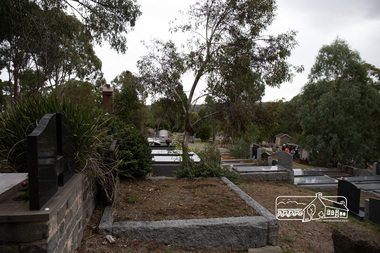
Photograph, Peter Pidgeon, Memorial to Alistair Knox, Eltham Cemetery, Victoria, 5 April 2021
... aesthetically pleasing. Mud-brick manufacture was a problem at first. Sonia Skipper had been experimenting with Eltham clays for years to find the best mix for making bricks and render. Alistair employed her as building foreman on several of his sites. By the 1980s, he had brought mud-brick and earth building into the Australian mainstream, and a Knox-designed house had become highly desirable. Sonia said that he would craft a bespoke earthen house to fit with his client's lifestyle. He was drawn to the environmental movement...aesthetically pleasing. Mud-brick manufacture was a problem at first. Sonia Skipper had been experimenting with Eltham clays for years to find the best mix for making bricks and render. Alistair employed her as building foreman on several of his sites. By the 1980s, he had brought mud-brick and earth building into the Australian mainstream, and a Knox-designed house had become highly desirable. Sonia said that he would craft a bespoke earthen house to fit with his client's lifestyle. He was drawn to the environmental movement ...Alistair Knox was an environmental based designer and builder who came to Eltham in 1948. Influenced by Frank Lloyd Wright and Walter Burley Griffin, he sought to create buildings that would blend into the landscape, enhanced by the planting of indigenous flora. The post-war shortage of building materials made traditional construction expensive. Adobe (mudbrick) provided a cheap and plentiful alternative, and one which would be aesthetically pleasing. Mud-brick manufacture was a problem at first. Sonia Skipper had been experimenting with Eltham clays for years to find the best mix for making bricks and render. Alistair employed her as building foreman on several of his sites. By the 1980s, he had brought mud-brick and earth building into the Australian mainstream, and a Knox-designed house had become highly desirable. Sonia said that he would craft a bespoke earthen house to fit with his client's lifestyle. He was drawn to the environmental movement, publishing three books on housing and the environment, and speaking on radio. He also served on the Eltham Shire Council 1971-1975, was Shire President 1974 and was instrumental in re-establishing the Eltham Community Festival in 1975. Alistair died in 1986 and is buried in a small garden setting at Eltham Cemetery.Born Digitaleltham cemetery, gravestones, heritage excursion, alistair knox -
 Eltham District Historical Society Inc
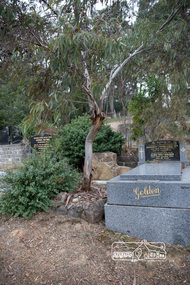
Photograph, Peter Pidgeon, Grave of Alistair Samuel Knox, Eltham Cemetery, Victoria, 5 April 2021
... aesthetically pleasing. Mud-brick manufacture was a problem at first. Sonia Skipper had been experimenting with Eltham clays for years to find the best mix for making bricks and render. Alistair employed her as building foreman on several of his sites. By the 1980s, he had brought mud-brick and earth building into the Australian mainstream, and a Knox-designed house had become highly desirable. Sonia said that he would craft a bespoke earthen house to fit with his client's lifestyle. He was drawn to the environmental movement...aesthetically pleasing. Mud-brick manufacture was a problem at first. Sonia Skipper had been experimenting with Eltham clays for years to find the best mix for making bricks and render. Alistair employed her as building foreman on several of his sites. By the 1980s, he had brought mud-brick and earth building into the Australian mainstream, and a Knox-designed house had become highly desirable. Sonia said that he would craft a bespoke earthen house to fit with his client's lifestyle. He was drawn to the environmental movement ...Alistair Knox was an environmental based designer and builder who came to Eltham in 1948. Influenced by Frank Lloyd Wright and Walter Burley Griffin, he sought to create buildings that would blend into the landscape, enhanced by the planting of indigenous flora. The post-war shortage of building materials made traditional construction expensive. Adobe (mudbrick) provided a cheap and plentiful alternative, and one which would be aesthetically pleasing. Mud-brick manufacture was a problem at first. Sonia Skipper had been experimenting with Eltham clays for years to find the best mix for making bricks and render. Alistair employed her as building foreman on several of his sites. By the 1980s, he had brought mud-brick and earth building into the Australian mainstream, and a Knox-designed house had become highly desirable. Sonia said that he would craft a bespoke earthen house to fit with his client's lifestyle. He was drawn to the environmental movement, publishing three books on housing and the environment, and speaking on radio. He also served on the Eltham Shire Council 1971-1975, was Shire President 1974 and was instrumental in re-establishing the Eltham Community Festival in 1975. Alistair died in 1986 and is buried in a small garden setting at Eltham Cemetery.Born Digitaleltham cemetery, gravestones, heritage excursion, alistair samuel knox -
 Coal Creek Community Park & Museum
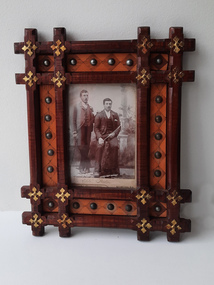
Fiddleback Frame
... This item is aesthetically significant, as it is an example of Arts and Crafts movement, 1880's Hand made Picture Frame, made by Local Korumburra, Carpenter and Builder Mr. ...It is made from polished fiddleback, Blackwood and sassafras, and studded with ornamental metalwork.This item is aesthetically significant, as it is an example of Arts and Crafts movement, 1880's Hand made Picture Frame, made by Local Korumburra, Carpenter and Builder Mr. Dan Jarvis. As a Builder, this item was made as a hobby item which showed his Excellent skills with minute craftsmanship. It was selected, and featured as item 233, in Murray Walkers catalog, Colonial Crafts of Victoria, published in 1978, for the Exhibition at the National Gallery of Victoria, November 1978 to January 1979.This hand-made picture frame is an example of the Arts and Crafts movement from the 1880's. It was made by Local Korumburra carpenter and builder, Mr. Dan Jarvis. This showed his excellent skills with minute craftsmanship. It was selected in 1978, and featured as item 233 in Murray Walker’s catalogue, Colonial Crafts of Victoria, for the exhibition at the National Gallery of Victoria. -
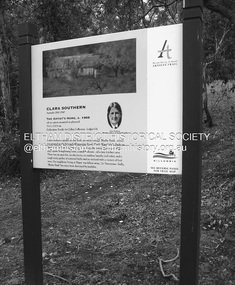 Eltham District Historical Society Inc
Photograph - Digital Photograph, Alan King, Sign: Clara Southern, Heidelberg School Artists Trail, Main Road, Research, 2008
... aesthetic sensibilities. As early as 1900, Will Longstaff, known for his painting The Ghosts of Menin Gate at the National War Memorial in Canberra, lived at Stanhope in Peter Street, Eltham, later to become the home of intellectuals Clem and Nina Christensen. Members of Australia’s first significant art movement...aesthetic sensibilities. As early as 1900, Will Longstaff, known for his painting The Ghosts of Menin Gate at the National War Memorial in Canberra, lived at Stanhope in Peter Street, Eltham, later to become the home of intellectuals Clem and Nina Christensen. Members of Australia’s first significant art movement ...Warrandyte artist, Clara Southern, features on the Artists Trail. Published: Nillumbik Now and Then / Marguerite Marshall 2008; photographs Alan King with Marguerite Marshall.; p189 Since early in the 20th century this district has attracted artists and other creative people. So much so, that Eltham has been compared to the Left Bank in Paris, New York’s Greenwich Village and London’s Bloomsbury. That is until the 1970s when Eltham rapidly expanded into a suburb. However many artists still flourish not only in Montsalvat, Dunmoochin and the Bend of Islands but elsewhere in Nillumbik. Some artists who have worked or lived in Nillumbik are well-known nationally and internationally. Artists are attracted to the hilly district’s subtle colours, unique light and the Yarra River and Diamond Creek. The railway’s extension to Eltham in 1902 brought artists to paint for the day or to camp. Then many settled in Eltham, perhaps also because the poor quality land, far from the city, was cheap. Following World War Two they found they could build houses and studios cheaply by making their own mud-bricks. The flexible material, with its warm tones blending into the bush, also satisfied their aesthetic sensibilities. As early as 1900, Will Longstaff, known for his painting The Ghosts of Menin Gate at the National War Memorial in Canberra, lived at Stanhope in Peter Street, Eltham, later to become the home of intellectuals Clem and Nina Christensen. Members of Australia’s first significant art movement, the Heidelberg School of Artists, painted in Eltham, Warrandyte and Diamond Creek. Walter Withers lived at the corner of Bolton and Brougham Street, Eltham and taught Sir Hans Heysen, who for a short while stayed with the Withers family. In Warrandyte were Clara Southern, whom Frederick McCubbin taught at the National Gallery School and Penleigh Boyd, who is represented in all Australian state galleries and the National Collection in Canberra. May Vale, daughter of politician William, lived in Diamond Creek. With Jane Price they feature on the Heidelberg School Artists Trail, part of which runs through Nillumbik. The trail includes signs each displaying a reproduction of a painting by an artist and located near where the artist lived or painted. In Nillumbik the trail includes parts of Warrandyte, Eltham in the Alistair Knox Park, Main Road shopping precinct and Wingrove Park, the Research walking track on Main Road and the Diamond Creek Reserve. In 1916 artist William ‘Jock’ Frater lived at the corner of Arthur and Bible Streets, Eltham. Before then, Frater, with other artists including Percy Leason (who moved to Eltham in the mid 1920s) painted in Eltham on weekends. They camped near Bible and Pitt Streets and along the Diamond Creek where the Eltham Retirement Centre now stands.4 In 1921, painter Peter Newbury (father to painter David Newbury, who was born in Eltham) moved to Cromwell Street, Eltham. Max Meldrum, the first Australian painter to formulate a consistent theory of art largely based on tone,5 taught local artists Alan Martin, Clarice Beckett, Peter Glass and Justus Jörgensen. Meldrum visited Eltham then rented a house there for 18 months opposite Wingrove Park. In 1934, artist and architect Justus Jörgensen and his doctor wife Lil and friends built Montsalvat, the artists’ colony. Montsalvat has played an important part in attracting artists to Eltham and its mud-brick, pisé, stone and recycled building materials has had a major influence on Eltham’s built environment. Jörgensen’s students who also helped him build Monstalvat included Arthur Munday, Lesley Sinclair, Helen Lempriere, Joe Hannan, Helen, Sonia and jeweller/sculptor, Matcham Skipper. Among artists who visited Montsalvat were Clifton Pugh and Angry Penguins’ artists Albert Tucker and Arthur Boyd. Some who painted after World War Two were Alan Martin of Eltham and Warrandyte artists Frank Crozier and Harry De Hartog6, one of Melbourne’s first painters influenced by Cubism.This collection of almost 130 photos about places and people within the Shire of Nillumbik, an urban and rural municipality in Melbourne's north, contributes to an understanding of the history of the Shire. Published in 2008 immediately prior to the Black Saturday bushfires of February 7, 2009, it documents sites that were impacted, and in some cases destroyed by the fires. It includes photographs taken especially for the publication, creating a unique time capsule representing the Shire in the early 21st century. It remains the most recent comprehenesive publication devoted to the Shire's history connecting local residents to the past. nillumbik now and then (marshall-king) collection, clara southern, main road, research (vic), heidelberg school artists trail -
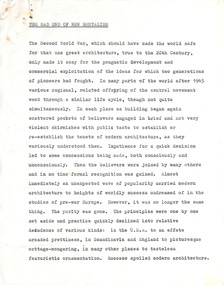 Robin Boyd Foundation
Document - Manuscript, Robin Boyd, The Sad End of New Brutalism, 1967
... aesthetic. Boyd discusses the arguments of Banham and the new brutalism in the context of the subtitle. It concludes with a code to characterise the modern movement....aesthetic. Boyd discusses the arguments of Banham and the new brutalism in the context of the subtitle. It concludes with a code to characterise the modern movement. ...Discusses the new brutalism, as a revival of the rebellious spirit of early modern architecture, in the context of Reyner Banham's book "The New Brutalism", with the subtitle ethic and aesthetic. Boyd discusses the arguments of Banham and the new brutalism in the context of the subtitle. It concludes with a code to characterise the modern movement.Original manuscript of an article published in Architectural Review Vol 142, No 845, July 1967. pp. 9–11 and reprinted as ‘El triste fin del Nuevo Brutalismo’ in 'Cuadernos Summa Nueva Vision' (Buenos Aires), No’s 24/25, May 1969, pp. 51-53.Two copies. One typewritten (c/copy) pencil edits Second typewritten (p/copy). Both quarto, 14 pagesle corbusier, reyner banham, smithson, peter and alison smithson, modernism, brutalism, robin boyd, manuscript -
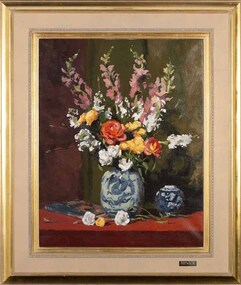 Wangaratta Art Gallery
Painting, Paul McDonald Smith, Flower Study, 1997
... The depiction of a Japanese dragon vase hints at the art aesthetic of Japonisme in the European Impressionist movement, a possible nod of respect to the movement by McDonald Smith....The depiction of a Japanese dragon vase hints at the art aesthetic of Japonisme in the European Impressionist movement, a possible nod of respect to the movement by McDonald Smith. wangaratta art gallery painting still life paul mcdonald smith Obverse: P McDONALD SMITH (bottom right corner) A rectangular still life painting of a bunch of flowers in a vase painted in oil using shades of white, red, green, blue, and yellow. ...McDonald Smith is famous for paining in the tradition of tonal impressionism, with most of his works painted in oil. This influence of the European Impressionist art style is clearly seen in his artwork Flower Study. The notion of light, an impressionist theme, is depicted by the use of a tonal colour palette and varied brushstrokes. The depiction of a Japanese dragon vase hints at the art aesthetic of Japonisme in the European Impressionist movement, a possible nod of respect to the movement by McDonald Smith.Rural City of Wangaratta Collection, Wangaratta Art Prize 1997.A rectangular still life painting of a bunch of flowers in a vase painted in oil using shades of white, red, green, blue, and yellow.Obverse: P McDONALD SMITH (bottom right corner)wangaratta art gallery, painting, still life, paul mcdonald smith -
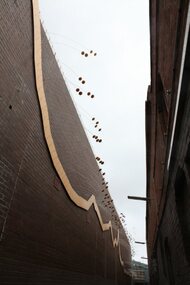 City of Ballarat
Artwork, other - Public Artwork, Sue Buchanan et al, Gold Fever by Eli Giannini and Sue Buchanan, 2011
... movement follows a pricing graph for gold from 1851 to 2011. This zigzagging golden graph line tells the tale of the gold rush spreading like lightning across the world. The artwork is of historic and aesthetic ...Gold Fever illuminates Drury Lane walkway entrance to Bridge Street Mall. The multiple metal forms act like mobiles suspended from the wall line out into the centre of the walkway. The flexing motion of the rolled metal and traffic reflectors wrapped on the ends creates movement and reflections in the laneway. This movement follows a pricing graph for gold from 1851 to 2011. This zigzagging golden graph line tells the tale of the gold rush spreading like lightning across the world. The artwork is of historic and aesthetic significance to the people of Ballarat Gold coloured bended metal, painted metal formed wall fitting and stoppers reflectors installed on wallGOLD FEVER/ Artists: Sue Buchanan and Eli Gianninigold fever, gold rush ballarat -
 City of Ballarat
Artwork, other - Public Artwork, Friends of Learmonth, Flock by The Friends of Learmonth
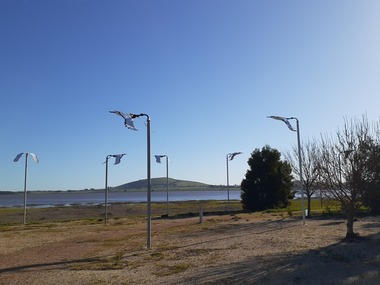
... Balanced on a spherical joint to allow fluid movement in all directions, each element of the Flock is designed to look like a bird in flight. The kinetic wind-powered elements of the artwork were inspired by the nearby Waubra Wind Farm. The artwork is of aesthetic ...The Flock is a kinetic sculpture made up of 11 parts. It celebrates a local migratory bird, the ibis. The sculpture comprises tall steel poles with a steel ibis balanced on the top of each pole by its beak. Balanced on a spherical joint to allow fluid movement in all directions, each element of the Flock is designed to look like a bird in flight. The kinetic wind-powered elements of the artwork were inspired by the nearby Waubra Wind Farm.The artwork is of aesthetic and social significance to the people of BallaratEleven white and black birds on poles with moving partsibis, friends of learmonth, learmonth -
 Albert Park-South Melbourne Rowing Club
APRC 1956 Olympic Banner, 1957
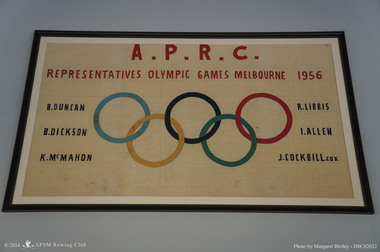
... aesthetically pleasing. The collection holds black and white photographs of the same oarsmen at the Olympic regatta. This banner complements their role in the collection by providing colour and a sense of connection with an affectionate and supportive community. Its social significance transcends the local context for which it was created and used, to become part of the large body of art, craft and memorabilia that are associated with the Olympic movement worldwide. rowing apsm rowing club olympic games albert park rowing club albert park lake duncan, robert dickson, bruce allen, ian libbis, reg mcmahon, kevin cockbill, john A.P.R.C. / REPRESENTATIVES OLYMPIC GAMES MELBOURNE 1956 / R. ..."The banner has been with the Club since it was created in 1957. Recent research has confirmed that it was made by Joan Eddy, the wife of club member Kevin Eddy and a professional seamstress. Grace Blake’s interview notes record her conversation with Mr Eddy on 24 October 2014: Kevin confirmed that the banner was made by his wife, Joan Eddy, in time for the opening of the new shed after the Olympics (1957). Kevin was the Social Secretary at the time, and co-opted his wife, who had worked as a machinist for Harford Clothing in Carlton before they married. Her mother had also worked there as a sewing hand (hand sewing the linings for jackets). The company was later taken over by Sires. ... It was made at home (Joan had ‘retired’ from work by then)." Excerpt from the 2014 Significance Assessment, p32.Banner Celebrating Albert Park Rowing Club Olympic Representatives, 1956 Statement of significance by Margaret Birtley, October 2014 Harry Gordon, the distinguished Australian sports historian, wrote of the 1956 Melbourne Olympic Games: "When the Olympic Games moved into Melbourne ... it was as if the city had been brushed by a certain magic. Nothing before or since ... has ever evoked such sheer emotional involvement from the whole community." Gordon refers to the large crowds that massed in Melbourne with anticipation and exhilaration on the day before the official opening, ‘with little apparent motive other than just to be there, and be happy’. The hand-crafted banner celebrating Albert Park Rowing Club’s representatives at those Olympic Games seems to exude that same sense of joy and exhilaration. Made by the wife of the club’s social secretary, it testifies to the admiration felt by individuals and organisations for the success of their own on a world stage. The banner has historic significance for its accurate documentation of the great achievement of a single rowing club in contributing six outstanding athletes to the relatively small Australian rowing team. Additional historic significance derives from the fact that this is an unofficial expression of tribute and pride. The banner’s incorporation of the Olympic rings would now be likely to require licensing by the Australian Olympic Committee, a process that can dampen social engagement. While definitely a hand-made item, there is some aesthetic significance in the design and execution of the banner. Good judgement has been demonstrated in the selection of fabrics and the choice of colours. The workmanship is quite skilful. The vertical symmetry and the horizontal balance of the design are pleasing to the eye. The use of red for the heading lines and black for the Olympians names is well-chosen and aesthetically pleasing. The collection holds black and white photographs of the same oarsmen at the Olympic regatta. This banner complements their role in the collection by providing colour and a sense of connection with an affectionate and supportive community. Its social significance transcends the local context for which it was created and used, to become part of the large body of art, craft and memorabilia that are associated with the Olympic movement worldwide. A handmade embroidered banner to commemorate the Albert Park members who were part of the 1956 Olympic Rowing team.A.P.R.C. / REPRESENTATIVES OLYMPIC GAMES MELBOURNE 1956 / R. DUNCAN / R. DICKSON / K. McMAHON / R. LIBBIS / I. ALLEN / J COCKBILL coxrowing, apsm rowing club, olympic games, albert park rowing club, albert park lake, duncan, robert, dickson, bruce, allen, ian, libbis, reg, mcmahon, kevin, cockbill, john -
 Hymettus Cottage & Garden Ballarat
Functional object - Bookmark, Scottish Widows Assurance Fund
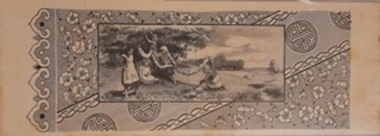
... Issued c. 1900 and printed in black on a thin card with aesthetic movement decoration surrounding an English country scene the reverse has a medallion designed by Walter Crane. ...The Scottish Widows' Fund was a Mutual Life Assurance Society established in 1815. It started issuing bookmarks advertising its services in the early 19th century. Many of these bookmarks may be found in Australia as not only were many Fund investors/insured in the Australian colonies but A & C Black books also contained these bookmarks and were sold in the colonies with them.Issued c. 1900 and printed in black on a thin card with aesthetic movement decoration surrounding an English country scene the reverse has a medallion designed by Walter Crane. walter crane, bookmark, a & c. black, australian colonies, scottish widows' fund, insurance company, australia, art
