
Showing 77 items matching "aftermath of war"
-
 Warrnambool RSL Sub Branch
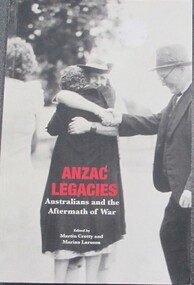
Book, BOOK: ANZAC LEGACIES - Australians and the aftermath of war
... BOOK: ANZAC LEGACIES - Australians and the aftermath of war...Edited by: Martin Crotly and Maria Larsson Publisher: Australian Scholarly Publications. 2010 BOOK: ANZAC LEGACIES - Australians and the aftermath of war Book ... -
 Moorabbin Air Museum
Book - RAAF air bases, Air Base Richmond The Story of the RAAF base on the Hawkesbury
... ...Aftermath of war...RAAF bases Early days Enter the RAAF The squadrons arrive Early thirties Expansion War declared The early war years The WAAAF The paratroopers The war continues Aftermath of war On to the nineties Bicentennial air show Historical overview of RAAF base Richmond, circa 1991 Air Base Richmond The Story of the RAAF base on the Hawkesbury Book RAAF air bases ...Historical overview of RAAF base Richmond, circa 1991non-fictionHistorical overview of RAAF base Richmond, circa 1991early days, enter the raaf, the squadrons arrive, early thirties, expansion, war declared, the early war years, the waaaf, the paratroopers, the war continues, aftermath of war, on to the nineties, bicentennial air show -
Bendigo Historical Society Inc.
Book - HARRY BIGGS COLLECTION: THE ILLUSTRATED WAR NEWS JAN 13TH 1915, 13 Jan, 1915
... Photo of war activities, and the aftermath of war....Photo of war activities, and the aftermath of war. Book HARRY BIGGS COLLECTION: THE ILLUSTRATED WAR NEWS JAN 13TH 1915 ...Book. Harry Biggs Collection. A damaged book titled 'The Illustrated War News, Jan 13, 1915 - (Part 23) Pages 5 to 46. Without a cover. Photo of war activities, and the aftermath of war.organisation, union, harry biggs collection, the illustrated war news jan 13th 1915 -
 City of Kingston
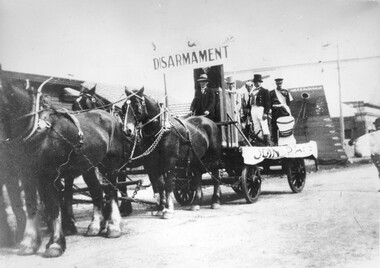
Photograph - Black and white, Disarmament Parade, Cheltenham, c.1918
... In the aftermath of World War I, calls for disarment rang out. ...In the aftermath of World War I, calls for disarment rang out. ...In the aftermath of World War I, calls for disarment rang out. Under the Treaty of Versailles, the 'peace treaty' signed in the Hall of Mirrors at Veresailles, Germany was declared the aggressor in WWI and restrictions were placed on the size of its military, the manufacture of armoured cars, tanks, submarines, planes and poisonous, and a demilitarised zone was put in place between Germany and France. The forced disarmament of Germany, it was hoped, would be accompanied by voluntary disarmament in other nations.It's difficult to know if this photograph was taken at the close of World War I, or later, when 'world disarment' was being investigated and promoted (c. 1920). Either way, a float bearing a banner in support of disarment made its way down Charman Road, Cheltenham to garner support. Black and white image of a wagon, drawn by four horses, with a group of men standing on the wagon.protest, war, disarmament -
 Linton and District Historical Society Inc
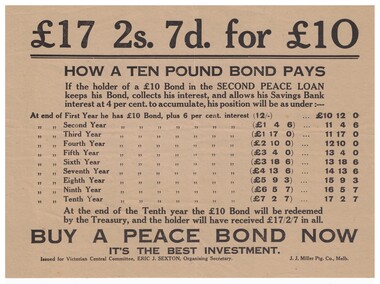
Document - Leaflet, How a Ten Pound Bond Pays
... In the aftermath of World War 1, the Australian government aimed to raise 25 million pounds through the Second Peace Loan. ...In the aftermath of World War 1, the Australian government aimed to raise 25 million pounds through the Second Peace Loan. ...In the aftermath of World War 1, the Australian government aimed to raise 25 million pounds through the Second Peace Loan. Money raised was to be used for the repatriation and resettlement of former servicemen. Targets were set for money to be raised in each of the Australian states. This notice encouraged Victorians to help WWI returned servicemen through the purchase of peace bonds. It details the amount of interest a purchaser of a bond in the Second Peace Loan would receive after ten years. This notice was displayed in various public buildings, and the wording of the notice was also used in newspaper advertisements, for example this advertisement appeared in The Argus on 6 September 1920.Small cream coloured notice advertising the financial rewards to be gained through investment in peace bonds issued by the Australian government as part of the Second Peace Loan 1920.peace bonds, world war i, first world war -
 Emerald Museum & Nobelius Heritage Park
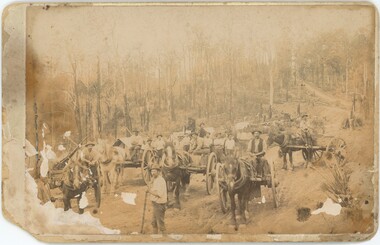
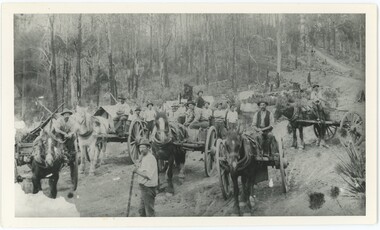
Photograph, Mr O'Connor, Making the Road to Clematis, c. 1920
... Public works projects such as road constructions were popular in the immediate aftermath of the First World War, when many men returned home without work and were eager to earn a living by participating in government projects....Public works projects such as road constructions were popular in the immediate aftermath of the First World War, when many men returned home without work and were eager to earn a living by participating in government projects. ...In late 1919, the Country Roads Board approved an amendment of the Belgrave-Emerald Road between Gembrook Road (likely now Old Gembrook Road) in Emerald and Paradise (now Clematis) Station. This image shows part of those works, where they intersected with Ogilvy Road. Public works projects such as road constructions were popular in the immediate aftermath of the First World War, when many men returned home without work and were eager to earn a living by participating in government projects.This image represents an infrastructure project from the 1920s that helped to build the Emerald of today. It displays the tools and technology available for public works projects in the early 20th century, and the manner in which road construction occurred.A sepia photograph on card backing depicting a road construction project. The workers are relying on horses and manual labour to build a road amongst trees and hills. The lower-left corner of the photograph is damaged and faded, with some damage and the photo peeling away from the backing along the left side as a whole. The rear has some handwritten text, with some illegible.Rear: "Mr O'Connor / 12 / date / Clematis / Making the Road to Clematis / 1920?"emerald, clematis, 1920s, transport -
 Emerald Museum & Nobelius Heritage Park
Photograph, Mr O'Connor, Making the Road to Clematis, Original Taken c. 1920
... Public works projects such as road constructions were popular in the immediate aftermath of the First World War, when many men returned home without work and were eager to earn a living by participating in government projects. ...Public works projects such as road constructions were popular in the immediate aftermath of the First World War, when many men returned home without work and were eager to earn a living by participating in government projects. ...In late 1919, the Country Roads Board approved an amendment of the Belgrave-Emerald Road between Gembrook Road (likely now Old Gembrook Road) in Emerald and Paradise (now Clematis) Station. This image shows part of those works, where they intersected with Ogilvy Road. Public works projects such as road constructions were popular in the immediate aftermath of the First World War, when many men returned home without work and were eager to earn a living by participating in government projects. This image is a black-and-white copy of the original sepia photograph (VEMUP0996).This image represents an infrastructure project from the 1920s that helped to build the Emerald of today. It displays the tools and technology available for public works projects in the early 20th century, and the manner in which road construction occurred.A black and white photograph on paper depicting a road construction project. The workers are relying on horses and manual labour to build a road amongst trees and hills. The lower-left corner of the photograph is faded - an artefact from the original that this is a copy of, though this copy was made when more of the original was intact.N/Aemerald, clematis, 1920s, transport -
 Flagstaff Hill Maritime Museum and Village
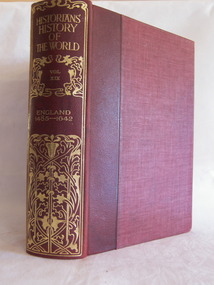
Book - Reference Book/History, Henry Smith Williams, The Historians History of the World Vol 19 set 1 - Edited by Henry Smith Williams L.L.D. Published by “The Times” 1908, 1908
... Volume 19 covers the history of England from the rise of the Tudor Dynasty to the eve of the English Civil War. The narrative begins with the aftermath of the Wars of the Roses and the coronation of Henry VII (1485). ...Volume 19 covers the history of England from the rise of the Tudor Dynasty to the eve of the English Civil War. The narrative begins with the aftermath of the Wars of the Roses and the coronation of Henry VII (1485). ...Henry Smith Williams’ “The Historians' History of the World” is a chronological and geographical "tapestry" of human events, these twenty five volumes occupy a very specific and prestigious place in historical research. Volume 19 is a pivotal component of the series, focusing specifically on a trans-formative era of British history from 1485 to 1642 covering the history of England from the rise of the Tudor Dynasty to the eve of the English Civil War.The Book is part of a 25 volume set with red cloth bindings and gold filigree design to rib.non-fictionHenry Smith Williams’ “The Historians' History of the World” is a chronological and geographical "tapestry" of human events, these twenty five volumes occupy a very specific and prestigious place in historical research. Volume 19 is a pivotal component of the series, focusing specifically on a trans-formative era of British history from 1485 to 1642 covering the history of England from the rise of the Tudor Dynasty to the eve of the English Civil War.flagstaff hill, warrnambool, shipwrecked-coast, flagstaff-hill-maritime-museum, maritime-museum, shipwreck-coast, flagstaff-hill-maritime-village, book, the historians history of the world vol 19 set 1, henry smith williams -
 Warrnambool and District Historical Society Inc.
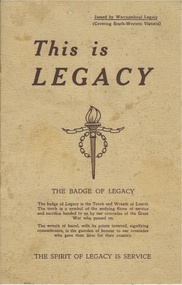
Work on paper - Booklet, This is Legacy, 1947
... Legacy had its origins in the aftermath of the first World War. General Sir John Gellibrand in 1923 in Hobart established the Remembrance Club which was to assist returned soldiers. ...Legacy had its origins in the aftermath of the first World War. General Sir John Gellibrand in 1923 in Hobart established the Remembrance Club which was to assist returned soldiers. ...Dark cream coloured soft card cover with brown text. Title is in larger text with the Legacy emblem in the centre of the front cover. The back cover has the poem, Flanders Field and the legacy response. Eight pages which has text and some photographs. A list of Warrnambool office bearers is on the inside back cover. non-fictionlegacy 1947, warrnambool history, warrnambool legacy -
 Flagstaff Hill Maritime Museum and Village
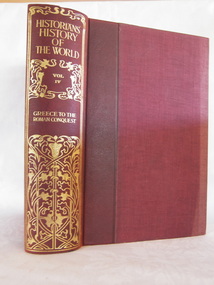
Book - Reference Book/History, Henry Smith Williams, The Historians History of the World Vol 4 set 1 - Edited by Henry Smith Williams L.L.D. Published by “The Times” 1908, 1908
... Volume 4 is a deep dive into the later history of Ancient Greece, specifically focusing on the period from the aftermath of the Peloponnesian War through to the Roman conquest. ...Volume 4 is a deep dive into the later history of Ancient Greece, specifically focusing on the period from the aftermath of the Peloponnesian War through to the Roman conquest. ...The 1908 edition of The Historians' History of the World is a monumental work of Edwardian scholarship, representing a specific era of "universal history" where the goal was to synthesise all human knowledge into a single narrative. Volume 4 is a deep dive into the later history of Ancient Greece, specifically focusing on the period from the aftermath of the Peloponnesian War through to the Roman conquest. This volume bears the subtitle "Greece to the Roman Conquest." It covers several pivotal shifts in power regards the post war struggle (404 to 374 BC.)Book is part of a 25 volume set with red cloth bindings and gold filigree design to rib.non-fictionThe 1908 edition of The Historians' History of the World is a monumental work of Edwardian scholarship, representing a specific era of "universal history" where the goal was to synthesise all human knowledge into a single narrative. Volume 4 is a deep dive into the later history of Ancient Greece, specifically focusing on the period from the aftermath of the Peloponnesian War through to the Roman conquest. This volume bears the subtitle "Greece to the Roman Conquest." It covers several pivotal shifts in power regards the post war struggle (404 to 374 BC.)flagstaff hill, warrnambool, shipwrecked-coast, flagstaff-hill, flagstaff-hill-maritime-museum, maritime-museum, book, the historians history of the world vol 4 set 1, henry smith williams -
 City of Melbourne Libraries
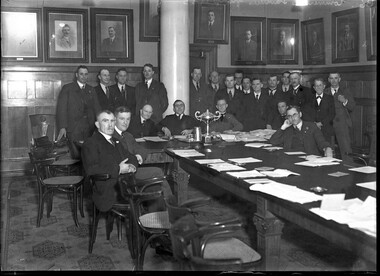
Photograph, Bull, Hugh Jones, 1897-1993, Commercial Travellers' Association, Victoria, Board Room
... The film is based on the bestselling Neville Shute novel about the aftermath of World War Three, a nuclear war that has obliterated most of the Northern Hemisphere. ...The film is based on the bestselling Neville Shute novel about the aftermath of World War Three, a nuclear war that has obliterated most of the Northern Hemisphere. ...Seven seated and fifteen standing men dressed in suits around a long table in a panelled room hung with formal portraits of men. A trophy sits on the long table amongst loose paper sheets. Research by project volunteer, Fiona Collyer: The Commercial Travellers’ Association of Victoria (CTA) was formed at a meeting of 40 commercial travellers held at the Duke of Rothesay Hotel, 24 Elizabeth Street on 1 December 1880. Their charter was to advocate for better working conditions for commercial travelling salesmen, including improved accommodation at discounted rates and travel concession fares. At first by locomotive, horse and buggy, steamers and horseback, later also by motor car and motorcycle, “The Man on the Road” went into the back-blocks of the country to extend the interests of commerce to the stores and households of Australian regional towns and isolated settlements. Affiliated organisations existed in all states and New Zealand and in 1895 they integrated to form the United Commercial Travellers’ Association of Australasia (UCTAA). By the turn of the 20th century, the Victorian branch of the CTA had 421 Association Members and 520 Club members. The CTA continued to hold meetings in leased rooms in hotels and offices until 1898 when they commissioned purpose-built premises at 190-192 Flinders Street (extant, now the Macstore, next to former Metropolitan Gas Company Buildings). Designed by leading architectural firm of brothers H.W. & F.B.Tompkins (Dimmey’s Model Store, Swan Street, London Stores, Herald and Weekly Times, Myer building, Diamond House, Centreway Arcade, Manton’s Store) in the Queen Anne Revival style at the cost of £20,000, the four storey building had a facade of red Northcote bricks and an entrance of Pyrmont stone. It was very modern for the time, featuring elevators, offices, bars, kitchen, dining, card and billiard rooms and 31 bedrooms with shared bathrooms for the footsore travellers. However, despite adding two storeys in 1901, and another storey and a basement in 1905, they soon outgrew their premises, and in 1912 the CTA commissioned a new building at 328 Flinders Street. At this time, buildings in Melbourne were constrained by the city height limit of 132 feet (40 metres)- the maximum height of firefighting ladders. The new CTA building was the tallest building in Melbourne until 1932 when regulations changed allowing the Manchester Unity Building to be built. The new CTA headquarters was the epitome of comfort and luxury with cutting edge facilities to ease the fatigued salesman and prepare him for another stint on the road. General Secretary, James Davies travelled to Britain and America to acquire the very best and latest innovations. After visiting the new premises, Punch magazine 11 June 1914 reported “furnishings, appliances, and labour-saving conveniences which were more than up to date- they were up to-morrow.” The Edwardian Baroque style building was again designed by architects H.W. & F.B. Tompkins at the cost of £100,000 and built by contractors F.E. Shillabeer and Sons (Nicholas Building, Kellow-Falkiner Pty Ltd car showroom). The nine storey plus basement building is of steel frame construction with concrete floors. The ground floor facade is of grey granite and above that it is faced with cream glazed bricks chosen to combat discolouration from the pollution emitted by Flinders Street Station trains across the road. The facade is decorated with mascarons, gum leaf trim and balconies with classical style balustrade. The club was entered through revolving doors into a two storey high, circular, domed lobby with white columns, American oak panelled walls and intricate mosaic flooring. The ceiling is festooned with plaster gum leaf and gum nut detail, a theme that is repeated throughout the building. The basement kitchen had modern, labour saving appliances that would be the envy of any Edwardian housewife, including an electric toaster, a potato peeling machine, heated dumb waiter, dishwashing machine and electric refrigeration and cooking. It serviced the commodious second floor dining room which seated 200 people and the cafe/breakfast room, 80 people. Members were permitted to entertain their lady friends there for afternoon tea between the hours of 3 and 5 pm every day, except Sunday. The members’ facilities included a barbershop, clothes pressing machine, boot cleaning chair, pipe and cigar stall with electric humidor, public telephones, lockers and safe deposit. The building was serviced with five elevators, a built in vacuum cleaning plant, hot water radiators and linen and postal chutes. The first floor was devoted to business and relaxing, containing the Board, Writing, Reading and four Business Rooms. The board room had Queensland maple panelling with huge blackwood tables topped with blue morocco and golden tortoise-shell trim and cane bottomed chairs. Large framed photographs of past presidents since 1884 lined the walls. The Reading Room ran the whole width of the building. Arthur Streeton’s painting “Between the Lights, Princes Bridge 1888” and Frederick McCubbin’s “Looking North from Mount Macedon” were hung there, as well as paintings by renowned Australian artists Hans Heysen, Walter Withers, John Mather, Jan Hendrik Scheltema. The Argus 30 May 1914 quipped “Around the walls hang evidences that the commercial traveller's soul has not been killed in his pursuit of commerce”. The blackwood panelled room was furnished with Queen Anne style tables and chairs and green leather armchairs with inviting rocker foot rests allowing weary travellers to relax after traversing the railways and dusty roads of Victoria while planning their next sales trip. “The Australasia Traveller” Volume 10, Number 2, April 1914 page 35 noted “An attendant will be constantly employed on this floor to take care of the stationary supply, to tidy up newspapers, and generally study the convenience of members.” The third floor was for amusements with billiards, a bar and four rooms for playing cards, dominoes and chess. The huge billiard room had seven Alcock billiard tables including a table in a partitioned match-room for tournaments, exhibitions and matches. The walls were lined with members’ cues and for spectators, comfortable lounges with marble topped tables and electric bell pushes for drinks service. There were 150 bedrooms over five floors, each with their own telephone and wash basin and five suites with a private sitting room attached. There were four bathrooms per bedroom floor and capacious, well-lighted shaving rooms. Top rate club tariff for bed and breakfast - 6 shillings, if called for a country train leaving Melbourne before 8am - 4 shillings, suite and breakfast- 9 shillings, sixpence. “The Australasia Traveller” Volume 10, Number 2, April 1914 page 35 reported “All “early calls” will be made from the Club Office to Bedrooms by means of the Telephone, so that instead of waking everybody else up on the corridor, only the member concerned will know that it is his unpleasant duty to get up.” The new CTA premises was widely regarded as the finest club in the Southern Hemisphere. The CTA also built the adjacent six storey Commerce House with 52 sample rooms for travellers to display their wares with the remainder rented to retail businesses and a post and telegraph office. After the CTA moved into their new, larger premises in 1914, neighbouring department store Ball & Welch expanded into the former CTA. The CTA saw themselves in a nation building role and were an influential lobby group to the Government. They advocated for inter city trunk telephone lines, standard gauge railway lines between NSW and Victoria, improved roads and highways, the Murray River water scheme and maintaining the White Australia Policy. They were very active in fund raising for the war efforts. The CTA offered its members support in other ways with benevolent funds for widows and orphans, mortuary, accident, sickness and an annuities fund for members over 65 years. There were scholarships for members’ children and home purchase scheme to assist with home ownership. A secondary membership scheme provided access to non commercial travellers (men only) to its exclusive club premises. They also organised social events and activities such as billiard tourneys, golf tournaments, dances and an annual “Smoke Social” which was a social event where men gathered for a formal dinner, community singing, lectures, speeches and of course, to smoke! Daylesford born James Davies OBE, (1865-1931) worked at the CTA for 50 years, starting as an office boy and working his way up to General Secretary and editor of the monthly trade journal for UCTAA members, “The Traveller” (1890-1905, later “The Australasian Traveller” 1905-1924 and then “The Australian Traveller” 1925-1976) and the annual colour supplement magazine “Australia To-Day” (1904-1973). “The Australasia Traveller” featured commentary on the issues of the day like wars, tariffs and trade, articles on new products and hotel recommendations and their rates and lots of advertising, especially alcohol, tobacco and accommodation in regional hotels. There were regular columns, each illustrated with a line drawing and these included “Our Immigration Record” a state by state summary of arrivals of “desirable immigrants” to Australia, while bemoaning the declining (white) birth rate. The column followed the arrival of British boys sent to Australia as agricultural apprentices to work on rural properties which were short of labour. Between 1913-1928, 1750 “Barwell Boys”, some as young as 14 years of age arrived in South Australia to work. NSW had a similar program known as the Dreadnaught Boys Scheme where 5595 boys immigrated between 1911-1939. The boys were considered of “good British stock”. There was a “Home Page For The Ladies” showcasing the latest fashions in women’s clothing, millinery and hairstyles and tips and trends in home furnishings.“Children’s Corner for Dear Little Folks” which featured puzzles, jokes and stories and members could send in photographs of their children. “Road Echoes” devoted to “The Man On The Road” and his doings. “Face Massage, Smiling is the Best Face Massage”, the humour page full of jokes and funny stories. “Railway Rumbles” news of innovations, timetables, tickets and grumbles about lavatories, food and drinking water on trains and at railway stations. And in case we forget that members had a home away from their CTA home, gardening tips with “The C.T. as Gardener”column. The annual magazine “Australia To-Day” was a vehicle to promote Australia here and overseas as a modern, prosperous country with abundant opportunities and pleasant climate. It sought to showcase its manufacturing, agriculture and tourism and encourage British immigration to Australia. The magazine featured articles about recently arrived migrants at work, quirky native flora and fauna, beach culture, recreation and the Australian way of life in the settler nation. Many of the articles were written by politicians of the day, including Robert Menzies. The UCTAA commissioned original artwork for the front covers and feature articles of “Australia To-day” from leading Australian artists. These included Norman Lindsay, Frederick McCubbin, Napier Waller, Lionel Lindsay, Hans Heysen, C Dudley Wood, Louis McCubbin, Penleigh Boyd, Louis Buvelot, Christian Waller and Ellis Rowan and her Australian wildflowers. Some of the photographs in “Australia To-Day” were provided by state and federal government departments as well as manufacturers, newspapers and mining companies. Amongst of the credited photographers was Helmut Newton who later earned world acclaim as a fashion photographer and architectural and industrial photographer Wolfgang Sievers (unfortunately their photographs remain in copyright and aren’t available online). Also featured was Richard C. Strangman, a professional photographer from Canberra, William Howieson of Melbourne, who has 22 photographs in the collection of NGV, Tasmanian wilderness photographer Frederick Smithies, Athol Shmith, portrait photographer and educator from Melbourne, Gordon de Lisle, a Melbourne commercial, industrial, aerial and society portrait photographer. (One of Gordon’s assignments was as the stills photographer for the 1959 movie “On The Beach” filmed in Melbourne). Photographs taken by acclaimed Antarctic and official war photographer Captain Frank Hurley OBE for Adelaide’s Centenary were also featured. The Australian Government was keenly aware of the influence and quality of the UCTAA publications. On 1 June 1914 The Age reported that to advertise Australia in Great Britain and elsewhere, the Department of External Affairs purchased 6500 copies of “Australia To-Day” magazine for £515 to distribute free to “places where they are most likely to come under the notice of a desirable class of immigrants.” In 1950, the office of Prime Minister Robert Menzies ordered 2550 copies of that year’s issue of “Australia To-Day” for the Department of Commerce and Information to distribute. The CTA donated their archives to University of Melbourne Archives which includes original artworks and photos used in “Australia To-Day” (Melbourne University has digitised 1114 photos) and sundry items including trophies, ashtrays, commemorative souvenirs, menus, a rare “Safechek” sovereign changer, a bust of James Davies and even a CTA embossed wash bowl and chamber pot. After the death of General Secretary James Davies in 1931, the CTA held the annual “James Davies Memorial Cup” golf tournament at various Melbourne golf courses, the winner receiving a splendid silver cup. “Table Talk” magazine photographs from 29 June 1933 depict the travellers beautifully (and I would say correctly) attired in tweedy plus fours, Fair Isle knitwear, flat caps and of course fringed brogues. I have been unable to ascertain whether the trophy in our photo is for golf or another CTA social activity. The CTA Victoria membership peaked in 1951 with 4,672 Aassociation members and 3,693 Club members. In 1959, Hollywood came to Melbourne when film stars Gregory Peck, Ava Gardner, Anthony Perkins and Fred Astaire descended to film ‘On the Beach,’ directed by Stanley Kramer. The film is based on the bestselling Neville Shute novel about the aftermath of World War Three, a nuclear war that has obliterated most of the Northern Hemisphere. Radioactive dust is heading toward Australia and everyone is preparing for death. Scenes with Anthony Perkins were filmed in the CTA billiards room as the exclusive Pastoral Club. Anthony Perkins’ character, Lieutenant Commander Peter Holmes of RAN tells Gregory Peck’s character, Commander Dwight Lionel, that The Pastoral Club is…”A mahogany and polished brass sort of place-some people claim it was the stuffiest club in the Commonwealth” before assuring him that despite shortages, the club is likely to have some Scotch left. In a scene at the Pastoral Club two, old (probably red faced) codgers discuss the challenge of drinking all of the 400 bottles of Gould Campbell vintage port in the club wine cellar before they succumb to radiation sickness in five months time. The NGV has 12 photographs in their collection of wardrobe stills of Ava Gardner modelling costumes designed by the Fontana Sisters of Rome for “On The Beach”, taken by Italian photographer G.B.Poletto. During the filming, Gregory Peck and his family stayed at “Kurneh” 206 Domain Road, South Yarra, the former home of three times Grand Slam winner Norman Brookes. Through the decades, Australian society was changing and in order to stay relevant, the CTA had to change too. In 1971, two women were elected for club membership, although they were only granted limited access to the club’s facilities and in 1972, women were invited for the first time to participate in the previously men only annual “Smoke Social”. In 1975, dwindling membership forced the closure of The Commercial Travellers’ Association building and in 1977, the building was sold, with the CTA ceasing to operate in 2014. It was the end of the road for the “Knights of the Road”. In 1992, the CTA building at 328 Flinders Street was placed on the Victorian Heritage Register in recognition of its architectural and cultural significance. The building has been meticulously restored with many of the original fittings, decorative plasterwork, mosaic flooring, stained glass windows, columns, chandeliers and the panelling made from Australian timbers retained. After renovations the building became first the Euro Asia Hotel, then the Duxton Hotel and in 2005 The Rendezvous Hotel, Melbourne. In tribute to the history of the building and the film “On The Beach”, the Rendezvous Hotel has the Ms Ava Bar, Perkins room, Mr Tompkins restaurant, Commerce Room and the Davies Room. References: COMMERCIAL TRAVELLERS' ASSOCIATION OF VICTORIA. (1899, May 27). The Australasian (Melbourne, Vic. : 1864 - 1946), p. 25. Retrieved February 21, 2025, from http://nla.gov.au/nla.news-article138615498 COMMERCIAL TRAVELLERS. (1914, May 30). The Argus (Melbourne, Vic. : 1848 - 1957), p. 8. Retrieved February 13, 2025, from http://nla.gov.au/nla.news-article7272511 NEWS OF THE DAY. (1914, June 1). The Age (Melbourne, Vic. : 1854 - 1954), p. 8. Retrieved February 19, 2025, from http://nla.gov.au/nla.news-article189414314 COMMERCIAL TRAVELLERS' "AT HOME." (1914, June 11). Punch (Melbourne, Vic. : 1900 - 1918; 1925), p. 32. Retrieved March 19, 2025, from http://nla.gov.au/nla.news-article129699692 https://archives.library.unimelb.edu.au/nodes/view/69669 https://vhd.heritagecouncil.vic.gov.au/places/757 http://www.pikitiapress.com/blog/2015/1/26/australia-today Commercial Travellers at Yarra Yarra (1933, June 29). Table Talk (Melbourne, Vic. : 1885 - 1939), p. 6. Retrieved February 28, 2025, from http://nla.gov.au/nla.news-article149547845 https://archives.library.unimelb.edu.au/nodes/view/537460 https://viewer.slv.vic.gov.au/?entity=IE7420895&file=FL19171568&mode=browse https://www.history.sa.gov.au/wp-content/uploads/2021/03/Barwell_Boys_Catalogue-compressed-compressed-compressed.pdf Australia Today," 1927 (1926, December 11). Weekly Times (Melbourne, Vic. : 1869 - 1954), p. 15. Retrieved March 17, 2025, from http://nla.gov.au/nla.news-article223844810 https://blogs.unimelb.edu.au/librarycollections/2020/12/19/an-inhabited-space-helmut-newtons-lovers/ https://www.ngv.vic.gov.au/explore/collection/artist/2075/ https://www.ngv.vic.gov.au/?s=Poletto+&type=collection https://rendezvousmelbourne.com.au/digital-history-tour/Photographer notations on slide: "Commercial Travellers Group B6".clubs, department stores, 1930-1939, commerce, manufacturing, federation/edwardian style architecture, railways, tourism, games, agriculture -
 Ballarat Clarendon College
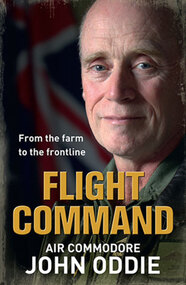
Book, Flight command: from the farm to the front line, 2014
... As well as covering the war in Afghanistan, Flight Command provides an insider's account of being a combat pilot in the first Gulf War, a commander supporting peace in Bougainville and security in Cambodia and the often harrowing experience of being a first-response commander dealing with the aftermath of the Boxing Day tsunami in Indonesia. ...As well as covering the war in Afghanistan, Flight Command provides an insider's account of being a combat pilot in the first Gulf War, a commander supporting peace in Bougainville and security in Cambodia and the often harrowing experience of being a first-response commander dealing with the aftermath of the Boxing Day tsunami in Indonesia. ...John Oddie's (1974) appointment as deputy commander of Aussie forces in the Middle East capped a remarkable career of service to Australia. Sadly, this honour also involved the heartbreaking duty of informing families of the deaths of their husbands and sons in Afghanistan and overseeing departure ceremonies for the fallen soldiers. As well as covering the war in Afghanistan, Flight Command provides an insider's account of being a combat pilot in the first Gulf War, a commander supporting peace in Bougainville and security in Cambodia and the often harrowing experience of being a first-response commander dealing with the aftermath of the Boxing Day tsunami in Indonesia. By turns heart-warming and poignant, Flight Command is the story of a farm boy who managed to carve an international career in the military that included service in two wars.Medium size, soft cover bookjohn oddie, ballarat college -
 Ringwood and District Historical Society
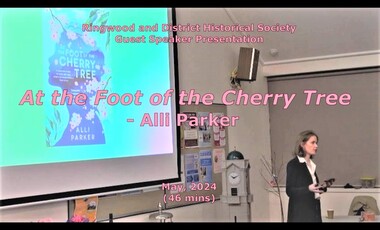
Mixed media - Video, RDHS Guest Speaker Presentation - "At the Foot of the Cherry Tree" - Alli Parker
... Guest Speaker, Alli Parker, accomplished scriptwriter, talks about her Ringwood family and her book based on the incredible true story of her Grandparents, Gordon and Cherry - Australia's first Japanese war bride - spanning seven years and two countries reeling from the aftermath of WWII....Guest Speaker, Alli Parker, accomplished scriptwriter, talks about her Ringwood family and her book based on the incredible true story of her Grandparents, Gordon and Cherry - Australia's first Japanese war bride - spanning seven years and two countries reeling from the aftermath of WWII. ...Digitised video (2.50GB). Duration: 46 minutes. Recorded May, 2024. (Video is available for viewing at Ringwood & District Historical Society Archives by appointment)Guest Speaker, Alli Parker, accomplished scriptwriter, talks about her Ringwood family and her book based on the incredible true story of her Grandparents, Gordon and Cherry - Australia's first Japanese war bride - spanning seven years and two countries reeling from the aftermath of WWII. -
Mission to Seafarers Victoria
Article - Survey, Bronwyn Hughes, The Art of Light: a survey of stained glass in Victoria, December 1990
... Published in the La Trobe Journal No 90, December 2012 History of Brooks, Robinson & Co. maker of most of the windows in the chapel. la trobe journal state library of victoria bronwyn hughes stained glass window Introduction Early Stained Glass in Victoria "Marvellous Melbourne" The Aftermath of the First World War Post-1945: Australian Modernism Conclusion The Art of Light: a survey of stained glass in Victoria Article Survey Bronwyn Hughes ...Introduction Early Stained Glass in Victoria "Marvellous Melbourne" The Aftermath of the First World War Post-1945: Australian Modernism Conclusionnon-fictionIntroduction Early Stained Glass in Victoria "Marvellous Melbourne" The Aftermath of the First World War Post-1945: Australian Modernism Conclusionla trobe journal, state library of victoria, bronwyn hughes, stained glass window -
 Monbulk RSL Sub Branch
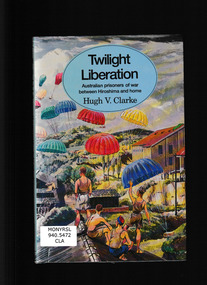
Book, George Allen & Unwin, Twilight liberation : Australian prisoners of war between Hiroshima and home, 1985
... World war 1939 – 1945 - Prisons and prisoners – Japanese World War 1939-1945 - Personal narratives - Australia Australian prisoners of war in Japan in the aftermath of The Japanese surrender Ill, p.165 Twilight liberation : Australian prisoners of war between Hiroshima and home Book George Allen & Unwin Hugh V Clarke ...Australian prisoners of war in Japan in the aftermath of The Japanese surrenderIll, p.165non-fictionAustralian prisoners of war in Japan in the aftermath of The Japanese surrenderworld war 1939 – 1945 - prisons and prisoners – japanese, world war 1939-1945 - personal narratives - australia -
 Monbulk RSL Sub Branch
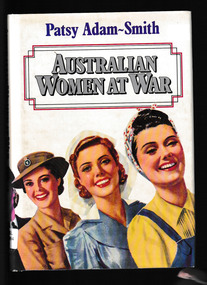
Book, Thomas Nelson, Australian Women at War, 1984
... This magnificent work is a history of how Australian women have responded to war – from 1900, when the first nurses sailed to the Boer War, to 1945 and its aftermath. Recording the achievements of our women for all time, it tells of their bravery, self-sacrifice, endurance and devotion. ...This book records the achievements of our women for all time. It tells of bravery, self-sacrifice, endurance and devotion. When Patsy Adam-Smith wrote Australian Women at War in 1984, her aim was to tap into the memories of all the ‘brave, modest, forgotten women’ while they were still alive, in order to honour them. Now, for the first time, this iconic volume is republished for an entirely new generation of readers. This magnificent work is a history of how Australian women have responded to war – from 1900, when the first nurses sailed to the Boer War, to 1945 and its aftermath. Recording the achievements of our women for all time, it tells of their bravery, self-sacrifice, endurance and devotion. Australian Women at War is a tribute to Australian women.Index, ill, p.386.non-fictionThis book records the achievements of our women for all time. It tells of bravery, self-sacrifice, endurance and devotion. When Patsy Adam-Smith wrote Australian Women at War in 1984, her aim was to tap into the memories of all the ‘brave, modest, forgotten women’ while they were still alive, in order to honour them. Now, for the first time, this iconic volume is republished for an entirely new generation of readers. This magnificent work is a history of how Australian women have responded to war – from 1900, when the first nurses sailed to the Boer War, to 1945 and its aftermath. Recording the achievements of our women for all time, it tells of their bravery, self-sacrifice, endurance and devotion. Australian Women at War is a tribute to Australian women. women - australia - social conditions, war - female participation -
 Monbulk RSL Sub Branch
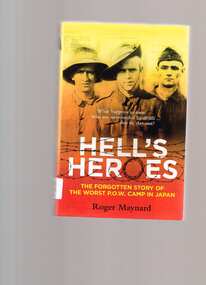
Book, Harper Collins, Hell's heroes, 2009
... war 1939 – 1945 - Prisons and prisoners - Japanese Atrocities - Japan Hell′s Heroes is the story of the POW camp that never was − so dubbed by one old soldier because the atrocities that occurred there went largely unreported at the time. For while the Burma−Thai railway‚ the Bataan death march and events at Changi and in many other parts of Asia became synonymous with Japanese brutality‚ most of the camps which were set up to provide slave labour for the enemy military machine at home were slowly forgotten in the aftermath of World War II. ...Hell′s Heroes is the story of the POW camp that never was − so dubbed by one old soldier because the atrocities that occurred there went largely unreported at the time. For while the Burma−Thai railway‚ the Bataan death march and events at Changi and in many other parts of Asia became synonymous with Japanese brutality‚ most of the camps which were set up to provide slave labour for the enemy military machine at home were slowly forgotten in the aftermath of World War II.Ill, maps, p.359.non-fictionHell′s Heroes is the story of the POW camp that never was − so dubbed by one old soldier because the atrocities that occurred there went largely unreported at the time. For while the Burma−Thai railway‚ the Bataan death march and events at Changi and in many other parts of Asia became synonymous with Japanese brutality‚ most of the camps which were set up to provide slave labour for the enemy military machine at home were slowly forgotten in the aftermath of World War II.world war 1939 – 1945 - prisons and prisoners - japanese, atrocities - japan -
 Monbulk RSL Sub Branch
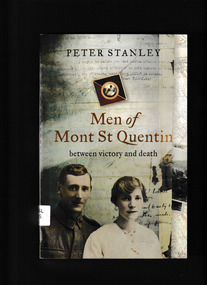
Peter Stanley, Men of Mont St Quentin : between victory and death, 2009
... australian army - 21st battalion - 9 platoon - history world war 1914-1918 - 2nd battle of the somme In the hands of Peter Stanley, one of Australia's leading military historians, a famous battlefield in France becomes unforgettably connected with Australian men and their families in the long aftermath of the Great War. ...In the hands of Peter Stanley, one of Australia's leading military historians, a famous battlefield in France becomes unforgettably connected with Australian men and their families in the long aftermath of the Great War.Index, notes, bibliography, ill, p.298.non-fictionIn the hands of Peter Stanley, one of Australia's leading military historians, a famous battlefield in France becomes unforgettably connected with Australian men and their families in the long aftermath of the Great War.australian army - 21st battalion - 9 platoon - history, world war 1914-1918 - 2nd battle of the somme -
 Monbulk RSL Sub Branch
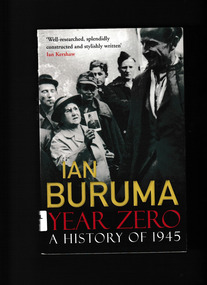
Book, Atlantic, Year zero : a history of 1945, 2013
... world war 1939-1945 - peace 20th century - history Many books have been written, and continue to be written, about the Second World War: military histories, histories of the Holocaust, the war in Asia, or collaboration and resistance in Europe. Few books have taken a close look at the immediate aftermath of the worldwide catastrophe. ...Many books have been written, and continue to be written, about the Second World War: military histories, histories of the Holocaust, the war in Asia, or collaboration and resistance in Europe. Few books have taken a close look at the immediate aftermath of the worldwide catastrophe.Index, notes, ill, p.368.non-fictionMany books have been written, and continue to be written, about the Second World War: military histories, histories of the Holocaust, the war in Asia, or collaboration and resistance in Europe. Few books have taken a close look at the immediate aftermath of the worldwide catastrophe.world war 1939-1945 - peace, 20th century - history -
 Monbulk RSL Sub Branch
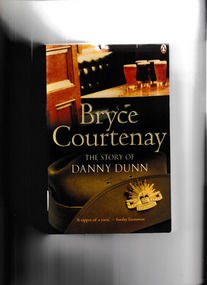
Book, Bryce Courtenay, The story of Danny Dunn, 2011
... world war 1939-1945 - veterans - fiction bars - australia - fiction In the aftermath of the Great Depression few opportunities existed for working-class boys, but at just eighteen Danny Dunn has everything going for him: brains, looks, sporting ability and an easy charm. ...In the aftermath of the Great Depression few opportunities existed for working-class boys, but at just eighteen Danny Dunn has everything going for him: brains, looks, sporting ability and an easy charm. His parents run The Hero, a neighbourhood pub, and Danny is a local hero. Luck changes for Danny when he signs up to go to war. He returns home a physically broken man, to a life that will be changed forever.p.610.fictionIn the aftermath of the Great Depression few opportunities existed for working-class boys, but at just eighteen Danny Dunn has everything going for him: brains, looks, sporting ability and an easy charm. His parents run The Hero, a neighbourhood pub, and Danny is a local hero. Luck changes for Danny when he signs up to go to war. He returns home a physically broken man, to a life that will be changed forever.world war 1939-1945 - veterans - fiction, bars - australia - fiction -
 Monbulk RSL Sub Branch
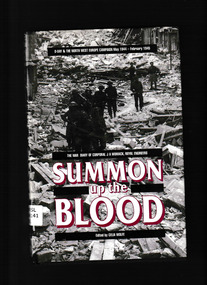
Book, L. Cooper, Summon up the blood : a unique record of D-Day and its aftermath, 1997
... World war 1939 – 1945 – Personal narratives – Britain James Albert Womack The personal diaries of J Womack of his experiences in the invasion of Europe, edited by his daughter. Index, bibliography, ill, maps, p.182. Summon up the blood : a unique record of D-Day and its aftermath ...The personal diaries of J Womack of his experiences in the invasion of Europe, edited by his daughter.Index, bibliography, ill, maps, p.182.non-fictionThe personal diaries of J Womack of his experiences in the invasion of Europe, edited by his daughter.world war 1939 – 1945 – personal narratives – britain, james albert womack -
 Monbulk RSL Sub Branch
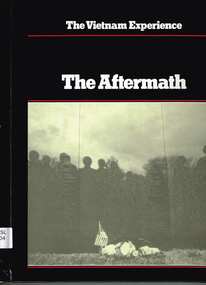
Book, Boston Publishing Company, The aftermath, 1982
... Vietnam war 1961-1975 Vietnam - History - 20th century Photography, maps, and eyewitness accounts describe the War in Vietnam. Index, Bibliography, ill, maps, p.185. The aftermath Book Boston Publishing Company Boston Publishing Company ...Photography, maps, and eyewitness accounts describe the War in Vietnam.Index, Bibliography, ill, maps, p.185.non-fictionPhotography, maps, and eyewitness accounts describe the War in Vietnam.vietnam war 1961-1975, vietnam - history - 20th century -
 Monbulk RSL Sub Branch
Book, Time-Life Books, The aftermath: Europe, 1982
... Diplomatic history - Europe World politics - 1945 The geopolitical consequences of the European war Index, bib, ill, p.208. The aftermath: Europe Book Time-Life Books Douglas Botting ...The geopolitical consequences of the European warIndex, bib, ill, p.208.non-fictionThe geopolitical consequences of the European wardiplomatic history - europe, world politics - 1945 -
 Monbulk RSL Sub Branch
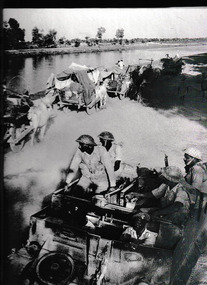
Book, Time-Life Books, The aftermath: Asia, 1982
... Diplomatic history - Asia Asia - History - 1945 The geopolitical consequences of the war in the east Index, bib, ill, p.208. The aftermath: Asia Book Time-Life Books Charles Osborne ...The geopolitical consequences of the war in the eastIndex, bib, ill, p.208.non-fictionThe geopolitical consequences of the war in the east diplomatic history - asia, asia - history - 1945 -
 Monbulk RSL Sub Branch
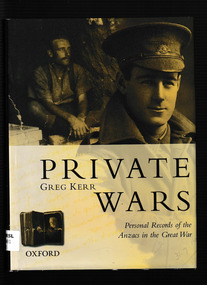
Book, Greg Kerr, Private wars : personal records of the Anzacs in the Great War, 2000
... Although the author summarises the general strategic course of the war and the success or otherwise of each campaign, his primary concern is with the personal factor - the human burden of combat and its aftermath Ill, index, p.306. ...Private Wars: Personal Records of the Anzacs in the Great War offers a new perspective on Australia's engagement in the twentieth century's bloodiest war. It retraces the journey of Australian troops from Gallipoli in 1915 to the final penetration of the Hindenburg Line in 1918. Although the author summarises the general strategic course of the war and the success or otherwise of each campaign, his primary concern is with the personal factor - the human burden of combat and its aftermathIll, index, p.306.non-fictionPrivate Wars: Personal Records of the Anzacs in the Great War offers a new perspective on Australia's engagement in the twentieth century's bloodiest war. It retraces the journey of Australian troops from Gallipoli in 1915 to the final penetration of the Hindenburg Line in 1918. Although the author summarises the general strategic course of the war and the success or otherwise of each campaign, his primary concern is with the personal factor - the human burden of combat and its aftermathaustralian army - anzac corps, soldiers - australia - biographies -
 Monbulk RSL Sub Branch
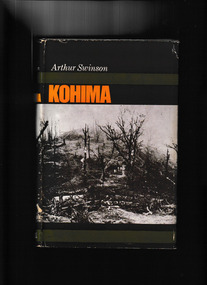
Book, Cassell, Kohima, 1966
... War 1939-1945 - Land operations - India On 7 March 1944 Tokyo announced that the Japanese invasion of British India had begun. By mid-month, the Japanese 31st Division had crossed the Chindwin River in northern Burma, advancing on a wide front towards Imphal and Kohima. In bitter jungle fighting from early April, the British Fourteenth Army under Field Marshal Slim held the Japanese assault on Kohima Ridge. By late June the Japanese were in headlong retreat. Kohima ranks for strategic importance with Alamein, Midway and Stalingrad. The increasing dominance of Allied airpower in the region in the aftermath ...On 7 March 1944 Tokyo announced that the Japanese invasion of British India had begun. By mid-month, the Japanese 31st Division had crossed the Chindwin River in northern Burma, advancing on a wide front towards Imphal and Kohima. In bitter jungle fighting from early April, the British Fourteenth Army under Field Marshal Slim held the Japanese assault on Kohima Ridge. By late June the Japanese were in headlong retreat. Kohima ranks for strategic importance with Alamein, Midway and Stalingrad. The increasing dominance of Allied airpower in the region in the aftermath of the battle was a major factor.Index, bibliography, ill, maps, p.275.non-fictionOn 7 March 1944 Tokyo announced that the Japanese invasion of British India had begun. By mid-month, the Japanese 31st Division had crossed the Chindwin River in northern Burma, advancing on a wide front towards Imphal and Kohima. In bitter jungle fighting from early April, the British Fourteenth Army under Field Marshal Slim held the Japanese assault on Kohima Ridge. By late June the Japanese were in headlong retreat. Kohima ranks for strategic importance with Alamein, Midway and Stalingrad. The increasing dominance of Allied airpower in the region in the aftermath of the battle was a major factor. kohima - siege - 1944, world war 1939-1945 - land operations - india -
 Monbulk RSL Sub Branch
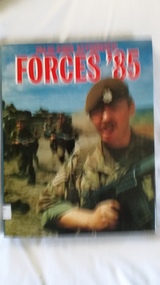
Book, Marshall Cavendish, Falklands aftermath : forces '85, 1984
... Implications of Falkland Islands War Ill, maps, p.144. Falklands aftermath : forces '85 Book Marshall Cavendish Mark Dartford. ...British military forces. Implications of Falkland Islands WarIll, maps, p.144.non-fictionBritish military forces. Implications of Falkland Islands Warfalklands war 1982, graet britain - military history -
 Monbulk RSL Sub Branch
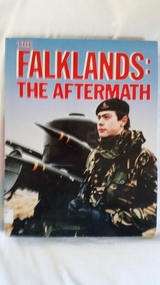
Book, Marshall Cavendish, The Falklands : the aftermath, 1984
... Falklands war 1982 Falkland Islands - Social conditions Discusses the aftermath of the Falklands conflict in 1982 Ill, maps, p.144. ...Discusses the aftermath of the Falklands conflict in 1982Ill, maps, p.144.non-fictionDiscusses the aftermath of the Falklands conflict in 1982falklands war 1982, falkland islands - social conditions -
 Monbulk RSL Sub Branch
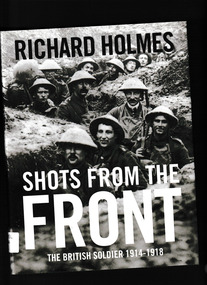
Book, Harper Press, Shots from the front : the British soldier 1914-18, 2008
... "The book's topics include the preparations for war and the mobilisation of 1914; the 'roses of no-man's land' - the contribution made by nurses; 'blighty ones and other ones' - the wounded and their treatment; 'brother lead and sister steel' - soldiers and their weapons; scenes from the battlefield and the campaigns where Tommies fought; the armistice and its aftermath. ...Leading military historian Richard Holmes has selected over 200 rare and unusual photographs to illustrate the wide range of the British Army's experience in the First World War - on all fronts, from Mesopotamia (Iraq) and Gallipoli to the Flanders trenches." "The book's topics include the preparations for war and the mobilisation of 1914; the 'roses of no-man's land' - the contribution made by nurses; 'blighty ones and other ones' - the wounded and their treatment; 'brother lead and sister steel' - soldiers and their weapons; scenes from the battlefield and the campaigns where Tommies fought; the armistice and its aftermath.Ill, p.240.non-fictionLeading military historian Richard Holmes has selected over 200 rare and unusual photographs to illustrate the wide range of the British Army's experience in the First World War - on all fronts, from Mesopotamia (Iraq) and Gallipoli to the Flanders trenches." "The book's topics include the preparations for war and the mobilisation of 1914; the 'roses of no-man's land' - the contribution made by nurses; 'blighty ones and other ones' - the wounded and their treatment; 'brother lead and sister steel' - soldiers and their weapons; scenes from the battlefield and the campaigns where Tommies fought; the armistice and its aftermath.world war 1914 -1918 - pictorial works, great britain - army - military life -
 Monbulk RSL Sub Branch
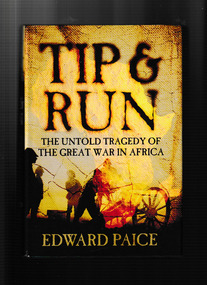
Book, Weidenfeld and Nicolson, Tip & run : the untold tragedy of the Great War in Africa, 2007
... World War 1914-1918 - Campaigns - East Africa World War 1914-1918 - Campaigns - Africa In the aftermath of the Great War the East Africa campaign was destined to be dismissed by many in Britain as a remote 'sideshow' in which only a handful of names and episodes - the Königsberg, von Lettow-Vorbeck, the 'Naval Expedition to Lake Tanganyika' - achieved any lasting notoriety. ...In the aftermath of the Great War the East Africa campaign was destined to be dismissed by many in Britain as a remote 'sideshow' in which only a handful of names and episodes - the Königsberg, von Lettow-Vorbeck, the 'Naval Expedition to Lake Tanganyika' - achieved any lasting notoriety. But to the other combatant powers - Germany, South Africa, India, Belgium and Portugal - it was, and would remain, a campaign of huge importance. A 'small war', consisting of a few 'local affairs', was all that was expected in August 1914 as Britain moved to eliminate the threat to the high seas of German naval bases in Africa. But two weeks after the Armistice was signed in Europe British and German troops were still fighting in Africa after four years of what one campaign historian described as 'a war of extermination and attrition without parallel in modern times'. The expense of the campaign to the British Empire was immense, the Allied and German 'butchers bills' even greater. But the most tragic consequence of the two sides' deadly game of 'tip and run' was the devastation of an area five times the size of Germany, and civilian suffering on a scale unimaginable in Europe. Such was the cost of 'The White Man's Palaver', the final phase of the European conquest of Africa.Index, bib, ill, maps, p.488.non-fictionIn the aftermath of the Great War the East Africa campaign was destined to be dismissed by many in Britain as a remote 'sideshow' in which only a handful of names and episodes - the Königsberg, von Lettow-Vorbeck, the 'Naval Expedition to Lake Tanganyika' - achieved any lasting notoriety. But to the other combatant powers - Germany, South Africa, India, Belgium and Portugal - it was, and would remain, a campaign of huge importance. A 'small war', consisting of a few 'local affairs', was all that was expected in August 1914 as Britain moved to eliminate the threat to the high seas of German naval bases in Africa. But two weeks after the Armistice was signed in Europe British and German troops were still fighting in Africa after four years of what one campaign historian described as 'a war of extermination and attrition without parallel in modern times'. The expense of the campaign to the British Empire was immense, the Allied and German 'butchers bills' even greater. But the most tragic consequence of the two sides' deadly game of 'tip and run' was the devastation of an area five times the size of Germany, and civilian suffering on a scale unimaginable in Europe. Such was the cost of 'The White Man's Palaver', the final phase of the European conquest of Africa.world war 1914-1918 - campaigns - east africa, world war 1914-1918 - campaigns - africa
