
Showing 6 items matching "agapanthus"
-
 Darebin Art Collection
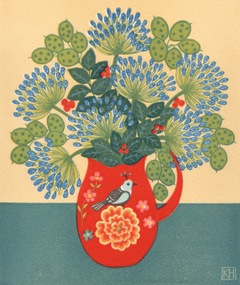
Print, Kate Hudson, 'Agapanthus and Honesty', 2010
... 'Agapanthus and Honesty'...'Agapanthus and Honesty' Print Kate Hudson ...In 'Agapanthus and Honest'y, Kate Hudson transforms the much maligned agapanthus plant, reviled in some quarters as a noxious weed but planted ferociously in others due to its hardy tolerance to drought and poor soil, into a cut flower of gentle beauty. Augmented with sprigs of honesty, the predominant shades of blue and green of the floral arrangement contrast delightfully with an oriental influenced, burnt orange vase decorated with delicate flowers and a small bird. The result is a traditional floral still life with contemporary appeal. Artist Bio Kate Hudson is a Melbourne-based printmaker who trained in textile design at London’s Central School of Art & Design prior to immigrating to Australia in 1990. Focussing on pattern, design and colour, Hudson specialises in multi coloured linocut reduction prints taking inspiration for her work from the Arts & Crafts Movement, Japanese woodblocks and printmakers such as Margaret Preston (1875-1963). Hudson’s commercial collaborations with Catherine Manuell and Earth Greetings feature some of her most recognisable designs on a range of fashion accessories and greetings cards. Since 2003 Hudson has participated in numerous solo and group exhibitions around Victoria. Her artwork is held in a number of public, corporate and private collections including the National Gallery of Australia, Australian Print Workshop, Geelong Gallery, Austin Hospital, Australian Unity, Crown Casino and several local councils. -
 University of Melbourne, Burnley Campus Archives
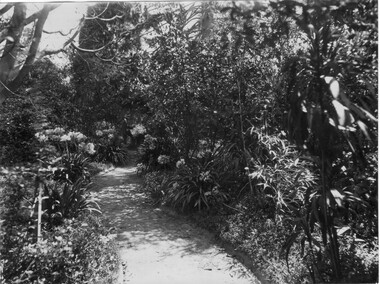
Photograph - Black and white print, Garden View, 1913
... ...agapanthus...The pathway is lined with shrubs and patches of agapanthus ....The pathway is lined with shrubs and patches of agapanthus . Garden View Photograph Black and white print ...Appears as an illustration in, "Green Grows Our Garden," A.P. Winzenried p 25.Black and white photograph. Pathway leading to the Orchard with a man in the background. The pathway is lined with shrubs and patches of agapanthus .On reverse, "1913."pathway, orchard, green grows our garden, a.p. winzenried, man, garden view, agapanthus -
 Whitehorse Historical Society Inc.
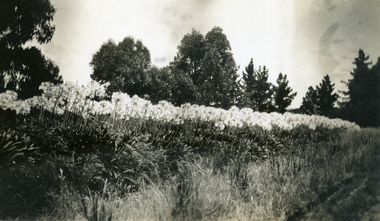
Photograph, Jones Flower Farm, 1930s
... Black and white photograph of agapanthus growing in Jones' Flower Farm in Mt Pleasant Road, Nunawading in the early 1930s....See also ND3831. jones bette walter rolf geoffrey arthur keith lionel muriel jones flower farm mount pleasant road nunawading Black and white photograph of agapanthus growing in Jones' Flower Farm in Mt Pleasant Road, Nunawading in the early 1930s. ...Jones Family Collection - NP2565 to NP2606. See also ND3831.Black and white photograph of agapanthus growing in Jones' Flower Farm in Mt Pleasant Road, Nunawading in the early 1930s.jones, bette, walter, rolf, geoffrey, arthur, keith, lionel, muriel, jones flower farm, mount pleasant road nunawading -
 City of Ballarat Libraries
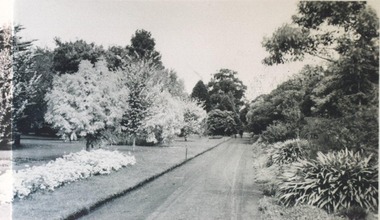
Photograph, Botanic Gardens, Ballarat circa 1930
... Botanic Gardens pathway. Agapanthus grows in the garden beds....Botanic Gardens pathway. Agapanthus grows in the garden beds. Botanic Gardens Ballarat Gardens Botanic Gardens, Ballarat circa 1930 Photograph Photograph ...Botanic Gardens pathway. Agapanthus grows in the garden beds.botanic gardens, ballarat, gardens -
 Glen Eira Historical Society
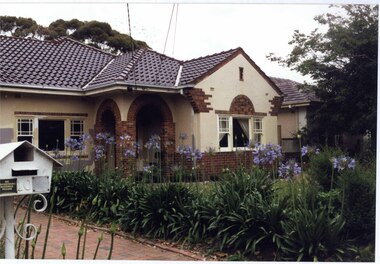
Photograph, Beauville Avenue, 10, Murrumbeena, 2001
... Other features include a porch with two decorative open arches, tiled roof, 2 sets of matching double sashed windows with large square pane within each set, agapanthus lining the brick paved driveway and a cast iron work metal letterbox with number "10" on it. ...Other features include a porch with two decorative open arches, tiled roof, 2 sets of matching double sashed windows with large square pane within each set, agapanthus lining the brick paved driveway and a cast iron work metal letterbox with number "10" on it. ...Originally labelled "Beauville Estate, Established 1936, Still Thriving 65 years on, 10th March 2001", the Beauville Estate Album contains colour photographs of houses in the Estate. They were taken around the time of the Beauville Estate’s 65th Heritage Celebration held on 10/03/2001 and donated to the Caulfield Historical Society shortly afterwards. Photographer Bev Baxter. From Glen Eira’s Heritage Management Plan by Andrew Ward (1996) Vol 2 p63: The inclusion of shops in Murrumbeena Road and a common parkland developed at the rear of the properties were complemented by the construction of a gas display home at No. 10 Beauville Avenue.City of Glen Eira’s Heritage Management Plan Vol 2 p79 (this is p84 of the pdf version) – HO12 Beauville Estate and environs, Murrumbeena: The Beauville Historic Area is important at the State level as the first large housing estate undertaken by the AV Jennings Construction Co, later Jennings Group Limited, Victoria’s largest home builder. It is important also as a very early estate development incorporating a range of features other than houses and including made roads, shops and recreation facilities. In this respect it was the forerunner of the comprehensively planned housing estate of the post war era. The estate is distinguished by its aesthetic values, as is the earlier and comparable Hillcrest Estate, which are formed by a combination of restrained diversity in house styles, with the exception of no. 30 in the emerging International style, and by a landscaped garden environment. Colour photograph of cream rendered house with decorative unpainted brown brick features. Other features include a porch with two decorative open arches, tiled roof, 2 sets of matching double sashed windows with large square pane within each set, agapanthus lining the brick paved driveway and a cast iron work metal letterbox with number "10" on it. murrumbeena, houses, beauville avenue, architectural styles, 1930's, inter war style, a.v. jennings, av jennings, jennings, brick houses, beauville estate, porches, arches, sir albert victor jennings, a v jennings construction co, beauville estate heritage area, glen eira city council, architectural features, jennings group limited, land subdivision, gardens, beauville historic area, brick features, sash windows, paved drives, cast iron work, letter boxes, gas display houses -
 Flagstaff Hill Maritime Museum and Village
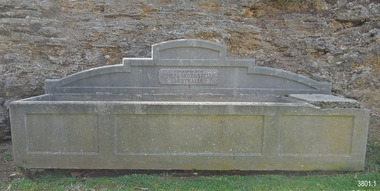
Container - Horse trough, Annis & George Bills, circa Dec. 1932
... Over the time there its purpose was changed from a horse watering trough to a colourful garden bed of agapanthus plants. By February 2013 the horse trough had been transferred to Flagstaff Hill for display in the Maritime Village’s grounds. ...Over the time there its purpose was changed from a horse watering trough to a colourful garden bed of agapanthus plants. By February 2013 the horse trough had been transferred to Flagstaff Hill for display in the Maritime Village’s grounds. ...This horse trough is the only survivor of the two troughs originally installed in Raglan Parade, Warrnambool, in 1932. It was later moved to the Pony Club at Albert Part, near the north corner of Coulstock and Craig Streets. Over the time there its purpose was changed from a horse watering trough to a colourful garden bed of agapanthus plants. By February 2013 the horse trough had been transferred to Flagstaff Hill for display in the Maritime Village’s grounds. This trough is one of hundreds provided by the Annis and George Bills Estate Trust since 1927 for the welfare of working horses and dogs. The original concrete cap over the small compartment is still retained. There are also markings on the right side of the trough where it probably had a birdbath, tap or a dish for the horseman’s dog, similar to other troughs donated elsewhere by the Trust. Less than half of the troughs produced for the Annis and George Bills Trust still survive. In 2017 Felicity Watson, National Trust Victoria’s advocacy manager, said that the troughs were treasures and becoming rare, with more than a dozen across Victoria now being heritage protected. ABOUT ANNIS AND GEORGE BILLS The 1927 Will of George Bills included setting up the Annis and George Bills Estate Trust, which provided for hundreds of horse troughs to be supplied and installed throughout Australia, Britain, USA and other parts of the world for the welfare of horses. Town and city councils could apply to the Trustees for a horse trough for their communities. George “Joe” Bills was born in Brighton, England, in 1859. The family migrated first to New Zealand then to Australia in 1873, settling in the Echuca-Moama district. George moved to Brisbane in 1882 where he met Annis Swann, formerly from Sheffield. Both were animal lovers. George and Annis married 1885 and moved to Sydney to join George’s brother Henry in his mattress wire weaving business, later known as the Bills Brothers. They patented their own machine in 1893 and the business became very profitable. George was able to donate to charities that supported his passion to improve animal welfare. He and Annis joined the Victorian Society for the Protection of Animals and in 1924 George received a Life Membership with the RSPCA. George retired in 1908. The couple moved to Hawthorn, Victoria, in 1910, where they donated troughs for the work horses of Melbourne. During a visit to England Annis passed away. In 1927 George moved from Hawthorn to Camberwell, where he passed away at the end of that year. George had requested in his Will that a trust fund be set up from his estate "…construct and erect and pay for horse troughs wherever they may be of the opinion that such horse troughs are desirable for the relief of horses and other dumb animals either in Australasia, in the British Islands or in any other part of the world subject to the consent of the proper authorities being obtained." The troughs were to bear a plaque inscribed “Donated by Annis and George Bills, Australia”. In 1927 the cost to make a trough was about £13 (which converts to about $1079 in 2020 ), plus transport and installation costs. Most of the troughs were installed between 1930 and 1939 in Victoria and New South Wales. It is estimated that over that time around 500-700 Bills Horse Troughs were installed in Australia and another 50 overseas. Most of the troughs made in Victoria had three moulded front panels like this trough, and no panels moulded on the rear, whereas troughs made in NSW had four panels on the front and five on the back. Victorian troughs were made by a Bills’ relative, J H Phillips. Later, other manufactures for the Trust’s troughs included Rocla Concrete Pipes Ltd, in Auburn Road, Hawthorn, Victoria, who produced to the same original design. No further troughs produced after the end of World War II. A memorial to Annis and George Bills was first erected in Hawthorn in 1929. It included a drinking fountain and a dog dish. Its current location is unknown. In 1964 the George Bills RSPCA Resource Centre opened in Burwood East. This Bills horse trough is nationally significant as one of the surviving examples of the standard Bills memorial horse troughs that still has its compartment cap and evidence of it once having had attached fittings, possibly for a birdbath or dog dish. This trough has State historical significance for being produced in the early 1930s by a business in Hawthorn, Victoria. This example of a Bills horse trough is significant for being in comparatively good condition. The trough is locally significant for being the sole survivor of the two Bills horse troughs installed in the City of Warrnambool in 1932, originally installed on Raglan Parade and continued to be used in the community at the Pony Club, then finally transferred to its current location at Flagstaff Hill by early 2013. It is culturally significant as it represents the community’s dependence on horses for travel and transportation previous to motorised vehicles. It is morally significant as a generous gift from a couple concerned with the welfare of animals.Horse trough; a long narrow rectangular container used for storing water. Trough is made from pre-cast concrete with one large open compartment and a small covered compartment. The base of the small compartment is raised slightly above the base of the trough and is covered by a removable concrete cap. The design of the front of the trough includes three panels moulded into it that align with the shape of the back pediment (panel). The pediment is shaped with side arcs that step up to a wide centre arc. A rectangular concrete plaque is cast into the centre of the pediment and is engraved with the names of the original donors, Annis and George Bills. The trough was made in Hawthorn, Victoria, by J H Phillips circa 1932. “DONATED BY / ANNIS & GEORGE BILLS / AUSTRALIA”flagstaff hill, warrnambool, shipwrecked coast, flagstaff hill maritime museum, maritime museum, shipwreck coast, flagstaff hill maritime village, great ocean road, annis and george bills, bills trust, j h phillips, rocla concrete pipes ltd, hawthorn, water trough, watering trough, horse trough, animal welfare, bills horse trough
