
Showing 14 items matching "air sense"
-
 Moorabbin Air Museum
Pamphlet - Aircraft engines, Engine Sense (Air Ministry Pamphlet 1942)
... Engine Sense (Air Ministry Pamphlet 1942)...Aircraft engines Principle engine controls Engine sense Other sources for students Brief overview of aircraft engines, circa 1942 Photocopied pages in manila folder Engine Sense (Air Ministry Pamphlet 1942) Pamphlet Aircraft engines ...Brief overview of aircraft engines, circa 1942Photocopied pages in manila foldernon-fictionBrief overview of aircraft engines, circa 1942principle engine controls, engine sense, other sources for students -
Moorabbin Air Museum
Book - Pilot training - general aviation, Stick and Rudder An Explanation of the Art of Flying
... ...Air sense...Pilot training - general aviation Wings Controls Air sense Basic maneuvers Getting down Dangers of the air Analyses of the art of flying, circa 1944 ( renewed in 1972) Stick and Rudder An Explanation of the Art of Flying Book Pilot training - general aviation ...Analyses of the art of flying, circa 1944 ( renewed in 1972)non-fictionAnalyses of the art of flying, circa 1944 ( renewed in 1972)wings, controls, air sense, basic maneuvers, getting down, dangers of the air -
 The Beechworth Burke Museum
Photograph, Walter William McLean Thwaites, c.1870
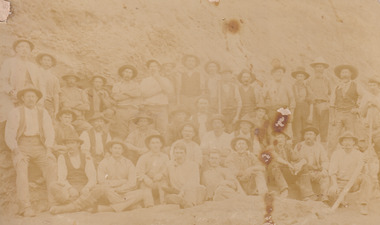
... sense of comradery or equality between them. It is likely that they are from the same, or similar, social status. They have an air...sense of comradery or equality between them. It is likely that they are from the same, or similar, social status. They have an air ...This photograph depicts a large group of men in their work clothing situated in front of a large bank of earth. They are identified as miners working in an unidentified location in Australia. This photograph was taken by photographer Walter Thwaites sometime during the period of 1865-1908, likely c.1870. It is unsure where this image was taken since Thwaites travelled a lot over his photography career and the photograph is not annotated with this information. In addition, the identities of the men in the photograph are also unknown. These men are photographed in front of a large bank of earth where they had presumably been mining for gold or other precious metals. The men, with the exception of four, are wearing wide brimmed hats to protect their faces from the sun. They are also wearing loose fitting white shirts which are often worn beneath a darker coloured vest. They wear pale coloured work pants and boots. The men are mostly clean shaven with the exception of the moustache and a couple of beards. Two of the men have pipes in their mouth. Their clothing is basic and much less dramatic than the outfits worn by the gold diggers of the 1852 gold rush. These men, by wearing similar outfits, are expressing a sense of comradery or equality between them. It is likely that they are from the same, or similar, social status. They have an air of independence and share social equality in their stance and clothing. Walter William McLean Thwaites (1840-1908) was a professional photographer born in Sydney, Australia. He learnt the craft in his father's Hobart studio, but later embarked on his own solo career and toured every existing Australian colony between 1860 to 1888. The Thwaites family were a long line of photographers and artists with Thwaites' father Walter WIlliam Thwaites Sr working as an artist and photographer in Australia after moving from England in 1834. Walter Thwaites Sr's father, also named Walter Thwaites, was a British miniature portrait artist.Images, like this one, of Australian gold rush history can reveal important information about the social and environmental impact of this period. This image depicts over 30 diggers standing in front of a bank of earth and therefore, this image has the capacity to reveal or support significant information for researchers studying the fashion and social status of diggers in Australia in approximately 1870. It can also provide information on the landscape of Australia in this period and the impact of mining for gold on both society and the Australian landscape. The Burke Museum is home to a substantial collection of Australian mining photographs which can be used to gain a deeper understanding into life on the gold fields, technology used in mining, the miners themselves and the impact of the gold digging on the environment.Sepia toned rectangular photograph printed on matte photographic paper and mounted on board.Reverse: 1997.208 / MINERS. / W. Thwaites / Photography /australia, australian photography, photography, miners, gold rush, australian landscape, diggers, walter thwaites, thwaites photography, w. thwaites photography, social history -
 Bendigo Historical Society Inc.
Photograph - Gliding in Bendigo, Late 1930s
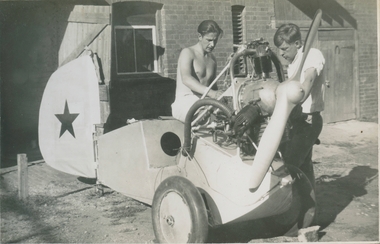
... sense of optimistic can-do, and the cavalier estimation of risks that goes with being in your early 20s. The events described here took place against a darkening political background. Alan and his mates were politically aware, very left wing, and viewed the gathering storm in Europe with apprehension. They could see from early on that war was coming, and it would change everything. Prevented from joining the Air...sense of optimistic can-do, and the cavalier estimation of risks that goes with being in your early 20s. The events described here took place against a darkening political background. Alan and his mates were politically aware, very left wing, and viewed the gathering storm in Europe with apprehension. They could see from early on that war was coming, and it would change everything. Prevented from joining the Air ...These are the recollections of Alan Menere (1915 – 2001). Alan grew up in Moonee Ponds, Victoria, and moved to Bendigo while in his early 20s. There he met some like-minded young men who enjoyed challenges and matters mechanical. Flying was the adventure of the time, and they decided to give it a go. There was no intention to be on the leading edge of gliding technology. The challenge was to fly, and by their own efforts. They were aided in this by the embryonic regulatory arrangements covering light aircraft construction and flying, a sense of optimistic can-do, and the cavalier estimation of risks that goes with being in your early 20s. The events described here took place against a darkening political background. Alan and his mates were politically aware, very left wing, and viewed the gathering storm in Europe with apprehension. They could see from early on that war was coming, and it would change everything. Prevented from joining the Air Force by his red-green colour blindness, Alan joined the Army the day after the Pearl Harbour attack. He served in an Armoured Reconnaissance Unit in Western Australia, then with the Army Education Service in New Britain. After the War he joined the Commonwealth Public Service. He moved to Canberra, but his Bendigo habits stayed with him, as he built sailboards and carved propellers, to the admiration of his sons. Alan developed macular degeneration in his mid-60s. He retired to Port Stephens, fishing and socializing when he wasn’t tinkering with wing-sails for his catamaran. As he could touch-type, he quickly learned to use a computer. Very aware that he was the last member of the Bendigo group still alive, he resolved to set down his flying experiences. The images he selected are included, but there are many more from the Bendigo days.A CD entitled "Alan Menere - Recollections of Gliding in Bendigo in the late 1930s". The CD contains 33 documents consisting of one word file, one PDF file (entitled "The Urge to Fly") and the rest are of either photos of the Bendigo Gliding club or generally around Bendigo itself. Also included are some paper clippings of accidents that happened and description of flights.history, bendigo, bendigo gliding club, alan menere -
Moorabbin Air Museum
Booklet - (SP) Supercharger Sense for Pilots and Advanced Trainers and Operational-Type Aircraft, Air Ministry
... Air Ministry Booklet (SP) Supercharger Sense for Pilots and Advanced Trainers and Operational-Type Aircraft ... -
Moorabbin Air Museum
Document (Item) - Air Warfare Applictions Of Laser Remote Sensing
... Document Air Warfare Applictions Of Laser Remote Sensing ...Description: Publisher: RAAF Pages: 300 Keywords: Mirage Equipment Development Sheets Level of Importance: National. -
 Villa Alba Museum
Decorative object - Gilt metal fringe for furnishings - detached
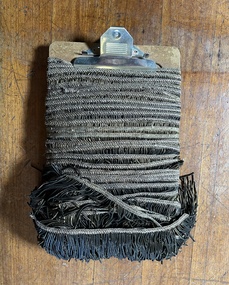
... air, but sections of the fringe under the top layers retain the luxurious gold finish. Westman (2019: 242) explains that 'gold thread' was made of gold fired onto silver bars from which thin, flat or round wires were cut to wrap around a core linen thread for use in trimmings. Shen notes that the very thin layer of gold often wears away, exposing the silver which tarnishes. Bullion fringe: fringe made of bullion, in the sense...air, but sections of the fringe under the top layers retain the luxurious gold finish. Westman (2019: 242) explains that 'gold thread' was made of gold fired onto silver bars from which thin, flat or round wires were cut to wrap around a core linen thread for use in trimmings. Shen notes that the very thin layer of gold often wears away, exposing the silver which tarnishes. Bullion fringe: fringe made of bullion, in the sense ...It is not clear that this fringe was ever attached to the curtain suite; it may have come from an associated part of the original ensemble (eg pelmet) or from associated furniture. However, it is certainly connected to the fringe on the tieback tassels, whose tassels are finished with the same product. The detached gilt metal fringe has aesthetic significance as specimen of an opulent furnishing decoration in very lavish contexts, such as gold rush Victoria. Part of it still preserves the original bright gold metal, ie is untarnished; this is probably quite rare in Australian collections.Board wrapped w c.17m of heavy gilt metal fringe (known as bullion fringe) in several pieces, evidently detached from curtains, and/or furniture items. (No sign of it having been attached to the curtains). The fringe is composed of metallic thread very tightly wound over a cotton/linen thread, attached to a narrow header braid with an ornamental design worked in metallic gimp cord. The colour was originally gold, now tarnished on all parts exposed to air, but sections of the fringe under the top layers retain the luxurious gold finish. Westman (2019: 242) explains that 'gold thread' was made of gold fired onto silver bars from which thin, flat or round wires were cut to wrap around a core linen thread for use in trimmings. Shen notes that the very thin layer of gold often wears away, exposing the silver which tarnishes. Bullion fringe: fringe made of bullion, in the sense of precious metal, used for prestigious royal, ecclesiastical and military garments and furnishings. Westman (2019: 193, 240) says that by the 19thC, the name was also used for twisted thread long fringe made of wool, silk, cotton or a mix, as it is today. In this form, 'bullion fringe' became a lavish edge-trim in the early-mid-19thC wherever its vertical look could add richness to drapery. interior decoration - history -
 Robin Boyd Foundation
Document - Script, Robin Boyd, University of the Air. Design in Australia 2. The home, 1964
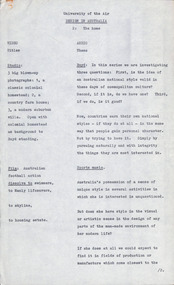
... Air. 'Design in Australia' was an eight part series. (Items D184-D193 contain all the manuscripts except part six titled 'Communications'.) In Part 2, through a brief discussion of the history of Australian houses, both urban and rural, Boyd points out distinct Australian qualities that differentiate the domestic houses from their European and American origins. Boyd believes that the Australian suburban villa is authentically vernacular in the sense...Air. 'Design in Australia' was an eight part series. (Items D184-D193 contain all the manuscripts except part six titled 'Communications'.) In Part 2, through a brief discussion of the history of Australian houses, both urban and rural, Boyd points out distinct Australian qualities that differentiate the domestic houses from their European and American origins. Boyd believes that the Australian suburban villa is authentically vernacular in the sense ...Robin Boyd was involved in creating several TV series for the ABC University of the Air. 'Design in Australia' was an eight part series. (Items D184-D193 contain all the manuscripts except part six titled 'Communications'.) In Part 2, through a brief discussion of the history of Australian houses, both urban and rural, Boyd points out distinct Australian qualities that differentiate the domestic houses from their European and American origins. Boyd believes that the Australian suburban villa is authentically vernacular in the sense of social phenomenon.This is a draft script for the ABC television program 'University of the Air', subtitled 'Design in Australia', broadcast in 1965.Typewritten (c copy), foolscap, 16 pagesuniversity of the air, design in australia, robin boyd, private home, homesteads, australian home, suburban villa, vernacular, manuscript -
 Broadmeadows Historical Society & Museum
Photograph - Group Photograph, Hilltop Moments, 1990
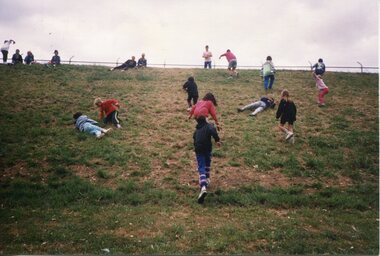
... Annual events like the Christmas picnic were central to the school’s culture, offering students opportunities to celebrate the end of the school year in a natural, open-air setting. These gatherings fostered a sense of belonging and community among students, families, and staff. ...Annual events like the Christmas picnic were central to the school’s culture, offering students opportunities to celebrate the end of the school year in a natural, open-air setting. These gatherings fostered a sense of belonging and community among students, families, and staff. ...This photograph, taken during the 1990 Jacana Primary School Christmas picnic, shows children playing freely on a grassy hill—likely within Greenvale Reservoir Park, a popular location for school and family outings in Melbourne’s northern suburbs. The image captures a relaxed and spontaneous moment of outdoor play, with students climbing, sitting, and lying on the hillside while others observe from the fence line above. Jacana Primary School, founded in 1959, was a key educational and social institution in the Jacana community until its closure in the early 2000s. Annual events like the Christmas picnic were central to the school’s culture, offering students opportunities to celebrate the end of the school year in a natural, open-air setting. These gatherings fostered a sense of belonging and community among students, families, and staff. The choice of Greenvale Reservoir Park reflects the school’s emphasis on accessible, inclusive experiences and its connection to local landscapes. The park’s open spaces provided a safe and engaging environment for children to explore, play, and interact beyond the classroom. This photograph is historically significant as it illustrates the role of public education in promoting social cohesion and community identity in Melbourne’s outer suburbs during a period of rapid urban development. It also serves as a visual reminder of the value placed on outdoor learning and intergenerational connection in the school’s traditions.This photograph, taken during the 1990 Jacana Primary School Christmas picnic, is a significant visual record of childhood experience and community life in Melbourne’s outer northern suburbs. It captures students engaging in unstructured outdoor play on a grassy hill—likely within Greenvale Reservoir Park—highlighting the school’s emphasis on freedom, exploration, and connection to the natural environment. Jacana Primary School, established in 1959 and closed in the early 2000s, was a vital institution in the Jacana community. Events like the annual Christmas picnic were central to the school’s culture, offering students opportunities to celebrate the end of the school year in a relaxed, inclusive setting. The choice of Greenvale Reservoir Park reflects the school’s commitment to accessible, local spaces that supported both learning and play. The image is historically significant as it illustrates the broader role of public education in fostering social cohesion, community identity, and intergenerational connection during a period of suburban growth and change. It also serves as a testament to the enduring value of outdoor experiences in shaping childhood memories and school traditions.Photograph on glossy paper of a group children in the park.PH18289 (crossed out) PH-4209 (crossed out) PH-4868jacana primary school, christmas picnic, 1990, jacana, christmas party -
 Broadmeadows Historical Society & Museum
Photograph - Park Photograph, A Flying Kick, 1990
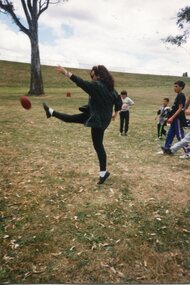
... air, while other children look on or participate in the activity. The open grassy field and surrounding trees reflect the relaxed, natural setting typical of school-organised community events of the time. Such gatherings were a key part of Jacana Primary School’s end-of-year traditions, designed to celebrate the festive season and foster a sense of belonging among students, families, and staff. ...air, while other children look on or participate in the activity. The open grassy field and surrounding trees reflect the relaxed, natural setting typical of school-organised community events of the time. Such gatherings were a key part of Jacana Primary School’s end-of-year traditions, designed to celebrate the festive season and foster a sense of belonging among students, families, and staff. ...This photograph, taken during Jacana Primary School’s 1990 Christmas picnic, captures a dynamic moment of outdoor play, likely held at Greenvale Reservoir—a popular recreational site in Melbourne’s northern suburbs. The image shows an adult mid-kick, sending a football into the air, while other children look on or participate in the activity. The open grassy field and surrounding trees reflect the relaxed, natural setting typical of school-organised community events of the time. Such gatherings were a key part of Jacana Primary School’s end-of-year traditions, designed to celebrate the festive season and foster a sense of belonging among students, families, and staff. The inclusion of informal sports and games highlights the school’s emphasis on physical activity, social interaction, and inclusive celebration. As part of the school’s visual archive, this photograph offers insight into the recreational culture of suburban Melbourne in the early 1990s. It illustrates how schools used public spaces like Greenvale Reservoir to create memorable experiences that strengthened community ties and enriched student life beyond the classroom.This photograph is a significant visual record of Jacana Primary School’s 1990 Christmas picnic, believed to have taken place at Greenvale Reservoir, a well-known recreational site in Melbourne’s northern suburbs. It captures a lively moment of outdoor play, with an adult mid-kick sending a football into the air, surrounded by peers in a relaxed park setting. The image reflects the school’s commitment to fostering student well-being through physical activity and informal social interaction. Events like this picnic were central to Jacana Primary’s end-of-year traditions, promoting community spirit and inclusive celebration among students, families, and staff. As part of the school’s visual archive, this photograph contributes to a broader understanding of how public education in Victoria supported holistic development and community engagement. It stands as a testament to the enduring value of shared experiences in shaping school culture and the social fabric of suburban Melbourne in the early 1990s.A glossy colour photograph portrait formatPH18289 (crossed out) PH-4209 (crossed out) PH-4868jacana primary school, christmas picnic, 1990, jacana, education -
Moorabbin Air Museum
Pamphlet - Aircraft engines - superchargers, Supercharger Sense
... Aircraft engines - superchargers Cost Two speed superchargers Two stage superchargers Boost control Gear change Overview of engine supercharger for pilots, circa 1944 Photocopied reproduction of British air ministry pamphlet circa 1944 Supercharger Sense Pamphlet Aircraft engines - superchargers ...Overview of engine supercharger for pilots, circa 1944Photocopied reproduction of British air ministry pamphlet circa 1944non-fictionOverview of engine supercharger for pilots, circa 1944cost, two speed superchargers, two stage superchargers, boost control, gear change -
 Melbourne Legacy
Photograph - Photo, Anzac Day 1993, 1993
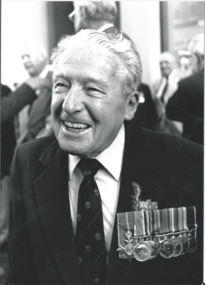
... Air Attache in Washington, D.C. Ron retired from the Service in 1955 as Wing Commander. It comes as no surprise that Ron was awarded an O.B.E. for his tireless devotion to duty and you might sense Ron has been a tireless member of Legacy too." ...Air Attache in Washington, D.C. Ron retired from the Service in 1955 as Wing Commander. It comes as no surprise that Ron was awarded an O.B.E. for his tireless devotion to duty and you might sense Ron has been a tireless member of Legacy too." ...According to the paper label "Over 300 Legatees participated in the ANZAC Day march commemorating Legacy's 70th Anniversary." Photos show three Legatees assembling in Flinders Street before the march, and a close up of Legatee Ron Austin. Ron Austin was the last surviving World War 1 veteran alive involved with Melbourne Legacy. (See also 00754, 00755 and 00756). The article in The Answer in May 1993 says: The ever-smiling L/ Ron Austin is an inspiration for all. Ron has the distinction of being the youngest surviving Melbourne Legatee to have served in WW1. He joined over 300 Legatees to march as part of the Legacy contingent to mark Legacy's 70th anniversary, and he marched again for a a few blocks as he joined members of his wireless unit to catch up with old friends. Ron was just 14 and a half when he joined the R.A.N. in 1917 as a Boy Seaman. He served for 10 years, resumed civilian life, then in 1931 joined the RAAF Telecommunications. WWII kept him busy! In 1949 he became Assistant Air Attache in Washington, D.C. Ron retired from the Service in 1955 as Wing Commander. It comes as no surprise that Ron was awarded an O.B.E. for his tireless devotion to duty and you might sense Ron has been a tireless member of Legacy too." Plus a note in the Answer in 1997 after Ron passed away aged 94.A record of Legatees marching together on Anzac Day to commemorate the 70th Anniversary of Legacy.Black and white photo x 2 of Anzac Day March 1993 and an article from The Answer on Ron Austin.Marked B10, and B16 which are the frame numbers from the B proof sheet (00754.2). 00788.1 says "L'tee Ron Austin last WWI veteran alive in Melbourne Legacy" in blue pen.70th anniversary, anzac day, answer, ron austin -
 Melbourne Legacy
Photograph, Ron Austin WW 1 Veteran on Anzac Day 1995, 1995
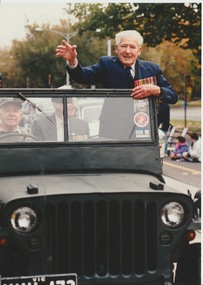
... Air Attache in Washington, D.C. Ron retired from the Service in 1955 as Wing Commander. It comes as no surprise that Ron was awarded an O.B.E. for his tireless devotion to duty and you might sense Ron has been a tireless member of Legacy too." ...Air Attache in Washington, D.C. Ron retired from the Service in 1955 as Wing Commander. It comes as no surprise that Ron was awarded an O.B.E. for his tireless devotion to duty and you might sense Ron has been a tireless member of Legacy too." ...Colour photos of an Anzac Day march with Legatee Ron Austin in a jeep. More photos from the march include Jeff Kennett, Bruce Ruxton, John Brumby, and Peter Costello who appear to be the distinguished guests. It is Anzac Day 1995. The article in The Answer in May 1993 says: The ever-smiling L/ Ron Austin is an inspiration for all. Ron has the distinction of being the youngest surviving Melbourne Legatee to have served in WW1. He joined over 300 Legatees to march as part of the Legacy contingent to mark Legacy's 70th anniversary, and he marched again for a few blocks as he joined members of his wireless unit to catch up with old friends. Ron was just 14 and a half when he joined the R.A.N. in 1917 as a Boy Seaman. He served for 10 years, resumed civilian life, then in 1931 joined the RAAF Telecommunications. WWII kept him busy! In 1949 he became Assistant Air Attache in Washington, D.C. Ron retired from the Service in 1955 as Wing Commander. It comes as no surprise that Ron was awarded an O.B.E. for his tireless devotion to duty and you might sense Ron has been a tireless member of Legacy too." Plus a note in the Answer in 1997 after Ron passed away aged 94.A record of Legatee Austin being one of the last surviving World War 1 veterans and him attending Anzac Day in the 1990s.Colour photo x 3 of an Anzac Day march with WW1 veteran Ron Austin in a jeep.ron austin, jeep, anzac day, march -
 Department of Energy, Environment and Climate Action
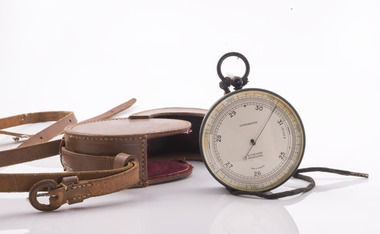
Surveyor's Pocket Altimeter, c 1940
... This instrument measures elevation by sensing minute changes in barometric air pressure relative to a fixed datum point at sea level or a known elevation, such as the starting point of a major town during a road survey, and has an accuracy of +/- 20 feet when used in experienced hands. ...This instrument measures elevation by sensing minute changes in barometric air pressure relative to a fixed datum point at sea level or a known elevation, such as the starting point of a major town during a road survey, and has an accuracy of +/- 20 feet when used in experienced hands. ...This instrument measures elevation by sensing minute changes in barometric air pressure relative to a fixed datum point at sea level or a known elevation, such as the starting point of a major town during a road survey, and has an accuracy of +/- 20 feet when used in experienced hands. The finely divided scale around the perimeter of the face is marked from 0 to 6000 feet elevation and 25 to 31 inches of mercury (Hg) for barometric pressure The single fine counter-balanced hand or pointer rotates anti-clockwise with increasing elevation and decreasing pressure. The label "compensated" indicates that the instrument is constructed to compensate for the effect of temperature changes on the accuracy of readings. Surveyor's Pocket Altimeter - Aneroid Barometer Type Branded N H Seward, Melbourne. Made in England. With leather carrying case and strap.forest measurement, forests commission victoria (fcv), surveying
