
Showing 9 items matching "aircraft doping "
-
 Moorabbin Air Museum
Book - Wooden aircraft, Aircraft Woodwork
... ...Aircraft doping & finishing...Wooden aircraft Wood properties & characteristics Aircraft woods Defects in & selection of aircraft woods Plywood Fundamentals of aircraft woodworking Technical drawings Glues & gluing Joints & Laminations Aircraft woodworkers tools Aircraft doping & finishing Safety rules Construction of various wing & tail components Wood propellers Repairs Overview of the characteristics, identification & uses of aircraft woods, circa 1946 Aircraft Woodwork Book Wooden aircraft ...Overview of the characteristics, identification & uses of aircraft woods, circa 1946non-fictionOverview of the characteristics, identification & uses of aircraft woods, circa 1946wood properties & characteristics, aircraft woods, defects in & selection of aircraft woods, plywood, fundamentals of aircraft woodworking, technical drawings, glues & gluing, joints & laminations, aircraft woodworkers tools, aircraft doping & finishing, safety rules, construction of various wing & tail components, wood propellers, repairs -
 Sunshine and District Historical Society Incorporated
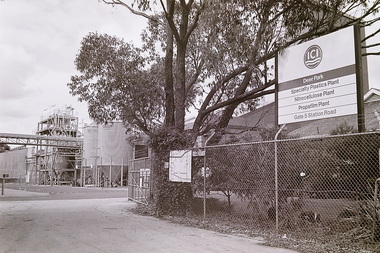
Photograph - I.C.I. Nitrocellulose Plant Station Road Entrance Deer Park 1989 Photograph, C. McGee, 14th April 1989
... It was used for Explosives (historical origin of the Deer Park site), Aircraft fabric dope (WWI–WWII aviation coatings), Waterproof cloth and coated textiles and Leathercloth (ICI’s trade name for nitrocellulose‑coated fabric used in cars, furniture, bags, and industrial goods). ...It was used for Explosives (historical origin of the Deer Park site), Aircraft fabric dope (WWI–WWII aviation coatings), Waterproof cloth and coated textiles and Leathercloth (ICI’s trade name for nitrocellulose‑coated fabric used in cars, furniture, bags, and industrial goods). ...The I.C.I. Nitrocellulose Plant on Station Road, Deer Park was part of the ICI Leathercloth Factory, a major industrial complex producing nitrocellulose‑based coated fabrics “Leathercloth”. It operated as a specialised chemical works linked to explosives, aircraft fabric coatings, and waterproof materials. Nitrocellulose (guncotton reacted with nitric acid) was one of the earliest multi‑use synthetic materials. It was used for Explosives (historical origin of the Deer Park site), Aircraft fabric dope (WWI–WWII aviation coatings), Waterproof cloth and coated textiles and Leathercloth (ICI’s trade name for nitrocellulose‑coated fabric used in cars, furniture, bags, and industrial goods). The Station Road plant specialised in the nitrocellulose coating and finishing processes, not explosives manufacture.The history of the Nitrocellulose Plant is tightly connected to the evolution of the Deer Park explosives precinct and the wider ICI industrial township.I.C.I. Nitrocellulose Plant Station Road Deer Park 893.1i.c.i., station road, deer park -
 Bendigo Military Museum
Book - AIRCRAFT TRAINING NOTES, c.1939-45
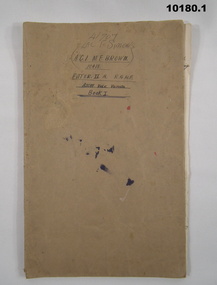
... Trade training course for Aero frame fitter, Rigging, Splicing, Doping, Hydraulics, Metallurgy, Maintenance. The book is cardboard covered with blue and white swirls. Book AIRCRAFT ...Collection re Frederick Simons. Refer to Cat No 10159.1. Foolscap sized, lined, exercise book. It has a brown paper cover. Inside the first date is 2 Oct 1940. There are handwritten notes and drawings on; Theory of flight, Parts of a Tiger Moth, Avro Anson, Wirraway, Lockheed, Fairey Battle, Auro Trainer, Lockheed Hudson. 2. Foolscap size, 3 column cash book used as an exercise book. Some of the first pages have been cut out. Trade training course for Aero frame fitter, Rigging, Splicing, Doping, Hydraulics, Metallurgy, Maintenance. The book is cardboard covered with blue and white swirls.1. Front cover shows “41707 LAC F. Simons over riding ACI - MF Brown 10418. Fitter # A R.A.A.F. Ascot Vale, Victoria. Book 1” 2. Front cover printed is: - “E.B. James, Printer, High St, Eaglehawk” Written is “A.C.1 Brown (?) F. 10418. No I.E.S. Ascot Vale, Vic” Crossed out is phrase "Bought Ledger".raaf, aircraft fitter training, trade training manual -
Moorabbin Air Museum
Manual (item) - Aircraft Painting, Paints, Dopes & Fabric
... Paints, Dopes & Fabric Manual Aircraft Painting ... -
 Australian Gliding Museum
Machine - Glider – Sailplane, 1940
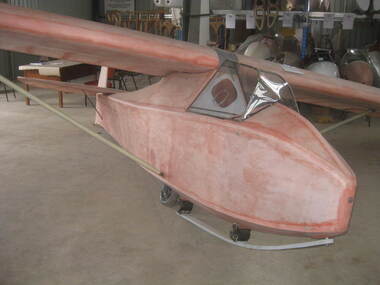
... Also the aircraft provides an insight into gliding technology in Australia in the 1940s. australian gliding glider sailplane coogee tom proctor victorian motorless flight group geelong gliding club Wood and fabric single seat glider sailplane with strutted wings and strutted tailplane – features metal framed perspex canopy, central fuselage skid and wheel, small tail skid, instruments include airspeed, turn and bank indicator; variometer and altimeter. Metal parts include struts and fairing covering wing joint. All surfaces are pink doped ...The “Coogee” is an intermediate single seat sailplane designed and built by Tom Proctor in 1940. Only one was built. It was first flown at Stuart Hill near Bendigo Victoria in January 1941 and was maintained in flying condition until 1967. The aircraft was flown extensively by the Victorian Motorless Flight Group (now the Melbourne Gliding Club) and Geelong Gliding Club and several subsequent owners. This exhibit is a "one off" Australian designed and built glider similar in some respects to the Hutter H17. Its usage is relevant to the history of gliding in Victoria in the post war years. Also the aircraft provides an insight into gliding technology in Australia in the 1940s. Wood and fabric single seat glider sailplane with strutted wings and strutted tailplane – features metal framed perspex canopy, central fuselage skid and wheel, small tail skid, instruments include airspeed, turn and bank indicator; variometer and altimeter. Metal parts include struts and fairing covering wing joint. All surfaces are pink doped – awaiting painting.australian gliding, glider, sailplane, coogee, tom proctor, victorian motorless flight group, geelong gliding club -
 Australian Gliding Museum
Machine - ES56 Nymph Sailplane
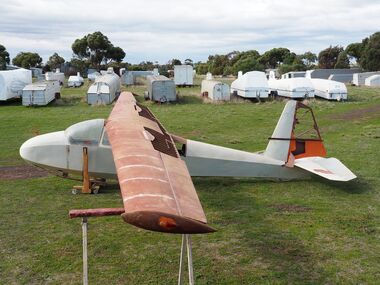
... doped fabric. It exbibits design innovation, notably the use of a laminar flow wing profile in pursuit of better glide performance. Also, considerable attention was given to simplifying the structure in order to keeping cost and the weight low. The ES56 played a useful role at gliding clubs where it was operated, especially the late 1950s and early 1960s and is remembered well by pilots who flew her. The glider is in the course of restoration and provides an insight into the skills and workmanship that were involved in design, building and maintenance of these wooden aircraft ...ES 56 Nymph Following the successful introduction of the ES 52 Kookaburra two-seater in mid-1954, Edmund Schneider Ltd designed a higher performance single seat sailplane of similar construction and with similar handling qualities. It was designated the ES 56 and became known as the ES56 “Nymph”. The ES56 Nymph was a success in that it delivered the anticipated performance and was found to have satisfactory flying characteristics. However, only the prototype (“Nymph -I”) and three production examples (“Nymph-II”) were built. Schneiders made some changes to the design before building the production version. The wing chord at the tip on the prototype measured 650 mm. This was reduced to 500 mm for subsequent builds. The explanation is that provision was made in the original design for the possible lengthening of the tapered wing to 13 metres. However, apparently it was decided to retain the 11.900 metre span which allowed the tip chord to be reduced slightly. Other changes included the installation of scissor type air brakes in the wing instead of simple hinged flap spoilers and the addition of a landing wheel behind the skid on the fuselage. On one of the Nymph-II a dorsal was added on top of the fuselage forward of the vertical fin when repairs were made rectifying damage incurred as a result of an accident at Benalla on 31 March 1963. Even before these ES56 gliders were finished, Edmund Schneider Ltd decided to offer a less expensive single seat design to cater in particular for newly solo pilots, the ES57 Kingfisher. With the Kingfisher, Schneiders reverted to a traditional airfoil (Gott 549) for the wing instead of the laminar flow section that was chosen for the Nymph in the pursuit of performance. As such, the Kingfisher was more appropriately characterised as a single seat version of the Kookaburra in comparison to the Nymph. Schneiders continued for a time to offer the ES56 Nymph as a high-performance sailplane. However, its place in the market was soon overtaken by imported designs with superior performance, such as the Schleicher KA6, which Schneiders also imported and built under license. Nymph-I was test flown in December 1955 and entered by Harry Schneider into the gliding championships held at Waikerie from 5th to 16th of that month. Harry finished 12th in the individual placing out of a field of approximately 24. The capabilities of the Nymph were further demonstrated by Harry Schneider in January 1956 with a Gold C flight of 193 miles from Gawler in South Australia to Walpeup in Victoria. Nymph-I was acquired by the Port Pirie Gliding Club in South Australia. It has been saved and restored and is a regular feature at vintage glider rallies in Victoria and New South Wales. See Museum Newsletter No 35 Winter Edition 2017 pages 3 -6, for that story. The Nymph-II production models were delivered by Edmund Schneider Ltd in October 1956 to the Gliding Club of Victoria, the Victorian Motorless Flight Group and the Royal Australian Navy Gliding Association. The VMFG flew its Nymph in the First National Gliding Championships at Tocumwal, NSW, in December 1956 and all three were flown at the Second National Gliding Championships at Benalla in 29th December 1958 to 8th January 1959, delivering competitive performances based on handicap. Nymph-I Serial Number 17 Original owner – Port Pirie Gliding Club, S.A. Registered VH-GHG on 20 August 1957 Re-registered VH-GHA on 11 October 2016 Currently Raywood, Victoria Believed airworthy Nymph-II Serial Number 20 Original owner – R.A.N. Gliding Association Registered VH-GDX on 20 May 1957 Currently Locksley, Victoria. In storage Nymph-II Serial Number 21 Original owner – Gliding Club of Victoria Registered VH-GHU on 27 August 1957 Currently Bendick Murrell, N.S.W. In storage Nymph-II Serial Number 22 Original owner – Victorian Motorless Flight Group Registered VH-GFE on 5 March 1957 Currently Bacchus Marsh, Victoria Under restoration for display. The Museum’s exhibit is the ES56, serial number 22, registered as VH-GFE. The glider was flown by the VMFG in Victoria until approximately September 1968. GFA records show that it was transferred to Queensland in 1968, and it passed through several owners until the mid-1970s. Information received indicates that it was flown by the Leichardt Soaring Club at Mount Isa in the (late?) 1960s. The history from then is not presently known except to say that it has been kept in dry storage for many years. It is not known when the glider was last flown. What is Significant? The Schneider ES 56 Nymph single seat sailplane, serial number 22, designed and built in 1955-1956, by Edmund Schneider Ltd in Adelaide. It was delivered to its original owner, the Victorian Motorless Flight Group, in October 1956, and registered as VH-GFE on 5 March 1957. How it is Significant? The ES56 Nymph is of historical, aesthetic, scientific and research, and social significance to the Australian gliding community. Why it is Significant? The ES56 is of historical significance as it was designed and built by Edmund and Harry Schneider. The Schneiders immigrated to Australia after the end of the second world war bringing with them considerable expertise in relation to glider design and construction. Over the following decades they maintained a close association with the Gliding Federation of Australia and the gliding clubs and through their glider production made a major contribution to the sport. The ES56 is part of that story. The ES56 in its design and construction exhibits the glider construction technology of the time, which principally consisted of lightweight wooden framework skinned with ply and doped fabric. It exbibits design innovation, notably the use of a laminar flow wing profile in pursuit of better glide performance. Also, considerable attention was given to simplifying the structure in order to keeping cost and the weight low. The ES56 played a useful role at gliding clubs where it was operated, especially the late 1950s and early 1960s and is remembered well by pilots who flew her. The glider is in the course of restoration and provides an insight into the skills and workmanship that were involved in design, building and maintenance of these wooden aircraft. It is of aesthetic and scientific and research significance. Glider airframe of a traditional wood and fabric covered constructionNoneglider, sailplane, edmund schneider, harry schneider, es56, nymph, es57, kingfisher, victorian motorless flight group, gliding club of victoria, ran gliding association, port pirie gliding club, leichardt soaring club. -
Moorabbin Air Museum
Book - Aircraft construction, Materials of Aircraft Construction
... Aircraft construction Alloys .Corrosion Timbers Varnish Glues Rubber Fabric & dopes Material selection Overview of aircraft construction materials for designer, users & students of aircraft & aircraft engines, circa 1942 Materials of Aircraft Construction Book Aircraft construction ...Overview of aircraft construction materials for designer, users & students of aircraft & aircraft engines, circa 1942non-fictionOverview of aircraft construction materials for designer, users & students of aircraft & aircraft engines, circa 1942alloys, .corrosion, timbers, varnish, glues, rubber, fabric & dopes, material selection -
Moorabbin Air Museum
Book - Aircraft materials, Aircraft Materials and Processes
... Aircraft materials Testing Steel & its alloys Heat treatment Nickel alloys Aluminium alloys Magnesium alloys Welding blazing & soldering. Wood & glue Corrosion Fabrics & dope ...Essential information on materials/processes used in aircraft construction, circa 1941non-fictionEssential information on materials/processes used in aircraft construction, circa 1941testing, steel & its alloys, heat treatment, nickel alloys, aluminium alloys, magnesium alloys, welding blazing & soldering., wood & glue, corrosion, fabrics & dope, plastics -
 Whitehorse Historical Society Inc.
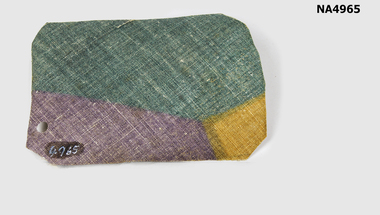
Souvenir - Fabric Sample, c 1914
... Sample of doped canvas fabric from W W I German aircraft. Rectangular shape of Fabric in green, purple and yellow with hole for tag in one corner...Part of Honybun collection Sample of W W I camoflague fabric military history army air force WW1 Charles Henry Honybun Sample of doped canvas fabric from W W I German aircraft. Rectangular shape of Fabric in green, purple and yellow with hole for tag in one corner Souvenir Fabric Sample ...Collected by Charles Honybun. Part of Honybun collectionSample of W W I camoflague fabricSample of doped canvas fabric from W W I German aircraft. Rectangular shape of Fabric in green, purple and yellow with hole for tag in one cornermilitary history, army, air force, ww1, charles henry honybun
