
Showing 8 items matching "aircraft noise"
-
 Moorabbin Air Museum
Book - Airport & airspace studies, Brisbane Airport The Impact of Aircraft Noise
... Brisbane Airport The Impact of Aircraft Noise......Impact of aircraft noise...Airport & airspace studies The task force The issues Runway development options Aircraft operation Impact of aircraft noise Aircraft flight paths Environmental & administrative considerations Review of operation & planning of Brisbane airport to minimise impact of noise, circa 1991 Brisbane Airport The Impact of Aircraft Noise Book Airport & airspace studies ...Review of operation & planning of Brisbane airport to minimise impact of noise, circa 1991non-fictionReview of operation & planning of Brisbane airport to minimise impact of noise, circa 1991the task force, the issues, runway development options, aircraft operation, impact of aircraft noise, aircraft flight paths, environmental & administrative considerations -
Moorabbin Air Museum
Book - Airport & airspace studies, Port Phillip Region Airport and Airspace Study Appendices to Report
... ...Aircraft noise...Airport & airspace studies Essendon airport role Summary of issues raised by submissions Forecasts Avalon airport Airspace in Port Phillip area Airport capacity vs demand Economic evaluation of airport options Environmental impact of aircraft operations Aircraft noise Airport operations & risk Essendon airport-site value estimates Appendices to report published in 1991 re. airspace in Port Phillip Port Phillip Region Airport and Airspace Study Appendices to Report Book Airport & airspace studies ...Appendices to report published in 1991 re. airspace in Port Phillipnon-fictionAppendices to report published in 1991 re. airspace in Port Phillipessendon airport role, summary of issues raised by submissions, forecasts, avalon airport, airspace in port phillip area, airport capacity vs demand, economic evaluation of airport options, environmental impact of aircraft operations, aircraft noise, airport operations & risk, essendon airport-site value estimates -
 Melton City Libraries
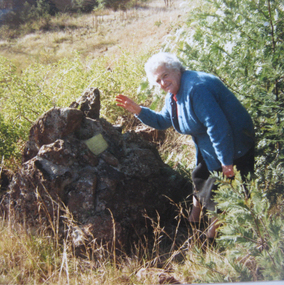
Photograph, The Cairn- Jimmy Melrose's plane crash site, 1988
... At 8.45 people at Melton (30 miles West of Melbourne) heard an approaching aircraft. The engine noise increased abnormally and eye witnesses saw the machine fall out of control from the cloud base about 800 feet and then disintegrate, fragments were scattered for 1½ miles and both occupants were killed. ...At 8.45 people at Melton (30 miles West of Melbourne) heard an approaching aircraft. The engine noise increased abnormally and eye witnesses saw the machine fall out of control from the cloud base about 800 feet and then disintegrate, fragments were scattered for 1½ miles and both occupants were killed. ...Edna Barrie at the cairn, photo received from Graeme Minns in 1988. The cairn marks the site of Jimmy Melrose's plane crash in Melton South. The accident which happened on July 5th 1936. In 1934 Melrose made headlines with a series of spectacular flights. In July of that year, he set around Australia record and in that year established a new solo Australia England record when he flew to England to compete in the MacRoberston race with a De Havilland Puss Moth VH- YQO. The only Australian and the only solo pilot to complete the course within the time limit. He was seventh in finishing order and third in the handicap section making news again during the race with a dramatic landing in Darwin with empty fuel tanks. Late in 1935 Melrose imported the Phoenix for his “Adelaide to Anywhere” Charter Service. The previous year the Heston Aircraft Company had taken over the interests of the well known Comper Aircraft Company, and the first production of the new firm was the Phoenix, a single-engined all wooden five seater machine of sesquiplane configuration. The forward half of the fuselage was a streamlined rectangular section and the rear portion was a monocogue shell; the whole was of plywood fabric covered. The wing was built up of spruce box spars and lattice ribs, ply covered from the leading edge to the front spar and the fabric covered over the remainder. The tail surfaces were of similar construction. The most notable feature of the design was the lower stub wing which ran right across the fuselage embodying two box spars, plywood covered it housed the main undercarriage wheels when retracted and provided a substantial anchorage for the Nu form wing struts. The Dowty undercarriage retracted inwards, operated manually by hydraulic packs, Dual control fitted, with side by side seating for the pilots and three passenger seats behind. Power was a 200 h.p. De Havilland Gipsy VI 6 cylinder inverted in-line air-cooled engine. Six Phoenix were built; five of them registered in Great Britain and one of those was later sold abroad the remaining four were impressed into the R.A.F. in 1940. Specifications were: 40 feet 4 inches length 30 ft 2 ins height, 9ft 7ins, wing area 270 sq ft, Tare weight 2,600lbs loaded weight 3,300lbs; cruising speed 360 m.p.h. landing 50mph ceiling 14,000 ft range 700 miles. Melrose’s machine the first production aircraft was built early in 1936 and test flown of the 24th March. Painted green it carries the words “South Australian Centenary 1936” in silver of the fuselage and the name “Billing on the engine cowling in honor of Melrose’s uncle Noel Pemberton Billing, pioneer designer and founder of the Supermarine Aviation Company. The delivery flight was planned as a goodwill mission to publicise the forthcoming South Australian Centenary celebrations. Melrose left Dympne on the 9th April 1936, and flying via Marseilles, Naples, Athens, Baghdad, Basra, Karachi, Jodphur, Calcutta, Akyab, Penang, Singapore, Lombok, Darwin, Newcastle Waters and Alice Springs reached Adelaide on the 25th of April. Continuing the goodwill flight to other States, he visited Melbourne, Sydney, Newcastle, Grafton, Brisbane, Coff’s Harbour, Sydney again, Launceston, Hobart and Mount Gambier before returning to Adelaide on the 13th May. During June Jimmy made some charter flights and early in July was engaged by Mr. A.J. Campbell a director of several mining companies from Melbourne to Darwin to commence at Essendon on the4th July. However on that day low cloud and steady rain caused the postponement. There was little improvement and Melrose was advised to delay the departure again. However he wished to reach Oodnadatta that night, and when he observed the break in the clouds decided to leave. He planned to climb above the cloud and fly to Adelaide at 3,000 feet. The aircraft was airborne about 8.10 a.m. and was last seen from Essendon climbing above the clouds. At 8.45 people at Melton (30 miles West of Melbourne) heard an approaching aircraft. The engine noise increased abnormally and eye witnesses saw the machine fall out of control from the cloud base about 800 feet and then disintegrate, fragments were scattered for 1½ miles and both occupants were killed. Hand written carbon copy by Edna Barrie.Typed by Wendy Barrie March 2014 Last Flight of Jimmy Melrose by John Burke Parade Magazine July 1972 Page 2 –4 This article gives the take off time of 7.50 am from Essendon Airport Eyewitness account at the time Maisie Arthur’s description. Newspaper article. Edna Barrie at the site of the 'Cairn'local identities, local significant events -
 Federation University Historical Collection
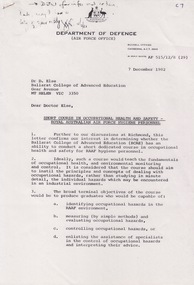
Document - Document - Correspondence, VIOSH: Department of Defence - Air Force Office, Canberra, December 1982
... Noise induced hearing loss is the most widespread occupational health risk in the RAAF. Industrial chemicals used and hazardous industrial procedures in the repair and maintenance of aircraft are an issue needing resolution. ...Noise induced hearing loss is the most widespread occupational health risk in the RAAF. Industrial chemicals used and hazardous industrial procedures in the repair and maintenance of aircraft are an issue needing resolution. ...Victorian Institute of Occupational Safety and Health (VIOSH) Australia is the Asia-Pacific centre for teaching and research in occupational health and safety (OHS) and is known as one of Australia's leaders on the field. VIOSH has a global reputation for its innovative approach within the field of OHS management. VIOSH had its first intake of students in 1979. At that time the Institution was known as the Ballarat College of Advanced Education. In 1990 it became known as Ballarat University College, then in 1994 as University of Ballarat. It was 2014 that it became Federation University. VIOSH Australia students are safety managers, senior advisors and experienced OHS professionals. They come from all over Australia and industry. Students are taught active research and enquiry; rather than textbook learning and a one-size fits all approach. VIOSH accepts people into the Graduate Diploma of Occupational Hazard Management who have no undergraduate degree - on the basis of extensive work experience and knowledge Letter from the Department of Defence to Dennis Else looking at the possibility of Ballarat College of Advanced Education conducting a short course in occupational health and safety for RAAF hygiene personnel. It would teach the fundamentals of occupational health and environmental monitoring and control. Better use of the practical time allocated is needed. Noise induced hearing loss is the most widespread occupational health risk in the RAAF. Industrial chemicals used and hazardous industrial procedures in the repair and maintenance of aircraft are an issue needing resolution. Existing terminal objectives for basic hygiene inspectors course in occupational health and safety are provided for comment. Information provided by K R Stone, Flight Lieutenant for Director General of Air Force Health Services. Eight A4 pages,typed. Handwritten note top left cornerLetterhead of Department of Defence - Air Force Office.Signature of K R Stoneviosh, victorian institute of occupational safety and health, department of defence, air force office, raaf, ballarat college of advanced education, dennis else, k r stone, flight lieutenant, director general of air force health services, short course in occupational health and safety, raaf hygiene personnel, hearing loss, industrial chemicals, hazardous industrial procedures -
Moorabbin Air Museum
Photograph (Item) - Taylor Monoplane design , Twin Wasp C3 engine, De Havilland story, Retirement activities, Industrial relations, tool design data Lidcombe, Kingsford Smith, Southern Cross, Flying Finns, benalla, Gliders, Maatsuyker, ICAO, Concorde noise level, Bristol Beaufighter Whispering death, Boeing CH-47C Chinook, Cessna A-37B Dragonfly, Jim Knight, Saab J29, Harvard MkIIA, Wackett trainer, Rocket powered interceptor, YF-23, Henty house, DCA day, Gabo Island, Fokker F28, Transport Australia magazines, P-39 Aircobra, Civil Aviation in Australia, Construction of Melbourne airport, Technology in Australia, Computers, John Cock, Navy today, Vickers Viscount, Bantam 820, Orville Wright first fight telegram, Qantas history, Australias Aircraft industry, Beaufighters, Mustangs, Beauforts, Tudors, Mosquitos, Boomerangs, Dragons, Wacketts, Tiger Moths, ME109, Australian aviation history
... Taylor Monoplane design , Twin Wasp C3 engine, De Havilland story, Retirement activities, Industrial relations, tool design data Lidcombe, Kingsford Smith, Southern Cross, Flying Finns, benalla, Gliders, Maatsuyker, ICAO, Concorde noise level, Bristol Beaufighter Whispering death, Boeing CH-47C Chinook, Cessna A-37B Dragonfly, Jim Knight, Saab J29, Harvard MkIIA, Wackett trainer, Rocket powered interceptor, YF-23, Henty house, DCA day, Gabo Island, Fokker F28, Transport Australia magazines, P-39 Aircobra, Civil Aviation in Australia, Construction of Melbourne airport, Technology in Australia, Computers, John Cock, Navy today, Vickers Viscount, Bantam 820, Orville Wright first fight telegram, Qantas history, Australias Aircraft industry, Beaufighters, Mustangs, Beauforts, Tudors, Mosquitos, Boomerangs, Dragons, Wacketts, Tiger Moths, ME109 ...Australian aviation history Photograph Taylor Monoplane design , Twin Wasp C3 engine, De Havilland story, Retirement activities, Industrial relations, tool design data Lidcombe, Kingsford Smith, Southern Cross, Flying Finns, benalla, Gliders, Maatsuyker, ICAO, Concorde noise level, Bristol Beaufighter Whispering death, Boeing CH-47C Chinook, Cessna A-37B Dragonfly, Jim Knight, Saab J29, Harvard MkIIA, Wackett trainer, Rocket powered interceptor, YF-23, Henty house, DCA day, Gabo Island, Fokker F28, Transport Australia magazines, P-39 Aircobra, Civil Aviation in Australia, Construction of Melbourne airport, Technology in Australia, Computers, John Cock, Navy today, Vickers Viscount, Bantam 820, Orville Wright first fight telegram, Qantas history, Australias Aircraft industry, Beaufighters, Mustangs, Beauforts, Tudors, Mosquitos, Boomerangs, Dragons, Wacketts, Tiger Moths, ME109 ... -
Moorabbin Air Museum
Manual (Item) - CAC Radio noise elimination in aircraft 12 R-1-1, radio set AN ARC-34, CAC Radio noise elimination in aircraft 12 R-1-1
... CAC Radio noise elimination in aircraft 12 R-1-1, radio set AN ARC-34...CAC Radio noise elimination in aircraft 12 R-1-1...CAC Radio noise elimination in aircraft 12 R-1-1 Manual CAC Radio noise elimination in aircraft 12 R-1-1, radio set AN ARC-34 ... -
Moorabbin Air Museum
Manual - CAC radio AF amplifier american 11 F4 -2-2-4 446-40-0001 11 70AB -100 radar AN APG-30, CAC radio noise elimination in aircraft 12 R-1-1
... CAC radio noise elimination in aircraft 12 R-1-1...CAC radio noise elimination in aircraft 12 R-1-1 Manual CAC radio AF amplifier american 11 F4 -2-2-4 446-40-0001 11 70AB -100 radar AN APG-30 ... -
Moorabbin Air Museum
Book - Aircraft gas turbine/jet engines, The Jet Engine
... Aircraft gas turbine/jet engines Basic mechanics Working cycle & airflow Compressors Combustion chambers Turbines Exhaust system Noise suppression Thrust reversal Water injection Lubrication Air cooling & sealing Starting and ignition Ice & fire protection Installation Description of the working & underlying principles of aero gas turbine engine, circa 1966 The Jet Engine Book Aircraft gas turbine/jet engines ...Description of the working & underlying principles of aero gas turbine engine, circa 1966non-fictionDescription of the working & underlying principles of aero gas turbine engine, circa 1966basic mechanics, working cycle & airflow, compressors, combustion chambers, turbines, exhaust system, noise suppression, thrust reversal, water injection, lubrication, air cooling & sealing, starting and ignition, ice & fire protection, installation
