
Showing 11 items matching "airfoils"
-
 Moorabbin Air Museum
Book - Aerodynamics, Technical Aerodynamics
... Airfoils...Aerodynamics Airfoils Engine-propeller characteristics Performance Stability Flight testing Overview of principles of mechanics & hydrodynamics for technical engineering students, circa 1935 Technical Aerodynamics Book Aerodynamics ...Overview of principles of mechanics & hydrodynamics for technical engineering students, circa 1935non-fictionOverview of principles of mechanics & hydrodynamics for technical engineering students, circa 1935airfoils, engine-propeller characteristics, performance, stability, flight testing -
Moorabbin Air Museum
Book - Aerodyamics, Simple Aerodynamics and The Airplane
... Airfoils...Aerodynamics Airfoils stability Control surfaces Dynamic loads Structure Military and civilian aircraft US Army Air Corps overview of aircraft aerodynamics circa 1927 Simple Aerodynamics and The Airplane Book Aerodyamics ...US Army Air Corps overview of aircraft aerodynamics circa 1927non-fictionUS Army Air Corps overview of aircraft aerodynamics circa 1927airfoils, stability, control surfaces, dynamic loads, structure, military and civilian aircraft -
Moorabbin Air Museum
Book - Aircraft design, Aircraft Design: A Conceptual Approach
... ...Airfoils...Aircraft design Overview of design process Sizing Airfoils Thrust to weight Configuration layout Payload Crew station/passengers Landing gear Performance Cost analysis Industry perspective on new aircraft concept development process, circa 1992 Aircraft Design: A Conceptual Approach Book Aircraft design ...Industry perspective on new aircraft concept development process, circa 1992non-fictionIndustry perspective on new aircraft concept development process, circa 1992overview of design process, sizing, airfoils, thrust to weight, configuration layout, payload, crew station/passengers, landing gear, performance, cost analysis -
Moorabbin Air Museum
Book - Aircraft construction, Practical Lightplane Design and Construction for the Amateur
... Airfoils...Aircraft construction Airfoils Power plants Propellers Fuel systems Landing Gear Fuselage Wings Tail surfaces Control systems Miscellaneous construction details Guidance on light aircraft construction for amateur builders, circa 1965 Practical Lightplane Design and Construction for the Amateur Book Aircraft construction ...Guidance on light aircraft construction for amateur builders, circa 1965non-fictionGuidance on light aircraft construction for amateur builders, circa 1965airfoils, power plants, propellers, fuel systems, landing gear, fuselage, wings, tail surfaces, control systems, miscellaneous construction details -
Moorabbin Air Museum
Book - Aircraft design, Aircraft Layout and Detail Design
... ...Airfoils...Aircraft design Requirements for a good layout Descriptive geometry Airfoils General design condsiderations Connections Forgings Castings Machined fittings Fitting analysis Strength calculations for riveted & bolted joints Bending Torsion Shear & its application to thin web beams Columns Overview of aircraft detail design, circa 1946 Aircraft Layout and Detail Design Book Aircraft design ...Overview of aircraft detail design, circa 1946non-fictionOverview of aircraft detail design, circa 1946requirements for a good layout, descriptive geometry, airfoils, general design condsiderations, connections, forgings, castings, machined fittings, fitting analysis, strength calculations for riveted & bolted joints, bending, torsion, shear & its application to thin web beams, columns -
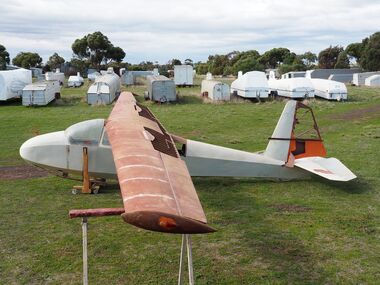 Australian Gliding Museum
Machine - ES56 Nymph Sailplane
... With the Kingfisher, Schneiders reverted to a traditional airfoil (Gott 549) for the wing instead of the laminar flow section that was chosen for the Nymph in the pursuit of performance. ...With the Kingfisher, Schneiders reverted to a traditional airfoil (Gott 549) for the wing instead of the laminar flow section that was chosen for the Nymph in the pursuit of performance. ...ES 56 Nymph Following the successful introduction of the ES 52 Kookaburra two-seater in mid-1954, Edmund Schneider Ltd designed a higher performance single seat sailplane of similar construction and with similar handling qualities. It was designated the ES 56 and became known as the ES56 “Nymph”. The ES56 Nymph was a success in that it delivered the anticipated performance and was found to have satisfactory flying characteristics. However, only the prototype (“Nymph -I”) and three production examples (“Nymph-II”) were built. Schneiders made some changes to the design before building the production version. The wing chord at the tip on the prototype measured 650 mm. This was reduced to 500 mm for subsequent builds. The explanation is that provision was made in the original design for the possible lengthening of the tapered wing to 13 metres. However, apparently it was decided to retain the 11.900 metre span which allowed the tip chord to be reduced slightly. Other changes included the installation of scissor type air brakes in the wing instead of simple hinged flap spoilers and the addition of a landing wheel behind the skid on the fuselage. On one of the Nymph-II a dorsal was added on top of the fuselage forward of the vertical fin when repairs were made rectifying damage incurred as a result of an accident at Benalla on 31 March 1963. Even before these ES56 gliders were finished, Edmund Schneider Ltd decided to offer a less expensive single seat design to cater in particular for newly solo pilots, the ES57 Kingfisher. With the Kingfisher, Schneiders reverted to a traditional airfoil (Gott 549) for the wing instead of the laminar flow section that was chosen for the Nymph in the pursuit of performance. As such, the Kingfisher was more appropriately characterised as a single seat version of the Kookaburra in comparison to the Nymph. Schneiders continued for a time to offer the ES56 Nymph as a high-performance sailplane. However, its place in the market was soon overtaken by imported designs with superior performance, such as the Schleicher KA6, which Schneiders also imported and built under license. Nymph-I was test flown in December 1955 and entered by Harry Schneider into the gliding championships held at Waikerie from 5th to 16th of that month. Harry finished 12th in the individual placing out of a field of approximately 24. The capabilities of the Nymph were further demonstrated by Harry Schneider in January 1956 with a Gold C flight of 193 miles from Gawler in South Australia to Walpeup in Victoria. Nymph-I was acquired by the Port Pirie Gliding Club in South Australia. It has been saved and restored and is a regular feature at vintage glider rallies in Victoria and New South Wales. See Museum Newsletter No 35 Winter Edition 2017 pages 3 -6, for that story. The Nymph-II production models were delivered by Edmund Schneider Ltd in October 1956 to the Gliding Club of Victoria, the Victorian Motorless Flight Group and the Royal Australian Navy Gliding Association. The VMFG flew its Nymph in the First National Gliding Championships at Tocumwal, NSW, in December 1956 and all three were flown at the Second National Gliding Championships at Benalla in 29th December 1958 to 8th January 1959, delivering competitive performances based on handicap. Nymph-I Serial Number 17 Original owner – Port Pirie Gliding Club, S.A. Registered VH-GHG on 20 August 1957 Re-registered VH-GHA on 11 October 2016 Currently Raywood, Victoria Believed airworthy Nymph-II Serial Number 20 Original owner – R.A.N. Gliding Association Registered VH-GDX on 20 May 1957 Currently Locksley, Victoria. In storage Nymph-II Serial Number 21 Original owner – Gliding Club of Victoria Registered VH-GHU on 27 August 1957 Currently Bendick Murrell, N.S.W. In storage Nymph-II Serial Number 22 Original owner – Victorian Motorless Flight Group Registered VH-GFE on 5 March 1957 Currently Bacchus Marsh, Victoria Under restoration for display. The Museum’s exhibit is the ES56, serial number 22, registered as VH-GFE. The glider was flown by the VMFG in Victoria until approximately September 1968. GFA records show that it was transferred to Queensland in 1968, and it passed through several owners until the mid-1970s. Information received indicates that it was flown by the Leichardt Soaring Club at Mount Isa in the (late?) 1960s. The history from then is not presently known except to say that it has been kept in dry storage for many years. It is not known when the glider was last flown. What is Significant? The Schneider ES 56 Nymph single seat sailplane, serial number 22, designed and built in 1955-1956, by Edmund Schneider Ltd in Adelaide. It was delivered to its original owner, the Victorian Motorless Flight Group, in October 1956, and registered as VH-GFE on 5 March 1957. How it is Significant? The ES56 Nymph is of historical, aesthetic, scientific and research, and social significance to the Australian gliding community. Why it is Significant? The ES56 is of historical significance as it was designed and built by Edmund and Harry Schneider. The Schneiders immigrated to Australia after the end of the second world war bringing with them considerable expertise in relation to glider design and construction. Over the following decades they maintained a close association with the Gliding Federation of Australia and the gliding clubs and through their glider production made a major contribution to the sport. The ES56 is part of that story. The ES56 in its design and construction exhibits the glider construction technology of the time, which principally consisted of lightweight wooden framework skinned with ply and doped fabric. It exbibits design innovation, notably the use of a laminar flow wing profile in pursuit of better glide performance. Also, considerable attention was given to simplifying the structure in order to keeping cost and the weight low. The ES56 played a useful role at gliding clubs where it was operated, especially the late 1950s and early 1960s and is remembered well by pilots who flew her. The glider is in the course of restoration and provides an insight into the skills and workmanship that were involved in design, building and maintenance of these wooden aircraft. It is of aesthetic and scientific and research significance. Glider airframe of a traditional wood and fabric covered constructionNoneglider, sailplane, edmund schneider, harry schneider, es56, nymph, es57, kingfisher, victorian motorless flight group, gliding club of victoria, ran gliding association, port pirie gliding club, leichardt soaring club. -
Moorabbin Air Museum
Manual (Item) - AGARD, Loads on Aircraft, Stability, Turbulent Flows, Aerodynamics, Airfoil Design, Data Base for computers
... AGARD, Loads on Aircraft, Stability, Turbulent Flows, Aerodynamics, Airfoil Design, Data Base for computers...AGARD, Loads on Aircraft, Stability, Turbulent Flows, Aerodynamics, Airfoil Design, Data Base for computers Manual AGARD, Loads on Aircraft, Stability, Turbulent Flows, Aerodynamics, Airfoil Design, Data Base for computers ... -
Moorabbin Air Museum
Book - Aeroelasticity, An Introduction to the Theory of Aeroelasticity
... Aeroelasticity Aeroelastic problems Lifting surfaces Flutter Loads Buffeting & stall Airfoil theory Overview of aeroelasticity circa 1955 An Introduction to the Theory of Aeroelasticity Book Aeroelasticity ...Overview of aeroelasticity circa 1955non-fictionOverview of aeroelasticity circa 1955aeroelastic problems, lifting surfaces, flutter, loads, buffeting & stall, airfoil theory, -
Moorabbin Air Museum
Manual (Item) - NACA Confidential Bulletin No AA/36/9 Tests in the NACA Two-dimensional Low Turbulence Tunnel of Airfoil Sections Designed to have small pitching moments and High Lift-Drag Ratios
... Manual NACA Confidential Bulletin No AA/36/9 Tests in the NACA Two-dimensional Low Turbulence Tunnel of Airfoil Sections Designed to have small pitching moments and High Lift-Drag Ratios ... -
Moorabbin Air Museum
Manual (Item) - Laminar Flow Airfoils
... Manual Laminar Flow Airfoils ... -
Moorabbin Air Museum
Book - AGARD reports, Transonic Aerodynamics
... AGARD reports Transonic shock free flow Transonic aerofoil problem Supercritical airfoil theory Compressible flow computations Airfoil flows in transonic freestream Transonic airfoil design Wing profiles in transonic flow Unsteady transonic flow Viscous transonic flow Shock & rear separation Airfoil pressure distribution Supercritical wing profiles Leading edge supersonic velocity peaks Thickness distribution Swept wing design Pressure distribution in wings Wing- body interference Wind tunnel experiments on interference Overview of transonic aerodynamics, circa 1968 Transonic Aerodynamics Book AGARD reports ...Overview of transonic aerodynamics, circa 1968non-fictionOverview of transonic aerodynamics, circa 1968transonic shock free flow, transonic aerofoil problem, supercritical airfoil theory, compressible flow computations, airfoil flows in transonic freestream, transonic airfoil design, wing profiles in transonic flow, unsteady transonic flow, viscous transonic flow, shock & rear separation, airfoil pressure distribution, supercritical wing profiles, leading edge supersonic velocity peaks, thickness distribution, swept wing design, pressure distribution in wings, wing- body interference, wind tunnel experiments on interference
