
Showing 23 items matching "alcohol and drugs"
-
 Marysville & District Historical Society
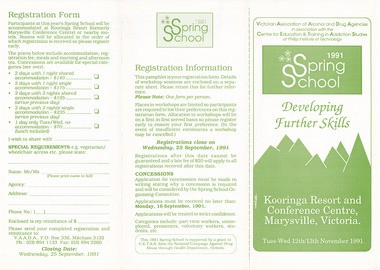
Ephemera (item) - Conference program brochure, 1991 Spring School-Developing Further Skills, 1991
... The conference was held by the Victorian Association of Alcohol and Drug Agencies in association with the Centre for Education & Training in Addiction Studies at Phillip Institute of Technology....The conference was held by the Victorian Association of Alcohol and Drug Agencies in association with the Centre for Education & Training in Addiction Studies at Phillip Institute of Technology....The conference was held by the Victorian Association of Alcohol and Drug Agencies in association with the Centre for Education & Training in Addiction Studies at Phillip Institute of Technology. ...A brochure outlining the program for a conference held at Kooringa Resort and Conference Centre in Marysville in November 1991. The conference was held by the Victorian Association of Alcohol and Drug Agencies in association with the Centre for Education & Training in Addiction Studies at Phillip Institute of Technology.A brochure outlining the program for a conference held at Kooringa Resort and Conference Centre in Marysville in November 1991.marysville, victoria, australia, kooringa, frederick webb, cuzens brothers, betha wilhelmina christina unmack, minnie webb, t.e. foster, edgar charles webb, clarence thomas pitman, jacob pitman, sir isaac pitman, caroline anna blood newenham, henry newenham pitman, carrie rosalind persse pitman, reginald william stringer, alice burton pitman, clarence edward pitman, newenham mueller pitman, olive birch, constance may pitman, olive dora blakeney pitman, gwendoline de burch pitman, kooringa guesthouse, lilian may shelton, thomas henry branchflower, wilbur anderson, peter mackey, caroline anna pitman, joyce anderson, barry brenton, kathy brenton, kooringa tourist house, photograph, kooringa conference centre, kooringa resort and conference centre, 1991 spring school, victorian association of alcohol and drug agencies, centre for education & training in addiction studies, phillip institute of technology -
 Marysville & District Historical Society
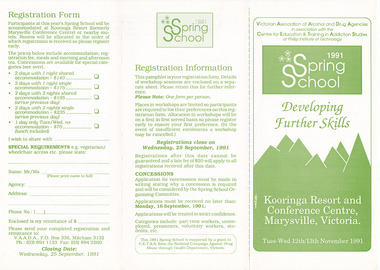
Ephemera (item) - Conference program brochure, 1991 Spring School-Developing Further Skills, 1991
... The conference was held by the Victorian Association of Alcohol and Drug Agencies in association with the Centre for Education & Training in Addiction Studies at Phillip Institute of Technology....The conference was held by the Victorian Association of Alcohol and Drug Agencies in association with the Centre for Education & Training in Addiction Studies at Phillip Institute of Technology....The conference was held by the Victorian Association of Alcohol and Drug Agencies in association with the Centre for Education & Training in Addiction Studies at Phillip Institute of Technology. ...A brochure outlining the program for a conference held at Kooringa Resort and Conference Centre in Marysville in November 1991. The conference was held by the Victorian Association of Alcohol and Drug Agencies in association with the Centre for Education & Training in Addiction Studies at Phillip Institute of Technology.A brochure outlining the program for a conference held at Kooringa Resort and Conference Centre in Marysville in November 1991.marysville, victoria, australia, kooringa, frederick webb, cuzens brothers, betha wilhelmina christina unmack, minnie webb, t.e. foster, edgar charles webb, clarence thomas pitman, jacob pitman, sir isaac pitman, caroline anna blood newenham, henry newenham pitman, carrie rosalind persse pitman, reginald william stringer, alice burton pitman, clarence edward pitman, newenham mueller pitman, olive birch, constance may pitman, olive dora blakeney pitman, gwendoline de burch pitman, kooringa guesthouse, lilian may shelton, thomas henry branchflower, wilbur anderson, peter mackey, caroline anna pitman, joyce anderson, barry brenton, kathy brenton, kooringa tourist house, photograph, kooringa conference centre, kooringa resort and conference centre, 1991 spring school, victorian association of alcohol and drug agencies, centre for education & training in addiction studies, phillip institute of technology -
 Marysville & District Historical Society
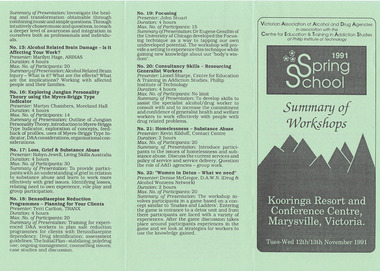
Ephemera (item) - Summary of workshops brochure, 1991 Spring School-Summary of Workshops, 1991
... The conference was held by the Victorian Association of Alcohol and Drug Agencies in association with the Centre for Education & Training in Addiction Studies at Phillip Institute of Technology....The conference was held by the Victorian Association of Alcohol and Drug Agencies in association with the Centre for Education & Training in Addiction Studies at Phillip Institute of Technology....The conference was held by the Victorian Association of Alcohol and Drug Agencies in association with the Centre for Education & Training in Addiction Studies at Phillip Institute of Technology. ...A brochure detailing the various workshops available to attendees attending a conference held at Kooringa Resort and Conference Centre in Marysville in November 1991. The conference was held by the Victorian Association of Alcohol and Drug Agencies in association with the Centre for Education & Training in Addiction Studies at Phillip Institute of Technology.A brochure detailing the various workshops available to attendees attending a conference held at Kooringa Resort and Conference Centre in Marysville in November 1991.marysville, victoria, australia, kooringa, frederick webb, cuzens brothers, betha wilhelmina christina unmack, minnie webb, t.e. foster, edgar charles webb, clarence thomas pitman, jacob pitman, sir isaac pitman, caroline anna blood newenham, henry newenham pitman, carrie rosalind persse pitman, reginald william stringer, alice burton pitman, clarence edward pitman, newenham mueller pitman, olive birch, constance may pitman, olive dora blakeney pitman, gwendoline de burch pitman, kooringa guesthouse, lilian may shelton, thomas henry branchflower, wilbur anderson, peter mackey, caroline anna pitman, joyce anderson, barry brenton, kathy brenton, kooringa tourist house, photograph, kooringa conference centre, kooringa resort and conference centre, 1991 spring school, victorian association of alcohol and drug agencies, centre for education & training in addiction studies, phillip institute of technology -
 Marysville & District Historical Society
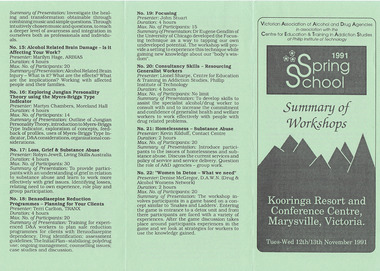
Ephemera (item) - Summary of workshops brochure, 1991 Spring School-Summary of Workshops, 1991
... The conference was held by the Victorian Association of Alcohol and Drug Agencies in association with the Centre for Education & Training in Addiction Studies at Phillip Institute of Technology....The conference was held by the Victorian Association of Alcohol and Drug Agencies in association with the Centre for Education & Training in Addiction Studies at Phillip Institute of Technology....The conference was held by the Victorian Association of Alcohol and Drug Agencies in association with the Centre for Education & Training in Addiction Studies at Phillip Institute of Technology. ...A brochure detailing the various workshops available to attendees attending a conference held at Kooringa Resort and Conference Centre in Marysville in November 1991. The conference was held by the Victorian Association of Alcohol and Drug Agencies in association with the Centre for Education & Training in Addiction Studies at Phillip Institute of Technology.A brochure detailing the various workshops available to attendees attending a conference held at Kooringa Resort and Conference Centre in Marysville in November 1991.marysville, victoria, australia, kooringa, frederick webb, cuzens brothers, betha wilhelmina christina unmack, minnie webb, t.e. foster, edgar charles webb, clarence thomas pitman, jacob pitman, sir isaac pitman, caroline anna blood newenham, henry newenham pitman, carrie rosalind persse pitman, reginald william stringer, alice burton pitman, clarence edward pitman, newenham mueller pitman, olive birch, constance may pitman, olive dora blakeney pitman, gwendoline de burch pitman, kooringa guesthouse, lilian may shelton, thomas henry branchflower, wilbur anderson, peter mackey, caroline anna pitman, joyce anderson, barry brenton, kathy brenton, kooringa tourist house, photograph, kooringa conference centre, kooringa resort and conference centre, 1991 spring school, victorian association of alcohol and drug agencies, centre for education & training in addiction studies, phillip institute of technology -
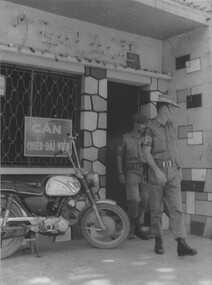 National Vietnam Veterans Museum (NVVM)
Photograph, Gibbons, Denis, Palace Bar
... A black and white photograph of Australian and New Zealand Military Police leave the Palace Bar following and inspection for unauthorised trading practices, particularly alcohol sales. MP's were also very vigilant in the pursuit of drug dealers....Photograph Military Police Palace Bar Gibbons Collection Catalogue New Zealand Military Police Denis Gibbons A black and white photograph of Australian and New Zealand Military Police leave the Palace Bar following and inspection for unauthorised trading practices, particularly alcohol sales. MP's were also very vigilant in the pursuit of drug dealers. ...Denis Gibbons (1937 – 2011) Trained with the Australian Army, before travelling to Vietnam in January 1966, Denis stayed with the 1st Australian Task Force in Nui Dat working as a photographer. For almost five years Gibbons toured with nine Australian infantry battalions, posting compelling war images from within many combat zones before being flown out in late November 1970 after sustaining injuries. The images held within the National Vietnam Veterans Museum make up the Gibbons Collection. A black and white photograph of Australian and New Zealand Military Police leave the Palace Bar following and inspection for unauthorised trading practices, particularly alcohol sales. MP's were also very vigilant in the pursuit of drug dealers.photograph, military police, palace bar, gibbons collection catalogue, new zealand military police, denis gibbons -
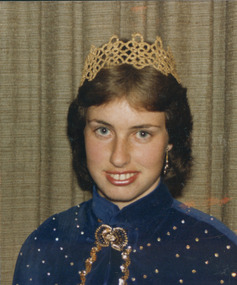 Uniting Church Archives - Synod of Victoria
Photograph, "Temperance Queen" Adelle McKenzie, 1984
... Contestants studied material dealing with alcohol and other drugs, alcohol as related to the Scriptures, Christian living, and the WCTU."...Contestants studied material dealing with alcohol and other drugs, alcohol as related to the Scriptures, Christian living, and the WCTU." mckenzie, adelle temperance queen wctu "C&N 22/8/84, p. 17" Snapshot of head and shoulders of Adelle wearing a 'crown' and 'robe'. ..."Temperance Queen: Adelle McKenzie of Cheltenham, Victoria, was crowned 'Temperance Queen' at the recent National Woman's Christian Temperance Union convention in Brisbane. Adelle is the daughter of Industrial Chaplain Mr. Ray McKenzie and his wife Mrs. Betty McKenzie. Contestants studied material dealing with alcohol and other drugs, alcohol as related to the Scriptures, Christian living, and the WCTU."Snapshot of head and shoulders of Adelle wearing a 'crown' and 'robe'."C&N 22/8/84, p. 17"mckenzie, adelle, temperance queen, wctu -
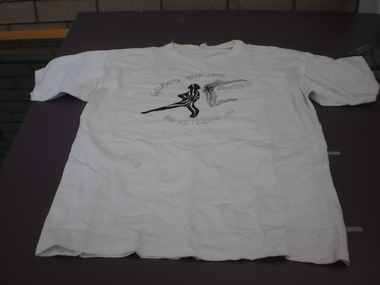 Wangaratta High School
WHS Uniform- Rock Eisteddfod Shirt, 1993
... These events are initiated by the Rock Eisteddfod Challenge Foundation, and aim to promote healthy lifestyle choices, particularly abstinence from drugs, alcohol and cigarettes....These events are initiated by the Rock Eisteddfod Challenge Foundation, and aim to promote healthy lifestyle choices, particularly abstinence from drugs, alcohol and cigarettes. White t-shirt with a large logo in the centre reading WANGARATTA HIGH SCHOOL ROCK EISTEDDFOD 1993 INDIVIDUALITY surrounding two silhouettes of jumping people. ...The Rock Eisteddfod Challenge is a series of dance and drama events staged worldwide by school pupils as part of the Global Rock Challenge. These events are initiated by the Rock Eisteddfod Challenge Foundation, and aim to promote healthy lifestyle choices, particularly abstinence from drugs, alcohol and cigarettes.White t-shirt with a large logo in the centre reading WANGARATTA HIGH SCHOOL ROCK EISTEDDFOD 1993 INDIVIDUALITY surrounding two silhouettes of jumping people. -
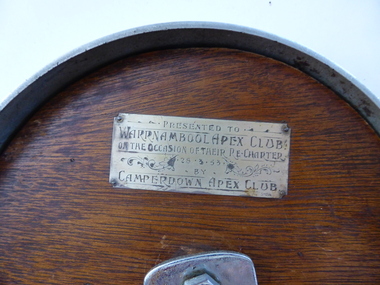 Warrnambool and District Historical Society Inc.
Gong and Gavel, 1950s
... It supported the Warrnambool-based Western Region Drug and Alcohol Rehabilitation Centre and Beyond Blue, an organization concentrating on men’s mental health. ...It supported the Warrnambool-based Western Region Drug and Alcohol Rehabilitation Centre and Beyond Blue, an organization concentrating on men’s mental health. ...This gong and gavel was presented to the Warrnambool Apex Club in 1953 when the club was re-formed following the disbanding of the club during World War Two. The Warrnambool Apex Club was the fifth club formed in the early 1930s and was a strong and important service club in Warrnambool for many years. It supported the Warrnambool-based Western Region Drug and Alcohol Rehabilitation Centre and Beyond Blue, an organization concentrating on men’s mental health. The Warrnambool Apex Club was disbanded in 2011. The Apex gong and gavel are of historical interest as they are a memento of the now-defunct Warrnambool Apex Club. For many years it was an important service club in Warrnambool. These are a gong on a stand and a gavel, used by the Apex Club of Warrnambool to call a meeting to order. The gong is circular and made of silver-coloured metal. It has a metal triangular-shaped emblem of Apex, featuring a rising sun in red and gold colouring and the word ‘Apex’ in gold lettering on a blue background. The gong is hollow at the back and has a wooden insert with a metal plaque attached with four metal screws. The gong is mounted on a rectangular wooden platform, in four layers, pyramidal-shaped. The platform has been lightly polished. The gavel is made of wood and has a round handle and a rectangular knob inserted into the handle. The knob has rounded edges. ‘Presented to Warrnambool Apex Club on the occasion of their re-charter 28.3.53 by the Camperdown Apex Club’. warrnambool apex club, history of warrnambool -
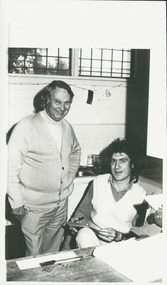 Uniting Church Archives - Synod of Victoria
Photograph, Ron Croxford & Peter Mulheisen, 09/1986
... The photo was part of the September 24 1986 edition of C&N as the 'cover story', entitled "House of fallen angels", and the article was about Moreland Hall (in 2015 renamed as ReGen) and its work with alcohol and other drug addictions. Croxford was the executive director and Mulheisen the pharmacist at Moreland Hall. ...The photo was part of the September 24 1986 edition of C&N as the 'cover story', entitled "House of fallen angels", and the article was about Moreland Hall (in 2015 renamed as ReGen) and its work with alcohol and other drug addictions. Croxford was the executive director and Mulheisen the pharmacist at Moreland Hall. ...The photo was part of the September 24 1986 edition of C&N as the 'cover story', entitled "House of fallen angels", and the article was about Moreland Hall (in 2015 renamed as ReGen) and its work with alcohol and other drug addictions. Croxford was the executive director and Mulheisen the pharmacist at Moreland Hall. The Rev. Ron Croxford had been ordained in 1966, and parishes included Yirrakala (1961-64), Caulfield (1967-68), Mt Waverley (1969-74), Sth & Port Melbourne Mission (1975-77), South-Port-Parks 1977-?Ron Croxford is shown standing by a seated Peter Mulheisen.Their names.croxford, ron, mulheisen, peter, moreland hall (regen) -
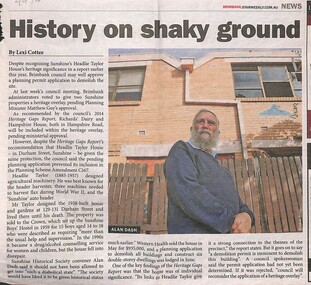 Sunshine and District Historical Society Incorporated
Article - Headlie Taylor's House 129 - 131 Durham Road Sunshine, Lexi Cottee, 2nd September 2014
... In the 1990's the house became a drug / alcohol counselling centre for women and children by Western Health. ...In the 1990's the house became a drug / alcohol counselling centre for women and children by Western Health. ...Headlie Taylor worked for H.V. McKay and was the chief designer there. Headlie designed and built the house and gardends at 129 - 131 Durham Road Sunshine in 1938. He lived in the house until his death in 1957. The house was then sold to the Crown, which then set up a boys' hostel in 1959. In the 1990's the house became a drug / alcohol counselling centre for women and children by Western Health. The house then fell into disrepair and Western Health then sold the house to developers. The developers lodged a planning application to demolish all buildings and construct six double story townhouses. There were many objections to this application which led to a compromise and only single story townhouses were built.History On Shaky Ground -
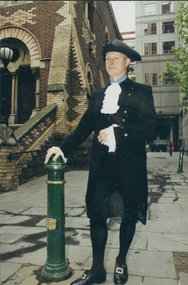 Uniting Church Archives - Synod of Victoria
Photograph, October 2001
... Macrae was an inaugural member of the Victorian State Government's Community Support Fund and served on the advisory committee of the Community Alcohol Action network of the Australian Drug Foundation. ...Macrae was an inaugural member of the Victorian State Government's Community Support Fund and served on the advisory committee of the Community Alcohol Action network of the Australian Drug Foundation. ...Rev. Alistair Macrae, born 1950. Macrae was ordained in 1984 and served in rural, regional and inner city congregations in Victoria, at Mt Beauty, Portland and West Brunswick. He served as Moderator of the Synod of Victoria and Tasmania (2000–2003) and as Executive Director of the Uniting Church Centre for Theology and Ministry (2004–2009) in that synod. He was a member of the board of Wesley Mission Melbourne and chaired its social policy committee. Macrae was an inaugural member of the Victorian State Government's Community Support Fund and served on the advisory committee of the Community Alcohol Action network of the Australian Drug Foundation. Macrae became President of the UCA in July 2009, at the 12th Assembly. In September 2013 Macrae commenced as Minister of Wesley Uniting Church, Lonsdale Street, Melbourne. Gloss colour photograph of the Rev Alistair Macrae wearing traditional Scottish Moderator's dress outside St. Michael's Church, Collins Street Melbourne. -
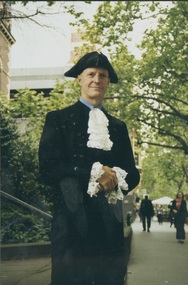 Uniting Church Archives - Synod of Victoria
Photograph, October 2001
... Macrae was an inaugural member of the Victorian State Government's Community Support Fund and served on the advisory committee of the Community Alcohol Action network of the Australian Drug Foundation. ...Macrae was an inaugural member of the Victorian State Government's Community Support Fund and served on the advisory committee of the Community Alcohol Action network of the Australian Drug Foundation. ...Rev. Alistair Macrae, born 1950. Macrae was ordained in 1984 and served in rural, regional and inner city congregations in Victoria, at Mt Beauty, Portland and West Brunswick. He served as Moderator of the Synod of Victoria and Tasmania (2000–2003) and as Executive Director of the Uniting Church Centre for Theology and Ministry (2004–2009) in that synod. He was a member of the board of Wesley Mission Melbourne and chaired its social policy committee. Macrae was an inaugural member of the Victorian State Government's Community Support Fund and served on the advisory committee of the Community Alcohol Action network of the Australian Drug Foundation. Macrae became President of the UCA in July 2009, at the 12th Assembly. In September 2013 Macrae commenced as Minister of Wesley Uniting Church, Lonsdale Street, Melbourne. Gloss colour photograph of the Rev Alistair Macrae wearing traditional Scottish Moderator's dress outside St. Michael's Church, Collins Street Melbourne.Moderator, Rev Alistair Macrae with Scottish Moeratorial attire, 2001. -
 Eltham District Historical Society Inc
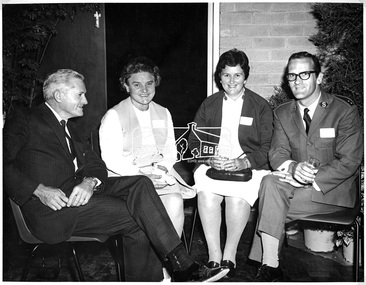
Photograph, Four guests at Buffet Dinner. Left: Mr. Higgins Methodist Minister, Eltham, Mrs. Higgins and Captain Brian Robertson and Captain Irene Robertson of the Salvation Army, 7 Jul 1971
... After several years in church work, Brian and Irene transferred over to the Social Services branch of the Salvos and worked with homeless men, broken families, drug & alcohol dependent clients (similar to what Brendan Nottle does in Burke St), family stores and eventually seniors (nursing homes). ...After several years in church work, Brian and Irene transferred over to the Social Services branch of the Salvos and worked with homeless men, broken families, drug & alcohol dependent clients (similar to what Brendan Nottle does in Burke St), family stores and eventually seniors (nursing homes). ...Guests at the West Riding Hall, Henry Petrie Community Centre, Montmorency on the occasion of a buffet dinner as part of the Shire of Eltham centenary celebrations. Left: Mr Higgins, Methodist Minister, Eltham and Mrs Higgins and Brian & Irene Robertson, both Captains in the Salvation Army. Reverend William ‘Bill’ Leslie Higgins (b. 15/1/1925, Renmark, Victoria, d. 18/10/1998) and Mrs Ella May Higgins (née Leersen b. 3/11/1921, Avoca, Victoria, d. 24/5/2003). William was ordained to the Methodist Church of Australia on September 1, 1959. Bill and Ella were involved with many communities throughout Bill’s full-time service until 1989. These parishes included Underbool, Wycheproof, Drysdale, Wonthaggi, South Yarra, Eltham, Nathalia, Murchison and Seymour. Bill and Ella touched many thousands lives during their ministry. Bill passed away in 1998 while assisting with a Sunday evening service near Drysdale, and Ella continued to dedicate her time to others until her death in 2003. Information received via Brian and Irene Robertson's son, Mark (15 Dec 2023), noted that in 1969 they lived in Prahran and by 1971 they would have been appointed to Briar Hill (now Greensborough). Brian Robertson's parents and at least one set of his grandparents were also Salvation Army officers (primarily from Victoria), whilst Irene was originally from Perth and she had 2 other sisters that became Salvation Army Officers as well. Irene also had 3rd sister and younger brother who were linked to the Salvos (as was Brian’s brother). After several years in church work, Brian and Irene transferred over to the Social Services branch of the Salvos and worked with homeless men, broken families, drug & alcohol dependent clients (similar to what Brendan Nottle does in Burke St), family stores and eventually seniors (nursing homes). Brian, known as Robbie passed away in 2013, and Irene is currently living in a retirement unit. [Dedc 2023]This photo forms part of a collection of photographs gathered by the Shire of Eltham for their centenary project book, "Pioneers and Painters: 100 years of the Shire of Eltham" by Alan Marshall (1971). The collection of over 500 images is held in partnership between Eltham District Historical Society and Yarra Plenty Regional Library (Eltham Library) and is now formally known as 'The Shire of Eltham Pioneers Photograph Collection.' It is significant in being the first community sourced collection representing the places and people of the Shire's first one hundred years.Digital imagesepp, shire of eltham pioneers photograph collection, shire of eltham, shire of eltham centenary, henry petrie community centre, centenary celebrations, buffet dinner, higgins, rev. william (bill) higgins, ella may higgins (nee leersen), salvation army, brian robertson, irene robertson -
 Melbourne Tram Museum
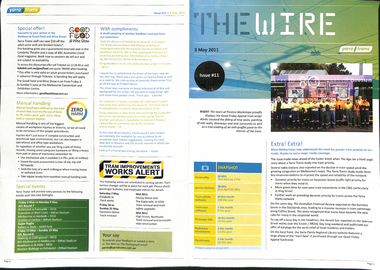
Magazine, Yarra Trams, "The Wire", 5/2011 to 1/2015
... (see htd5043i21 for a image from an unknown newspaper of the actual event - features Z3 158.) .11 - No. 25 - 22/11/2011 - new staff guide, Gold Coast tram line, Macarthur St, overhead, fund raising, route numbering update. .12 - No. 26 - 6/12/2011 - Swanston St Superstops, Newmarket bridge strikes, rhinos. .13 - No. 27 - 20/12/2011 - Christmas carnival, Lenny Bates, portable crossover, uniforms. .14 - No. 28 - 17/1/2012 - Passing of Len Bates, Myki, Gardiner railway station. 14a - No. 29 - 31/1/2012 - Southbank depot, patronage, myki, think like a passenger, fatigue management, .15 - No. 30 - 15/2/2012 - visit of Keolis, SNCF people, list of Executive leadership team with photos, Swanston St works, Myki introduction. .16 - No. 31 - 29/2/2012 - patronage up, tram postage stamps, Myki, rhinos. .17 - No. 32 - 14/3/2012 - St Kilda Rd trackwork, fund raising, Southbank Depot extensions, Myki, driving conditions, grand prix. .18 - No. 33 - 30/3/2012 - introduction of the PTV, end of MetLink and Transport Ticketing Authority, changes in management structure, trackwork, Gold Coast tramway and Keolis. .19 - No. 34 - Dr Jake - Royal children's Hospital super stop, route 96 - Premium line. .20 - No. 35, 2/5/2012 - Revision of Rules, trackwork in St Kilda Road and Elizabeth St, Myki, safety - Zero Harm. .21 - No. 69 - 25/9/2013 - Passengers paying their way, E class update, Mal Ashworth retires, progress report, feedback, new chime on trams. .22 - No. 70 - 9/10/2013 - Art comes alive, tram 925, driver simulator at Preston Workshops, E class project, 90th Glen Huntly. .23 - No. 83 - 23/4/2014 - Screen time for trams, new PIDs on B class, assistance animals, Operations Centre, Preston Workshops, Electrical log sheets to SLV. .24 - No. 89 - 23/7/2014 - punctuality, refresh of network map (fold-out map), women drivers. .25 - No. 97 - 19/11/2014 - Revitalising route 96, Keolis news, free tram zone, guide dogs. .26 - No. 99 - 17/12/2014 - Accessibility week, new uniform top for CSE's, free tram zone, world trade centre stop upgrade, heat stress, Art tram 158. .27 - No. 100 - 14/1/2015 - Route 96 complete, New Years eve free travel, fare compliance, patronage down, .28 - No. 12 - 16/5/2011 - Gold coast tramway, performance dashboard, tramworks and the rhino .29 - No. 16 - 19/7/2011 - Depot managers, tevor jones, record patronage, vision, rhino .30 - No. 17 - 2/8/2011 - High St Westgarth works, Duncan Smith, David Clarke Training, Swanston St works, and Preston Workshops . .32 - No. 39 - 28/6.2012 - maintenance, Emmanual Sorin, transformation, fare evasion, and Combino in Potsdam. .33 - No. 105 - 25/3/2015 - Grand Prix, Elgin and Lygon upgrade, Camberwell Junction, PTV hub, overhead. .34 - No. 78 - 12/2/2014 - January heatwave, Australian Open, Mark Wild of PTV, and Curt Skinner - voice in Channel 10 series Get Ace .35 - No. 81 - 26/3/2014 - drug and alcohol testing, zero harm, Victoria Bridge works, Keolis, relations with Toronto, Collins St safety and incident on a route 57 tram. .36 - No. 109 - 20/5/2015 - Goodbye Z class, Hello E class, Kew Depot centenary, drug & alcohol reminder, passenger satisfaction, Anzac day, B class life extension. .37 - No. 110 - 3/6/2015 - 3rd W class tram back grom Bendigo, employer of the year, CSE's go digital, Camberwell depot, Queensbridge tram and bus stop and Tram Hub preview. .38 - No. 115 - Feb. 2016 - 12 page centre stapled - New Year's eve services, spike the rhino is back, Burke Road level crossing removed, more E class, safe network in 2106, tennis, customers happy, New Preston depot, Farewell to Clement, Z class 40 years on network....(see htd5043i21 for a image from an unknown newspaper of the actual event - features Z3 158.) .11 - No. 25 - 22/11/2011 - new staff guide, Gold Coast tram line, Macarthur St, overhead, fund raising, route numbering update. .12 - No. 26 - 6/12/2011 - Swanston St Superstops, Newmarket bridge strikes, rhinos. .13 - No. 27 - 20/12/2011 - Christmas carnival, Lenny Bates, portable crossover, uniforms. .14 - No. 28 - 17/1/2012 - Passing of Len Bates, Myki, Gardiner railway station. 14a - No. 29 - 31/1/2012 - Southbank depot, patronage, myki, think like a passenger, fatigue management, .15 - No. 30 - 15/2/2012 - visit of Keolis, SNCF people, list of Executive leadership team with photos, Swanston St works, Myki introduction. .16 - No. 31 - 29/2/2012 - patronage up, tram postage stamps, Myki, rhinos. .17 - No. 32 - 14/3/2012 - St Kilda Rd trackwork, fund raising, Southbank Depot extensions, Myki, driving conditions, grand prix. .18 - No. 33 - 30/3/2012 - introduction of the PTV, end of MetLink and Transport Ticketing Authority, changes in management structure, trackwork, Gold Coast tramway and Keolis. .19 - No. 34 - Dr Jake - Royal children's Hospital super stop, route 96 - Premium line. .20 - No. 35, 2/5/2012 - Revision of Rules, trackwork in St Kilda Road and Elizabeth St, Myki, safety - Zero Harm. .21 - No. 69 - 25/9/2013 - Passengers paying their way, E class update, Mal Ashworth retires, progress report, feedback, new chime on trams. .22 - No. 70 - 9/10/2013 - Art comes alive, tram 925, driver simulator at Preston Workshops, E class project, 90th Glen Huntly. .23 - No. 83 - 23/4/2014 - Screen time for trams, new PIDs on B class, assistance animals, Operations Centre, Preston Workshops, Electrical log sheets to SLV. .24 - No. 89 - 23/7/2014 - punctuality, refresh of network map (fold-out map), women drivers. .25 - No. 97 - 19/11/2014 - Revitalising route 96, Keolis news, free tram zone, guide dogs. .26 - No. 99 - 17/12/2014 - Accessibility week, new uniform top for CSE's, free tram zone, world trade centre stop upgrade, heat stress, Art tram 158. .27 - No. 100 - 14/1/2015 - Route 96 complete, New Years eve free travel, fare compliance, patronage down, .28 - No. 12 - 16/5/2011 - Gold coast tramway, performance dashboard, tramworks and the rhino .29 - No. 16 - 19/7/2011 - Depot managers, tevor jones, record patronage, vision, rhino .30 - No. 17 - 2/8/2011 - High St Westgarth works, Duncan Smith, David Clarke Training, Swanston St works, and Preston Workshops . .32 - No. 39 - 28/6.2012 - maintenance, Emmanual Sorin, transformation, fare evasion, and Combino in Potsdam. .33 - No. 105 - 25/3/2015 - Grand Prix, Elgin and Lygon upgrade, Camberwell Junction, PTV hub, overhead. .34 - No. 78 - 12/2/2014 - January heatwave, Australian Open, Mark Wild of PTV, and Curt Skinner - voice in Channel 10 series Get Ace .35 - No. 81 - 26/3/2014 - drug and alcohol testing, zero harm, Victoria Bridge works, Keolis, relations with Toronto, Collins St safety and incident on a route 57 tram. .36 - No. 109 - 20/5/2015 - Goodbye Z class, Hello E class, Kew Depot centenary, drug & alcohol reminder, passenger satisfaction, Anzac day, B class life extension. .37 - No. 110 - 3/6/2015 - 3rd W class tram back grom Bendigo, employer of the year, CSE's go digital, Camberwell depot, Queensbridge tram and bus stop and Tram Hub preview. .38 - No. 115 - Feb. 2016 - 12 page centre stapled - New Year's eve services, spike the rhino is back, Burke Road level crossing removed, more E class, safe network in 2106, tennis, customers happy, New Preston depot, Farewell to Clement, Z class 40 years on network. ...0 - No 9 - 1/4/2011 - Rhinos on skateboards, Did you know, Spencer St works, 00 - No 10 - 19/4/2011 - safety boards, busting ghost routes, works alerts, travelling without tickets, launch of a new tram network maps and compliments received from customers. .1 - No. 11 of 3/5/2011 with the revised Yarra trams logo, traffic priority, work over Easter in Spencer St at Bourke and Collins St, Good Friday appeal, safety, passenger feedback and future works. .2 - No. 13 - 31/5/2011 - new uniform, cleaning, CEPR, trackwork - Fitzroy St, Northcote, Rhino, Carlton Control. .3 - No. 14 - 15/6/2011 - Haymarket Roundabout, accessibility, maintenance, CSE. 3a - No. 16 - 19/7/2011 - Managers on the move, Trevor Jones, Yarra's vision, Richard Ch'ng and Rhino update. .4 - No. 17 - 2/8/2011 - High St Westgarth trackwork, Swanston St, IMF CEO visit .5 - No. 18 - 16/8/2011 - Performance benchmarks met, Preston Workshops, repairs to 3018, tram signal priority. .6 - No . 19 - 30/8/2011 - New E class trams, routes "a" or "d", TramTracker in shelters, police, fare evasion .7 - No. 20 - 15/9/2011 - Football trams, Superstops, Bridge Road, Rhinos. .8 - No. 21 - 27/9/2011 - CEO's journey to work, accessibility, increased patronage, E class. .8a - No. 22 - 11/10/2011 - Minister Mulder visit, E class, Customer experience, Elizabeth Kerdelhue Corporate Affairs Director, flood indicator in Wellington Parade, Keolis - Orleans and PTV coming your way. .9 - No. 23 - 25/10/2011 - forthcoming royal visit, opening for Footscray Road extension, Rhinos, Stockholm .10 - No. 24 - 8/11/2011- Royal visit, photos, Z3 158, route 86 works in High St. (see htd5043i21 for a image from an unknown newspaper of the actual event - features Z3 158.) .11 - No. 25 - 22/11/2011 - new staff guide, Gold Coast tram line, Macarthur St, overhead, fund raising, route numbering update. .12 - No. 26 - 6/12/2011 - Swanston St Superstops, Newmarket bridge strikes, rhinos. .13 - No. 27 - 20/12/2011 - Christmas carnival, Lenny Bates, portable crossover, uniforms. .14 - No. 28 - 17/1/2012 - Passing of Len Bates, Myki, Gardiner railway station. 14a - No. 29 - 31/1/2012 - Southbank depot, patronage, myki, think like a passenger, fatigue management, .15 - No. 30 - 15/2/2012 - visit of Keolis, SNCF people, list of Executive leadership team with photos, Swanston St works, Myki introduction. .16 - No. 31 - 29/2/2012 - patronage up, tram postage stamps, Myki, rhinos. .17 - No. 32 - 14/3/2012 - St Kilda Rd trackwork, fund raising, Southbank Depot extensions, Myki, driving conditions, grand prix. .18 - No. 33 - 30/3/2012 - introduction of the PTV, end of MetLink and Transport Ticketing Authority, changes in management structure, trackwork, Gold Coast tramway and Keolis. .19 - No. 34 - Dr Jake - Royal children's Hospital super stop, route 96 - Premium line. .20 - No. 35, 2/5/2012 - Revision of Rules, trackwork in St Kilda Road and Elizabeth St, Myki, safety - Zero Harm. .21 - No. 69 - 25/9/2013 - Passengers paying their way, E class update, Mal Ashworth retires, progress report, feedback, new chime on trams. .22 - No. 70 - 9/10/2013 - Art comes alive, tram 925, driver simulator at Preston Workshops, E class project, 90th Glen Huntly. .23 - No. 83 - 23/4/2014 - Screen time for trams, new PIDs on B class, assistance animals, Operations Centre, Preston Workshops, Electrical log sheets to SLV. .24 - No. 89 - 23/7/2014 - punctuality, refresh of network map (fold-out map), women drivers. .25 - No. 97 - 19/11/2014 - Revitalising route 96, Keolis news, free tram zone, guide dogs. .26 - No. 99 - 17/12/2014 - Accessibility week, new uniform top for CSE's, free tram zone, world trade centre stop upgrade, heat stress, Art tram 158. .27 - No. 100 - 14/1/2015 - Route 96 complete, New Years eve free travel, fare compliance, patronage down, .28 - No. 12 - 16/5/2011 - Gold coast tramway, performance dashboard, tramworks and the rhino .29 - No. 16 - 19/7/2011 - Depot managers, tevor jones, record patronage, vision, rhino .30 - No. 17 - 2/8/2011 - High St Westgarth works, Duncan Smith, David Clarke Training, Swanston St works, and Preston Workshops . .32 - No. 39 - 28/6.2012 - maintenance, Emmanual Sorin, transformation, fare evasion, and Combino in Potsdam. .33 - No. 105 - 25/3/2015 - Grand Prix, Elgin and Lygon upgrade, Camberwell Junction, PTV hub, overhead. .34 - No. 78 - 12/2/2014 - January heatwave, Australian Open, Mark Wild of PTV, and Curt Skinner - voice in Channel 10 series Get Ace .35 - No. 81 - 26/3/2014 - drug and alcohol testing, zero harm, Victoria Bridge works, Keolis, relations with Toronto, Collins St safety and incident on a route 57 tram. .36 - No. 109 - 20/5/2015 - Goodbye Z class, Hello E class, Kew Depot centenary, drug & alcohol reminder, passenger satisfaction, Anzac day, B class life extension. .37 - No. 110 - 3/6/2015 - 3rd W class tram back grom Bendigo, employer of the year, CSE's go digital, Camberwell depot, Queensbridge tram and bus stop and Tram Hub preview. .38 - No. 115 - Feb. 2016 - 12 page centre stapled - New Year's eve services, spike the rhino is back, Burke Road level crossing removed, more E class, safe network in 2106, tennis, customers happy, New Preston depot, Farewell to Clement, Z class 40 years on network.Demonstrates Yarra trams staff newsletters.Set of 34 Yarra Trams internal newsletter "The Wire", All A4, printed in full colour. All four pages unless noted otherwise, full colour, performance snapshot on front cover.trams, tramways, yarra trams, traffic control, trackwork, spencer st, fund raising, operations, rhinos, carlton control, high st, haymarket, preston workshops, e class, route numbers, bridge road, wellington parade, ptv, royal visit, footscray road, gold coast, macarthur st, swanston st, superstops, newmarket, gardiner, burke road, level crossings, railway squares, myki, metlink, tickets, route 96, rules, st kilda road, elizabeth st, tram 158, tram 925, glen huntly depot, simulator, b class, opeations centre, art trams, patronage, kew depot, new preston, queensbridge, w class, bendigo, map -
 Sunshine and District Historical Society Incorporated
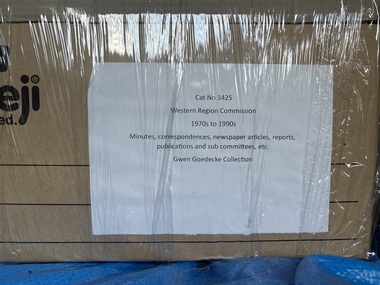
Archive - Gwen Goedecke Collection - Western Region Commission
... (1982)|Submissions to the Western Metro Region Health Planning Process #4 (1987) - West Metro Region Health Department|Comparitive Local Statistics - MMBW (1981)|Melbourne's West - The Way Ahead - Western Region Commission (1988)|A Social Profile of the Western Region of Melbourne - Western Region Consultative Commission (1979)|The Western Region - Action for the Eighties - Joh Cain MP Premier for Victoria / Beanland Lecture Footscray Institute of Technology (1983)|Hospitals and Health Services Planning Committee submission to the National Hospital and Health Services Interim Commission - Western Region Commission (1973)|Monitoring Melbourne's West - Western Region Commission 1986/1987|Extractive Industries in the Western Region - Draft by Western Region Commission (70's)|Melbourne Western Region discussion report - Department of Urban and Regional Development (1974)|Western Suburbs Transport Study - Wilbur Smith & Associates (1975)|Regionalisation of Refuse Disposal, a report to Western Region Steering Committee - Extractive Industries and Waste Disposal in the Western Region (1976)|Western Region Community Directory compiled by Footscray Institute of Technology (1989)|submission to the Hospitals and Charities Commission re Community and Counselling Centre in the Western Region by the Western Region Working Group of Alcohol and Drug Dependance (1976)|Report of the Western Region Recreation Study Draft (1976) for the Western Region Consultative Commission by John Paterson Urban Systems P/L...(1982)|Submissions to the Western Metro Region Health Planning Process #4 (1987) - West Metro Region Health Department|Comparitive Local Statistics - MMBW (1981)|Melbourne's West - The Way Ahead - Western Region Commission (1988)|A Social Profile of the Western Region of Melbourne - Western Region Consultative Commission (1979)|The Western Region - Action for the Eighties - Joh Cain MP Premier for Victoria / Beanland Lecture Footscray Institute of Technology (1983)|Hospitals and Health Services Planning Committee submission to the National Hospital and Health Services Interim Commission - Western Region Commission (1973)|Monitoring Melbourne's West - Western Region Commission 1986/1987|Extractive Industries in the Western Region - Draft by Western Region Commission (70's)|Melbourne Western Region discussion report - Department of Urban and Regional Development (1974)|Western Suburbs Transport Study - Wilbur Smith & Associates (1975)|Regionalisation of Refuse Disposal, a report to Western Region Steering Committee - Extractive Industries and Waste Disposal in the Western Region (1976)|Western Region Community Directory compiled by Footscray Institute of Technology (1989)|submission to the Hospitals and Charities Commission re Community and Counselling Centre in the Western Region by the Western Region Working Group of Alcohol and Drug Dependance (1976)|Report of the Western Region Recreation Study Draft (1976) for the Western Region Consultative Commission by John Paterson Urban Systems P/L Collection of documents on the Western Region Commission 1970's to 1990's including minutes, correspondence, newspaper articles, reports, publications and sub committees Archive Gwen Goedecke Collection - Western Region Commission ...Part of the Gwenyth "Gwen" Goedecke Collectionsub committees in separate folders|Executive Committee|Advisory Committee|Environment Committee|Social Development Commission|Parks and Gardens Committee|Trainee and Apprenticeship Committee Engineering Committee|Health Commission|Regional Planners Group|Western Region Right to Work Committee|Arts Committee |publications: The Privatisation Papers - John Ernst (VU) 1994|Key Health Issues in Melbourne's West - Victorian Health Department (1987)|Western Region Social Profile - Western Region Consultative Commission/Westurb and Footscray Institute of Technology (1998)|West Link #4&8 - Western Region Consultative Committee (1976)|Industry and Industrial Relations in the Western Suburbs, Needs and Policies (Seminar in Sunshine 1976)|Metropolian Arterial Road Access Study (2 publications) - Ministry of Transport Priorities and Planning (1984)|Western Region Directory of Welfare Personnel (1979 & 1982) - Western Region Commission|We neeed great publict transport (no tollway tunnel and freeway) -office of Colleen Hartland MLC (2008)|Planning a better place to live -The Western Suburbs Facts Booklet (Western Region Commission ?) (1982)|Submissions to the Western Metro Region Health Planning Process #4 (1987) - West Metro Region Health Department|Comparitive Local Statistics - MMBW (1981)|Melbourne's West - The Way Ahead - Western Region Commission (1988)|A Social Profile of the Western Region of Melbourne - Western Region Consultative Commission (1979)|The Western Region - Action for the Eighties - Joh Cain MP Premier for Victoria / Beanland Lecture Footscray Institute of Technology (1983)|Hospitals and Health Services Planning Committee submission to the National Hospital and Health Services Interim Commission - Western Region Commission (1973)|Monitoring Melbourne's West - Western Region Commission 1986/1987|Extractive Industries in the Western Region - Draft by Western Region Commission (70's)|Melbourne Western Region discussion report - Department of Urban and Regional Development (1974)|Western Suburbs Transport Study - Wilbur Smith & Associates (1975)|Regionalisation of Refuse Disposal, a report to Western Region Steering Committee - Extractive Industries and Waste Disposal in the Western Region (1976)|Western Region Community Directory compiled by Footscray Institute of Technology (1989)|submission to the Hospitals and Charities Commission re Community and Counselling Centre in the Western Region by the Western Region Working Group of Alcohol and Drug Dependance (1976)|Report of the Western Region Recreation Study Draft (1976) for the Western Region Consultative Commission by John Paterson Urban Systems P/Lwestern region commission -
 City of Melbourne Libraries
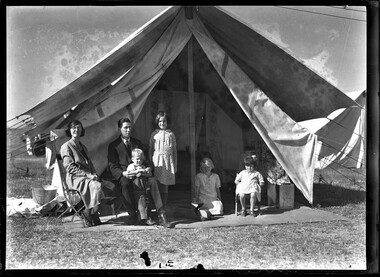
Photograph, Bull, Hugh Jones, 1897-1993, Seventh Day Adventists Camp at Hampton: E. Gane + family
... They eat a mainly plant based diet with no caffeinated beverages and abstain from alcohol and tobacco. They believe in the observance of Saturday, the seventh day of the week in the Christian (Gregorian) and Hebrew calendars as the sabbath and the literal and imminent second coming of Jesus Christ. ...They eat a mainly plant based diet with no caffeinated beverages and abstain from alcohol and tobacco. They believe in the observance of Saturday, the seventh day of the week in the Christian (Gregorian) and Hebrew calendars as the sabbath and the literal and imminent second coming of Jesus Christ. ...Photographer notations on slide: Seventh Day Adventists Camp. E Gane + family Published: 28 December 1933 Published title: SEVENTH DAY ADVENTISTS. Published caption: “I. — The Annual Camp of the Seventh Day Adventists in Highett-road, Hampton, comprising more than 250 tents and accommodating over a thousand persons. II. —W. J. Westerman (vice-president of Australasian) and Pastor G. G. Stewart (president of Victoria), conversing with Pastor C. H. Watson (world president of the Seventh Day Adventists).- III.— Evangelist E. R. Gane and family.” SEVENTH DAY ADVENTISTS. (1933, December 28). The Age (Melbourne, Vic. : 1854 - 1954), p. 9. Retrieved August 1, 2025, from http://nla.gov.au/nla.news-article203356427 Research by project volunteer, Fiona Collyer: In December 1933, evangelist Mr E.R. Gane and his family gather outside their tent during the ten day Seventh Day Adventist Conference held in Highett Road, Hampton. Description: A woman, man and four small children sit and stand in front of a tent. One child plays with a toy train. In December 1933, delegates from all over Victoria and beyond travelled to Melbourne for the annual Seventh Day Adventists Conference of Victoria, held over ten days on a vacant allotment at Highett Road Hampton. A canvas town of 250 tents for over 1000 campers was created along with large marquees for lectures, devotional services and kitchens. Many daily visitors also attended the lectures and services. The principal speaker was Victorian born world president of the Seventh Day Adventists, Pastor Charles H. Watson (1877-1962), who travelled from Washington DC for the event. The Highett Street campers attended a busy schedule of bible readings, devotional services and health lectures during the ten days of the camp. Lecture subjects included- “Among the Head Hunters of the Solomon Islands”, “ Looking Through the Prophetic Telescope into 1934”, “Soul Surgery”, “Viewing the Celestial Land Through the Prophetic Telescope”and “The Four Horsemen of the Apocalypse”. The Seventh Day Adventist religion was established in the USA in 1863. One of its co-founders was American Ellen G. White whose writings are regarded as divinely inspired and are still adhered to today. Ellen preached on the “Eight Laws of Health”- Nutrition, exercise, water, sunshine, temperance, air, rest and trust in God. Adventists regard their bodies as holy temples and avoid food deemed by the Bible as unclean. They eat a mainly plant based diet with no caffeinated beverages and abstain from alcohol and tobacco. They believe in the observance of Saturday, the seventh day of the week in the Christian (Gregorian) and Hebrew calendars as the sabbath and the literal and imminent second coming of Jesus Christ. New converts are baptised by immersion in water. The Adventists opened the Warburton Sanitarium in 1910 as a health retreat, integrating their holistic health philosophy of physical, mental and spiritual well being. It was a resort in the hills “among picturesque mountain scenery…surrounded by tall forests and deep fern gullies…” where highly strung Melburians could alleviate their digestive maladies, stress and jaded nerves as “…worn down nervous systems mend quickly in this peaceful environment…invigorating air and an abundance of home-grown fruit, vegetables, fresh eggs, milk, and cream help to build healthy bodies”. The resort also offered hydrotherapy, massage and electrical treatments. An advertisement in The Argus- 1 December 1947 assured readers- “EVERYTHING SUNNY AGAIN." “That's how you'll feel when you say farewell to Warburton Sanitarium and Hospital after spending a holiday here. Victoria's Hydro is famous far and wide for wonders worked with sufferers from nervous and digestive disorders. Wholesome food, perfectly cooked; splendid air, regulated exercise, sweet natural sleep; these quickly correct faulty digestion, restore vitality, bring back that sunny optimism natural to healthy people. Massage and curative baths under medical supervision…” Later, after further building work, it became the Warburton Hospital with medical, casualty and obstetrics wards as well as offering strategies to stop smoking, lose weight and for stress management. The hospital ceased operation in 2001. Ellen G. White wrote “God sent me to Australia” and in 1891, accompanied by her son William C. White she arrived in Australia to start a Bible school, spread her health philosophy and for missionary work. At first health food products were imported from America, but it soon became apparent that due to the expense and the food becoming stale over the long journey, that local manufacturing was necessary. In 1898 William secured the services of American Adventist baker Edward C. Halsey, who had worked at Dr Kellogg’s Battle Creek (“Cereal City”), Sanitarium, Michigan, USA. They rented the St George’s bakery in Northcote, Melbourne, producing the first ready to eat breakfast cereal Granola, Caramel Cereal, and peanut butter. The fledgling company relocated to larger premises in Cooranbong, NSW soon after. The Sanitarium Health Food Company opened a factory in Warburton in 1925, manufacturing Granose Biscuits, Cerix Puffed Wheat, San-Bran, Bixies malted wheat flakes, Betta peanut butter, Marmite, “Kwic-Bru - A delicious health “coffee” made from choicest cereals and free from drugs that affect the heart and nerves” In 1928, Sanitarium bought out Grain Products Limited who were manufacturing a sweet cereal biscuit called Weet-Bix which soon became Australia’s favourite breakfast cereal. The Warburton factory closed in 1997, with manufacturing shifting interstate. Sanitarium breakfast cereal boxes offered free collectable cards inside and children could buy albums from grocers for sixpence and mount the cards. Subjects of the albums included- “Aboriginal Tribes, Legends, Customs”, “Australia- Yesterday and Today”, “Marvels of the Great Barrier Reef”, “Advance Australia- a Pageant of the Years”. In 1902 the Adventist’s opened the “Pure Food Vegetarian Cafe” in Sydney (In 1907 the name was changed to “Sanitarium Health Food Cafe”), Eating vegetarian food was definitely a curiosity. “Cristina” reviewed the cafe for The Australasian-27 October 1906. Topics For The Block. “Feeling somewhat like a criminal, and hoping to escape detection, I stealthily made my way into a vegetarian restaurant the other day... If my friends happened to catch me walking in there, I should henceforth be considered a crank, a faddist, and little short of a lunatic! Whom did I find within, seated with the air of habitués at the small tables, but heaps of my friends. They had all this while been pursuing their vegetarian way, layin' low and sayin' nuffin'. Flesh-eaters, now that the Sydney summer has set in apparently in good earnest, are beginning to wonder if the vegetarians are not wiser in their day and generation. Roast beef, hot cornea beef, ragouts, and meat curries, the very thought of them makes one feel hot. Frosted lemon pudding, stewed fruits, wheatmeal rolls, and tomatoes sound nice when you look at their names on the vegetarian menu. Such weird messes are served, square, unintelligible blocks of some brown substance, a few bites of which form a full and satisfying meal. Cold nut foods, granose, nuttose, and jam protose, bromose, with jelly and various "ose" sandwiches, impossible for the unbeliever to diagnose, are put before you. You drink malted nut broth, you eat gluten sticks, stewed beans, lentil patties, with vegetable sauce, any or all of which are distinctly nourishing and filling at the price. A mock (decidedly mock) veal cutlet or a red lentil roast is sufficient lunch, it appears, for anyone. Thus, "you obtain the best working results from your machinery with the least possible expenditure..." In December 1906 the Adventists branched out to Melbourne, opening the Sanitarium Health Food Cafe at 289 Collins Street next to the Royal Bank building. (corner Collins and Elizabeth Streets, demolished in 1939). Their motto was “Quality and Purity”. “Cynthia” of The Leader “Social Circle” column reviewed the cafe in 9 March 1907- “Hundreds of people have a feeling of positive affection for a diet that will be satisfying, appetising and nourishing, without having meat for its backbone. It will come as news that we have in Melbourne a cafe where you can really enjoy yourself without eating anything in the way of meat. Cream, custard, cheese and the like are not cold shouldered out of the menu, and the housewife in search of new dishes will find here ever so much in the way of suggestions. Nuts figure conspicuously in the menu, and lentil and walnut cutlets may be instanced among the delicacies. Beans are cooked in quite alluring fashion, while creamed parsnips are excellent. For sandwiches you could hardly desire anything more appetising than granosi biscuits, and nut cheese. The combination is suggestive of school lunches, and nut meat might well be employed as a variant. A visit to the cafe itself — it is next the Royal Bank in Collins-street — will surprise anyone used to the average vegetarian restaurant. Every thing is fresh, fragrant, and thoroughly modern… It is run, in connection with that curious people the Seventh Day Adventists.” However, “Adele” writing for the Evelyn Observer and Bourke East Record -13 December 1907 had a different experience- CITY RESTAURANTS. “There is no glamour from the outside. We enter the dining room at six and secure a seat at a small table, for this night we are going to dine on vegetables. Some people pride themselves on being vegetarians, and devote a great deal of their spare cash and energy to disseminating vegetarian principles. I shall not in a hurry forget the dinner we tried to get through at this vegetarian restaurant. There was put before us plate after plate of vegetables not soaked, but sodden with water, not an atom of flavouring or dressing; no attempt was made to give the slightest piquancy to potato, cabbage, turnip or carrot. I beg pardon, I am unjust, there were two caterpillars in the cabbage. It is astonishing how persistently ordinary cooks spoil vegetables in the process of cooking and how little they understand the value of vegetables on a menu.” From the extensive menu of 1924, you could order cream of green pea soup, followed by nut meat with Yorkshire pudding, egg timbales, stewed brown lentils, savoury rissoles with piquant sauce. Among the dessert offerings were creamed sago, steamed figs and walnut drops. Washed down with fermented wine and to finish, “Frucerea”, a coffee substitute essence made from fruit and cereal. A four course meal of soup, entree, vegetables and sweets cost 1/6 in 1924. Proving that plant-based food was not just a novelty, 67,000 meals were served at the cafe in 1918, rising to 73,000 in 1921. Later the Sanitarium Cafe moved to 293 Little Collins Street, (opposite Royal Arcade) sharing the building with The Lilliput Golf Course, a miniature golf course of 18 holes. The course was a replica of the fashionable Lido Course in France and was open daily from 10am to midnight with a green fee of one shilling. It featured goldfish, waterfalls and dance music. Lilliput boasted that they were “Melbourne’s coolest indoor course” Miniature golf (mini, minnie, midget, miget, Tom Thumb, Wee golf, putt-putt, pigmy, peewee, crazy golf, obstacle golf) swept the globe in the 1930s, starting in the USA, then Europe. The courses provided affordable recreation during uncertainty at the start of the Great Depression. The craze arrived in Sydney September 1930 with the first mini golf course opening in the basement of the State Theatre. It featured a replica Sydney Harbour Bridge and attracted over 1000 players a day at one shilling per game. The miniature golf bug hit Melbourne hard in 1930-31 with nearly 200 courses springing up in the CBD and suburbs within a few months. The first miniature golf course to open in Melbourne was on 4 October 1930 in the basement of recently built art deco style Wentworth House at 203 Collins Street, designed by architect Cedric Heise Ballantyne, (also designed Regent Theatre, Plaza Ballroom, Athenaeum Club, National Theatre, St Kilda, built in 1930, demolished in 1974 for the City Square) It was managed by J. C. Williamson who advertised for a “Girl Spruiker” who “Must be Young, Attractive Personality, and Able to Talk to the Public” to work at the course. The Age 26 September 1930 reported - “The Wentworth House management have spared no expense in preparing the links. Water hazards, sand bunkers, running streams, ancestral castles, moats and a cunning drawbridge have each been devised to test the skill of players, while the walls and ceiling have been "atmospherically" treated to convey an exterior effect”. Even Melbourne City Council jumped on the bandwagon, leasing the lower hall of Melbourne Town Hall to colourful car dealer and racehorse owner Mr A. G. Barlow for £43 per week for the “Kit Kat Tiny Golf Course”, opening on 11 December 1930. (Turf identity, Mr Alexander George Barlow, (1880-1937) who raced under the nom de course “A. G. Vauxhall”, owned filly Frances Tressady, who in 1923 won the Victoria Derby and Oaks Stakes double and came fifth in the Melbourne Cup. The “Frances Tressady Stakes” is held each March at Flemington Racecourse in honour of the horse, the last filly to win the Derby. Barlow was the proprietor of Barlow Brothers Pty Ltd car dealership at 442 Elizabeth Street, Melbourne. He played 14 games for Carlton Football Club (VFL) on the half-forward line from 1901-1903). Patrons could vie for The Herald Miniature Golf Championship Cup, a gold cup worth £7/7, in an eight week long competition. Sports newspaper The Sporting Globe also offered a Cup and prize money. Many courses offered prizes of theatre tickets, cash and cigarettes. Myer’s department store, hoping to cash in on the fad, advertised in Melbourne’s newspapers that their Sports Department could design and equip complete miniature golf courses using “Fairway” imitation turf at 4/6 a yard. Newspaper cartoonists loved to lampoon the fad. Both Percy Leason, cartoonist for society magazine Table Talk and Syd Miller of Smith’s Weekly depicted “real” golfers causing havoc on a mini golf course, showing that being a “real” golf player was no advantage to playing miniature golf. But bust often follows boom. With such rapid market saturation, expensive novel hazards, waning interest, long opening hours, often to midnight, and price cutting of game fees from one shilling to sixpence and then to threepence amongst some courses, the bubble was bound to burst. The Sporting Globe columnist J.M.Dillon on 20 May 1931 lamented- £100,000 LOST Failure of ‘Minnie’ Golf. “Miniature golf might have provided fun and jokes for thousands of people in Australia, but there were many for whom it panned out a tragedy. It is likely that the dead losses of those who attempted to make money out of the game in Australia were in the vicinity of £100,000. …For a while there was hardly a spare block of land, or a possible “site” in the shape of a hall, or a showroom, in Sydney and Melbourne, that some one was not after to set upon it a “minnie links.” Big amusement firms and private individuals anxious to make money began to run courses. Practically every individual who touched the game had his finger’s financially burnt. …From the approximately £60,000 invested in Melbourne alone, there must have been £25,000 lost. …There are now dozens of courses going to ruin, and many more that the owners would be happy to give away if the takers would remove from them obligations of leases, &c…” The lease on the “Kit Kat Tiny Golf Club” at the Melbourne Town Hall expired on 30 April 1931, with Mr Barlow losing £798 on the venture. The hazards and fittings, which cost £400 and included a large replica of the Town Hall, now worthless. Due to declining patronage, the Little Collins Street cafe closed in 1938, although the adjacent shop continued to sell Sanitarium products. In New Zealand, the first Sanitarium factory opened in Christchurch in 1900, with the company later opening factories in Palmerston North and Auckland. The Adventists opened vegetarian cafes, firstly at 37 Taranaki Street Wellington in 1906, followed by cafes in Auckland, Christchurch and Dunedin. Weet-Bix is also New Zealand’s favourite cereal- there the jingle is “Kiwi kids are Weet-Bix kids.” In 1955, the Australian Women’s Weekly ran an illustrated, full colour advertisement featuring New Zealand born Edmund Hillary (later Sir) 1919-2008, who, along with Sherpa Tenzing Norgay, was the first climber to reach the summit of Mount Everest on 29 March 1953. The Australian Women’s Weekly, 30 March, 1955- “WEET-BIX carried by Hillary on Himalayan adventure! c/- N.Z. Alpine Club Inc., Dunedin, New Zealand. The Manager, Sanitarium Health Food Company, Christchurch, N.Z. Dear Sir. …Weet-Bix was chosen at my special request as I had always felt that some easily prepared form of breakfast was essential to the primitive conditions of high camps. Weet-Bix fulfilled its task very well indeed. We usually had them with hot milk (powdered) and sugar, and even when we were unable to eat anything else, we usually managed to have a little Weet-Bix . . . I regard them as a great success and expect they will be more widely used in the Himalayas in future. Yours faithfully, (Signed) E.P. Hillary. Sanitarium Marmite - motto- “Too much spoils the flavour”- is as beloved with Kiwis as Vegemite is with Australians. In 1966, a fire gutted the Christchurch Marmite factory causing a nation wide shortage. Once the factory was rebuilt, Sanitarium relaunched the yeasty extract in reusable glass tumblers with printed designs such as yachts, New Zealand birds and vintage cars. These popular collectibles can still be found in the kitchen cupboards of many New Zealand baches (holiday homes). After the devastating 2011 earthquake in Christchurch damaged the Marmite factory causing shortages and panic buying, a “Marmageddon” was declared with jars of the “black gold” advertised online for up to NZ$800. Consumers were advised to spread their Marmite sparingly until production resumed. (The Christchurch plant reportedly produces around 640,000kg of Marmite per year). Sanitarium Health and Wellbeing Company is exempt from paying company income tax on their profits due to their ownership by a religious organisation. Although not a compulsory rule for salvation, Adventists are encouraged to pay a tithe of 10% of their income to the church to support the ministry in God’s work. Nowadays, there are over 25 million members of the Seventh Day Adventists Church in 200 countries. ITEMS OF INTEREST (1933, December 22). The Argus (Melbourne, Vic. : 1848 - 1957), p. 8. Retrieved July 21, 2025, from http://nla.gov.au/nla.news-article11723188 SEVENTH DAY ADVENTISTS. (1933, December 28). The Age (Melbourne, Vic. : 1854 - 1954), p. 9. Retrieved July 1, 2025, from http://nla.gov.au/nla.news-article203356427 EVANGELISTS' CAMP (1933, December 20). The Herald (Melbourne, Vic. : 1861 - 1954), p. 30. Retrieved July 1, 2025, from http://nla.gov.au/nla.news-article243213209 Master Butchers Have A Time Pilots FOR School Air Race Charity Golf At Riversdale (1931, May 1). The Sun News-Pictorial (Melbourne, Vic. : 1922 - 1954; 1956), p. 14-15. Retrieved September 4, 2025, from http://nla.gov.au/nla.news-article276159136 2000 ADVENTISTS UNDER CANVAS (1933, December 27). The Herald (Melbourne, Vic. : 1861 - 1954), p. 17. Retrieved July 1, 2025, from http://nla.gov.au/nla.news-article243223698 TOPICS FOR THE BLOCK. (1906, October 27). The Australasian (Melbourne, Vic. : 1864 - 1946), p. 45. Retrieved August 30, 2025, from http://nla.gov.au/nla.news-article139178204 https://en.wikipedia.org/wiki/Seventh-day_Adventist_Church https://www.sanitarium.com/au/about/sanitarium-story/profits-for- ENTERTAINMENT AT MENZIES'. (1906, December 6). Punch (Melbourne, Vic. : 1900 - 1918; 1925), p. 26. Retrieved August 3, 2025, from http://nla.gov.au/nla.news-article175380296 https://encyclopedia.adventist.org/article?id=9HN0&highlight=Conference SOCIAL CIRCLE (1907, March 9). Leader (Melbourne, Vic. : 1862 - 1918, 1935), p. 41. Retrieved August 3, 2025, from http://nla.gov.au/nla.news-article196649677 CITY RESTAURANTS. (1907, December 13). Evelyn Observer and Bourke East Record (Vic. : 1902 - 1917), p. 1 (MORNING.). Retrieved August 3, 2025, from http://nla.gov.au/nla.news-article61133109 Advertising (1924, May 6). The Sun News-Pictorial (Melbourne, Vic. : 1922 - 1954; 1956), p. 9. Retrieved August 3, 2025, from http://nla.gov.au/nla.news-article274271406 1930, December 5). The Herald (Melbourne, Vic. : 1861 - 1954), p. 14. Retrieved August 5, 2025, from http://nla.gov.au/nla.news-page26374135 Thousands Are Still Playing Miniature Golf (1931, January 2). The Herald (Melbourne, Vic. : 1861 - 1954), p. 11. Retrieved August 8, 2025, from http://nla.gov.au/nla.news-article242880087 MINIATURE GOLF. (1930, October 16). The Argus (Melbourne, Vic. : 1848 - 1957), p. 10. Retrieved August 8, 2025, from http://nla.gov.au/nla.news-article4209280 THE REAL GOLFER WHO FORGOT HIMSELF ON THE MINIATURE GOLF COURSE (1930, November 13). Table Talk (Melbourne, Vic. : 1885 - 1939), p. 13. Retrieved August 8, 2025, from http://nla.gov.au/nla.news-article146706596 Advertising (1930, December 5). The Herald (Melbourne, Vic. : 1861 - 1954), p. 14. Retrieved August 8, 2025, from http://nla.gov.au/nla.news-article242761991 Advertising (1931, January 9). The Herald (Melbourne, Vic. : 1861 - 1954), p. 12. Retrieved August 8, 2025, from http://nla.gov.au/nla.news-article242887972 1955, March 30). The Australian Women's Weekly (1933 - 1982), p. 38. Retrieved August 9, 2025, from http://nla.gov.au/nla.news-page4812489 £100,000 LOST (1931, May 20). Sporting Globe (Melbourne, Vic. : 1922 - 1954), p. 1 (Edition1). Retrieved August 14, 2025, from http://nla.gov.au/nla.news-article183023946 1930, December 5). The Herald (Melbourne, Vic. : 1861 - 1954), p. 14. Retrieved August 15, 2025, from http://nla.gov.au/nla.news-page26374135 Advertising (1931, January 23). The Herald (Melbourne, Vic. : 1861 - 1954), p. 14. Retrieved August 15, 2025, from http://nla.gov.au/nla.news-article242887795 MINIATURE GOLF. (1931, February 5). The Dandenong Journal (Vic. : 1927 - 1954), p. 6. Retrieved August 16, 2025, from http://nla.gov.au/nla.news-article201082526 Still Time To Enter Midge (1931, January 16). The Herald (Melbourne, Vic. : 1861 - 1954), p. 12. Retrieved August 16, 2025, from http://nla.gov.au/nla.news-article242888830 WIT OF THE WEEK (1930, October 23). Table Talk (Melbourne, Vic. : 1885 - 1939), p. 23. Retrieved August 29, 2025, from http://nla.gov.au/nla.news-article146455050 Advertising (1930, October 2). Table Talk (Melbourne, Vic. : 1885 - 1939), p. 16. Retrieved August 18, 2025, from http://nla.gov.au/nla.news-article146454620 MIDGET GOLF LINKS. (1930, September 26). The Age (Melbourne, Vic. : 1854 - 1954), p. 6. Retrieved August 18, 2025, from http://nla.gov.au/nla.news-article202235074 https://www.smh.com.au/national/fairfax-archive-mini-golf-20131125-2y608.html TURF NOTES (1923, November 6). The Ballarat Star (Vic. : 1865 - 1924), p. 6. Retrieved September 3, 2025, from http://nla.gov.au/nla.news-article213855201 Advertising (1930, October 4). The Herald (Melbourne, Vic. : 1861 - 1954), p. 10. Retrieved October 14, 2025, from http://nla.gov.au/nla.news-article242937272 LAUGHTER AND TEARS. (1930, November 15). Smith's Weekly (Sydney, NSW : 1919 - 1950), p. 21. Retrieved September 9, 2025, from http://nla.gov.au/nla.news-article234426874 Advertising (1947, December 1). The Argus (Melbourne, Vic. : 1848 - 1957), p. 5. Retrieved September 15, 2025, from http://nla.gov.au/nla.news-article22523355Photographer notations on slide: "Seventh Day Adventists Camp. E Gane + family".religion, health food, mini golf, 1930-1939, tents, churches, camps -
 City of Melbourne Libraries
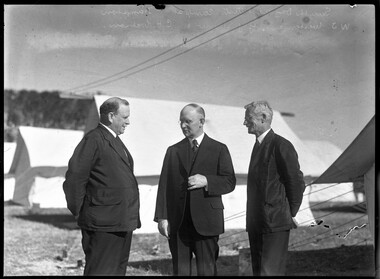
Photograph, Bull, Hugh Jones, 1897-1993, Seventh Day Adventists Camp at Hampton: W.J. Westerman, G.G. Stewart & C.H. Watson
... They eat a mainly plant based diet with no caffeinated beverages and abstain from alcohol and tobacco. They believe in the observance of Saturday, the seventh day of the week in the Christian (Gregorian) and Hebrew calendars as the sabbath and the literal and imminent second coming of Jesus Christ. ...They eat a mainly plant based diet with no caffeinated beverages and abstain from alcohol and tobacco. They believe in the observance of Saturday, the seventh day of the week in the Christian (Gregorian) and Hebrew calendars as the sabbath and the literal and imminent second coming of Jesus Christ. ...Photographer notations on slide: Seventh Day Adventists Camp at Hampton W.J. Westerman, G.G. Stewart & C.H. Watson Published: 28 December 1933 Published title: SEVENTH DAY ADVENTISTS. Published caption: “I. — The Annual Camp of the Seventh Day Adventists in Highett-road, Hampton, comprising more than 250 tents and accommodating over a thousand persons. II. —W. J. Westerman (vice-president of Australasian) and Pastor G. G. Stewart (president of Victoria), conversing with Pastor C. H. Watson (world president of the Seventh Day Adventists).- III.— Evangelist E. R. Gane and family.” SEVENTH DAY ADVENTISTS. (1933, December 28). The Age (Melbourne, Vic. : 1854 - 1954), p. 9. Retrieved August 1, 2025, from http://nla.gov.au/nla.news-article203356427 Research by project volunteer, Fiona Collyer: In December 1933, the annual Seventh Day Adventists Conference of Victoria was held, with over a 1000 participants camping for ten days at Highett Road Hampton. Pastor Charles H. Watson, world president of the Seventh Day Adventists, Walter J. Westerman, vice-president of Australasian and Pastor George G. Stewart, president of Victoria attended. Interestingly, The Age newspaper modified the original photo in their publication, placing the three men close to each other. Description: Three middle aged men dressed in suits converse in front of tents. In December 1933, delegates from all over Victoria and beyond travelled to Melbourne for the annual Seventh Day Adventists Conference of Victoria, held over ten days on a vacant allotment at Highett Road Hampton. A canvas town of 250 tents for over 1000 campers was created along with large marquees for lectures, devotional services and kitchens. Many daily visitors also attended the lectures and services. The principal speaker was Victorian born world president of the Seventh Day Adventists, Pastor Charles H. Watson (1877-1962), who travelled from Washington DC for the event. The Highett Street campers attended a busy schedule of bible readings, devotional services and health lectures during the ten days of the camp. Lecture subjects included- “Among the Head Hunters of the Solomon Islands”, “ Looking Through the Prophetic Telescope into 1934”, “Soul Surgery”, “Viewing the Celestial Land Through the Prophetic Telescope”and “The Four Horsemen of the Apocalypse”. The Seventh Day Adventist religion was established in the USA in 1863. One of its co-founders was American Ellen G. White whose writings are regarded as divinely inspired and are still adhered to today. Ellen preached on the “Eight Laws of Health”- Nutrition, exercise, water, sunshine, temperance, air, rest and trust in God. Adventists regard their bodies as holy temples and avoid food deemed by the Bible as unclean. They eat a mainly plant based diet with no caffeinated beverages and abstain from alcohol and tobacco. They believe in the observance of Saturday, the seventh day of the week in the Christian (Gregorian) and Hebrew calendars as the sabbath and the literal and imminent second coming of Jesus Christ. New converts are baptised by immersion in water. The Adventists opened the Warburton Sanitarium in 1910 as a health retreat, integrating their holistic health philosophy of physical, mental and spiritual well being. It was a resort in the hills “among picturesque mountain scenery…surrounded by tall forests and deep fern gullies…” where highly strung Melburians could alleviate their digestive maladies, stress and jaded nerves as “…worn down nervous systems mend quickly in this peaceful environment…invigorating air and an abundance of home-grown fruit, vegetables, fresh eggs, milk, and cream help to build healthy bodies”. The resort also offered hydrotherapy, massage and electrical treatments. An advertisement in The Argus- 1 December 1947 assured readers- “EVERYTHING SUNNY AGAIN." “That's how you'll feel when you say farewell to Warburton Sanitarium and Hospital after spending a holiday here. Victoria's Hydro is famous far and wide for wonders worked with sufferers from nervous and digestive disorders. Wholesome food, perfectly cooked; splendid air, regulated exercise, sweet natural sleep; these quickly correct faulty digestion, restore vitality, bring back that sunny optimism natural to healthy people. Massage and curative baths under medical supervision…” Later, after further building work, it became the Warburton Hospital with medical, casualty and obstetrics wards as well as offering strategies to stop smoking, lose weight and for stress management. The hospital ceased operation in 2001. Ellen G. White wrote “God sent me to Australia” and in 1891, accompanied by her son William C. White she arrived in Australia to start a Bible school, spread her health philosophy and for missionary work. At first health food products were imported from America, but it soon became apparent that due to the expense and the food becoming stale over the long journey, that local manufacturing was necessary. In 1898 William secured the services of American Adventist baker Edward C. Halsey, who had worked at Dr Kellogg’s Battle Creek (“Cereal City”), Sanitarium, Michigan, USA. They rented the St George’s bakery in Northcote, Melbourne, producing the first ready to eat breakfast cereal Granola, Caramel Cereal, and peanut butter. The fledgling company relocated to larger premises in Cooranbong, NSW soon after. The Sanitarium Health Food Company opened a factory in Warburton in 1925, manufacturing Granose Biscuits, Cerix Puffed Wheat, San-Bran, Bixies malted wheat flakes, Betta peanut butter, Marmite, “Kwic-Bru - A delicious health “coffee” made from choicest cereals and free from drugs that affect the heart and nerves” In 1928, Sanitarium bought out Grain Products Limited who were manufacturing a sweet cereal biscuit called Weet-Bix which soon became Australia’s favourite breakfast cereal. The Warburton factory closed in 1997, with manufacturing shifting interstate. Sanitarium breakfast cereal boxes offered free collectable cards inside and children could buy albums from grocers for sixpence and mount the cards. Subjects of the albums included- “Aboriginal Tribes, Legends, Customs”, “Australia- Yesterday and Today”, “Marvels of the Great Barrier Reef”, “Advance Australia- a Pageant of the Years”. In 1902 the Adventist’s opened the “Pure Food Vegetarian Cafe” in Sydney (In 1907 the name was changed to “Sanitarium Health Food Cafe”), Eating vegetarian food was definitely a curiosity. “Cristina” reviewed the cafe for The Australasian-27 October 1906. Topics For The Block. “Feeling somewhat like a criminal, and hoping to escape detection, I stealthily made my way into a vegetarian restaurant the other day... If my friends happened to catch me walking in there, I should henceforth be considered a crank, a faddist, and little short of a lunatic! Whom did I find within, seated with the air of habitués at the small tables, but heaps of my friends. They had all this while been pursuing their vegetarian way, layin' low and sayin' nuffin'. Flesh-eaters, now that the Sydney summer has set in apparently in good earnest, are beginning to wonder if the vegetarians are not wiser in their day and generation. Roast beef, hot cornea beef, ragouts, and meat curries, the very thought of them makes one feel hot. Frosted lemon pudding, stewed fruits, wheatmeal rolls, and tomatoes sound nice when you look at their names on the vegetarian menu. Such weird messes are served, square, unintelligible blocks of some brown substance, a few bites of which form a full and satisfying meal. Cold nut foods, granose, nuttose, and jam protose, bromose, with jelly and various "ose" sandwiches, impossible for the unbeliever to diagnose, are put before you. You drink malted nut broth, you eat gluten sticks, stewed beans, lentil patties, with vegetable sauce, any or all of which are distinctly nourishing and filling at the price. A mock (decidedly mock) veal cutlet or a red lentil roast is sufficient lunch, it appears, for anyone. Thus, "you obtain the best working results from your machinery with the least possible expenditure..." In December 1906 the Adventists branched out to Melbourne, opening the Sanitarium Health Food Cafe at 289 Collins Street next to the Royal Bank building. (corner Collins and Elizabeth Streets, demolished in 1939). Their motto was “Quality and Purity”. “Cynthia” of The Leader “Social Circle” column reviewed the cafe in 9 March 1907- “Hundreds of people have a feeling of positive affection for a diet that will be satisfying, appetising and nourishing, without having meat for its backbone. It will come as news that we have in Melbourne a cafe where you can really enjoy yourself without eating anything in the way of meat. Cream, custard, cheese and the like are not cold shouldered out of the menu, and the housewife in search of new dishes will find here ever so much in the way of suggestions. Nuts figure conspicuously in the menu, and lentil and walnut cutlets may be instanced among the delicacies. Beans are cooked in quite alluring fashion, while creamed parsnips are excellent. For sandwiches you could hardly desire anything more appetising than granosi biscuits, and nut cheese. The combination is suggestive of school lunches, and nut meat might well be employed as a variant. A visit to the cafe itself — it is next the Royal Bank in Collins-street — will surprise anyone used to the average vegetarian restaurant. Every thing is fresh, fragrant, and thoroughly modern… It is run, in connection with that curious people the Seventh Day Adventists.” However, “Adele” writing for the Evelyn Observer and Bourke East Record -13 December 1907 had a different experience- CITY RESTAURANTS. “There is no glamour from the outside. We enter the dining room at six and secure a seat at a small table, for this night we are going to dine on vegetables. Some people pride themselves on being vegetarians, and devote a great deal of their spare cash and energy to disseminating vegetarian principles. I shall not in a hurry forget the dinner we tried to get through at this vegetarian restaurant. There was put before us plate after plate of vegetables not soaked, but sodden with water, not an atom of flavouring or dressing; no attempt was made to give the slightest piquancy to potato, cabbage, turnip or carrot. I beg pardon, I am unjust, there were two caterpillars in the cabbage. It is astonishing how persistently ordinary cooks spoil vegetables in the process of cooking and how little they understand the value of vegetables on a menu.” From the extensive menu of 1924, you could order cream of green pea soup, followed by nut meat with Yorkshire pudding, egg timbales, stewed brown lentils, savoury rissoles with piquant sauce. Among the dessert offerings were creamed sago, steamed figs and walnut drops. Washed down with fermented wine and to finish, “Frucerea”, a coffee substitute essence made from fruit and cereal. A four course meal of soup, entree, vegetables and sweets cost 1/6 in 1924. Proving that plant-based food was not just a novelty, 67,000 meals were served at the cafe in 1918, rising to 73,000 in 1921. Later the Sanitarium Cafe moved to 293 Little Collins Street, (opposite Royal Arcade) sharing the building with The Lilliput Golf Course, a miniature golf course of 18 holes. The course was a replica of the fashionable Lido Course in France and was open daily from 10am to midnight with a green fee of one shilling. It featured goldfish, waterfalls and dance music. Lilliput boasted that they were “Melbourne’s coolest indoor course” Miniature golf (mini, minnie, midget, miget, Tom Thumb, Wee golf, putt-putt, pigmy, peewee, crazy golf, obstacle golf) swept the globe in the 1930s, starting in the USA, then Europe. The courses provided affordable recreation during uncertainty at the start of the Great Depression. The craze arrived in Sydney September 1930 with the first mini golf course opening in the basement of the State Theatre. It featured a replica Sydney Harbour Bridge and attracted over 1000 players a day at one shilling per game. The miniature golf bug hit Melbourne hard in 1930-31 with nearly 200 courses springing up in the CBD and suburbs within a few months. The first miniature golf course to open in Melbourne was on 4 October 1930 in the basement of recently built art deco style Wentworth House at 203 Collins Street, designed by architect Cedric Heise Ballantyne, (also designed Regent Theatre, Plaza Ballroom, Athenaeum Club, National Theatre, St Kilda, built in 1930, demolished in 1974 for the City Square) It was managed by J. C. Williamson who advertised for a “Girl Spruiker” who “Must be Young, Attractive Personality, and Able to Talk to the Public” to work at the course. The Age 26 September 1930 reported - “The Wentworth House management have spared no expense in preparing the links. Water hazards, sand bunkers, running streams, ancestral castles, moats and a cunning drawbridge have each been devised to test the skill of players, while the walls and ceiling have been "atmospherically" treated to convey an exterior effect”. Even Melbourne City Council jumped on the bandwagon, leasing the lower hall of Melbourne Town Hall to colourful car dealer and racehorse owner Mr A. G. Barlow for £43 per week for the “Kit Kat Tiny Golf Course”, opening on 11 December 1930. (Turf identity, Mr Alexander George Barlow, (1880-1937) who raced under the nom de course “A. G. Vauxhall”, owned filly Frances Tressady, who in 1923 won the Victoria Derby and Oaks Stakes double and came fifth in the Melbourne Cup. The “Frances Tressady Stakes” is held each March at Flemington Racecourse in honour of the horse, the last filly to win the Derby. Barlow was the proprietor of Barlow Brothers Pty Ltd car dealership at 442 Elizabeth Street, Melbourne. He played 14 games for Carlton Football Club (VFL) on the half-forward line from 1901-1903). Patrons could vie for The Herald Miniature Golf Championship Cup, a gold cup worth £7/7, in an eight week long competition. Sports newspaper The Sporting Globe also offered a Cup and prize money. Many courses offered prizes of theatre tickets, cash and cigarettes. Myer’s department store, hoping to cash in on the fad, advertised in Melbourne’s newspapers that their Sports Department could design and equip complete miniature golf courses using “Fairway” imitation turf at 4/6 a yard. Newspaper cartoonists loved to lampoon the fad. Both Percy Leason, cartoonist for society magazine Table Talk and Syd Miller of Smith’s Weekly depicted “real” golfers causing havoc on a mini golf course, showing that being a “real” golf player was no advantage to playing miniature golf. But bust often follows boom. With such rapid market saturation, expensive novel hazards, waning interest, long opening hours, often to midnight, and price cutting of game fees from one shilling to sixpence and then to threepence amongst some courses, the bubble was bound to burst. The Sporting Globe columnist J.M.Dillon on 20 May 1931 lamented- £100,000 LOST Failure of ‘Minnie’ Golf. “Miniature golf might have provided fun and jokes for thousands of people in Australia, but there were many for whom it panned out a tragedy. It is likely that the dead losses of those who attempted to make money out of the game in Australia were in the vicinity of £100,000. …For a while there was hardly a spare block of land, or a possible “site” in the shape of a hall, or a showroom, in Sydney and Melbourne, that some one was not after to set upon it a “minnie links.” Big amusement firms and private individuals anxious to make money began to run courses. Practically every individual who touched the game had his finger’s financially burnt. …From the approximately £60,000 invested in Melbourne alone, there must have been £25,000 lost. …There are now dozens of courses going to ruin, and many more that the owners would be happy to give away if the takers would remove from them obligations of leases, &c…” The lease on the “Kit Kat Tiny Golf Club” at the Melbourne Town Hall expired on 30 April 1931, with Mr Barlow losing £798 on the venture. The hazards and fittings, which cost £400 and included a large replica of the Town Hall, now worthless. Due to declining patronage, the Little Collins Street cafe closed in 1938, although the adjacent shop continued to sell Sanitarium products. In New Zealand, the first Sanitarium factory opened in Christchurch in 1900, with the company later opening factories in Palmerston North and Auckland. The Adventists opened vegetarian cafes, firstly at 37 Taranaki Street Wellington in 1906, followed by cafes in Auckland, Christchurch and Dunedin. Weet-Bix is also New Zealand’s favourite cereal- there the jingle is “Kiwi kids are Weet-Bix kids.” In 1955, the Australian Women’s Weekly ran an illustrated, full colour advertisement featuring New Zealand born Edmund Hillary (later Sir) 1919-2008, who, along with Sherpa Tenzing Norgay, was the first climber to reach the summit of Mount Everest on 29 March 1953. The Australian Women’s Weekly, 30 March, 1955- “WEET-BIX carried by Hillary on Himalayan adventure! c/- N.Z. Alpine Club Inc., Dunedin, New Zealand. The Manager, Sanitarium Health Food Company, Christchurch, N.Z. Dear Sir. …Weet-Bix was chosen at my special request as I had always felt that some easily prepared form of breakfast was essential to the primitive conditions of high camps. Weet-Bix fulfilled its task very well indeed. We usually had them with hot milk (powdered) and sugar, and even when we were unable to eat anything else, we usually managed to have a little Weet-Bix . . . I regard them as a great success and expect they will be more widely used in the Himalayas in future. Yours faithfully, (Signed) E.P. Hillary. Sanitarium Marmite - motto- “Too much spoils the flavour”- is as beloved with Kiwis as Vegemite is with Australians. In 1966, a fire gutted the Christchurch Marmite factory causing a nation wide shortage. Once the factory was rebuilt, Sanitarium relaunched the yeasty extract in reusable glass tumblers with printed designs such as yachts, New Zealand birds and vintage cars. These popular collectibles can still be found in the kitchen cupboards of many New Zealand baches (holiday homes). After the devastating 2011 earthquake in Christchurch damaged the Marmite factory causing shortages and panic buying, a “Marmageddon” was declared with jars of the “black gold” advertised online for up to NZ$800. Consumers were advised to spread their Marmite sparingly until production resumed. (The Christchurch plant reportedly produces around 640,000kg of Marmite per year). Sanitarium Health and Wellbeing Company is exempt from paying company income tax on their profits due to their ownership by a religious organisation. Although not a compulsory rule for salvation, Adventists are encouraged to pay a tithe of 10% of their income to the church to support the ministry in God’s work. Nowadays, there are over 25 million members of the Seventh Day Adventists Church in 200 countries. ITEMS OF INTEREST (1933, December 22). The Argus (Melbourne, Vic. : 1848 - 1957), p. 8. Retrieved July 21, 2025, from http://nla.gov.au/nla.news-article11723188 SEVENTH DAY ADVENTISTS. (1933, December 28). The Age (Melbourne, Vic. : 1854 - 1954), p. 9. Retrieved July 1, 2025, from http://nla.gov.au/nla.news-article203356427 EVANGELISTS' CAMP (1933, December 20). The Herald (Melbourne, Vic. : 1861 - 1954), p. 30. Retrieved July 1, 2025, from http://nla.gov.au/nla.news-article243213209 Master Butchers Have A Time Pilots FOR School Air Race Charity Golf At Riversdale (1931, May 1). The Sun News-Pictorial (Melbourne, Vic. : 1922 - 1954; 1956), p. 14-15. Retrieved September 4, 2025, from http://nla.gov.au/nla.news-article276159136 2000 ADVENTISTS UNDER CANVAS (1933, December 27). The Herald (Melbourne, Vic. : 1861 - 1954), p. 17. Retrieved July 1, 2025, from http://nla.gov.au/nla.news-article243223698 TOPICS FOR THE BLOCK. (1906, October 27). The Australasian (Melbourne, Vic. : 1864 - 1946), p. 45. Retrieved August 30, 2025, from http://nla.gov.au/nla.news-article139178204 https://en.wikipedia.org/wiki/Seventh-day_Adventist_Church https://www.sanitarium.com/au/about/sanitarium-story/profits-for- ENTERTAINMENT AT MENZIES'. (1906, December 6). Punch (Melbourne, Vic. : 1900 - 1918; 1925), p. 26. Retrieved August 3, 2025, from http://nla.gov.au/nla.news-article175380296 https://encyclopedia.adventist.org/article?id=9HN0&highlight=Conference SOCIAL CIRCLE (1907, March 9). Leader (Melbourne, Vic. : 1862 - 1918, 1935), p. 41. Retrieved August 3, 2025, from http://nla.gov.au/nla.news-article196649677 CITY RESTAURANTS. (1907, December 13). Evelyn Observer and Bourke East Record (Vic. : 1902 - 1917), p. 1 (MORNING.). Retrieved August 3, 2025, from http://nla.gov.au/nla.news-article61133109 Advertising (1924, May 6). The Sun News-Pictorial (Melbourne, Vic. : 1922 - 1954; 1956), p. 9. Retrieved August 3, 2025, from http://nla.gov.au/nla.news-article274271406 1930, December 5). The Herald (Melbourne, Vic. : 1861 - 1954), p. 14. Retrieved August 5, 2025, from http://nla.gov.au/nla.news-page26374135 Thousands Are Still Playing Miniature Golf (1931, January 2). The Herald (Melbourne, Vic. : 1861 - 1954), p. 11. Retrieved August 8, 2025, from http://nla.gov.au/nla.news-article242880087 MINIATURE GOLF. (1930, October 16). The Argus (Melbourne, Vic. : 1848 - 1957), p. 10. Retrieved August 8, 2025, from http://nla.gov.au/nla.news-article4209280 THE REAL GOLFER WHO FORGOT HIMSELF ON THE MINIATURE GOLF COURSE (1930, November 13). Table Talk (Melbourne, Vic. : 1885 - 1939), p. 13. Retrieved August 8, 2025, from http://nla.gov.au/nla.news-article146706596 Advertising (1930, December 5). The Herald (Melbourne, Vic. : 1861 - 1954), p. 14. Retrieved August 8, 2025, from http://nla.gov.au/nla.news-article242761991 Advertising (1931, January 9). The Herald (Melbourne, Vic. : 1861 - 1954), p. 12. Retrieved August 8, 2025, from http://nla.gov.au/nla.news-article242887972 1955, March 30). The Australian Women's Weekly (1933 - 1982), p. 38. Retrieved August 9, 2025, from http://nla.gov.au/nla.news-page4812489 £100,000 LOST (1931, May 20). Sporting Globe (Melbourne, Vic. : 1922 - 1954), p. 1 (Edition1). Retrieved August 14, 2025, from http://nla.gov.au/nla.news-article183023946 1930, December 5). The Herald (Melbourne, Vic. : 1861 - 1954), p. 14. Retrieved August 15, 2025, from http://nla.gov.au/nla.news-page26374135 Advertising (1931, January 23). The Herald (Melbourne, Vic. : 1861 - 1954), p. 14. Retrieved August 15, 2025, from http://nla.gov.au/nla.news-article242887795 MINIATURE GOLF. (1931, February 5). The Dandenong Journal (Vic. : 1927 - 1954), p. 6. Retrieved August 16, 2025, from http://nla.gov.au/nla.news-article201082526 Still Time To Enter Midge (1931, January 16). The Herald (Melbourne, Vic. : 1861 - 1954), p. 12. Retrieved August 16, 2025, from http://nla.gov.au/nla.news-article242888830 WIT OF THE WEEK (1930, October 23). Table Talk (Melbourne, Vic. : 1885 - 1939), p. 23. Retrieved August 29, 2025, from http://nla.gov.au/nla.news-article146455050 Advertising (1930, October 2). Table Talk (Melbourne, Vic. : 1885 - 1939), p. 16. Retrieved August 18, 2025, from http://nla.gov.au/nla.news-article146454620 MIDGET GOLF LINKS. (1930, September 26). The Age (Melbourne, Vic. : 1854 - 1954), p. 6. Retrieved August 18, 2025, from http://nla.gov.au/nla.news-article202235074 https://www.smh.com.au/national/fairfax-archive-mini-golf-20131125-2y608.html TURF NOTES (1923, November 6). The Ballarat Star (Vic. : 1865 - 1924), p. 6. Retrieved September 3, 2025, from http://nla.gov.au/nla.news-article213855201 Advertising (1930, October 4). The Herald (Melbourne, Vic. : 1861 - 1954), p. 10. Retrieved October 14, 2025, from http://nla.gov.au/nla.news-article242937272 LAUGHTER AND TEARS. (1930, November 15). Smith's Weekly (Sydney, NSW : 1919 - 1950), p. 21. Retrieved September 9, 2025, from http://nla.gov.au/nla.news-article234426874 Advertising (1947, December 1). The Argus (Melbourne, Vic. : 1848 - 1957), p. 5. Retrieved September 15, 2025, from http://nla.gov.au/nla.news-article22523355Photographer notations on slide: "Seventh Day Adventists Camp at Hampton W.J. Westerman, G.G. Stewart & C.H. Watson".religion, health food, mini golf, 1930-1939, tents, churches, camps -
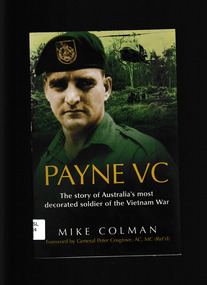 Monbulk RSL Sub Branch
Book, ABC Books for the Australian Broadcasting Corporation, Payne VC : the story of Australia's most decorated soldier of the Vietnam War, 2009
... Vietnam conflict - Australian involvement Vietnam conflict 1961-1975 - Personal recollections The dramatic story of an Australian soldier who was awarded the VC for his extraordinary bravery in Vietnam, only to return home to spend years struggling with depression, alcohol and prescription drugs, before turning his life around Index, ill, p.244. ...The dramatic story of an Australian soldier who was awarded the VC for his extraordinary bravery in Vietnam, only to return home to spend years struggling with depression, alcohol and prescription drugs, before turning his life aroundIndex, ill, p.244.non-fictionThe dramatic story of an Australian soldier who was awarded the VC for his extraordinary bravery in Vietnam, only to return home to spend years struggling with depression, alcohol and prescription drugs, before turning his life aroundvietnam conflict - australian involvement, vietnam conflict 1961-1975 - personal recollections -
 Glen Eira Historical Society
Document - Alcoholics
... The notes include the address of the Sanatorium and a small map of the location, as well as details of references to the sanatorium in various directories. Social Problems Alcohol and Drugs Caulfield Hospitals Caulfield Hall Caulfield Institute for Alcoholics Directories Orang Road Alma Road St. ...This file contains one page of handwritten notes on the Caulfield Institute for Alcoholics, undated and author unknown. The notes include the address of the Sanatorium and a small map of the location, as well as details of references to the sanatorium in various directories.social problems, alcohol and drugs, caulfield, hospitals, caulfield hall, caulfield institute for alcoholics, directories, orang road, alma road, st. aubins avenue, hotham street, east st. kilda -
Koorie Heritage Trust
Book, Brady, Maggie, The Health of Young Aborigines: A report on the health of Aborigines aged 12 to 25, 1992
... Contents: Concepts of youth and adolescence - The Aboriginal youth population in Australia; Urban and rural residence.The health of young Aboriginal people: an overview - Mortality: an overview; Specific data on mortality; Morbidity: an overview; Specific data on morbidity; Presentations at local health centres.Social factors related to youth health - Sexually transmitted Diseases; AIDS: prevalence and education; Social issues and AIDS; Pelvic inflammatory disease; Childbirth among adolescent girls; Social and cultural issues in youthful childbirth; Young mothers; Maternal education; Ear disease: prevalence and social influences; Eye disease: prevalence and solutions.Psychosocial health issues among young Aborigines - Prevalence of drug and alcohol use; Social factors associated with drug use; Stress and mental health; Interpersonal violence, accidents and poisoning; Domestic violence and child abuse.Social factors in overall health - Priorities; Washing; Eating; School; Utilisation of health services; Hospitalisation; Aboriginal Medical Services; Drug and alcohol services.Issues related to urban or remote residence - Health issues and remoteness; 'Street kids'; Sport play and recreation; Some concluding ideas; Recommendations and key issues. viii, 51 p. ; 26 cm. ...Contents: Concepts of youth and adolescence - The Aboriginal youth population in Australia; Urban and rural residence. The health of young Aboriginal people: an overview - Mortality: an overview; Specific data on mortality; Morbidity: an overview; Specific data on morbidity; Presentations at local health centres. Social factors related to youth health - Sexually transmitted Diseases; AIDS: prevalence and education; Social issues and AIDS; Pelvic inflammatory disease; Childbirth among adolescent girls; Social and cultural issues in youthful childbirth; Young mothers; Maternal education; Ear disease: prevalence and social influences; Eye disease: prevalence and solutions. Psychosocial health issues among young Aborigines - Prevalence of drug and alcohol use; Social factors associated with drug use; Stress and mental health; Interpersonal violence, accidents and poisoning; Domestic violence and child abuse. Social factors in overall health - Priorities; Washing; Eating; School; Utilisation of health services; Hospitalisation; Aboriginal Medical Services; Drug and alcohol services. Issues related to urban or remote residence - Health issues and remoteness; 'Street kids'; Sport play and recreation; Some concluding ideas; Recommendations and key issues.viii, 51 p. ; 26 cm.Contents: Concepts of youth and adolescence - The Aboriginal youth population in Australia; Urban and rural residence. The health of young Aboriginal people: an overview - Mortality: an overview; Specific data on mortality; Morbidity: an overview; Specific data on morbidity; Presentations at local health centres. Social factors related to youth health - Sexually transmitted Diseases; AIDS: prevalence and education; Social issues and AIDS; Pelvic inflammatory disease; Childbirth among adolescent girls; Social and cultural issues in youthful childbirth; Young mothers; Maternal education; Ear disease: prevalence and social influences; Eye disease: prevalence and solutions. Psychosocial health issues among young Aborigines - Prevalence of drug and alcohol use; Social factors associated with drug use; Stress and mental health; Interpersonal violence, accidents and poisoning; Domestic violence and child abuse. Social factors in overall health - Priorities; Washing; Eating; School; Utilisation of health services; Hospitalisation; Aboriginal Medical Services; Drug and alcohol services. Issues related to urban or remote residence - Health issues and remoteness; 'Street kids'; Sport play and recreation; Some concluding ideas; Recommendations and key issues.aboriginal australians -- health and hygiene. | youth, aboriginal australian -- health and hygiene. -
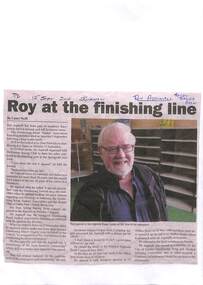 Dandenong & District Historical Society
Aspinall Family, Roy Aspinall - Newspaper Articles and Personal Facts
... Aspinall Family - Roy Aspinall - Newspaper Articles and Personal Facts Owner, Highway Bowls Centre ; Chairman, Dandenong Retailer Traders Association ; Freelance Journalist ; Member, Noble Park Rotary ; Member, Sandown Racecourse ; Member, City of Greater Dandenong Drug and Alcohol Advisory Committee ; Recipient, Centenary Of Federation Medal Margaret Aspinall Bowls Highway Bowls Centre Roy Aspinall Sandown Racecourse Dandenong Retail Traders Association Journalist Freelance Journalist Drug and Alcohol Advisory Committee Centenary of Federation Medal Ron Aspinall - Newspaper Articles and Personal Facts Roy Aspinall - Newspaper Articles and Personal Facts Aspinall Family ...Aspinall Family - Roy Aspinall - Newspaper Articles and Personal FactsOwner, Highway Bowls Centre ; Chairman, Dandenong Retailer Traders Association ; Freelance Journalist ; Member, Noble Park Rotary ; Member, Sandown Racecourse ; Member, City of Greater Dandenong Drug and Alcohol Advisory Committee ; Recipient, Centenary Of Federation Medalmargaret aspinall, bowls, highway bowls centre, roy aspinall, sandown racecourse, dandenong retail traders association, journalist, freelance journalist, drug and alcohol advisory committee, centenary of federation medal -
RMIT GSBL Justice Smith Collection
Pamphlet, Waller, Louis, Intoxication & criminal responsibility : the 15th Leonard Ball oration, 1982
... ...The Alcohol & Drug Foundation...criminal liability drunkenness (criminal law) alcoholism and crime 'With kind regards, Louis' (inscription on front cover) Intoxication & criminal responsibility : the 15th Leonard Ball oration Pamphlet Waller, Louis The Alcohol & Drug Foundation ...'With kind regards, Louis' (inscription on front cover)criminal liability, drunkenness (criminal law), alcoholism and crime -
Whitehorse Historical Society Inc.
Article, A High old time, 2003
... Related to museum display: 'Drugs, a social history'. Smith L.L. Dr Alcohol and drugs Opium Heroin Discussion of the history of drugs, legal or illegal. ...Discussion of the history of drugs, legal or illegal. Quotes Dr L.L. Smith in parliament supporting the use of opium through to the use of ecstasy in the 1990's.Discussion of the history of drugs, legal or illegal. Quotes Dr L.L. Smith in parliament supporting the use of opium through to the use of ecstasy in the 1990's. Related to museum display: 'Drugs, a social history'.Discussion of the history of drugs, legal or illegal. Quotes Dr L.L. Smith in parliament supporting the use of opium through to the use of ecstasy in the 1990's. smith, l.l. dr, alcohol and drugs, opium, heroin
