
Showing 5 items matching "alice francés henty"
-
 Kew Historical Society Inc
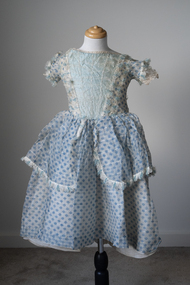
Clothing - Girl's dress, 1858
... ...Alice frances henty...This dress belonged to Alice Frances Henty (1852-1932) the youngest daughter of Francis Henty (1815-89) and his wife Mary Ann Henty [nee Lawrence] (1821-81). ...This dress belonged to Alice Frances Henty (1852-1932) the youngest daughter of Francis Henty (1815-89) and his wife Mary Ann Henty [nee Lawrence] (1821-81). ...This dress belonged to Alice Frances Henty (1852-1932) the youngest daughter of Francis Henty (1815-89) and his wife Mary Ann Henty [nee Lawrence] (1821-81). It is recorded that Alice wore the dress at the age of six. Alice's father, Francis Henty, was the youngest son of Thomas Henty, who with his family, their retainers and property moved to the Australian colonies between 1829 and 1832. In 1834, Francis’ older brother, Edward, sailed from Launceston in Van Diemen’s Land to what was to become Portland in the western part of Port Phillip District [Victoria]. Francis, together with the first flock of Merino sheep [in Victoria], followed some months later. The first and second generations of the Henty family established vast pastoral properties in the Western part of the Port Phillip District. Francis Henty managed ‘Merino Downs’ near Casterton, while also living in his retirement at ‘Field Place' in Kew. The Henty Collection of nineteenth and twentieth century clothing, including outerwear and underwear, was collected, stored and exhibited over time by female family members descended from Francis and Mary Ann Henty. During the twentieth century, items from the collection were modelled in two fashion parades by various descendants [1937, 1959]. The items in the collection are historically and aesthetically significant, with provenance provided by oral and written tradition within or held by the family. A number of the items in the collection are very rare survivors, and provide researchers with the evidence needed to reconstruct the lives of notable women in the Port Phillip District [later Victoria] during the nineteenth and early twentieth century.Girl's two-tone, one-piece cotton voile dress from the 1850s has a high round neck and short sleeves has a lace insert on the front of the bodice and matching lace at the rear. The layered skirt is bordered with lace. Measurements (mm): Girth - Neck 609.6, Chest 635, Waist 558.8, Cuff 203.2, Hem circumference 2108.2. Vertical - Front neck to hem 685.8, Front waist to hem 508, Back neck to hem 723.9, Back waist to hem 534.4, Sleeve length 63.5. Horizontal - Neck to sleeve head 38.1, Cross back 304.8, Underarm to underarm 406.4.fashion -- 1850s, children's clothing, alice frances henty -
 Kew Historical Society Inc
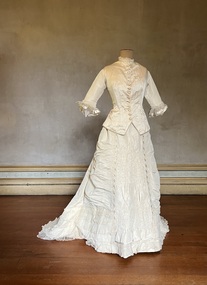
Clothing - Ivory silk and tulle bridesmaid's outfit, 1874
... ...Alice Frances (Henty) Hindson...This bridesmaid's dress was owned and first worn by Alice Frances Henty, the daughter of Francis Henty and Mary Ann (Lawrence) Henty. ...This bridesmaid's dress was owned and first worn by Alice Frances Henty, the daughter of Francis Henty and Mary Ann (Lawrence) Henty. ...This bridesmaid's dress was owned and first worn by Alice Frances Henty, the daughter of Francis Henty and Mary Ann (Lawrence) Henty. The outfit was worn at the marriage of her friend Miss Hopkins to Mr ST Staughnton in 1874. Alice's father, Francis Henty, was the youngest son of Thomas Henty, who with his family, their retainers and property moved to the Australian colonies between 1829 and 1832. In 1834, Francis’ older brother, Edward, sailed from Launceston in Van Diemen’s Land to what was to become Portland in the western part of Port Phillip District [Victoria]. Francis, together with the first flock of Merino sheep [in Victoria], followed some months later. The first and second generations of the Henty family established vast pastoral properties in the Western part of the Port Phillip District. Francis Henty managed ‘Merino Downs’ near Casterton, while also living in his retirement at ‘Field Place' in Kew. The Henty Collection of nineteenth and twentieth century clothing, including outerwear and underwear, was collected, stored and exhibited over time by female family members descended from Francis and Mary Ann Henty. During the twentieth century, items from the collection were modelled in two fashion parades by various descendants [1937, 1959]. The items in the collection are historically and aesthetically significant, with provenance provided by oral and written tradition within or held by the family. A number of the items in the collection are very rare survivors, and provide researchers with the evidence needed to reconstruct the lives of notable women in the Port Phillip District [later Victoria] during the nineteenth and early twentieth century.An ivory silk skirt and matching jacket worn by Alice Henty, aged 22, at the marriage of her friend Lizzie Hopkins and S.T. Staugnton in 1874. The ivory silk satin peplum jacket is boned, tailored, and fitted with many princess line panels. The front closure has handmade embroidered buttonholes and covered buttons. The collar and sleeves are decorated with gathered silk tulle frills. The peplum back features a silk cord bow decoration. The skirt with bustle and train features a central panel with hand ruching and silk satin piping. It is decorated with five rows of pleated silk tulle frills. Measurements (mm): PEPLUM JACKET Girth - Neck 317.5, Chest 914.4, Waist 698.5, Hip 965.2, Cuff 279.4, Hem circumference 1168.4. Vertical - From neck to hem 558.8, Front waist to hem 254, Back neck to hem 838.2, Back waist to hem 241.3, Sleeve length 279.4. Horizontal - Neck to sleeve head 165.1,Cross back 292.1, Underarm to underarm 393.7. SKIRT Girth - Waist 635, Hip 914.4, Hem circumference 3810. Vertical - Front waist to hem 1092.2, Back waist to hem 1701.8. fashion -- 1870s, alice frances (henty) hindson, women's clothing, bridesmaid's dresses -
 Kew Historical Society Inc
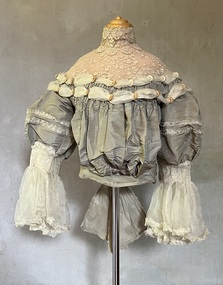
Clothing - Grey silk and lace bodice, 1875
... ...Alice francés henty...Alice Frances (Henty) Hindson's grey silk bodice is believed to be part of her 'going-away' outfit after her wedding to John Hindson on 15 April 1875. ...Alice Frances (Henty) Hindson's grey silk bodice is believed to be part of her 'going-away' outfit after her wedding to John Hindson on 15 April 1875. ...Alice Frances (Henty) Hindson's grey silk bodice is believed to be part of her 'going-away' outfit after her wedding to John Hindson on 15 April 1875. The bodice must have been a family favourite as it was used and amended over the years. Alice was the youngest daughter of Francis Henty and Mary Ann (Lawrence) Henty. Alice's father, Francis Henty, was the youngest son of Thomas Henty, who with his family, their retainers and property moved to the Australian colonies between 1829 and 1832. In 1834, Francis’ older brother, Edward, sailed from Launceston in Van Diemen’s Land to what was to become Portland in the western part of Port Phillip District [Victoria]. Francis, together with the first flock of Merino sheep [in Victoria], followed some months later. The first and second generations of the Henty family established vast pastoral properties in the Western part of the Port Phillip District. Francis Henty managed ‘Merino Downs’ near Casterton, while also living in his retirement at ‘Field Place' in Kew. The Henty Collection of nineteenth and twentieth century clothing, including outerwear and underwear, was collected, stored and exhibited over time by female family members descended from Francis and Mary Ann Henty. During the twentieth century, items from the collection were modelled in two fashion parades by various descendants [1937, 1959]. The items in the collection are historically and aesthetically significant, with provenance provided by oral and written tradition within or held by the family. A number of the items in the collection are very rare survivors, and provide researchers with the evidence needed to reconstruct the lives of notable women in the Port Phillip District [later Victoria] during the nineteenth and early twentieth century.The yoke is a bustier bodice, made of silk and silk organza with an insert of hand-tatted lace. The bodice is carefully boned and has a little padding in the bust line. It includes the name of the maker of the bodice as ‘Madame Jay, Brighton, 38 London Road’. The silk organza sleeves have hand shirring, trim, and frilled cuffs. The bodice is finished with a large, frilled bow at the back. Believed by the Henty family to be part of the ‘going away’ outfit worn by Alice Henty in 1875. Measurements (mm): BODICE: Girth - Neck 304.8, Chest 762, Waist 571.5, Cuff 127 Vertical - From neck to hem 381, Front waist to hem 152.4, Back neck to hem 419.1, Back waist to hem 228.6, Sleeve length 254. Horizontal - Neck to sleeve head 165.1, Cross back 457.2, Underarm to underarm 431.8.Mme Jay, Brighton Road, London [dressmaker]bodices, women's clothing, alice (henty) hindson, alice francés henty -
 Kew Historical Society Inc
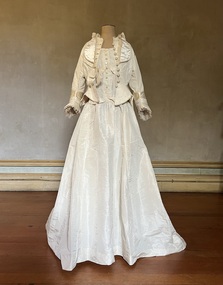
Clothing - Ivory silk and satin wedding dress and jacket, 1876-1944
... Alice Frances (Henty) Hindson...A number of the items in the collection are very rare survivors, and provide researchers with the evidence needed to reconstruct the lives of notable women in the Port Phillip District [later Victoria] during the nineteenth and early twentieth century. Alice Frances (Henty) Hindson Women's clothing wedding dresses Margaret Henty Hindson Alice Henty’s wedding dress, made in 1876 for her marriage to John Hindson was remodelled in 1943 for the wedding of her granddaughter, Alice Henty Hindson to Norman Lithgow Tait at Holy Trinity, Kew. ...Alice Henty (1852-1932) was the third daughter of Francis and Mary Ann Henty. her father was the youngest son of Thomas Henty, who with his family, their retainers and property moved to the Australian colonies between 1829 and 1832. In 1834, Francis’ older brother, Edward, sailed from Launceston in Van Diemen’s Land to what was to become Portland in the western part of Port Phillip District [Victoria]. Francis, together with the first flock of Merino sheep [in Victoria], followed some months later. The first and second generations of the Henty family established vast pastoral properties in the Western part of the Port Phillip District. Francis Henty managed ‘Merino Downs’ near Casterton, while also living with his wife following his retirement at ‘Field Place' in Kew. The Henty Collection of nineteenth and twentieth century clothing, including outerwear and underwear, was collected, stored and exhibited over time by female family members descended from Francis and Mary Ann Henty. During the twentieth century, items from the collection were modelled in two fashion parades by various descendants [1937, 1959]. The items in the collection are historically and aesthetically significant, with provenance provided by oral and written tradition within or held by the family. A number of the items in the collection are very rare survivors, and provide researchers with the evidence needed to reconstruct the lives of notable women in the Port Phillip District [later Victoria] during the nineteenth and early twentieth century.Alice Henty’s wedding dress, made in 1876 for her marriage to John Hindson was remodelled in 1943 for the wedding of her granddaughter, Alice Henty Hindson to Norman Lithgow Tait at Holy Trinity, Kew. It was worn again by Margaret Henty Hindson (1918-2000) at her marriage to Dougald Webster Matheson at St Paul's Church, Henty in 1944. The two piece dress has a low décolletage shaped with a collar from which two curved panels drop. The fastenings for the bodice are buttons covered with the same fabric. The bodice is completed with two full length sleeves. The full skirt is slightly flattened at the front with a long train. In contrast, the ivory silk, silk faille and satin bodice with long tails remained unaltered. The front closure of the jacket has handmade embroidered buttonholes and covered buttons. The pleated collar and sleeves are decorated with gathered silk tulle. The jacket features long tails. alice frances (henty) hindson, women's clothing, wedding dresses, margaret henty hindson -
 Kew Historical Society Inc
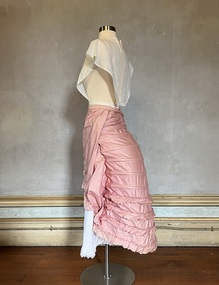
Clothing - Pink lobster-tail bustle, c. 1875
... ...Alice Frances (Henty) Hindson...This full length lobster tail bustle was owned and worn by Alice Frances Henty, the daughter of Francis Henty and Mary Ann (Lawrence) Henty. ...This full length lobster tail bustle was owned and worn by Alice Frances Henty, the daughter of Francis Henty and Mary Ann (Lawrence) Henty. ...This full length lobster tail bustle was owned and worn by Alice Frances Henty, the daughter of Francis Henty and Mary Ann (Lawrence) Henty. Bustles of this form date from the mid-1860s however this example probably dates from the mid 1870s, and perhaps from before her marriage to John Hindson in 1876. Alice's father, Francis Henty, was the youngest son of Thomas Henty, who with his family, their retainers and property moved to the Australian colonies between 1829 and 1832. In 1834, Francis’ older brother, Edward, sailed from Launceston in Van Diemen’s Land to what was to become Portland in the western part of Port Phillip District [Victoria]. Francis, together with the first flock of Merino sheep [in Victoria], followed some months later. The first and second generations of the Henty family established vast pastoral properties in the Western part of the Port Phillip District. Francis Henty managed ‘Merino Downs’ near Casterton, while also living in his retirement at ‘Field Place' in Kew.The Henty Collection of nineteenth and twentieth century clothing, including outerwear and underwear, was collected, stored and exhibited over time by female family members descended from Francis and Mary Ann Henty. During the twentieth century, items from the collection were modelled in two fashion parades by various descendants [1937, 1959]. The items in the collection are historically and aesthetically significant, with provenance provided by oral and written tradition within or held by the family. A number of the items in the collection are very rare survivors, and provide researchers with the evidence needed to reconstruct the lives of notable women in the Port Phillip District [later Victoria] during the nineteenth and early twentieth century.An exceptionally rare and fine, floor length, 'lobster tail' bustle that belonged to Alice Henty possibly worn with her two-piece pink silk gown but also with other dresses that she owned that required a bustle of this shape. The structure of the bustle includes an outer layer of polished cotton with inserted steel hoops and ties at the front. The lower four hoops have flounces of the same fabric. Overall, the bustle contains 12 hoops, crossed nearer the waist and semi-circular for the remainder of the undergarment. [One of the tapes of the bustle is imprinted with the word lockstitch. Elias Howe invented the lockstitch sewing machine in 1846.] Measurements (mm): BUSTLE: Girth - Waist 660 Vertical - Front waist to hem 914, Back waist to hem 965.fashion -- 1870s, alice frances (henty) hindson, women's clothing, bustles, underwear
