
Showing 10 items matching "alice kitchen"
-
 Australian Nursing & Midwifery Federation
1985 recording of 3CR Community Radio 'The History Show' broadcast about nurses in World War I featuring historian Katie Holmes, 3CR Community Radio, 1985 April 28
... ...Alice Kitchen...Features feminist historian Katie Holmes speaking on the experience of nurses in World War I. nurses nursing war world war one community radio 3cr radio broadcast history katie holmes feminism history of nursing lemnos Lydia King WW1 Elsie Trantor Narelle Hobbes Evelyn Davies Alice Kitchen Sister Fanny Harris 29 minute audio file (.mp3 multimedia format), transferred from compact disc recording. ...Broadcast of 'The History Show' on 3CR Community Radio. Features feminist historian Katie Holmes speaking on the experience of nurses in World War I.29 minute audio file (.mp3 multimedia format), transferred from compact disc recording. Note: this audio has static throughout the recording nurses, nursing, war, world war one, community radio, 3cr, radio, broadcast, history, katie holmes, feminism, history of nursing, lemnos, lydia king, ww1, elsie trantor, narelle hobbes, evelyn davies, alice kitchen, sister fanny harris -
 Alfred Hospital Nurses League - Nursing History Collection
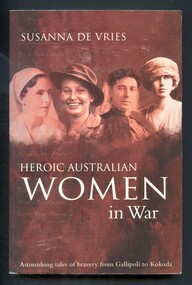
Book - Illustrated Book, HarperCollins Publishers Pty Ltd, Heroic Australian women in war: astonishing tales of bravery from Gallipoli to Kokoda, 2004
... Front and back covers also have photographs of four women (Joyce Tweddell, Vivian Bullwinkel, Alice Kitchen and Joyce Loch) A summary of the book is printed in white on the back cover....Front and back covers also have photographs of four women (Joyce Tweddell, Vivian Bullwinkel, Alice Kitchen and Joyce Loch) A summary of the book is printed in white on the back cover. ...The author profiles the love, dedication and selflessness of eleven outstanding women over the course of two world wars.Illustrated book with brown cover. Title and author's name printed in white on front cover and spine. Front and back covers also have photographs of four women (Joyce Tweddell, Vivian Bullwinkel, Alice Kitchen and Joyce Loch) A summary of the book is printed in white on the back cover.non-fictionThe author profiles the love, dedication and selflessness of eleven outstanding women over the course of two world wars.world war 1914-1918, world war 1939-1945, women in war -
 Returned Nurses RSL Sub-branch
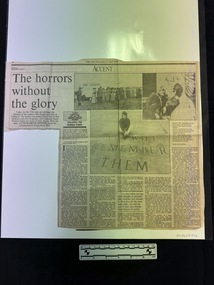
Newspaper - Newspaper clipping, Elizabeth Minter, The horrors without the glory, 19900425
... Nurses mentioned in the article: Elsie [May] Tranter Nellie [Constance] Maurice [sic] [Morrice] Evelyn Davies Laura Grubb C E Harries Lydia [Kate] King Alice [Elizabeth Barrett] Kitchen [Florence Narrelle] Narelle [sic] [Jessie] Hobbes ...Nurses mentioned in the article: Elsie [May] Tranter Nellie [Constance] Maurice [sic] [Morrice] Evelyn Davies Laura Grubb C E Harries Lydia [Kate] King Alice [Elizabeth Barrett] Kitchen [Florence Narrelle] Narelle [sic] [Jessie] Hobbes World War one WWI WW1 Nursing in warfare Nursing conditions A large black and white newspaper clipping of a single article with three inset images, two photographs and one illustration. ...Article interview with historian Katie Holmes about the harsh experiences of WWI nurses she is finding in her reading of journals and diaries belonging to these nurses. Nurses mentioned in the article: Elsie [May] Tranter Nellie [Constance] Maurice [sic] [Morrice] Evelyn Davies Laura Grubb C E Harries Lydia [Kate] King Alice [Elizabeth Barrett] Kitchen [Florence Narrelle] Narelle [sic] [Jessie] Hobbes A large black and white newspaper clipping of a single article with three inset images, two photographs and one illustration. Article has five columns of text with a large headline and brief intro paragraph. The clipping has minor tears and folds and is not cut straight.world war one, wwi, ww1, nursing in warfare, nursing conditions -
 Mission to Seafarers Victoria
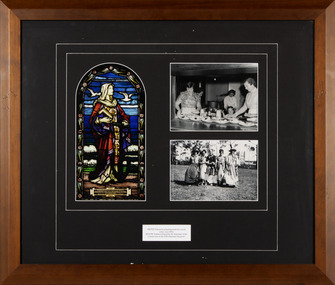
Photograph - Framed montage, Arthouse - Picture Framing & Gallery, Hope, 2013
... alice sibthorpe tracy...social events...kitchen...This frame is showcasing the memorial window to Alice Sibthorpe Tracy, a photograph of ladies pin the kitchen in the Flinders Street building, and seamen dressed up during a picnic....This frame is showcasing the memorial window to Alice Sibthorpe Tracy, a photograph of ladies pin the kitchen in the Flinders Street building, and seamen dressed up during a picnic. ...ENTERTAINMENT AND SOCIAL EVENTS The Ladies of the Harbour Lights Guild played a central role in everyday functions of the Mission to Seafarers. Concerts and social events were held nightly all the year round, as were special events on Cup Day, the King and Queen’s Birthdays, Christmas Day, Boxing Day and New Years Eve. Ladies of the Guild and other friends of the Mission contributed greatly to the organisation of such occasions, which provided great comfort to seafarers so far removed from home and their loved ones. As one seafarer remarked: “Ah miss, it is not so much the concerts and picnics that does us men so good, but that you ladies will come and talk to us”. This window, titled ‘Hope’, was installed in 1933 in memoriam of one of the founders and long- standing members of the Guild, Miss Alice Tracey, who passed away in 1932. She is remembered as a much- loved leader and key member of LHLG.Reflections of the Sea was an exhibition of 10 framed montage of photographs from the mission's archive collection showcasing 10 stained glass windows from the St Peter chapel. This exhibition curated by Georgia Melville and Catherine McLay, and funded by PROV and Creative Victoria, was displayed in the World Trade Centre Wharf Gallery in June July 2013 and toured to Queenscliff Maritime Museum. The photographs of the windows were taken by scientific photographer Justine M. Philip. This frame is showcasing the memorial window to Alice Sibthorpe Tracy, a photograph of ladies pin the kitchen in the Flinders Street building, and seamen dressed up during a picnic.Framed and mounted on black cardboard of black and white and colour reproductions from the MTSV collection for the exhibition Reflections of the Sea with brief label signageon label: ABOVE: Volunteers preparing meals for a social event, circa 1950s BELOW: Seafarers dressed for the "final heat"of the costume race at the 1926 Christmas Day picnicreflections of the sea, georgia melville, exhibition, 2013, world trade centre, wtc, creative victoria, prov, mission to seafarers, stained glass windows, justine m. philip, alice sibthorpe tracy, social events, kitchen, lhlg, picnic, fancy dress, seamen, sailors, catherine mclay, arthouse -
 Orbost & District Historical Society
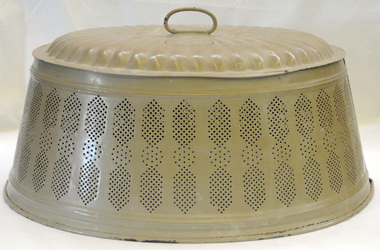
food cover, 1940's (?)
... food food-protection kitchen-ware pow-maccie mcwilliam-alice...Maccie Pow was a member of the Orbost Bowling Club, Red Cross and Orbost Golf Club. food food-protection kitchen-ware pow-maccie mcwilliam-alice An oval shaped metal food cover made of pressed tin painted tan. ...This item was owned and used by Alice Pow (nee McWilliam), known as Maccie. Maccie was a nurse who came to Orbost in 1936. She was highly respected in Orbost for her nursing skills particularly during the 1938 outbreak of polio, Most patients were cared for in their homes and Miss McWilliam was sent out to care for them. Over 14 months she travelled 9560 miles supervising their treatments. She eventually married Mr Hec Pow who had been left to bring up his three daughters after his wife died.. The Pows lived in Orbost where Hec Pow was worked with his father Fred at the saw mill in Cabbage Tree. Maccie Pow was a member of the Orbost Bowling Club, Red Cross and Orbost Golf Club.An oval shaped metal food cover made of pressed tin painted tan. It has a loop handle on the top. The sides slope outwards and it is seamed on both sides. The bottom edge is rolled. The sides have a perforated design for air flow.food food-protection kitchen-ware pow-maccie mcwilliam-alice -
 Bendigo Historical Society Inc.
Journal - Lansell Articles - A History of the Dobson Family - High Flyer to Port Phillip, 1978
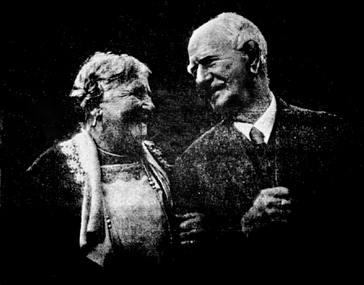
... Alice Bassford, tracing their origins, migration, and descendants from 19th-century England to Australia. The Dobson family traces back to Samuel Dobson, born around 1780 in Stepney, London, a scalemaker. William Dobson (b. 1809), son of Samuel, married Mary Ann Kitchen...Alice Bassford, tracing their origins, migration, and descendants from 19th-century England to Australia. The Dobson family traces back to Samuel Dobson, born around 1780 in Stepney, London, a scalemaker. William Dobson (b. 1809), son of Samuel, married Mary Ann Kitchen ...This document provides a detailed family history of Samuel Dobson and Frances Alice Bassford, tracing their origins, migration, and descendants from 19th-century England to Australia. The Dobson family traces back to Samuel Dobson, born around 1780 in Stepney, London, a scalemaker. William Dobson (b. 1809), son of Samuel, married Mary Ann Kitchen in 1833. They had twelve children, including Samuel Dobson (b. 1844), the main subject. The family lived in Stepney, London, during a period of significant social and industrial change. Samuel Dobson was born in 1844 in London, the sixth child of William and Mary Ann Dobson. He married Frances Alice Bassford in 1867. Frances was born in Tamworth, Staffordshire, in 1849, the daughter of Thomas and Sarah Bassford. Samuel and Frances, with their infant son, Samuel William, emigrated to Australia in 1868 aboard the clipper ship "Highflyer. "The voyage took 83 days, arriving in Melbourne in December 1868. They settled first in Melbourne, then moved to Bendigo during the gold mining boom. The Dobsons lived in Bendigo for about 15 years, where Samuel worked as a draughtsman and later in mining-related roles. Seven children were born in Bendigo, with three infants delivered stillborn. The family experienced both the excitement and challenges of the gold rush era. The family later moved to South Melbourne and then to Moonee Ponds, Melbourne, where more children were born. Frances’s sister, Edith Bassford, married George Lansell, a prominent mining magnate in Bendigo. Samuel Dobson was active in local cricket, playing against notable teams and figures. The Dobson family became well-established in Melbourne, with several members working for Buchanan and Brock Pty. Ltd., and participating in community and sporting activities. Samuel Dobson died in 1933 at age 89. Frances lived to 101, passing away in 1950, and was celebrated for her longevity and family contributions. The document includes family trees, photographs, and letters, illustrating the family’s growth and connections across generations. By Frances’s 100th birthday, the family included numerous grandchildren, great-grandchildren, and great-great-grandchildren, highlighting a lasting legacy.Lansell Articles - A History of the Dobson Family - High Flyer to Port Phillip by William T Dobson, donated by Mrs H Smith of Ferny Creek Victoria This item contains the following documents which are photocopies of the originals: 11217.69a1 The journal contains 46 A4 pages of text, and several pages of photos along with the family tree and detailed family history of Samuel Dobson and Frances Alice Bassford 11217.69a2 A large family tree approx 3 x A3 sheets wide by W T Dobson in 1978 - Contact the BHS for details 11217.69b Black and white diamond wedding anniversay photo of Franes Alice aged 77 and Samuel aged 82. They were married on Feb 28th in 1927non-fictionbendigo, fortuna, george lansell, samuel dobson, frances alice bassford, edith bassord, edith lansell -
 Port Melbourne Historical & Preservation Society
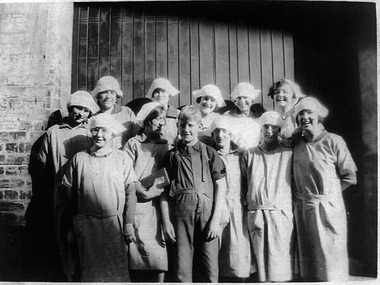
Photograph - Workers, Cardboard department, J Kitchen & Sons, 1920s
... Kitchen & Sons Pty Ltd...Myrtle BENNETT nee MOTT...Alice...After all these years, it was hard to remember who was who! Alice Mott started working at Kitchen's at 14 year old, and her younger sister Myrtle started there at 15 years, having worked for a year at Swallows. ...Business and Traders - Soaps/Candles John BRADLEY Jim BRADLEY J Kitchen & Sons Pty Ltd Myrtle BENNETT nee MOTT Alice MOTT Millie ROBINSON Florrie McPHERSON Mabel McPHERSON Lily EDDY Alma EDDY HEGARTY Family Copy of photo of twelve young workers from cardboard department of J Kitchen & Sons, Ingles Street. ...This photo has been in the Hegarty famly collection since the twenties. It shows a group of workers from the Cardbox Department of J Kitchen & Sons Pty Ltd, of Ingles Street, Port Melbourne. These workers made boxes for soap by hand, i.e. presentation boxes for Christmas gifts. There are three sets of sisters in this photo: Lily and Alma Eddy, who travelled from Coburg; Mabel and Florrie McPherson and Alice and Myrtle Mott, all of Cruikshank Street. Mrs Myrtle Mott Bennett of Box Hill, was able to identify Millie Robinson (front row, 2nd from left) of Graham Street, Alice Mott (back row, 3rd from left). She is 2nd from left in front row. After all these years, it was hard to remember who was who! Alice Mott started working at Kitchen's at 14 year old, and her younger sister Myrtle started there at 15 years, having worked for a year at Swallows. Myrtle was to spend 15 years there prior to her marriage in 1939, and received a gold watch for long service She feels that working at Kichens was a bit more prestigious than Swallows. John and Jim Bradley were the foremen and were real gentlemen!Copy of photo of twelve young workers from cardboard department of J Kitchen & Sons, Ingles Street. Also an attachment (.02) written by Barbara Gardiner which lists all the people in the photo.business and traders - soaps/candles, john bradley, jim bradley, j kitchen & sons pty ltd, myrtle bennett nee mott, alice mott, millie robinson, florrie mcpherson, mabel mcpherson, lily eddy, alma eddy, hegarty family -
 Alfred Hospital Nurses League - Nursing History Collection
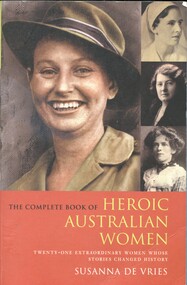
Book - Illustrated Book, Susanna De Vries 1935, The complete book of heroic Australian women, 2010
... The 21 women are :- Georgiana Molloy, Frances ('Fanny') Bussell, Elizabeth ('Bessie') Bussell, Charlotte Cookworthy Bussell, Emma Mary Withnell, Atlanta Hope Bradshaw, Jeannie Gunn OBE, Evelyn Maunsell, Catherine Langloh Parker, Myrtle Rose White, Olive May Kelso King, Dr Agnes Elizabeth Lloyd Bennett, Dr Lilian Violet Cooper, Sister Alice Elizabeth Kitchen, Joice NanKivell Loch, Sister Sylvia Muir, Sister Vivian Bullwinkel, Sister Joyce Tweddell, Sister Betty Jeffrey, Mavis Parkinson, and Sister Frances May Hayman. ...Providing inspiration for contemporary women, this book profiles 21 individuals who faced different tests - harshness of the Australian outback, but when encountering adversity, even death, each proved her mettle, showing what it takes to be a truly heroic Australian. The 21 women are :- Georgiana Molloy, Frances ('Fanny') Bussell, Elizabeth ('Bessie') Bussell, Charlotte Cookworthy Bussell, Emma Mary Withnell, Atlanta Hope Bradshaw, Jeannie Gunn OBE, Evelyn Maunsell, Catherine Langloh Parker, Myrtle Rose White, Olive May Kelso King, Dr Agnes Elizabeth Lloyd Bennett, Dr Lilian Violet Cooper, Sister Alice Elizabeth Kitchen, Joice NanKivell Loch, Sister Sylvia Muir, Sister Vivian Bullwinkel, Sister Joyce Tweddell, Sister Betty Jeffrey, Mavis Parkinson, and Sister Frances May Hayman.Illustrated book, with brown and green cover. On the front cover is one large and three small photographs Of women (the large photograph is of Vivian Bullwinkel, top right - Joyce Tweedle, centre -Myrtle Rose White, bottom right - Jeannie Gunn). Below these photos title (black, green and white ink) and author's name (white ink) are printed. Three of these photos are also on the spine (Vivian Bullwinkel, Joyce Tweedle & Jessie Gunn) above the phots the book title is printed in black and brown ink, and below the author's name, publisher's name and logo are printed in white ink. On the back cover is a summary of the book and a photograph of a woman (Myrtle Rose White. non-fictionProviding inspiration for contemporary women, this book profiles 21 individuals who faced different tests - harshness of the Australian outback, but when encountering adversity, even death, each proved her mettle, showing what it takes to be a truly heroic Australian. The 21 women are :- Georgiana Molloy, Frances ('Fanny') Bussell, Elizabeth ('Bessie') Bussell, Charlotte Cookworthy Bussell, Emma Mary Withnell, Atlanta Hope Bradshaw, Jeannie Gunn OBE, Evelyn Maunsell, Catherine Langloh Parker, Myrtle Rose White, Olive May Kelso King, Dr Agnes Elizabeth Lloyd Bennett, Dr Lilian Violet Cooper, Sister Alice Elizabeth Kitchen, Joice NanKivell Loch, Sister Sylvia Muir, Sister Vivian Bullwinkel, Sister Joyce Tweddell, Sister Betty Jeffrey, Mavis Parkinson, and Sister Frances May Hayman.women-biography, women-australian-biography -
 Melton City Libraries
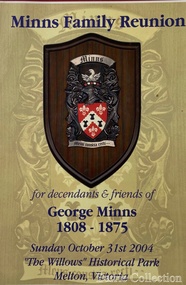
Document, Minns Family Reunion, 2004
... kitchen, ablutions and laundry rooms and rooms for seasonal workers. This was attached to the house by means of a trellised walkway using the original front entry to the house (long since the back door). A photograph of this building appears in a local history of Melton. This was demolished in recent decades during the period when the house was tenanted (after the Minns family had left). James Minns son, George, took over the property following his marriage to Alice...kitchen, ablutions and laundry rooms and rooms for seasonal workers. This was attached to the house by means of a trellised walkway using the original front entry to the house (long since the back door). A photograph of this building appears in a local history of Melton. This was demolished in recent decades during the period when the house was tenanted (after the Minns family had left). James Minns son, George, took over the property following his marriage to Alice ..."A perpetual spring in the adjacent creek provided a steady supply of fresh water to the site on which the homestead is built. Although we can not be certain of the identity of the builder, the first stage of ‘The Willows’ homestead appears to have been constructed in the mid 1850s. The house is situated on Crown Allotment No.1 (No Section), Parish of Kororoit, an allotment of 5 acres 3 roods 4 perches. Although it had surveyed the land, the Crown did not offer it for sale until 22nd November 1861, at which time it was purchased by Charles March Williams. (Although the property is directly opposite and immediately adjacent to the Township of Melton, and was sold as ‘Suburban Allotment 33’, it was situated within the Shire of Braybrook rather than the Shire of Melton until 1917.) Considerable improvements had taken place on the land prior to the Crown sale. When CM Williams purchased the allotment in November 1861 he paid £23.5.0 for the land itself, and valued the improvements at £400. Even allowing for some exaggeration by Williams, this is an extremely high valuation for improvements, and must have included a house. Some local research has claimed that in 1858 Williams had taken over the interest of a Mr Parkinson in the property, and that Parkinson built the house upon taking possession of the land c.1855. It was definitely built by 1861, when a map shows a square building on the site marked as ‘House’. The property is important in the district for its association with the establishment of the pound. The district pound had been established in 1854, when George Scarborough of Mount Cottrell (Mt Cottrell Road, south of Greigs Road) was appointed pound-keeper. Scarborough resigned in 1857. The pound was moved to Melton following agitation from local farmers and Charles March Williams appointed pound-keeper on 26th April 1858. Williams, the son of a doctor, had been born in London. Reminiscences of local residents of the time, as recorded in the Express newspaper, note Williams’ success in breeding horses on the property. Sales of up to 60 guineas were noted. Whether this was from Williams’s own stock or from unclaimed pound stock is not made clear. Williams appeared before a government inquiry in 1860 and advocated registration of all stock brands in the State. Williams died in 1862 leaving a widow, Catherine, and five living children aged 15 years to five months. At the time of his death Williams had entered negotiations with one Matthew Devenish and had a mortgage of £100 on allotments 1 and 2, Parish of Kororoit. Catherine Williams was appointed pound-keeper on 2 September 1863, with her eldest son Charles as her assistant. Her tenure was short for on 22nd March 1864 George Minns senior paid Matthew Devenish £135 for allotments 1 and 2 Parish of Kororoit (considerably less than Williams had claimed the property was worth in 1861) and on the same day paid William Tullidge £45 for the adjoining allotments 3 and 4. In April 1867, James Ebden Minns, the newly married son of George senior became the owner of The Willows property having entered into a mortgage arrangement with his father to the extent of £200. At the time George Minns was residing in Kaarimba having left Melton in 1867 for a short trip to England and upon his return having taken up a selection in the Kaarimba district with his son Frederick who had a hotel licence there. James paid out the mortgage on 2-1-1873. James Minns was appointed pound-keeper in 1872; in 1885 the pound was moved elsewhere and Minns purchased the old pound site and added it to his farm. The Willows residence underwent a major change about this time. A two room extension, similar in style but with a lower elevation was added to the original rear of the house with a chimney matching the distinctive originals. Window arrangements did not match the original but became a feature of the façade when the new addition became the front of the building. Six buttresses were attached to the east and west walls of the old building, two to the south wall and the whole rendered with mortar to give the appearance of dressed stonework around the windows. Galvanized iron was placed over the shingles and a verandah added on three sides. By 1876 The Willows was the homestead for a thriving mixed farm of 340 acres of which 156 was rented from a H. Ruck. In October of that year the Australasian travelling reporter visited and reported on the property. In common with the nearly every other property in the district the farm had ‘recently’ (generally within the last two years) abandoned cultivation of crops, and turned over completely to cattle pasture. Butter making was the principal occupation of the farm, which had about 50 head of cattle, a large proportion of which were milking cows. The reporter also noted that a ‘large number of pigs are kept upon this farm and are found to be very profitable stock’. Their manure was used in an orchard and garden in which ‘large quantities of lucerne and prairie grass are grown for the use of stock when ordinary feed is scarce’. Two bores attached to deep brick lined wells supplied water for the house in addition to the farm. A commodious timber barn and necessary sheds had also been constructed. Access to the property was improved following the construction of the bluestone ford across the creek c.1887, when the recreation ground came into use. Prior to this date it may have been that the crossing referred to as ‘Mr Minns bridge’ was used. This appears to have been a flimsy structure and has but two references in Council reports in the Melton Express in the 1880’s. It is believed that in the late 1890’s a timber building was added near the rear of the building to house a kitchen, ablutions and laundry rooms and rooms for seasonal workers. This was attached to the house by means of a trellised walkway using the original front entry to the house (long since the back door). A photograph of this building appears in a local history of Melton. This was demolished in recent decades during the period when the house was tenanted (after the Minns family had left). James Minns son, George, took over the property following his marriage to Alice Walsh in 1903. James and Caroline moved into a house on the former JH Games property at the eastern end of Henry Street. George held the position of Shire Secretary for Melton for 40 years. He was a most prominent member of the community being Secretary to, among others, the Melton Coursing Club, the Shooting Club and the Cemetery Trust. He also rode with the hunting parties who sported across the Plains and were entertained at Mount Kororoit. George and Alice had one son, Norman who followed his father into local government and became Secretary of the Shire of Werribee completing a record term in this position. George retired to Werribee in 1951, where he died in 1965. The National Trust records note that James Ebden Minns and his sons were ‘leading men of the district, Justices of the Peace, and Shire Councillors’. It claims that Sir Thomas Bent was a frequent visitor. The Willows passed into the hands of George’s grandson, Bruce Minns and the property was let for a number of years. In the 1960s it became vacant and was subject to vandalism. Major structural problems arose with the part demolition of the roof, the loss of windows and doors and holes dug into and under the floorboards. The outbuildings were particularly targeted. Following widespread public support, the Shire of Melton purchased the house, with 3.75 acres of land, in 1972. In 1975 the Shire of Melton and the Melton and District Historical Society were successful in nominating the building for National Trust classification, and then the Australian Heritage Commission’s Register of the National Estate. The AHC particularly noted its ‘townscape importance’. It was envisaged that the farmhouse would form ‘a picturesque centrepiece to Melton’s planned … historical park, along with Dunvegan bluestone cottage … and similar structures as they become available.’ In a time of great Melton’s ‘satellite city’ development the Council spelt out its broader vision in its submission to the AHC: ‘Melton is destined to become, by the end of the present century, a city of between 75,000 and 100,000 people. Significant relics of the past, such as ‘The Willows’, regrettably will be rare in that situation. It is essential that sufficient tangible links with Melton’s pioneering days remain to promote in the new community a sense of history and continuity’. Under the direction of ‘The Willows’ Restoration Committee and consultant architect John Hitch, all outbuildings, with the exception of the garage and toilet, were demolished and the dwelling house restored. Finances were provided by the Shire of Melton and the National Estate Grants Program, and considerable amount of voluntary labour was provided by the local community. The orchard was removed, and remaining wooden buildings were relocated to provide an open vista for visitors to the Park. The property was furnished with donations from district families keen to preserve this example of pioneer life in the area. The Willows became the headquarters of the Melton and District Historical Society". Invitation to the family reunion at the Willowslocal identities, pioneer families -
Kew Historical Society Inc
Archive (series) - Subject File, Artists I (Kew), 1958-present
... Alice Marion Ellen Bale (1875-1955), Arthur Loureiro (1860-1932), Frances Derham, Eugenia Meldrum, Max Meldrum, Louis Buvelot, Kitchen Dimensions High Street Kew, Ron Walker, Melissa Peacock, Isobel Davies 6 A'Beckett Street, Hertha Kluge-Pott, Debra Luccio, Elise Martinson, Carole Milton, Louise Minahan, Miranda Millane, Sonja Kan, Holly Walton, Q Art Gallery, Archibald Colquhoun, Amalie Colquhoun, John Perry, Pamela Pretty, Christopher Shelton, Amanda Tuohy, Margot Westhorpe, Ian Wood, James O’Brien, Gaby Jung, Rupert Gray, Ray Gee - 3 Fernhurst Grove, Louis Foletta, Thomas King (Tim) Fitchett, Wendy Fantasia, Marion Cravino, Brett Coelho, Eileen Cambell, Helen Carnage, Erin Carnage, John Bates, Nina Bennett, Donald Cameron, Gwen Walker...Alice Marion Ellen Bale (1875-1955), Arthur Loureiro (1860-1932), Frances Derham, Eugenia Meldrum, Max Meldrum, Louis Buvelot, Kitchen Dimensions High Street Kew, Ron Walker, Melissa Peacock, Isobel Davies 6 A'Beckett Street, Hertha Kluge-Pott, Debra Luccio, Elise Martinson, Carole Milton, Louise Minahan, Miranda Millane, Sonja Kan, Holly Walton, Q Art Gallery, Archibald Colquhoun, Amalie Colquhoun, John Perry, Pamela Pretty, Christopher Shelton, Amanda Tuohy, Margot Westhorpe, Ian Wood, James O’Brien, Gaby Jung, Rupert Gray, Ray Gee - 3 Fernhurst Grove, Louis Foletta, Thomas King (Tim) Fitchett, Wendy Fantasia, Marion Cravino, Brett Coelho, Eileen Cambell, Helen Carnage, Erin Carnage, John Bates, Nina Bennett, Donald Cameron, Gwen Walker Artists I (Kew) Archive Subject File ...Various PartiesReference, Research, InformationKHS OrderInformation file including a collection, largely compiled of newspaper articles/cuttings, relating to artists born or practising in Kew. In addition to the cuttings, there is a catalogue of an exhibition at the Town Hall Gallery - Louis Kahan: Art, theatre and fashion (curated by Laura Jokic, 2016), and biographical entries from various publications including the ADB. There is also an invitation (undated) from the Mayor of Kew, Cr. Kaye Cole, to an exhibition of paintings by Gwen Walker and Donald Cameron in the Mayor’s Room. Alice Marion Ellen Bale (1875-1955), Arthur Loureiro (1860-1932), Frances Derham, Eugenia Meldrum, Max Meldrum, Louis Buvelot, Kitchen Dimensions High Street Kew, Ron Walker, Melissa Peacock, Isobel Davies 6 A'Beckett Street, Hertha Kluge-Pott, Debra Luccio, Elise Martinson, Carole Milton, Louise Minahan, Miranda Millane, Sonja Kan, Holly Walton, Q Art Gallery, Archibald Colquhoun, Amalie Colquhoun, John Perry, Pamela Pretty, Christopher Shelton, Amanda Tuohy, Margot Westhorpe, Ian Wood, James O’Brien, Gaby Jung, Rupert Gray, Ray Gee - 3 Fernhurst Grove, Louis Foletta, Thomas King (Tim) Fitchett, Wendy Fantasia, Marion Cravino, Brett Coelho, Eileen Cambell, Helen Carnage, Erin Carnage, John Bates, Nina Bennett, Donald Cameron, Gwen Walker
