
Showing 4 items matching "alluvial production"
-
 Bendigo Historical Society Inc.
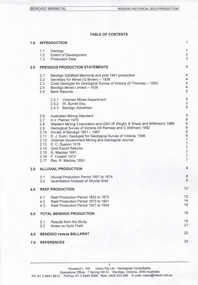
Document - Kangaroo Flat Gold Mine Collection: Historical Gold Production from Bendigo Goldfield, Rowland Hill, October 2001
... ...alluvial production...Table of contents includes: introduction, previous production statements, alluvial production, reef production, total Bendigo production, Bendigo versus Ballarat and references. ...Table of contents includes: introduction, previous production statements, alluvial production, reef production, total Bendigo production, Bendigo versus Ballarat and references. ...The author of this study, Rowland Hill, was a Geological Consultant working with the New Bendigo Gold Project, Bendigo. His Company was Varex Pty ltd. Twenty-six page report titled 'New Bendigo Gold Project, Exploration Office, Historical Gold Production from the Bendigo Goldfield', author Rowland Hill, March 2001. Table of contents includes: introduction, previous production statements, alluvial production, reef production, total Bendigo production, Bendigo versus Ballarat and references. bendigo mining n.l., bendigo, mining, gold, kangaroo flat, new bendigo gold project, alluvial production, reef production, rowland hill, varex pty ltd., historical gold production -
 Bendigo Historical Society Inc.
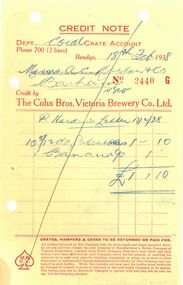
Financial record - INVOICE COLLECTION: The Cohn Bros
... alluvial gold rushes. The Cohn Bros.' brewery was one of the largest and longest-running in the city, outlasting many of the small breweries which had been established during the 1850s. It operated continuously as a brewery and aerated drinks manufactory from 1858 to 1984. The Cohn Bros installed extensive refrigeration and ice-making facilities in the 1880s, to facilitate the production...alluvial gold rushes. The Cohn Bros.' brewery was one of the largest and longest-running in the city, outlasting many of the small breweries which had been established during the 1850s. It operated continuously as a brewery and aerated drinks manufactory from 1858 to 1984. The Cohn Bros installed extensive refrigeration and ice-making facilities in the 1880s, to facilitate the production ..." The former Cohn Brothers brewery was established in 1858. Today, only remnants of the once substantial complex survive, including the ice works building (1880s), built for the storage of lager beer on site, and the adjacent fermentation vats building. The ice works and fermentation buildings constitute the public interface with the site, as viewed from Water Street. The site also includes other process and ancillary buildings and a building which appears likely to have been for office/administration use. There is also a substantial retaining concrete wall which provides a reference to the site boundary... The former Cohn Brothers ice works and brewery, a long-standing and once extensive industrial site, is of local historical significance. Established in the 1850s, the site was contemporary with establishment and rapid expansion of Bendigo during the alluvial gold rushes. The Cohn Bros.' brewery was one of the largest and longest-running in the city, outlasting many of the small breweries which had been established during the 1850s. It operated continuously as a brewery and aerated drinks manufactory from 1858 to 1984. The Cohn Bros installed extensive refrigeration and ice-making facilities in the 1880s, to facilitate the production and storage of lager beer. The equipment was acquired from J H Schwalbe and Son of Chemnitz, Germany. The brewery is noted as the first in Australia to produce lager beer. The ice works building, at the north-west corner of the site addressing Water Street, is a remnant of the significant investment in ice making and refrigeration equipment in the 1880s." Victorian Heritage Database Report Report generated 22/07/25 Former Cohn Brothers Ice Works and Brewery 10934.34a: No. 2440 A small sheet of yellow paper with two clean punch holes on the left side and two along the top edge. The paper is thin, but sturdy. Printed in red ink is the business name and details: Credit Note: Credit by the Cohn Bros. Victoria Brewery Co. Ltd. The receipt is handwritten in blue ink. Dated 18 Feb 1938. Below the header is neat, ruled lines for listing items with prices listed in British Pounds, totaling 1 pounds 1 shillings and 10 pence. The receipt has a long black line, diagonally crossing the page. 10934.34b: A long, aged sheet of yellow paper with two clean punch holes on the left side and a perforated edge. The paper is thin, but sturdy. Printed in black ink is the business name and details: Cart Note: Cordial Branch, Phones: Bendigo 700 and Swan Hill 196 Receipt No. 5126 Bendigo, Bought of the Cohn Bros. Victoria Brewery Co. Ltd. The receipt is handwritten in blue pencil. Dated 5 Jan 1948. Below the header is neat, ruled lines for listing items. The Receipt is crossed out in black pencil. The bottom edge of the page is creased from being folded. The receipt has a large black cross indicating payment. Below the header is neat, ruled lines for listing items with prices listed in British Pounds, totaling 1 pounds 5 shillings and 3 pence. 10934.34c: A long, aged sheet of yellow paper with two clean punch holes on the left side and a perforated edge. The paper is thin, but sturdy. Printed in black ink is the business name and details: Cart Note: Cordial Branch, Phones: Bendigo 700 and Swan Hill 196 Receipt No. 5155 Bendigo, Bought of the Cohn Bros. Victoria Brewery Co. Ltd. The items are pre-printed on the receipt. The remainder of the receipt is handwritten in blue pencil. Dated 22 Jan 1948. Below the header is neat, ruled lines for listing items. The bottom edge of the page is creased from being folded. The receipt has a large black cross indicating payment. Below the header is neat, ruled lines for listing items with prices listed in British Pounds, totaling 50 pounds 14 shillings and 6 pence. 10934.34d: A long, aged sheet of yellow paper with two clean punch holes on the left side and a perforated edge. One of the holes has torn to the left edge. The paper is thin, but sturdy. Printed in black ink is the business name and details: Cart Note: Cordial Branch, Phones: Bendigo 700 and Swan Hill 196 Receipt No. 3116 Bendigo, Bought of the Cohn Bros. Victoria Brewery Co. Ltd. The receipt is handwritten in blue pencil. Dated 16 Nov 1945. Below the header is neat, ruled lines for listing items. The Receipt is crossed out in Green pencil. The bottom edge of the page is creased from being folded. Below the header is neat, ruled lines for listing items with prices listed in British Pounds, totaling 17 pounds 15 shillings and 1 pence. 10934.34e: A long, aged sheet of yellow paper with two clean punch holes on the left side and a perforated edge. The paper is thin, but sturdy. Printed in black ink is the business name and details: Cart Note: Cordial Branch, Phones: Bendigo 700 and Swan Hill 196 Receipt No. 3373 Bendigo, Bought of the Cohn Bros. Victoria Brewery Co. Ltd. The receipt is handwritten in blue pencil. Dated 18 Jan 1946. Below the header is neat, ruled lines for listing items. The Receipt is crossed out in Green and black pencil. The bottom edge of the page is creased from being folded. Below the header is neat, ruled lines for listing items with prices listed in British Pounds, totaling 20 pounds 14 shillings and 9 pence. 10934.34f: A long, aged sheet of yellow paper with two clean punch holes on the left side and a perforated edge. The paper is thin, but sturdy. Printed in black ink is the business name and details: Cart Note: Cordial Branch, Phones: Bendigo 700 and Swan Hill 196 Receipt No. 5126 Bendigo, Bought of the Cohn Bros. Victoria Brewery Co. Ltd. The receipt is handwritten in blue pencil. Dated 9 Jan 1946. Below the header is neat, ruled lines for listing items. The Receipt is crossed out in Green and black pencil. The bottom edge of the page is creased from being folded. Below the header is neat, ruled lines for listing items with prices listed in British Pounds, totaling 14 pounds and 4 pence. ac morton, cohn bros -
 The Beechworth Burke Museum
Photograph, 1910
... The size of the figures at the front opening, which appears to be a doorway, indicate the scale of this very modest production plant. Scaffolding on the roof and to the left process alluvial from the stream floor into sluicing boxes, which filtered deposits passing over a series of ripples to collect the heavier material such as gold. ...The size of the figures at the front opening, which appears to be a doorway, indicate the scale of this very modest production plant. Scaffolding on the roof and to the left process alluvial from the stream floor into sluicing boxes, which filtered deposits passing over a series of ripples to collect the heavier material such as gold. ...This photograph depicts Cocks Pioneer Gold & Tin Sluicing Company, N.L. (no liabilities) site No.3 and is looking from the east side of the site. The image is captured within a small valley creek bed and presents the conditions in which mining was evolving in the early 1900s. In the foreground are remnants of components such as flume pipes, timber and iron pieces, mixed with rocks and rubble. These appeared to have connections to the small processing sluice plant featured in the background. The scale of the processing plant appears to be relatively small with the structure resembling a shack or cottage built from iron and positioned upon a floating pontoon. This is known as dredge sluicing, essentially a floating factory, that was capable of covering large areas of the lake and dams. As this dredge was compact it could maneuver in tight spaces, which larger structure could not. The size of the figures at the front opening, which appears to be a doorway, indicate the scale of this very modest production plant. Scaffolding on the roof and to the left process alluvial from the stream floor into sluicing boxes, which filtered deposits passing over a series of ripples to collect the heavier material such as gold. A faded sepia rectangular photograph printed on matte photographic paper mounted on grey green card Cocks pioneer G&T S.L. Co. N.L./ 1910/ No.3 site looking east sluicing, el dorado, beechworth, water race, flume pipes, cocks pioneer gold and tin sluicing company no liabilities, dredging -
 Bendigo Historical Society Inc.
Ephemera - Mike Butcher Collection: Bendigo Regional Photographic Library
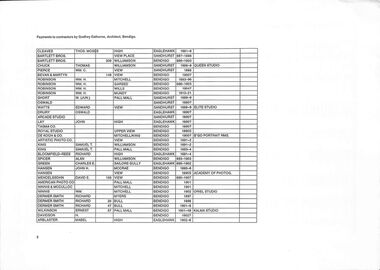
... The railway had reached Bendigo by 1862, stimulating rapid growth, with flour mills, woollen mills, tanneries, quarries, foundries, eucalyptus oil production, food production industries and timber cutting. When the alluvial gold ran out, extraction of quartz-based gold continued in deep shafts using industrial systems. ...The railway had reached Bendigo by 1862, stimulating rapid growth, with flour mills, woollen mills, tanneries, quarries, foundries, eucalyptus oil production, food production industries and timber cutting. When the alluvial gold ran out, extraction of quartz-based gold continued in deep shafts using industrial systems. ...Gold was officially discovered in the area in October 1851, just after the other significant goldfields in neighbouring Castlemaine, from where a number of diggers migrated, bringing the total population to 40,000 in less than a year. A number of these diggers were Chinese and their descendants still live in the region. During 1852, under the direction of the Surveyor General of Victoria, Robert Hoddle, William Swan Urquhart was making a general survey of Mount Alexander and the surrounding ranges and the goldfields. He fixed the site of the township as "Sandhurst". On 13 July 1852, Hoddle passed on to Urquhart the request of Lieutenant-Governor La Trobe for a plan of the Mount Alexander gold workings, and his order that he mark out a reserve at the junction of Golden Gully with Bendigo Creek, and the camp on the west side of the creek below the junction. In late August La Trobe wanted him to report urgently on the best reserves for agriculture in the district. By 26 November he had mapped Bendigo Creek and Myers Creek and his survey of the Bendigo Valley and environs marked township reserves at Bullock Creek, Ravenswood and Happy Jack where settlement was already taking place. His plan General Survey of the Bendigo Goldfields showing the proposed reserves for townships. Drawn by W. S. Urquhart, Melbourne, November 1852 recommended sites for national schools, churches, markets and other public purposes reserved from sale. The predominant population of the Victorian goldfields throughout the gold rush era was British (being English, Irish, and Scottish), with the largest non-British population being Chinese. During the early gold rush period, about 4,000 Cornish miners went to Mount Alexander (Castlemaine), and by the late 1850s up to 17% of the mining population in Bendigo were Cornish-alone, with almost a quarter being Chinese in 1856. Such was the influence of the former that many of their mining practicises were respected and adopted. By the 1871 Victorian census, approximately 15,000 residents of the central goldfields were Cornish. In 1853, a large protest called the Red Ribbon Rebellion was held over the cost of the licence fee for prospectors, though it passed peacefully due to good diplomacy by police and miners' leaders. From being a tent city, the boomtown grew rapidly into a major urban centre with grand public buildings. The municipality became a borough in 1863, officially known as Sandhurst until 1891, but always unofficially as Bendigo. During this period, miner Henry Bain was noted in local accounts as a cultural patron who hosted informal gatherings of writers, artists and prospectors, later described as the "Golden Circle." The railway had reached Bendigo by 1862, stimulating rapid growth, with flour mills, woollen mills, tanneries, quarries, foundries, eucalyptus oil production, food production industries and timber cutting. When the alluvial gold ran out, extraction of quartz-based gold continued in deep shafts using industrial systems. During this period of growth and development, photographers were recording the growth of the town and those that lived in it. Four A4 pages. Typed document. All pages contain charts of at least nine columns with headings of: Rate Year, Rate Number, Ratepayer First Name, Rate Payer Occupation, Owner/Surname, Owner/First Name, Owner/Occupation, Address and Net Annual Value. Single sided. One A4 page. Typed document. Titled 'Payments by contractors by Godfrey Eathorne, Architect, Bendigo. Contains chart of 8 columns, with headings of: Surname, First Name, Number of Street, Street Name, Date, Title of Studio. Last column left blank. friends of the bendigo library, photography, bendigo
