
Showing 5 items matching "american foundation for the blind"
-
 Vision Australia
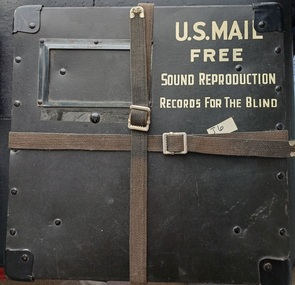
Container - Object, American Foundation for the Blind, Records for the Blind case, 1948-1980
... ...American Foundation for the Blind...Books purchased from the American Foundation for the Blind, who began producing them in 1935, came to Australia in these cases, which where then used to send and return them....American Foundation for the Blind...Audio Books American Foundation for the Blind U.S. Mail Free Sound Reproductions Records for the Blind 1 black plastic and cardboard container with metal corners and straps Records for the Blind case Container Object American Foundation for the Blind ...Audio records were dispatched via the postal service and needed to be protected against damage to and from their destination. In this example of a record case, two straps with metal ends held the front and rear containers together. The contents were protected by thick cardboard inside each container as well as metal corners on the upper lid. Books purchased from the American Foundation for the Blind, who began producing them in 1935, came to Australia in these cases, which where then used to send and return them.1 black plastic and cardboard container with metal corners and strapsU.S. Mail Free Sound Reproductions Records for the Blindaudio books, american foundation for the blind -
 Vision Australia
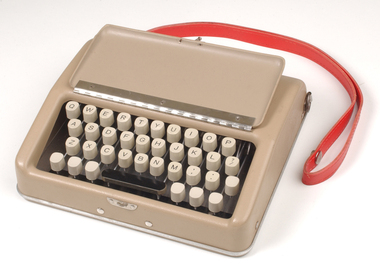
Equipment - Object, American Foundation for the Blind, Tellatouch
... The Tellatouch was developed in the American Foundation research laboratory and resulted from one of the first AFB research projects, a major effort in the mid-1940s to help deaf-blind people. ...American Foundation for the Blind...The lid is secured with a metal latch at the front. braille equipment Assistive devices Beige vinyl machine with leather carry strap Tellatouch Equipment Object American Foundation for the Blind ...The Tellatouch was developed in the American Foundation research laboratory and resulted from one of the first AFB research projects, a major effort in the mid-1940s to help deaf-blind people. The device helped end social isolation for hundreds of deaf-blind children and adults. The Tellatouch provides a means of communication between a sighted (or blind) person and a deaf-blind person who can read braille. The keyboard has three rows of ten keys each and a standard braille keyboard on the fourth row. At the rear of the machine is a round metal plate with the braille cell in the center. The deaf-blind person rests a finger on the braille cell. Pins rise to form the equivalent of the letter key that is struck. The body of the device covered in beige vinyl, with a hinged lid at the front which lifts up to reveal the keyboard. The lid is secured with a metal latch at the front.Beige vinyl machine with leather carry strapbraille equipment, assistive devices -
 Vision Australia
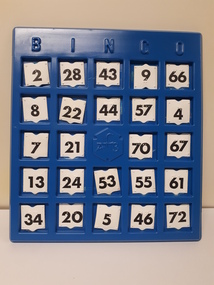
Leisure object - Object, Bingo cards, 19
... American Foundation for the Blind...Recreation Games 2 blue bingo cards Bingo cards Leisure object Object American Foundation for the Blind ...With large print numbers as well as Braille, these cards allow everyone to participate in Bingo. Originating in Italy, this competitive game is enjoyed almost the world over and has also been used as an educational tool to teach children numeracy as well as history. 2 blue bingo cards recreation, games -
 Vision Australia
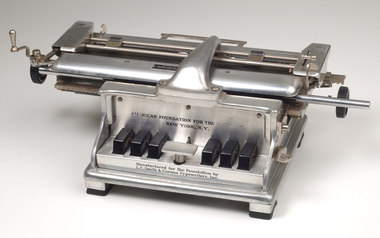
Equipment - Object, Foundation writer
... The American Foundation for the Blind developed this new model in their experimental shop in 1932 and contracted with the typewriter manufacturer to produce the machines and continued production until 1947. ...On front of writer: "American Foundation for the Blind Inc. New York." "Manufactured for the Foundation by L.C. ...The American Foundation for the Blind developed this new model in their experimental shop in 1932 and contracted with the typewriter manufacturer to produce the machines and continued production until 1947. ...The American Foundation for the Blind developed this new model in their experimental shop in 1932 and contracted with the typewriter manufacturer to produce the machines and continued production until 1947. It's sleek silver look was a change of look from the previously manufactured Hall Braille Writer, and improvements included a carriage return, the ability to add spaces between lines and a back space key. It was found in the Braille and Talking Book Library in South Yarra, Victoria, Australia and was used by either staff or volunteers at Vision Australia Library.Stainless steel braille writer in the shape of a typewriter. The braille writer consists of a heavy moulded machine with 6 black plastic keys.On front of writer: "American Foundation for the Blind Inc. New York." "Manufactured for the Foundation by L.C. Smith & Corona Typewriters, Inc." On back: "Licenced by Underwood Elliot Fisher company/ Serial no. 5-2422.braille equipment, assistive devices -
 Sunshine and District Historical Society Incorporated
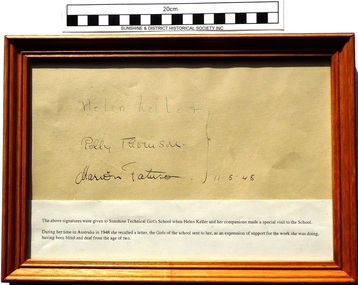
Memorabilia - Signature of Hellen Keller, Helen Keller, Polly Thomson, Marion Fatuson, 1948
... In 1943 Helen visited blind, deaf, and disabled soldiers in a USA military hospital, which she described as "the crowning experience of my life". In 1946 Helen and Polly made their first world tour for the American Foundation for the Overseas Blind and over the next 11 years visited 35 countries. ...In 1943 Helen visited blind, deaf, and disabled soldiers in a USA military hospital, which she described as "the crowning experience of my life". In 1946 Helen and Polly made their first world tour for the American Foundation for the Overseas Blind and over the next 11 years visited 35 countries. ...In 1948 during her Australian tour Helen Keller visited the west suburban SUNSHINE GIRLS TECHNICAL SCHOOL, to express her thanks for a letter written by the students in support of her work with deaf and blind people. She and her travelling companions presented the school with their signatures. Helen Keller was born on June 27, 1880 and due to an illness at the age of 20 months lost both her sight and hearing. Helen was taught to communicate by Anne Sullivan who wrote words into her hand, and she also learned to speak by touching the throat and lips of people as they spoke. In June 28, 1904 Helen Keller graduated from Radcliffe College with a Bachelor of Arts degree, being the first deaf and blind person to do so. In October 1914 Polly Thomson joined up with Helen and Anne. Helen published an account of her religious beliefs and an autobiography, and in 1930 the three women travelled to Scotland, England and Ireland. In 1931 they participated in the first World Council for the Blind. After Anne Sullivan Macy died in 1936 Helen and Polly continued to travel to several countries. In 1943 Helen visited blind, deaf, and disabled soldiers in a USA military hospital, which she described as "the crowning experience of my life". In 1946 Helen and Polly made their first world tour for the American Foundation for the Overseas Blind and over the next 11 years visited 35 countries. In 1955 Helen became the first woman to be honoured with an honorary degree from Harvard University. In 1960 Polly Thomson died, and in 1961 Helen suffered her first stroke and so retired from public life. In 1964 President Johnson conferred the Presidential Medal of Freedom however she was unable to attend the ceremony. On June 1, 1968 Helen died in her sleep, and her ashes have been interred with those of Anne and Polly at the National Cathedral. Over 1200 mourners attended the funeral.It is significant that Helen Keller actually took the time and effort to visit the Sunshine Girls Technical School to thank the students for their supporting letter. Helen Keller's many achievements show that a severely handicapped deaf and blind person can make significant contributions to society, if they apply themselves and receive assistance from dedicated friends. Helen Keller, Polly Thomson, Marion Fatuson, 11.5.48deaf, blind, signatures, helen keller, polly thomson, marion fatuson, anne sullivan macy, radcliffe college, sunshine girls technical school
