
Showing 7 items matching "american surgeon"
-
 National Vietnam Veterans Museum (NVVM)
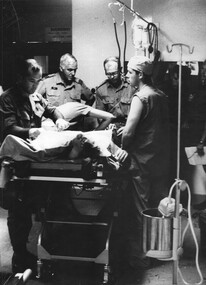
Photograph, Gibbons, Denis, Wounded VC 2
... ...American Surgeon...Pictured are an American surgeon Wg Audio, CDr Alan Beech, Lt Col Mike Naughton and Theatre Nurse Capt June Minchow as she prepares a wounded VC soldier for surgery....Pictured are an American surgeon Wg Audio, CDr Alan Beech, Lt Col Mike Naughton and Theatre Nurse Capt June Minchow as she prepares a wounded VC soldier for surgery. ...Denis Gibbons (1937 – 2011) Trained with the Australian Army, before travelling to Vietnam in January 1966, Denis stayed with the 1st Australian Task Force in Nui Dat working as a photographer. For almost five years Gibbons toured with nine Australian infantry battalions, posting compelling war images from within many combat zones before being flown out in late November 1970 after sustaining injuries. The images held within the National Vietnam Veterans Museum make up the Gibbons Collection.A black and white photograph of a triage team at the 1st Australian Field Hospital, Vung Tau, South Vietnam. Pictured are an American surgeon Wg Audio, CDr Alan Beech, Lt Col Mike Naughton and Theatre Nurse Capt June Minchow as she prepares a wounded VC soldier for surgery.photograph, 1st australian field hospital, vung tau, cdr alan beech, lt col naughton, medic, capt june minchow, gibbons collection catalogue, denis gibbons, photographer, vietnam war, wing audio, american surgeon, wounded viet cong soldier, triage -
 Flagstaff Hill Maritime Museum and Village
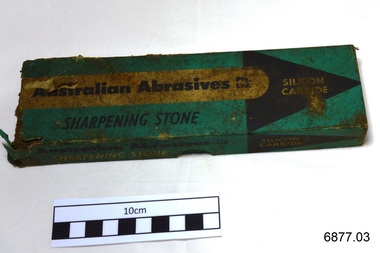
Sharpening Stone, mid 1900's
... America in 1981 by Edward Achison whilst trying to make artificial diamonds from a mixture of clay and powdered coke. Initially the substance was used for polishing gems then it went on to be used as an abrasive in sandpapers, grinding and sharpening stones and cutting tools. This sharpening stone was donated to Flagstaff Hill Maritime Village by the family of Doctor William Roy Angus, Surgeon...America in 1981 by Edward Achison whilst trying to make artificial diamonds from a mixture of clay and powdered coke. Initially the substance was used for polishing gems then it went on to be used as an abrasive in sandpapers, grinding and sharpening stones and cutting tools. This sharpening stone was donated to Flagstaff Hill Maritime Village by the family of Doctor William Roy Angus, Surgeon ...In 1938 William Edward Mc Pherson established Australian Abrasives Pty. Ltd., manufacturing grinding and filing tools, blades and other similar hardware items. This sharpening stone is made of silicon carbide, which is a very hard synthetic product. The compound was discovered in America in 1981 by Edward Achison whilst trying to make artificial diamonds from a mixture of clay and powdered coke. Initially the substance was used for polishing gems then it went on to be used as an abrasive in sandpapers, grinding and sharpening stones and cutting tools. This sharpening stone was donated to Flagstaff Hill Maritime Village by the family of Doctor William Roy Angus, Surgeon and Oculist. It is part of the “W.R. Angus Collection” includes historical medical equipment, surgical instruments and material once belonging to Dr Edward Ryan and Dr Thomas Francis Ryan, (both of Nhill, Victoria) as well as Dr Angus’ own belongings. The Collection’s history spans the medical practices of the two Doctors Ryan, from 1885-1926 plus that of Dr Angus, up until 1969. ABOUT THE “W.R.ANGUS COLLECTION” Doctor William Roy Angus M.B., B.S., Adel., 1923, F.R.C.S. Edin.,1928 (also known as Dr Roy Angus) was born in Murrumbeena, Victoria in 1901 and lived until 1970. He qualified as a doctor in 1923 at University of Adelaide, was Resident Medical Officer at the Royal Adelaide Hospital in 1924 and for a period was house surgeon to Sir (then Mr.) Henry Simpson Newland. Dr Angus was briefly an Assistant to Dr Riddell of Kapunda, then commenced private practice at Curramulka, Yorke Peninsula, SA, where he was physician, surgeon and chemist. In 1926, he was appointed as new Medical Assistant to Dr Thomas Francis Ryan (T.F. Ryan, or Tom), in Nhill, Victoria, where his experiences included radiology and pharmacy. In 1927 he was Acting House Surgeon in Dr Tom Ryan’s absence. Dr Angus had become engaged to Gladys Forsyth and they decided he further his studies overseas in the UK in 1927. He studied at London University College Hospital and at Edinburgh Royal Infirmary and in 1928, was awarded FRCS (Fellow from the Royal College of Surgeons), Edinburgh. He worked his passage back to Australia as a Ship’s Surgeon on the on the Australian Commonwealth Line’s T.S.S. Largs Bay. Dr Angus married Gladys in 1929, in Ballarat. (They went on to have one son (Graham 1932, born in SA) and two daughters (Helen (died 12/07/1996) and Berenice (Berry), both born at Mira, Nhill ) According to Berry, her mother Gladys made a lot of their clothes. She was very talented and did some lovely embroidery including lingerie for her trousseau and beautifully handmade baby clothes. Dr Angus was a ‘flying doctor’ for the A.I.M. (Australian Inland Ministry) Aerial Medical Service in 1928 . Its first station was in the remote town of Oodnadatta, where Dr Angus was stationed. He was locum tenens there on North-South Railway at 21 Mile Camp. He took up this ‘flying doctor’ position in response to a call from Dr John Flynn; the organisation was later known as the Flying Doctor Service, then the Royal Flying Doctor Service. A lot of his work during this time involved dental surgery also. Between 1928-1932 he was surgeon at the Curramulka Hospital, Yorke Peninsula, South Australia. In 1933 Dr Angus returned to Nhill and purchased a share of the Nelson Street practice and Mira hospital (a 2 bed ward at the Nelson Street Practice) from Dr Les Middleton one of the Middleton Brothers, the current owners of what previously once Dr Tom Ryan’s practice. Dr Tom and his brother had worked as surgeons included eye surgery. Dr Tom Ryan performed many of his operations in the Mira private hospital on his premises. He had been House Surgeon at the Nhill Hospital 1902-1926. Dr Tom Ryan had one of the only two pieces of radiology equipment in Victoria during his practicing years – The Royal Melbourne Hospital had the other one. Over the years Dr Tom Ryan had gradually set up what was effectively a training school for country general-practitioner-surgeons. Each patient was carefully examined, including using the X-ray machine, and any surgery was discussed and planned with Dr Ryan’s assistants several days in advance. Dr Angus gained experience in using the X-ray machine there during his time as assistant to Dr Ryan. When Dr Angus bought into the Nelson Street premises in Nhill he was also appointed as the Nhill Hospital’s Honorary House Surgeon 1933-1938. His practitioner’s plate from his Nhill surgery is now mounted on the doorway to the Port Medical Office at Flagstaff Hill Maritime Village, Warrnambool. When Dr Angus took up practice in the Dr Edward and Dr Tom Ryan’s old premises he obtained their extensive collection of historical medical equipment and materials spanning 1884-1926. A large part of this collection is now on display at the Port Medical Office at Flagstaff Hill Maritime Village in Warrnambool. In 1939 Dr Angus and his family moved to Warrnambool where he purchased “Birchwood,” the 1852 home and medical practice of Dr John Hunter Henderson, at 214 Koroit Street. (This property was sold in1965 to the State Government and is now the site of the Warrnambool Police Station. and an ALDI sore is on the land that was once their tennis court). The Angus family was able to afford gardeners, cooks and maids; their home was a popular place for visiting dignitaries to stay whilst visiting Warrnambool. Dr Angus had his own silk worm farm at home in a Mulberry tree. His young daughter used his centrifuge for spinning the silk. Dr Angus was appointed on a part-time basis as Port Medical Officer (Health Officer) in Warrnambool and held this position until the 1940’s when the government no longer required the service of a Port Medical Officer in Warrnambool; he was thus Warrnambool’s last serving Port Medical Officer. (Masters of immigrant ships arriving in port reported incidents of diseases, illness and death and the Port Medical Officer made a decision on whether the ship required Quarantine and for how long, in this way preventing contagious illness from spreading from new immigrants to the residents already in the colony.) Dr Angus was a member of the Australian Medical Association, for 35 years and surgeon at the Warrnambool Base Hospital 1939-1942, He served as a Surgeon Captain during WWII1942-45, in Ballarat, Victoria, and in Bonegilla, N.S.W., completing his service just before the end of the war due to suffering from a heart attack. During his convalescence he carved an intricate and ‘most artistic’ chess set from the material that dentures were made from. He then studied ophthalmology at the Royal Melbourne Eye and Ear Hospital and created cosmetically superior artificial eyes by pioneering using the intrascleral cartilage. Angus received accolades from the Ophthalmological Society of Australasia for this work. He returned to Warrnambool to commence practice as an ophthalmologist, pioneering in artificial eye improvements. He was Honorary Consultant Ophthalmologist to Warrnambool Base Hospital for 31 years. He made monthly visits to Portland as a visiting surgeon, to perform eye surgery. He represented the Victorian South-West subdivision of the Australian Medical Association as its secretary between 1949 and 1956 and as chairman from 1956 to 1958. In 1968 Dr Angus was elected member of Spain’s Barraquer Institute of Barcelona after his research work in Intrasclearal cartilage grafting, becoming one of the few Australian ophthalmologists to receive this honour, and in the following year presented his final paper on Living Intrasclearal Cartilage Implants at the Inaugural Meeting of the Australian College of Ophthalmologists in Melbourne In his personal life Dr Angus was a Presbyterian and treated Sunday as a Sabbath, a day of rest. He would visit 3 or 4 country patients on a Sunday, taking his children along ‘for the ride’ and to visit with him. Sunday evenings he would play the pianola and sing Scottish songs to his family. One of Dr Angus’ patients was Margaret MacKenzie, author of a book on local shipwrecks that she’d seen as an eye witness from the late 1880’s in Peterborough, Victoria. In the early 1950’s Dr Angus, painted a picture of a shipwreck for the cover jacket of Margaret’s book, Shipwrecks and More Shipwrecks. She was blind in later life and her daughter wrote the actual book for her. Dr Angus and his wife Gladys were very involved in Warrnambool’s society with a strong interest in civic affairs. He had an interest in people and the community They were both involved in the creation of Flagstaff Hill, including the layout of the gardens. After his death (28th March 1970) his family requested his practitioner’s plate, medical instruments and some personal belongings be displayed in the Port Medical Office surgery at Flagstaff Hill Maritime Village, and be called the “W. R. Angus Collection”. W.R. Angus Collection is significant for still being located at the site it is connected with, Doctor Angus being the last Port Medical Officer in Warrnambool. The collection of medical instruments and other equipment is culturally significant, being an historical example of medicine from late 19th to mid-20th century. Dr Angus assisted Dr Tom Ryan, a pioneer in the use of X-rays and in ocular surgery. Sharpening stone, part of the W.R. Angus Collection. Grey, rectangular block of silicon carbide made from two pieces of different densities joined together. Sharpening stone is in green and black cardboard box with lid. Maker is Australian Abrasives Pty Ltd. Circa mid 1900’s.Box text "AUSTRALIAN ABRASIVES Pty Ltd SHARPENING STONE" and "SILICON CARBIDE" and "NO. 108 / COMB", "8" x 2" x 1" "flagstaff hill, warrnambool, shipwrecked coast, flagstaff hill maritime museum, maritime museum, shipwreck coast, flagstaff hill maritime village, great ocean road, dr w r angus, dr ryan, sharpening stone, australian abrasives pty ltd, sharpening tool, metal working equipment -
 Geoffrey Kaye Museum of Anaesthetic History
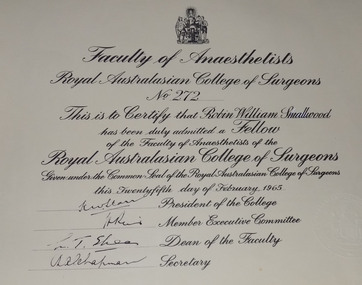
Certificate - Certificate, Fellowship, c. 1965
... Surgeons from 1986 - 1987. Smallwood died 6 October 1987 after a brief illness and was awarded the Orton Medal posthumously. The Orton Medal is the highest single achievement the College can bestow. Anaesthesia had its origins in October 1846 in America...Surgeons from 1986 - 1987. Smallwood died 6 October 1987 after a brief illness and was awarded the Orton Medal posthumously. The Orton Medal is the highest single achievement the College can bestow. Anaesthesia had its origins in October 1846 in America ...Robin William Smallwood completed medicine at the University of Melbourne in 1958 and decided on anaesthesia as a career, attaining his FFARACS in 1964. Smallwood was Dean of the Faculty of Anaesthetists at the Royal Australasian College of Surgeons from 1986 - 1987. Smallwood died 6 October 1987 after a brief illness and was awarded the Orton Medal posthumously. The Orton Medal is the highest single achievement the College can bestow. Anaesthesia had its origins in October 1846 in America, by May 1847 news of ether anaesthesia had reached Australian shores and by June 1847 Australian medical practitioners had begun experimenting with and demonstrating ether anaesthesia. Anaesthesia was not really recognised as a distinct branch of medicine in Australia until the first Diploma of Anaesthesia course began in Sydney in 1944. The specialty grew quickly and by 1952 the Faculty of Anaesthesia at the Royal Australasian College of Surgeons had been established. Within 40 years the Faculty had grown to such an extent it became a College in its own right and continues to offer training and professional support to anaesthetists.Printed certificate from the Faculty of Anaesthetists of the Royal Australasian College of Surgeons (RACS) awarded to Robin William Smallwood as a Fellowship. Printed in black ink at the top of the certificate is the RACS coat of arms. The certificate is dated 25 Feburary 1965 and has been signed by President of the College, Member Executive Committee, Dean of the Faculty and the Secretary.smallwood, robin william, orton, robert, faculty of anaesthetists, royal australasian college of surgeons, ffaracs, racs, fanzca -
 National Vietnam Veterans Museum (NVVM)
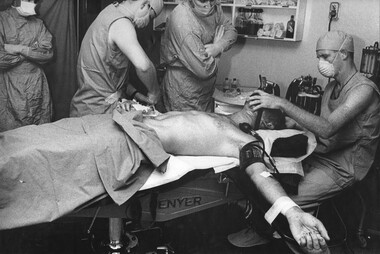
Photograph, Gibbons, Denis, American Helicopter Pilot
... A black and white photograph - In the operating theatre at the 1st Australian Field Hospital, Vung Tau, South Vietnam a surgeon waiing to perform the operation, watches as the theatre medics complete preparation of an American Helicopter Pilot burned when he was shot down...Photograph 1st Australian Field Hospital Vung Tau Gibbons Collection Catalogue American Soldier Surgeons Medics Helicopter Pilot Operating Theatre Denis Gibbons A black and white photograph - In the operating theatre at the 1st Australian Field Hospital, Vung Tau, South Vietnam a surgeon waiing to perform the operation, watches as the theatre medics complete preparation of an American Helicopter Pilot burned when he was shot down American Helicopter Pilot Photograph Gibbons, Denis ...Denis Gibbons (1937 – 2011) Trained with the Australian Army, before travelling to Vietnam in January 1966, Denis stayed with the 1st Australian Task Force in Nui Dat working as a photographer. For almost five years Gibbons toured with nine Australian infantry battalions, posting compelling war images from within many combat zones before being flown out in late November 1970 after sustaining injuries. The images held within the National Vietnam Veterans Museum make up the Gibbons Collection. A black and white photograph - In the operating theatre at the 1st Australian Field Hospital, Vung Tau, South Vietnam a surgeon waiing to perform the operation, watches as the theatre medics complete preparation of an American Helicopter Pilot burned when he was shot downphotograph, 1st australian field hospital, vung tau, gibbons collection catalogue, american soldier, surgeons, medics, helicopter pilot, operating theatre, denis gibbons -
 Stawell Historical Society Inc
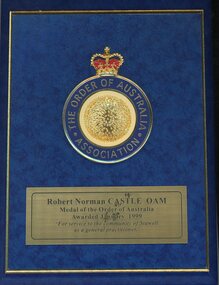
Archive, Collection of Dr Norm Castles Certificates and Photographs
... 5296 Letter of Introduction for Dr Norm Castle to America -1 University of Adelaide Certificates for the Degrees of M.B. and B.S. 1947-1953 -2 Passport for Medical Practitioner Norman Castle 1961 -3 Letter of Introduction to the Medical Board of Victoria 1955 from Adelaide Children's Hospital -4 Letter of Introduction for London 1965 -5 Letter of reference from E.S.R Hughes Surgeon Royal Melbourne Hospital 1965 -6 Booklet of Cases Adelaide Children Hospital 1952 -7 Surgery Odds & Ends Exercise Notebook -8 Unley High School Magazine, May 1946, August 1964, December 1946 -9 Stawell District Hospital Life Governor -10 The Clinic Magazine, Adelaide Medical Students Society, July 1947, May 1948, July 1948 -11 Medicine Lectures Notebook 1951 -12 Obstetrics Lectures Notebook 1949 -13 Surgery Lectures Notebook 1951 -15 The Royal Australian College of General Practitioners Accreditation of Practice operated by Dr W N Castle as a Teaching Post -16 Completion Certificate of Early Management of Severe Trauma Committee of Royal Australasian College of Surgeons -17 Medal of The Order of Australia. ...5296 Letter of Introduction for Dr Norm Castle to America -1 University of Adelaide Certificates for the Degrees of M.B. and B.S. 1947-1953 -2 Passport for Medical Practitioner Norman Castle 1961 -3 Letter of Introduction to the Medical Board of Victoria 1955 from Adelaide Children's Hospital -4 Letter of Introduction for London 1965 -5 Letter of reference from E.S.R Hughes Surgeon Royal Melbourne Hospital 1965 -6 Booklet of Cases Adelaide Children Hospital 1952 -7 Surgery Odds & Ends Exercise Notebook -8 Unley High School Magazine, May 1946, August 1964, December 1946 -9 Stawell District Hospital Life Governor -10 The Clinic Magazine, Adelaide Medical Students Society, July 1947, May 1948, July 1948 -11 Medicine Lectures Notebook 1951 -12 Obstetrics Lectures Notebook 1949 -13 Surgery Lectures Notebook 1951 -15 The Royal Australian College of General Practitioners Accreditation of Practice operated by Dr W N Castle as a Teaching Post -16 Completion Certificate of Early Management of Severe Trauma Committee of Royal Australasian College of Surgeons -17 Medal of The Order of Australia. ...5296 Letter of Introduction for Dr Norm Castle to America -1 University of Adelaide Certificates for the Degrees of M.B. and B.S. 1947-1953 -2 Passport for Medical Practitioner Norman Castle 1961 -3 Letter of Introduction to the Medical Board of Victoria 1955 from Adelaide Children's Hospital -4 Letter of Introduction for London 1965 -5 Letter of reference from E.S.R Hughes Surgeon Royal Melbourne Hospital 1965 -6 Booklet of Cases Adelaide Children Hospital 1952 -7 Surgery Odds & Ends Exercise Notebook -8 Unley High School Magazine, May 1946, August 1964, December 1946 -9 Stawell District Hospital Life Governor -10 The Clinic Magazine, Adelaide Medical Students Society, July 1947, May 1948, July 1948 -11 Medicine Lectures Notebook 1951 -12 Obstetrics Lectures Notebook 1949 -13 Surgery Lectures Notebook 1951 -15 The Royal Australian College of General Practitioners Accreditation of Practice operated by Dr W N Castle as a Teaching Post -16 Completion Certificate of Early Management of Severe Trauma Committee of Royal Australasian College of Surgeons -17 Medal of The Order of Australia. Robert Norman Castle -18 Rotary International 2000 Special Award Citizen of Century -19 Way College Adelaide - Medal for Chemistry 1946 -20 University of Adelaide, Gosse Memorial Medal for Ophthalmology 1952 -21 Paul Harris Fellow Medallion on ribbon with Lapel Badge -22 R Norman Castle OAM Paul Harris Fellow Certificate -23 Glass - Veteran Golf Association Award -24 2000 Rural Health Award Grampians Recognition of Outstanding Contribution to the Health of Community -25 Stawell District Hospital Robert Norman Castle Life Governor -26 Norman Castle Fellow Australian College of Rural and Remote Medicine -27 Photograph Julie Castle, Norm Castle, Alistair Castle, Stephanie Castle -28 Stawell Regional Health Certificate of Appreciation 27 Years as Foundation Trustee -29 University of Adelaide Bachelor of Medicine and Bachelor of Surgery -30 Stawell Rotary Club Changeover Dinner Photographs and Article -31 Australian Doctor G P Awards Recognition of Achievements and Work in the Community 1994 -32 Victorian Rural Health Awards 2013 Dr Norman Castle 35 Years of Service -33 University of Adelaide Gazette 1954 -34 Stawell Regional Health Twenty Five Years as Board Member -35 Letter of Congratulations Under Seal from Northern Grampians Shire re Order of Australia Dr Norman Castle OAM October 2005 -36 Rotary Service Award for Professional Excellence 2004-2005 -37 Centenary of Accumulated Medical Service to the Community of Stawell and District.. Dr Andrew Cunningham 26 Years, Dr Norman Castle 48 Years, Mr Roger Warne 26 Years -38 Medical Registration Certificate Robert Norman Castle 1955 -39 Unley High School Magazine. December 1944 -40 Robert Norman Castle The Order of Australia Certificate Large Cardboard Archive Box Containing Items Collection of Certificates and Medallions -
 Returned Nurses RSL Sub-branch
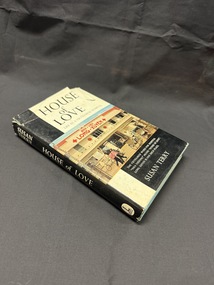
Book - Illustrated hardback book, Susan Terry, House of love : Life in a Vietnamese hospital, 1966
... She reports on the Viet Cong, on children, on anguish, on cities and villages, on Americans, on Buddhists, on happiness, on people at many levels of society, on fascinating facets of everyday life. She writes of lives transformed by the surgeon's knife, of ignorance, fear and death, of a wonderland of human emotion. ...This warm, personal document by an ordinary Australian girl who worked in Vietnam does not pretend to enter areas of speculation and reporting where experts are confounded. It is simple, homely, informative, disarmingly honest, and clothes the shadowed image of a suffering nation with flesh, blood and heart. Out of it walk the unknown ones, the forgotten ones, the ordinary people of Vietnam. In growing bewilderment Western readers have puzzled over millions of words about the politics and violence of Vietnam. Quietly, without fuss or humbug, Susan Terry lets in a little light and a lot of love. Here is something that is real, that one can accept and trust. For one memorable year she worked with an Australian medical team of civilian specialists in Long Xuyen Hospital on the Mekong Delta and met life in the raw. She reports on the Viet Cong, on children, on anguish, on cities and villages, on Americans, on Buddhists, on happiness, on people at many levels of society, on fascinating facets of everyday life. She writes of lives transformed by the surgeon's knife, of ignorance, fear and death, of a wonderland of human emotion. Perhaps unwittingly, Sister Susan Terry also reveals herself; young, fresh, and nice to know. To read her is to believe her. Her is something of truth out of Vietnam. (From inside dust jacket)Hardback book with a torn dust jacket. Dust jacket is black and white with a colour photograph of a street scene in front of a hospital building.non-fictionThis warm, personal document by an ordinary Australian girl who worked in Vietnam does not pretend to enter areas of speculation and reporting where experts are confounded. It is simple, homely, informative, disarmingly honest, and clothes the shadowed image of a suffering nation with flesh, blood and heart. Out of it walk the unknown ones, the forgotten ones, the ordinary people of Vietnam. In growing bewilderment Western readers have puzzled over millions of words about the politics and violence of Vietnam. Quietly, without fuss or humbug, Susan Terry lets in a little light and a lot of love. Here is something that is real, that one can accept and trust. For one memorable year she worked with an Australian medical team of civilian specialists in Long Xuyen Hospital on the Mekong Delta and met life in the raw. She reports on the Viet Cong, on children, on anguish, on cities and villages, on Americans, on Buddhists, on happiness, on people at many levels of society, on fascinating facets of everyday life. She writes of lives transformed by the surgeon's knife, of ignorance, fear and death, of a wonderland of human emotion. Perhaps unwittingly, Sister Susan Terry also reveals herself; young, fresh, and nice to know. To read her is to believe her. Her is something of truth out of Vietnam. (From inside dust jacket)australian nurses, vietnam war, civilian nurse, susan terry -
 Flagstaff Hill Maritime Museum and Village
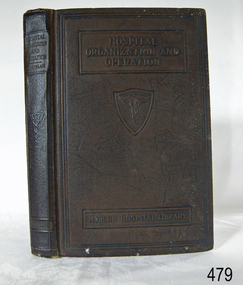
Book - Reference Book Hospital Management, Frank Elmo Chapman, Hospital Organization and Operation, 1924
... This book is historically significant as part of the hospital standardisation movement of the 1910s and 1920s, spearheaded by the American College of Surgeons and the American Hospital Association. ...This publication, Hospital Organization and Operation (1924) by Frank Elmo Chapman, is a landmark early text in the field of modern healthcare administration. Published as part of the Modern Hospital Library series, this volume served as a practical, comprehensive guide to running a modern medical facility. During the 1920s, hospitals were rapidly evolving from charitable almshouses into complex, technology-driven scientific institutions. Chapman’s work addresses the internal machinery required to run a hospital efficiently, covering: · Administrative & Governance Structure: Defining the duties of hospital boards, superintendents, and department heads. · Departmental Workflow: Organising nursing services, dietary management, laundry, housekeeping, and medical record-keeping. · Financial Management: Standardised accounting, purchasing protocols, inventory control, and patient fee structures. · Medical Staff Integration: Rules and procedures for coordinating physician care with administrative operations.Hospital Organization and Operation, part of the W.R. Angus Collection. Author: Frank E. Chapman. Publisher: Macmillan & Co Date: 1924 Further Information: Hardcover, textured brown, embossed title and details in black embossed lettering.non-fictionThis publication, Hospital Organization and Operation (1924) by Frank Elmo Chapman, is a landmark early text in the field of modern healthcare administration. Published as part of the Modern Hospital Library series, this volume served as a practical, comprehensive guide to running a modern medical facility. During the 1920s, hospitals were rapidly evolving from charitable almshouses into complex, technology-driven scientific institutions. Chapman’s work addresses the internal machinery required to run a hospital efficiently, covering: · Administrative & Governance Structure: Defining the duties of hospital boards, superintendents, and department heads. · Departmental Workflow: Organising nursing services, dietary management, laundry, housekeeping, and medical record-keeping. · Financial Management: Standardised accounting, purchasing protocols, inventory control, and patient fee structures. · Medical Staff Integration: Rules and procedures for coordinating physician care with administrative operations.flagstaff hill, warrnambool, shipwrecked-coast, flagstaff-hill, flagstaff-hill-maritime-museum, maritime-museum, shipwreck-coast, flagstaff-hill-maritime-village, hospital organization and operation, book, dr w r angus, dr ryan, surgical instrument, t.s.s. largs bay, warrnambool base hospital, nhill base hospital, mira hospital, flying doctor, medical treatment, medical history, medical education, medical textbook
