
Showing 21 items matching "among the diggers"
-
 Ballarat Heritage Services
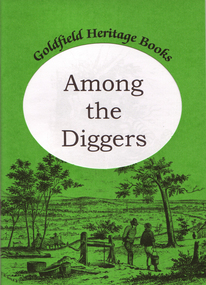
Book, Among the Diggers
... Among the Diggers...Among the diggers...One of a series of Goldfields Heritage Books, Among the Diggers was published by BHS Publishing....Among the diggers mining Soft covered book. Among the Diggers Book ...One of a series of Goldfields Heritage Books, Among the Diggers was published by BHS Publishing.Soft covered book. among the diggers, mining -
 Bendigo Historical Society Inc.
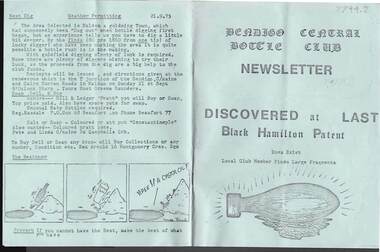
Document - JAMES LERK COLLECTION: BENDIGO CENTRAL BOTTLE CLUB NEWSLETTER
... Short reference to dissentry (sic) i.e. dysentery; scurvy and use of vinegar among diggers....Short reference to dissentry (sic) i.e. dysentery; scurvy and use of vinegar among diggers. Document JAMES LERK COLLECTION: BENDIGO CENTRAL BOTTLE CLUB NEWSLETTER ...Bendigo Central Bottle Club Newsletter - James Lerk Collection (Sept. 1975? By deduction). Short reference to dissentry (sic) i.e. dysentery; scurvy and use of vinegar among diggers.bendigo central bottle club, newsletter, james lerk -
 Bendigo Historical Society Inc.
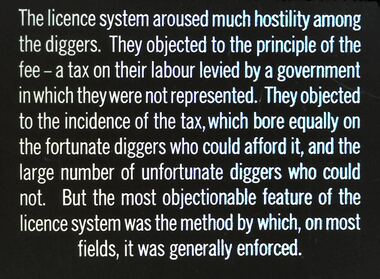
Slide - DIGGERS & MINING. THE GOLD LICENCE, c1850s
... The licence system aroused much hostility among the diggers. They objected to the principle of the fee - a tax on their labour levied by a government in which they were not represented. ...The licence system aroused much hostility among the diggers. They objected to the principle of the fee - a tax on their labour levied by a government in which they were not represented. ...Diggers & Mining. The gold licence. The Government Camp. The licence system aroused much hostility among the diggers. They objected to the principle of the fee - a tax on their labour levied by a government in which they were not represented. They objected to the incidence of the tax, which bore equally on the fortunate diggers who could afford it, and the large number of unfortunate diggers who could not. But the most objectionable feature of the licence system way the method by which, on most fields, it was generally enforced. Markings: 34 994.LIF. 4. Used as a teaching aid.hanimounteducation, tertiary, goldfields -
 Bendigo Historical Society Inc.
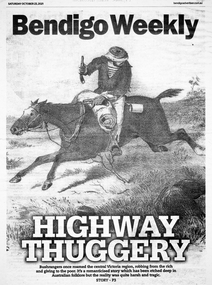
Newspaper - Bendigo Advertiser story Sat Oct 23 2021 entitled "Cop-killer caught out", Sat Oct 23 2021
... He was known for his bravado, often displaying weapons openly among gold diggers. Smith was eventually recognized and arrested in Maryborough after the murder, narrowly avoiding a murder conviction due to a technicality with his arrest warrant. ...He was known for his bravado, often displaying weapons openly among gold diggers. Smith was eventually recognized and arrested in Maryborough after the murder, narrowly avoiding a murder conviction due to a technicality with his arrest warrant. ...This document recounts the story of Gipsy Smith (real name William Turner), a notorious bushranger in 19th-century Australia, focusing on his involvement in violent crimes and his eventual capture. Gipsy Smith was involved in a shootout in central Victoria in 1856 that resulted in the death of Sergeant John McNally and the wounding of Constable John Moore. Smith and his accomplice escaped after the incident, which caused public outrage due to McNally's popularity. Smith was part of a group of bushrangers who terrorized travelers, merchants, and goldfields communities with armed robberies and audacious hold-ups. Notable incidents included tying up and robbing multiple victims, and high-speed horse chases with police. Bushrangers like Smith were sometimes romanticized as rebellious figures, but the document emphasizes the real violence and fear they caused. Smith, originally William Turner, was a former convict from Tasmania who became a bushranger after escaping to Victoria during the gold rush. He was known for his bravado, often displaying weapons openly among gold diggers. Smith was eventually recognized and arrested in Maryborough after the murder, narrowly avoiding a murder conviction due to a technicality with his arrest warrant. He was sentenced to 15 years of hard labor for manslaughter. After serving his sentence, Smith was trusted with responsible work, such as driving cattle and managing a farm, suggesting a degree of rehabilitation. The story is part of a historical series highlighting notable events in the region’s past.Bendigo Advertiser story Sat Oct 23 2021 entitled "Cop-killer caught out" This item contains the following documents 3486.51a Bendigo Advertiser Page 1 Title Page - "Highway Thuggery" 3486.51b Bendigo Advertiser Page 3 article "Cop-killer caught out" the story of Gypsy Smith Bushrangerbendigo, gipsy smith bushranger -
 Orbost & District Historical Society
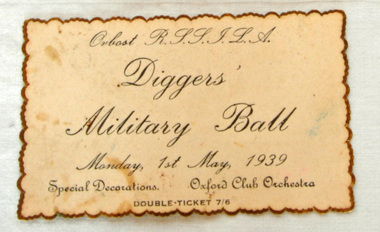
invitation, 1939
... Socially , the ‘Diggers’ Annual Ball’ accomplished a great deal in bringing Returned Servicemen together. At this time, these functions were organised by self-appointed committees and proceeds were distributed among special causes – mainly to the RSSAILA members who were experiencing hardship. military-balls R.S.S.I.L.A. ...The Returned Sailors and soldiers Imperial League of Australia was formed in 1916. Annual RSSAILA Balls (originally known as the Diggers Balls) were held to raise funds for those who returned fromconflicts especially those who were not eligible for war pensions.Socially , the ‘Diggers’ Annual Ball’ accomplished a great deal in bringing Returned Servicemen together. At this time, these functions were organised by self-appointed committees and proceeds were distributed among special causes – mainly to the RSSAILA members who were experiencing hardship.A rectangular card invitation to the Diggers' Military Ball, Monday 1st May 1939. Print is in black. The card is edged in gold. It is a Double Ticket - 7/6 RSSILAmilitary-balls r.s.s.i.l.a. -
 Bendigo Historical Society Inc.
Slide - DIGGERS & MINING. STORES AT THE DIGGINGS, c1852
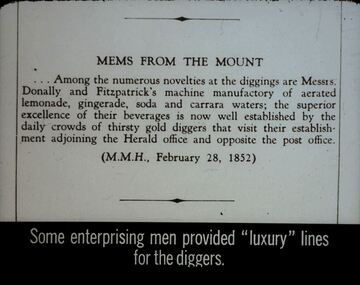
... Diggers & Mining. Stores at the diggings. MEMS FROM THE MOUNT . . . Among the numerous novelties at the diggings are Messers. ...EDUCATION Tertiary goldfields hanimount Diggers & Mining. Stores at the diggings. MEMS FROM THE MOUNT . . . Among the numerous novelties at the diggings are Messers. ...Diggers & Mining. Stores at the diggings. MEMS FROM THE MOUNT . . . Among the numerous novelties at the diggings are Messers. Dunolly and Fitzpatrick's machine manufacturing of aerated lemonade, gingerade, soda and carrara waters; the superior excellence of their beverages is now well established by the daily crowds of thirsty gold diggers that visit their establishment adjoining the Herald office and opposite the point office (M.M.H., February 28, 1852) Slide reads: Some enterprising men provided ''luxury'' lines for the diggers. Markings: 15 994.LIF. 5. Used as a teaching aid.hanimounteducation, tertiary, goldfields -
 Bendigo Historical Society Inc.
Slide - DIGGERS & MINING. THE DIGGINGS THE DIGGERS, c1850s
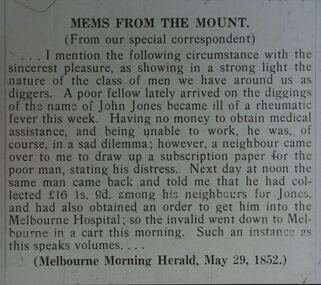
... diggers. A poor fellow lately arrived on the diggings of the name of John Jones became ill of a rheumatic fever this week. Having no money to obtain medical assistance, and being unable to work, he was, of course, in a sad dilemma; however, a neighbour came over to me to draw up a subscription paper for the poor man, stating his distress. Next day at noon the same man came back and told me that he had collected 16 pounds 1shilling and sixpence among...diggers. A poor fellow lately arrived on the diggings of the name of John Jones became ill of a rheumatic fever this week. Having no money to obtain medical assistance, and being unable to work, he was, of course, in a sad dilemma; however, a neighbour came over to me to draw up a subscription paper for the poor man, stating his distress. Next day at noon the same man came back and told me that he had collected 16 pounds 1shilling and sixpence among ...Diggers & Mining. The Diggings The Diggers. Slide: MEMS FROM THE MOUNT (From the special correspondent) I mention the following circumstance with the sincerest pleasure, as showing in a strong light the nature of the class of men we have around us as diggers. A poor fellow lately arrived on the diggings of the name of John Jones became ill of a rheumatic fever this week. Having no money to obtain medical assistance, and being unable to work, he was, of course, in a sad dilemma; however, a neighbour came over to me to draw up a subscription paper for the poor man, stating his distress. Next day at noon the same man came back and told me that he had collected 16 pounds 1shilling and sixpence among his neighbours for Jones and had also obtained an order to get him into the Melbourne Hospital; so the invalid went down to Melbourne I a cart this morning. Such an instance as this speaks volumes. (Melbourne Morning Herald, May 29, 1852) Markings: 76 994.LIF:4. Used as a teaching aid.hanimounteducation, tertiary, goldfields -
 Bendigo Historical Society Inc.
Slide - DIGGERS & MINING. STORES AT THE DIGGINGS, c1852
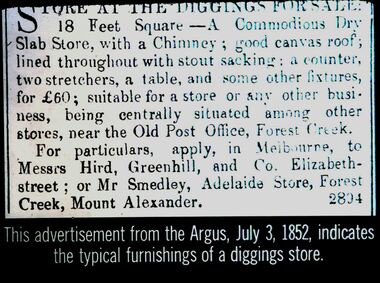
... Diggers & Mining. Stores at the diggings. Store at the digging for sale: 18 Feet Square - A Commodious Slab Store, with a Chimney; good canvas roof, lined throughout with stout sacking: a counter, two stretchers, a table, and some other fixtures, for 60 Pounds; suitable for a store or any other business, being centrally situated among other stores, near the Old Post Office, Forest Creek. ...Diggers & Mining. Stores at the diggings. Store at the digging for sale: 18 Feet Square - A Commodious Slab Store, with a Chimney; good canvas roof, lined throughout with stout sacking: a counter, two stretchers, a table, and some other fixtures, for 60 Pounds; suitable for a store or any other business, being centrally situated among other stores, near the Old Post Office, Forest Creek. ...Diggers & Mining. Stores at the diggings. Store at the digging for sale: 18 Feet Square - A Commodious Slab Store, with a Chimney; good canvas roof, lined throughout with stout sacking: a counter, two stretchers, a table, and some other fixtures, for 60 Pounds; suitable for a store or any other business, being centrally situated among other stores, near the Old Post Office, Forest Creek. For particulars, apply, in Melbourne, to Messrs Hird, Greenhill, and Co. Elizabeth street: of Mr Smedley, Adelaide Store, Forest Creek, Mount Alexander. 2804. This advertisement from the Argus, July 3, 1852, indicates the typical furnishings of a diggings store. Markings: 5 994.LIF. 5. Used as a teaching aid.hanimounteducation, tertiary, goldfields -
 Bendigo Historical Society Inc.
Slide - DIGGERS & MINING. GETTING THE GOLD, c1850
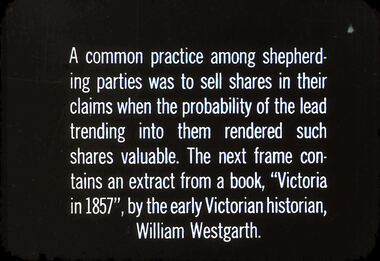
... Diggers & Mining. Getting the Gold. Slide: A common practice among shepherding parties was to sell shares in their claims when the probability of the lead trending into them rendered such shares valuable. ...EDUCATION Tertiary goldfields hanimount Diggers & Mining. Getting the Gold. Slide: A common practice among shepherding parties was to sell shares in their claims when the probability of the lead trending into them rendered such shares valuable. ...Diggers & Mining. Getting the Gold. Slide: A common practice among shepherding parties was to sell shares in their claims when the probability of the lead trending into them rendered such shares valuable. The next frame contains an extract from a book, 'Victoria in 1857', by the early Victorian historian, William Westgarth. Markings: 56 994.LIF:4. Used as a teaching aid.hanimounteducation, tertiary, goldfields -
 Bendigo Historical Society Inc.
Photograph - 1853 Bendigo Goldfields Petition, abt 1990-2019
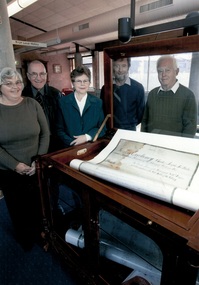
... diggers marched in peaceful protest. Miners from White Hills, Eaglehawk, Golden Square, Kangaroo Flat as well as from Bendigo Flat, converged on what is now Pall Mall and View Point, surrounding the ~government camp on Camp Hill. The camp had been reinforced with soldiers of the 40 Regiment, as the Government feared bloodshed. The miners then gathered on the hill behind View Point to hear from their leaders - among...diggers marched in peaceful protest. Miners from White Hills, Eaglehawk, Golden Square, Kangaroo Flat as well as from Bendigo Flat, converged on what is now Pall Mall and View Point, surrounding the ~government camp on Camp Hill. The camp had been reinforced with soldiers of the 40 Regiment, as the Government feared bloodshed. The miners then gathered on the hill behind View Point to hear from their leaders - among ...The Red Ribbon Movement of 1853 represented a significant series of events in the history of Bendigo. During that year there was much agitation on the Bendigo gold fields, particularly during July and August of 1853, directed against the payment of what the miners called a tax - a licence fee of thirty shillings ($3) a month for the right to search for gold on what was declared Crown land. They had to pay the licence whether they found gold or not. The miners, or diggers as they were called, also resented the means used by the authorities at the time to collect the gold licence - through so-called 'digger hunts'. The miners were expected to carry their licences with them, and the police, who were often untrained, used harsh methods to check these licences. In Bendigo, the miners took to wearing a red ribbon ‘as a symbol of their protest against the licence. Red was a very common colour in items such as shirts, so was readily available. Shopkeepers too tied red ribbons to their premises as a sign of support for the miners. It should be remembered at that time virtually everyone was a miner. The diggers also had their own banner, designed by William Dexter, a china painter from Devon. This flag showed the pick, shovel and cradle representing labour, the scales representing justice, the Roman bundle of sticks meaning unity and the kangaroo and emu of Australia Many thousands of Bendigo miners signed a petition to La Trobe, the Governor of Victoria, protesting against the licence fee. When the Governor rejected the petition, thousands of diggers marched in peaceful protest. Miners from White Hills, Eaglehawk, Golden Square, Kangaroo Flat as well as from Bendigo Flat, converged on what is now Pall Mall and View Point, surrounding the ~government camp on Camp Hill. The camp had been reinforced with soldiers of the 40 Regiment, as the Government feared bloodshed. The miners then gathered on the hill behind View Point to hear from their leaders - among them George Thomson, Captain Harrison, Captain Brown and W.D.C. Denovan. They resolved to pay a token fee often shillings ($1) for the September licence, whenthey met with Commissioners Panton and Wright on Camp Hill. Although Wright and Panton were sympathetic to the miners, the offer was rejected, but no licence fees were collected for September. Thus a possible bloody conflict was averted by the common sense shown by the miners' leaders and the commissioners. It was a truly democratic protest against arbitrary government and preceded the Eureka Stockade Incident by over a year. Bendigo Historical Society Committee on a Tram, two photos, one of five people standing behind a display cabinet, and the second one a Banner stretched across the tram. On the rear of the photo is "L-R Jim Evans, Terry Davidson, Ron Monro." Second from left is Jim Evans (President) and fourth from the left is Terry Davidson, with extreme right, Ron Munro (Vice President). In the cabinet is the 1853 Bendigo Goldfields Petition (Red Ribbon Rebellion) The society holds the petition in digital form. The diggers had their own banner, designed by William Dexter, a china painter from Devon. This flag showed the pick, shovel and cradle representing labour, the scales representing justice, the Roman bundle of sticks meaning unity and the kangaroo and emu of Australia history, bendigo, tram, 1853 bendigo goldfields petition, red ribbon rebellions -
 Bendigo Historical Society Inc.
Document - BACK TO EAST SHELBOURNE SPORTS CARNIVAL, 8 October, 1927
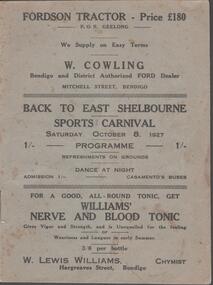
... Next 8 pages contain information on the history of East Shelbourne beginning with; This district is situated about ten miles west of south-west of Bendigo on Back Creek or Spring Creek, which received its names from the early diggers of Bendigo who, through shortage of water, were compelled to puddle at Bullock Creek or further 'back,' hence Back Creek; and because of the number of springs it contained - Spring Creek. Among...Next 8 pages contain information on the history of East Shelbourne beginning with; This district is situated about ten miles west of south-west of Bendigo on Back Creek or Spring Creek, which received its names from the early diggers of Bendigo who, through shortage of water, were compelled to puddle at Bullock Creek or further 'back,' hence Back Creek; and because of the number of springs it contained - Spring Creek. Among ...Back To East Shelbourne Sports Carnival, Saturday, October 8, 1927. Programme. Refreshments on grounds, dance at night. 1/- Casamento's Buses. Executive Committee: President; W Harris. Vice-President; M De Araugo. Messrs. E Wright, A D Holden, W Hamilton, J Bartels, J Hinck, and H Hinck. Hon. Sec.; H M Burke. Asst. Hon. Sec.; G H Marshall. Ladies; Mesdames J Bartels, H Burke, G H Marshall, E Pocock, R Vines, and E Wright. General Committee; In addition to the above, Messrs. E Pocock, J De Araugo, F J Roberts, and W Marshall, Mesdames W Harris, A Holden, J De Araugo, F J Roberts, and Miss Pocock. Officials Judges: Messrs. T D Cairns, J Craven, and Geo. Hogben. Handicappers: Mr P Davidson (Northern District Walker's Assn.) Starter: Mr W Harris, M De Araugo, J Hinck, H Hovenden, E Pocock, W Hamilton, F J Roberts, A D Holden. Timekeeper: Mr H Hinck. Patrons: Cr, J Bartels, Nuttall & Clarke, Mrs D Punton, R S V Cocking, J Murray, and A Wells. Next 8 pages contain information on the history of East Shelbourne beginning with; This district is situated about ten miles west of south-west of Bendigo on Back Creek or Spring Creek, which received its names from the early diggers of Bendigo who, through shortage of water, were compelled to puddle at Bullock Creek or further 'back,' hence Back Creek; and because of the number of springs it contained - Spring Creek. Among the first to settle, in 1860, were Messrs. John Jenkinson, J Kilgour, T Connelly, G Nichols, R Fox, (who married Mrs James Jenkinson), Kenny, J Roberts, J Genders, J Curry, G Nevinson, Bartram, J Geary, A Nicholl, H Spencer, W Saunders, Mrs Prichard, and J Stansfield. History of East Shelbourne continues . . . Events held were Boy's (State School) Bicycle Race, Stepping the Distance (Gents), Stepping the Distance (Ladies), Bowling at the Stump, Kicking Football Through Hoop, Sheaf Toss, Bucket Ball, Sheffield, Children's Relay Race, Men's Potato Race, Tilting Rings, on Bikes, Walking Contest 1 mile, Car Race through pegs, Slow Bicycle Race 50 yards, Handicap Bicycle Race 2 miles, Tilting Rings in Cars, High Jump, Ladies' and Gent's Cigarette Race, Weight Guessing. Prizes were awarded for first and second placing of these events.In 1923, a Sports Carnival was held in the precincts of what was then a water reserve, situated south of the State School. The area was reserved for watering purposes on 1st May, 1894; and on July 15th, 1912, a small portion was excised. By 1923 its usefulness for water storage had disappeared, and being ideal for recreation purposes, it was decided, at the final meeting of the above sorts carnival, to apply for the area appointed, Mr W Harris (chairman), Messrs. G H Marshall, J Roberts, D Gill, M Connolly, R Vines, E Pocock, and H M Burke (secretary). The matter terminated in a Land Board, presided over by Mr McPherson, being held in Bendigo. The application was granted, but was not gazetted, until Messrs. W Harris and F J Roberts, with Messrs. A E Cook, MLA and Hon. H Keck, MLC interviewed the Minister for Lands. Soon afterwards, at a public meeting, the following members were elected to constitute the first Board of management, Messrs. W Harris (chairman), G H Marshall, A D Holden, F J Roberts (tres.), M D'Araugo, E Wright, and H M Burke (sec.). Since then the arena has been cleared and levelled by residents, and labor and material to the value of 150 pounds have been put into the reserve. At least 2/3rds of the program contain ads from business in Bendigo. Fordson Tractor - W Cowling, W Lewis William's Chymist, Collier footwear, William Wallace Land and Clearing Sales, Bain & Daws Groceries, Farmers & Citizens Trustees Company Bendigo Limited, Northern Seed Supply Co., Marong Bakery, Bennetts' Arcade Store, Marong Hotel, Warren's Drapery & Clothing, Jas. Friswell Butcher, Webster's Wireless, Baker & Woods Tennis Supplies, Hartleys Wireless, Cycle Hartleys, Bendigo Book & Stationery Centre Frank J Every's, T R Jones Chemist, Wool Skins & Hides F Ferguson, Furniture Carpets Linoleums Morley Johnsons, Jewellery & Silverware Prescott & Dawe, Drapers Honan & O'Toole, Stilwell's of Bendigo, Gents' & Ladies' Tailoring Hatters & Mercers Messrs. Denton Bros., Groceries Ales Wines & Spirits W Jeffrey, Ashman's Tailors Hatters Mercers, Myer's, Farmers' Grocery D Whyte & Co., Drapers & Furniture Stores The Beehive, Butcher les. Friswell, Tobacconist & Hairdresser W J Lenten, Timber Merchants & Ironmongers Hume & Iser, Stock E M Vains & Co., Ladies' & Gents' Tailors Clifford & Fulton, Printers & Stationers Bolton Bros. Pty Ltd, Bendigo Leather Shop, Everything Musical Suttons, Andrew's Auction Rooms Butter Eggs Poultry etc, Meats A C Petherick's, Albert Bush's Produce Stores & Chaff Mills, T D Cairns & Co., Jeweller C J Kirby, Casamento's Garage & Ballarat Motor Bus Service, Webster Bros. Sporting House Cycle Builders Motor Cycle & Car Agents, British Motors Bendigo, Webb's Bacon Depot. 20 pages plus coverBoltons Print, Bendigoevent, social, east shelbourne sports carnival -
 National Vietnam Veterans Museum (NVVM)
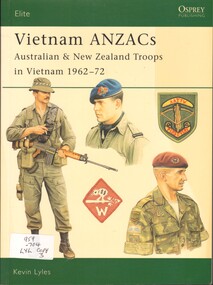
Book, Lyles, Kevin, Vietnam Anzacs: Australian & New Zealand Troops in Vietnam 1962-72 (Copy 3)
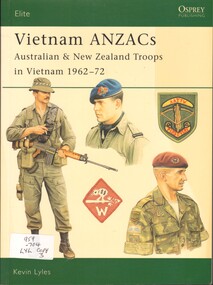
... Army The Australian and New Zealand part in the Vietnam War is sometimes overlooked, but it is generally accepted that the 'Diggers' and 'Kiwis' were among the most effective and professional troops involved. ...The Australian and New Zealand part in the Vietnam War is sometimes overlooked, but it is generally accepted that the 'Diggers' and 'Kiwis' were among the most effective and professional troops involved.The Australian and New Zealand part in the Vietnam War is sometimes overlooked, but it is generally accepted that the 'Diggers' and 'Kiwis' were among the most effective and professional troops involved. australia. army. australian and new zealand army corps, new zealand. army -
 National Vietnam Veterans Museum (NVVM)
Book, Lyles, Kevin, Vietnam Anzacs: Australian & New Zealand troops in Vietnam 1962-72 (Copy 2)
... Army The Australian and New Zealand part in the Vietnam War is sometimes overlooked, but it is generally accepted that the 'Diggers' and 'Kiwis' were among the most effective and professional troops involved. ...The Australian and New Zealand part in the Vietnam War is sometimes overlooked, but it is generally accepted that the 'Diggers' and 'Kiwis' were among the most effective and professional troops involved.The Australian and New Zealand part in the Vietnam War is sometimes overlooked, but it is generally accepted that the 'Diggers' and 'Kiwis' were among the most effective and professional troops involved. australia. army. australian and new zealand army corps, new zealand. army -
 National Vietnam Veterans Museum (NVVM)
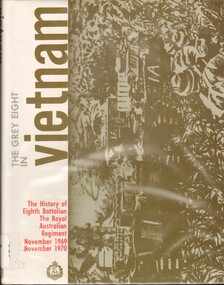
Book, Clunies Ross, A. ed, The Grey Eight in Vietnam: The history of Eighth Battalion, the Royal Australian Regiment, Nov 1969-Nov 1970 (Copy 2)
... Battalion Vietnam War 1961-1975 - Regimental histories - Australia 8th Battalion Royal Australian Regiment The Australian and New Zealand part in the Vietnam War is sometimes overlooked, but it is generally accepted that the 'Diggers' and 'Kiwis' were among the most effective and professional troops involved. ...The Australian and New Zealand part in the Vietnam War is sometimes overlooked, but it is generally accepted that the 'Diggers' and 'Kiwis' were among the most effective and professional troops involved.The Australian and New Zealand part in the Vietnam War is sometimes overlooked, but it is generally accepted that the 'Diggers' and 'Kiwis' were among the most effective and professional troops involved. australia. army. battalion, vietnam war, 1961-1975 - regimental histories - australia, 8th battalion, royal australian regiment -
 National Vietnam Veterans Museum (NVVM)
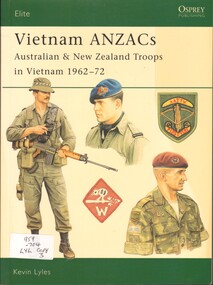
Book, Lyles, Kevin, Vietnam Anzacs: Australian & New Zealand troops in Vietnam 1962-1972 (Copy 1)
... Vietnam War 1961-1975 - Participation Australian ANZAC The Australian and New Zealand part in the Vietnam War is sometimes overlooked, but it is generally accepted that the 'Diggers' and 'Kiwis' were among the most effective and professional troops involved. ...The Australian and New Zealand part in the Vietnam War is sometimes overlooked, but it is generally accepted that the 'Diggers' and 'Kiwis' were among the most effective and professional troops involved.The Australian and New Zealand part in the Vietnam War is sometimes overlooked, but it is generally accepted that the 'Diggers' and 'Kiwis' were among the most effective and professional troops involved. australia. army. australian and new zealand army corps., vietnam war, 1961-1975 - participation, australian, anzac -
 National Vietnam Veterans Museum (NVVM)
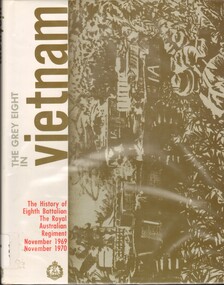
Book, The Grey Eight in Vietnam: The History of Eighth Battalion, The Royal Australian Regiment Nov 1969-Nov 1970 (Copy 3)
... Battalion Vietnam War 1961-1975 - Regimental histories - Australia 8th Battalion Royal Australian Regiment The Australian and New Zealand part in the Vietnam War is sometimes overlooked, but it is generally accepted that the 'Diggers' and 'Kiwis' were among the most effective and professional troops involved. ...The Australian and New Zealand part in the Vietnam War is sometimes overlooked, but it is generally accepted that the 'Diggers' and 'Kiwis' were among the most effective and professional troops involved.The Australian and New Zealand part in the Vietnam War is sometimes overlooked, but it is generally accepted that the 'Diggers' and 'Kiwis' were among the most effective and professional troops involved. australia. army. battalion, vietnam war, 1961-1975 - regimental histories - australia, 8th battalion, royal australian regiment -
 National Vietnam Veterans Museum (NVVM)
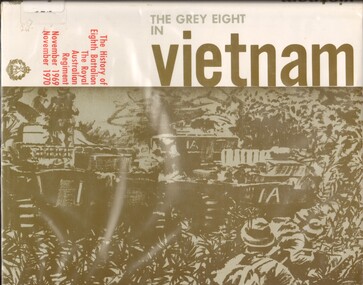
Book, Clunies Ross, A. ed, The grey eight in Vietnam: the history of Eighth Battalion, the Royal Australian Regiment Nov 1969-Nov 1970 (Copy 1)
... Battalion Vietnam War 1961-1975 - Regimental histories - Australia 8th Battalion The Australian and New Zealand part in the Vietnam War is sometimes overlooked, but it is generally accepted that the 'Diggers' and 'Kiwis' were among the most effective and professional troops involved. ...The Australian and New Zealand part in the Vietnam War is sometimes overlooked, but it is generally accepted that the 'Diggers' and 'Kiwis' were among the most effective and professional troops involved.The Australian and New Zealand part in the Vietnam War is sometimes overlooked, but it is generally accepted that the 'Diggers' and 'Kiwis' were among the most effective and professional troops involved. australia. army. battalion, vietnam war, 1961-1975 - regimental histories - australia, 8th battalion -
 Sunshine and District Historical Society Incorporated
Archive - Two-Up Gambling Schools
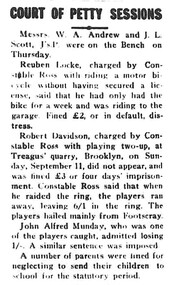
... among Australian soldiers in World War I, especially at Gallipoli and on the Western Front. It was simple, portable, and boosted morale. After the war, it became a symbol of mateship and remembrance. Two-up isn’t just a game, it’s a ritual of Mateship, Luck and Chance, Remembering diggers...among Australian soldiers in World War I, especially at Gallipoli and on the Western Front. It was simple, portable, and boosted morale. After the war, it became a symbol of mateship and remembrance. Two-up isn’t just a game, it’s a ritual of Mateship, Luck and Chance, Remembering diggers ...Two-up is a traditional Australian gambling game played with two coins tossed in the air, and players bet on whether they will land two heads, two tails, or odds (one of each). It’s one of the most iconic pieces of Australian cultural history. Two-up became famous among Australian soldiers in World War I, especially at Gallipoli and on the Western Front. It was simple, portable, and boosted morale. After the war, it became a symbol of mateship and remembrance. Two-up isn’t just a game, it’s a ritual of Mateship, Luck and Chance, Remembering diggers and Community gatherings. Because of this, Two-up is legally allowed to be played in most Australian states on ANZAC Day, even where gambling laws would normally prohibit it.Two‑up has a surprisingly rich little history in Sunshine, Victoria, because of the suburb’s strong links to WWI and WWII service, the RSL, and the old industrial workforce culture where the game stayed alive long after it faded elsewhere. Two-up was played in lunchrooms at the large factories throughout the district, such as at H.V. McKay’s Sunshine Harvester Factory, ICI & Wunderlich. It was played at private gatherings in back sheds, houses, paddocks, behind buildings and hotels around Albion, Braybrook, Matthews Hill, Sunshine & Sunshine North, and informally at the early Sunshine RSL. As the game was illegal, there are many reports in the local papers of places being raided by the police and fines being imposed by the courts on players that were caught playing the game. Many of the local two-up locations are listed in these newspaper's reports.5347.01 - Court Of Petty Sessions - Sunshine Advocate 1st October 1927 Page 5.pdf 5347.02 - Two-Up, Beer-Up And Betting School - Sunshine Advocate 14th February 1936 Page 2.pdf 5347.03 - Two-Up At Ding Sunshine Station Reserve - Sunshine Advocate 15th November 1935 Page 3.pdf 5347.04 - Young Bloods Playing Two-Up - Sunshine Advocate 24th October 1941 Page 1.pdf 5347.05 - Played Two-Up - Sunshine Advocate 1st May 1942 Page 1.pdf 5347.06 - Two-Up Players Fined - Sunshine Advocate 19th June 1942 Page 1.pdf 5347.07 - Alleged Two-Up School - Sunshine Advocate 15th October 1943 Page 1.pdf 5347.08 - Alleged Two-Up School Case Against Occupier Dismissed - Sunshine Advocate 3rd December 1943 Page 3.pdf 5347.09 - Two-Up Players Fined - Sunshine Advocate 19th May 1944 Page 1.pdf 5347.10 - The Police Infiltrated Two Uppers Landed Cold - Sunshine Advocate 22nd September 1944 Page 1.pdf 5347.11 - Hard Swearing In Two-Up Cases - Sunshine Advocate 15th June 1945 Page 1.pdf 5347.12 - Gambols In Paddock To Escape Gambling Police Raid - Sunshine Advocate 24th January 1947 Page 3.pdf 5347.13 - Obstructing Of Police Brings Fine - Sunshine Advocate 14th February 1947 Page 1.pdf 5347.14 - Charge Of Gambling Fails - Sunshine Advocate 21st February 1947 Page 1.pdf 5347.15 - Police Raid House For 'Swy' Game Occupier And Players Fined - Sunshine Advocate 3rd September 1948 Page 1.pdf 5347.16 - Caught Red Handed At Two-Up - Sunshine Advocate 21st October 1949 Page 1.pdf 5347.17 - Two-Up Players Fined - Sunshine Advocate 25th November 1949 Page 1.pdf 5347.18 - Two-up Players Caught - Sunshine Advocate 20th January 1950 Page 4.pdf 5347.19 - Gave Wrong Name To Police Two-Up Player Fined - Sunshine Advocate 17th March 1950 Page 4.pdf 5347.20 - Youth Won't Work - Sunshine Advocate 27th October 1950 Page 1.pdf 5347.21 - Bing Crosby Caught Playing Two-Up - Sunshine Advocate 13th April 1951 Page 1.pdf 5347.22 - Jotting From the Court Two-Up Player Fined - Sunshine Advocate 23rd November 1951 Page 4.pdf 5347.23 - No Claim Expected For This Money - Sunshine Advocate 11th January 1952 Page 1.pdf 5347.24 - Police Distrurb Two-Up Players In House - Sunshine Advocate 2nd July 1954 Page 1.pdf 5347.25 - The History Of Two-Up Schools In Melbourne West - The Westsider 26th April 2026 Page 15.pdf two-up, two up -
 Ballarat Heritage Services
Photograph - Colour, Pikeman's Dog Statue by Charles Smith and Joan Walsh-Smith, 21/05/2017
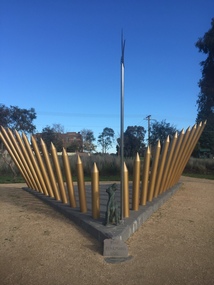
... diggers who were killed. The Pikeman`s Dog (known as Wee Jock), a little terrier, showed great devotion and bravery at the death of his master at the Eureka Stockade on 3 December 1854. As a result of the attack on the miners by Crown forces, five British soldiers and some thirty miners died. Among...diggers who were killed. The Pikeman`s Dog (known as Wee Jock), a little terrier, showed great devotion and bravery at the death of his master at the Eureka Stockade on 3 December 1854. As a result of the attack on the miners by Crown forces, five British soldiers and some thirty miners died. Among ...A sculpture unveiled on December 3rd 1999, the Anniversary of the Eureka Stockade Rebellion, in Ballarat, Victoria commemorates the Pikeman's Dog . The centerpiece of the sculpture is the bronze Irish Terrier. His stance, is a direct expression of his forlorn anguish, as he sits at the base of a symbolic bronze Pike, his head turned towards the place where once his master stood. The Pikeman's Dog statue was relocated from inside the Eureka Centre to a more prominent position within the Eureka Stockade Memorial Park. The new memorial was unveiled at a ceremony on December 3, 2014 - the 160th anniversary of the Eureka Stockade. The new memorial consists of 22 large golden stockade posts – representing the number of diggers killed in battle – erected in a triangle behind the statue of Wee Jock, on high ground outside the Museum of Australian Democracy at Eureka. The triangular shape of the monument is metaphorically symbolic. The V shape can be interpreted as symbolising victory, and the 22 golden posts represent the 22 diggers who were killed. The Pikeman`s Dog (known as Wee Jock), a little terrier, showed great devotion and bravery at the death of his master at the Eureka Stockade on 3 December 1854. As a result of the attack on the miners by Crown forces, five British soldiers and some thirty miners died. Among the miners lay a Pikeman, mortally wounded with some 15 wounds. Guarding his body throughout the hours it lay unclaimed at the battlefield, and later accompanying it on the death cart as the remaining bodies were transferred to the cemetery, was this small dog. According to reports the dog howled continuously and could not be separated from his master. The dog was awarded the RSPCA`s Purple Cross which Honours exceptional behaviour in serving humans in 1997.Colour photographs of the Pikeman's Dog statue in the Eureka Stockade Memorial Gardens. pikeman's dog, eureka stockade, statue, charles smith, joan walsh-smith -
 Returned Nurses RSL Sub-branch
Book - Illustrated hardcover book, Fourth Division A.M.C. Association, With the Diggers 1914-1918, 1933
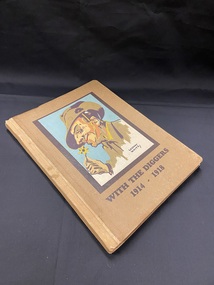
... among others, Hal Gye, Cecil Hartt, and Leyshon White."--Bookseller's description - from Trove record. 'B74' [Handwriiten in pencil on the first page] 'To / Returned Nurses Club / of Victoria / with compliments from / [?]' [Handwritten in pencil on the first page] '[? signature] / 25/7/34' [Handwritten in pencil on the first page] Light brown hardcover book with a lighter brown spine. There is a handdrawn image of a soldier smelling a flower in a dark brown border. The title is printed across the bottom. With the Diggers ...The Fourth Division Army Medical Corps comprised the 4th, 12th, and 13th Field Ambulances, but this compilation is not just a record of fallen comrades, but "a remarkably rich work, not just an anthology of digger verse, song, and illustration but an extensive record of Australian war service, including the Anglo-Boer War. In addition to the requisite chronology of the Great War, the volume includes laboriously compiled records of the entire A.I.F. giving every unit in all divisions, the principal engagements, casualties, etc; a detailed record of the Nursing Service; a detailed record of the Australian Navy and the R.A.N.B. in the war; details of warship and mercantile marine losses; number and name of every transport requisitioned by the Australian Navy with complements of officers and men (and horses); honour rolls of the 4th, 12th, and 13th Field Ambulances; etc. The Boer War section includes details of enlistments, principal actions, casualties, as well as South African War songs and verses (and printings of these are especially elusive). The illustrations are by, among others, Hal Gye, Cecil Hartt, and Leyshon White."--Bookseller's description - from Trove record.Light brown hardcover book with a lighter brown spine. There is a handdrawn image of a soldier smelling a flower in a dark brown border. The title is printed across the bottom.non-fictionThe Fourth Division Army Medical Corps comprised the 4th, 12th, and 13th Field Ambulances, but this compilation is not just a record of fallen comrades, but "a remarkably rich work, not just an anthology of digger verse, song, and illustration but an extensive record of Australian war service, including the Anglo-Boer War. In addition to the requisite chronology of the Great War, the volume includes laboriously compiled records of the entire A.I.F. giving every unit in all divisions, the principal engagements, casualties, etc; a detailed record of the Nursing Service; a detailed record of the Australian Navy and the R.A.N.B. in the war; details of warship and mercantile marine losses; number and name of every transport requisitioned by the Australian Navy with complements of officers and men (and horses); honour rolls of the 4th, 12th, and 13th Field Ambulances; etc. The Boer War section includes details of enlistments, principal actions, casualties, as well as South African War songs and verses (and printings of these are especially elusive). The illustrations are by, among others, Hal Gye, Cecil Hartt, and Leyshon White."--Bookseller's description - from Trove record. australian imperial forces, world war 1914-1918 songs and music, world war 1914-1918, war poetry, wwi, ww1, world war one -
 Returned Nurses RSL Sub-branch
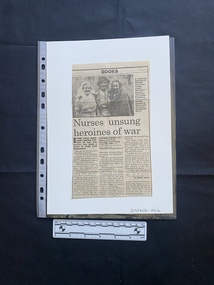
Newspaper - Newspaper clipping, Judith White, Nurses unsung heroines of war, [1988]
... Among those commemorated in the book are the nurses killed or died in action in World War II. Dr Goodman says one of the most outstanding episodes was the sinking of the hospital ship, the Centaur, off Brisbane by a Japanese sub. Of 11 sisters, one survived, Sister Savage and she kept up the morale of the survivors in shark-infested waters for 24 hours. Another was Sister Anderson, who was tending wounded on deck aboard the Empire Star and threw herself over a Digger...Among those commemorated in the book are the nurses killed or died in action in World War II. Dr Goodman says one of the most outstanding episodes was the sinking of the hospital ship, the Centaur, off Brisbane by a Japanese sub. Of 11 sisters, one survived, Sister Savage and she kept up the morale of the survivors in shark-infested waters for 24 hours. Another was Sister Anderson, who was tending wounded on deck aboard the Empire Star and threw herself over a Digger ...Our war heroines have always received less attention than their male counterparts, but Dr Rupert Goodman is helping to set the record straight, with the first book to give a comprehensive history of Australia's war nurses. Among those commemorated in the book are the nurses killed or died in action in World War II. Dr Goodman says one of the most outstanding episodes was the sinking of the hospital ship, the Centaur, off Brisbane by a Japanese sub. Of 11 sisters, one survived, Sister Savage and she kept up the morale of the survivors in shark-infested waters for 24 hours. Another was Sister Anderson, who was tending wounded on deck aboard the Empire Star and threw herself over a Digger to protect him from strafing as they were escaping from the fall of Singapore. Or the Banka Island massacre. Twenty three nurses were ordered to march into the sea and were shot dead. Only one survived, Sister Vivian Bullwinkel, after feigning death, she returned to shore tended to a wounded solider, then was captured and became a POW.A newspaper clipping of three columns of text with a black and white photo above of three women, two obviously in nurse's uniformwwii, ww2, world war two, our war nurses - the history of the royal australian army nursing corps 1902-1988, george medal, banker island, edith cavell, world war 1, world war one, ww1, wwi, war memorial, canberra
