
Showing 90 items matching "amusement park"
-
 Wodonga & District Historical Society Inc
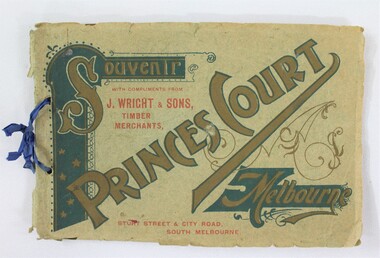
Booklet - Souvenir Booklet for Princes Court Amusement Park, Melbourne 1904-1905
... Souvenir Booklet for Princes Court Amusement Park, Melbourne 1904-1905...Souvenir Booklet for Princes Court Amusement Park, Melbourne 1904-1905......amusement park...Princes Court was an amusement park in Melbourne, located on St Kilda Road. ...A souvenir booklet for Princes Court, an amusement park in Melbourne, printed for the years 1904-5. ...Princes Court was an amusement park in Melbourne, located on St Kilda Road. ...Princes Court was an amusement park in Melbourne, located on St Kilda Road. Established in 1904, it closed its doors in 1909 after poor ticket sales due to Melbourne's temperamental weather. The park featured a toboggan ride and water chute ride where patrons inside open carriages were plunged down sloping structures from a height at great speeds. The park's other facilities and activities included a rifle range, a tug of war game, a Japanese tea house, a wine bar, a variety show, an open air cinema, and roller skating and bicycle races.This item contributes to our understanding of social life and recreation in early twentieth century Victoria. A souvenir booklet for Princes Court, an amusement park in Melbourne, printed for the years 1904-5. The booklet features photographs of the park's attractions, and advertisements for local businesses in Melbourne. wodonga, melbourne, princes park, amusement park, rides, fair, fairground, japanese tea house, st kilda -
 Lakes Entrance Historical Society
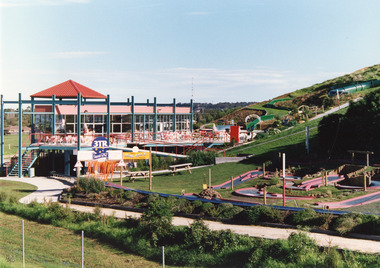
Photograph - Kinkuna Amusement Park on Princes Highway, Lakes Entrance 2009
... Kinkuna Amusement Park on Princes Highway, Lakes Entrance 2009...Kinkuna Amusement Park was opened 19 December 1987, closed 2002, building demolished or removed, land sold and subdivided into residential allotments....Copy colour photographic print showing Kinkuna Amusement Park on Princes Highway, owned by Joe and Shirley Walters. ...Kinkuna Amusement Park was opened 19 December 1987, closed 2002, building demolished or removed, land sold and subdivided into residential allotments. ...Kinkuna Amusement Park was opened 19 December 1987, closed 2002, building demolished or removed, land sold and subdivided into residential allotments.Copy colour photographic print showing Kinkuna Amusement Park on Princes Highway, owned by Joe and Shirley Walters. Photo shows main building and restaurant, mini golf, long taboggan on hill, garden and other attractions. Lakes Entrance Victoriaentertainment, recreation -
 Williamstown Historical Society Inc
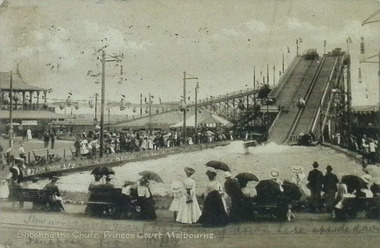
Postcard - Alice Evans Postcard Collection, 26/03/1906
... ...Amusement Park...Melbourne Alice Evans Postcards Entertainment Amusement Park Shooting the Chute, Princes Court, Melbourne Part of collection of 142 Postcards.This is a b&w photograph is of people enjoying a day out and entertainment Postcard Alice Evans Postcard Collection ..."Dear Alice" Is a collection of 142 Postcards from Australia and around world, almost all of which are addressed to Miss Alice Evans, No. 2 Cox Gardens, Williamstown, dated between 1905 - 1909. These postcards form part of a collection found in the ceiling of No. 2 Cox Gardens by a local builder and carpenter Gordon Peterson. Peterson was contracted to demolish the house in the mid 1970's. The cards were held in the Estate of Gordon Peterson, along with a photo of the cottage, before demolition until donation to the historical society by his descendants in 2024. Alice Edith Evans was born in Williamstown in 1885 to parents Benjamin Samuel Evans (1833-1900), a bootmaker from Ruabon, Denbighshire, Wales and Catherine (nee Jones) (1850-1915) from Eaglehawk, near Castlemaine. Alice had three older step sisters, and two younger brothers, Benjamin and Samuel, who sadly died in infancy. Alice’s father, Benjamin, had been married previously, his wife dying during childbirth, leaving him with three daughters to care for. After leaving school, Alice was employed as a clerk with Trevor Jones & Co. (real estate agents), until her declining health prevented her from working. She was an active and well known member of the Welsh Church and Sunday School on Ferguson Street and enjoyed singing and playing in local concerts. Well known in the community, a Grand Benefit Concert was organised in her honour on 9th April, 1910, at the Mechanics Institute, Williamstown. Hosted by Mayor Cr. Wymark, the event featured a delightful program of musical performances, showcasing both individual talents and the Carlton Club Choir. Tragically, Alice passed away due to the effects of her illness on 3rd December 1910, at the age of just 25. She is buried in Williamstown Cemetery. The postcards, written between 1905 to 1906, illustrate the social history of residents and everyday life at the turn of the century, using postcards as a means of communication.Part of collection of 142 Postcards.This is a b&w photograph is of people enjoying a day out and entertainmentShooting the Chute, Princes Court, Melbournemelbourne, alice evans postcards, entertainment, amusement park -
 Williamstown Historical Society Inc
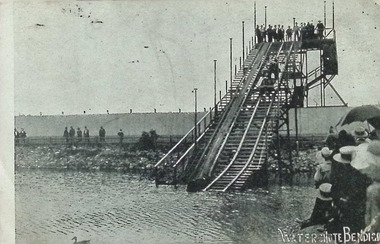
Postcard - Alice Evans Postcard Collection, 21/09/1905
... ...Amusement Park...Bendigo Victoria Alice Evans Postcards Entertainment Amusement Park Water Chute, Bendigo Part of the collection of 142 Postcards. ..."Dear Alice" Is a collection of 142 Postcards from Australia and around world, almost all of which are addressed to Miss Alice Evans, No. 2 Cox Gardens, Williamstown, dated between 1905 - 1909. These postcards form part of a collection found in the ceiling of No. 2 Cox Gardens by a local builder and carpenter Gordon Peterson. Peterson was contracted to demolish the house in the mid 1970's. The cards were held in the Estate of Gordon Peterson, along with a photo of the cottage, before demolition until donation to the historical society by his descendants in 2024. Alice Edith Evans was born in Williamstown in 1885 to parents Benjamin Samuel Evans (1833-1900), a bootmaker from Ruabon, Denbighshire, Wales and Catherine (nee Jones) (1850-1915) from Eaglehawk, near Castlemaine. Alice had three older step sisters, and two younger brothers, Benjamin and Samuel, who sadly died in infancy. Alice’s father, Benjamin, had been married previously, his wife dying during childbirth, leaving him with three daughters to care for. After leaving school, Alice was employed as a clerk with Trevor Jones & Co. (real estate agents), until her declining health prevented her from working. She was an active and well known member of the Welsh Church and Sunday School on Ferguson Street and enjoyed singing and playing in local concerts. Well known in the community, a Grand Benefit Concert was organised in her honour on 9th April, 1910, at the Mechanics Institute, Williamstown. Hosted by Mayor Cr. Wymark, the event featured a delightful program of musical performances, showcasing both individual talents and the Carlton Club Choir. Tragically, Alice passed away due to the effects of her illness on 3rd December 1910, at the age of just 25. She is buried in Williamstown Cemetery. The postcards, written between 1905 to 1906, illustrate the social history of residents and everyday life at the turn of the century, using postcards as a means of communication.Part of the collection of 142 Postcards. B&W Image depicts the Water Chute, BendigoWater Chute, Bendigobendigo, victoria, alice evans postcards, entertainment, amusement park -
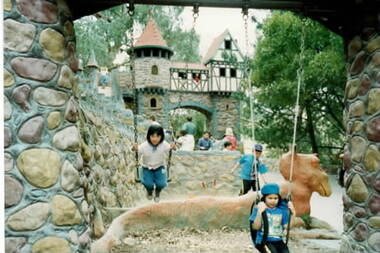 Sunbury Family History and Heritage Society Inc.
Photograph, Anakie Fairy Park
... The photograph was taken in the Anakie Fairy Amusement Park....The photograph was taken in the Anakie Fairy Amusement Park. Anakie Fairy Park Photograph ...The children from Bulla Primary School were taken on an excursion to Anakie Fairy Park, near Geelong, in the 1980s. They joined with a group of Asian exchange students on the day and explored the variety of fairy tale structures that have been erected in the park. A non- digital photograph of two girls on a swing while the group in the background are looking at a Tudor style arch. The photograph was taken in the Anakie Fairy Amusement Park.anakie fairy park, geelong, school excursions, bulla primary schooil -
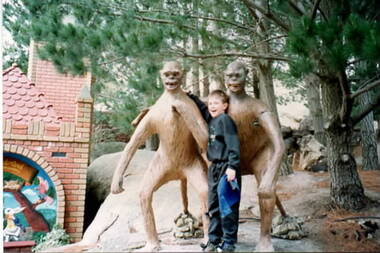 Sunbury Family History and Heritage Society Inc.
Photograph, Anakie Fairy Park
... A non-digital coloured photograph of a boy standing in front of a statue of two monkeys in an amusement park. A brick castle like structure is on the LHS of the sculpture and conifer trees are in the background....Anakie Fairy Park Geelong Bulla Primary Schooil School Excursions A non-digital coloured photograph of a boy standing in front of a statue of two monkeys in an amusement park. A brick castle like structure is on the LHS of the sculpture and conifer trees are in the background. ...The photograph is one of a set that was taken when the children from Bulla Primary School enjoyed a school excursion to the Anakie Fairy Park neat Geelong in the 1980s. On that day they joined up with a group of young Asian exchange students and explored the various fairy tale exhibits that can be seen in the park.A non-digital coloured photograph of a boy standing in front of a statue of two monkeys in an amusement park. A brick castle like structure is on the LHS of the sculpture and conifer trees are in the background.anakie fairy park, geelong, bulla primary schooil, school excursions -
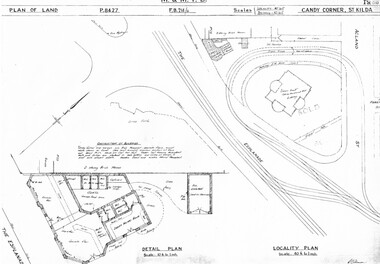 Melbourne Tram Museum
Drawing, Melbourne & Metropolitan Tramways Board (MMTB), "Candy Corner St Kilda", c1938
... Set of two photocopied plans or drawings on A3 sheets of "Candy Corner St Kilda" .1 - P8427 - Plan showing locality plan, detail plan and adjacent buildings - 6-12-1938 .2 - ditto, but not the detail of the building in the centre of the island - "Green Knoll" Cafe and Amusement Park....Trams tramways Drawings Depots Property Candy Corner St Kilda turning loops Set of two photocopied plans or drawings on A3 sheets of "Candy Corner St Kilda" .1 - P8427 - Plan showing locality plan, detail plan and adjacent buildings - 6-12-1938 .2 - ditto, but not the detail of the building in the centre of the island - "Green Knoll" Cafe and Amusement Park. "Candy Corner St Kilda" Drawing Melbourne & Metropolitan Tramways Board (MMTB) ...Set of two photocopied plans or drawings on A3 sheets of "Candy Corner St Kilda" .1 - P8427 - Plan showing locality plan, detail plan and adjacent buildings - 6-12-1938 .2 - ditto, but not the detail of the building in the centre of the island - "Green Knoll" Cafe and Amusement Park.trams, tramways, drawings, depots, property, candy corner, st kilda, turning loops -
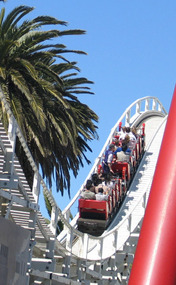 Ballarat Heritage Services
Digital Photograph Luna Park rollercoaster, Lisa Gervasoni, Luna Park rollercoaster St Kilda, early 2000s
... park...amusement...luna park rollercoaster roller coaster theme park amusement just for fun Digital Photograph of a rollercoaster at Luna Park, St Kilda. ...Digital Photograph of a rollercoaster at Luna Park, St Kilda.luna park, rollercoaster, roller coaster, theme park, amusement, just for fun -
 Puffing Billy Railway
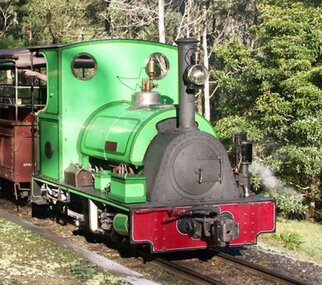
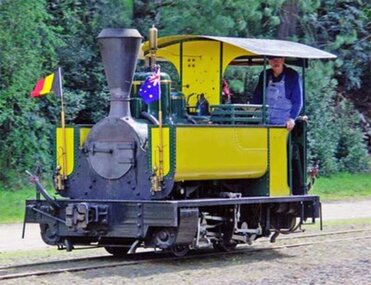
Peckett, 1711 Peckett Steam Locomotive, 1926
... In 1965 it was sold again and went to the Whistle Stop Amusement Park in Frankston and again stored until bought at auction by the Puffing Billy Preservation Society in 1974 and put on static display in the Steam Museum. ...In 1965 it was sold again and went to the Whistle Stop Amusement Park in Frankston and again stored until bought at auction by the Puffing Billy Preservation Society in 1974 and put on static display in the Steam Museum. ...Steam Locomotive - 1711 Peckett “Sir John Grice” Date built - 1926 Locomotive type ; Cranmore Original owner - Metropolitan Gas Coy., West Melbourne Original gauge - 762mm Withdrawn - 1941 Next owner - Whistle Stop Amusement Park, Frankston Built in 1926 for the West Melbourne site of the Metropolitan Gas Company, and issued to traffic the same year this saddle tank locomotive was named “Sir John Grice” in 1928. It was withdrawn from traffic in 1941 and stored until sold privately in 1962. In 1965 it was sold again and went to the Whistle Stop Amusement Park in Frankston and again stored until bought at auction by the Puffing Billy Preservation Society in 1974 and put on static display in the Steam Museum. Restoration started in 1978 and it was returned to service in 1981 painted light green with yellow lining. It is temporarily renamed “Thomas the Tank Engine” with a fibreglass “Thomas” body cover each time it appears in the “Thomas the Tank Engine” shows at Gembrook station.Historic - Industrial Narrow Gauge Railway - Steam Locomotive used at the Metropolitan Gas Coy., West Melbourne, Victoria, AustraliaSteam Locomotive made of steel, wrought iron Peckettpeckett “sir john grice”, 1711 peckett, puffing billy, steam locomotive, industrial narrow gauge railway, metropolitan gas coy., west melbourne -
 Ballarat Heritage Services
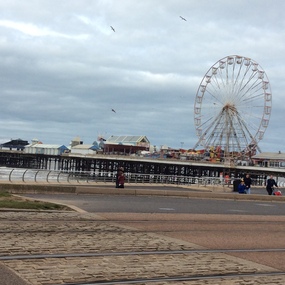
Digital photographs, Blackpool 2016, 2016
... It's known for Blackpool Pleasure Beach, an old-school amusement park with vintage wooden roller coasters. ...It's known for Blackpool Pleasure Beach, an old-school amusement park with vintage wooden roller coasters. ...Black pool was one of the first seaside towns to experience middle and lower class visitations in the Edwardian period. The Blackpool tower is noted as an iconic landscape. "Blackpool is a seaside resort on the Irish Sea coast of England. It's known for Blackpool Pleasure Beach, an old-school amusement park with vintage wooden roller coasters. Built in 1894, the landmark Blackpool Tower houses a circus, a glass viewing platform and the Tower Ballroom, where dancers twirl to the music of a Wurlitzer organ. Blackpool Illuminations is an annual light show along the Promenade. Weather: 8 °C, Wind SE at 18 km/h, 81% Humidity Local time: Wednesday 8:44 am Postcode: FY1-FY4" wikipediaDigital images in colour -
 Sunshine and District Historical Society Incorporated
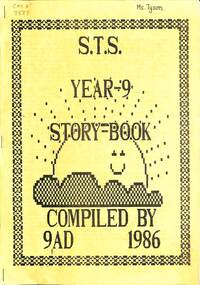
Memorabilia - Sunshine Technical School Memorabilia - Story Book S.T.S. Story Book 1986 Class 9AD
... The Stabbing by Tracey Mills|Ghost Town by Marion Walker|PEPE The Pigeon Who Ruled Sunshine by Anthony Micallef|The Phone Call by Kaelene Knott|Calder Park Finals Drag Racing March 1986 by Michelle Chatzidimitriou|My Dog Corky by Nicolle Meyers|The Day We Went Motor Bike Riding by Shane Hynds|The Mystery by Donna Tatlow|Annual Camp by David Shilling|Forces Vengeance by Jeff Ward|Sunshine Tech Bombed by Claudia Rundel|Mystery 2 by Donna Tatlow|Amazon Jungle by Barry Howard|An Experience Of My Own by Rodger Greaves|Best Friends by Vicki Psomiadis|The Book And Me by Amanda Alldis|Deadley Mistake by Corey Havarc|The Gate Of Imagination by Rachel Masuglia|The Picnic by Dion Beasley|The Magic Seeds by Tracey McDonagh|The Drowing by Mark Herrick|The Day I Wagged School by Michael Sammut|The Magic Seeds by Tracey McDonagh|The Ghost That Never Spooked by Chris MacDonald|Amusement Park By Tracey McDonagh|Lost Treasure by Allen Carrick|Ghost Train by Nikkie Potter...Was part of the Sunshine Technical School Collection Sunshine Technical School Technical School The Stabbing by Tracey Mills|Ghost Town by Marion Walker|PEPE The Pigeon Who Ruled Sunshine by Anthony Micallef|The Phone Call by Kaelene Knott|Calder Park Finals Drag Racing March 1986 by Michelle Chatzidimitriou|My Dog Corky by Nicolle Meyers|The Day We Went Motor Bike Riding by Shane Hynds|The Mystery by Donna Tatlow|Annual Camp by David Shilling|Forces Vengeance by Jeff Ward|Sunshine Tech Bombed by Claudia Rundel|Mystery 2 by Donna Tatlow|Amazon Jungle by Barry Howard|An Experience Of My Own by Rodger Greaves|Best Friends by Vicki Psomiadis|The Book And Me by Amanda Alldis|Deadley Mistake by Corey Havarc|The Gate Of Imagination by Rachel Masuglia|The Picnic by Dion Beasley|The Magic Seeds by Tracey McDonagh|The Drowing by Mark Herrick|The Day I Wagged School by Michael Sammut|The Magic Seeds by Tracey McDonagh|The Ghost That Never Spooked by Chris MacDonald|Amusement Park By Tracey McDonagh|Lost Treasure by Allen Carrick|Ghost Train by Nikkie Potter A stapled document containg various student's short stories Memorabilia Sunshine Technical School Memorabilia - Story Book S.T.S. ...Was part of the Sunshine Technical School CollectionThe Stabbing by Tracey Mills|Ghost Town by Marion Walker|PEPE The Pigeon Who Ruled Sunshine by Anthony Micallef|The Phone Call by Kaelene Knott|Calder Park Finals Drag Racing March 1986 by Michelle Chatzidimitriou|My Dog Corky by Nicolle Meyers|The Day We Went Motor Bike Riding by Shane Hynds|The Mystery by Donna Tatlow|Annual Camp by David Shilling|Forces Vengeance by Jeff Ward|Sunshine Tech Bombed by Claudia Rundel|Mystery 2 by Donna Tatlow|Amazon Jungle by Barry Howard|An Experience Of My Own by Rodger Greaves|Best Friends by Vicki Psomiadis|The Book And Me by Amanda Alldis|Deadley Mistake by Corey Havarc|The Gate Of Imagination by Rachel Masuglia|The Picnic by Dion Beasley|The Magic Seeds by Tracey McDonagh|The Drowing by Mark Herrick|The Day I Wagged School by Michael Sammut|The Magic Seeds by Tracey McDonagh|The Ghost That Never Spooked by Chris MacDonald|Amusement Park By Tracey McDonagh|Lost Treasure by Allen Carrick|Ghost Train by Nikkie Pottersunshine technical school, technical school -
 Flagstaff Hill Maritime Museum and Village
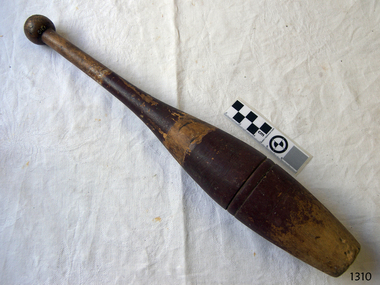
Equipment - Juggling Club, late 19th to early 20th century
... JUGGLING Jugglers entertain audiences with their tricks and routines at events such as circuses, amusement parks, parties, shows on television or theatre, schools and parties. ...JUGGLING Jugglers entertain audiences with their tricks and routines at events such as circuses, amusement parks, parties, shows on television or theatre, schools and parties. ...This wooden juggling club or exercise club may also be referred to as a juggling pin. It is very similar in shape to a bowling pin or an Indian club. It dates approximately to the early 20th century. It may have been used as one of a pair for gymnastics or exercise, or part of a larger set used by a juggler for entertainment in a circus or carnival. At some time it may have been used with a ball or disc as part of a Skittles or bowling game set. The historical collection of Federation University Australia, Victoria, includes a very similar but slightly shorter club, labelled ‘timber skittle”, as can be seen in their photograph. Another example of very similar-shaped, same-sized clubs can be seen in the collection of Nobelius Heritage Park and Emerald Museum, Emerald, Victoria. JUGGLING Jugglers entertain audiences with their tricks and routines at events such as circuses, amusement parks, parties, shows on television or theatre, schools and parties. Juggles also compete at International Championships to obtain world records, performing as individuals or in groups or teams. Contemporary champion juggler David Cain performs a Juggling History Show that both entertains and educates his audience. His routines date from the early 1600s to the 20th century. He uses a wide variety of equipment in his acts including juggling clubs. EXERCISE Exercise clubs or Indian clubs were used in 19th century Victorian times as part of exercise or strengthening programs when they were swung in certain patterns and movements. Even in the early 20th century workplace a few minutes of Indian club swinging was common practice for the relief of tension. A video clip of an American school room in 1904 shows a group of boys and girls skilfully wielding clubs in an exercise sequence (see ‘Links” section). The 1904 and 1932 Olympic Games had an event called Club Swinging. Rhythmic gymnastics was added to the Olympic Program at the L.A. Games in 1984 where competitors use apparatus such as rope, hoop, ball, ribbon and clubs. The clubs come in a variety of weights and heights and have been used from the mid-1800s until around the 1930s in schools and military institutions. They are decorated in a variety of patterns and colours and some have feature lines or scored rings on them. This juggling club is significant for its association with education, entertainment and sport in the late 19th and early 20th century.Wooden juggling club (or pin, skittle or Indian club). Vintage, bottle-shaped club with a flat, slightly concave, base. Its turned, solid timber body tapers out from the base then in again to a very narrow handle with a round knob joined onto the top. Two concentric feature lines are scored into the wider part of club. It was possibly used in exercise, gymnastics or as a skittle. Sections of the club have two brown painted stripes; paint on the lower strip has been worn off at the base . There are remnants of white paint in two areas, possibly the remains of a maker’s name or decoration. There also appears to be an inscription stamped into the wooden handle but this is illegible. Late 19th to early 20th century.Remnants of what appears to be stamped lettering and painted labelling.flagstaff hill, warrnambool, shipwrecked coast, flagstaff hill maritime museum, maritime museum, shipwreck coast, flagstaff hill maritime village, great ocean road, wooden skittle, entertainment, bowling skittle, wooden juggling pin, wooden juggling club, wooden exercise club, indian club, exercise club, club swinging, rhythmic gymnastics, sport equipment, juggling equipment, wooden club -
 Puffing Billy Railway
Carbon - No. 986 Couliett / No. 90 Decauville Steam Locomotive, 1889
... For a few years in the 1960s it was used on a circle of track at Walhalla, before going to the Whistle Stop Amusement Park in Frankston. Although a number of similar locomotives still exist, as far as is known Carbon is the only one still operating in its original condition. ...For a few years in the 1960s it was used on a circle of track at Walhalla, before going to the Whistle Stop Amusement Park in Frankston. Although a number of similar locomotives still exist, as far as is known Carbon is the only one still operating in its original condition. ...The locomotive was supplied new by Decauville to the Metropolitan Gas Company Ltd, Melbourne, for use at their gasworks in West Melbourne, where it was named Carbon suppied in 1889 (Couillet builder's number 986, Decauville serial number 90). It was named Carbon. The West Melbourne gas works sourced its coal from Maitland, New South Wales, and the coal was brought by ship to a wharf adjacent to the West Melbourne gas plant. John Benn and Carbon were used to haul the coal over a 762 mm (2 ft 6 in) gauge railway from the wharf to the gasworks, a distance of about 450 metres (500 yards). West Melbourne Gas Works No. "Carbon" Wheels: 0-4-0T Builder: Couillet Build Date: 1890 Construction No.: 986 Empty Weight: Unknown Weight on Drivers: Unknown Driver Diameter: Unknown Tractive Effort: Unknown Boiler Pressure: Unknown Cylinders: Unknown Fuel: Coal Gauge: 30 Decauville locomotives The firm Société Anonyme Decauville located at Petit Bourg, France, was founded to manufacture light railways pioneered by French farmer Paul Decauville to transport crops from the field in 1875. Decauville began designing their own locomotives in 1882, although initially manufacture was contracted out to other builders, notably the Belgian firm Hainault at Couillet Although not well known in Australia, in Europe Couillet was a significant builder of steam locomotives of many different gauges and sizes over a long period of time. The locomotive was supplied new by Decauville to the Metropolitan Gas Company Ltd, Melbourne, for use at their gasworks in West Melbourne, where it was named Carbon (986) . Carbon ( 986 ) The locomotive weighs approximately seven tons. It has the Couillet builder's number 986. of 1889 It was built for Decauville & Cie. of Paris, suppliers of portable and industrial railway equipment, and has their serial number of 90 of 1890. Built in 1889 for the West Melbourne site of the Metropolitan Gas Company, it is a four-wheel tank locomotive and was named “Carbon”. It was withdrawn from service in the 1930s and stored until sold privately in 1962. For a few years in the 1960s it was used on a circle of track at Walhalla, before going to the Whistle Stop Amusement Park in Frankston. Although a number of similar locomotives still exist, as far as is known Carbon is the only one still operating in its original condition. Historic - Industrial railways - Metropolitan Gas Company Ltd, Melbourne Steam Locomotive Small Decauville Couillet Steam locomotive. - Iron & wrought iron framesCouillet builder's number 986, Decauville serial number 90puffing billy, narrow gauge, industrial narrow gauge railway, couillet 986, decauville 90, steam locomotive, metropolitan gas company, carbon -
 City of Melbourne Libraries
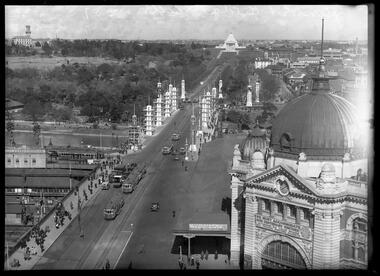
Photograph, Bull, Hugh Jones, 1897-1993, Princes Bridge Centenary pylons under construction
... But at this time it was the home of Wirths Olympia Circus, which comprised Wirths Pleasure Park (an amusement park), a 5,000 seat auditorium – Hippodrome, a roller skating rink, a glaciarium, a cinema, and the Green Mill Dance Hall. ...But at this time it was the home of Wirths Olympia Circus, which comprised Wirths Pleasure Park (an amusement park), a 5,000 seat auditorium – Hippodrome, a roller skating rink, a glaciarium, a cinema, and the Green Mill Dance Hall. ...Princes Bridge Centenary pylons under construction Possibly taken from Young and Jacksons Hotel (formerly Princes Bridge Hotel) on the corner of Flinders and Swanston streets, Flinders Street Station’s clocks and main entrance dominate, along with its distinctive copper dome and decorative façade. The time on the main clock is 1.40pm, and the sign underneath, reflecting Melbourne’s upcoming Centenary reads, “We must accommodate our Centenary visitors! Citizens! Do your share by taking paying guests.” At left is the original Princes Bridge Station, today the site of Federation Square. The riverside tram terminus advertises a Café/Tobacconist/Refreshment Room selling cigars & cigarettes, fountain drinks & confectionery, and in smaller text: “Leave your boot repairs here”. Nearly everyone is dressed in dark suits, coats and hats. The footpaths are wide and there are no traffic lights. The roadway stretches towards the Shrine of Remembrance, not yet dedicated but very dominant on the skyline. Government House is clearly visible across the wide parkland that would come to be known as Kings Domain and that is an area of deep importance to the people of the Eastern Kulin. Originally, Birrarung was part of a network of swamps and lagoons linked to the course of the river. From 1896, Public Works Department engineer Carlo Catani, oversaw a new channel to straighten the river and the swamps and lagoons were filled with spoil from the channel works. From the same vantage point today, only the top of the tower of Government House would be visible. The photo captures the pylons along Princes Bridge, mid-construction and being installed to mark Melbourne’s Centenary. The pylons were not without controversy. Both The Argus and The Age bemoaned them for being “made almost entirely of imported softwood timber”, denying work to native hardwood timber workers and sawmillers, and leading visitors to think Australia did not have its own exceptional native hardwoods. The pylons were also variously described in their incomplete state, as unimaginative and resembling an oilfield. Published: The Age 5 September 1934 Featured in "Newsworthy: Melbourne in photographs 1933-1936" exhibition at East Melbourne Library, October to December 2023. Exhibition caption by project volunteer, Louise McKenzie Photographer notations on slide: "Pylons + St Kilda Rd C57" Published: Age (Melbourne, Vic. : 1854 - 1954), Wednesday 5 September 1934, page 11 Published title: DECORATIONS -- THEN AND NOW. Published caption: "Although not completed yet, some impression of the effect of the decorations on Princes-bridge may be obtained from the first picture which shows the majestic sweep of St Kilda road with the Shrine of Remembrance and Government House dominating the horizon. The area to the left of St. Kilda-road and in front of Government House is portion of the area which it is proposed to call the King's Domain, which extends to Domain-road and Anderson-street..." Description: East-facing, elevated view of Flinders Street Station and Princes Bridge, featuring partially completed pylons erected for Melbourne's Centenary celebrations. The Shrine of Remembrance and Government House can be seen in the distance. In the foreground are trams, cars and trucks, pedestrians, Batman Avenue tram terminus and refreshment rooms. Signage on Flinders Street Station encourages citizens to accommodate Centenary visitors. The Melbourne Centenary was held 1934-35 in celebration John Batman's proclamation that Melbourne "the place for a village". Centenary events included a visit by Prince Henry, Duke of Gloucester. A Centenary Cake measuring 50 feet in height and ten tons in weight was cut into 250,000 pieces and sold at 1 shilling per piece for charity. Spectacular floodlighting of city landmarks, the creation of the Pioneer Women's Memorial Garden, and the MacRobertson Air Race from London, were other notable activities. Research by project volunteer, Louise McKenzie: The photo in The Age collage of 5 September 1934 has a slightly cropped foreground. The original photo has been taken from an elevated vantage point, most probably the roof of the Nicholas Building on the corner of Flinders and Swanston streets. The right foreground is dominated by the main “clocks” entrance to Flinders Street Station, showing its distinctive copper dome and decorative façade. The time on the main clock is 1.40 pm. The main sign on the front of the Station reads, "We Must Accommodate our Centenary Visitors! Citizens! Do your share by taking paying guests. Write to The Official Centenary Accommodation Bureau, 436 Collins St. City. Tel M 4671”. Another sign at eye level at the main entrance says: “Cheap Trips on Sundays”. The sign on the end of the roof along the eastern side of the station reads, “The Babies Need Your Help! Support Broadmeadows Foundling Hospital Appeal. July and August”. Run by the Sisters of St Joseph of the Sacred Heart, St Joseph’s Foundling Hospital was a purpose built infants’ home for up to 300 babies, plus accommodation for expectant mothers, mainly single women. In the early 1930s, the department (Victorian Children’s Welfare Department) contracted St Joseph’s Foundling Hospital to care for an additional 60 infant state wards, and up to 175 non wards at any given time. In 1931 it also operated a mothercraft training school. The centre foreground shows the commencement of Princes Bridge. Beneath the left side of the bridge was the site of the original Princes Bridge Station, by this time incorporated into Flinders Street Station, and today the area is the site of Federation Square. It was linked to Flinders Street station by the railway tracks that ran underneath the northern approach to the bridge. This photo shows a tram terminus which has a Café/Tobacconist/Refreshment Room, selling cigars & cigarettes, fountain drinks & confectionary, and a sign: Leave your boot repairs here. In the foreground is a wide roadway running south/north, comprising two vehicle lanes each heading north/south, and a central section containing two sets of tram tracks. There are cars, buses and delivery vans on the roadway. The trams visible are Glen Iris (Route No. 6; tram no. 448), Toorak (Route No. 8, tram no. 333), ? (No. 7), ? (No. 1), and ? (No. 2A). The footpaths are extremely wide. There is a square newspaper/magazine stand on the eastern side footpath. And also a “Ferry” sign. There are no traffic lights, but a policeman is visible on the roadway. There are pedestrians – men, women, children, a porter with trolley, women with prams. Clothing comprises dark suits, coats and hats for nearly everyone. There are double headed “Collins Street” lights along the side of the roadway, and along the northern riverbank. The roadway in the foreground is an extension of Swanston Street, which becomes Princes Bridge, then St Kilda Road, stretching towards the Shrine of Remembrance, and diverting past it. The Shrine had not yet been officially dedicated, and looks very white and dominant on the skyline. On the LHS of St Kilda Road, Government House is clearly visible across the wide parkland to be known as Kings Domain. The Kings Domain area is important to the people of the Eastern Kulin nation, and also has historical importance for its association with the early settlement of Melbourne and the foundation of British colonial administration in Victoria. On the southern side of the Yarra River (Birrarung) an historic rowing boathouse is visible, located adjacent to the Alexandra Gardens. Originally Birrarung was part of a network of swamps and lagoons linked to the course of the river. From 1896, under the guidance of engineer Carlo Catani* a new channel to straighten the river was created and the swamps and lagoons were filled with spoil from the channel works. The gardens were then created and completed in time for a Royal visit by the Duke of York in May 1901. The gardens are named after Alexandra of Denmark, the wife of King Edward VII. Both these areas, plus the Royal Botanic Gardens Victoria, Shrine of Remembrance Reserve, Sidney Myer Music Bowl, Government House, and the Queen Victoria Gardens together form the Domain Parklands. The extent of the subsequent plantings is evident today, where from the same vantage point only the top of the tower of Government House would be visible. *Catani was born in Florence in 1852, but after arriving in Melbourne worked as a civil engineer for the Victorian Government. His last major project was the reclamation of the foreshore of St Kilda, envisaged in the style of a European resort, complete with a split level esplanade, bathing pavilions, dance halls, amusements and a French-Italian style of landscape complete with palms. The gardens at the end of Fitzroy Street, St Kilda, now bear his name. The historic boathouse visible across the Yarra is another glimpse into Melbourne’s past. “Boathouse Row” comprises 7 amateur rowing clubs, the first established in 1859 (Melbourne University Boat Club). Other Clubs were Richmond, Melbourne, Banks, Melbourne Grammar School, Yarra Yarra and Mercantile. South of the river and west of the bridge is an area today developed into the Melbourne arts precinct of Hamer Hall and the Arts Centre. But at this time it was the home of Wirths Olympia Circus, which comprised Wirths Pleasure Park (an amusement park), a 5,000 seat auditorium – Hippodrome, a roller skating rink, a glaciarium, a cinema, and the Green Mill Dance Hall. Dog shows were also held at Olympia. The Green Mill Dance Hall closed in 1950, and the remainder of the Wirth buildings on site were destroyed by fire in December 1953. The feature of the photo is the pylons erected along Princes Bridge to mark Melbourne’s Centenary in 1934. The sixteen plastered pylons were designed by Roy Prentice, the second person to qualify as an architect at The University of Melbourne’s Bachelor of Architecture degree, in 1933, aged 27. Simon Reeves in his article marking the 100th birthday of Roy Prentice on 20 June 2006 reports that the State Electricity Commission sponsored this work, and the Argus reported that “… the pylons were “illuminated from within to give the effect of soft radiance”. Australia Home Beautiful 1 Oct 1934 reports in a very detailed and comprehensive article: The 10 taller pylons, including flagpole, were 48 ft, with a base of 8 ft. Timber-framed and faced with fibrous plaster and galvanised sheet iron, each structure was securely bolted to a concrete foundation three feet in depth. Panels of glass let into the shaft of each pylon were indirectly lit by 40, 100 watt lamps, and the upper bank of internal lamps were dyed so as to flood the panels with a deep red light. The decorative painted shields and flagpoles/pennants were illuminated by three 200 watt projectors concealed in the roof of each pylon, and were part of an electric night light decoration scheme involving 28 miles of wire to supply more than 20,000 lights. An article in the Argus on 18 October 1934 provided minute detail of the lighting erected in Melbourne for the Centenary, converting it “… into a coloured fairyland by night.” The estimated cost of 10 pounds per hour the lights were on. The display included 800 standard light poles 30 feet high which were tiered with electric bulbs concealed in inverted cones, 138 specially designed “Venetian poles” draped in flags trophies and streamers. The streets included in the electric night light decoration scheme were Bourke Street from Spring to William, the entire length of Collins Street, Flinders Street from Elizabeth to Spring, Lonsdale Street from Elizabeth to Swanston, Swanston and Elizabeth Streets from Flinders to Lonsdale, and parts of Springs and Spencer Streets. Together with the Princes Bridge pylons, approximately 28 miles of wire was required to supply power to the more than 20,000 lights. And that is just in the city of Melbourne. It was estimated the same amount of lighting was duplicated among other local councils. The pylons were not without controversy. The Argus on 28 August 1934 in an article headed “Imported Timber in Pylons” reported that the Princes Bridge pylons are “made almost entirely of imported softwood timber”, and have therefore denied work to native hardwood timber workers and sawmillers. The same day the Melbourne Age ran a similar story, bemoaning the fact that foreign oregon had been used which may lead tourists to think Australia did not have its own exceptional native hardwoods. A Camberwell City Councillor described the pylons as unimaginative, and the Herald reported that skeletons of pylons for the Centenary decorations in their present form led the area to resemble an oilfield! The Yarra River and Princes Bridge have long been a focal point of Melbourne life. In the early days of European settlement in Melbourne a rope-hauled punt carried people across the Yarra River. A surge in population and increased shipping traffic created a need for a bridge. There was difficulty in agreeing on a suitable site for the bridge (options were crossing at Elizabeth, Swanston, Queen or Market Streets), but the NSW Government favoured Swanston Street and the Melbourne Town Council decided on a temporary bridge across the Yarra spanning from the foot of Swanston Street. This first bridge was a single span timber toll bridge designed by Scottish born bridge designer David Lennox, and completed in 1845. It was 120 feet long, had a roadway of 17 feet wide, and a footpath on one side of 4 feet. It was leased to the Melbourne Bridge Company in the name of Robert A Balbirnie. The tollhouse was on the north side of the river and the toll keeper, Patrick Doherty, was credited with saving nine lives during the four years he was in charge of the toll station. The second bridge was stone (completed 1850), and named Prince’s Bridge after the HRH Prince of Wales, later Edward VII. It was designed with an elliptical single arc and an exceedingly small rise in proportion to the span. However, this design created an obstacle for flood waters, and together with Melbourne’s increasing population it was quickly apparent that a new bridge was required. At its opening on 15 November 1850 coincided with the imminent declaration of Victoria as a separate colony, it provided a moment of great celebration for Melbournians and “The opening ceremony was described as the grandest processional display witnessed in the colony.” (ToMelbourne.com.au) Princes Bridge in its present form, as depicted in this photograph, was designed by Jenkins, D’Ebro and Grainger, and constructed in 1886-88 by David Munro. John Grainger (father of Australian composer Percy Grainger) did the majority of the design work for the bridge. The structure was to have three arches each 96 feet wide measured across the river, and the banks on both sides were raised to allow more space for floodwater to flow. St Kilda Road was originally many feet below the current level. The bridge is of architectural significance for its substantial size, giant half columns, extensive use of wrought and cast iron, decorative elements (cast-iron lamps) and the skilled stonemasonry in the construction of the abutments and piers. Its main design features are similar to those of Blackfriars Bridge in London (1870). The bluestones were quarried from Footscray, the Malmsbury stones were from quarries at Kyneton, and the granite from Harcourt. The cost was met by the State of Victoria, City of Melbourne, and six out of seven of its municipalities, and their coats of arms feature on the bridge. The building of the bridge reflected the boom period of Melbourne, including the Victorian gold rush 1851- late 1860s, and its contractor, David Munro, was also responsible for the construction of Queens Bridge and Sandridge Railway Bridge. The Centenary pylons are no longer in place, but today this intersection still plays a major part in Melbourne’s daily life: people still meet “under the clocks” at Flinders Street station, and the route in and out of the city along St Kilda Road is often a feature of parades such as Moomba, the Grand Final Parade, and of course the Anzac Day Parade which commences at the Princes Bridge intersection and finishes at the Shrine of Remembrance. There are many tram routes, which cross the Bridge, and it directs pedestrians towards the Arts Precinct, the various components of Domain Park, plus the Southbank restaurant and rowing precincts. Even though this is a street scene, it feels very intimate; the viewer is instantly immersed in the activity of a Melbourne afternoon, looking down St Kilda Road from a viewpoint near today’s Federation Square. References: DECORATIONS -- THEN AND NOW. (1934, September 5). The Age (Melbourne, Vic. : 1854 - 1954), p. 11. Retrieved September 21, 2023, from http://nla.gov.au/nla.news-article205880269 'Flinders Street railway station', Wikipedia, https://en.wikipedia.org/wiki/Flinders_Street_railway_station 'St Joseph’s Foundling Hospital (1901-75)', Finding Records, Department of Health and Human Services, State of Victoria, https://www.findingrecords.dhhs.vic.gov.au/collectionresultspage/St-JosephsFoundling-Hospital-Babies-Home#departmental-administration 'Alexandra Gardens', City of Melbourne, https://www.melbourne.vic.gov.au/community/parks-open-spaces/major-parks-gardens/Pages/alexandra-gardens.aspx 'Wirths Circus', Wikipedia, https://en.wikipedia.org/wiki/Wirth's_Circus 'Roy Prentice: Centenary Architect', Built Heritage Pty Ltd, Simon Reeves, https://www.builtheritage.com.au/downloads/prentice.pdf 'Princes Bridge', Heritage Council Victoria, https://vhd.heritagecouncil.vic.gov.au/places/817 PORT PHILLIP. (1846, April 1). The Sydney Morning Herald (NSW : 1842 - 1954), p. 3. Retrieved September 21, 2023, from http://nla.gov.au/nla.news-article12886251 'Edward VII', Wikipedia, https://en.wikipedia.org/wiki/Edward_VII 'Princes Bridge', ToMelbourne.com, https://tomelbourne.com.au/princes-bridge/ 'Princes Bridge', eMelbourne, https://www.emelbourne.net.au/biogs/EM01189b.htm 'Princes Bridge', Australia for everyone, http://australiaforeveryone.com.au/files/melbourne/princes-bridge.html 'Victorian gold rush', Wikipedia, https://en.wikipedia.org/wiki/Victorian_gold_rush IMPORTED TIMBER IN PYLONS (1934, August 28). The Argus (Melbourne, Vic. : 1848 - 1957), p. 9. Retrieved September 21, 2023, from http://nla.gov.au/nla.news-article10952507 Princes-Bridge Pylons. (1934, August 28). The Age (Melbourne, Vic. : 1854 - 1954), p. 7. Retrieved September 21, 2023, from http://nla.gov.au/nla.news-article205532235 Pylons Appear Near Princes Bridge (1934, August 18). The Herald (Melbourne, Vic. : 1861 - 1954), p. 1. Retrieved September 21, 2023, from http://nla.gov.au/nla.news-article243104375 PRINCES-BRIDGE PYLONS. (1934, September 20). The Age (Melbourne, Vic. : 1854 - 1954), p. 10. Retrieved September 21, 2023, from http://nla.gov.au/nla.news-article205873535 28 Miles of Wire (1934, October 18). The Argus (Melbourne, Vic. : 1848 - 1957), p. 1 (The Junior Argus). Retrieved September 21, 2023, from http://nla.gov.au/nla.news-article10977836 'Historical references for Boathouse Row, Melbourne', http://boathouserowmelbourne.com.au/history/ 'ITALIAN DELEGATION TO HONOUR CARLO CATANI, DESIGNER OF THE ST KILDA FORESHORE, St Kilda Historical Society, 2001, https://web.archive.org/web/20070928061938/http://www.skhs.org.au/~SKHSarticles/articles/Carlo_Catani.html# HISTORY IN LIGHTS (1934, July 12). The Herald (Melbourne, Vic. : 1861 - 1954), p. 16. Retrieved September 21, 2023, from http://nla.gov.au/nla.news-article243172436 'Dressing Melbourne for the Duke', The Australian home beautiful: a journal for the home builder. Vol 12 No. 10 (1 October 1934), page 21, 58. Retrieved September 14, 2023, from http://nla.gov.au/nla.obj-2950922209Photographer notations on slide: "Pylons + St Kilda Rd C57".centenaries, bridges, lighting, flinders street railway station -
 Sunshine and District Historical Society Incorporated
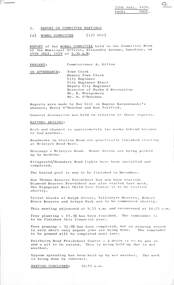
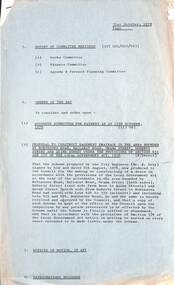
Administrative record - City of Sunshine - Commissioner Mr Alexander "Alex" George Gillon Collection 1976 - 1982 - Report of committee meetings 24th July 1978, City of Sunshine, 25th July 1978
... Report of Committee Meetings Works Committee Report Station Road Roadworks McIntyre Road Drainage Fitzgerald Road and Boundary Road Lights Heated Pool Finished Bon Thomas Pre-School Started Diamond Reserve Pre-School Started Highpoint West Child Care Centre to Start Shortly Ralph Street, Tallintyre Reserve, Robert Bruce Reserve and Selwyn Park to Commence Shorty Fairbairn Road Pre-School Drain Finance Committee Report Medway Golf Club Security Inspections at City Engineer's Depot and Sunshine Tip Agenda and Forward Planning Committee Report Amusement Parlours ...City of Sunshine Alexander "Alex" George Gillon Station Road Deer Park McIntyre Road Sunshine North Fitzgerald Road Boundary Road Brooklyn Bon Thomas Pre-School Started Diamond Reserve Pre-School Started Highpoint West Child Care Centre Ralph Street Tallintyre Reserve Sunshine West Robert Bruce Reserve Selwyn Park Selwyn Street Albion Medway Golf Club Omar Street Maidstone Sunshine Tip Report of Committee Meetings Works Committee Report Station Road Roadworks McIntyre Road Drainage Fitzgerald Road and Boundary Road Lights Heated Pool Finished Bon Thomas Pre-School Started Diamond Reserve Pre-School Started Highpoint West Child Care Centre to Start Shortly Ralph Street, Tallintyre Reserve, Robert Bruce Reserve and Selwyn Park to Commence Shorty Fairbairn Road Pre-School Drain Finance Committee Report Medway Golf Club Security Inspections at City Engineer's Depot and Sunshine Tip Agenda and Forward Planning Committee Report Amusement Parlours Paper Report Administrative record City of Sunshine - Commissioner Mr Alexander "Alex" George Gillon Collection 1976 - 1982 - Report of committee meetings 24th July 1978 City of Sunshine ...Report of Committee Meetings Works Committee Report Station Road Roadworks McIntyre Road Drainage Fitzgerald Road and Boundary Road Lights Heated Pool Finished Bon Thomas Pre-School Started Diamond Reserve Pre-School Started Highpoint West Child Care Centre to Start Shortly Ralph Street, Tallintyre Reserve, Robert Bruce Reserve and Selwyn Park to Commence Shorty Fairbairn Road Pre-School Drain Finance Committee Report Medway Golf Club Security Inspections at City Engineer's Depot and Sunshine Tip Agenda and Forward Planning Committee Report Amusement Parlours city of sunshine, alexander "alex" george gillon, station road, deer park, mcintyre road, sunshine north, fitzgerald road, boundary road, brooklyn, bon thomas pre-school started, diamond reserve pre-school started, highpoint west child care centre, ralph street, tallintyre reserve, sunshine west, robert bruce reserve, selwyn park, selwyn street, albion, medway golf club, omar street, maidstone, sunshine tip -
 Sunshine and District Historical Society Incorporated
Administrative record - City of Sunshine - Commissioner Mr Alexander "Alex" George Gillon Collection 1976 - 1982 - Minutes of the Ordinary Meeting of Council Held on 17th October 1978, City of Sunshine, 17th October 1978
... Sewerage Mapledene Court and Dinnell Street Sunshine West Street Lighting Cost Sharing Western Highway (Ballarat Road) between Hampshire Road and Anderson Road Sunshine View Estate Stage 2 Partial Private Street Scheme Hampshire Road and Wright Street Traffic Signals Finalisation of Fourth Avenue Group Private Street Scheme Provision of Sewerage Facilities Tallintyre Road Report of the Building Surveyor Building Over Easement 204 Wright Street Sunshine West Building Over Easement 2 Mia Court Sunshine Building Over Easement 745 Ballarat Road Deer Park Siting of Building 58 Birchwood Boulevard Deer Park Siting of Building Lot 42 Phyliss Parade Deer Park Ruinous and Dangerous Building 28 & 30 Ridley Street Sunshine Ruinous and Dangerous Building 41 Wright Street Sunshine Report of Committee Meetings Finance Committee Plant Purchase Out of Replacement Account Agenda and Forward Planning Committee Proposal to Construct Warrs Road (Northern Section) Under the Provisions of Division 10 of Part XIX of the Local Government Act 1958 Extraordinary Business Planning Permit Application Take Away Food Premises Cafe Amusement Parlour Highpoint City 200 Rosamond Road...Sewerage Mapledene Court and Dinnell Street Sunshine West Street Lighting Cost Sharing Western Highway (Ballarat Road) between Hampshire Road and Anderson Road Sunshine View Estate Stage 2 Partial Private Street Scheme Hampshire Road and Wright Street Traffic Signals Finalisation of Fourth Avenue Group Private Street Scheme Provision of Sewerage Facilities Tallintyre Road Report of the Building Surveyor Building Over Easement 204 Wright Street Sunshine West Building Over Easement 2 Mia Court Sunshine Building Over Easement 745 Ballarat Road Deer Park Siting of Building 58 Birchwood Boulevard Deer Park Siting of Building Lot 42 Phyliss Parade Deer Park Ruinous and Dangerous Building 28 & 30 Ridley Street Sunshine Ruinous and Dangerous Building 41 Wright Street Sunshine Report of Committee Meetings Finance Committee Plant Purchase Out of Replacement Account Agenda and Forward Planning Committee Proposal to Construct Warrs Road (Northern Section) Under the Provisions of Division 10 of Part XIX of the Local Government Act 1958 Extraordinary Business Planning Permit Application Take Away Food Premises Cafe Amusement Parlour Highpoint City 200 Rosamond Road Stapled paper report of the council meeting held on 17th October, 1978. ...Minutes of the Ordinary Meeting of Council held on 17th October 1978 Report of the Town Clerk's Department Report of the Town Clerk Lease G.U.D. Premises Maribyrnong Funding Recreational Projects Inquiry into Role of Local Government Home Help Subsidies Municipal Boundaries Between Keilor and Sunshine Creation of Reserve Fund Report of the Co-Ordinator of Welfare Services Early Childhood Development Programme Report of the Chief Health Inspector Health Act Registrations Applications for Transfer of Proprietorship of Premises under the Health Act B.C.G. Campaign Sunshine Municipality Mantoux Test for Active Tuberculosis J.L. Mactaggart (Victoria) Pty Ltd Establishment of Rendering Plant Report of Inspector of Weights & Measures Report of the Medical Officer of Health Report of Chief By-Laws Officer Parking Restrictions Fairbairn Road and Tallintyre Road Report of the City Librarian Library Week Report of the Municipal Recreation Officer Tallintyre Reserve Football Ground Sunshine Heights Football Club and West United Football Club Summer Grounds Rental Costs Sporting Season 1978/79 Swimming Pool Management Plan Report of the City Engineer Retail Network Planning Strategy Town Planning General Proposed Shopping Centre Taylors Road City of Keilor Newmarket Saleyards and Special Use Zone 7 Planning Permit Application Sky Sign 193 Hampshire Road Sunshine Amendment 70 Part 4B to the Melbourne Metropolitan Planning Scheme Planning Permit Application Advertising Bunting North East Corner Mitchell Street and Ashley Street Planning Permit Application Consulting Rooms Lot 7 Devonshire Road North West Corner Gertrude Street Planning Permit Application Service Premise and Caretaker's Dwelling Lot 1 Ballarat Road Sunshine Rezoning Land Occupied by the Sunshine Swimming Pool Kennedy Street and Service Street Proposed Children's Service Centre Andrea Street St. Albans Plan of Subdivision Disraeli Street and Buchanan Street Plan of Subdivision Justin Road South East Side Consolidation of Title Ormond Road Contract Kerb & Channel Berkshire Road Location and Construction of Outer Ring Road and F12 Bon Thomas Reserve Development Boring Operation M.M.B.W. Sewerage Mapledene Court and Dinnell Street Sunshine West Street Lighting Cost Sharing Western Highway (Ballarat Road) between Hampshire Road and Anderson Road Sunshine View Estate Stage 2 Partial Private Street Scheme Hampshire Road and Wright Street Traffic Signals Finalisation of Fourth Avenue Group Private Street Scheme Provision of Sewerage Facilities Tallintyre Road Report of the Building Surveyor Building Over Easement 204 Wright Street Sunshine West Building Over Easement 2 Mia Court Sunshine Building Over Easement 745 Ballarat Road Deer Park Siting of Building 58 Birchwood Boulevard Deer Park Siting of Building Lot 42 Phyliss Parade Deer Park Ruinous and Dangerous Building 28 & 30 Ridley Street Sunshine Ruinous and Dangerous Building 41 Wright Street Sunshine Report of Committee Meetings Finance Committee Plant Purchase Out of Replacement Account Agenda and Forward Planning Committee Proposal to Construct Warrs Road (Northern Section) Under the Provisions of Division 10 of Part XIX of the Local Government Act 1958 Extraordinary Business Planning Permit Application Take Away Food Premises Cafe Amusement Parlour Highpoint City 200 Rosamond Road city of sunshine, alexander "alex" george gillon, g.u.d., burton crescent, maribyrnong, tallintyre reserve, sunshine heights football club, west united football club, kermeen street, sunshine west, taylors road, st. albans, hampshire road, sunshine, mitchell street, ashley street, maidstone, devonshire road, gertrude street, ballarat road, sunshine swimming pool, kennedy street, service street, andrea street, disraeli street, buchanan street, justin road, tottenham, ormond road, berkshire road, bon thomas reserve, quinn street, deer park, mapledene court, dinnell street, western highway, anderson road, wright street, fourth avenue, tallintyre road, mia court, birchwood boulevard, phyliss parade, ridley street, albion, warrs road, highpoint city, rosamond road -
 Sunshine and District Historical Society Incorporated
Administrative record - City of Sunshine - Commissioner Mr Alexander "Alex" George Gillon Collection 1976 - 1982 - Extraordinary Business Report of the Town Clerk 31st October 1978, City of Sunshine, 31st October 1978
... Albans Sydney Street Albion Highpoint West Rosamond Road Maribyrnong Hulett Street Robinsons Road Ballarat Road Orama Street Doherty Street Quinn Street Deer Park Extraordinary Business Report of the Town Clerk Errington Reserve South East Corner Ownership Dispute Report of the City Librarian Unemployment Discussion Report of the City Engineer Planning Permit Application 36 Sydney Street Advertising Signs for Child Minding Centre Planning Permit Application Take Away Food Premise Cafe Amusement Parlour Highpoint West 200 Rosamond Road Application to Country Road Board for Funds for the Year Ending 30th June 1980 Construction of Hulett Street Construction of Sydney Street Orders of the Day Accounts Submitted for Payment as at 15th October 1978 Proposal to Construct Easement Drainage in the Area Bounded by Robinsons Road, Ballarat Road, Orama Street, Doherty Street and Quinn Street Foolscap sized document. ...Extraordinary Business Report of the Town Clerk Errington Reserve South East Corner Ownership Dispute Report of the City Librarian Unemployment Discussion Report of the City Engineer Planning Permit Application 36 Sydney Street Advertising Signs for Child Minding Centre Planning Permit Application Take Away Food Premise Cafe Amusement Parlour Highpoint West 200 Rosamond Road Application to Country Road Board for Funds for the Year Ending 30th June 1980 Construction of Hulett Street Construction of Sydney Street Orders of the Day Accounts Submitted for Payment as at 15th October 1978 Proposal to Construct Easement Drainage in the Area Bounded by Robinsons Road, Ballarat Road, Orama Street, Doherty Street and Quinn Street city of sunshine, alexander "alex" george gillon, errington reserve, main road east, st. albans, sydney street, albion, highpoint west, rosamond road, maribyrnong, hulett street, robinsons road, ballarat road, orama street, doherty street, quinn street, deer park -
 Sunshine and District Historical Society Incorporated
Administrative record - City of Sunshine - Commissioner Mr Alexander Alex George Gillon Collection 1976 - 1982 -- Minutes of the ordinary meeting of council held on 16th November 1977, City of Sunshine, 9th November 1977
... Richardsons & Sons Social Club Prohibited Parking Various Streets Deer Park Primary School Report of City Engineer Land Use Permit Application Consulting Rooms Dental Surgery Lot 193 Fairbairn Road Land Use Permit Application Light Industry Station Road Land Use Permit Application Motor Body Works (Panel Beating) 3 Bank Street Land Use Permit Application Caravan Park Sunshine Road Land Use Permit Application Amusement Parlour 21A Sun Crescent Land Use Permit Application Storage, Supply and Retails of Quarry Products Sands, Cement and Garden Supplies 1 Station Road Land Use Permit Application Flats Lots 24 & 25 Matthew Street Land Use Permit Application Lot 42 Killara Street Shopping Centre Site North West Corner Station Road and Neale Road Land Use Permit Extension to Shopping Centre Highpoint West Land Use Permit Bird Lot 83 Aviary Sandford Avenue Melbourne Metropolitan Planning Scheme Definition of Hotel and Cabaret Licence Carvan Parks Plan of Subdivision Wintersun Drive Albanvale Plan of Subdivision Fairbairn Road and Plantation Street and The Esplanade Contract Supply & Maintenance of Vehicles Annual Supply of Bituminous Concrete Coping with Disasters Australian Hospital Association Annual Conference Canberra New Passenger Bus Shelters Melbourne & Metropolitan Tramways Board Western Highway Western Highway / Anderson Road / McIntyre Road Statcon Signal Programme Public Lighting Agreement Between the City of Sunshine and the State Electricity Commission Tender Berkshire Road Kerb & Channel Report of the Building Surveyor Installation of Underground Tank Lot 1 Ballarat Road Corner Burke Street Braybrook Illegal Shed & Carport 11 Oleander Drive St. ...Richardsons & Sons Social Club Prohibited Parking Various Streets Deer Park Primary School Report of City Engineer Land Use Permit Application Consulting Rooms Dental Surgery Lot 193 Fairbairn Road Land Use Permit Application Light Industry Station Road Land Use Permit Application Motor Body Works (Panel Beating) 3 Bank Street Land Use Permit Application Caravan Park Sunshine Road Land Use Permit Application Amusement Parlour 21A Sun Crescent Land Use Permit Application Storage, Supply and Retails of Quarry Products Sands, Cement and Garden Supplies 1 Station Road Land Use Permit Application Flats Lots 24 & 25 Matthew Street Land Use Permit Application Lot 42 Killara Street Shopping Centre Site North West Corner Station Road and Neale Road Land Use Permit Extension to Shopping Centre Highpoint West Land Use Permit Bird Lot 83 Aviary Sandford Avenue Melbourne Metropolitan Planning Scheme Definition of Hotel and Cabaret Licence Carvan Parks Plan of Subdivision Wintersun Drive Albanvale Plan of Subdivision Fairbairn Road and Plantation Street and The Esplanade Contract Supply & Maintenance of Vehicles Annual Supply of Bituminous Concrete Coping with Disasters Australian Hospital Association Annual Conference Canberra New Passenger Bus Shelters Melbourne & Metropolitan Tramways Board Western Highway Western Highway / Anderson Road / McIntyre Road Statcon Signal Programme Public Lighting Agreement Between the City of Sunshine and the State Electricity Commission Tender Berkshire Road Kerb & Channel Report of the Building Surveyor Installation of Underground Tank Lot 1 Ballarat Road Corner Burke Street Braybrook Illegal Shed & Carport 11 Oleander Drive St. ...Minutes of the ordinary meeting of council held on 16th November 1977 Report of Town Clerk's Department Report of the Town Clerk Loan Interest Land Lots 25, 6, 29 & 30 Chifley Drive Proposed Acquisition by the Melbourne & Metropolitan Board of Works Western Region Commission Proposed Administration Land Transfer Reserve Neale Road Deer Park Hall Management Committee Financial Statement Rates, Sanitary and Interest Abandonments for 1976/77 Purchase of 24 Northumberland Road Lease of Premises Dickson Street for Citizens Advice Bureau Proposed Purchase of Land Nickson's Estate for Childcare purposes Purchase of Sunshine Tip Site Finalisation of Contract Inquiry into Housing Commission Land Purchases Subdivision Ascquith Investments Proposed to Lease G.U.D. Premises Maribyrnong Report of the Co-Ordinator Welfare Services State Relief Committee Appeals Tribunal for Migrants Under Threat of Deportation Family and Community Services Consultative Committee Caravan Parks & Permanent Hut or Bungalow Dwellings Report of the Chief Health Inspector Application for Installation of Gas Fired Dry Spetic Tank Units Application for Spetic Tanks Immunization Prosecution Proceedings Sunshine Magistrates Court Health (Septic Tank) Regulations 1977 Report of the Chief By-Laws Officer Court Proceedings Parking Infringements Helicoptor Landing Pennell Reserve D. Richardsons & Sons Social Club Prohibited Parking Various Streets Deer Park Primary School Report of City Engineer Land Use Permit Application Consulting Rooms Dental Surgery Lot 193 Fairbairn Road Land Use Permit Application Light Industry Station Road Land Use Permit Application Motor Body Works (Panel Beating) 3 Bank Street Land Use Permit Application Caravan Park Sunshine Road Land Use Permit Application Amusement Parlour 21A Sun Crescent Land Use Permit Application Storage, Supply and Retails of Quarry Products Sands, Cement and Garden Supplies 1 Station Road Land Use Permit Application Flats Lots 24 & 25 Matthew Street Land Use Permit Application Lot 42 Killara Street Shopping Centre Site North West Corner Station Road and Neale Road Land Use Permit Extension to Shopping Centre Highpoint West Land Use Permit Bird Lot 83 Aviary Sandford Avenue Melbourne Metropolitan Planning Scheme Definition of Hotel and Cabaret Licence Carvan Parks Plan of Subdivision Wintersun Drive Albanvale Plan of Subdivision Fairbairn Road and Plantation Street and The Esplanade Contract Supply & Maintenance of Vehicles Annual Supply of Bituminous Concrete Coping with Disasters Australian Hospital Association Annual Conference Canberra New Passenger Bus Shelters Melbourne & Metropolitan Tramways Board Western Highway Western Highway / Anderson Road / McIntyre Road Statcon Signal Programme Public Lighting Agreement Between the City of Sunshine and the State Electricity Commission Tender Berkshire Road Kerb & Channel Report of the Building Surveyor Installation of Underground Tank Lot 1 Ballarat Road Corner Burke Street Braybrook Illegal Shed & Carport 11 Oleander Drive St. Albans Installation of Two Underground Tanks 390 Ballarat Road Sunshine Bank Safety Willis Street Pre-School Centre Orders of the Day Accounts Submitted for Payment Subdivision for Asquith Investiments Public Open Space Extraordinary Business Consideration of Tenders for Erection of Fairbairn Road Pre-School Centre city of sunshine, alexander "alex" george gillon, chifley drive, maribyrnong, g.u.d., neale road reserve, neale road, deer park, deer park hall management committee, northumberland road, sunshine north, citizens advice bureu, dickson street, sunshine, sunshine tip, richardsons & sons social club, deer park primary school, ballarat road, fairbairn road, sunshine west, bank street, braybrook, sun crescent, matthew street, killara street, station road, highpoint west, sandford avenue, wintersun drive, albanvale, plantation street, the esplanade, western highway, anderson road, mcintyre road, burke street, oleander drive, st. albans, willis street pre-school centre, willis street, fairbairn road pre-school centre -
 Sunshine and District Historical Society Incorporated
Administrative record - City of Sunshine - Commissioner Mr Alexander Alex George Gillon Collection 1976 - 1982 - Minutes of the ordinary meeting of council held on 23rd February 1977, City of Sunshine, 23rd February 1977
... Andrews Street Land Use Permit Application Amusement Parlour 32A Sydney Street Land Use Permit Application Fencing & Pram Park St. ...Andrews Street Land Use Permit Application Amusement Parlour 32A Sydney Street Land Use Permit Application Fencing & Pram Park St. ...Minutes of the Ordinary Meeting of Council held on 23rd February 1977 Report of the Town Clerk Transfer of Reserves Nickson Subdivision Hampton Avenue Private Street Scheme Public Open Space Lot 7, 8 & 9 Graham Street South Crown Lands Adjoining Kororoit Creek Anderson Road Sunshine Report of the Chief Health Inspector Application for Septic Tank Application for Installation of Gas Fired Dry Septic Tank Units Prosecutions Proceedings Sunshine Magistrates Court Report of the Medical Officer of Health Report of the Weights & Measures Inspector Weights & Measures Report for the Two Months Ending 31st January 1977 Prosecutions Proceedings Sunshine Magistrates Court Report of the Welfare Officer Commonwealth Funds for Kindergartens St. Albans Commonwealth Government Task Force on Co-Ordinator of Health and Welfare Report on Holiday Activities January 1988 Kindergarten for Physically Handicapped Children Report of City Engineer Report on Contract Dalton Street Private Street Scheme Report on Contract Private Subdivision Albanvale Stage 17 Melbourne & Metropolitan Planning Scheme Variation of Delegation McIntyre Road Parking Restrictions Request for Contribution Towards Photographic Competition Maribyrnong River Western Region Commission Painting of Fire Hydrants M.M.B.W. Land Use Permit Consulting Rooms Ainsworth Avenue Plan of Strata Subdivision 18 - 20 Marsden Crescent Consolidation of Title Railway Parade Land Use Permit Application Extension of St. Peter Chanel Primary School Ballarat Road Land Use Permit Application Alterations to Greek Orthodox Church of St. Andrew Church Corner Simmie Street & St. Andrews Street Land Use Permit Application Amusement Parlour 32A Sydney Street Land Use Permit Application Fencing & Pram Park St. Andrews Street and Simmie Street Land Use Permit Application Extension to Holy Eucharist Primary School Lot 2 Oleander Drive Land Use Permit Application Proposed Warehouse and Workshops Lot 311 Ayton Street Consolidation of Title Hampton Avenue & Bolitho Street Central Avenue Drain Sunshine Land Use Permit Application Factory Holmwood Road Plan of Strata Subdivision 8 & 10 Middle Road Land Use Permit Application Warehouse Office and Showroom 112 Mitchell Street Land Use Permit Application Grandview Avenue and Warrs Road Amendment to Approved Plan Land Use Permit Application Emu Road Amendment to Plan Land Use Permit Application Sign Ashley Hotel Ballarat Road Drainage Mitchell Street Condition of Tennis Courts Rosamond Road Bowling Club Report of the Building Surveyor Study Leave Air Conditioning Municipal Offices & Library Installation of Underground Tank 150 Glengala Road Sunshine West Fencing 3 Kennedy Street Undersize Allotment Lot 78 Forrest Street Ardeer Undersize Allotment Lot 584 Quinn Street Deer Park Outbuildings 97 Westmoreland Road Sunshine North Installation of Underground Tank Massey Ferguson Premises Devonshire Road Undersize Allotment Lot 32 Ballarat Road South West Corner of Farnsworth Street Sunshine Sunblind Under Veranda for Shop 110 Hertford Road Installation of Above Ground Tank 43 Burke Street Braybrook Dangerous Outbuilding 5 Wattle Road Maidstone Rosamond Bowling Club Building Refund Cash In Liew Amount Flats Lot 13 Grandview Avenue Maribyrnong Installation of Underground Tank Golden Fleece Petroleum Lot 2 Sunshine Road Tottenham Flats 2 Stenhouse Avenue Brooklyn Tenders for Purchase of Surplus Equipment Tender for Disposal of Garbage Holders Orders of the Day Accounts Submitted for Payment as at 1st February 1977 city of sunshine, alexander "alex" george gillon, hampton avenue, sunshne, sydney street, albion, kororoit creek, anderson road, graham street south, ainsworth avenue, sunshine west, simmie street, st. andrews street, dalton street, mcintyre road, sunshine north, maribyrnong rive, marsden crescent, st. albans, st. peter chanel primary school, ballarat road, deer park, greek orthodox church of st. andrew, holy eucharist primary school, oleander drive, ayton street, bolitho street, holmwood road, brooklyn, middle road, maribyrnong, mitchell street, maidstone, grandview avenue, warrs road, emu road, ashley hotel, braybrook, rosamond road bowling club, rosamond road tennis club, rosamond road, glengala road, kennedy street, forrest street, ardeer, quinn street, westmoreland road, farnsworth street, hertford road, burke street, wattle road, sunshine road, tottenham, stenhouse avenue -
 Sunshine and District Historical Society Incorporated
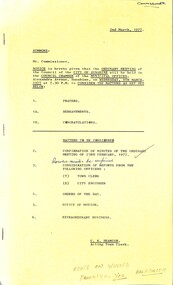
Administrative record - City of Sunshine - Commissioner Mr Alexander Alex George Gillon Collection 1976 - 1982 - Notice of ordinary meeting of the council of the City of Sunshine to be held on 9th March 1977, City of Sunshine, 2nd March 1977
... Park Metropolitan Fire Brigades Board Rates & Sanitary Interest Abandonments for 1976/77 Safety Precautions with Swimming Pools Land Transfer from D.U.L. National Estate Programme Award Matters Variation to the General Award for Building Inspectors Staff Gratuity Scheme Federal Funding for Local Government PRojects Report of the Chief Health Inspector Amusements Parlour Application Woolworths Shop Hampshire Road Corner Devonshire Road Application to Extend an Amusement Parlour 69 McIntyre Road Application for Septic Tank Prosecutions Proceedings Sunshine Magistrates Court Conditions of Flats Application Office & Amenities Block Colyer Fehr Pty Ltd Burke Street Braybrook Authorised Officer for Immunisation Procedures for Housing Orders Infant Welfare Request for Opening Outside Normal Hours Report of the By-Laws Officer Scout Hall Signs on Lamp Poles Various Area Report of the Welfare Officers People Rights Booklets Family Day Care Report of the City Library Extended Hours of Opening Rainbow Workshop Report of the City Engineer Furlong Road Estate Stage 6 Westerngate Estate Stage 1A Plan of Subdivision Tallintyre Road Housing Commission of Victoria Land Use Permit Application Detached House 38 Doherty Street Land Use Permit Application Detached House Lot 497 Leila Street Land Use Permit Application Extension to Flats Lot 50 Oldfield Street Land Use Permit Application Detached House Lot 275 Orama Street Rezoning St. ...Park Metropolitan Fire Brigades Board Rates & Sanitary Interest Abandonments for 1976/77 Safety Precautions with Swimming Pools Land Transfer from D.U.L. National Estate Programme Award Matters Variation to the General Award for Building Inspectors Staff Gratuity Scheme Federal Funding for Local Government PRojects Report of the Chief Health Inspector Amusements Parlour Application Woolworths Shop Hampshire Road Corner Devonshire Road Application to Extend an Amusement Parlour 69 McIntyre Road Application for Septic Tank Prosecutions Proceedings Sunshine Magistrates Court Conditions of Flats Application Office & Amenities Block Colyer Fehr Pty Ltd Burke Street Braybrook Authorised Officer for Immunisation Procedures for Housing Orders Infant Welfare Request for Opening Outside Normal Hours Report of the By-Laws Officer Scout Hall Signs on Lamp Poles Various Area Report of the Welfare Officers People Rights Booklets Family Day Care Report of the City Library Extended Hours of Opening Rainbow Workshop Report of the City Engineer Furlong Road Estate Stage 6 Westerngate Estate Stage 1A Plan of Subdivision Tallintyre Road Housing Commission of Victoria Land Use Permit Application Detached House 38 Doherty Street Land Use Permit Application Detached House Lot 497 Leila Street Land Use Permit Application Extension to Flats Lot 50 Oldfield Street Land Use Permit Application Detached House Lot 275 Orama Street Rezoning St. ...Notice of Ordinary Meeting of the Council of the City of Sunshine to be held on 9th March 1977 Report of the Acting Town Clerk Acquisition of land bounded by Gooding and Willis Streets and the Railway Line St. Albans Cat Protection Society Audit Fees Lease of Navigational Deacon site in Robinsons Road Deer Park Metropolitan Fire Brigades Board Rates & Sanitary Interest Abandonments for 1976/77 Safety Precautions with Swimming Pools Land Transfer from D.U.L. National Estate Programme Award Matters Variation to the General Award for Building Inspectors Staff Gratuity Scheme Federal Funding for Local Government PRojects Report of the Chief Health Inspector Amusements Parlour Application Woolworths Shop Hampshire Road Corner Devonshire Road Application to Extend an Amusement Parlour 69 McIntyre Road Application for Septic Tank Prosecutions Proceedings Sunshine Magistrates Court Conditions of Flats Application Office & Amenities Block Colyer Fehr Pty Ltd Burke Street Braybrook Authorised Officer for Immunisation Procedures for Housing Orders Infant Welfare Request for Opening Outside Normal Hours Report of the By-Laws Officer Scout Hall Signs on Lamp Poles Various Area Report of the Welfare Officers People Rights Booklets Family Day Care Report of the City Library Extended Hours of Opening Rainbow Workshop Report of the City Engineer Furlong Road Estate Stage 6 Westerngate Estate Stage 1A Plan of Subdivision Tallintyre Road Housing Commission of Victoria Land Use Permit Application Detached House 38 Doherty Street Land Use Permit Application Detached House Lot 497 Leila Street Land Use Permit Application Extension to Flats Lot 50 Oldfield Street Land Use Permit Application Detached House Lot 275 Orama Street Rezoning St. Albans Road and Percy Street St. Albans Glengala Estate Stage 3 Abandonment of Easement Land Use Permit Application Motorcycle Sales and Service 87 - 89 McIntyre Road Land Use Permit Application Sign Magnet Store Ballarat Road Deer Park Exchange of Land Nickson's Subdivision Furlong Road abutting the North West Boundary of the Sunshine Tip. Lots 700 to 407 abuts on to Denton Avenue and came across garbage. Transport Regulation Board Variation to Existing Bus Route 455 Transport Regulation Board Bus Service Glengala Estate Preferred Development Area Deer Park Variation to Contract Glengala Estate Stage 3 Meals on Wheel Van Irrigation of Reserves Employment of Council Plumber Land Use Permit Application Subdivision Geelong Road and Old Geelong Road Geelong Road at Burgess Road Brooklyn Land Use Permit Application Extension of Annunciation Primary School Playground Heather Avenue & Eames Avenue Central Avenue Drain Culvert at Western Avenue Land Use Permit Application Lot 122 Whitehill Avenue Land Use Permit Application Home for the Frail / Aged Darnley Street North West Corner Lily Street Land Use Permit Application Factory 172 McIntyre Road Steers Street Group Part Private Street Scheme Easement Drain under the Health Act Albion Navigator Street North of The Esplanade Proposed 6 Tonne Load Limit Strata Subdivision 1 Fabian Court Cranwell Street Kerb & Channel & Footpath Construction Land Use Permit Additions to Christ the King Primary School & Caroline Chisholm Catholic College Churchill Avenue Plan of Subdivision Ballarat Road South Side between Ashley Street and Whittaker Street Land Use Permit Application Extension of Offices Pridham Holdings Evans Street Alterations to Flat Areas Maribyrnong Opening in Party Walls Lots 24 & 25 Alick Road Brooklyn Undersize Allotment 17 Benjamin Street Installation of Underground Tank Orders of the Day Accounts Submitted for Payment as at 15th February 1977 Confirmation of Loan with Melbounre & Metropolitan Board of Works Plan of Subdivision 36 Market Road city of sunshine, alexander "alex" george gillon, gooding street, willis street, st. albans, navigational beacon, robinsons road, deer park, woolworths, hampshire road, devonshire road, sunshine, mcintyre road, sunshine north, burke street, furlong road, doherty street, leila street, oldfield street, sunshine west, orama street, st. albans road, percy street, ballarat road, sunshine tip, geelong road, old geelong road, burgess road, brooklyn, annunciation primary school, eames avenue, heather avenue, western avenue, whitehill avenue, darnley street, lily street, braybrook, navigator street, the esplanade, maribyrnong, cranwell street, christ the king primary school, caroline chisholm catholic college, churchill avenue, ashley street, whittaker street, pridham holdings, evans street, alick road, benjamin street -
 Sunshine and District Historical Society Incorporated
Administrative record - City of Sunshine - Commissioner Mr Alexander Alex George Gillon Collection 1976 - 1982 - Minutes of the ordinary meeting of council held on 9th March 1977, City of Sunshine, 9th March 1977
... Park Metropolitan Fire Brigades Board Rates & Sanitary Interest Abandonments for 1976/77 Safety Precautions with Swimming Pools Land Transfer from D.U.L. National Estate Programme Award Matters Variation to the General Award for Building Inspectors Staff Gratuity Scheme Federal Funding for Local Government PRojects Report of the Chief Health Inspector Amusements Parlour Application Woolworths Shop Hampshire Road Corner Devonshire Road Application to Extend an Amusement Parlour 69 McIntyre Road Application for Septic Tank Prosecutions Proceedings Sunshine Magistrates Court Conditions of Flats Application Office & Amenities Block Colyer Fehr Pty Ltd Burke Street Braybrook Authorised Officer for Immunisation Procedures for Housing Orders Infant Welfare Request for Opening Outside Normal Hours Report of the By-Laws Officer Scout Hall Signs on Lamp Poles Various Area Report of the Welfare Officers People Rights Booklets Family Day Care Report of the City Library Extended Hours of Opening Rainbow Workshop Report of the City Engineer Furlong Road Estate Stage 6 Westerngate Estate Stage 1A Plan of Subdivision Tallintyre Road Housing Commission of Victoria Land Use Permit Application Detached House 38 Doherty Street Land Use Permit Application Detached House Lot 497 Leila Street Land Use Permit Application Extension to Flats Lot 50 Oldfield Street Land Use Permit Application Detached House Lot 275 Orama Street Rezoning St. ...Park Metropolitan Fire Brigades Board Rates & Sanitary Interest Abandonments for 1976/77 Safety Precautions with Swimming Pools Land Transfer from D.U.L. National Estate Programme Award Matters Variation to the General Award for Building Inspectors Staff Gratuity Scheme Federal Funding for Local Government PRojects Report of the Chief Health Inspector Amusements Parlour Application Woolworths Shop Hampshire Road Corner Devonshire Road Application to Extend an Amusement Parlour 69 McIntyre Road Application for Septic Tank Prosecutions Proceedings Sunshine Magistrates Court Conditions of Flats Application Office & Amenities Block Colyer Fehr Pty Ltd Burke Street Braybrook Authorised Officer for Immunisation Procedures for Housing Orders Infant Welfare Request for Opening Outside Normal Hours Report of the By-Laws Officer Scout Hall Signs on Lamp Poles Various Area Report of the Welfare Officers People Rights Booklets Family Day Care Report of the City Library Extended Hours of Opening Rainbow Workshop Report of the City Engineer Furlong Road Estate Stage 6 Westerngate Estate Stage 1A Plan of Subdivision Tallintyre Road Housing Commission of Victoria Land Use Permit Application Detached House 38 Doherty Street Land Use Permit Application Detached House Lot 497 Leila Street Land Use Permit Application Extension to Flats Lot 50 Oldfield Street Land Use Permit Application Detached House Lot 275 Orama Street Rezoning St. ...Minutes of the ordinary meeting of council held on 9th March 1977 Report of the Acting Town Clerk Acquisition of land bounded by Gooding and Willis Streets and the Railway Line St. Albans Cat Protection Society Audit Fees Lease of Navigational Deacon site in Robinsons Road Deer Park Metropolitan Fire Brigades Board Rates & Sanitary Interest Abandonments for 1976/77 Safety Precautions with Swimming Pools Land Transfer from D.U.L. National Estate Programme Award Matters Variation to the General Award for Building Inspectors Staff Gratuity Scheme Federal Funding for Local Government PRojects Report of the Chief Health Inspector Amusements Parlour Application Woolworths Shop Hampshire Road Corner Devonshire Road Application to Extend an Amusement Parlour 69 McIntyre Road Application for Septic Tank Prosecutions Proceedings Sunshine Magistrates Court Conditions of Flats Application Office & Amenities Block Colyer Fehr Pty Ltd Burke Street Braybrook Authorised Officer for Immunisation Procedures for Housing Orders Infant Welfare Request for Opening Outside Normal Hours Report of the By-Laws Officer Scout Hall Signs on Lamp Poles Various Area Report of the Welfare Officers People Rights Booklets Family Day Care Report of the City Library Extended Hours of Opening Rainbow Workshop Report of the City Engineer Furlong Road Estate Stage 6 Westerngate Estate Stage 1A Plan of Subdivision Tallintyre Road Housing Commission of Victoria Land Use Permit Application Detached House 38 Doherty Street Land Use Permit Application Detached House Lot 497 Leila Street Land Use Permit Application Extension to Flats Lot 50 Oldfield Street Land Use Permit Application Detached House Lot 275 Orama Street Rezoning St. Albans Road and Percy Street St. Albans Glengala Estate Stage 3 Abandonment of Easement Land Use Permit Application Motorcycle Sales and Service 87 - 89 McIntyre Road Land Use Permit Application Sign Magnet Store Ballarat Road Deer Park Exchange of Land Nickson's Subdivision Furlong Road abutting the North West Boundary of the Sunshine Tip. Lots 700 to 407 abuts on to Denton Avenue and came across garbage. Transport Regulation Board Variation to Existing Bus Route 455 Transport Regulation Board Bus Service Glengala Estate Preferred Development Area Deer Park Variation to Contract Glengala Estate Stage 3 Meals on Wheel Van Irrigation of Reserves Employment of Council Plumber Land Use Permit Application Subdivision Geelong Road and Old Geelong Road Geelong Road at Burgess Road Brooklyn Land Use Permit Application Extension of Annunciation Primary School Playground Heather Avenue & Eames Avenue Central Avenue Drain Culvert at Western Avenue Land Use Permit Application Lot 122 Whitehill Avenue Land Use Permit Application Home for the Frail / Aged Darnley Street North West Corner Lily Street Land Use Permit Application Factory 172 McIntyre Road Steers Street Group Part Private Street Scheme Easement Drain under the Health Act Albion Navigator Street North of The Esplanade Proposed 6 Tonne Load Limit Strata Subdivision 1 Fabian Court Cranwell Street Kerb & Channel & Footpath Construction Land Use Permit Additions to Christ the King Primary School & Caroline Chisholm Catholic College Churchill Avenue Plan of Subdivision Ballarat Road South Side between Ashley Street and Whittaker Street Land Use Permit Application Extension of Offices Pridham Holdings Evans Street Alterations to Flat Areas Maribyrnong Report of the Building Surveyor Opening in Party Walls Lots 24 & 25 Alick Road Brooklyn Undersize Allotment 17 Benjamin Street Installation of Underground Tank Orders of the Day Accounts Submitted for Payment as at 15th February 1977 Confirmation of Loan with Melbounre & Metropolitan Board of Works city of sunshine, alexander "alex" george gillon, gooding street, willis street, st. albans, navigational deacon, robinsons road, deer park, woolworths, hampshire road, devonshire road, sunshine, mcintyre road, burke street, braybrook, tallintyre road, doherty street, leila street, oldfield street, sunshine west, orama street, st. albans road, percy street, sunshine north, furlong road, sunshine tip, denton avenue, geelong road, old geelong road, brooklyn, burgess road, annunciation primary school, heather avenue, eames avenue, western avenue, whitehill avenue, darnley street, lily street, fabian court, navigator street, the esplanade, maribyrnong, cranwell street, christ the king primary school, caroline chisholm catholic college, churchill avenue, ashley street, whittaker street, pridham holdings, alick road, evans street, benjamin street, market road -
 Sunshine and District Historical Society Incorporated
Administrative record - City of Sunshine - Commissioner Mr Alexander Alex George Gillon Collection 1976 - 1982 - Minutes of the ordinary meeting of council held on 7th September 1977, City of Sunshine, 7th September 1977
... Brych and his Method of Cancer Treatment Report of the Medical Officer of Health Report of the By-Laws Officer Court Proceedings Parking Infringements Report of City Engineer Melbourne Metropolitan Planning Scheme Request for 3 Phase Power Home Occupation Servante Street Land Use Permit Application Office and Warehouse Complex Fairbairn Road Land Use Permit Application Three Display Homes Energy Conservation Display (Including Windmill) and Associated Car Parking Ballarat Road and Meager Street Deer Park Land Use Permit Application Illuminated Sky Sign 93 Station Road Land Use Permit Application Amusement Parlour Sunshine Crescent Land Use Permit Application Store Addition to Existing Shops and Dwelling 59 Sydney Street Land Use Permit Factory Lots 92, 93 & 94 Maida Avenue Land Use Permit Proposed Facia Sign 29 St. ...Brych and his Method of Cancer Treatment Report of the Medical Officer of Health Report of the By-Laws Officer Court Proceedings Parking Infringements Report of City Engineer Melbourne Metropolitan Planning Scheme Request for 3 Phase Power Home Occupation Servante Street Land Use Permit Application Office and Warehouse Complex Fairbairn Road Land Use Permit Application Three Display Homes Energy Conservation Display (Including Windmill) and Associated Car Parking Ballarat Road and Meager Street Deer Park Land Use Permit Application Illuminated Sky Sign 93 Station Road Land Use Permit Application Amusement Parlour Sunshine Crescent Land Use Permit Application Store Addition to Existing Shops and Dwelling 59 Sydney Street Land Use Permit Factory Lots 92, 93 & 94 Maida Avenue Land Use Permit Proposed Facia Sign 29 St. ...Minutes of the ordinary meeting of council held on 7th September 1977 Report of the Town Clerk's Department Report of the Town Clerk Financial Reports Rates, Sanitary and Interest Abandonments for 1976/77 Infant Welfare Services Report of the Department of Health Loan Programme Community Facilities Highpoint West Land Transfer Percy Street Reserve Proposed Sunshine Tip Site Used for That Purpose Sunshine Baseball Club Request for Extension of Lease Western Region Commission Future Operations D. J. Reserve Committee of Management Proposed Increase in Rent and Charges Ground Allocations for Summer Sport 1977/78 Banking Arrangements Combined Pensioners Association Wage Indexation Adjustments Errington Reserve Ground Management Committee Delegation of Authority Site for Kindergarten for Physically Handicapped Children Melbourne Tourist Authority Report of the Co-Ordinator of Welfare Services Victorian Family and Community Service Programme Closure of Access Radio Report of the Chief Health Inspector Prosecutions Proceedings Sunshine Magistrates Court Application for Septic Tanks Application for Installation of Gas Fired Dry Septic Tank Units Request from City of Berwick for Dr. Brych and his Method of Cancer Treatment Report of the Medical Officer of Health Report of the By-Laws Officer Court Proceedings Parking Infringements Report of City Engineer Melbourne Metropolitan Planning Scheme Request for 3 Phase Power Home Occupation Servante Street Land Use Permit Application Office and Warehouse Complex Fairbairn Road Land Use Permit Application Three Display Homes Energy Conservation Display (Including Windmill) and Associated Car Parking Ballarat Road and Meager Street Deer Park Land Use Permit Application Illuminated Sky Sign 93 Station Road Land Use Permit Application Amusement Parlour Sunshine Crescent Land Use Permit Application Store Addition to Existing Shops and Dwelling 59 Sydney Street Land Use Permit Factory Lots 92, 93 & 94 Maida Avenue Land Use Permit Proposed Facia Sign 29 St. Albans Road Land Use Permit Application Two Advertising Hoardings Lot 1 Ballarat Road Land Use Permit Application Office 232A Hampshire Road Land Use Permit Fencing and Pram Park St. Andrews Street and Simmie Street Land Use Permit Application Steel Framed Warehouse Crown Portion 19 Berkshire Road Land Use Permit Application Extension to Existing Warehouse Lots 15, 16 & 17 McIntyre Road and Lots 31, 32, 33, 33 & 35 Cromer Avenue Plan of Subdivision Corner Simmie Street and St. Andrews Street Westerngate Estate Stage 2A Strata Subdivision 22 Forrest Street Plan of Subdivision 8 & 10 Newstead Street Plan of Subdivision 80 & 82 Rockbank Road Plan of Subdivision Warrs Road Steers Street Group Part Private Street Scheme Liquid Waste Disposal Western Region Environment Committee Defective Asphalt Fourth Avenue Private Street Scheme Provision of Water Service to Reserve Ballarat Road Deer Park Rotary Club of Sunshine Vehicle Crossing 79 Fraser Street Statcon Programme Additions to Existing Primary Road Network Western Region Commission Playground Equipment Quotations For Fencing Reconstruction of Sydney Street Tenders Association for Regional Parks & Countryside Commissions of Australia Bon Thomas Reserve Development Access to the Right Bank of the Maribyrnong River Through Council Property (Ex GUD Factory) in Burton Crescent Annual Supply Tender Report of the Building Surveyor Fencing 83 Hall Street Sunshine West Foundations and Footing Seminar House Disraeli Street St. Albans Dwelling Attached to Shop 67 McIntyre Road Sunshine North Cash in Lieu Lot 4 Devonshire Road Sunshine Siting of House Lot 32 Ballarat Road Sunshine Sunshine Indoor Swimming Pool Solar Heating Sunshine Cricket Club Dempster Park Pavilion Orders of the Day Accounts Submitted for Payment as at 31st August 1977 & 1st September 1977 Confirmation of Swimming Pools Fees and Charges city of sunshine, alexander "alex" george gillon, highpoint west, rosamond road, maribyrnong, percy street reserve, percy street, st. albans, sunshine tip, sunshine baseball club, talmage street, d. j. reserve committee of management, errington reserve ground management committee, errington reserve, main road west, servante street, albion, sunshine, fairbairn road, sunshine west, ballarat road, meager street, deer park, station road, sun crescent, sydney street, maida avenue, sunshine north, st. albans road, hampshire road, st. andrews street, simmie street, berkshire road, mcintyre road, cromer avenue, forrest street, newstead street, rockbank road, ardeer, warrs road, fourth avenue, deer park rotary club of sunshine, fraser street, bon thomas reserve, quinn street, maribyrnong river, burton crescent, gud, hall street, disraeli street, devonshire road, sunshine indoor swimming pool, sunshine cricket club, dempster park, phoenix street -
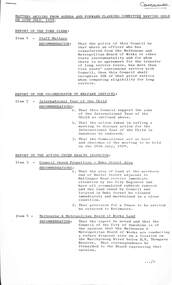 Sunshine and District Historical Society Incorporated
Administrative record - City of Sunshine - Commissioner Mr Alexander Alex George Gillon Collection 1976 - 1982 - Matters Arising Agenda And Forward Committee 10th July 1978, City of Sunshine, 10th July 1978
... Thompson Reserve Maribyrnong Basic Microbiology for Health Services Course Poliomyelitis Immunisation Amusement Parlours Municipal Saleyards Association Report of the Municipal Recreation Officer Future of The Hub and the Indoor Heated Swimming Pool Use of the Marching Girls' Hall Kinder Smith Reserve Lily Street Braybrook by Sunshine East Primary School Report of the City Engineer Planning Permit Application Cafe Lot 4 Glengala Road Sunshine West Proposed Melbourne Metropolitan Planning Scheme Amendment Load Limit on road Tottenham Area More Park Pavilion Orders of the Day Purchase of Second Bookmobile...Thompson Reserve Maribyrnong Basic Microbiology for Health Services Course Poliomyelitis Immunisation Amusement Parlours Municipal Saleyards Association Report of the Municipal Recreation Officer Future of The Hub and the Indoor Heated Swimming Pool Use of the Marching Girls' Hall Kinder Smith Reserve Lily Street Braybrook by Sunshine East Primary School Report of the City Engineer Planning Permit Application Cafe Lot 4 Glengala Road Sunshine West Proposed Melbourne Metropolitan Planning Scheme Amendment Load Limit on road Tottenham Area More Park Pavilion Orders of the Day Purchase of Second Bookmobile Foolscap sized document Administrative record City of Sunshine - Commissioner Mr Alexander Alex George Gillon Collection 1976 - 1982 - Matters Arising Agenda And Forward Committee 10th July 1978 City of Sunshine ...Matters Arising Agenda And Forward Committee 10th July 1978 Report of the Co-Ordinator of Welfare Services International Year of the Child Report of the Acting Chief Health Inspector Council Own Properties Duke Street North End of Butler Street, Mullenger Street and on the Bank of the Maribyrnong River Melbourne & Metropolitan Board of Works Land on Maribyrnong River below D. F. Thompson Reserve Maribyrnong Basic Microbiology for Health Services Course Poliomyelitis Immunisation Amusement Parlours Municipal Saleyards Association Report of the Municipal Recreation Officer Future of The Hub and the Indoor Heated Swimming Pool Use of the Marching Girls' Hall Kinder Smith Reserve Lily Street Braybrook by Sunshine East Primary School Report of the City Engineer Planning Permit Application Cafe Lot 4 Glengala Road Sunshine West Proposed Melbourne Metropolitan Planning Scheme Amendment Load Limit on road Tottenham Area More Park Pavilion Orders of the Day Purchase of Second Bookmobile city of sunshine, alexander "alex" george gillon, fraser street, sunshine, sunshine avenue, gooding street, st. albans, mcintyre road, sunshine north -
 Sunshine and District Historical Society Incorporated
Administrative record - City of Sunshine - Commissioner Mr Alexander Alex George Gillon Collection 1976 - 1982 - Notice of Ordinary Meeting 23rd February 1982, City of Sunshine, 17th February 1982
... Albans Planning Permit Application 67 Dumfries Street Deer Park Consulting Rooms Planning Permit Application Cafe 1B & 1C Bell Street Sunshine West Planning Permit Application Coffee Shop / Amusement Parlour 77 Main Road West St. ...Albans Planning Permit Application 67 Dumfries Street Deer Park Consulting Rooms Planning Permit Application Cafe 1B & 1C Bell Street Sunshine West Planning Permit Application Coffee Shop / Amusement Parlour 77 Main Road West St. ...Ordinary meeting notice including reports from Council's officers Report of Town Clerk Report on Statistical Data Seminar Budgeting for Municipal Governments Transfer of Reserves from Urban Land Authority Proposal to Compulsorily Acquire Lot 99 Pizzey Street Sunshine Report of the Town Clerk Department St. Albans Youth Service Petition Sunshine CYSS Staff Resignation Deer Park Elderly Citizens Club Family Day Care Special Needs Subsidy Report of the Chief Health Inspector Report of the Inspector of Weights & Measures for year ending 31st December 1981 Health Inspector Refresher Course National Conference on Waste Management Litter Bins in Streets Issuing of Septic Tank Approval Notices Aycliffe Drive Infant Welfare Centre Health Act Registrations Application for Transfer of proprietorship of Premises under the Health Act Report of the Superintendent of Traffic and By-laws Dog Act Report of Chief Librarian Proposed Amendments to Sales Tax Law Report of the City Engineer's Department Report of the City Engineer / Planner Estate Improvement Proposal Hargreaves Crescent / Churchill Avenue Braybrook Planning Permit Application Cash-In-Lieu of Payment for Shop St. Albans Road St. Albans Planning Permit Application 67 Dumfries Street Deer Park Consulting Rooms Planning Permit Application Cafe 1B & 1C Bell Street Sunshine West Planning Permit Application Coffee Shop / Amusement Parlour 77 Main Road West St. Albans Planning Permit Application Vehicle Maintenance Workshop Lot 21 McIntyre Road Sunshine North Planning Permit Application Lots 1 & 2 Main Road East St. Albans Alterations to the existing Petrol Filling Station Pedestrian Operated Signals McIntyre Road near Cranbourne Avenue Sunshine North Northumberland Road Footpath Construction Parallel Parking outside 119 South Road (Shopping Centre) Braybrook Wright Street No Standing Anytime Prohibition G.U.D. Manufacturing Co Pty Ltd Proposed Traffic Signals Neale Road / Station Road Intersection Deer Park Statcon Linemarking Maintenance Policy Lot 1 Cranwell Street Half Cost Footpath Abandonment Private Street Construction Scheme Right of Way, East of Sydney Street, King Edward Avenue to Forrest Street Report of the Building Surveyor Building Over Easement No 8 Roussac Court Sunshine North Building Over Easement 37 Lachlan Road Sunshine West Land Liable to Flooding Lot 2 Middle Road Deer Park Statistical Information Number of Building Permits 5th October 1981 to 29th January 1982 city of sunshine, alexander "alex" george gillon, pizzey street, sunshine, deer park elderly citizens club, aycliffe drive infant welfare centre, deer park, hargreaves crescent, churchill avenue, braybrook, st. albans road, st. albans, dumfries street, bell street, sunshine west, main road west, mcintyre road, sunshine north, main road east, northumberland road, south road, wright street, neale road, station road, roussac court, lachlan road, middle road -
 Sunshine and District Historical Society Incorporated
Administrative record - Commissioner Mr Alexander Alex George Gillon Collection 1976 - 1982 - Notice of Ordinary Meeting 25th May 1982, City of Sunshine, 19th May 1982
... Albans Community Theatre Project Report of the City Engineer / Planner Office Zone Policy Melbourne Metropolitan Planning Scheme Amendment No 155 Melbourne Metropolitan Planning Scheme Amendment No 178 Rezoning Application Fairbairn Road Sunshine West Rezoning Application Esso and Amoco Sites Ballarat Road Sunshine Planning Permit Application Offices 16 Withers Street & 47 Dickson Street Sunshine Planning Permit Application Amusement Parlour 129 McIntyre Road Sunshine North Planning Permit Application Restaurant and Take Away Foods 427 Ballarat Road Sunshine Planning Permit Application Medical Consulting Rooms Lots 68 & 69 South Road Braybrook Planning Permit Application Junk Yard Lots 21 to 25 Bunnett Street Sunshine North Planning Permit Application Extension to Brick Works 57 Reid Street Ardeer Delegated Matters Proposed Plan of Consolidation 4 -5 Glengala Road Sunshine West Proposed Plan of Consolidation 146 Ashley Street Maidstone Proposed Subdivision 22 Second Avenue Sunshine Proposed Intersection Signals Station Road & Neale Road Deer Park Proposed Roundabout Adelaide Street / King Edward Avenue Albion Western Highway - Princess Highway West to Ashley Street Study Harrison Street and Miles Street Deer Park Private Street Scheme Melbourne Bikeplan Stage 2 Statewide Priorities for Improved Road Safety and Traffic Management ROSTA Bulletin 1982/5 Glass Doors in Foyer of Municipal Offices Council Chambers Rainbow Workshop Condition of Roof Air Conditioning System in Old Municipal Offices Heating of Existing Building Southwald Street Pre-School Centre Ridgeway Parade Pre-School and Infant Welfare Centre Maintenance Agreement Air Conditioning System Municipal Offices and Library Development Diamond Aenue Reserve Report of the Building Suyveyor Location of Building 1 High Street Braybrook Location of Building 8 Kent Street Braybrook Building Over Easement 4 Krambrook Street Sunshine West Building Over Easement 25 Roberts Crescent Sunshine Report of Superintendent of Parks & Recreations Tree Removals 197 Sunshine Road Tottenham, 13 Joan Street Sunshine West, 9 Scott Avenue St. ...Albans Community Theatre Project Report of the City Engineer / Planner Office Zone Policy Melbourne Metropolitan Planning Scheme Amendment No 155 Melbourne Metropolitan Planning Scheme Amendment No 178 Rezoning Application Fairbairn Road Sunshine West Rezoning Application Esso and Amoco Sites Ballarat Road Sunshine Planning Permit Application Offices 16 Withers Street & 47 Dickson Street Sunshine Planning Permit Application Amusement Parlour 129 McIntyre Road Sunshine North Planning Permit Application Restaurant and Take Away Foods 427 Ballarat Road Sunshine Planning Permit Application Medical Consulting Rooms Lots 68 & 69 South Road Braybrook Planning Permit Application Junk Yard Lots 21 to 25 Bunnett Street Sunshine North Planning Permit Application Extension to Brick Works 57 Reid Street Ardeer Delegated Matters Proposed Plan of Consolidation 4 -5 Glengala Road Sunshine West Proposed Plan of Consolidation 146 Ashley Street Maidstone Proposed Subdivision 22 Second Avenue Sunshine Proposed Intersection Signals Station Road & Neale Road Deer Park Proposed Roundabout Adelaide Street / King Edward Avenue Albion Western Highway - Princess Highway West to Ashley Street Study Harrison Street and Miles Street Deer Park Private Street Scheme Melbourne Bikeplan Stage 2 Statewide Priorities for Improved Road Safety and Traffic Management ROSTA Bulletin 1982/5 Glass Doors in Foyer of Municipal Offices Council Chambers Rainbow Workshop Condition of Roof Air Conditioning System in Old Municipal Offices Heating of Existing Building Southwald Street Pre-School Centre Ridgeway Parade Pre-School and Infant Welfare Centre Maintenance Agreement Air Conditioning System Municipal Offices and Library Development Diamond Aenue Reserve Report of the Building Suyveyor Location of Building 1 High Street Braybrook Location of Building 8 Kent Street Braybrook Building Over Easement 4 Krambrook Street Sunshine West Building Over Easement 25 Roberts Crescent Sunshine Report of Superintendent of Parks & Recreations Tree Removals 197 Sunshine Road Tottenham, 13 Joan Street Sunshine West, 9 Scott Avenue St. ...Ordinary meeting notice including reports from Council's officers Report of the Town's Clerk Department Report of the Town Clerk Land Transfer Discontinued Right of Way Corio Street Non-Rateable Property 14 High Street Tax Sharing Election of Member of the Metropolitan Fire Brigades Board Insurance Workers' Compensation Australian - Nadur Association Festival Swimming Pool Training Squad Compulsory Acquisition Lot 99 Pizzey Street Sunshine Report of the Co-Ordinator of Welfare Services West Sunshine Multi Cultural Senior Citizens' Club National Estate Programme 1982/83 Aged People and Special Benefits Western Region Youth Refuge Report of the Chief Health Surveyor Amendments, Alterations and Additions to the City of Sunshine General Specifications and Approvals for Food Premises and Eating Houses Removal of Dwelling Outside the Municipality 17 Carter Drive Sunshine West to 101 Campaspe Drive Kyneton Report of the Superintendent Traffic and By-Laws Traffic and Recreation Vehicle Violations Animal Refuge R.S.P.C.A. Dog Act Report of the Chief Librarian Repainting Mobile Library Rainbow Workshop Traditional Folkcraft Exhibition & Music Classes Community Leisure Courses for 1982 The St. Albans Community Theatre Project Report of the City Engineer / Planner Office Zone Policy Melbourne Metropolitan Planning Scheme Amendment No 155 Melbourne Metropolitan Planning Scheme Amendment No 178 Rezoning Application Fairbairn Road Sunshine West Rezoning Application Esso and Amoco Sites Ballarat Road Sunshine Planning Permit Application Offices 16 Withers Street & 47 Dickson Street Sunshine Planning Permit Application Amusement Parlour 129 McIntyre Road Sunshine North Planning Permit Application Restaurant and Take Away Foods 427 Ballarat Road Sunshine Planning Permit Application Medical Consulting Rooms Lots 68 & 69 South Road Braybrook Planning Permit Application Junk Yard Lots 21 to 25 Bunnett Street Sunshine North Planning Permit Application Extension to Brick Works 57 Reid Street Ardeer Delegated Matters Proposed Plan of Consolidation 4 -5 Glengala Road Sunshine West Proposed Plan of Consolidation 146 Ashley Street Maidstone Proposed Subdivision 22 Second Avenue Sunshine Proposed Intersection Signals Station Road & Neale Road Deer Park Proposed Roundabout Adelaide Street / King Edward Avenue Albion Western Highway - Princess Highway West to Ashley Street Study Harrison Street and Miles Street Deer Park Private Street Scheme Melbourne Bikeplan Stage 2 Statewide Priorities for Improved Road Safety and Traffic Management ROSTA Bulletin 1982/5 Glass Doors in Foyer of Municipal Offices Council Chambers Rainbow Workshop Condition of Roof Air Conditioning System in Old Municipal Offices Heating of Existing Building Southwald Street Pre-School Centre Ridgeway Parade Pre-School and Infant Welfare Centre Maintenance Agreement Air Conditioning System Municipal Offices and Library Development Diamond Aenue Reserve Report of the Building Suyveyor Location of Building 1 High Street Braybrook Location of Building 8 Kent Street Braybrook Building Over Easement 4 Krambrook Street Sunshine West Building Over Easement 25 Roberts Crescent Sunshine Report of Superintendent of Parks & Recreations Tree Removals 197 Sunshine Road Tottenham, 13 Joan Street Sunshine West, 9 Scott Avenue St. Albans, 61 Killara Street Sunshine Wet, 4 Kororoit Street Albion, 68, 72 & 74 Benjamin Street Sunshine, 83 Northumberland Road Sunshine North, 11 Edna Street Sunshine North, 7, 9 & 11 Ballarat Road Maidstone, 18 Stradbroke Drive St. Albans. 32 Pinoak Street St. Albans city of sunshine, alexander "alex" george gillon -
 Sunshine and District Historical Society Incorporated
Administrative record - City of Sunshine - Commissioner Mr Alexander Alex George Gillon Collection 1976 - 1982 - Minutes Of Ordinary Meeting 23rd November 1976, City of Sunshine, 23rd November 1976
... Albans Road & Furlong Road Outbuilding 6 Anley Court Outbuilding 70 Armstrong Street Land Use Permit Application Service Premises & Dwelling Browne Avenue Sunshine North Land Use Permit Application Car Sales Yard Ballarat Road Outbuilding 9 Daley Street Sunshine West Land Use Permit Application Subdivision and Detached House Neale Road Land Use Permit Application Agriculture Metherall Street Sunshine North Fairbairn Road Kindergarten Demolition of Existing Building Kindergarten Station Road Deer Park Land Use Permit Application Store West Avenue Land Use Permit Application Factory for Joinery Construction Maida Avenue Land Use Permit Application Cromer Avenue Land Use Permit Application Medical Practice Anderson Road Land Use Permit Application Amusement Parlour Perth Avenue Land Use Permit Application Home for the Frail Aged Darnley Street Proposed Heated Pool Sunshine Land Use Permit Application Fuel Tanks Underground Cargo Newpack Industries Lot 1 Victoria Drive (Off Somerville Road) Land Use Permit Application Factory Holmwood Road Undersized Allotment Hampshire Road Land Use Permit Application Illuminated Sign 77 Wright Street Land Use Permit Application Warehouse Emu Road Land Use Permit Application Light Induistry Emu Road Land Use Permit Application Flats Clyde Street Maribyrnong High School Orders of the Day Accounts Submitted for Payment...Albans Road & Furlong Road Outbuilding 6 Anley Court Outbuilding 70 Armstrong Street Land Use Permit Application Service Premises & Dwelling Browne Avenue Sunshine North Land Use Permit Application Car Sales Yard Ballarat Road Outbuilding 9 Daley Street Sunshine West Land Use Permit Application Subdivision and Detached House Neale Road Land Use Permit Application Agriculture Metherall Street Sunshine North Fairbairn Road Kindergarten Demolition of Existing Building Kindergarten Station Road Deer Park Land Use Permit Application Store West Avenue Land Use Permit Application Factory for Joinery Construction Maida Avenue Land Use Permit Application Cromer Avenue Land Use Permit Application Medical Practice Anderson Road Land Use Permit Application Amusement Parlour Perth Avenue Land Use Permit Application Home for the Frail Aged Darnley Street Proposed Heated Pool Sunshine Land Use Permit Application Fuel Tanks Underground Cargo Newpack Industries Lot 1 Victoria Drive (Off Somerville Road) Land Use Permit Application Factory Holmwood Road Undersized Allotment Hampshire Road Land Use Permit Application Illuminated Sign 77 Wright Street Land Use Permit Application Warehouse Emu Road Land Use Permit Application Light Induistry Emu Road Land Use Permit Application Flats Clyde Street Maribyrnong High School Orders of the Day Accounts Submitted for Payment Foolscap sized document. ...Minutes Of Ordinary Meeting 23rd November 1976 Report of the Town Clerk Subsidy for proposed indoor heated swimming pool Construction of Neale Road Maribyrnong R.S.L. lease Hall committees' annual statements of receipts Report of the Chief Health Inspector Garbage Collection By-Law and Garbage Usage Report of the By-Laws Officer Court Proceedings Parking Infringements Dog Act Dogs' Home Agreement Report of the City Engineer Deposits Held On Tenders Disposal of Surplus Equipment Reduction of Bank Guarantee Furlong Road Estate Stage 7 Reduction of Bank Guarantee Neale Road Estate Application for Funds Country Roads Board Annual Supply Contract Supply of Concrete McIntyre Road Bridge New Road Surface Plan of Subdivision Gould Street and Station Road Plan of Subdivision Station Road Plan of Subdivision Gould Street Plan of Subdivision Gould Street and Melissa Court Plan of Subdivision Neale Road and Robinsons Road Construction of Neale Road Boundary Road Culvert East of Robinsons Road Consolidation of Title McIntyre Road and Cromer Avenue Strata Subdivision 127 Anderson Road Part Private Street Scheme North Sunshine Strata Subdivision 74 - 76 Anderson Road Surfacing Paramount Road Tottenham Strata Subdivision 18 Belvedere Close Report of the Cheif Planner Load Limit Stradbroke Drive Between Mulhall Drive and Novara Parade Load Limit Sydney Street Load Limit Adelaide Street Load Limit King Edward Avenue Timber Stress Grading Course Land Use Permit Subdivision and Detached House Neale Road Fencing Lot 19 Meadowbank Drive Land Use Permit Application Signs St. Albans Road & Furlong Road Outbuilding 6 Anley Court Outbuilding 70 Armstrong Street Land Use Permit Application Service Premises & Dwelling Browne Avenue Sunshine North Land Use Permit Application Car Sales Yard Ballarat Road Outbuilding 9 Daley Street Sunshine West Land Use Permit Application Subdivision and Detached House Neale Road Land Use Permit Application Agriculture Metherall Street Sunshine North Fairbairn Road Kindergarten Demolition of Existing Building Kindergarten Station Road Deer Park Land Use Permit Application Store West Avenue Land Use Permit Application Factory for Joinery Construction Maida Avenue Land Use Permit Application Cromer Avenue Land Use Permit Application Medical Practice Anderson Road Land Use Permit Application Amusement Parlour Perth Avenue Land Use Permit Application Home for the Frail Aged Darnley Street Proposed Heated Pool Sunshine Land Use Permit Application Fuel Tanks Underground Cargo Newpack Industries Lot 1 Victoria Drive (Off Somerville Road) Land Use Permit Application Factory Holmwood Road Undersized Allotment Hampshire Road Land Use Permit Application Illuminated Sign 77 Wright Street Land Use Permit Application Warehouse Emu Road Land Use Permit Application Light Induistry Emu Road Land Use Permit Application Flats Clyde Street Maribyrnong High School Orders of the Day Accounts Submitted for Payment city of sunshine, alexander "alex" george gillon, neale road, deer park, maribyrnong r.s.l., furlong road, sunshine north, mcintyre road, gould street, station road, melissa court, robinsons road, cromer avenue, anderson road, sunshine, paramount road, tottenham, belvedere close, maribyrnong, mulhall drive, novara parade, st. albans, sydney street, adelaide street, king edward avenue, albion, meadowbank drive, st. albans road, anley court, sunshine west, armstrong street, browne avenue, ballarat road, daley street, metherall street, deer park kindergarten, west avenue, maida avenue, perth avenue, darnley street, cargo newpack industries, victoria drive, holmwood road, brooklyn, hampshire road, wright street, emu road, clyde street, maribyrnong high school -
 Sunshine and District Historical Society Incorporated
Administrative record - City of Sunshine - Commissioner Mr Alexander Alex George Gillon Collection 1976 - 1982 - Notice of Ordinary Meeting 23rd November 1976, City of Sunshine, 19th November 1976
... Albans Road & Furlong Road Outbuilding 6 Anley Court Outbuilding 70 Armstrong Street Land Use Permit Application Service Premises & Dwelling Browne Avenue Sunshine North Land Use Permit Application Car Sales Yard Ballarat Road Outbuilding 9 Daley Street Sunshine West Land Use Permit Application Subdivision and Detached House Neale Road Land Use Permit Application Agriculture Metherall Street Sunshine North Fairbairn Road Kindergarten Demolition of Existing Building Kindergarten Station Road Deer Park Land Use Permit Application Store West Avenue Land Use Permit Application Factory for Joinery Construction Maida Avenue Land Use Permit Application Cromer Avenue Land Use Permit Application Medical Practice Anderson Road Land Use Permit Application Amusement Parlour Perth Avenue Land Use Permit Application Home for the Frail Aged Darnley Street Proposed Heated Pool Sunshine Land Use Permit Application Fuel Tanks Underground Cargo Newpack Industries Lot 1 Victoria Drive (Off Somerville Road) Land Use Permit Application Factory Holmwood Road Undersized Allotment Hampshire Road Land Use Permit Application Illuminated Sign 77 Wright Street Land Use Permit Application Warehouse Emu Road Land Use Permit Application Light Induistry Emu Road Land Use Permit Application Flats Clyde Street Maribyrnong High School...Albans Road & Furlong Road Outbuilding 6 Anley Court Outbuilding 70 Armstrong Street Land Use Permit Application Service Premises & Dwelling Browne Avenue Sunshine North Land Use Permit Application Car Sales Yard Ballarat Road Outbuilding 9 Daley Street Sunshine West Land Use Permit Application Subdivision and Detached House Neale Road Land Use Permit Application Agriculture Metherall Street Sunshine North Fairbairn Road Kindergarten Demolition of Existing Building Kindergarten Station Road Deer Park Land Use Permit Application Store West Avenue Land Use Permit Application Factory for Joinery Construction Maida Avenue Land Use Permit Application Cromer Avenue Land Use Permit Application Medical Practice Anderson Road Land Use Permit Application Amusement Parlour Perth Avenue Land Use Permit Application Home for the Frail Aged Darnley Street Proposed Heated Pool Sunshine Land Use Permit Application Fuel Tanks Underground Cargo Newpack Industries Lot 1 Victoria Drive (Off Somerville Road) Land Use Permit Application Factory Holmwood Road Undersized Allotment Hampshire Road Land Use Permit Application Illuminated Sign 77 Wright Street Land Use Permit Application Warehouse Emu Road Land Use Permit Application Light Induistry Emu Road Land Use Permit Application Flats Clyde Street Maribyrnong High School Foolscap sized document. ...Notice of Ordinary Meeting 23rd November 1976 Report of the Town Clerk Subsidy for proposed indoor heated swimming pool Appointment of Auditor and Audit Fees Construction of Neale Road Maribyrnong R.S.L. lease Appointment of Various Organisations Hall committees' Annual Statements of Receipts Revaluation 1st October 1976 Report of the Chief Health Inspector Garbage Collection By-Law and Garbage Usage Immunisation at St. Albans Tennis Pavilion Report of the By-Laws Officer Court Proceedings Parking Infringements Dog Act Dogs' Home Agreement Report of the City Engineer Deposits Held On Tenders Disposal of Surplus Equipment Reduction of Bank Guarantee Furlong Road Estate Stage 7 Reduction of Bank Guarantee Neale Road Estate Application for Funds Country Roads Board Annual Supply Contract Supply of Concrete McIntyre Road Bridge New Road Surface Plan of Subdivision Gould Street and Station Road Plan of Subdivision Station Road Plan of Subdivision Gould Street Plan of Subdivision Gould Street and Melissa Court Plan of Subdivision Neale Road and Robinsons Road Construction of Neale Road Boundary Road Culvert East of Robinsons Road Consolidation of Title McIntyre Road and Cromer Avenue Strata Subdivision 127 Anderson Road Part Private Street Scheme North Sunshine Strata Subdivision 74 - 76 Anderson Road Surfacing Paramount Road Tottenham Strata Subdivision 18 Belvedere Close Report of the Cheif Planner Load Limit Stradbroke Drive Between Mulhall Drive and Novara Parade Load Limit Sydney Street Load Limit Adelaide Street Load Limit King Edward Avenue Timber Stress Grading Course Design Construction Schedule Land Use Permit Subdivision and Detached House Neale Road Fencing Lot 19 Meadowbank Drive Land Use Permit Application Signs St. Albans Road & Furlong Road Outbuilding 6 Anley Court Outbuilding 70 Armstrong Street Land Use Permit Application Service Premises & Dwelling Browne Avenue Sunshine North Land Use Permit Application Car Sales Yard Ballarat Road Outbuilding 9 Daley Street Sunshine West Land Use Permit Application Subdivision and Detached House Neale Road Land Use Permit Application Agriculture Metherall Street Sunshine North Fairbairn Road Kindergarten Demolition of Existing Building Kindergarten Station Road Deer Park Land Use Permit Application Store West Avenue Land Use Permit Application Factory for Joinery Construction Maida Avenue Land Use Permit Application Cromer Avenue Land Use Permit Application Medical Practice Anderson Road Land Use Permit Application Amusement Parlour Perth Avenue Land Use Permit Application Home for the Frail Aged Darnley Street Proposed Heated Pool Sunshine Land Use Permit Application Fuel Tanks Underground Cargo Newpack Industries Lot 1 Victoria Drive (Off Somerville Road) Land Use Permit Application Factory Holmwood Road Undersized Allotment Hampshire Road Land Use Permit Application Illuminated Sign 77 Wright Street Land Use Permit Application Warehouse Emu Road Land Use Permit Application Light Induistry Emu Road Land Use Permit Application Flats Clyde Street Maribyrnong High School city of sunshine, alexander "alex" george gillon, neale road, deer park, maribyrnong r.s.l., furlong road, sunshine north, mcintyre road, gould street, station road, melissa court, robinsons road, cromer avenue, anderson road, sunshine, paramount road, tottenham, belverdere close, maribyrnong, mulhall drive, novara parade, st. albans, syndey street, adelaide street, king edward avenue, albion, meadowbank drive, st. albans road, anley court, sunshine west, armstrong street, browne avenue, ballarat road, daley street, metherall street, deer park kindergarten, west avenue, maida avenue, perth avenue, darnley street, cargo newpack industries, vicitoria drive, holmwood road, brooklyn, hampshire road, wright street, emu road, clyde street, maribyrnong high school -
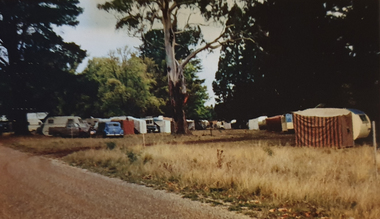 Ballarat Heritage Services
Photograph, Nucolorvue, Caravans in Victoria Park Camping Ground, Daylesford, 1957
... Park Daylesford, Victoria, Australia This famous holiday resort is famous for its up-to-date facilities, as well as for its natural attractions. The mineral Springs are renowned for their high medicinal elements. The visitor finds ample to amuse, in excellent fishing, boating, Boating, Swimming, golfing, hiking and riding. The district provides a wide range of typical Australian bush scenery, and the altitude of 2,000 feet above sea level as a tonic effect on all. Daylesford has modern hotels, guest houses, shops and places of amusement ...Daylesford is a tourist town in Central Victorian, known for its mineral water springs.Caravans in Victoria Park Camping Ground, DaylesfordDaylesford, Victoria, Australia This famous holiday resort is famous for its up-to-date facilities, as well as for its natural attractions. The mineral Springs are renowned for their high medicinal elements. The visitor finds ample to amuse, in excellent fishing, boating, Boating, Swimming, golfing, hiking and riding. The district provides a wide range of typical Australian bush scenery, and the altitude of 2,000 feet above sea level as a tonic effect on all. Daylesford has modern hotels, guest houses, shops and places of amusement, also many other places of interest within short travelling distance. Bendigo, 50 miles, Ballara 30 miles, and Melbourne 75 miles, bring Daylesford within easy reach of many parts of Victoria. daylesford, victoria park caravan park, camping, victoria park, caravan park -
 Ballarat Heritage Services
Digital Photograph, L.J. Gervasoni, luna park entrance, early 2010s
... park...entrance...mouth...amusement...luna park entrance mouth amusement fun palace st kilda Digital Image of the entrance to Luna Park in St Kilda, Victoria. luna park entrance Digital Photograph L.J. ...Digital Image of the entrance to Luna Park in St Kilda, Victoria. luna park, entrance, mouth, amusement, fun palace, st kilda -
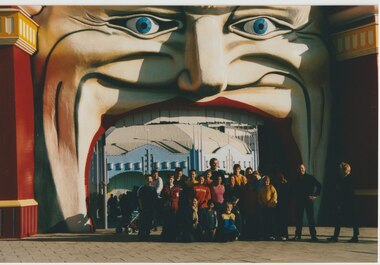 Melbourne Legacy
Photograph - Junior legatee outing, Luna Park, 2001
... A record of the outings provided for Junior Legatees organised by Legacy. junior legatee outing amusement parks junior legatees Yellow label printed 'Luna Park 2001'. ...Three photos of a trip to Melbourne's Luna Park in 2001 for a group of junior legatees. The photos were mounted in an album of events that happened for Junior Legatees in 2001, including a trip to the Aquarium, a trip to Luna Park, horse riding and fishing and a Melbourne Legacy Leadership Group Christmas party. Melbourne Legacy arranged many events for Junior Legatees to experience. A record of the outings provided for Junior Legatees organised by Legacy.Colour photo x 3 of Junior Legatees on a trip to Melbourne's Luna Park in 2001.Yellow label printed 'Luna Park 2001'.junior legatee outing, amusement parks, junior legatees
