
Showing 7 items matching "andrew rider"
-
 Mission to Seafarers Victoria
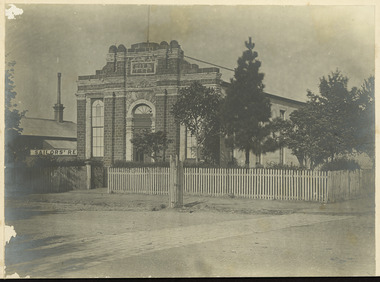
Photograph - Photograph, Sepia, Andrew Rider, c. 1885
... ...andrew rider (1821-1903)...Written on verso: Photograph - Andrew Rider. Written on verso: Sailors' Rest, Ann St., Williamtown, 1880's....Andrew Rider ...Photograph Photograph, Sepia Andrew Rider ...This Wesleyan Chapel was used as the first Sailor's Rest in Williamstown in 1875. Photograph of the first Institute locales in Williamstown.View looking across street to a brick building with arched doorway on a corner block. A sign on the left reads: Sailors' Re[st].Typed sheet attached to verso: No. 15: The Sailor's Rest, Ann Street, Williamstown, about 1885. Written on verso: Photograph - Andrew Rider. Written on verso: Sailors' Rest, Ann St., Williamtown, 1880's.williamstown, ann street, sailors' rest, seamen's mission, andrew rider (1821-1903), wesleyan church -
 Williamstown Historical Society Inc
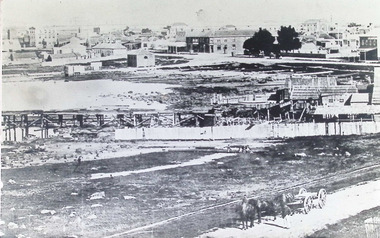
Photograph - Nelson Place, showing the slipway and the Morgue, c.1863
... ...Andrew Rider - Photographer...Photographer: Andrew Rider ...Nelson Place Morgue c.1863 Andrew Rider - Photographer Photographer: Andrew Rider Photograph Nelson Place, showing the slipway and the Morgue, c.1863 ...Photographer: Andrew Rider nelson place, morgue, c.1863, andrew rider - photographer -
 Williamstown Historical Society Inc
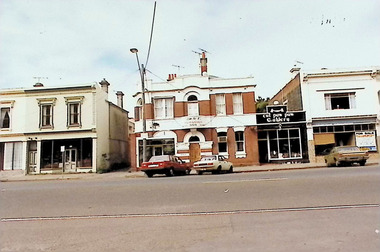
Photograph - Nelson Place, Bayview Hotel
... ...Andrew Rider...The original hotel was a wooden building built pre-1869. Andrew Rider, hairdresser and photographer, whose name is linked with the hotel from 1875, was the owner of the new 13 room brick Bay View hotel and shop constructed in 1910 whilst George W. ...Bayview hotel Nelson Place 175 Nelson Place Andrew Rider The Bay View Hotel located at 175 Nelson Place was designed by Gordon McCrae and built by Mr. ...The Bay View Hotel located at 175 Nelson Place was designed by Gordon McCrae and built by Mr. Ingham in 1910 as a 13 room hotel. Upstairs was used as a clubroom for 100 people and billiard tables were installed downstairs. The laneway at the side led to the Artillery Brewery building, which has since been replaced by Nelson Heights Towers. The original hotel was a wooden building built pre-1869. Andrew Rider, hairdresser and photographer, whose name is linked with the hotel from 1875, was the owner of the new 13 room brick Bay View hotel and shop constructed in 1910 whilst George W. Magor was both the new and old publican. A year later, JJ Jeffries purchased the hotel, and by 1920 Hannah Starr was the licensee.bayview hotel, nelson place, 175 nelson place, andrew rider -
 Williamstown Historical Society Inc
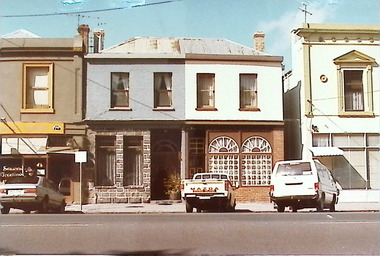
Photograph - Nelson Place, No. 151-153
... He represented Williamstown in the Legislative Assembly in 1860-61 (6). Andrew Rider's photograph of Nelson Place, taken c1866 shows these shops as the most substantial in the block and adorned with a slender timber verandah. ...He represented Williamstown in the Legislative Assembly in 1860-61 (6). Andrew Rider's photograph of Nelson Place, taken c1866 shows these shops as the most substantial in the block and adorned with a slender timber verandah. ...No. 151-153 Nelson Place was designed by Michael Egan and constructed in 1860. The buildings are recorded in the Hobsons Bay Heritage Study Amended 2017 (Heritage Overlay No. HO219) and notes the following: Historically, they are among the oldest shops in Nelson Place and illustrate the early development of the street during the most prosperous period of the Port. They are also important for their associations with Thomas Mason. Thomas Mason, who owned these two shops, each of stone, brick and four rooms until c1880, was one of the most significant men in the early history of Williamstown. In 1858 he ran the two shops jointly with Benjamin Culley, a draper and clothier (Refer to 55 Cecil Street). Culley and Mason's partnership dissolved and after a brief period as the Ship Inn, in 1859, the two shops were now leased to various other businessmen, some of the longest standing being Matthew Suffren, a watchmaker; Edward Bailey, a chemist; a stationer, George Divers; Henry Douglas a plumber and Henry Linton, a boot maker (Refer to 22 James St, 46-48 and 50 Stevedore Street). In 1880 Mrs. Mason had assumed ownership which she retained until the shops were retaken by the executors of Sutton's estate (1890). Given the property's description in the period 1857-59 as a store of wood and stone and in 1860, as two shops of brick and stone, it is probable in that year that the whole premises was rebuilt. Thomas Mason, originally a Londoner, arrived in the colony in 1841. On 24 August 1844 he took charge of the signal station, and subsequently the light- house (then a lamp in a wooden tower), for a further five years. In `Port of Many Prows', Wilson Evans recounts a tale which indicates that Mason may not have been entirely conscientious in this role. After this he took up storekeeping and auctioneering but gave up the shopkeeping in 1858. He was a member of the first Williamstown Council and its chairman no less than four times (1856, 1860, 1862, 1864). He represented Williamstown in the Legislative Assembly in 1860-61 (6). Andrew Rider's photograph of Nelson Place, taken c1866 shows these shops as the most substantial in the block and adorned with a slender timber verandah. nelson place, 151-157 nelson place, thomas mason -
 Flagstaff Hill Maritime Museum and Village
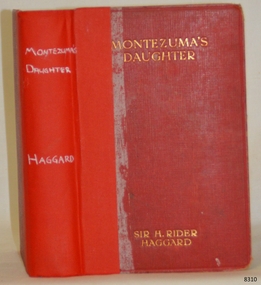
Book - Fictional Novel, H Rider Haggard, author, Montezumas Daughter, 1893
... They were the primary British publishers for iconic Victorian authors, including Robert Louis Stevenson, H. Rider Haggard, and Andrew Lang. The firm operated out of Paternoster Row in London, expanding globally to New York and India....They were the primary British publishers for iconic Victorian authors, including Robert Louis Stevenson, H. Rider Haggard, and Andrew Lang. The firm operated out of Paternoster Row in London, expanding globally to New York and India. ...Montezuma’s Daughter (1893) is an epic Victorian adventure and historical fiction novel set during the sixteenth-century Spanish conquest of the Aztec Empire. The story is narrated in the first person by an elderly Englishman, Thomas Wingfield, reflecting on the tumultuous journey of his youth. After his Spanish mother is murdered by his malicious cousin, Juan de Garcia, Thomas embarks on a quest for vengeance. His pursuit takes him across Europe, through a brush with the Spanish Inquisition, and onto a ship bound for the New World. Following a shipwreck and capture, Thomas finds himself in Mexico, where he is initially slated for Aztec human sacrifice. He is ultimately spared, rises to high status among the Aztecs, and marries Princess Otomie, the daughter of Emperor Montezuma. The narrative reaches its emotional and historical peak as Thomas fights alongside the Aztecs against Hernán Cortés during the brutal siege and fall of Tenochtitlan. Prior to its book release, the novel was serialised in the British weekly newspaper The Graphic between July and November of 1893. Longmans, Green, and Co. published the official first book edition in London on November 13, 1893, printing an initial run of 10,000 copies.Montezumas Daughter Author: H Rider Haggard Publisher: Longmans Green Date: 1893 A novel in a red, hard covered book with a reinforced spine with a handwritten title, front cover has gold embossed title. Inscriptions include stickers and a stamp. It is part of the Pattison Collection.fictionMontezuma’s Daughter (1893) is an epic Victorian adventure and historical fiction novel set during the sixteenth-century Spanish conquest of the Aztec Empire. The story is narrated in the first person by an elderly Englishman, Thomas Wingfield, reflecting on the tumultuous journey of his youth. After his Spanish mother is murdered by his malicious cousin, Juan de Garcia, Thomas embarks on a quest for vengeance. His pursuit takes him across Europe, through a brush with the Spanish Inquisition, and onto a ship bound for the New World. Following a shipwreck and capture, Thomas finds himself in Mexico, where he is initially slated for Aztec human sacrifice. He is ultimately spared, rises to high status among the Aztecs, and marries Princess Otomie, the daughter of Emperor Montezuma. The narrative reaches its emotional and historical peak as Thomas fights alongside the Aztecs against Hernán Cortés during the brutal siege and fall of Tenochtitlan. Prior to its book release, the novel was serialised in the British weekly newspaper The Graphic between July and November of 1893. Longmans, Green, and Co. published the official first book edition in London on November 13, 1893, printing an initial run of 10,000 copies.flagstaff hill, warrnambool, shipwrecked coast, flagstaff hill maritime museum, maritime museum, shipwreck coast, flagstaff hill maritime village, great ocean road, book, pattison collection, warrnambool library, warrnambool mechanics’ institute, ralph eric pattison, corangamite regional library service, warrnambool city librarian, mechanics’ institute library, victorian library board, warrnambool books and records, warrnambool children’s library, montezumas daughter, h rider haggard, longmans green and co., thomas longman, paternoster row london, free library -
 Victorian Interpretive Projects Inc.
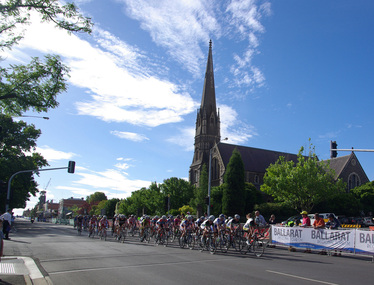
Photograph - Colour, Clare Gervasoni, Australian Road Cycling Championships, Ballarat, 05/01/2012
... Colour photograph in digital format of a number of female bicycle riders taking part in the National Road Cycling Championships at Ballarat. The church is St Andrew's Kirk, Sturt Street, Ballarat...Ballarat St Andrew's Cycling bicycle Colour photograph in digital format of a number of female bicycle riders taking part in the National Road Cycling Championships at Ballarat. ...Each year the national cycling championships are held at Ballarat.Colour photograph in digital format of a number of female bicycle riders taking part in the National Road Cycling Championships at Ballarat. The church is St Andrew's Kirk, Sturt Street, Ballaratballarat, st andrew's, cycling, bicycle -
 Robin Boyd Foundation
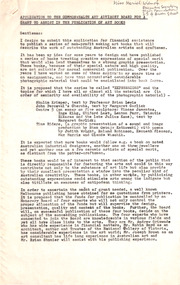
Document, Mark Strizic, Application to the Commonwealth Art Advisory Board for a Grant to Assist in the Publication of Art Books, c. 1970
... Robin Boyd Meriel Wilmot-Wright Myer Foundation Mark Strizic Schulim Krimper Brian Lewis Margaret Garlick Inge King Clifford Last Lenton Parr Teisutis Zikaras Julius Kane Centre 5 Time Riders John Perceval Vincas Jomantas Stan Ostoja Kotkowski Judith Wright Roland Robinson Kenneth Slessor Max Harris Claude Wischik Commonwealth Art Advisory Board Andrew Grimwade National Gallery of Victoria Joseph Brown Brian Stonier Robin Boyd pencil note Typewritten, carbon copy, foolscap, 4 pages Application to the Commonwealth Art Advisory Board for a Grant to Assist in the Publication of Art Books Document Mark Strizic ...A proposal letter written by Mark Strizic for a grant from the Commonwealth Art Advisory Board to fund a series of art books. Strizic proposes a series of books illustrated by Strizic's own photography, under the series title Expressions. Strizic seeks a grant of $4900 from the board for the publication of two books, one of furniture maker Schulim Krimper, another on John Perceval's Cherubs. Budgets for these books are included, proposing to use the profit from sales to fund subsequent books, including one on the Centre 5 group of sculptors and one with Australian poets with graphics by artist Stan Ostoja-Kotkowski.Typewritten, carbon copy, foolscap, 4 pagesRobin Boyd pencil noterobin boyd, meriel wilmot-wright, myer foundation, mark strizic, schulim krimper, brian lewis, margaret garlick, inge king, clifford last, lenton parr, teisutis zikaras, julius kane, centre 5, time riders, john perceval, vincas jomantas, stan ostoja kotkowski, judith wright, roland robinson, kenneth slessor, max harris, claude wischik, commonwealth art advisory board, andrew grimwade, national gallery of victoria, joseph brown, brian stonier
