
Showing 314 items matching "anglican church of england"
-
 Stawell Historical Society Inc
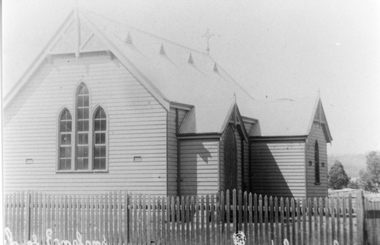
Photograph, Anglican Church of England Landsborough c1920
... Anglican Church of England Landsborough c1920 ...Photograph of Landsborough Anglican Church of England taken c 1920...Anglican Church of England Landsborough c1920 Photograph ...Photograph of Landsborough Anglican Church of England taken c 1920Black & white photograph depicting a weather board Church building with a picket fence in the foreground.Church of England stawell religion -
 Stawell Historical Society Inc
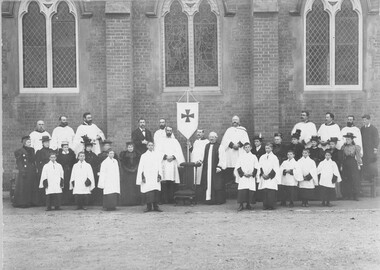
Photograph, Anglican Church of England Stawell. Six Photos
... Anglican Church of England Stawell. Six Photos...-1 Group of Anglican clergy alter boys and women -2 Alter inside Stawell Anglican Church -3 Anglican Hall at rear of church -4 Group of fifteen ministers in robes -5 Minister and family in front of Anglican manse -6 Minister with ladies tennis group Religion Six black and white photocopy prints related to the Anglican church Anglican Church of England Stawell. ...-1 Group of Anglican clergy alter boys and women -2 Alter inside Stawell Anglican Church -3 Anglican Hall at rear of church -4 Group of fifteen ministers in robes -5 Minister and family in front of Anglican manse -6 Minister with ladies tennis group Six black and white photocopy prints related to the Anglican church religion -
 Clunes Museum
Booklet - CHURCHES OF CLUNES
... anglican church of england...PAUL'S (ANGLICAN CHURCH OF ENGLAND) ST. THOMAS AQUINAS (ROMAN CATHOLIC CHURCH) ST. ...PAUL'S (ANGLICAN CHURCH OF ENGLAND) ST. THOMAS AQUINAS (ROMAN CATHOLIC CHURCH) ST. ...BLACK FOLDER, A PROJECT BY A WESLEY STUDENT TITLED : CHURCHES OF CLUNES PHOTOGRAPHS, DRAWINGS AND INFORMATION ABOUT THE FOUR MAIN CHURCHES IN CLUNES. ST. PAUL'S (ANGLICAN CHURCH OF ENGLAND) ST. THOMAS AQUINAS (ROMAN CATHOLIC CHURCH) ST. ANDREWS(UNITING CHURCH) WESLEYAN CHURCH (METHODIST)anglican church of england, roman catholic church, uniting church, methodist church, wesleyan church -
 Inverloch Historical Society
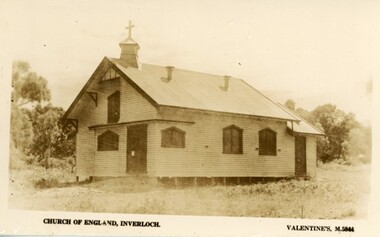
004283 - Postcard - Anglican Church (Church of England), The Crescent, Inverloch Valentines 1920's
... 004283 - Postcard - Anglican Church (Church of England), The Crescent, Inverloch Valentines 1920's...004283 - Postcard - Anglican Church (Church of England), The Crescent, Inverloch Valentines 1920's ... -
 Inverloch Historical Society
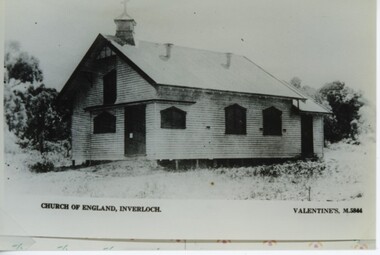
001285 - Photograph - circa 1930's - Inverloch Anglican Church (Church of England) - Valentines 5844 - from Jill Harrop
... 001285 - Photograph - circa 1930's - Inverloch Anglican Church (Church of England) - Valentines 5844 - from Jill Harrop...001285 - Photograph - circa 1930's - Inverloch Anglican Church (Church of England) - Valentines 5844 - from Jill Harrop ... -
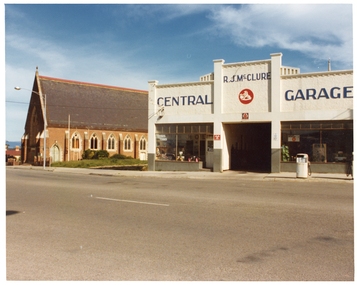 Stawell Historical Society Inc
Photograph, Pleasant Creek Special School, Anglican Holy Trinity Church of England, R J McClure Central Garage with petrol Bowsers out front -- Nov 1975, Nov 1975
... Anglican Holy Trinity Church of England, R J McClure Central Garage with petrol Bowsers out front -- Nov 1975 ...Showing shops and businesses in Main Street. Anglican Holy Trinity Church of England, R J McClure Central Garage with petrol Bowsers out front -- Nov 1975 Photograph Pleasant Creek Special School ...Photographs taken by teacher at Pleasant Creek Training Centre to help train students in living skills and becoming familiar with what shops sold. Part of socializing students for leaving the training centre.Main Street Stawell. Showing shops and businesses in Main Street. education, shops, main street, streetscape -
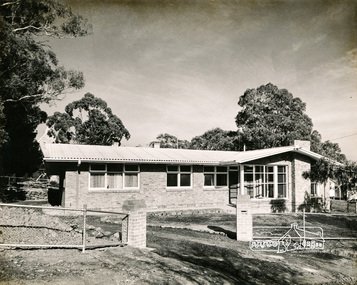 Eltham District Historical Society Inc
Photograph, St Margaret's Vicarage, Eltham, c. 1950s, 1950s
... anglican...church of england...churches vicarage st margarets anglican church of england eltham john street Black and white photograph of new vicarage at St Margaret's, John Street, Eltham c 1950s. ...Black and white photograph of new vicarage at St Margaret's, John Street, Eltham c 1950s.churches, vicarage, st margarets, anglican, church of england, eltham, john street -
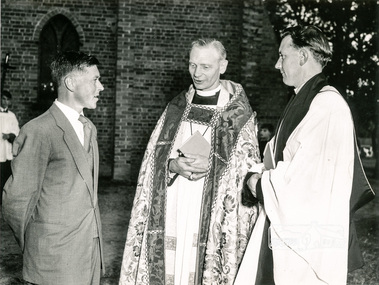 Eltham District Historical Society Inc
Photograph, St Margaret's Eltham, Consecration of Vicarage, 1950s
... anglican...church of england...consecrations churches anglican church of england priests clergy st margarets Black and white photograph showing clergy officiating at consecration of St Margaret's Vicarage, Eltham c.1950s. ...Black and white photograph showing clergy officiating at consecration of St Margaret's Vicarage, Eltham c.1950s.consecrations, churches, anglican, church of england, priests, clergy, st margarets -
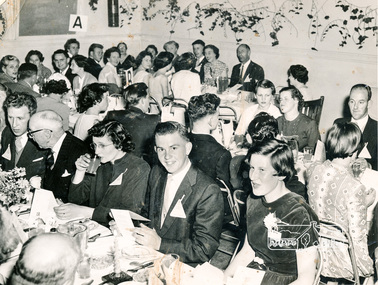 Eltham District Historical Society Inc
Photograph, St Margaret's Church, Eltham, fundraising dinner, 1950s
... anglican...church of england...st margarets churches anglican church of england functions lilas scale eltham shire hall Inscribed on back with arrows indicating Rowley and self (Lilas Scale) Black and white photograph of group at church dinner to raise money for a new St Margaret's Vicarage held at Eltham Shire Hall, Arthur Street c.1950s St Margaret's Church, Eltham, fundraising dinner Photograph ...Black and white photograph of group at church dinner to raise money for a new St Margaret's Vicarage held at Eltham Shire Hall, Arthur Street c.1950sInscribed on back with arrows indicating Rowley and self (Lilas Scale)st margarets, churches, anglican, church of england, functions, lilas scale, eltham shire hall -
Glen Eira Historical Society
Document - TOURS
... Anglican Church... Church of England...Mary’s Anglican Church Church of England Bishop Moorhouse Joynt Donoman Elsternwick Post Office Elsternwick Elsternwick Bowling Club Elsternwick RSL Caulfield Grammar School Davis Henry Rev. ...There are two copies of the Discover Caulfield guide produced by the Caulfield Historical Society. One from 1982 which contains twelve pages, seven of which are typed and the last five a continuation of the guide added later, hand-written. The other is a modern typed version of the same document, including information at the end that "Notes prepared by R. Ballantyne, 25th July, 1982, updated by Betty Snowball, 1992 and Gladys Vallati 4th August, 1995". They both detail a pictorial tours of the mansions and gardens in the City of Caulfield, similar but not identical.caulfield, mansions, gardens, homes, ‘lirrewa’, lirrewa grove, caulfield city hall, smith sydney, ‘halstead’, bambra road, halstead road, caulfield historical society, messrs. upton and smith, civic establishments, dickson james dr., houses, national trust, st. stephen’s church, balaclava road, gothic (revival) architecture, messrs. haddon and henderson, st. aloysius, archbishop of melbourne mannix dr., caulfield park, hawthorn road, inkerman road, kambrook road, paddy’s swamp, cannizzo philip, caulfield city council, trams, orrong road, grimwade house, ‘harleston’, grimwade frederick sheppard, primary schools, caulfield art centre, ‘stanmark’, art galleries, ‘craigellachie’, person william, pearson eliza, francis newton mr., greenmeadows gardens, milburn grove, greenmeadows house, lempriere john, mayors, ‘glenfern’, boyd john captain, boyd martin, ‘myoora’, alma road, ‘bagatelle’, christian thomas, henderson anketell, flats, building construction, ‘burreel’, kooyong road, burreel avenue, francis john, stephen sidney, allan george l., ‘royston’, renwick s. mrs., sargood frederick sir., ‘glen eira’, ricketson henry, caulfield hospital, royal southern memorial hospital, caulfield general medical centre, ‘ripponlea’, reed and barnes, architects, towers, rippon emma, rippon thomas, guilfoyle william, employees, ‘the village houses’, regent street, st. george’s road, cottages, bent thomas sir., jones louisa mrs., nathan benjamin, ‘anselm’, glenferrie street, queen anne style, haddon robert, historical buildings, princes’ park, ‘glenmore’, watts thomas, more hugh, glenhuntly road, gates, villas, ‘hopetoun’, hopetoun street, webb charles, hopetoun hospital, harleston park, allison street, langdon montague, langdon harry joseph, ‘tarqua’, ‘labassa’, manor grove, koch john, robertson a. w., wagner john, ‘ontario’, trinity congregational church, grange road, glen huntly, churches, greek orthodox church, ‘fairfield hall’, north road, younger james, glenhuntly post office, smith alfred, smith anne, methodist church, ‘lambros the cobbler’, railways, ballantyne r., snowball betty, kahlyn private hospital, ‘kynaston’, st. mary’s jubilee school, festivals and celebrations, st. mary’s anglican church, church of england, bishop moorhouse, joynt donoman, elsternwick post office, elsternwick, elsternwick bowling club, elsternwick rsl, caulfield grammar school, davis henry rev., selwyn street, elsternwick railway station, glen eira road, barnett r. j. rev., tudor court, world war 1914-1918, ‘fairhaven’, hope george, caulfield library, plaques, cannons, ‘janvec joinery’, parkside street, ‘parkside court’, clarence street, ‘streetscene’, grange road, greenhouses, vallati gladys -
 Port Fairy Historical Society Museum and Archives
Photograph
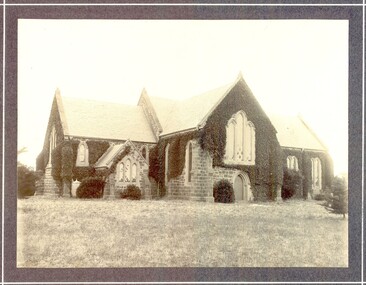
... anglican...church of england...St Johns Anglican Church with ivy growing over exterior church sunday-school building st johns anglican church of england Black and white photograph of St Johns Church of England with ivy growing over the exterior Photograph Photograph ...St Johns Anglican Church with ivy growing over exteriorBlack and white photograph of St Johns Church of England with ivy growing over the exterior church, sunday-school, building, st johns, anglican, church of england -
 Port Fairy Historical Society Museum and Archives
Photograph
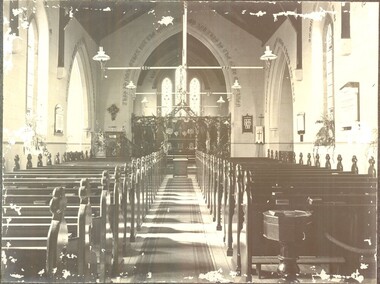
... anglican...church of england...St Johns Anglican church interior with gas lighting and the sanctuary has a defining arch between it and the body of the church . church sunday-school building St johns anglican church of england interior gas lighting Black and white photograph Photograph Photograph ...St Johns Anglican church interior with gas lighting and the sanctuary has a defining arch between it and the body of the church .Black and white photographchurch, sunday-school, building, st johns, anglican, church of england, interior, gas, lighting -
 Port Fairy Historical Society Museum and Archives
Photograph
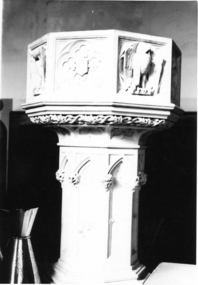
... Anglican...Church of England...Memorial Font St Johns Church of England (Anglican) Pt Fairy...Memorial Font St Johns Church of England (Anglican) Pt Fairy memorial Font St Johns Anglican Church of England Interior Black and white photograph of White marble font in St John’s church Photograph Photograph ...Memorial Font St Johns Church of England (Anglican) Pt FairyBlack and white photograph of White marble font in St John’s churchmemorial, font, st johns, anglican, church of england, interior -
Emerald Museum & Nobelius Heritage Park
Photograph - St Cuthbert's, Menzies Creek, Unknown photographer
... anglican church...church of england...The Church served as a place of worship for people of the Anglican faith in the area from approximately 1909 to 1997 and as a wedding venue from 1998 until the venue's closure. Menzies Creek st cuthberts church james hermon robert cason anglican church church of england weddings Christenings funerals Black and white rectangular photograph printed on photographic paper. ...The land St Cuthbert's stands on may have been donated by a resident of the region by James Hermon and may have been designed by Robert Cason. The Victorian Heritage Register lists the year the building was completed as 1909 but other sources indicate a slightly earlier date of 1907-8. The architectural design is unusual in combining a Gothic arched door with square pointed windows. The Register notes that the building's Arts and Crafts character would have been accentuated by the original stained-wood cladding, though in this image the cladding has been painted white. Further research would be needed to state the percentage of people in Menzies Creek, Emerald and surrounds who identified as Anglican in the first half of the Twentieth Century due to a lack of detail in the available census data. In the 1991 Census 18.2% of Victorians stated that they were Anglican, the second largest faith group. Despite this, the Church sold the property to a private owner in 1997. St Cuthbert's was subsequently used for weddings, christenings, funerals and other functions, extending the building's significance to the local community as a place of celebration and commemoration. The wedding chapel closed in 2022 and the building became a private home.The photograph is significant as an image of a heritage listed church building prior to renovations and extension works in 1997 that changed the profile of the building. The Church served as a place of worship for people of the Anglican faith in the area from approximately 1909 to 1997 and as a wedding venue from 1998 until the venue's closure.Black and white rectangular photograph printed on photographic paper. The photograph depicts St Cuthbert's Anglican Church in Menzies Creek, prior to renovation and extension works in 1997 that have given the modern building a different profile.menzies creek, st cuthberts church, james hermon, robert cason, anglican church, church of england, weddings, christenings, funerals -
Marysville & District Historical Society
THE TRIANGLE NEWS-VOL 5 NO 14-MAY 9 1980
... anglican church services...church of england...marysville victoria australia thank you think it over senior citizens for sale uniting church lost dogs dance golf associates footy club marysville bowls wanted villains bingo fire brigade fashion parade child minding mountain views home improvements centre junior and senior youth clubs anglican church services church of england paper collection depots kindergarten community care centre THE TRIANGLE NEWS-VOL 5 NO 14-MAY 9 1980 ...marysville, victoria, australia, thank you, think it over, senior citizens, for sale, uniting church, lost dogs, dance, golf associates, footy club, marysville bowls, wanted, villains bingo, fire brigade, fashion parade, child minding, mountain views home improvements centre, junior and senior youth clubs, anglican church services, church of england paper collection depots, kindergarten, community care centre -
 Ballarat Heritage Services
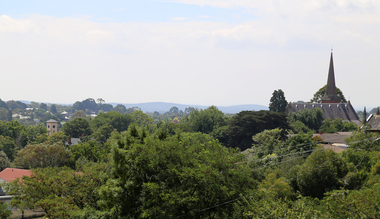
Photograph - Digital Image Daylesford Anglican Church after removal of Bunya Bunya Pine, Daylesford Anglican Church after removal of Bunya Bunya Pine, 2015, 2010s
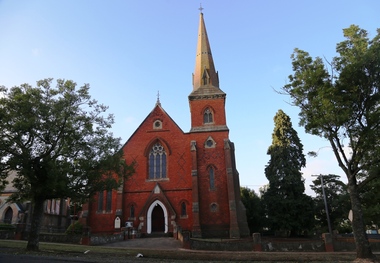
... anglican...church...daylesford...Daylesford Anglican Church...Daylesford Church of England...HO664 Hepburn Planning Scheme anglican church daylesford Daylesford Anglican Church Daylesford Church of England Digital Image of the Daylesford Anglican Church after removal of Bunya Bunya Pine in 2015. ...HO664 Hepburn Planning SchemeDigital Image of the Daylesford Anglican Church after removal of Bunya Bunya Pine in 2015.anglican, church, daylesford, daylesford anglican church, daylesford church of england -
 Ballarat Heritage Services
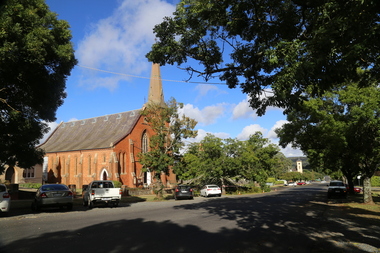
Photograph - Digital Image Daylesford Anglican Church with Bunya Bunya Pine, L.J. Gervasoni, Daylesford Anglican Church with Bunya Bunya Pine, 1987 - 2015
... anglican...church...daylesford...Central Springs Road...Daylesford Anglican Church...Daylesford Church of England...HO664 Hepburn Planning Scheme anglican church daylesford Central Springs Road Daylesford Anglican Church Daylesford Church of England Bunya Bunya Pine Digital Images showing the Bunya Bunya pine at the Daylesford Anglican Church over a number of years. ...HO664 Hepburn Planning SchemeDigital Images showing the Bunya Bunya pine at the Daylesford Anglican Church over a number of years.anglican, church, daylesford, central springs road, daylesford anglican church, daylesford church of england, bunya bunya pine -
 Ballarat Heritage Services
Photograph - Digital Image Daylesford Anglican Church with Bunya Bunya Pine Tornado Damage, Daylesford Anglican Church with Bunya Bunya Pine Tornado Damage, 1987 - 2015
... anglican...church...daylesford...tornado damage...bunya bunya...Daylesford Anglican Church...Daylesford Church of England...HO664 Hepburn Planning Scheme anglican church daylesford tornado damage bunya bunya Daylesford Anglican Church Daylesford Church of England Digital Images Daylesford Anglican Church with Bunya Bunya Pine Tornado Damage Photograph Digital Image Daylesford Anglican Church with Bunya Bunya Pine Tornado Damage L.J. ...HO664 Hepburn Planning SchemeDigital Imagesanglican, church, daylesford, tornado damage, bunya bunya, daylesford anglican church, daylesford church of england -
 Buninyong & District Historical Society
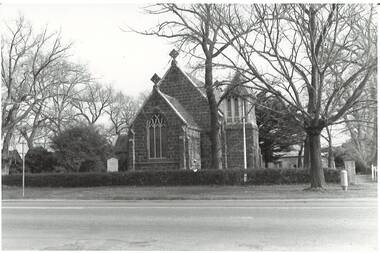
Photograph - B/W photograph, Mr C J Brooks, Holy Trinity Church of England, cnr Scott & Warrenheip Sts. Buninyong, July 1993
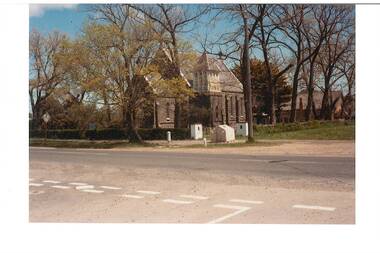
... Anglican...Buninyong...Church of England...Original brick church/school (1857) and bluestone church (1862) Anglican Buninyong Church of England Bluestone building BW photograph, of Holy Trinity Church of England church, corner of Scott Street and Warrenheip Street, Buninyong. ...Original brick church/school (1857) and bluestone church (1862)BW photograph, of Holy Trinity Church of England church, corner of Scott Street and Warrenheip Street, Buninyong. Rev. Garrett John Russell arrived Buninyong 1857 when vicarage and school were built, Church of Holy Trinity opened in 1862.anglican, buninyong, church of england, bluestone, building -
 Buninyong & District Historical Society
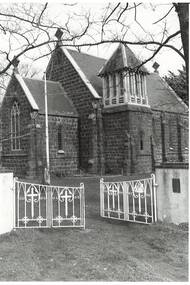
Photograph - B/W photograph, Mr C J Brooks, Holy Trinity Church of England, cnr Scott & Warrenheip Sts. Buninyong, July 1993
... Anglican...Buninyong...Church of England...Original brick church/school (1857) and bluestone church (1862) Anglican Buninyong Church of England Bluestone building BW photograph, of Holy Trinity Church of England church, corner of Scott Street and Warrenheip Street, Buninyong. ...Original brick church/school (1857) and bluestone church (1862)BW photograph, of Holy Trinity Church of England church, corner of Scott Street and Warrenheip Street, Buninyong. Rev. Garrett John Russell arrived Buninyong 1857 when vicarage and school were built, Church of Holy Trinity opened in 1862. 3/4 angle view through corner gates.anglican, buninyong, church of england, bluestone, building -
 Buninyong & District Historical Society
Photograph - Colour photograph, Holy Trinity Church of England, cnr Scott & Warrenheip Sts. Buninyong, c 1982
... Anglican...Buninyong...Church of England...Original brick church/school (1857) and bluestone church (1862) Anglican Buninyong Church of England Bluestone building BW photograph, of Holy Trinity Church of England church, corner of Scott Street and Warrenheip Street, Buninyong. ...Original brick church/school (1857) and bluestone church (1862)BW photograph, of Holy Trinity Church of England church, corner of Scott Street and Warrenheip Street, Buninyong. Rev. Garrett John Russell arrived Buninyong 1857 when vicarage and school were built, Church of Holy Trinity opened in 1862. A Telecom workers tent is visible in the foreground.anglican, buninyong, church of england, bluestone, building -
 Eltham District Historical Society Inc
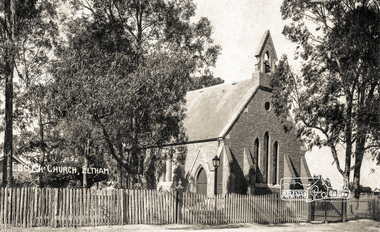
Photograph - Photograph postcard, English Church, Eltham, c.1920
... Anglican Church...Church...Church of England...Church of England, Pitt Street, Eltham. Early photo showing timber picket fence. Written on the back of the postcard: "Today is the Glamorgan Fete. A lovely sunny day. The crowd is here to spend their cash. And everyone is gay. We are all glad to see you here And for th school we give a cheer!" Glamorgan was a kindergarten in Toorak during the 1920s and is now part of Geelong Grammar Schools Preparatory School Glamorgan Campus, Toorak. michael aitken collection postcards eltham Pitt Street St Margaret's Anglican Church Church Church of England English Church St Margarets Anglican Church St Margarets Church Glamorgan Fete Digital file only Postcards scanned from the collection of Michael Aitken on loan to EDHS, 13 Feb 2018 English Church, Eltham Photograph Photograph postcard ...St. Margaret's Church of England, Pitt Street, Eltham. Early photo showing timber picket fence. Written on the back of the postcard: "Today is the Glamorgan Fete. A lovely sunny day. The crowd is here to spend their cash. And everyone is gay. We are all glad to see you here And for th school we give a cheer!" Glamorgan was a kindergarten in Toorak during the 1920s and is now part of Geelong Grammar Schools Preparatory School Glamorgan Campus, Toorak.Digital file only Postcards scanned from the collection of Michael Aitken on loan to EDHS, 13 Feb 2018michael aitken collection, postcards, eltham, pitt street, st margaret's anglican church, church, church of england, english church, st margarets anglican church, st margarets church, glamorgan fete -
 Ballarat Heritage Services
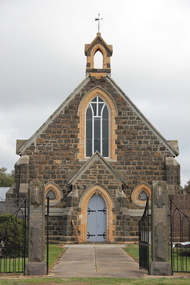
Photograph - Photograph - Colour, L.J. Gervasoni, Carisbrook Church of England, 06/08/2011
... Anglican Church...Caribsrook Chirch of England...The first Church of England at was a wooden building built in as a Common School in 1854.The large bluestone church was opened in 1861. carisbrook church Carisbrook Anglican Church Caribsrook Chirch of England A bluestone church in Carisbrook. ...The first Church of England at was a wooden building built in as a Common School in 1854.The large bluestone church was opened in 1861.A bluestone church in Carisbrook.carisbrook, church, carisbrook anglican church, caribsrook chirch of england -
 Bendigo Historical Society Inc.
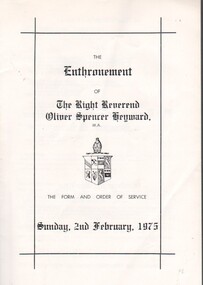
Programme - Reverend Oliver Spencer Heyward
... He was a Tasmanian Rhodes Scholar in 1949 and was ordained into the Anglican Church in England in 1954. He initially served in England before returning to Tasmania and then Victoria. ...He was a Tasmanian Rhodes Scholar in 1949 and was ordained into the Anglican Church in England in 1954. He initially served in England before returning to Tasmania and then Victoria. ...Oliver Heyward was born in Tasmania 16/3/1926 and died in Melbourne 15/12/2003. He was a Tasmanian Rhodes Scholar in 1949 and was ordained into the Anglican Church in England in 1954. He initially served in England before returning to Tasmania and then Victoria. Upon his enthronement as Bishop in 1975, he became the 6th Bishop of Bendigo from 1975 - 1991. He then became Assistant to the primate of the Anglican Church in Victoria 1991 - 1995.Form and order of service for the Enthronement of the Right Reverend Oliver Spencer Heyward on Sunday 2nd February 1975, at All Saints' Cathedral, Bendigoenthronement order of service, the right reverend oliver spencer heyward -
 Flagstaff Hill Maritime Museum and Village
Textile - Altar Cloth
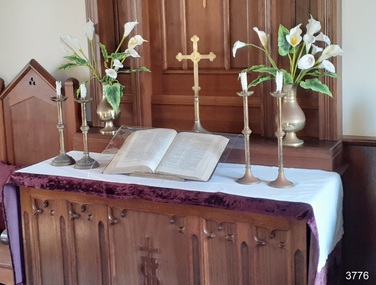
... The Missions to Seamen organisation The Missions to Seamen is an Anglican (Church of England) charity that has been serving the world's seafarers since 1856. ...The Missions to Seamen organisation The Missions to Seamen is an Anglican (Church of England) charity that has been serving the world's seafarers since 1856. ...This altar cloth represents ecclesiastical linen used in the early to mid-20th century. It is used on the altar in the Chapel of St Nicholas Seamen's Church at Flagstaff Hill Maritime Museum and Village. The Missions to Seamen organisation The Missions to Seamen is an Anglican (Church of England) charity that has been serving the world's seafarers since 1856. It was inspired by the work of Rev. John Ashley, who, 20 years earlier, had pioneered a ministry to seafarers in the Bristol Channel in Great Britain. When Ashley retired because of ill health, others determined that the work should continue, and they founded the Missions to Seamen. It adopted as its symbol a Flying Angel, inspired by a verse from Revelation 14 in the Bible. Today, there are over 200 ports worldwide where the Missions to Seamen has centres and chaplains. A Missions to Seamen’s Club offers a warm welcome to sailors of all colours, creeds and races. A sailor can watch television, have a drink and a chat, change money or buy goods from the club shop or worship in the Chapel. In Victoria, the Missions to Seamen still has clubs in Melbourne, Portland and Geelong. The altar cloth represents ecclesiastical linen used in the early to mid-20th century, when the original St Nicholas Seamen's Church was opened in Williamstown, Victoria. Altar cloth: simple white linen cloth, long rectangle shape with wide hems.flagstaff hill, warrnambool, shipwrecked coast, flagstaff hill maritime museum, maritime museum, shipwreck coast, flagstaff hill maritime village, great ocean road, religion, religious service, st nicholas seamen’s church flagstaff hill, altar cloth, church linen, ecclesiastical linen -
 Lakes Entrance Historical Society
Photograph - St Nicholas Church of England Lakes Entrance, 1900 c
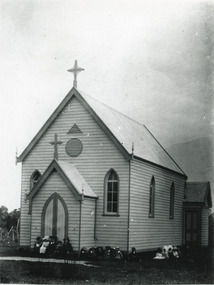
... St Nicholas Anglican Church, (Church of England) showing timber building with porch at front and vestry at rear. ...St Nicholas Anglican Church, (Church of England) showing timber building with porch at front and vestry at rear. ...St Nicholas Anglican Church, (Church of England) showing timber building with porch at front and vestry at rear. Main building, vestry and porch have high pitched gable roofs with cross apex, window each side of porch, two windows at side of church, upper arched panes open. Two ventilators, one triangular, one circular in wall above porch. About eighteen children seated on ground. Lakes Entrance Victoria. Photo taken of original church site, south corner of Church and Mechanics Streets, before removal and enlargement on north corner of streets.Black and white photograph of St Nicholas Anglican Church, showing timber building with porch at front and vestry at rear. Main building, vestry and porch have high pitched gable roofs with cross apex, window each side of porch, two windows at side of church, upper arched panes open. Two ventilators, one triangular, one circular in wall above porch. About eighteen children seated on ground. Lakes Entrance VictoriaOriginal Church 1898 removed, rededicated 1908religion, buildings, churches -
 Bacchus Marsh & District Historical Society
Photograph, Trinity Church Bacchus Marsh (The Iron Church)
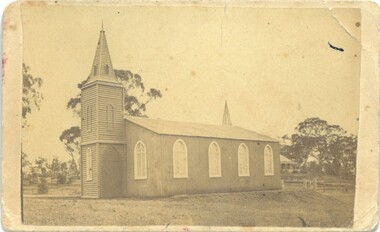
... Anglican (Church of England) services began in Bacchus Marsh as early as the 1840s. ...Anglican (Church of England) services began in Bacchus Marsh as early as the 1840s. ...Anglican (Church of England) services began in Bacchus Marsh as early as the 1840s. In 1855 an imported iron building from England became the first permanent Anglican Church building in Bacchus Marsh. It stood close to the location of the Holy Trinity Anglican Church erected in 1877 which still stands in 2025. It was in use between 1855 and 1877. These type of iron structures were cheaper to erect and could be dismantled and moved to other locations when necessary. The Iron Church was brick-lined and could hold between 150 and 200 people. The Church was opened on 4 July 1855 by Hussey Burgh Macartney, Dean of Melbourne. It was later consecrated by Bishop Perry on 28 July, 1861. The cost of construction was around 1,000 pounds. In 1877 the Holy Trinity Church was erected. The Iron Church was dismantled and sold to to two local businessmen, George Marshall and James Reid. It was re-erected in July 1877 without its brick lining or steeple and is presumed to have been used as a shed at a location in Graham Street known as 'Webster's Brothers Yard', (14 Graham Street). Over time the structure deteriorated to the point that it could no longer be used. Remnants of the Iron Church could be seen for many years. In 1995 the remnants were described by Peterson and Catrice in the Heritage Study of Bacchus Marsh Shire in the this way, 'on the rear boundary, now used as an outbuilding, is the surviving fabric of the former "Iron Church". This has a gabled roof and had four pointed windows at sides. It is all clad in corrugated iron. Access was not possible, but a 1977 photograph shows Gothic tracery in a window'. This is a rare image of a prefabricated building in mid-nineteenth century Victoria. Prefabricated buildings were widely used in the early Colonial period of Victoria as a cheaper building option for new and developing communities. Most of these buildings did not survive in the long term and photographic evidence of these type of structures is an important record of an aspect of Victoria's architectural history.Small black and white 'carte de viste' style photograph mounted on card. The image depicts the first permanent Anglican Church building in Bacchus Marsh, the Trinity Church, also known as the Iron Church. The date of the image is thought to be about 1867.anglican church bacchus marsh, churches bacchus marsh, trinity church bacchus marsh, bacchus marsh iron church, prefabricated buildings -
 Flagstaff Hill Maritime Museum and Village
Photograph - Historical, religious, mid-20th century
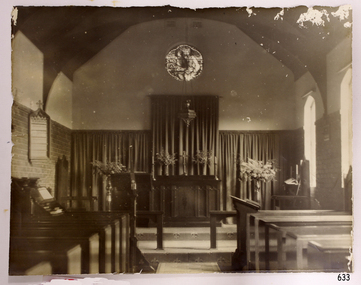
... HISTORY of the Missions to Seamen: - DETAILED HISTORY of the Missions to Seamen: - The Missions to Seamen is an Anglican (Church of England) charity that has served the world’s seafarers since 1856. ...HISTORY of the Missions to Seamen: - DETAILED HISTORY of the Missions to Seamen: - The Missions to Seamen is an Anglican (Church of England) charity that has served the world’s seafarers since 1856. ...This photograph records the interior of St Nicholas Seamen's Church at 139 Nelson Place, Williamstown, Victoria, which was purchased and furnished around 1943. The furniture and furnishings are now part of the St. Nicholas Seamen's Church collection. HISTORY of the Missions to Seamen: - DETAILED HISTORY of the Missions to Seamen: - The Missions to Seamen is an Anglican (Church of England) charity that has served the world’s seafarers since 1856. It was inspired by the work of Rev. John Ashley, who, 20 years earlier, had pioneered a ministry to seafarers in the Bristol Channel in Great Britain. When Ashley retired, others continued the work, founding the Missions to Seamen. It adopted a Flying Angel as its symbol, inspired by a verse from the Bible in Revelation 14. Today, over 200 world ports have Missions to Seamen centres and chaplains. A Missions to Seamen’s Club warmly welcomes sailors of all colours, creeds and races and provides a wide range of facilities. The Missions to Seamen organisation changed its name to the Mission to Seafarers in 2000, continuing to include Missions to Seamen clubs in Victoria’s cities of Melbourne, Portland, Geelong and Hastings. Flagstaff Hill’s St Nicholas’ Seamen’s Church is named after its namesake from Williamstown, Victoria, which began in 1857. Bishop Perry opened the first Sailors’ Church there, known as ‘Bethel’, on an old hulk floating in Hobson’s Bay, Port of Melbourne. In 1860, a Sailors’ Rest started operating from rented premises in Williamstown. In 1878, the Sailors’ Church moved into an old Wesleyan chapel in Ann Street. By the end of that year, they managed to purchase the building, which they had already refurbished. In 1883, they affiliated with the Victorian Seamen’s Mission. A few years later, in 1906, the building had to be demolished because it was no longer safe. While they raised funds for a new building, the Sailors’ Rest temporarily moved to premises in front of Customs House in Nelson Place. Around this time, in 1906, the Ladies Harbour Lights Guild was formed in Australia to support and raise funds for the Mission to Seamen organisation in Melbourne. Two of the most significant ladies of the Guild were founding members Ethel Godfrey and Alice Sibthorpe. During the Mission's time at Siddeley Street, Melbourne, the activities of the Guild raised funds for the Mission to Seamen's Chapel at their new, and still current, premises in Flinders Street, Melbourne, opened in 1917. The Guild continued its important work until the 1960s. In 1908, the Williamstown Mission had enough money to purchase the former Mascotte skating rink on Thompson Street, Williamstown. In August of that year, they were inaugurated into the Victorian Missions to Seamen. They continued at that venue for a few decades. In 1943, the former ES&A Bank building at 139 Nelson Place, Williamstown, was purchased to become the new Mission to Seamen’s Club. On May 6th, 1944, it was officially opened, described as a ‘distinctive little building’. Funds had previously been raised for the building and furnishing of the chapel at the rear. The chapel was named St Nicholas’ Seamen’s Church, after St Nicholas, fourth-century bishop and patron saint of sailors. Services were held on Wednesdays and Sundays. The church was supported by the Williamstown Lightkeepers’ Auxiliary, newly founded by Mrs Ethel Margaret Musther in 1943, as well as the Harbour Lights Guild and the League of Soldiers’ and Sailors’ Friends. The Williamstown Mission to Seamen’s Church operated until 1966, when large international ships no longer used the Port of Williamstown. The Commonwealth Government then leased the premises. In the formative years of Flagstaff Hill Maritime Village, the Advisory Board decided to include a Missions to Seamen Chapel and Recreation Room in its village. The Missions organisation was a significant feature of ports during the late 1800s and early 1900s, the period that the Village represents. They often erected Missions to house social and worshipful activities for seamen. Flagstaff Hill’s curator, Mr Ken Marshman, approached the Melbourne Board of Management of Missions to Seamen regarding the Williamstown branch. Consequently, the Board permitted the furnishings of the Williamstown chapel to be transferred to Flagstaff Hill Maritime Village. A provision of the transfer was that the Victoria Missions to Seamen be recognised, that the items would remain as a collection, and that the chapel would be called St Nicholas Seamen’s Church and conduct Divine services. The donation was approved on 21st May 1979. Flagstaff Hill's St. Nicholas Seamen's Church: - The idea behind Flagstaff Hill’s Missions to Seamen’s Church was partly driven by the offer of Stained Glass Memorial Windows that originated from the Warrnambool and District Base Hospital, which was undergoing multi-storey expansion in the late 1960s and early 1970s. The hospital’s Manager/Secretary was eager to see the historic window installed in a suitable place. The church, or chapel, was designed by a local architectural draftsman in collaboration with the Flagstaff Hill Planning Board and was constructed by Mr Leon Habel. The designers hoped that the church would be used for formal worship such as weddings, funerals, and multi-denominational special services like war commemorations. The design is inspired by the ‘Missions to Seamen’ buildings in Portland and the Port of Melbourne. The furniture and furnishings were placed as accurately as possible according to photographs of the Williamstown St Nicholas Seamen’s Church and with assistance from local clergy. The Recreation Room was furnished and arranged on advice from experienced members of the Missions to Seamen organisation. A framed document in the building recognises the donor of the furnishings, Victoria Missions to Seamen, and includes the names of some original donors and their donated item/s. The building’s design incorporates local features such as Warrnambool sandstone, which was no longer commercially available but was procured from demolished buildings and uniformly cut to use as a veneer over the stronger Mt. Gambier stone. Also, traditional green American roofing slate was used, sourced from the 1908 local shipwreck “Falls of Halladale” by Flagstaff Hill volunteer divers. The bell tower includes a bell believed to be from a local shipwreck. Additional furnishings were acquired locally, along with several items donated by Warrnambool residents. Light fittings in both rooms were assembled to simulate 19th-century gas light fittings. The stained-glass window at the back of the church is a memorial to Dr Connell, a well-respected member of the Warrnambool community. It was originally installed in 1928 in the main building of Warrnambool Hospital. The St Nicholas’ Seamen’s Church at Flagstaff Hill was officially opened by His Worship the Mayor, Cr. John Lindsay, on Sunday, 11th October 1981. The event included a service of thanksgiving conducted by the Warrnambool Ministers Fraternal. Since then, the Chapel has been the historic venue for many weddings. This photograph is significant through its association with the St Nicholas' Mission to Seamen Church in Williamstown, Melbourne, established in 1857. The building in the photograph is the former English, Scottish and Australian Bank (ES&A bank), also known as the Mission to Seamen. It is listed on the Victorian Heritage Database for having local historic and aesthetic interest. Photograph of St Nicholas Seamen's Church, Williamstown. Sepia photograph. The photograph shows the inside of the Chapel of Mission to Seamen, including organ, pews and other furniture and furnishings. There is a circular stained glass window high on the back wall depicting a sailor at the helm of a ship and a man standing behind him and pointing the way - "Christ Showing The Helmsman The Way". A Sanctuary Light is suspended from the ceiling. The Sanctuary chars are visible. This shows the St Nicholas Seamen's Church in Williamstown, the furnishings and furniture of which is now part of the St Nicholas Seamen's Church Collection’.flagstaff hill, warrnambool, shipwrecked-coast, flagstaff-hill, flagstaff-hill-maritime-museum, maritime-museum, shipwreck-coast, flagstaff-hill-maritime-village, st nicholas mission to seamen's church williamstown, mission to seamen williamstown, mission to seamen victoria, st nicholas mission to seamen, chapel window, christ showing the helmsman the way, stained glass window, st nicholas seamen's church, religion, religious service, sailor's rest, ladies harbour light guild -
 Flagstaff Hill Maritime Museum and Village
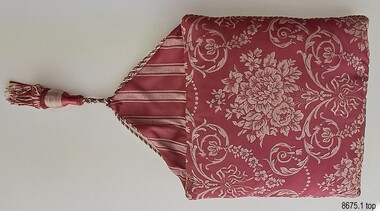
Textile - Seat Squabs, mid-20th century
... DETAILED HISTORY of the Missions to Seamen: - The Missions to Seamen is an Anglican (Church of England) charity that has served the world’s seafarers since 1856. ...DETAILED HISTORY of the Missions to Seamen: - The Missions to Seamen is an Anglican (Church of England) charity that has served the world’s seafarers since 1856. ...The term 'seat squabs' is no longer commonly used, but is sometimes referred to in the upholstery and motor vehicle industries. Squabs are padded cushions frequently added to wooden chairs or benches to add comfort to their hard forms. They have been made to an 18th-to-19th-century pattern using beautiful, richly coloured satin fabric and fancy cord tassels. The weighted flap at the rear of the squabs helps to keep them in place on the chair, and could be used on the top of the backrest instead of on the seat. These days, squabs are attached with fabric ties or hook-and-loop tabs. These seat squabs were once used in the St Nicholas Seamen's Church at 139 Nelson Place, Williamstown, Victoria, which was purchased and furnished around 1943. The furniture and furnishings are now part of the St. Nicholas Seamen's Church collection. DETAILED HISTORY of the Missions to Seamen: - The Missions to Seamen is an Anglican (Church of England) charity that has served the world’s seafarers since 1856. It was inspired by the work of Rev. John Ashley, who, 20 years earlier, had pioneered a ministry to seafarers in the Bristol Channel in Great Britain. When Ashley retired, others continued the work, founding the Missions to Seamen. It adopted a Flying Angel as its symbol, inspired by a verse from the Bible in Revelation 14. Today, over 200 world ports have Missions to Seamen centres and chaplains. A Missions to Seamen’s club warmly welcomes sailors of all colours, creeds and races and provides a wide range of facilities. The Missions to Seamen organisation changed its name to the Mission to Seafarers in 2000, continuing to include Missions to Seamen clubs in Victoria’s cities of Melbourne, Portland, Geelong and Hastings. Flagstaff Hill’s St Nicholas’ Seamen’s Church is named after its namesake from Williamstown, Victoria, which began in 1857. Bishop Perry opened the first Sailors’ Church, which was known as ‘Bethel’, on an old hulk floating in Hobson’s Bay, Port of Melbourne. In 1860, a Sailors’ Rest started operating from rented premises in Williamstown. In 1878, the Sailors’ Church moved into an old Wesleyan chapel in Ann Street. By the end of that year, they managed to purchase the building, which they had already refurbished. In 1883, they affiliated with the Victorian Seamen’s Mission. A few years later, in 1906, the building had to be demolished because it was no longer safe. While they raised funds for a new building, the Sailors’ Rest temporarily moved to premises in front of Customs House in Nelson Place. Around this time, in 1906, the Ladies Harbour Lights Guild was formed in Australia to support and raise funds for the Mission to Seamen organisation in Melbourne. Two of the most significant ladies of the Guild were founding members Ethel Godfrey and Alice Sibthorpe. During the Mission's time at Siddeley Street, Melbourne, the activities of the Guild raised funds for the Mission to Seamen's Chapel at their new, and still current, premises in Flinders Street, Melbourne, opened in 1917. The Guild continued its important work until the 1960s. In 1908, the Williamstown Mission had enough money to purchase the former Mascotte skating rink on Thompson Street, Williamstown. In August of that year, they were inaugurated into the Victorian Missions to Seamen. They continued at that venue for a few decades. In 1943, the former ES&A Bank building at 139 Nelson Place, Williamstown, was purchased for the new Mission to Seaman’s Club. The official opening was on May 6th, 1944. It was described as a ‘distinctive little building’. Funds had previously been raised for the building and furnishing of the chapel at the rear. The chapel was named St Nicholas’ Seamen’s Church, after St Nicholas, fourth-century bishop and patron saint of sailors. Services were held on Wednesdays and Sundays. The church was supported by the Williamstown Lightkeepers’ Auxiliary, newly founded by Mrs Ethel Margaret Musther in 1943, as well as the Harbour Lights Guild and the League of Soldiers’ and Sailors’ Friends. The Williamstown Mission to Seamen’s Church operated until 1966, when large international ships no longer used the Port of Williamstown. The Commonwealth Government then leased the premises. In the formative years of Flagstaff Hill Maritime Village, the Advisory Board decided to include a Missions to Seamen Chapel and Recreation Room in its village. The Missions organisation was a significant feature of ports during the late 1800s and early 1900s, the period that the Village represents. They often erected Missions to house social and worshipful activities for seamen. Flagstaff Hill’s curator, Mr Ken Marshman, approached the Melbourne Board of Management of Missions to Seamen regarding the Williamstown branch. Consequently, the Board permitted the furnishings of the Williamstown chapel to be transferred to Flagstaff Hill Maritime Village. A provision of the transfer was that the Victoria Missions to Seamen be recognised, that the items would remain as a collection, and that the chapel would be called St Nicholas Seamen’s Church and conduct Divine services. The donation was approved on 21st May 1979. Flagstaff Hill's St. Nicholas Seamen's Church: - The idea behind Flagstaff Hill’s Missions to Seamen’s Church was partly driven by the offer of Stained Glass Memorial Windows that originated from the Warrnambool and District Base Hospital, which was undergoing multi-storey expansion in the late 1960s and early 1970s. The hospital’s Manager/Secretary was eager to see the historic window installed in a suitable place. The church, or chapel, was designed by a local architectural draftsman in collaboration with the Flagstaff Hill Planning Board and was constructed by Mr Leon Habel. The designers hoped the church would be used for formal worship, such as weddings, funerals, and multi-denominational special services like war commemorations. Its design was inspired by the ‘Missions to Seamen’ buildings in Portland and the Port of Melbourne. The furniture and furnishings were placed as accurately as possible according to photographs of the Williamstown St Nicholas Seamen’s Church and with assistance from local clergy. The Recreation Room was furnished and arranged on advice from experienced members of the Missions to Seamen organisation. A framed document in the building recognises the donor of the furnishings, Victoria Missions to Seamen, and includes the names of some original donors and their donated item/s. The building’s design incorporates local features such as Warrnambool sandstone, which was no longer commercially available but was procured from demolished buildings and uniformly cut to use as a veneer over the stronger Mt. Gambier stone. Also, traditional green American roofing slate was used, sourced from the 1908 local shipwreck “Falls of Halladale” by Flagstaff Hill volunteer divers. The bell tower includes a bell believed to be from a local shipwreck. Additional furnishings were acquired locally, and several items were donated by Warrnambool residents. Light fittings in both rooms were assembled to simulate 19th-century gas light fittings. The stained-glass window at the back of the church is a memorial to Dr Connell, a well-respected member of the Warrnambool community. It was originally installed in 1928 in the main building of Warrnambool Hospital. The St Nicholas’ Seamen’s Church at Flagstaff Hill was officially opened by His Worship the Mayor, Cr. John Lindsay, on Sunday, 11th October 1981. The event included a service of thanksgiving conducted by the Warrnambool Ministers Fraternal. Since then, the Chapel has been the historic venue for many weddings. This pair of seat squabs is historically significant for its origin in the St Nicholas Mission to Seamen's Church in Williamstown, established in 1857 to cater for seafarers’ physical, social, and spiritual needs. The organisation originated in Bristol, England, when a Seamen's Mission was formed in 1837. The squabs are also significant for their use in the St Nicholas Missions to Seamen's chapel, Williamstown, as the original building is now listed on the Victorian Heritage Register. Squabs or padded seat cushions, a pair of two. These 18th to 19th-century design squabs have crimson and cream satin fabric on top and underneath, and weighted tassels are attached to their rear corners. They can be used for comfort on hard seats and benches. The squabs were furnishings from the Missions to Seamen chapel in Williamstown, and they are now part of the St Nicholas Seamen's Church Collection.flagstaff hill, warrnambool, shipwrecked-coast, flagstaff-hill, flagstaff-hill-maritime-museum, maritime-museum, shipwreck-coast, flagstaff-hill-maritime-village, st nicholas mission to seamen's church williamstown, mission to seamen williamstown, mission to seamen victoria, st nicholas mission to seamen, st nicholas seamen's church, religion, religious service, sailor's rest, ladies harbour light guild, squab, seat covers, cushions, squabs, religious furnishing, padded seats, seating, accessory -
 Flagstaff Hill Maritime Museum and Village
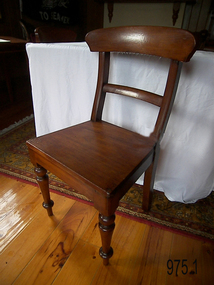
Furniture - Chair, ca. 1944
... Church in Williamstown, established in 1857 to cater for the physical, social, and spiritual needs of seafarers. The organisation originated in Bristol, England, when a Seamen's Mission was formed in 1837. Flagstaff Hill Maritime Museum and Village Flagstaff Hill Warrnambool Maritime Museum Maritime Village Shipwreck Coast Great Ocean Road Religion Religious service St Nicholas Seamen’s Church Williamstown Missions to Seamen Victoria chair religious furniture dining chair church furniture religious worship Anglican Church worship service Mission to Seafarers St Nicholas Missions to Seamen’s Church Williamstown Missions to Seamen St Nicholas Missions to Seamen’s Church Flagstaff Hill 139 Nelson Place Williamstown Chair, dark brown wood, curved backrest. ...This chair, one of a set of three, was part of the original furnishings of the St Nicholas' Mission to Seamen's Church at 139 Nelson Place, Williamstown, Victoria. The Church was operated by the Mission to Seamen organisation. THE MISSIONS TO SEAMEN (Brief History: for more, see our Reg. No. 611, Set of Pews) The Missions to Seamen was an Anglican charity that served seafarers of the world since 1856 in Great Britain. It symbol is a Flying Angel, inspired by a Bible verse. Today there are centres in over 200 ports worldwide where seamen of all backgrounds are offered a warm welcome and provided with a wide range of facilities. In Victoria, the organisation began in Williamstown in 1857 as a Sailors’ Church, also known as ‘Bethel’ or the ‘Floating Church’ in an old hulk floating in Hobson’s Bay, Port of Melbourne. It soon became part of the Missions to Seamen, Victoria. In the year 2000 the organisation, now named Mission to Seafarers, still operated locally in Melbourne, Portland, Geelong and Hastings. The Ladies’ Harbour Lights Guild was formed in 1906 to support the Missions to Seamen in Melbourne and other centres such as Williamstown. Two of the most significant ladies of the Guild were founder Ethel Augusta Godfrey and foundation member Alice Sibthorpe Tracy (who established a branch of the Guild in Warrnambool in 1920). The Guild continued its work until the 1960s. In 1943 a former Williamstown bank was purchased for the Missions to Seaman Club. The chapel was named St Nicholas’ Seamen’s Church and was supported by the Ladies’ Harbour Lights Guild, the Williamstown Lightkeepers’ Auxiliary and the League of Soldiers’ and Sailors’ Friends. It ceased operation in 1966. A Missions to Seamen Chapel and Recreation Room was a significant feature of ports during the late 1800s and into the 1900s. It seemed appropriate for Flagstaff Hill to include such a representation within the new Maritime Village, so the Melbourne Board of Management of Missions to Seamen Victoria gave its permission on 21st May 1979 for the entire furnishings of the Williamstown chapel to be transferred to Flagstaff Hill. The St Nicholas Seamen’s Church was officially opened on October 11, 1981, and closely resembles the Williamstown chapel. This chair is historically significant for its origin in the St Nicholas Mission to Seamen's Church in Williamstown, established in 1857 to cater for the physical, social, and spiritual needs of seafarers. The organisation originated in Bristol, England, when a Seamen's Mission was formed in 1837. Chair, dark brown wood, curved backrest. One of a set of three. The two front legs are decoratively shaped (turned), while the back legs are plain and flat-sided. It has an almost square flat seat. This chair is part of the St Nicholas Seamen's Church Collection. flagstaff hill maritime museum and village, flagstaff hill, warrnambool, maritime museum, maritime village, shipwreck coast, great ocean road, religion, religious service, st nicholas seamen’s church, williamstown, missions to seamen victoria, chair, religious furniture, dining chair, church furniture, religious worship, anglican church, worship service, mission to seafarers, st nicholas missions to seamen’s church williamstown, missions to seamen, st nicholas missions to seamen’s church flagstaff hill, 139 nelson place williamstown
