
Showing 3 items matching "anti-magnetic"
-
 Flagstaff Hill Maritime Museum and Village
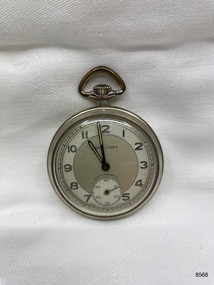
Instrument - Fob Watch, 1940-60s
... ...Anti-magnetic...The words 'ANTIMAGNETIC' are on the front of the watch. Anti-magnetic watches began to be made at the beginning of the 20th century as mechanical watches were affected by magnetic fields. ...The words 'ANTIMAGNETIC' are on the front of the watch. Anti-magnetic watches began to be made at the beginning of the 20th century as mechanical watches were affected by magnetic fields. ...Fob (or pocket) watches were developed in Europe in the 16th century and gained wide usage during the mid 18th century until World War 1 when the wristwatch was invented. These watches were designed to be carried in a small pocket and attached through the means of a 'fob' which could be a chain or made from a variety of materials such as leather. Their popularity peaked in the nineteenth century where they were an important part of middle and lower class society as well. This item is of social significance as fob / pocket watches were valued as an essential object in all levels of society. For some occupations, such as the railroads, it was a necessary tool of the job. Steel York Lever open face pocket / fob watch dated between 1940-1960. The dial has an inner pewter circle, outer minute divisions and a circular insert and hand to show the seconds. The numbers are finely edged with a black line and the hands are two coloured. The back of the watch is patterned with fine lines and three rectangle shapes. The words 'ANTIMAGNETIC' are on the front of the watch. Anti-magnetic watches began to be made at the beginning of the 20th century as mechanical watches were affected by magnetic fields. The 'lever' set on watches was a requirement for railroad watches. It required a two step process for the hands to be adjusted. The front dial of the watch has the words 'YORK LEVER', 'ANTIMAGNETIC' and 'MADE IN GERMANY'. flagstaff hill maritime museum and village, warrnambool, great ocean road, shipwreck coast, fob watch, pocket watch, watch, horology, time keeper, york lever, anti-magnetic, made in germany -
 City of Moorabbin Historical Society (Operating the Box Cottage Museum)
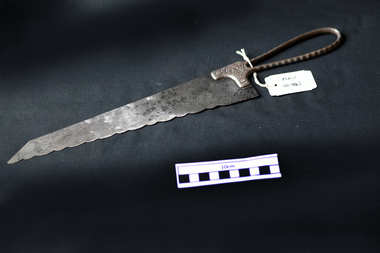
Kitchen Equipment, Bread Knife 'Clauss', c1900
... Clauss made surgical scissors for eye operations, heavy duty metal cutting shears, poultry shears for gutting chickens and specialty items such as anti-acid, anti-magnetic tweezers for the electronics industry. ...Clauss made surgical scissors for eye operations, heavy duty metal cutting shears, poultry shears for gutting chickens and specialty items such as anti-acid, anti-magnetic tweezers for the electronics industry. ...Clauss Cutlery’s long and vivid history started in early 1880’s when John Clauss and his younger brother Henrie established Elyria Shear Works in Elyria, Ohio. At one time the company was the largest manufacturer of scissors and shears in the world and was acquired by Acme United Corporation in 2004. John and Henrie Clauss, of German origin, started Elyria Shear Works from a one-room building in Elyria, Ohio Together with five employees, they began manufacturing scissors, shears, straight razors and serrated kitchen knives In August 1887, the Company moved to Fremont, Ohio to be near an accessible, abundant supply of natural gas which had recently been discovered. 1889, disaster struck as the plant was completely destroyed by fire, In 4 months Clauss built a new plant and was back in full operation and changed the company’s name to Clauss Shear Company. 1919 Clauss Shear merged with Henkel Company, to become Henkel-Clauss Company. Henkel Company was founded in 1906 to manufacture manicure and pedicure files, knives, shears and razors. After World War II, Clauss was unable to compete with European firms producing household scissors and shifted its focus to industrial scissors. In 1967 Clauss was taken over by Alco Standard Corporation who integrated Clauss into its existing structure to manufacture tools for industrial niche markets. Clauss made surgical scissors for eye operations, heavy duty metal cutting shears, poultry shears for gutting chickens and specialty items such as anti-acid, anti-magnetic tweezers for the electronics industry. Clauss had approximately 100 employees and produced about $18 million in annual revenues in the late 1980s, but profits continued to decline. In 2004, Acme United Corporation acquired the Clauss inventory, trademarks and brand names from Alco Industries for approximately $500,000 A large Bread Knife with scalloped / serrated edge and looped handle Front : CLAUSS Back : FREEMONT / OHIO cutlery, knives, clauss shear company, ohio, freemont, market gardeners, early settlers, moorabbin, cheltenham, -
 Moorabbin Air Museum
Book - Aeronautics, Aeronautics Volume III
... Magnetic compasses...Air photography...Annual overhaul...Air navigation...Launching & hauling in large flying boats...Acceptance tests...Navigation on long flights over sea...Tracing internal combustion engine troubles...Astronomical navigation...Testing flying boats...Safety measures in the air...Air photography interpretation...Directional radio systems...Boost pressure & mixture strengths...The controllable pitch airscrew...Aerobatics effect on carburation...Overhauls...Anti...Aeronautics Everyday precautions Daily pre flight inspections Fuel & oil systems Magnetic compasses Air photography Annual overhaul Air navigation Launching & hauling in large flying boats Acceptance tests Navigation on long flights over sea Tracing internal combustion engine troubles Astronomical navigation Testing flying boats Safety measures in the air Air photography interpretation Directional radio systems Boost pressure & mixture strengths The controllable pitch airscrew Aerobatics effect on carburation Overhauls Anti corrosive measures Fabric coverings Starting troubles & remedies Maps & charts Aircraft design The rating & performance testing of engines Aero engine accessories Overview on navigation, inspection & tests. ...Overview on navigation, inspection & tests. No publication date stated, but looks to be around late 1930s/early 1940snon-fiction Overview on navigation, inspection & tests. No publication date stated, but looks to be around late 1930s/early 1940s everyday precautions, daily pre flight inspections, fuel & oil systems, magnetic compasses, air photography, annual overhaul, air navigation, launching & hauling in large flying boats, acceptance tests, navigation on long flights over sea, tracing internal combustion engine troubles, astronomical navigation, testing flying boats, safety measures in the air, air photography interpretation, directional radio systems, boost pressure & mixture strengths, the controllable pitch airscrew, aerobatics effect on carburation, overhauls, anti corrosive measures, fabric coverings, starting troubles & remedies, maps & charts, aircraft design, the rating & performance testing of engines, aero engine accessories
