
Showing 6 items matching "anzac day 1918 commemorative medal"
-
 Geelong RSL Sub Branch
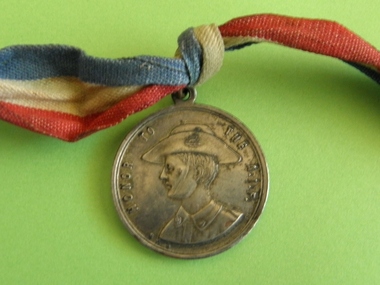
ANZAC Day 1918 Commemoratived Medal, 1918
... ANZAC Day 1918 Commemorative Medal...1918 to commemorate ANZAC Day. They were issued by the Education Department of Victoria to school children. The medal was also sold on behalf of the Australian Branch of the British Red Cross Society. The medal was made in bronze, silvered bronze, silver and gold. This medal is an original. ANZAC Day 1918 Commemorative ...These Medallions were made in 1918 to commemorate ANZAC Day. They were issued by the Education Department of Victoria to school children. The medal was also sold on behalf of the Australian Branch of the British Red Cross Society. The medal was made in bronze, silvered bronze, silver and gold.This medal is an original.Round silver medallion. ?Silver Bronze. Red, white and blue ribbon.On the front of the medallion an engraved picture of a soldier, the words Honor to the AIF. One the back of the medallion ANZAC Dat 1918, Gallipoli, France, Palestine.anzac day 1918 commemorative medal, victorian education department -
 Bendigo Military Museum
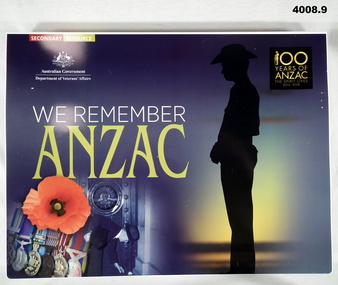
Education kit, Department of Veterans Affairs, WE REMEMBER ANZAC, 2) 2014, .4) 2014, .5) 2014, .6) 2014
... ANZAC - THE SPIRIT LIVES 2014-2018 - SECONDARY RESOURCE .1) .2) 'WE REMEMBER ANZAC' .3) 'COMMEMORATIVE CEREMONY' .4) 'Memories & Memorabilia - Recognising and Preserving Australia's War Heritage' .5) 'Candour. Stories in the words of those who served 1914-1918.' .6) Over a Century of Service 2015 (Calendar) .7) 'ANZAC CENTENARY' .8) 'ANZAC PORTAL' .9) '2015 Anzac Day School's Awards' Educational Kit ANZAC Centenary .1) Box folder - cardboard, white & gold print front, spine, back. Illustrated - collage colour photographs - medals ...WE REMEMBER ANZAC - 100 years of ANZAC - THE SPIRIT LIVES 2014-2018 - SECONDARY RESOURCE .1) .2) 'WE REMEMBER ANZAC' .3) 'COMMEMORATIVE CEREMONY' .4) 'Memories & Memorabilia - Recognising and Preserving Australia's War Heritage' .5) 'Candour. Stories in the words of those who served 1914-1918.' .6) Over a Century of Service 2015 (Calendar) .7) 'ANZAC CENTENARY' .8) 'ANZAC PORTAL' .9) '2015 Anzac Day School's Awards'.1) Box folder - cardboard, white & gold print front, spine, back. Illustrated - collage colour photographs - medals, poppy, rising sun badge, soldier in silhouette. .2) Softcover, cardboard with fold in front flap, white & gold print, spiral bound, colour collage photographs - poppy, medals, troops. Pages - 86 pages, cut, plain, white, illustrated black & white, colour photographs, work sheets. .3) DVD inside cover flap. .4) Soft cover, cardboard, spiral bound, black, print front, illustrated sepia photograph soldier with letter and slouch hat. Pages - 88 pages, cut, plain, white, illustrated black & white, colour photographs, posters. .5) Soft cover, cardboard, white print front & back, illustrated - collage colour and sepia photographs of service personnel, letters, pens, brooch. Pages - 56 pages, cut, plain, white, illustrated colour, black & white photographs, medals, paintings. .6) Calender - soft cover, cardboard, light brown and black print front and back. Illustrated - sepia and colour - in silhouette - Troops of 1st Australian Division and members of 4 RAR. Pages - cut, plain, white, illustrated colour, black & white photographs from Boer War to Afghanistan. .7) .8) Card, cardboard with Webkey attached. Card - white & dark red print, small colour, sepia illustrations. .8) Key - metal with words printed - 'ANZAC PORTAL'. In plastic pocket. .9) Leaflet - lightweight cardboard black, white, yellow print front and back. Illustrated - black & white photograph of troop ship dockside. educational kit, anzac centenary -
 Mont De Lancey
Medals, 1916 and 1918
... Presented to School children. commemorative medals 2 x Anzac Day Medals 1918 and 1916 on faded red, white and blue ribbons. ...Presented to School children.2 x Anzac Day Medals 1918 and 1916 on faded red, white and blue ribbons.commemorative medals -
 Kew Historical Society Inc
Medal, Education Department (Victoria), Anzac Day School Children's Medal, 1918
... anzac day medal (1918)...commemorative...Together it forms the largest privately-donated collection within the archives of the Kew Historical Society. anzac day medal (1918) commemorative medals world war 1 - commemorations australian commemorative medals Obverse: Bust of uniformed soldier wearing hat left; around, HONOR TO THE A.I.F. ...Anzac Day school children's medal, issued in 1918. The medal was distributed to every school child that year to commemorate Anzac Day. The Anzac forces first landed at Gallipoli on 25 April 1915. The medal sold to Victorian school children and the public to commemorate ANZAC Day, 25 April 1918. 250,000 medals were struck. Bronze medals were sold for 1 shilling and oxidised silver medals for 5 shillings. One-third of the proceeds was to be directed to the funding of a permanent institution for returned soldiers. [The Argus, 11 April 1918, p 8]This work forms part of the collection assembled by the historian Dorothy Rogers, that was donated to the Kew Historical Society by her son John Rogers in 2015. The manuscripts, photographs, maps, and documents were sourced by her from both family and local collections or produced as references for her print publications. Many were directly used by Rogers in writing ‘Lovely Old Homes of Kew’ (1961) and 'A History of Kew' (1973), or the numerous articles on local history that she produced for suburban newspapers. Most of the photographs in the collection include detailed annotations in her hand. The Rogers Collection provides a comprehensive insight into the working habits of a historian in the 1960s and 1970s. Together it forms the largest privately-donated collection within the archives of the Kew Historical Society.Bronze ANZAC Day medal distributed to all school children by the Department of Education in 1918 .Obverse has the bust of a uniformed soldier. The reverse image of the bust of an Australian soldier was adapted from a drawing by H. Harvey, an at assistant in the Victorian Education Department.Obverse: Bust of uniformed soldier wearing hat left; around, HONOR TO THE A.I.F. In small letters below bust, S&S 15C HH Reverse: Incuse on scroll which rests on olive branch, GALLIPOLI / FRANCE / PALESTINE; above EVD ; below, ANZAC DAY 1918anzac day medal (1918), commemorative medals, world war 1 - commemorations, australian commemorative medals -
 Emerald Museum & Nobelius Heritage Park
Award - British War Medal 1914-20, Royal Mint, 1919-1920
... The landings at Gallipoli on April 25, 1915 is remembered as ANZAC Day, and is still commemorated to this day, over 100 years later. medal commemorative medals military First World War World War One World War I World War 1 WWI WW1 Obverse: GEORGIVS V BRITT: OMN: REX ET IND: IMP: / Reverse: 1914 1918 // Silver, circular medallion. ...James Beashel enlisted for the Australian Imperial Force (AIF) on 1 June 1917. He served with the 33rd Battalion and was marched out to the front in France in February 1918. In that year the 33rd Battalion engaged in a number of significant battles as the Germans launched their ‘Spring Offensive’ – a final push for victory following the revolution and collapse of the Russian army in late 1917. Some of the notable engagements include the Battle of Mont St Quentin, the Battle of Amiens and the Battle of Villers Bretonneux. The British War Medal 1914-20 was instituted by King George V in 1919 to mark the end of the First World War. It was awarded to members of British and Imperial forces who had served for a prescribed period during the course of the war, or who had died in active service. Beashel was not the most disciplined of soldiers throughout his time with the AIF. He was regularly disciplined for offences such as neglecting to obey orders, drunkenness, going AWOL and missing marching parades. He was discharged from the AIF at the conclusion of the First World War and returned home to New South Wales. Later in life he relocated to Victoria and died in 1965. For his service he received the Victory Medal, the British War Medal 1914-20, and the 1914-15 Star.This item is historically significant as it represents the service of an Australian in one of the most significant events of the twentieth century, and indeed in human history. 416,809 Australians enlisted for service, of which more than 60,000 were killed and more than 150,000 were wounded, gassed, or taken prisoner. The First World War remains a significant event in Australia's history. The landings at Gallipoli on April 25, 1915 is remembered as ANZAC Day, and is still commemorated to this day, over 100 years later.Silver, circular medallion. The profile of King George V is impressed on the obverse, along with the words 'GEORGIVS V BRITT: OMN: REX ET IND: IMP:' The reverse has an impression of St George on horseback, along with '1914' and '1918'. The ribbon is a thick orange band, flanked on both sides by thinner blue, black and white bands.Obverse: GEORGIVS V BRITT: OMN: REX ET IND: IMP: / Reverse: 1914 1918 //medal, commemorative medals, military, first world war, world war one, world war i, world war 1, wwi, ww1 -
Emerald Museum & Nobelius Heritage Park
Award - War Medals - World War I, Royal Mint, 1919-1920
... 1918. This item is historically significant as it represents the service of an Australian in one of the most significant events of the twentieth century, and indeed in human history. 416,809 Australians enlisted for service, of which more than 60,000 were killed and more than 150,000 were wounded, gassed, or taken prisoner. The First World War remains a significant event in Australia's history. The landings at Gallipoli on April 25, 1915 is remembered as ANZAC Day, and is still commemorated to this day, over 100 years later. medal commemorative ...James Beashel enlisted for the Australian Imperial Force (AIF) on 1 June 1917. He served with the 33rd Battalion and was marched out to the front in France in February 1918. In that year the 33rd Battalion engaged in a number of significant battles as the Germans launched their ‘Spring Offensive’ – a final push for victory following the revolution and collapse of the Russian army in late 1917. Some of the notable engagements include the Battle of Mont St Quentin, the Battle of Amiens and the Battle of Villers Bretonneux. Beashel was not the most disciplined of soldiers throughout his time with the AIF. He was regularly disciplined for offences such as neglecting to obey orders, drunkenness, going AWOL and missing marching parades. He was discharged from the AIF at the conclusion of the First World War and returned home to New South Wales. Later in life he relocated to Victoria and died in 1965. For his service he received the Victory Medal, the British War Medal 1914-20, and the 1914-15 Star. The 1914-15 Star was awarded to those who served with the British and Imperial Forces between 5 August 1914 and 31 December 1915 The British War Medal 1914-20 was instituted by King George V in 1919 to mark the end of the First World War. It was awarded to members of British and Imperial forces who had served for a prescribed period during the course of the war, or who had died in active service. The Victory Medal was awarded to those who served with the armed forces of the British and Imperial Forces or with certain voluntary organisations between 5 August 1914 and 11 November 1918.This item is historically significant as it represents the service of an Australian in one of the most significant events of the twentieth century, and indeed in human history. 416,809 Australians enlisted for service, of which more than 60,000 were killed and more than 150,000 were wounded, gassed, or taken prisoner. The First World War remains a significant event in Australia's history. The landings at Gallipoli on April 25, 1915 is remembered as ANZAC Day, and is still commemorated to this day, over 100 years later.Four medals. One is a bronze four-pointed star medallion, ensigned with a crown. The obverse has two crossed swords overlaid with a wreath and a scroll that reads '1914-15'. Below is the royal cypher of King George V - GV. The ribbon is a thick white band flanked by a thinner blue band on one side and a red band on the other. Two of the medals are the same. Silver, circular medallions. The profile of King George V is impressed on the obverse, along with the words 'GEORGIVS V BRITT: OMN: REX ET IND: IMP:' The reverse has an impression of St George on horseback, along with '1914' and '1918'. The ribbon is a thick orange band, flanked on both sides by thinner blue, black and white bands. One is a circular, bronze medallion, impressed on the obverse with a winged, female figure holding a palm branch in her right hand. The reverse reads 'THE GREAT WAR FOR CIVILISATION 1914 - 1919', surrounded by a laurel wreath. The ribbon is rainbow coloured.Medal 1: Obverse: 1914-15 / Medals 2 and 4: Obverse: GEORGIVS V BRITT: OMN: REX ET IND: IMP: / Reverse: 1914 1918 / Medal 3: Reverse: THE GREAT / WAR FOR / CIVILISATION / 1914 - 1919 /medal, commemorative medals, military, first world war, world war one, world war i, world war 1, wwi, ww1
