
Showing 7 items matching "arc lighting"
-
 Bendigo Military Museum
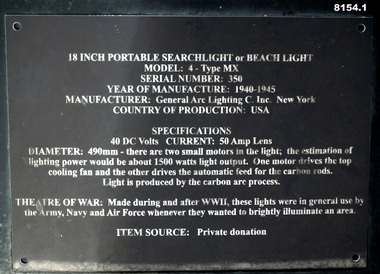
Equipment - SEARCH LIGHT, MOBILE, General Arc Lighting C. Inc New York, C. 1940 - 45
... General Arc Lighting C. Inc New York...Equipment SEARCH LIGHT, MOBILE General Arc Lighting C. Inc New York ...This item is in the gardens of the Bendigo District RSL Sub Branch Inc Havilah Road. Refer photo .1) For details re manufacture, history and use..1) Plaque black metal on stand with white text re details of the item. .2) Mobile search light portable Model: 4 - Type MX with 49.0 cm lens, mounted on a base with two tyres and towed. painted a greyish colour.brsl, smirsl, bdrslinc, search light, mobile -
 Federation University Historical Collection
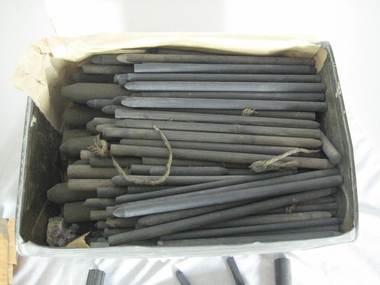
Equipment, Tin of carbon rods
... ...arc lighting...In electricity a current is conducted through carbon rod between the electrode holder and the arc in carbon arc lighting or welding. A carbon rod is also used in batteries. ...In electricity a current is conducted through carbon rod between the electrode holder and the arc in carbon arc lighting or welding. A carbon rod is also used in batteries. ballarat school of mines carbon carbon rod arc lighting electricity henry sutton theatre projector gem pictures On box found with carbon rods: "Siemens-Planiawerke aktiengesellaschaft fur kohlefabrikate berline-Lichtenberg Made in Germany jede kohle trägt unseren vollen firmenstempel Translation: Siemens Planiawerke A corporation limited by shares producing carbon in Berlin-Lichtenberg Each carbon carries our full company stamp A tin full of carbon rods Tin of carbon rods Equipment Siemens-Planiawerke Siemens-Planiawerke ...The carbon rods were either used by 'Gem Pictures' or in the study of 'Electricity and Magnetism' at the Ballarat School of Mines. In electricity a current is conducted through carbon rod between the electrode holder and the arc in carbon arc lighting or welding. A carbon rod is also used in batteries. A tin full of carbon rodsOn box found with carbon rods: "Siemens-Planiawerke aktiengesellaschaft fur kohlefabrikate berline-Lichtenberg Made in Germany jede kohle trägt unseren vollen firmenstempel Translation: Siemens Planiawerke A corporation limited by shares producing carbon in Berlin-Lichtenberg Each carbon carries our full company stampballarat school of mines, carbon, carbon rod, arc lighting, electricity, henry sutton, theatre, projector, gem pictures -
 Federation University Historical Collection
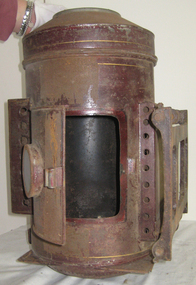
Equipment, Theatre Light
... lighting...entertainment...arc...Arc theatre lights produced light for performances before electricity. theatre light lighting entertainment arc theatre light carbon light Metal theatre light with hinged opening on side, and hole in the front and bottom. ...Arc theatre lights produced light for performances before electricity.Metal theatre light with hinged opening on side, and hole in the front and bottom. It is thought to be an arc theatre light. Remnants of maroon paint with gold trim remain. There is a fixture on the side, most probably to attach it to a wall or stage. theatre, light, lighting, entertainment, arc theatre light, carbon light -
 Flagstaff Hill Maritime Museum and Village
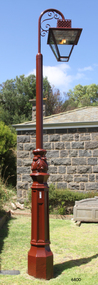
Functional object - Lamp Light, late 19th - early-20th century
... In 1879 a football match was played at the MCG under electric lighting and gradually electric arc lights were installed inside and outside buildings in the city. ...In 1879 a football match was played at the MCG under electric lighting and gradually electric arc lights were installed inside and outside buildings in the city. ...This gas lamp light and stand came from the original manufacturer in Melbourne. Gas street lights such as this one were used in Melbourne from the mid-19th century. The lights enabled safer after-dark travel for pedestrians and vehicles and were a deterrent to crime. A lamp lighter was employed to keep the lamps lit, sometimes with little success due to weather conditions and the pranks of youths. WARRNAMBOOL Gasworks In Warrnambool prior to 1874 there were about twenty rare, individually lit street lights in Warrnambool, each with its own supply of kerosene. These lamps were in the central business area of Timor, Koroit and Liebig Streets. The Warrnambool Gas Company Ltd. was registered as an incorporated company in 1873. It was a private, locally owned business. It was located at 209-215 Merri Street, Warrnambool, on the land, which is just west of the later-built railway station. The first managers of the Gas Company lived in a substantial stone house on site, but later the managers lived in a residence in Henna Street between Merri and Timor Streets. The original home, which still stands, became a residence for the Railway Station Master from about 1890. In August 1874 the construction of the gasworks was complete and at the end of that month gas was supplied to all of the existing lamps in Warrnambool for the first time. The Warrnambool Gas Company wound up in 1880-1881 and was purchased by the Warrnambool Borough Council with money raised by a loan – the Borough’s first ‘loan transaction’. The Council established a piped network to supply gas to other street connections. The gasworks were privatised and upgraded in 1952. In 1972 the town supply was converted to liquid petroleum gas and by the early 1980s the gasworks were closed down. In 1986 Warrnambool was supplied with natural gas from a site near Port Campbell. The Warrnambool gasworks supplied all street and shop lighting and most domestic lighting until 1923 when electricity was available for lighting. Bromfield Street in Warrnambool was named after the director of the gasworks, James Astley Bromfield (1823-1903). He arrived in Warrnambool from Worcestershire, England, in 1852 and was very active in the local council and community. Cockman Street was named after the first secretary of the gasworks in 1874, Walter Cockman (c.1821-1892). He was a Mayor and businessman. The second Manager, Luther Rodgers, worked for the gas company for about twenty years and both Rodger Place and Rodgers Road in Warrnambool have been named after him. LAMP LIGHTS IN MELBOURNE In the 1820s Melbourne's innkeepers were legally required to have a lamp light outside their premises from sunset to sunrise. This was the first instance of street lamps being used in Melbourne. In 1847 the first oil lamp was used in the city. In 1849 a gas lamp was installed on the Swanston Street Bridge and much of the city had oil lamps installed by then. In August 1857 the installation of street gas lamps began in Melbourne. They were welcomed for the much brighter illumination they gave. By 1860 there were 414 lamp pillars. The phrase was quoted often - "A light was as good as a policeman". The first gas burners used for street lighting were called 'fishtail' gas burners. These were replaced in the early 1900s by gas mantles. The City of Melbourne Gas Coke Company was formed in 1850 but due to the Gold Rush the manufacture and distribution of the gas supply was delayed until January 1856. By the 1890s the gas supplying the lights was supplied by three companies in Melbourne. In 1879 a football match was played at the MCG under electric lighting and gradually electric arc lights were installed inside and outside buildings in the city. Lamp lights such as the one in Flagstaff Hill’s collection were no longer needed. (References: John Lindsay re Lamp Light history 2019-01-29, Former Warrnambool Gas Company Limited, Victorian Heritage Database Report, Heritage Number 149746 https://vhd.heritagecouncil.vic.gov.au/places/149746/download-report ) The lamp light is representative of the lamps used in Melbourne from the mid-nineteenth century to light the streets at night and make Melbourne a safer city. The lamp is also representative of the gas street lighting in Warrnambool from the mid-1870s-1920s.Lamp light or gas light. Street light, one of the last gas street lights removed from Melbourne. (Reconditioned by Friends of Flagstaff Hill, 2013)flagstaff hill, warrnambool, shipwrecked coast, flagstaff hill maritime museum, maritime museum, shipwreck coast, flagstaff hill maritime village, great ocean road, lamp light, gas light, gas lamp, street lamp, street light, gas street light, melbourne street lighting, warrnambool street lighting, melbourne gas street light, warrnambool gas company, warrnambool gasworks, james bromfield, walter cockman, luther rodgers, city of melbourne gas coke company -
 Ballarat Tramway Museum
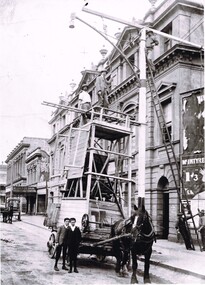
Photograph - Positioning street lights - Lydiard St North, Ballarat late 1890s
... Arc Lamps...Ballarat...Lydiard St North...Electric lighting...Yields information about the methodology of the late 1890's to install street lighting in Ballarat Arc Lamps Ballarat Lydiard St North Electric lighting tower wagons horses Workmen Street lights Digital print of a Positioning street lights Lydiard St North Ballarat late 1890s Photograph Positioning street lights - Lydiard St North, Ballarat late 1890s ...Photo of the installation of an electric arc type street lamp in Lydiard St North, near the Provincial Hotel Ballarat. The tower wagon is drawn by a single horse. Two boys standing alongside while two men are on the top of the wagon, a man on the top of the ladder is positioning a lifting beam while two men on the ground hold the rope for this beam. On the side of the wagon is possibly an extension that could be lifted onto the top of the tower itself to give a greater working height. The buildings between Mair St and the railway station on the west side of Lydiard St North remain in position. Yields information about the methodology of the late 1890's to install street lighting in BallaratDigital print of a Positioning street lights Lydiard St North Ballarat late 1890sarc lamps, ballarat, lydiard st north, electric lighting, tower wagons, horses, workmen, street lights -
 Flagstaff Hill Maritime Museum and Village
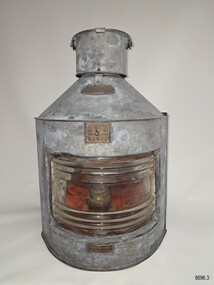
Equipment - Navigation Lamp, Port, George Bocock & Co. Ltd, Trading As Seahorse Lamps, 1930s
... Flagstaff Hill Maritime Museum and Village Great Ocean Road Shipwreck Coast ship lamp navigation lamp masthead light masthead lamp port lamp port light bow side lamp lighting device navigation marine light marine lamp marine equipment marine technology marine safety running light position light code of lights International Regulations for Preventing Collisions at Sea Antique galvanised Seahorse Great Britain GB Patent 546575 Seahorse logo Trade Mark P55933 oil burner Bocock & Wilkinson Bocock & Sons George Bocock & Co. Ltd Plaque on top, crescent shape: “PORT” Plaque in centre, square logo: “[rope design border] [Seahorse logo] “SEAHORSE / G B / TRADE / MARK / P55933” Plaque on base, rectangular: “PATENT NO. 546575 / AND OTHERS PENDING” Ship’s navigation lamp: an original, galvanised metal, Port bow-side lamp. The wedge-shaped case has an arc ...The donor recovered this navigation lamp before the 1980s from an old storage area in a South Melbourne factory where he worked. He asked about the lamp, but nobody there knew anything about its origin, and he was told that he could have it. This is a complete ship navigation lamp with its original oil burner. The internal red colour and shape indicate that the lamp was used for the port side of a vessel. The burner assembly is fixed to a removable tray, and the burner disconnects from the tank to allow fuel to be added. Light showing from the lamp is magnified by the polished brass reflector behind it, and the painted internal surfaces give the light its red colour. The lid on the chimney unclips for inspection purposes. The wedge shape of the lamp is intentional. It allows the light to be visible horizontally from up to a 112.5-degree angle, and to be invisible past that angle. The light's colour and position are part of the code of signals that inform viewers of the vessel’s position, direction of travel and status. The red lights indicate the port side of a vessel, green lights indicate the starboard side, and white lights are used on the masthead. From 1972, lights and signals on marine vessels are required to be fitted according to the International Regulations for Preventing Collisions at Sea. SEAHORSE lamp, made in Britain: The firm Bocock & Wilkinson was established in Birmingham in 1890 as an electroplate manufacturer. In 1900, Kelly’s Directory lists the firm as a ship lamp manufacturer. In 1910, the firm was listed Trading As “Seahorse” at 17 & 18 Mott Street, Birmingham. The firm later became Bocock & Son, and in 1932 was listed as George Bocock & Co. Ltd, and in 1973, it was still at that address. Ship’s navigation lamp: an original, galvanised metal, Port bow-side lamp. The wedge-shaped case has an arc front and two flat side panels that meet at the back, with a metal chimney and a swinging ‘C’ shaped handle on top. The curved, clear glass Fresnel has moulded ribs, top and bottom. The chimney has a hinged cap with a clip closure. One flat panel has a firmly attached, hollow rectangular channel for mounting onto a post or bracket. The other flat panel has a ‘D’ shaped, swinging handle, and slides upwards to access the burner assembly with its original brass burner. Concentric rings of ventilation holes are in the base. A removable tray, with ventilation holes on two edges, holds the round fuel tank and burner and the short post with the curved brass reflector. All internal metal surfaces, apart from the brass burner and reflector, were painted red sometime after the lamp’s manufacture. Inscriptions are embossed on the three brass plaques on the front; one has a rope design border and a seahorse emblem. Branded Seahorse, made in Great Britain, Ca. 1930s. Plaque on top, crescent shape: “PORT” Plaque in centre, square logo: “[rope design border] [Seahorse logo] “SEAHORSE / G B / TRADE / MARK / P55933” Plaque on base, rectangular: “PATENT NO. 546575 / AND OTHERS PENDING” flagstaff hill maritime museum and village, great ocean road, shipwreck coast, ship lamp, navigation lamp, masthead light, masthead lamp, port lamp, port light, bow side lamp, lighting device, navigation, marine light, marine lamp, marine equipment, marine technology, marine safety, running light, position light, code of lights, international regulations for preventing collisions at sea, antique, galvanised, seahorse, great britain, gb, patent 546575, seahorse logo, trade mark p55933, oil burner, bocock & wilkinson, bocock & sons, george bocock & co. ltd -
 Moorabbin Air Museum
Book - Aviation Theory Centre, PAARM 08 Radio Navigation & Instrument Flight Procedures
... Aviation Theory Centre Air traffic control services-radar Orientation NBD & ADF VOR DME TACAN Instrument landing systems Instrument runway markings & lighting RNAV systems Aviation documents IFR flight preparation IFR departures En route operations IFR arrivals Holding patterns/reversal procedures & DME arcs Instrument approaches Visual manoeuvering Overview of radio navigation aids & instrument flight procedures , circa 2008 PAARM 08 Radio Navigation & Instrument Flight Procedures Book Aviation Theory Centre ...Overview of radio navigation aids & instrument flight procedures , circa 2008non-fictionOverview of radio navigation aids & instrument flight procedures , circa 2008air traffic control services-radar, orientation, nbd & adf, vor, dme, tacan, instrument landing systems, instrument runway markings & lighting, rnav systems, aviation documents, ifr flight preparation, ifr departures, en route operations, ifr arrivals, holding patterns/reversal procedures & dme arcs, instrument approaches, visual manoeuvering
