
Showing 8 items matching "armed robberies"
-
 The Beechworth Burke Museum
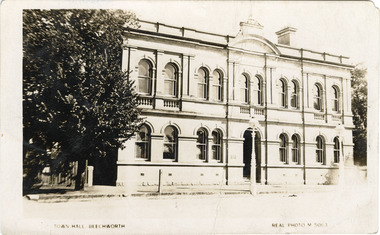
Photograph - Postcard, Town Hall Beechworth, c1910
... ...armed robberies...He gained his freedom six years later but spent time in and out of gaol for the rest of his life for a variety of offences including a number of armed robberies. The Town Hall is now home to the Visitor Information Centre which helps visitors with amongst other things, accommodation, tours, event enquiries, and is the commencement point for Precinct walking tours. ...He gained his freedom six years later but spent time in and out of gaol for the rest of his life for a variety of offences including a number of armed robberies. The Town Hall is now home to the Visitor Information Centre which helps visitors with amongst other things, accommodation, tours, event enquiries, and is the commencement point for Precinct walking tours. ...Beechworth Town Hall was designed by architects J.J. Coe and Thomas Dalziel and is dated to 1859. The building was made of granite and constructed to local builders Donald and William Fiddes. The original front to the building was replaced by a two story facade in 1889 designed by George Jobbins and built by Thomas Sandham according to a plaque on the front. The Town Hall is remarkable for its vaulted ceilings and columns. Originally the building was used as the Shire Offices but also doubled as a fire station and a courthouse, with still surviving cells underneath. Among the inmates was notorious bushranger Harry Power who was originally transported to Van Dieman’s Land for stealing a pair of shoes. He gained his freedom six years later but spent time in and out of gaol for the rest of his life for a variety of offences including a number of armed robberies. The Town Hall is now home to the Visitor Information Centre which helps visitors with amongst other things, accommodation, tours, event enquiries, and is the commencement point for Precinct walking tours. The Beechworth Town Hall is one of five distinctive granite buildings on Ford Street that comprise the Justice Precinct. It is of considerable historical significance as activity on the site dates from Australia’s gold rush period and was the administrative centre for north-eastern Victoria. The building has seen continual use from 1858 as an important public building and displays many aspects of the history of law enforcement in Victoria. The building is also of substantial architectural significance for its construction from local honey coloured granite, which also showcases early stone masonry techniques and craftsmanship. The Precinct is listed on the Victorian Heritage register and is protected by Heritage Victoria under the Victorian Heritage Act 2017. The buildings are also registered by the National Estate, the National Trust and protected by Indigo Shire Council’s Planning Scheme. Black and White rectangular postcard printed on cardReverse: 1906-1910?beechworth, beechworth town hall, town hall, jj coe, thomas dalziel, granite, beechworth historic building, courthouse, cells, geoge jobbins, thomas sandham, 1859, 1889, walking tours, beechworth historic precinct, historic precinct, harry power, bushranger, australian bushrangers, van dieman's land, transportation, armed robberies -
 Melbourne Tram Museum
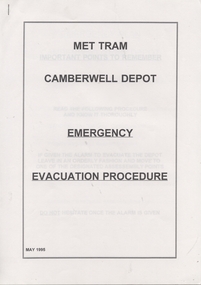
Document - Instruction, Public Transport Corporation (PTC), "Camberwell Depot Emergency Evacuation Procedure", May. 1995
... Nine page A4 document, stapled in the top left hand corner, titled "Camberwell Depot Emergency Evacuation Procedure", outlining the evacuation procedures in the case of a fire, chemical spill, armed robbery and bomb threats....Trams tramways Camberwell Procedures Met Tram Safety Nine page A4 document, stapled in the top left hand corner, titled "Camberwell Depot Emergency Evacuation Procedure", outlining the evacuation procedures in the case of a fire, chemical spill, armed robbery and bomb threats. "Camberwell Depot Emergency Evacuation Procedure" Document Instruction Public Transport Corporation (PTC) ...Nine page A4 document, stapled in the top left hand corner, titled "Camberwell Depot Emergency Evacuation Procedure", outlining the evacuation procedures in the case of a fire, chemical spill, armed robbery and bomb threats.trams, tramways, camberwell, procedures, met tram, safety -
 Bayside Gallery - Bayside City Council Art & Heritage Collection
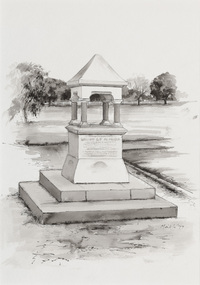
Work on paper - ink and watercolour, Annette Meikle, William Almeida Memorial, 1977
... The William Almeida Memorial is a drinking fountain located in the Triangle Gardens, Hampton, which commemorates William Almeida who was killed in an armed robbery at the Commercial Bank, Hampton, on 28 November 1914. ...The William Almeida Memorial is a drinking fountain located in the Triangle Gardens, Hampton, which commemorates William Almeida who was killed in an armed robbery at the Commercial Bank, Hampton, on 28 November 1914. ...In 1977, artist Annette Meikle undertook a commission to illustrate a book recording stories of places and people in the Bayside area. It was published in 1978 as Sandringham Sketchbook, with text by Elizabeth Waters. The sketches were intended to record remaining examples of Bayside’s early architecture and environment, as well as reflect newer architectural changes. Meikle went on to donate 22 of these sketches to Bayside City Council in 2003. The William Almeida Memorial is a drinking fountain located in the Triangle Gardens, Hampton, which commemorates William Almeida who was killed in an armed robbery at the Commercial Bank, Hampton, on 28 November 1914. Twenty-two year old Almeida was working alone at the bank when two armed robbers entered the premises. After refusing to hand over the bank’s money, Almeida was shot by one of the assailants before they fled. Despite the gunshot wounds, Almeida managed to chase one of the robbers down, dragging him back to the bank and handing him over to a bystander before collapsing. Almeida later died at the local hospital and this fountain was erected in his memory by the Bank Official’s Association and Almeida’s colleagues.Annette Meikle, William Almeida Memorial 1977, ink and watercolour, 35 x 23.5 cm. Bayside City Council Art and Heritage Collection. Donated by the artist, 2003annette meikle, sandringham sketchbook, elizabeth waters, william almeida memorial, hampton, william almeida, drinking fountain -
 Bendigo Historical Society Inc.
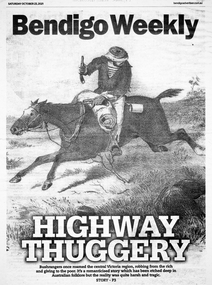
Newspaper - Bendigo Advertiser story Sat Oct 23 2021 entitled "Cop-killer caught out", Sat Oct 23 2021
... Smith was part of a group of bushrangers who terrorized travelers, merchants, and goldfields communities with armed robberies and audacious hold-ups. Notable incidents included tying up and robbing multiple victims, and high-speed horse chases with police. ...Smith was part of a group of bushrangers who terrorized travelers, merchants, and goldfields communities with armed robberies and audacious hold-ups. Notable incidents included tying up and robbing multiple victims, and high-speed horse chases with police. ...This document recounts the story of Gipsy Smith (real name William Turner), a notorious bushranger in 19th-century Australia, focusing on his involvement in violent crimes and his eventual capture. Gipsy Smith was involved in a shootout in central Victoria in 1856 that resulted in the death of Sergeant John McNally and the wounding of Constable John Moore. Smith and his accomplice escaped after the incident, which caused public outrage due to McNally's popularity. Smith was part of a group of bushrangers who terrorized travelers, merchants, and goldfields communities with armed robberies and audacious hold-ups. Notable incidents included tying up and robbing multiple victims, and high-speed horse chases with police. Bushrangers like Smith were sometimes romanticized as rebellious figures, but the document emphasizes the real violence and fear they caused. Smith, originally William Turner, was a former convict from Tasmania who became a bushranger after escaping to Victoria during the gold rush. He was known for his bravado, often displaying weapons openly among gold diggers. Smith was eventually recognized and arrested in Maryborough after the murder, narrowly avoiding a murder conviction due to a technicality with his arrest warrant. He was sentenced to 15 years of hard labor for manslaughter. After serving his sentence, Smith was trusted with responsible work, such as driving cattle and managing a farm, suggesting a degree of rehabilitation. The story is part of a historical series highlighting notable events in the region’s past.Bendigo Advertiser story Sat Oct 23 2021 entitled "Cop-killer caught out" This item contains the following documents 3486.51a Bendigo Advertiser Page 1 Title Page - "Highway Thuggery" 3486.51b Bendigo Advertiser Page 3 article "Cop-killer caught out" the story of Gypsy Smith Bushrangerbendigo, gipsy smith bushranger -
 Eltham District Historical Society Inc
Folder, Commercial Bank of Australia Eltham Branch Hold-Up, 15 December 1949
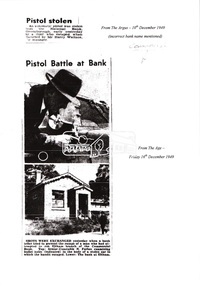
... Morgan ended up serving three years for the failed armed robbery and became a notorious criminal. ...Morgan ended up serving three years for the failed armed robbery and became a notorious criminal. ...Thursday, December 15, 1949, the quiet little bank was embroiled in an infamous wild shoot-out between a daring thief and two bank officers. Today, the building still carries the scars ; a bullet hole remains visible in a cedar bench testifying to the events that played out that day. 3.30 a.m., Friday, December 9. The manager of the Commercial Bank branch at Greensborough, Mr Harry Wallace and his wife are asleep in their bedroom of the little house behind the branch. Harry is awakened by a noise and sees an intruder in a corner of the bedroom. He calls out but the intruder who has switched off the power in anticipation flees through a side door and scarpers down Main Street. Harry summons the police but a search by First Constable Thomas of the Greensborough Police assisted by a wireless patrol car is unsuccessful. A report is filed noting the theft of a .25 calibre pistol from the wardrobe. Thursday, December 15th. It is 1pm and the Commercial Bank has just opened. The branch is only open Mondays and Thursdays from 1-3pm. The morning started off a little cool with some scattered showers but it has fined up and the temperature is now around 61 degrees (16 C). A new grey Singer sports car with soft-top pulls up on the opposite side of the road and a young man, neatly dressed in a dark blue suit, wearing a grey hat and carrying a brief case exits the vehicle. He looks around then crosses the road and walks up the steps and through the door into the bank. There are three people inside; Mr. Jack Burgoyne whose grocery store is situated just 50 yards up the road, Mr. Lindsay A. Spears, the Eltham Agency Receiving Officer and by chance, Mr Harry Wallace, manager of the Greensborough branch. Jack Burgoyne takes note of the young stranger; thinking to himself he appears nervous. The man approaches the counter and introduces himself as John Henderson of Greensborough and explains that he wishes to open a new account. He places his hat and £3 on the counter. Mr Spears attends to the paperwork. He asks the young man to sign two forms, which he does but then he withdraws from the counter and starts walking towards the door. Suddenly he spins around pulling an automatic pistol from his right-hand pocket. He exclaims forcefully; “The game’s on! I’ll take the lot!” Spears appears to comply by pretending to open a drawer. The man shouts loudly, “Keep your hand away from that drawer.” Spears instead reaches for a pistol in his pocket and challenges the man, “Here it is. Come and get it!” At the same time, Harry Wallace pulls a pistol from his pocket as well. The bandit fires a shot but misses, the bullet striking the counter. Both Spears and Wallace open fire and Jack Burgoyne ducks for cover. As the bandit turns and runs for the door leaving his £3 behind, he fires another shot, which strikes the ceiling. Spears fires back, and thinks he may have hit him in the foot. The bandit flees the bank and heads for the grey Singer car, registration NO-106, parked opposite. Wallace and Spears pursue him to the door and open fire again, striking the car three times around the driver’s door. Spears lets off eight shots and Wallace, seven before his gun jams. The getaway car initially heads slowly down Main Road towards Bridge Street. About 100 yards down the road, Dave Adams, a PMG employee, who has heard the shots, throws a steel manhole step at the driver. It hits the roof of the car nine inches above the driver’s head and tears the hood. Another witness claims to have seen the door blow open and the driver raise his hand. The car gathers speed and swings left into Bridge Street racing along at about 60 miles an hour careering recklessly past council employee, Mr. Percy Williams, who is driving a dray along Smarts Road [believed to be Bridge Street]. At the end of the road the Singer fails to get round the sharp turn and crashes into an embankment skidding to a stop outside the home of Mr John Clifford. One side of the car is wrecked. Mr Clifford, an aircraft engineer hears the fast travelling car bump heavily into the road bank at about 1.25 p.m. Hearing the whine of an engine he goes outside to find the grey Singer parked at the side of the road. Jack George also lives at the corner and hears the car crash. “The bandit opened the car door, ran 50 yards, and suddenly turned back,” exclaims Jack. “He took something from the car. It might have been a gun.” In his haste, the bandit drops his grey felt hat, size 6 7/8, on the road and dashes up Sherbourne Road for about 200 yards then disappears into the scrub carrying a brief case and a bundle in which a sailor’s cap can be seen. About 3 p.m., Mr H.D. Pettie of Mountain View Road, Montmorency is looking through his field glasses and notices a young man walking through thick scrub on private property some distance from his house. The man is wearing a sailor’s cap and disappears along the railway track toward Montmorency. As the day progresses, ten police cars, one motor cycle, and about 40 police led by Det. Sgt. McMennemin of Malvern CIB are searching for him. They believe he is hiding in thick scrub along the bank of the creek about half-a-mile outside Eltham township. Wireless patrol cars, four mobile traffic cars and the CIB area cars from Malvern and Kew are taking part. Police check the thief’s car and discover it was stolen from Helen Baxter, of Doncaster Road, North Balwyn from outside Victoria Barracks. Harry Wallace informs the police that he believes he recognised the bandit as the man who took his pistol from his bedroom the previous Friday morning. As night falls, armed police are posted at strategic points in the Eltham-Greensborough district. Police in cars are watching the roads. Others are searching the bush and checking passengers on trains. Little do they realise the young man has already slipped out of the net. SEQUEL YOUTH OF 19 CHARGED WITH ATTEMPTED ARMED ROBBERY OF BANK AT ELTHAM Weekly Times, Wednesday 15 February 1950, page 6 Detectives who raided a house in Bell St., Coburg, Melbourne, charged a 19-year-old youth, of South Yarra, with attempted armed robbery at the Commercial Bank’s Eltham (Vic.) receiving depot on Dec. 15. Police say they recovered a loaded automatic pistol, diamond and signet rings worth more than £200, a complete set of house-breaking instruments, a sailor’s uniform, and chloroform gauze in the raid. The youth was charged that while armed with an offensive weapon, he attempted to rob Lindsay George Spears of a sum of money. He was further charged on six counts of breaking, entering and stealing. Police allege that the person who tried to hold up Mr Spears in the Commercial Bank receiving depot at Eltham on December 15. escaped in a stolen car, after Mr Spears and Mr Henry Wallace, manager of the bank’s Greensborough branch, had fired at him. After the car crashed, he escaped into thick scrub and is alleged to have changed into a sailor’s uniform. On December 9 an automatic pistol was stolen from Mr Wallace’s bedroom at the Greensborough bank. The chloroform pad recovered is alleged to have been stolen from the Dental Supply Company, Plenty Road, Preston. The rings are alleged to have been taken in a £513 burglary from the shop of James Paton. Sydney Road, Coburg. Det. Sgt. H. McMennemin conducted the investigations with Senior Dets. R. Newton and M Downie, Detectives l. Dent, R. Rayner, P. Pedersen and M. Handley and First Constable A. Thomas. The youth will appear at Eltham Court on February 22. Manager’s Gun Used in Holdup at Bank The Age, Thursday 23 February 1950, page 4 It was stated in Eltham court yesterday that a youth who robbed a bank manager of his pistol, later used it in an attempt to hold-up the bank. Kay Arthur Morgan, 19, draftsman, of Castle-street, South Yarra, was committed for trial on charges of breaking and entering, and stealing a pistol and attempted robbery while armed with an offensive weapon. He pleaded guilty. The manager of Eltham branch of the Commercial Bank of Australia Ltd., Henry Clifton Cabot Wallace, said he disturbed someone in the bedroom, in which he and his wife were sleeping, at 3 a.m. on December. 9, 1949. Later he found that his automatic- pistol was missing. On December 15 a youth, who said his name was John Henderson, entered the bank and opened a new account. As the youth was leaving the bank he turned round with a pistol in his hand and said: — “I want the lot.” Spear indicated a drawer under the counter; and said.— “Here it is. Come and get it.” The youth said:— “Keep your hand away from that drawer.” Witness said Spear then drew his pistol from his hip pocket. The youth fired at them, and Spear returned the fire. “I pulled my pistol and fired, too” said witness. The youth fired again, ran out to a car and drove off. Witness and Spear fired several shots at the car. The youth was the accused Morgan, sitting in court, witness said. Evidence was given that one bullet was found in the celling and the other in the bank. Morgan was allowed £100 bail on each charge. Morgan ended up serving three years for the failed armed robbery and became a notorious criminal. He had twin sons, Peter and Doug and even though only ten years old, Morgan would get his sons to act as lookouts whilst he committed burglaries. The lads became building contractors but when the industry suffered a downturn in 1977 and they were short on cash, they returned to the family business. Over the following 23 months they undertook 24 raids on country and outer-suburban TABs and banks. Whilst robbing one country bank for the third time, just like their father, it all went wrong ending up with a police officer shot. They were nick-named the “After-dark” bandits and are considered to be Australia’s last bushrangers. They were convicted and served 17 years in prison.5 x A4 photocopied pagesbank hold-up, cba bank, det sgt mcmennemin, eltham, h.d. pettie, harry wallace, jack burgoyne, kay arthur morgan, lindsay a. spears, main road -
 Bendigo Historical Society Inc.
Document - ''MCIVOR GOLD ESCORT ROBBERY'': JOYCE COLES (TUTORIAL PAPER)
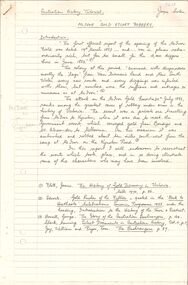
... ''McIvor Gold Escort Robbery'' - Joyce Coles (Australian History tutorial paper); no date. 14 pages handwritten paper to the July 1853 robbery - ''the first mass raid against armed gold escorts in Victoria''. ...McIvor Gold Escort Robbery Victoria Mt Alexander Kyneton Road Joyce Coles ''McIvor Gold Escort Robbery'' - Joyce Coles (Australian History tutorial paper); no date. 14 pages handwritten paper to the July 1853 robbery - ''the first mass raid against armed gold escorts in Victoria''. ...''McIvor Gold Escort Robbery'' - Joyce Coles (Australian History tutorial paper); no date. 14 pages handwritten paper to the July 1853 robbery - ''the first mass raid against armed gold escorts in Victoria''. Detailed account of the robbery and subsequent search for perpetrators and trial. Reference to possibility of gold still being buried in the area of the robbery. Bibliography, newspaper references and illustrations from a variety of specified sources.Joyce Colesbendigo, mining, early history., mcivor gold escort robbery, victoria, mt alexander, kyneton road -
 Williamstown Historical Society Inc
Book - Book - Piracy in the Bay, Wright, Paul W, Piracy in the Bay, Melbourne 1852. The Great Nelson Gold Robbery. Paul.W. Wright, 2025
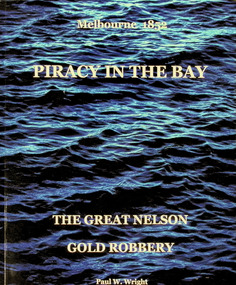
... Robbery Piracy Transportation Gold Rush Hobsons Bay Gold Heist From blub - "It remains the greatest act of theft in Australian history. On a moolit night in 1852, the barque Nelson, was riding at anchor in Hobson's Bay in the then young colony of Victoria. Aboard the vessel was an 8,000 ounce gold consignment bound for London. In an audacious assault, a band of heavily armed ...From blub - "It remains the greatest act of theft in Australian history. On a moolit night in 1852, the barque Nelson, was riding at anchor in Hobson's Bay in the then young colony of Victoria. Aboard the vessel was an 8,000 ounce gold consignment bound for London. In an audacious assault, a band of heavily armed pirates took possession of the ship, shooting her chief officer and imprisoning her crew. The pirates then helped themselves to the gold. In today's money, their heist would be worth more than 35 million dollars. This makes the value of their theft three times greater than the famed Eugowra Gold Robbery. The ramifications of the Nelson piracy were enormous. It was an incident that capped widespread lawlessness throughout Victoria during the early gold rush years. With crime rampant, and the government held accountable, it was perhaps the final straw that saw a hapless Governor Charles La Trobe resign his tenure. And it was the main factor in instigating the end of convict transportation - at least to Tasmania. The author of this boook is the great-grandson of Captain Walter Wright, the commander of the Nelson at the time of the piracy.Softcover, 127 pages. Ocean image with text in whitenon-fictionFrom blub - "It remains the greatest act of theft in Australian history. On a moolit night in 1852, the barque Nelson, was riding at anchor in Hobson's Bay in the then young colony of Victoria. Aboard the vessel was an 8,000 ounce gold consignment bound for London. In an audacious assault, a band of heavily armed pirates took possession of the ship, shooting her chief officer and imprisoning her crew. The pirates then helped themselves to the gold. In today's money, their heist would be worth more than 35 million dollars. This makes the value of their theft three times greater than the famed Eugowra Gold Robbery. The ramifications of the Nelson piracy were enormous. It was an incident that capped widespread lawlessness throughout Victoria during the early gold rush years. With crime rampant, and the government held accountable, it was perhaps the final straw that saw a hapless Governor Charles La Trobe resign his tenure. And it was the main factor in instigating the end of convict transportation - at least to Tasmania. The author of this boook is the great-grandson of Captain Walter Wright, the commander of the Nelson at the time of the piracy.hms nelson, nelson gold robbery, piracy, transportation, gold rush, hobsons bay, gold heist -
 Melbourne Tram Museum
Magazine, Hawthorn Historical Society, "Armed and Masked Footpads at Hawthorn", Feb. 2010
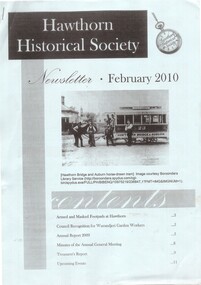
... Magazine - 6 A4 sheets, with blue colour cover, stapled in top left hand corner, Hawthorn Historical Society Newsletter Feb. 2010 containing an articled titled "Armed and Masked Footpads at Hawthorn" about the robbery of the Hawthorn horse tram at the corner of Power and Riversdale Road (the back of the Hawthorn tram depot), August 1901, written by Ruth Dwyer. ...Trams tramways Horse Trams Robbery Hawthorn Tours Magazine - 6 A4 sheets, with blue colour cover, stapled in top left hand corner, Hawthorn Historical Society Newsletter Feb. 2010 containing an articled titled "Armed and Masked Footpads at Hawthorn" about the robbery of the Hawthorn horse tram at the corner of Power and Riversdale Road (the back of the Hawthorn tram depot), August 1901, written by Ruth Dwyer. ...Magazine - 6 A4 sheets, with blue colour cover, stapled in top left hand corner, Hawthorn Historical Society Newsletter Feb. 2010 containing an articled titled "Armed and Masked Footpads at Hawthorn" about the robbery of the Hawthorn horse tram at the corner of Power and Riversdale Road (the back of the Hawthorn tram depot), August 1901, written by Ruth Dwyer. Also contains items on current activities of the Society, their Annual Report for 2009 and advert for a tour of the depot 6/2/2010.trams, tramways, horse trams, robbery, hawthorn, tours
