
Showing 7 items matching "army camp hospital matrons"
-
 Tatura Irrigation & Wartime Camps Museum
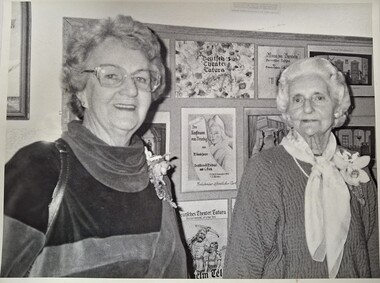
Photograph, Miss Marjorie and Beatrice Moore, 22 September 1991
... ...army camp hospital matrons...Official opening of the Bill Doller room. sister beatrice moore marjorie moore army camp hospitals army camp hospital staff army camp hospital matrons hospital matrons on the backdrop of the Poster inc. ...Official opening of the Bill Doller room.Black and white photograph of Miss Marjorie and Beatrice Moore on the right, the 1st Matron of the HQ Camp 1 hospital who officially opened the Bill Doller Room and photographer inside the museum.on the backdrop of the Poster inc. Wilhelm Tell.sister beatrice moore, marjorie moore, army camp hospitals, army camp hospital staff, army camp hospital matrons, hospital matrons -
 Alfred Hospital Nurses League - Nursing History Collection
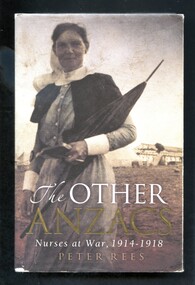
Book - Illustrated book, Peter Rees 1948, The other ANZACS: Nurses at War, 1914-1918, 2008
... hospital ship and scores of deaths on the following days Of significance to the AHNL, as Alfred graduates were among those who served. Grace Wilson, became matron of the Alfred in 1933 Australia Army-Nurses Military nursing-Australia World War 1914-1918 - Medical Care World War 1914-1918-Female participation Nurses Using diaries and letters the author takes us into the hospital camps, the wards and the tent surgeries on the edge of some of the most horrific battlefronts of human history. ...Using diaries and letters the author takes us into the hospital camps, the wards and the tent surgeries on the edge of some of the most horrific battlefronts of human history. He also showed how the friendships and loves of these courageous and compassionate women enriched their experiences.Illustrated book with dustjacket. Book has a brown cover with abbreviated title and authors name embossed in gold on spine. Dust jacket has a coloured black and white photograph of a nurse in uniform holding an umbrella, book and pencil with tents in the background: Grace Wilson on the Aegean Island of Lemnos, 1915. Full title is printed in white and gold on front along with the author's name in gold. Abbreviated title is printed in brown and gold on spine, along with the author's name and publishers mark in whitenon-fictionUsing diaries and letters the author takes us into the hospital camps, the wards and the tent surgeries on the edge of some of the most horrific battlefronts of human history. He also showed how the friendships and loves of these courageous and compassionate women enriched their experiences.australia army-nurses, military nursing-australia, world war 1914-1918 - medical care, world war 1914-1918-female participation, nurses -
 Tatura Irrigation & Wartime Camps Museum
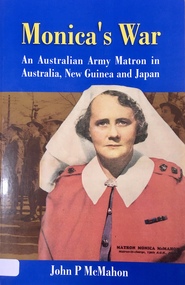
Book - Monica's War, John P Mcmahon, Monica's War, an Australian Army Matron in Australia, New Guinea and Japan, 2016
... She served at an Interrnment Camp in Tatura Australian Army Nursing Service Camp nursing staff True story of an Army nurse who served in a hospital ship, New Guinea, Japan, Internment Camp at Tatura, and her struggles to have the AANS members to be permitted to care for soldiers suffering tropical illnesses and post traumatic stress disorders Front cover is blue top & bottom witha sepia coloured strip featuring women in uniform, also a colour photo of matron Monica McMahon wearing a white matron veil, red cape with white collar. ...True story of an Army nurse who served in a hospital ship, New Guinea, Japan, Internment Camp at Tatura, and her struggles to have the AANS members to be permitted to care for soldiers suffering tropical illnesses and post traumatic stress disordersFront cover is blue top & bottom witha sepia coloured strip featuring women in uniform, also a colour photo of matron Monica McMahon wearing a white matron veil, red cape with white collar. Epaluts on her shoulders feature army badges, also her ribbons are pinned on the chest. An army badge is pinned at her throat. Underneath is a grey dress with metal buttons. Back cover is blue and brown with white writing re the subject of the book. Front cover is printed as follows : Monica's War. An Australian Army Matron in Australia, New Guinea and Japan. John P McMahonTrue story of an Army nurse who served in a hospital ship, New Guinea, Japan, Internment Camp at Tatura, and her struggles to have the AANS members to be permitted to care for soldiers suffering tropical illnesses and post traumatic stress disordersaustralian army nursing service, camp nursing staff -
 Tatura Irrigation & Wartime Camps Museum
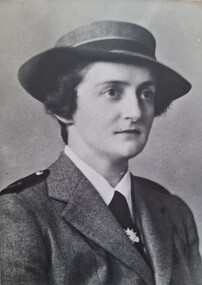
Photograph, Sister Beatrice Moore
... matron at Camp 1 Hospital, Tatura during WW2. Sister Beatrice Moore Camp 1 matron Camp 1 hospital Sister Moore Black and white photograph, head and shoulders, of a female nursing officer in Army uniform, looking to her left Sister Beatrice Moore Photograph Photograph ...Sister Beatrice Moore was the first matron at Camp 1 Hospital, Tatura during WW2.Black and white photograph, head and shoulders, of a female nursing officer in Army uniform, looking to her leftsister beatrice moore, camp 1 matron, camp 1 hospital, sister moore -
 Tatura Irrigation & Wartime Camps Museum
Suitcase, Leather
... Army during WW2. Matron "Trix" Moore was the first Matron at 28 Camp Hospital, attached to Internment Camp 1. ...Army during WW2. Matron "Trix" Moore was the first Matron at 28 Camp Hospital, attached to Internment Camp 1. ...Leather suitcase owned by Matron "Trix" Moore, when she served in the Australian Army during WW2. Matron "Trix" Moore was the first Matron at 28 Camp Hospital, attached to Internment Camp 1. Rescued by Les Kelly from a council nature strip rubbish collection in Mentone.Leather, stitching around edges. Metal studs on base/rear. Metal clasps, locks & attachment for leather handle. Inner leather straps retaining lid of suitcase to bottom, straps secured by metal studs at top & staples at bottom. Metal studs & brackets/ guards on corners.(Both on front): B. Moore|VFX111146 (her service number).|(On left side): Number "48028" stencilled in blue paint, above a faint blue square shape.camp 1, internee camps, matron 'trix' moore, camp 1 hospital, 28 camp hospital, personal, effects, travel, goods -
 Tatura Irrigation & Wartime Camps Museum
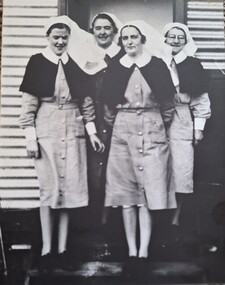
Photograph, Matron and Sisters Moore, Asche and Moors, copy 1989 original 1942
... WW2 internment camp 1, Tatura, hospital staff, Matron Captain Alice Adcock and Sister Moore, Asche and Moors, internment camps tatura internment camps sister moore sister moors sister ashe Matron Captain Alice Adcock 4 Army nurses, standing on steps in front of hut doorway. ...WW2 internment camp 1, Tatura, hospital staff, Matron Captain Alice Adcock and Sister Moore, Asche and Moors,4 Army nurses, standing on steps in front of hut doorway.internment camps, tatura internment camps, sister moore, sister moors, sister ashe, matron captain alice adcock -
 Returned Nurses RSL Sub-branch
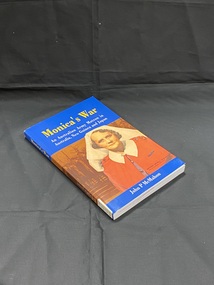
Book - Paperback book, John P McMahon, Monica's War: an Australian Army matron in Australia, New Guinea and Japan, 2016
... Australian Army Nursing Service AANS Matron Monica McMahon Monica McMahon WWII WW@ World War 1939-1945 Military Nurses women in war As a triple certificated nurse Monica joined the Australian Army Nursing Service (AANS) and in late 1941 became the matron of an Australian military hospital at Puckapunyal. Then she was a matron at the internment hospital at Tatura, a hospital ship, 11 other Australian military hospitals, a camp ...As a triple certificated nurse Monica joined the Australian Army Nursing Service (AANS) and in late 1941 became the matron of an Australian military hospital at Puckapunyal. Then she was a matron at the internment hospital at Tatura, a hospital ship, 11 other Australian military hospitals, a camp hospital at Koitaki New Guinea. - from Trove.Royal blue paperback book with an image that wraps around the spine, of a matron in red uniform and white veil, in the background is a brown image of women in uniform in a line. The title is printed in yellow. The author and subtitle printed in white. There is a white spine label semi-attached to the base of the spine.non-fictionAs a triple certificated nurse Monica joined the Australian Army Nursing Service (AANS) and in late 1941 became the matron of an Australian military hospital at Puckapunyal. Then she was a matron at the internment hospital at Tatura, a hospital ship, 11 other Australian military hospitals, a camp hospital at Koitaki New Guinea. - from Trove.australian army nursing service, aans, matron monica mcmahon, monica mcmahon, wwii, ww@, world war 1939-1945, military nurses, women in war
