
Showing 127 items matching "army recruits"
-
 Tatura Irrigation & Wartime Camps Museum
Photograph, H M Walker, Army Recruits, 1939
... Army Recruits...Army recruits...Group photograph of approx 150 Army recruits taken at Seymour in 1939. Many locals included and named....Back row left to right: 5th Maurie Hogan. Army recruits Seymour army recruits locals Group photograph of approx 150 Army recruits taken at Seymour in 1939. ...locals known in this photograph: front left to right: 4th Jack Kilmartin, 5th Ern Ranson, 7th Frank Hogan, 8th Jack Arnold, 10th Claude Nye, 13th John Sullivan, 15th Bob Forsyth, 17th Bert Warman, 18th Kevin Barry, 19th Ross Forsyth. 2nd row left to right: 2nd Ray Dunlop, 3rd Bill Geales, 5th Rupert Adams, 6th Aleck Collie, 11th Maurice Dick. Back row left to right: 5th Maurie Hogan.Group photograph of approx 150 Army recruits taken at Seymour in 1939. Many locals included and named.locals army recruits, seymour army recruits -
 Waverley RSL Sub Branch
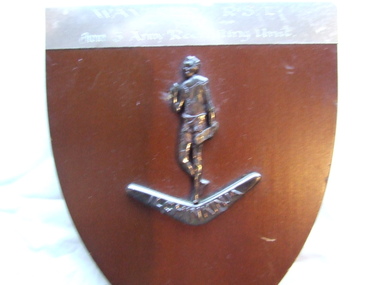
Plaque 3 Army Recruiting Unit, 3 Army Recruiting Unit
... Wooden Plaque 15cm x 13cm with insignia of 3 Army Recruiting Unit...3 Army Recruiting Unit...3 Army Recruiting Unit Wooden Plaque 15cm x 13cm with insignia of 3 Army Recruiting Unit 3 Army Recruiting Unit Plaque 3 Army Recruiting Unit ...Wooden Plaque 15cm x 13cm with insignia of 3 Army Recruiting Unit3 Army Recruiting Unit -
4th/19th Prince of Wales's Light Horse Regiment Unit History Room
Recruiting Poster, abt 1990's
... Army Publicity 1052c Issued by Director of Army Recruiting...Australian Army Reserve was previously Citizen Military Forces Army Publicity 1052c Issued by Director of Army Recruiting Recruiting poster for 4th/19th Prince of Wales's Light Horse Regiment (CMF). ...Australian Army Reserve was previously Citizen Military ForcesRecruiting poster for 4th/19th Prince of Wales's Light Horse Regiment (CMF). Poster depicts a M113A1 Armoured Pesonnel Carrier. Incorrect spelling of name of Regiment- "Wales' instead of "Wales's". Crew of APC are wearing Corps rather than Regimental beret badgesArmy Publicity 1052c Issued by Director of Army Recruiting -
 National Vietnam Veterans Museum (NVVM)
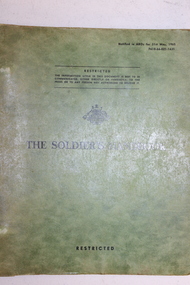
Booklet - Handbook, Army, The Soldiers Handbook
... ...Army recruits... Vietnam 7RAR Army recruits woods DG woods 2783285 Restricted top and bottom of front and back The Soldiers Handbook " Notified in AROs for 31st May 1965. 7610-66-021-1631 Green covered book with 147 pages of diagrams, graphs and information for soldiers. ...Standard issue Army manual from the Vietnam era. This item was donated by Pte David George Woods (2783285) who was a National Serviceman with the Royal Australian Infantry Corps. He served in Vietnam with the 7th Battalion, The Royal Australian Regiment from April 1967 to October 1967.Green covered book with 147 pages of diagrams, graphs and information for soldiers. Cover is soft cardboard secured by 2 brass screws positioned on inside of cover. Bold black print on front cover.Restricted top and bottom of front and back The Soldiers Handbook " Notified in AROs for 31st May 1965. 7610-66-021-1631handbook, new recruits, vietnam, 7rar, army recruits, woods, dg woods, 2783285 -
 Tramways/East Melbourne RSL Sub Branch - RSL Victoria Listing id: 27511
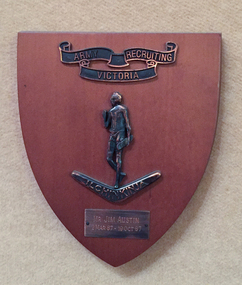
Memorabilia - Army Recruiting Victoria Plaque, c. 1987
... Pieces state 'Army Recruiting Victoria' and ' ILCHINKINJA' on the boomerang at the bottom of the piece. ...Memorabilia Army Recruiting Victoria Plaque ...No historical information available at present. Bronze pieces mounted on wood as a plaque. Pieces state 'Army Recruiting Victoria' and ' ILCHINKINJA' on the boomerang at the bottom of the piece. Plate on bottom of piece states "Mr Jim Austin, 2 March 1987 - 19 October 1987". army, recruitment, commemorative plaques, boomerangs, cultural identity, jim austin, aboriginal depictions -
 Melbourne Tram Museum
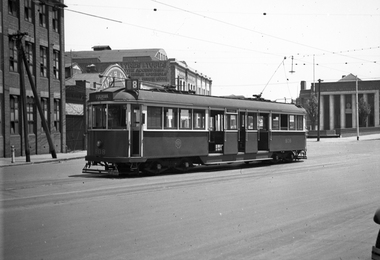
Negative, Wal Jack, 1940's
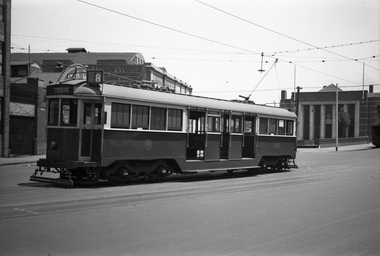
... Black and white negative by Wal Jack of W5 808 (Toorak Route 8) in Victoria St, shunting. Has the Army Recruiting centre in the background and a building advertising Goodyear tyres and tubes. ...Trams tramways Victoria St Route 8 Shunting W5 class tram 808 Black and white negative by Wal Jack of W5 808 (Toorak Route 8) in Victoria St, shunting. Has the Army Recruiting centre in the background and a building advertising Goodyear tyres and tubes. ...Black and white negative by Wal Jack of W5 808 (Toorak Route 8) in Victoria St, shunting. Has the Army Recruiting centre in the background and a building advertising Goodyear tyres and tubes. Photo undated, c1940.trams, tramways, victoria st, route 8, shunting, w5 class, tram 808 -
 Melbourne Tram Museum
Negative, Wal Jack, c1940
... Black and white negative by Wal Jack of W3 659 (Toorak Route 8) in Victoria St, shunting. Has the Army Recruiting centre in the background and a building advertising Goodyear tyres and tubes. ...Trams tramways Victoria St Route 8 Shunting W3 class tram 659 Black and white negative by Wal Jack of W3 659 (Toorak Route 8) in Victoria St, shunting. Has the Army Recruiting centre in the background and a building advertising Goodyear tyres and tubes. ...Black and white negative by Wal Jack of W3 659 (Toorak Route 8) in Victoria St, shunting. Has the Army Recruiting centre in the background and a building advertising Goodyear tyres and tubes. Photo undated, c1940.trams, tramways, victoria st, route 8, shunting, w3 class, tram 659 -
 National Vietnam Veterans Museum (NVVM)
Newspaper - Recruitment advertisement
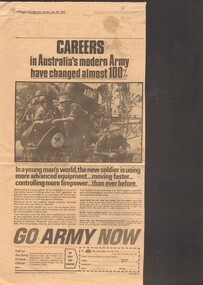
... Yellowed newspaper Army recruitment article from The Sun 20/01/1969. ...Yellowed newspaper Army recruitment article from The Sun 20/01/1969. ...This item contributes to an understanding of the experience of Australian society and attitudes to the war in Vietnam.Yellowed newspaper Army recruitment article from The Sun 20/01/1969. Photo of 3 young men in Australian Army uniform a Sioux helicopter with a kangaroo emblem. Beneahan article are the words 'Go Army Now" and a coupon to be detached, filled and posted.The Sun newspaper Jan 20 1969. Careers/in Australia's modern army/changed almost 100%. Picture of Australian helicopter with pilot inside and two soldiers beside the helicopter. Flying kangaroo on the side of the helicopter.careers, army, recruitment, vietnam -
 National Vietnam Veterans Museum (NVVM)
Booklet, British Army, Ministry of Defence: Physical Training In The Army 1969: Pamphlet No.2: Recruits' Physical Training, 1969
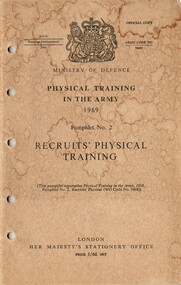
... Army...Physical Training...Recruits...Ministry of Defence (Army) British Army Physical Training Recruits' Physical Training A beige coloured cardboard cover which has what it looks like water marks on the cover. ...A beige coloured cardboard cover which has what it looks like water marks on the cover. There is the British Coat Of Arms Insignia with Ministry of Defence under it. The rest of the information is under this and in black writing. There are five punch holes down the left hand side.ministry of defence (army), british army, physical training, recruits' physical training -
 Diamond Valley Vietnam Veterans Sub-Branch
Photograph - Kapooka, c2002
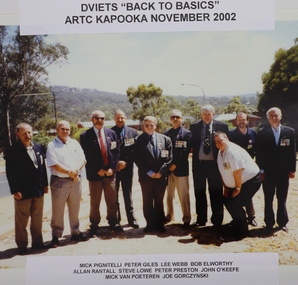
... Dviets visiting Army Recruit Training Centre (ARTC) Kapooka, 2002...Dviets visiting Army Recruit Training Centre (ARTC) Kapooka, 2002 Records some Diamond Valley Sub Branch members, 2002. vietnam vietnam war diamond valley vietnam veterans sub branch DViets "Back To Basics; Kapooka ARTC, November 2002. ...Dviets visiting Army Recruit Training Centre (ARTC) Kapooka, 2002Records some Diamond Valley Sub Branch members, 2002.Photograph, Diamond Valley members at ARTC, Kapooka, 2002DViets "Back To Basics; Kapooka ARTC, November 2002.vietnam, vietnam war, diamond valley vietnam veterans sub branch -
 National Vietnam Veterans Museum (NVVM)
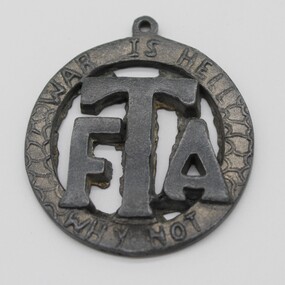
Memorabilia - Medallion, FTA anti-war
... 'Free the army' believed to have been used as a spoof of the American Army recruitment campaign 'Fun, Travel and Adventure'. ...'Free the army' believed to have been used as a spoof of the American Army recruitment campaign 'Fun, Travel and Adventure'. ...Medallion supporting anti-war activists. 'Free the army' believed to have been used as a spoof of the American Army recruitment campaign 'Fun, Travel and Adventure'. Soldiers in Vietnam often converted the slogan to "F-ck The Army ".Round Medallion with large FTA in middle, circled by inscription' War is Hell' at top/ 'Why Not' at bottom.protest movement, antiwar, vietnam, fta, free the army, war is hell, protest, anti-war -
 Ithacan Historical Society
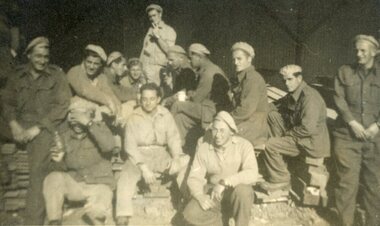
Photograph, WW2 Australian Defence Forces - Allied Aliens, 1940s
... Pictured is a group of army recruits to the Civilian Military Forces with a young Stathi Raftopoulos seated in the centre - he is the only one not wearing a cap....Pictured is a group of army recruits to the Civilian Military Forces with a young Stathi Raftopoulos seated in the centre - he is the only one not wearing a cap. ...Many young men, both Ithacan born and Australian born of Ithacan descent joined the Australian Defence Forces in various capacities during World War 2. Pictured is a group of army recruits to the Civilian Military Forces with a young Stathi Raftopoulos seated in the centre - he is the only one not wearing a cap.Ithacans who were not naturalised were recruited to the Civilian Military Forces as 'Allied Aliens'.A black and white photograph of thirteen men inn army uniform sitting and relaxing in a shed. -
 National Vietnam Veterans Museum (NVVM)
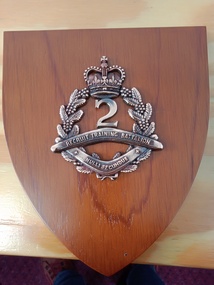
Plaque - 2 Recruit Training Plaque
... This shield bears the emblem of Australian Army 2nd Recruit Training battalion, raised at Puckapunyal (Vic) to provide basic training for the Second National Service Scheme which was in place during the Vietnam War. ...This shield bears the emblem of Australian Army 2nd Recruit Training battalion, raised at Puckapunyal (Vic) to provide basic training for the Second National Service Scheme which was in place during the Vietnam War. ...This shield bears the emblem of Australian Army 2nd Recruit Training battalion, raised at Puckapunyal (Vic) to provide basic training for the Second National Service Scheme which was in place during the Vietnam War. It operated from 1965-1973.Wooden plaque with bronze metal insignia of 2 Recruit Training Battalion. Crown on laurel wreath around number 2 with 2 crossed boomerangs below. 2 RECRUIT TRAINING / NULLI SECUNDUS2 recruit training battalion, vietnam, 2nd recruit, puckapunyal, australian national serviceman, conscription, training -
 City of Ballarat Libraries
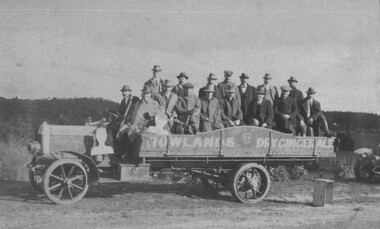
Photograph - Card Box Photographs, Troops on their way to Queenscliff
... Rowlands Soft Drink Delivery truck transports troops to Queenscliff for army training. The new recruits are yet to get their uniforms....Rowlands Soft Drink Delivery truck transports troops to Queenscliff for army training. The new recruits are yet to get their uniforms. e.r. rowlands soldiers vehicle queenscliff military Troops on their way to Queenscliff. ...A E.R. Rowlands Soft Drink Delivery truck transports troops to Queenscliff for army training. The new recruits are yet to get their uniforms.e.r. rowlands, soldiers, vehicle, queenscliff, military -
 Bendigo Military Museum
Photograph - POSTER PHOTOGRAPHS, 1960
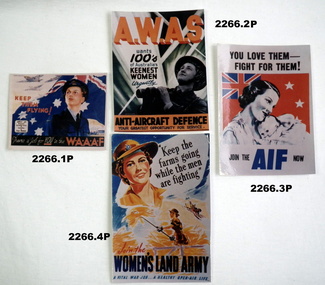
... Set of photos of women's service posters WW2. .1) WAAAF Recruiting poster coloured photo .2) AWAS recruiting poser photo for AA defence in colour .3) Recruiting poster for AIF showing mother and child. .4) Recruiting poster photo for womens land army .5) Recruiting poster photo women to join red cross. 2 shillings membership in colour. .6) Recruiting poster for women to be a victory job. in colour. .7) Welcome back poster photo displaying woman with red cross badge in colour. ...Posters photographs Recruiting Set of photos of women's service posters WW2. .1) WAAAF Recruiting poster coloured photo .2) AWAS recruiting poser photo for AA defence in colour .3) Recruiting poster for AIF showing mother and child. .4) Recruiting poster photo for womens land army .5) Recruiting poster photo women to join red cross. 2 shillings membership in colour. .6) Recruiting poster for women to be a victory job. in colour. .7) Welcome back poster photo displaying woman with red cross badge in colour. ...These are copies of original posters reproduced on Photograph paper.Set of photos of women's service posters WW2. .1) WAAAF Recruiting poster coloured photo .2) AWAS recruiting poser photo for AA defence in colour .3) Recruiting poster for AIF showing mother and child. .4) Recruiting poster photo for womens land army .5) Recruiting poster photo women to join red cross. 2 shillings membership in colour. .6) Recruiting poster for women to be a victory job. in colour. .7) Welcome back poster photo displaying woman with red cross badge in colour. posters, photographs, recruiting -
 Bendigo Military Museum
Manual - TRAINING VARIOUS, 15 TRANSPORT SQN, 1981
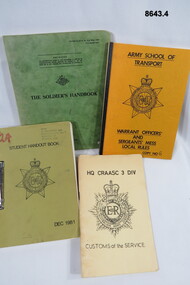
... The Soldiers handbook has been written primarily for the newly joined recruit. 2. Army School of Transport Warrant Officers and Sergeants Mess Local Rules No. 6. 3. ...Army 3. 68896 15 Transport SQN, Passchendaele Barracks, Mollison St. BENDIGO 3550 24. 4. 397883 CPL N.S. FULLARTON. Four Soldiers training and instruction manuals. 1. The Soldiers handbook has been written primarily for the newly joined recruit ...Four Soldiers training and instruction manuals. 1. The Soldiers handbook has been written primarily for the newly joined recruit. 2. Army School of Transport Warrant Officers and Sergeants Mess Local Rules No. 6. 3. Army School of Transport Student Handout Book. 4. Customs of the Service printed for the issue to all Officers and NCO's in the Column.3. 68896 15 Transport SQN, Passchendaele Barracks, Mollison St. BENDIGO 3550 24. 4. 397883 CPL N.S. FULLARTON.passchendaele barracks trust, handbook, rules, customs, army -
 Melbourne Legacy
Badge, Royal Dublin Fusiliers Regiment cap badge
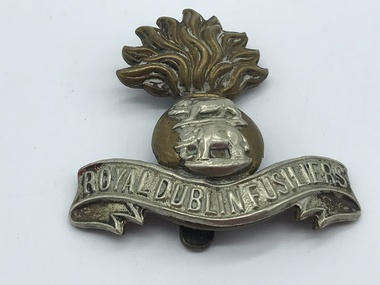
... From information found online: 'The Royal Dublin Fusiliers was an infantry regiment of the British Army, which recruited in the east of Ireland. Created in 1881 by the amalgamation of two former East India Company regiments, it was disbanded in 1922 on the establishment of the Irish Free State.' ...From information found online: 'The Royal Dublin Fusiliers was an infantry regiment of the British Army, which recruited in the east of Ireland. Created in 1881 by the amalgamation of two former East India Company regiments, it was disbanded in 1922 on the establishment of the Irish Free State.' ...A badge that once belonged to J B McLean, he could have brought it back from World War as a souvenir. From information found online: 'The Royal Dublin Fusiliers was an infantry regiment of the British Army, which recruited in the east of Ireland. Created in 1881 by the amalgamation of two former East India Company regiments, it was disbanded in 1922 on the establishment of the Irish Free State.' These were with other World War 1 memorabilia that has come from Private John Basil McLean, 2nd Reinforcements, 37th Battalion, A.I.F. J.B. McLean (Service No. 13824) was from near Maffra, Victoria and enlisted on 22 January 1916. He embarked on 16 December 1916 for Europe. He spent time with the Australian Field Artillery (Pack Section). At the end of the war he worked for a year at the A.I.F. Headquarters in London before returning to Australia on the 'Ceramic', arriving in Portsea in 1920. His full war record is available from the National Archives of Australia (B2455, MCLEAN JBM).This is an example of souvenir retained by an ex soldier.Royal Dublin Fusiliers Regiment cap badge. It is a bi-metal badge in the form of a fused (or flaming) grenade, on the brass ball of which is a white metal Royal Tiger above an elephant (both in white metal). At the base a white metal scroll bearing the title 'ROYAL DUBLIN FUSILIERS'. Royal Dublin Fusiliers world war one, soldier -
 Bendigo Military Museum
Photograph - Miss Golden North Charity Queen - 2LT Kathie Ryan Army Survey Regiment, Fortuna, Bendigo, 1985
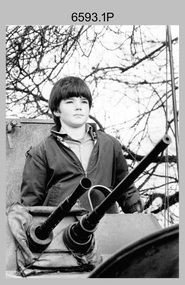
... Activities included static displays of armoured vehicles, map production displays, Army recruiting displays historical tours of Fortuna Villa, refreshments including Devonshire Teas, craft stalls, live music and children's rides....Activities included static displays of armoured vehicles, map production displays, Army recruiting displays historical tours of Fortuna Villa, refreshments including Devonshire Teas, craft stalls, live music and children's rides. ...This is a set of 12 photographs of the Army Survey Regiment’s winning entrant in the Miss Golden North Charity Queen quest - 2LT Kathie Ryan, taken on three occasions in 1985. The following article was compiled by the unit summarising her campaign. ‘On Friday 20 September 1985, 2LT Kathie Ryan of the Army Survey Regiment, Bendigo, faced a selection panel of a different kind. Kathie is an entrant in this years Miss Australia Quest and is sponsored by her unit. Together with seven other girls from Central Victora, Kathie vied for the Regional Title of Miss Golden North, held on 20 September 1985. With enthusiastic shouts of joy from the members of the Regiment present, Kathie Ryan was crowned Miss Golden North 1986. She is now one of 19 finalists contesting the title “Miss Victoria 1986”. “It has been a very rewarding experience being involved in raising money for such a worthwhile cause” said Kathie. “Organisations such as the Spastic Society, have a very important role in helping people with disabilities. To be involved with this society has been both enjoyable and a great learning experience”. The aim of the Miss Australia Quest is to raise funds for the Spastic Society of Australia. Kathie entered the Quest in March then, together with her committee, started to raise money. Over the next seven months, many fund-raising activities were conducted. These included an Open Day at the Army Survey Regiment, a Bingo night, several raffles, and several tin shakes in the streets of Bendigo as well a participating in several of the functions organised at a Regional or State level in the name of the Spastic Society. The total raised this year was in excess of $11,500. The Army Survey Regiment has now had 3 entrants in the Miss Australia Quest since 1981 and has raised over $23,000 for the Spastic Society in that time’ An abbreviated article with photo 6593.4P was published on page 12 of the Army Newspaper on 28 November 1985. Two articles with photographs were published in the Bendigo Advertiser Newspaper on 23 September and 30 October 1985. Clippings from these newspapers, a detailed breakdown of the funds raised during the campaign and the Army Survey Regiment’s Open Day Administrative Instruction are stored with these photographs. The Open Day was held on the weekend of 24-25 August 1985. Activities included static displays of armoured vehicles, map production displays, Army recruiting displays historical tours of Fortuna Villa, refreshments including Devonshire Teas, craft stalls, live music and children's rides.This is a set of 12 photographs of the Army Survey Regiment’s winning entrant in the Miss Golden North Quest - 2LT Kathie Ryan, taken on three occasions in 1985. The photographs were printed on photographic paper and are part of the Army Survey Regiment’s Collection. The colour and black and white photographs were scanned at 300 dpi. Included in this set are negatives of photo 6593.4P, 6593.5P and 6593.6P. .1) - Photo, black & white, Open Day 23-24 Aug 1985. Unidentified visitor on APC vehicle. .2) - Photo, black & white, Open Day 23-24 Aug 1985. Unidentified pipe band performs in front of APC vehicle. .3) - Photo, black & white, Open Day 23-24 Aug 1985. View of Fortuna Villa. .4) - Photo, black & white, Miss Australia Quest Presentation at All seasons Motor Inn 20 Sep 1985. 2LT Kathie Ryan crowned Miss Golden North Queen by former holder of the title Miss Celine Hull. Unidentified compere in background. .5) - Photo, black & white, Miss Australia Quest Presentation at All seasons Motor Inn 20 Sep 1985. 2LT Kathie Ryan reacts winning the Miss Golden North Queen. Winner of the Miss Golden North Charity Queen title Miss Noelene Earle is on her right. .6) - Photo, black & white, Miss Australia Quest Presentation at All seasons Motor Inn 20 Sep 1985. Title winners L to R: Miss Golden North Charity Queen - Noelene Earle, Miss North-West/Sunraysia & Charity Queen – Jo-Anne Collier and Miss Golden North Queen - 2LT Kathie Ryan. .7) & .8) - Photo, colour, Miss Australia Quest Presentation at All seasons Motor Inn 20 Sep 1985. 2LT Kathie Ryan is escorted to the ceremony dais by LT Greg Oaten CSC. .9) - Photo, colour, Miss Australia Quest Presentation at All seasons Motor Inn 20 Sep 1985. 2LT Kathie Ryan with her escorts L to R: LT Greg Oaten CSC and CAPT Neil Taylor. .10) - Photo, colour, Miss Australia Quest Presentation at All seasons Motor Inn 20 Sep 1985. Miss Golden North Queen 2LT Kathie Ryan with her organising committee L to R: SPR Sherri (Dally) Burke, WO2 Pat Lumsden, RSM WO1 Bob Mason, 2LT Kathie Ryan, MAJ Alex McLennan - President, SPR Gae (Robinson) Amato – Secretary, CPL Mick Minchin – Treasurer. .11) - Photo, colour, 1985. MAJ Alex McLennan presents 2LT Kathie Ryan with the Miss Golden North Queen prizes she had won at a celebration BBQ. In background L to R: SPR Wally Twidale, unidentified, SPR Dave Lambton-Young, SPR Jann (Caithness) Lambton-Young, unidentified, Mrs Pam Mason, WO2 Pat Lumsden. .12) - Photo, colour, 1985. L to R: MAJ Alex McLennan, Miss Golden North Queen 1985 Miss Celine Hull, CO LTCOL Jorge Gruszka, CPL Mick Minchin, Miss Golden North Queen 1986 2LT Kathie Ryan. 2x unidentified ladies in background double exposure.‘Miss Australia Quest 1985' annotated on cover sleeve. .7P to .11P – names annotated on back of photographs. ’15 October 1985’ annotated on back of photographs .7P to .9P is probably incorrect, based on other reports and newspaper articles. royal australian survey corps, rasvy, army survey regiment, army svy regt, fortuna -
 Bendigo Historical Society Inc.
Memorabilia - Doctor Lilian Cleeve Collection, 1915 - 1996
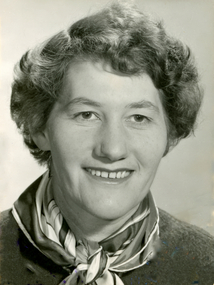
... She also used to visit Puckapunyal Army Base to screen both the regular army recruits and the conscripts who were sent to Vietnam. ...She also used to visit Puckapunyal Army Base to screen both the regular army recruits and the conscripts who were sent to Vietnam. ...Doctor Lilian Marjorie Cleeve was born in 1915 and died in February 1996. She grew up in Moonee Ponds and graduated as a Doctor from the University of Melbourne School of Medicine in 1941. She completed her training at the Women's Hospital in Melbourne between December 1940 and January 1941 where she delivered her first baby, Beverley Margaret Manley. In 1942 at the beginning of the war with Japan, Doctor Cleeve travelled to Bendigo. The train was full of soldiers travelling to camp at the Bendigo Showgrounds next to the hospital (now the Tom Flood Centre). Because of the war, the streets were in darkness. Some soldiers carried her suitcase to her new home. Doctor Cleeve immediately began work as the hospital Registrar. Later on she specialized in the delivery of babies, who always seemed to be born on her days off. After leaving the hospital Doctor Cleeve joined the medical practice of Doctors Gorman and Grant (husband and wife). Their rooms were on the corner of View and Mckenzie Streets in the Atkinson building (named after Doctor Harry Atkinson). Doctor Cleeve then established a medical practice in Garsed Street where the Dan Murphy Car Park is now located. Later Doctor Cleeve ran an eye clinic with Doctor Gorman's son, on the other side of Garsed Street. She also used to visit Puckapunyal Army Base to screen both the regular army recruits and the conscripts who were sent to Vietnam. Doctor Cleeve last worked as part of the associate medical staff at the Bendigo Teachers' College in Osborne Street from 1979 to 1980. In 1944 Lilian married Sargent George Cathcart (Fortuna Army Survey Regiment). George was the secretary/treasurer of the Bendigo Branch of the Liberal Party. They lived at 96 Moore Street ('Silver Birches'), close to the hospital. George and Lilian had one son, Andrew. George passed away from a heart attack in 1957. Lilian married Roy Lockart Chisholm in 1960. Roy was the manager of the Charing Cross Branch of the CBA Bank. Not long after their marriage, Lilian (now Mrs Chisholm), Roy, and Lilian's young son Andrew, took a honeymoon voyage on the cargo vessel "Milos" to Hong Kong, Japan, New Guinea and Borneo, where they visited the Sandakan War Memorial. In 1960 Lilian sold 96 Moore Street, and following Roy's retirement, they purchased a house which they named 'Roslyn' at 28 Reginald Street, Quarry Hill. Roy died in 1963 after suffering a stroke. Respected and well-liked, Mrs Chisholm continued to raise Andrew in Reginald Street with the assistance of her faithful housekeeper Coral Suurpaa, known to all as “Hickey". Coral lived in a house in Breen Street, beside the Myrtle Street railway bridge. Prior to this, "Hickey" had lived-in at Moore Street when Dr Cleeve was widowed after the death of her first husband. Photos, Passport, Letter and Nameplate 11138a Doctor Lilian Marjorie Cleeve passport photo May 1961 11138b British Australian Passport 11138c The Premier Visits 'Silver Birches' 96 Moore St., Bendigo on April 8th 1957 Photo. From Left to Right are: Former Bendigo Organiser, Mr T.J. Langdon (now at Ballarat), Mrs Langdon, Mrs John Stanistreet, The Premier, Hon. H.E. Bolte, Mr John Stanistreet, M.L.A., Mrs G. Cathcart (Dr Cleeve) and Mr G.W.S. Cathcart. 11138d Doctor Cleeve and George Cathcart Photo 11138e Dr Cleeve front row 3rd from the right with her first baby delivered at the Women's Hospital Melbourne 1940 Photo. Back Row: B J Bernstein, B Chromow, S I D Preston, H J Hoffman, P Zerman, D G Sisely. Middle Row: L B Satchell, J B Buchanan, O B Pearce, J C Trinea, M R Millikan, I J Selikoff, R E Dwork. Front Row: J Kremer, R B Lewis, Miss B Marshall, Dr M A Mackie, Prof. Marshall Allan, Miss L Cleeve, Miss J grant, H Berinshaw. 11138f Dr Cleeve, Coral Suurpaa, Andrew Cathcart Photo in the backyard at 28 Reginald St. Quarry Hill, 1195-1997. 11138g Letter from Andrew Cathcart to the Sisely family in dec 2009 re the photo taken at the Women's Hospital Melbourne in 1940-41 11138h Dr L M Cleeve Nameplate Front View 11138i Dr L M Cleeve Nameplate Rear View 11138j The University of Melbourne Conferring of degrees Wilson Hall Monday 1st June 1942bendigo, doctor lorna sisely, women's hospital melbourne, roy lockart chisholm, reginald street, quarry hill, coral suurpaa, dr lilian cleeve, george cathcart -
 Bendigo Historical Society Inc.
Administrative record - T.J. Connolly Invoicing book
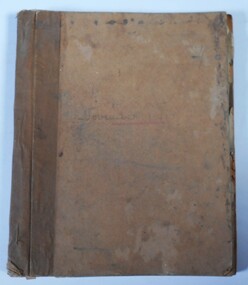
... The customers include army personnel and recruiters. Each page is signed and or checked off in red pencil. ...The customers include army personnel and recruiters. Each page is signed and or checked off in red pencil. ...The item is a hard cover invoicing book of T.J. Connolly, Ironmongers, Sandhurst. Inside the front cover is an index page listing customer name and customer number. The following pages are carbon copy records of work completed for each customer, recording date and description of work along with price. The pages are printed with the numbers 01 to 99 in the top right-hand corner. Pages 01 to 94 have been used. Pages 95 to 99 are blank. The descriptions of work mostly relate to work completed on cars but also includes hiring out of cars, destination and miles travelled. The customers include army personnel and recruiters. Each page is signed and or checked off in red pencil. The brown hard cardboard cover is worn and marked. The spine of the book is brown canvas. The pages are stapled together. The book includes the date range of 01 - 30 (?) November 1917. This item is part of the Margaret Roberts Collection.Written in grey lead pencil on the front cover is "November 1917". A red line has been ruled underneath this inscription.margaret roberts collection, ironmongers, forest street, bendigo businesses, motor vehicles, world war 1 -
 Running Rabbits Military Museum operated by the Upwey Belgrave RSL Sub Branch
Medals, Medals of L/Cpl George William Steele
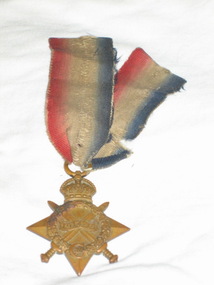
... It should be remembered that recipients of this medal were responsible for assisting the French to hold back the German army while new recruits could be trained and equipped. ...It should be remembered that recipients of this medal were responsible for assisting the French to hold back the German army while new recruits could be trained and equipped. ...Wounded7/5/1915 Gallipoli Died of Wounds at sea in transit to hospital The 1914 Star This bronze medal award was authorized by King George V in April 1917 for those who had served in France or Belgium between 5th August 1914 to midnight on 22nd November 1914 inclusive. The reverse is plain with the recipient's service number, rank, name and unit impressed on it. It should be remembered that recipients of this medal were responsible for assisting the French to hold back the German army while new recruits could be trained and equipped. Collectively, they fully deserve a great deal of honour for their part in the first sixteen weeks of the Great War. There were approximately 378,000 1914 Stars issued. The British War Medal, 1914-18 The silver or bronze medal was awarded to officers and men of the British and Imperial Forces who either entered a theatre of war or entered service overseas between 5th August 1914 and 11th November 1918 inclusive Approximately 6.5 million British War Medals were issued. Approximately 6.4 million of these were the silver versions of this medal. The recipient's service number, rank, name and unit was impressed on the rim. SN 1053 14Btn AIF -
 Running Rabbits Military Museum operated by the Upwey Belgrave RSL Sub Branch
Medals, Medals of PTE Arthur Ernest Clarke
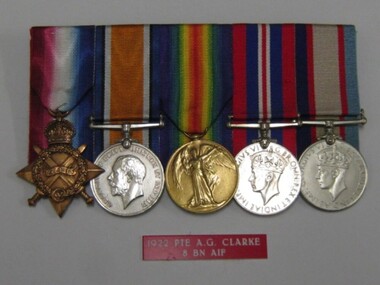
... It should be remembered that recipients of this medal were responsible for assisting the French to hold back the German army while new recruits could be trained and equipped. ...It should be remembered that recipients of this medal were responsible for assisting the French to hold back the German army while new recruits could be trained and equipped. ...WW1 Served in Gallipoli & France WW2 Militia The 1914 Star This bronze medal award was authorized by King George V in April 1917 for those who had served in France or Belgium between 5th August 1914 to midnight on 22nd November 1914 inclusive. The reverse is plain with the recipient's service number, rank, name and unit impressed on it. It should be remembered that recipients of this medal were responsible for assisting the French to hold back the German army while new recruits could be trained and equipped. Collectively, they fully deserve a great deal of honour for their part in the first sixteen weeks of the Great War. There were approximately 378,000 1914 Stars issued. The British War Medal, 1914-18 The silver or bronze medal was awarded to officers and men of the British and Imperial Forces who either entered a theatre of war or entered service overseas between 5th August 1914 and 11th November 1918 inclusive Approximately 6.5 million British War Medals were issued. Approximately 6.4 million of these were the silver versions of this medal. The recipient's service number, rank, name and unit was impressed on the rim. The Allied Victory Medal Approximately 5.7 million victory medals were issued. The recipient's service number, rank, name and unit was impressed on the rim. The 1939-45 Star Awarded for service as follows: • Army - awarded for six months service in an operational command during the period 3 September 1939 to 2 September 1945. The War Medal 1939-45 Awarded to members who served full-time in operational or non-operational service between 3 September 1939 and 2 September 1945. Clarke SN 1703 8 Btn AIF -
Federation University Historical Collection
Letter, Letter from National Service Recruit, 1969, 1969
... A letter regarding National Service recruit training at the Army's camp at Puckapunyal. The letter is thought to be directed to former classmates at the Ballarat Technical School, a division of the Ballarat School of Mines. ...A letter regarding National Service recruit training at the Army's camp at Puckapunyal. The letter is thought to be directed to former classmates at the Ballarat Technical School, a division of the Ballarat School of Mines. ...A letter regarding National Service recruit training at the Army's camp at Puckapunyal. The letter is thought to be directed to former classmates at the Ballarat Technical School, a division of the Ballarat School of Mines. This letter relates to Australian Commonwealth National Service training at Puckapunyal.Two paged letter on small lined paper, written in ball point pen. The letter is written to Kevin, and is signed by Peter Davis.recruit, national service, training, ballarat technical school, peter davis, puckapunyal -
 Lara RSL Sub Branch
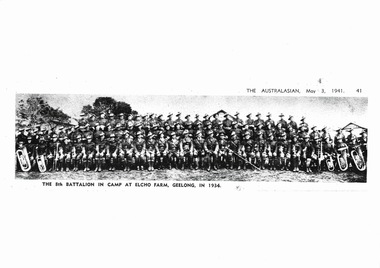
Photograph, THE 8TH BATTALION IN CAMP AT ELCHO FARM, GEELONG IN 1934, 1934
... Army. Initially raised in 1914 for the First Australian Imperial Force during the First World War the battalion was completely recruited from Victoria and formed part of the 2nd Brigade, 1st Division. ...Army. Initially raised in 1914 for the First Australian Imperial Force during the First World War the battalion was completely recruited from Victoria and formed part of the 2nd Brigade, 1st Division. ...The 8th Battalion was an infantry battalion of the Australian Army. Initially raised in 1914 for the First Australian Imperial Force during the First World War the battalion was completely recruited from Victoria and formed part of the 2nd Brigade, 1st Division. During the war it fought at Gallipoli and in France and Belgium on the Western Front. It was disbanded in 1919, before being re-raised as a Militia battalion in 1921. During the Second World War the 8th Battalion was used primarily as a garrison unit before taking part in the Bougainville campaign late in the war. It was disbanded again in 1946 during the demobilisation process, although it was reformed again in 1948 when it was amalgamated with the 7th Battalion. Today, its honours and traditions are perpetuated by the 8th/7th Battalion, Royal Victoria Regiment.Rectangular shaped black and white photograph.THE AUSTRALIAN, May 3, 1941. THE 8TH BATTALION IN CAMP AT ELCHO FARM, GELONG IN 1934. 8th battalion, ww1, australian infantry, lara r.s.l. -
 Lara RSL Sub Branch
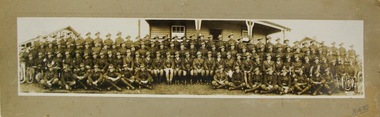
Photograph Elcho Farm, 1934
... Army. Initially raised in 1914 for the First Australian Imperial Force during the First World War the battalion was completely recruited from Victoria and formed part of the 2nd Brigade, 1st Division. ...Army. Initially raised in 1914 for the First Australian Imperial Force during the First World War the battalion was completely recruited from Victoria and formed part of the 2nd Brigade, 1st Division. ...The 8th Battalion was an infantry battalion of the Australian Army. Initially raised in 1914 for the First Australian Imperial Force during the First World War the battalion was completely recruited from Victoria and formed part of the 2nd Brigade, 1st Division. During the war it fought at Gallipoli and in France and Belgium on the Western Front. It was disbanded in 1919, before being re-raised as a Militia battalion in 1921.Rectangular Black and White Photograph mounted on Grey CardboardFront H. WaL? George Crawford Elcho Farm Lara 1936-1937elcho farm lara 1936 1937 photo george crawford -
 Lara RSL Sub Branch
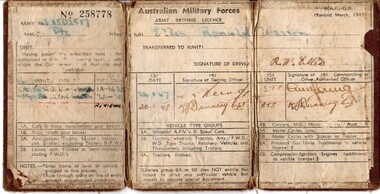
Drivers Licence, Australian Military Forces Army Driving Licence
... Recruit Training Battalion at Greta west of Newcastle, NSW. After 3 months training, he was sent to the Service Corps Training Centre for driver and maintenance training in Ingleburn, south of Sydney. When this course was completed, Ron was posted to the Australian Army...Recruit Training Battalion at Greta west of Newcastle, NSW. After 3 months training, he was sent to the Service Corps Training Centre for driver and maintenance training in Ingleburn, south of Sydney. When this course was completed, Ron was posted to the Australian Army ...Cpl. Ronald Warren Ellis, EM (VX502517) was born in Brunswick in 1927. His family moved to Lara when he was young, and his schooling took place at the Lara State School. After finishing his education, Ron took up employment at Sims Coopers in Corio. Ron was enlisted in the second AIF at Melbourne, and posted to the 3rd Recruit Training Battalion at Greta west of Newcastle, NSW. After 3 months training, he was sent to the Service Corps Training Centre for driver and maintenance training in Ingleburn, south of Sydney. When this course was completed, Ron was posted to the Australian Army Service Corps as a driver motor vehicle with the 2nd AIF. Rons service with the AIF lasted 425 days, when he was then transferred to the Interim Army for a further 309 days. The duration of his service was in NSW. Ron was discharged from the Army in Melbourne on the 4th of May 1948. In 1957, Ron enlisted in the CMF and served with 22nd Construction Squadron for 17 years with the last 5 as a Corporal, and was awarded the Efficiency Medal for long service and good conduct.Brown canvas booklet that is folded into three. Licence gives details of Army number, name, rank and type of vehicle that is able to be driven. Licence has been issued to Private Ronald Warren Ellis on 24/01/1948. No. 258778 Army No. V?SOL517 Rank: Private Name in full: Ellis, Ronald Warren Unit: Transferred to (unit): Having passed the prescribed tests ... authorised to drive... types of ... vehicles within the Commonwealth of Australia and Territories. Signature of Driver: drivers licence, australian military forces, army, private, ellis, ww2, wwii, world war two, second world war -
 Lara RSL Sub Branch
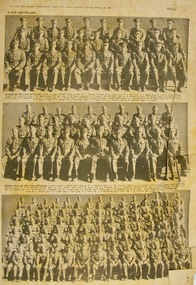
Newspaper, 17th Australian Infantry Brigade, February 22nd 1940
... Army. First formed in 1917 during World War I, it did not see any action. Reformed during World War II, before being disbanded in 1946. Today, its name is perpetuated by the 17th Combat Service Support Brigade, which was raised as a logistics formation in May 2006. The 17th Brigade was reformed on 13 October 1939, again as part of the 6th Division, recruited...Army. First formed in 1917 during World War I, it did not see any action. Reformed during World War II, before being disbanded in 1946. Today, its name is perpetuated by the 17th Combat Service Support Brigade, which was raised as a logistics formation in May 2006. The 17th Brigade was reformed on 13 October 1939, again as part of the 6th Division, recruited ...The 17th Australian Infantry Brigade was an infantry brigade in the Australian Army. First formed in 1917 during World War I, it did not see any action. Reformed during World War II, before being disbanded in 1946. Today, its name is perpetuated by the 17th Combat Service Support Brigade, which was raised as a logistics formation in May 2006. The 17th Brigade was reformed on 13 October 1939, again as part of the 6th Division, recruited from Victoria. The 17th Brigade fought in the Western Desert Campaign in Libya, the Battle of Greece, the Battle of Wau, the Salamaua-Lae campaign in Papua, and in the Aitape-Wewak campaign in New Guinea. The photographs are of national significance as they may reflect the only known photographs of individuals from WW2.4 page newspaper pictures of 17th Brigade, Second AIFThe Argus 17th Australian Infantry Brigade, Second AIF, Souvenir Supplement, Thursday, February 22, 1940 Page 1 2/5th Battalion - Picture 1 Officers of the 2/5th Battalion; Picture 2 Senior NCO's of the 2/5th Battalion; Picture 3 A Company 2/5th Battalion Page 2 B Company 2/5th Battalion; C Company 2/5th Battalion; D Company 2/5th Battalion Page 3 Headquarters 2/2nd Field Regiment 6th Divisional Artillery; 3rd Battery 2/2nd Field Regiment 6th Divisional Artillery Page 4 Officers, NCO's and men of 2/2nd Field Company, 6th Divisional Engineers; Officers NCO's and men 2/2nd Field Ambulance and 2/2nd Australian General Hospital 6th Divisional Australian Army Medical Corpsaif, army, 17th brigade, second aif, 2/5th battalion, australian army, australian infantry brigade, 2/2nd field aumbulance, 2/2nd australian general hospital, 6th divisional australian army medical corps, 6th divisional engineers -
 Lara RSL Sub Branch
Photo, Harry Grove
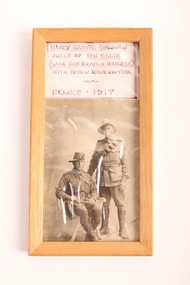
... Recruit Training Battalion at Greta west of Newcastle, NSW. After 3 months training, he was sent to the Service Corps Training Centre for driver and maintenance training in Ingleburn, south of Sydney. When this course was completed, Ron was posted to the Australian Army...Recruit Training Battalion at Greta west of Newcastle, NSW. After 3 months training, he was sent to the Service Corps Training Centre for driver and maintenance training in Ingleburn, south of Sydney. When this course was completed, Ron was posted to the Australian Army ...This photo is from 1917 and is of Private Harry Groves (standing) with his cousin Arthur Whitter (seated). Private Groves was the Uncle of Ron Ellis, who was a Lara Sub-Branch member. Cpl. Ronald Warren Ellis, EM (VX502517) was born in Brunswick in 1927. His family moved to Lara when he was young, and his schooling took place at the Lara State School. After finishing his education, Ron took up employment at Sims Coopers in Corio. Ron was enlisted in the second AIF at Melbourne, and posted to the 3rd Recruit Training Battalion at Greta west of Newcastle, NSW. After 3 months training, he was sent to the Service Corps Training Centre for driver and maintenance training in Ingleburn, south of Sydney. When this course was completed, Ron was posted to the Australian Army Service Corps as a driver motor vehicle with the 2nd AIF. Rons service with the AIF lasted 425 days, when he was then transferred to the Interim Army for a further 309 days. The duration of his service was in NSW. Ron was discharged from the Army in Melbourne on the 4th of May 1948. In 1957, Ron enlisted in the CMF and served with 22nd Construction Squadron for 17 years with the last 5 as a Corporal, and was awarded the Efficiency Medal for long service and good conduct. This photo represents the connection that Lara RSL members and their family members have to the conflicts that Australia has been involved in over time. Photograph of Harry Grove (standing) with his cousin Arthur Witter (seated) - France 1917. The black and white photo is framed within a wooden frame, and above it is a piece of paper with details about the photo written in red texta. The photo is black and white, and in the bottom right corner in pencil is written: Sincerely Yours, Arthur. The remainder of the text extends under the frame, but looks as though it says: Arthur, France. world war 1, ww1, wwi, photo, family, private, corporal -
 Flagstaff Hill Maritime Museum and Village
Clothing - Leather Leggings, 1899 to 1920
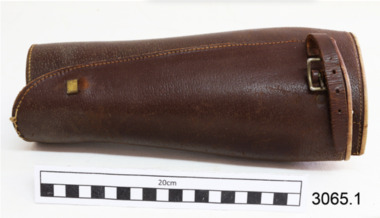
... recruits who served in the Light Horse regiments of the Citizen Forces. Many young men from rural areas of Australia volunteered for the Light Horse regiments. They had to pass a riding test to join, this test was easier for men from the bush because horses were still the main method of transport on farms and in country towns. The army...recruits who served in the Light Horse regiments of the Citizen Forces. Many young men from rural areas of Australia volunteered for the Light Horse regiments. They had to pass a riding test to join, this test was easier for men from the bush because horses were still the main method of transport on farms and in country towns. The army ...The subject leather leggings are associated with mounted troops known as the Australian Light Horse that served in the South African War from 1899 to 1902. After the war, Britain wanted to use fewer mounted troops and restructured its force around a style of combat that needed more infantry. But the defence of Australia still relied upon mounted military units as these were more mobile than infantry and could travel faster over long distances. Light Horse brigades in the Australian Imperial Force (AIF) mostly contained recruits who served in the Light Horse regiments of the Citizen Forces. Many young men from rural areas of Australia volunteered for the Light Horse regiments. They had to pass a riding test to join, this test was easier for men from the bush because horses were still the main method of transport on farms and in country towns. The army did not officially accept First Australians into the AIF until May 1917 when enlistment standards were relaxed to include 'half-castes' with a parent of European origin. Indigenous soldiers served as valuable members of the Light Horse and many possessed excellent horse handling skills and specialist tracking knowledge.The subject items are part of the uniform for the Light Horse Units that served in the Australian army from 1899 until 1918. These leggings were worn by soldiers on horseback and are significant as they represent a noteworthy time in Australia's early military history. It was a time when many young men gave their lives during the South African and First World Wars in the defence of the then British Empire as part of the Imperial Forces that were gathered from many British-controlled Colonial countries.A pair of two Leather Leggings used by Mounted Australian soldiers during the first world war. The leggings are dark tan in colour with stitching to attach buckles and fastener straps. The strap buckles are made of brass and the leather legging straps are of same leather as leggings. Noneflagstaff hill, warrnambool, flagstaff hill maritime museum, shipwreck coast, flagstaff hill maritime village, great ocean road, leggings, leather leggings, protective leggings, protective clothing, australian mounted light horse units, military equipment -
 Geelong RSL Sub Branch
Book - 40th Battalion, A souvenir of the 40th Battalion, Mid 20th Century
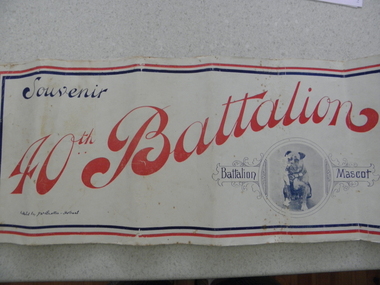
... The 40th Battalion was an Infantry Battalion of the Australian Army raised in 1916. The battalion was recruited completely from Tasmanis as part of the 10th Brigade, 3rd Division....The 40th Battalion was an Infantry Battalion of the Australian Army raised in 1916. The battalion was recruited completely from Tasmanis as part of the 10th Brigade, 3rd Division. ...The 40th Battalion was an Infantry Battalion of the Australian Army raised in 1916. The battalion was recruited completely from Tasmanis as part of the 10th Brigade, 3rd Division.The Batalion served during WW1 - along the Western Front, 1919 to 1921 was a CMF unit. During WW2 the Battalion remained in Australia and was amalgamated with 12th Battalion. The Battalion was merged into 12th/40th Battalion Royal Tasmania Regiment in 1987.An oblong book, buff colour, paper pages, blue and red edging.On the front page Souvenir 40th Battalion, the Battalion Mascot, Published by J W Beatie - Hobart, back page wholly Engraved and Printed by 'The Examiner' and 'Weekly Courier' Offices, 73-75 Patterson Street, Launceston, Tasmania.ww1 ww2 40th battalion tasmania
