
Showing 195 items matching "army tie"
-
 Lara RSL Sub Branch
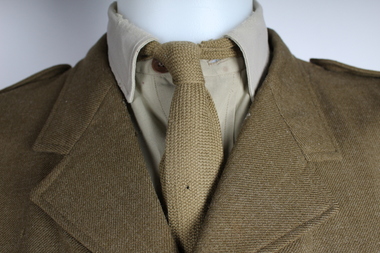
Army Tie, Australian Army Tie
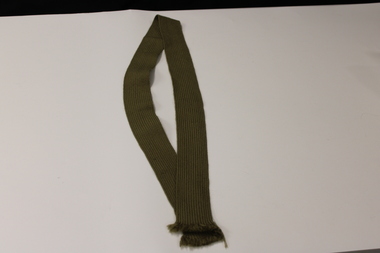
... Army Tie...Australian Army Tie...Australian Army Tie Army Tie ...This tie, along with the rest of the dress uniform, belonged to an individual named H.E Schulze. It is believed to have been dropped off to the RSL, so no additional information is known.This uniform serves as an example of the military dress worn by the Royal Australian Army (Royal Australian Artillery Regiment) during the late sixties.Khaki tie that is missing the bottom section (appears to have been cut off).lara, rsl, royal australian army, royal australian artillery, war -
 Wangaratta RSL Sub Branch
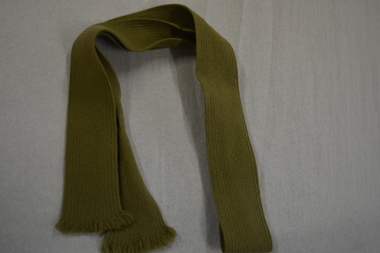
Uniform - Army Tie
... Army Tie......army tie...GREAVES 310387 who served with the Royal Australian Electrical and Mechanical Engineers 1965-1971. raeme army tie Khaki green woven neck tie Uniform Army Tie ...Item belonged to Lieutenant Leonard V. GREAVES 310387 who served with the Royal Australian Electrical and Mechanical Engineers 1965-1971.Khaki green woven neck tieraeme, army tie -
 Bendigo Military Museum
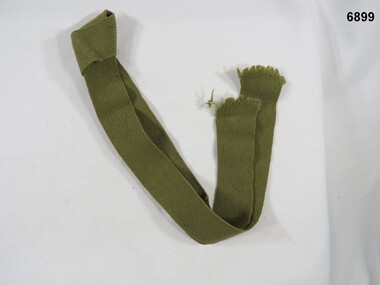
Uniform - TIE, ARMY, Unknown
... TIE, ARMY...Tie...Uniform...Army...Woollen khaki Army tie worn with day wear uniform....Uniform TIE, ARMY ...Woollen khaki Army tie worn with day wear uniform.tie, uniform, army, passchendaele barracks trust item 47 -
 Warrnambool RSL Sub Branch
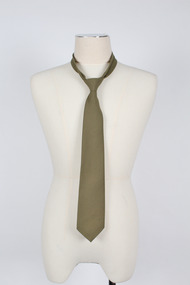
Army Uniform, tie, Fletcher Jones & Staff, 1990s
... Army Uniform, tie...army uniform...warrnambool...tie...Khaki tie with silk lining; tag attached to the reverse of the tie in the first quarter of the tie lenth. Label is sewn into seam on reverse. Army Uniform, tie Fletcher Jones & Staff Australian Tie Co. ...Worn as part of a uniform, by Bernie Farley, of the 8th/7th Battalion, Royal Victorian Regiment. This tie has social significance, being owned and worn by Secretary of the Warrnambool RSL, Bernie Farley. The tie was donated as part of a uniform set by Bernie Farley after 30 years of service in both the Australian Army and Royal Australian Air Force. Though worn in the 1990s, this uniform is in excellent condition as a representative example of an Army uniform of the period.Khaki tie with silk lining; tag attached to the reverse of the tie in the first quarter of the tie lenth. Label is sewn into seam on reverse. Label reads "AUSTRALIAN TIE CO./MADE IN AUSTRALIA", "65% POLYESTER/35% VISCOSE/MADE IN/AUSTRALIA", "DRY CLEAN/ONLY P50 [degree]/WARM IRON/USING INSERT."military uniform, ex-service, army uniform, warrnambool, tie, neck tie -
 Ringwood RSL Sub-Branch
Uniform - army khaki tie, uniforms
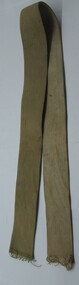
... army khaki tie...brown fabric tie uniforms Uniform army khaki tie ...brown fabric tie -
 Bendigo Military Museum
Uniform - SHIRT AND TIE, ARMY, Australian Defence Industries, unknown
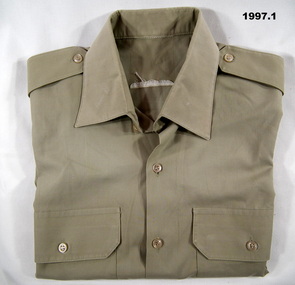
... SHIRT AND TIE, ARMY...Size stamp on inside collar. 2. Tie - Army issue khaki knitted cotton necktie, ends of the tie are cut and frayed....Uniform SHIRT AND TIE, ARMY Australian Defence Industries ...1. Shirt - Khaki cotton polyester short sleeves with shoulder epaulettes and plastic buttons. Cotton manufacturers label has been partially removed with lower edge still stitched in place. Size stamp on inside collar. 2. Tie - Army issue khaki knitted cotton necktie, ends of the tie are cut and frayed.Inside collar, black in stamp "Size 41".uniform, army -
 Running Rabbits Military Museum operated by the Upwey Belgrave RSL Sub Branch
Tie
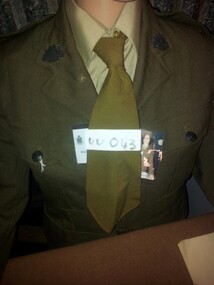
... Army Tie...Uniform ww2 Army Army Tie Tie ...Army Tieuniform, ww2, army -
 Flagstaff Hill Maritime Museum and Village
Uniform - Tie, 1939-1945
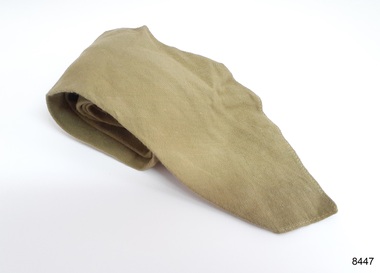
... ...Army uniform...tie...This men's khaki tie was issued to Dr W R Angus by the Australian Army to their men during WWII. ...Tie; Australian Army uniform neck tie, WWII era. The tie is a khaki-coloured lightweight fabric with an uneven point on the ends. ...ANGUS”" Tie; Australian Army uniform neck tie, WWII era. The tie is a khaki-coloured lightweight fabric with an uneven point on the ends. ...This men's khaki tie was issued to Dr W R Angus by the Australian Army to their men during WWII. The tie is now part of Flagstaff Hill’s comprehensive W.R. Angus Collection, donated by the family of Dr W R Angus (1901-1970), surgeon and oculist. Dr W R Angus was a Surgeon Captain for the Australian Defence Forces, Army Medical Corps, stationed in Ballarat, Victoria, and in Bonegilla, N.S.W. He completed his service just before the end of the war due to suffering from a heart attack. The W.R. Angus Collection: - The W.R. Angus Collection includes historical medical equipment, surgical instruments and material belonging to Dr Edward Ryan and Dr Thomas Francis Ryan, (both of Nhill, Victoria) and Dr Angus’ own belongings. The Collection’s history spans the medical practices of the two Doctors Ryan, from 1885-1926 plus that of Dr Angus, up until 1969. It includes historical medical and surgical equipment and instruments from the doctors Edward and Thomas Ryan of Nhill, Victoria. Dr Angus married Gladys in 1927 at Ballarat, the nearest big city to Nhill where he began as a Medical Assistant. He was also Acting House surgeon at the Nhill hospital where their two daughters were born. During World War II He served as a Military Doctor in the Australian Defence Forces. Dr Angus and his family moved to Warrnambool in 1939, where Dr Angus operated his own medical practice. He later added the part-time Port Medical Officer responsibility and was the last person appointed to that position. Both Dr Angus and his wife were very involved in the local community, including the planning stages of the new Flagstaff Hill and the layout of the gardens there. Dr Angus passed away in March 1970.This tie is significant for its connection with Australia's Military History as part of the uniform worn by officers in the Australian Army. Dr W R Angus (1901-1970), surgeon and oculist, collected a range of military objects including those he personally used during his time as Surgeon Captain in the Australian Defence Forces in World War II. The W.R. Angus Collection is significant for still being located at the site it is connected with, Doctor Angus being the last Port Medical Officer in Warrnambool. The Collection includes historical medical objects that date back to the late 1800s.Tie; Australian Army uniform neck tie, WWII era. The tie is a khaki-coloured lightweight fabric with an uneven point on the ends. The front-facing end is wider than the rear-facing end. The unlined tie has exposed stitching around the border of each end. The reverse has an inscription. The tie belonged to Dr W R Angus and is now part of the W. R. Angus Collection.Handwritten in black pen on the reverse "“W.R. ANGUS”"flagstaff hill, warrnambool, maritime village, maritime museum, shipwreck coast, great ocean road, flagstaff hill maritime museum and village, dr w r angus, w.r. angus collection, australian army, world war 2, second world war, australian defence forces, ww 2, army issue, wwii, army uniform, tie, necktie, neck tie -
 Warrnambool RSL Sub Branch
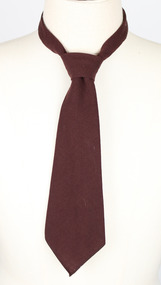
Tie; Army Nurse's Uniform
... Tie; Army Nurse's Uniform...Tie; Army Nurse's Uniform ... -
 Bendigo Military Museum
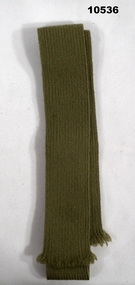
Uniform - KNECK TIE, ARMY
... KNECK TIE, ARMY...Collection re G.A.Jones 3790932, refer Cat No 10053.2P for his service details. uniform tie gajones Kahki woolen neck Tie with frayed ends. Uniform KNECK TIE, ARMY ...Collection re G.A.Jones 3790932, refer Cat No 10053.2P for his service details.Kahki woolen neck Tie with frayed ends.uniform, tie, gajones -
 Bendigo Military Museum
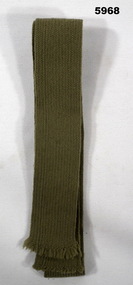
Uniform - TIE
... ...army tie...Military issue tie with frayed due to being cut from a large roll. uniform army tie Kevin John Herdman Military issue khaki woven tie with cut and frayed ends. ...Part of the Kevin John Herdman No. 397661 Collection. See Catalogue No. 5942P for details of his service record. Military issue tie with frayed due to being cut from a large roll.Military issue khaki woven tie with cut and frayed ends.uniform, army tie, kevin john herdman -
 Lara RSL Sub Branch
Australian Army Shirt, Trouses and Tie
... Australian Army Shirt, Trouses and Tie....Australian Army Shirt, Trouses and Tie. ... -
 Ringwood RSL Sub-Branch
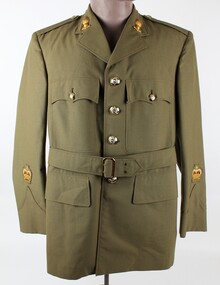
Uniform - Uniform, Army Jacket, Trousers and tie, Engineers Corps, 1963
... Uniform, Army Jacket, Trousers and tie, Engineers Corps...Commonwealth government clothing factory 1963, 00090.1 Warrent Officer 2nd class Kharki polly dress, 4 plastic brass look buttons front, 1 plastic brass look buttons breast pockets 2 brass belt keepers, 1 crown cloth badge each sleeve, 1 plastic brass look buttons on eppilate, 1 brass unint badge per collar. 1 belt 00090.2 pollyester tie, 00090.3 pollyester trousers, 00090.4 belt Uniform Uniform, Army Jacket, Trousers and tie, Engineers Corps ...00090.1 Warrent Officer 2nd class Kharki polly dress, 4 plastic brass look buttons front, 1 plastic brass look buttons breast pockets 2 brass belt keepers, 1 crown cloth badge each sleeve, 1 plastic brass look buttons on eppilate, 1 brass unint badge per collar. 1 belt 00090.2 pollyester tie, 00090.3 pollyester trousers, 00090.4 beltCommonwealth government clothing factory 1963, -
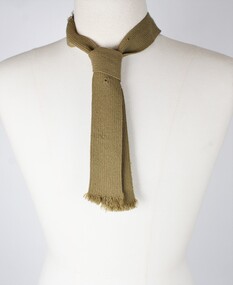 Shepparton RSL Sub Branch
Uniform, Tie, Circa 1960
... Post WW2 Army Tie....Post WW2 Army Tie. Green Woolen Knitted Tie. Moth damage and fraying. ...Post WW2 Army Tie.Green Woolen Knitted Tie. Moth damage and fraying. -
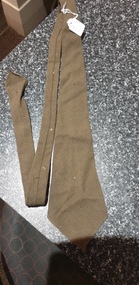 Colac RSL Sub Branch
Uniform - Khaki tie, standard issue tie
... Standard issue Army Tie...Standard issue Army Tie average Military Uniform Nil Cotton Tie standard issue tie Uniform Khaki tie ...Standard issue Army TieaverageCotton TieNilmilitary uniform -
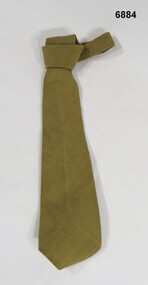 Bendigo Military Museum
Uniform - TIE, Unknown
... Tie...Army Uniform...Khaki cotton tie worn with Army polyester dress uniform....Passchendaele Barracks Trust Khaki Tie Army Uniform Lable "T.H. Iser". Khaki cotton tie worn with Army polyester dress uniform. ...Refer to items in the collection, Thomas Henry Iser, V34933, VX102660, Cat No 383.2.Khaki cotton tie worn with Army polyester dress uniform.Lable "T.H. Iser".passchendaele barracks trust, khaki, tie, army uniform -
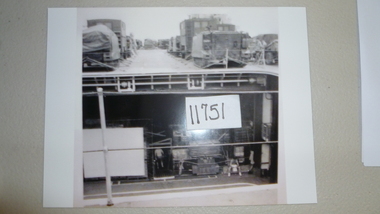 National Vietnam Veterans Museum (NVVM)
Photograph, Lower deck with movie screen
... B & W photo of lower deck of HMAS Sydney first trip 1965. Army vehicles tied down on upper deck. 2 men on lower deck....Photograph HMAS Sydney B & W photo of lower deck of HMAS Sydney first trip 1965. Army vehicles tied down on upper deck. 2 men on lower deck. ...B & W photo of lower deck of HMAS Sydney first trip 1965. Army vehicles tied down on upper deck. 2 men on lower deck.photograph, hmas sydney -
 National Vietnam Veterans Museum (NVVM)
Uniform - Tie
... An army issue tie as part of non-combat uniform worn by national Serviceman Pte D G Woods, No: 2783285, who served in 7RAR in 1967. ...An army issue tie as part of non-combat uniform worn by national Serviceman Pte D G Woods, No: 2783285, who served in 7RAR in 1967. ...An army issue tie as part of non-combat uniform worn by national Serviceman Pte D G Woods, No: 2783285, who served in 7RAR in 1967. These ties were primarily worn with Service Dress (both summer and winter versions) and General Duty dress. Veterans of the era often remember them as being too short.A straight tie made from khaki knitted fabric with hemmed sides but square unhemmed ends.7rar, woods, 2783285, vietnam, tie, service dress, service uniform -
 Ringwood RSL Sub-Branch
Uniform - Uniform Australian Army, C 1940's jacket
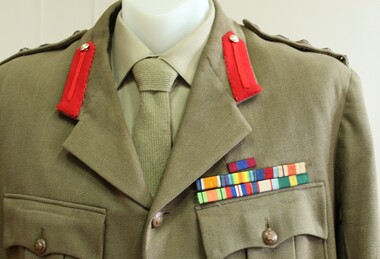
... tie on half mannequin. Rank of Colonel. Colour patches indicate service in WW1 and WW2. 3 blue service stripes on right sleeve and one red wound stripe on left sleeve. Possibly tailor made and not army...tie on half mannequin. Rank of Colonel. Colour patches indicate service in WW1 and WW2. 3 blue service stripes on right sleeve and one red wound stripe on left sleeve. Possibly tailor made and not army ...Officers Tunic complete with shirt and tie on half mannequin. Rank of Colonel. Colour patches indicate service in WW1 and WW2. 3 blue service stripes on right sleeve and one red wound stripe on left sleeve. Possibly tailor made and not army issue. Shirt and tie from 1990's period.Inside tag M. TX -
 Federation University Historical Collection
Album, Chatham-Holmes Collection: Family Photographs from 1930s and 1940s, 1930s-1940s
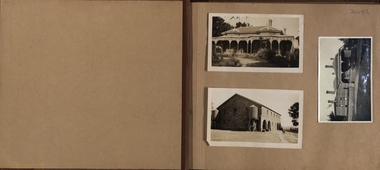
... During the Second World War it was used as a billet for the Women's Army Service. chatham-holmes collection holmes launchley sheep elizabeth holmes david holmes billie jack whitehall guesthouse queenscliff ascot ascot centenary celebration 1938 Women-in WW2 ww2 On the cover of album is 'Snapshots' in gold. Dates are written on some pages. Brown covered album of 30 pages of thick brown card with 94 photographs pasted into it. Pages tied ...Photographs of the Holmes family at "Launchley" Ascot, Victoria In 1934 they holidayed at "Whitehall" Guesthouse in Queenscliff. It is in Hesse Street and was built in 1926. During the Second World War it was used as a billet for the Women's Army Service.Brown covered album of 30 pages of thick brown card with 94 photographs pasted into it. Pages tied together with cord. Paper coming of cover. On the cover of album is 'Snapshots' in gold. Dates are written on some pages.chatham-holmes collection, holmes, launchley, sheep, elizabeth holmes, david holmes, billie, jack, whitehall guesthouse, queenscliff, ascot, ascot centenary celebration 1938, women-in ww2, ww2 -
 Frankston RSL Sub Branch
Sleeping Bag, 1942
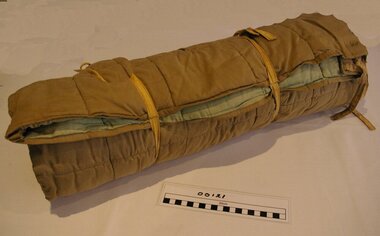
... Army inside liner for a sleeping bag, Fawn exterior with padded quilted light green interior.Complet with press studs and ties still intact ...Marked Department of Defence Windsors Pty Ltd 1942 Army inside liner for a sleeping bag, Fawn exterior with padded quilted light green interior.Complet with press studs and ties still intact Sleeping Bag ...Army inside liner for a sleeping bag, Fawn exterior with padded quilted light green interior.Complet with press studs and ties still intact Marked Department of Defence Windsors Pty Ltd 1942 -
 Nhill Aviation Heritage Centre
Kit bag, c .1940's
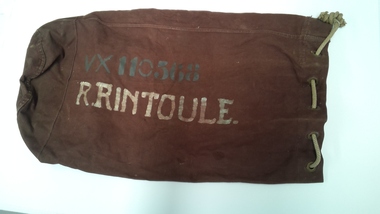
... Robert (Bob) Rintoule was a local Nhill man who joined the armed forces kit bag, army equipment, canvas bag, r.rintoule, vx110568 VX110568 R.RINTOULE Brown canvas with rope tie and eyelets at one end. ...Issued to Robert (Bob) Rintoule for use during his term in the army during World War 2.Robert (Bob) Rintoule was a local Nhill man who joined the armed forcesBrown canvas with rope tie and eyelets at one end.VX110568 R.RINTOULEkit bag, army equipment, canvas bag, r.rintoule, vx110568 -
 Lara RSL Sub Branch
Card, Christmas Card, 1916
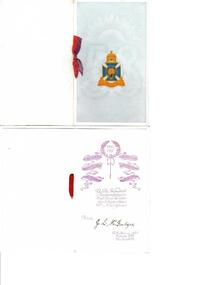
... army a.i.f mcintyre On the front page 58th Battalion Badge. Inside 1916-1917 inside a wreath of wheat .Going down on either side in a scroll like pattern is the names of battles on the left is Somme, Fromelles Sinai and on the right is Lagnicourt, Bullecourt, Polygon Wood. In the middle is written in script With Kindness Remembrances & all Good A.I.FWishes for Christmas & New Year From J.L McIntyre. Down the bottom is 58th Battalion A.I.F Xmas 1917 New Year 1918 Blue Card with white boundary, with card insert and red ribbon tying ...The cards where distributed army personal to send home from the war. J.I. McIntyre was a member of the Lara RSL along with brothers Jim and Thonas Blue Card with white boundary, with card insert and red ribbon tying them together On the front page 58th Battalion Badge. Inside 1916-1917 inside a wreath of wheat .Going down on either side in a scroll like pattern is the names of battles on the left is Somme, Fromelles Sinai and on the right is Lagnicourt, Bullecourt, Polygon Wood. In the middle is written in script With Kindness Remembrances & all Good A.I.FWishes for Christmas & New Year From J.L McIntyre. Down the bottom is 58th Battalion A.I.F Xmas 1917 New Year 1918 christmas card, world war one, army, a.i.f, mcintyre -
 Lara RSL Sub Branch
Belt, Leather Belt
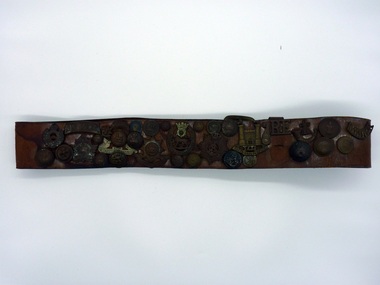
... This habit probably began with the Queens Household troops and Line Cavalry, but quickly spread throughout the Army and it appears as if this use of regimental colours spread to the canvas or wool strapping used to make stable belts. For this reason the stable belts invariably followed the same colour scheme (but not always the same pattern arrangement) of regimental neck ties. ...This habit probably began with the Queens Household troops and Line Cavalry, but quickly spread throughout the Army and it appears as if this use of regimental colours spread to the canvas or wool strapping used to make stable belts. For this reason the stable belts invariably followed the same colour scheme (but not always the same pattern arrangement) of regimental neck ties. ...This belt belonged to a WW1 Australian Anzac who most probably, because of the buttons and badges, served on the Western Front. Records destroyed in 1969 bush fires at Lara means we are unable to determine who owned this in the RSL. The belts is called a 'stable belt' and the one you have acquired is an early example with a leather pocket. It became common in WW1 for both, leather belts (especially that from the 1903 bandolier equipment as worn by those in the Boer War), and stable belts to be used to hold badges collected from fellow soldiers and for that reason it was often known as a 'souvenir belt'. The evolution of the stable belt: It seems that stable belts began to become popular across the Army as a whole around the turn of the 20th century, although they probably originated with the cavalry a little earlier sometime in the 1880s/1890s. All units at that time had horses on their establishment and those soldiers told off to attend them reported for Stable Parade in Stable Dress which consisted of very high waisted and pocket less breeches, or trousers, held up by braces and collarless, woollen flannel shirts with sleeves rolled up. This was to facilitate the rigorous physical effort and flexibility of movement necessary for mucking out and grooming. Braces at that time had no elastic as rubber was expensive, they were made of cotton with no 'give' whatsoever and so soldiers commonly allowed the braces to flop down from the waist so that they could bend over freely. For trousers that fitted loosely (due to the high waist) this meant that they tended to slip down and at first soldiers cinched them in with leather belts. Later on the regimental saddlers began to make belts from the same, plain canvas or wool strapping used for the horses Surcingle and utilising the same double leather strap and buckle arrangement for security (if one strap broke the other would hold and prevent the saddle from coming unseated). One particular feature of these early stable belts was a sewn on (or in) pocket, secured by a stud or clip, within which loose change could be kept, or a pocket watch, as there were no pockets in the breeches. As you might imagine these became very popular as the pocket was useful and the extra breadth afforded by the canvas strapping made them very comfortable. Around about the turn of the 20th century it began to be popular for officers to wear neckties in regimental colours both for sport and less formal, country dress. This habit probably began with the Queens Household troops and Line Cavalry, but quickly spread throughout the Army and it appears as if this use of regimental colours spread to the canvas or wool strapping used to make stable belts. For this reason the stable belts invariably followed the same colour scheme (but not always the same pattern arrangement) of regimental neck ties. This belt is an example of what Australian troops collected when on the Western Front during WW1 and when on leave.Leather Belt with 31 Badges and Buttons from WW1 attachedSee Mediaww1, world war 1, australian army, badges, button, belt, stable belt -
 Lara RSL Sub Branch
Belt, Webbing Belt
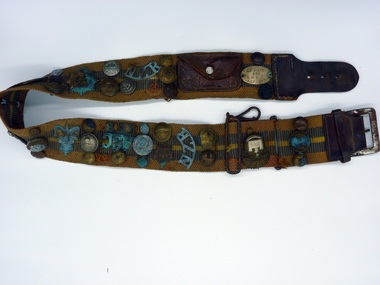
... This habit probably began with the Queens Household troops and Line Cavalry, but quickly spread throughout the Army and it appears as if this use of regimental colours spread to the canvas or wool strapping used to make stable belts. For this reason the stable belts invariably followed the same colour scheme (but not always the same pattern arrangement) of regimental neck ties....This habit probably began with the Queens Household troops and Line Cavalry, but quickly spread throughout the Army and it appears as if this use of regimental colours spread to the canvas or wool strapping used to make stable belts. For this reason the stable belts invariably followed the same colour scheme (but not always the same pattern arrangement) of regimental neck ties. ...This belt belonged to a WW1 Australian Anzac who most probably, because of the buttons and badges, served on the Western Front. Records destroyed in 1969 bush fires at Lara means we are unable to determine who owned this in the RSL. The belts is called a 'stable belt' and the one you have acquired is an early example with a leather pocket. It became common in WW1 for both, leather belts (especially that from the 1903 bandolier equipment as worn by those in the Boer War), and stable belts to be used to hold badges collected from fellow soldiers and for that reason it was often known as a 'souvenir belt'. The evolution of the stable belt: It seems that stable belts began to become popular across the Army as a whole around the turn of the 20th century, although they probably originated with the cavalry a little earlier sometime in the 1880s/1890s. All units at that time had horses on their establishment and those soldiers told off to attend them reported for Stable Parade in Stable Dress which consisted of very high waisted and pocket less breeches, or trousers, held up by braces and collarless, woollen flannel shirts with sleeves rolled up. This was to facilitate the rigorous physical effort and flexibility of movement necessary for mucking out and grooming. Braces at that time had no elastic as rubber was expensive, they were made of cotton with no 'give' whatsoever and so soldiers commonly allowed the braces to flop down from the waist so that they could bend over freely. For trousers that fitted loosely (due to the high waist) this meant that they tended to slip down and at first soldiers cinched them in with leather belts. Later on the regimental saddlers began to make belts from the same, plain canvas or wool strapping used for the horses Surcingle and utilising the same double leather strap and buckle arrangement for security (if one strap broke the other would hold and prevent the saddle from coming unseated). One particular feature of these early stable belts was a sewn on (or in) pocket, secured by a stud or clip, within which loose change could be kept, or a pocket watch, as there were no pockets in the breeches. As you might imagine these became very popular as the pocket was useful and the extra breadth afforded by the canvas strapping made them very comfortable. Around about the turn of the 20th century it began to be popular for officers to wear neckties in regimental colours both for sport and less formal, country dress. This habit probably began with the Queens Household troops and Line Cavalry, but quickly spread throughout the Army and it appears as if this use of regimental colours spread to the canvas or wool strapping used to make stable belts. For this reason the stable belts invariably followed the same colour scheme (but not always the same pattern arrangement) of regimental neck ties.This belt is an example of what Australian troops collected when on the Western Front during WW1 and when on leave.Webbing Belt with Badges and Buttons WW1See Mediaarmy, australian army, western front, aif, s.w.ellis, service number 640, 2 m.g.c., buttons, badges, belt, stable belt -
 Shepparton RSL Sub Branch
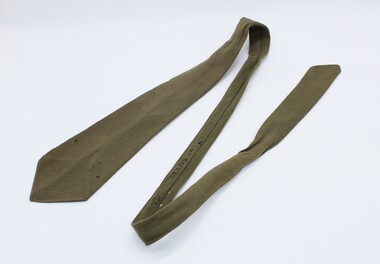
Uniform, Tie, C. 1943
... This tie belonged to Dorothy May Mortlock (VF518245) who was part of the Australian Womens Army Service (AWAS). ...Dorothy Mortlock was born in Swan Hill and enlisted with the 3rd AUST AWS REC DEPOT. world war ii second world war wwii women australian women's army service Interior of tie reads "VF518245 MORTLOCK" Khaki-coloured tie with pointed end. ...This tie belonged to Dorothy May Mortlock (VF518245) who was part of the Australian Womens Army Service (AWAS). Dorothy Mortlock was born in Swan Hill and enlisted with the 3rd AUST AWS REC DEPOT.Khaki-coloured tie with pointed end. Rising sun bdage (UA09.5) sits on tie at sternum height.Interior of tie reads "VF518245 MORTLOCK"world war ii, second world war, wwii, women, australian women's army service -
 Shepparton RSL Sub Branch
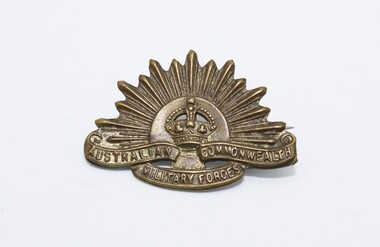
Uniform, Tie Badge, C. 1943
... Dorothy Mortlock was born in Swan Hill and enlisted with the 3rd AUST AWS REC DEPOT. world war ii second world war wwii women australian women's army service Badge reads "AUSTRALIAN COMMONWEALTH/MILITARY FORCES" Rising sun badge in bronze-coloured metal with pin and loop on reverse for attachment to tie. ...This badge belonged to Dorothy May Mortlock (VF518245) who was part of the Australian Womens Army Service (AWAS). Dorothy Mortlock was born in Swan Hill and enlisted with the 3rd AUST AWS REC DEPOT.Rising sun badge in bronze-coloured metal with pin and loop on reverse for attachment to tie.Badge reads "AUSTRALIAN COMMONWEALTH/MILITARY FORCES"world war ii, second world war, wwii, women, australian women's army service -
 Flagstaff Hill Maritime Museum and Village
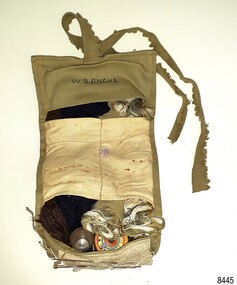
Equipment - Sewing Kit, 1939-1945
... Army sewing kit, WWII era. A rectangular khaki cotton fabric pouch with pockets containing sewing needles, threads of various colours, a thimble and a reel of cotton. The pouch rolls up and is secured with its own ties...Army sewing kit, WWII era. A rectangular khaki cotton fabric pouch with pockets containing sewing needles, threads of various colours, a thimble and a reel of cotton. The pouch rolls up and is secured with its own ties ...This sewing kit was issued to W.R. Angus during his Military Service in WWII. It is sometimes referred to as a soldier's ‘housewife’ and includes items necessary for mending and adjusting a soldier’s clothing and other fabric items. Earlier Army issue sewing kits were made of leather but were subject to deterioration due to holding moisture if they became wet. The sewing kit is now part of Flagstaff Hill’s comprehensive W.R. Angus Collection, donated by the family of Dr W R Angus (1901-1970), surgeon and oculist. Dr W R Angus was a Surgeon Captain for the Australian Defence Forces, Army Medical Corps, stationed in Ballarat, Victoria, and in Bonegilla, N.S.W. He completed his service just before the end of the war due to suffering from a heart attack. The W.R. Angus Collection: - The W.R. Angus Collection includes historical medical equipment, surgical instruments and material belonging to Dr Edward Ryan and Dr Thomas Francis Ryan, (both of Nhill, Victoria) and Dr Angus’ own belongings. The Collection’s history spans the medical practices of the two Doctors Ryan, from 1885-1926 plus that of Dr Angus, up until 1969. It includes historical medical and surgical equipment and instruments from the doctors Edward and Thomas Ryan of Nhill, Victoria. Dr Angus married Gladys in 1927 at Ballarat, the nearest big city to Nhill where he began as a Medical Assistant. He was also Acting House surgeon at the Nhill hospital where their two daughters were born. During World War II He served as a Military Doctor in the Australian Defence Forces. Dr Angus and his family moved to Warrnambool in 1939, where Dr Angus operated his own medical practice. He later added the part-time Port Medical Officer responsibility and was the last person appointed to that position. Both Dr Angus and his wife were very involved in the local community, including the planning stages of the new Flagstaff Hill and the layout of the gardens there. Dr Angus passed away in March 1970.This item is significant in Australia's War History and its connection with local history. It aids in understanding life in the military and the changes to normal life. Dr W R Angus (1901-1970), surgeon and oculist, collected a range of military objects including those he personally used during his time as Surgeon Captain in the Australian Defence Forces in World War II. The W.R. Angus Collection is significant for still being located at the site it is connected with, Doctor Angus being the last Port Medical Officer in Warrnambool. The Collection includes historical medical objects that date back to the late 1800s.Australian Army sewing kit, WWII era. A rectangular khaki cotton fabric pouch with pockets containing sewing needles, threads of various colours, a thimble and a reel of cotton. The pouch rolls up and is secured with its own ties. It has a handwritten inscription. The cloth patches belonged to Dr W R Angus and are now part of the W. R. Angus Collection."W.R. ANGUS"flagstaff hill, warrnambool, maritime village, maritime museum, shipwreck coast, great ocean road, flagstaff hill maritime museum and village, dr w r angus, w.r. angus collection, australian army, surgeon captain, ballarat, bonegilla, world war 2, second world war, australian defence forces, army medical corps, australian army medical corp (militia), ww 2, ww ii, aamc, sewing kit, sewing roll, housewife, clothing repairs, military equipment, army issue -
 City of Moorabbin Historical Society (Operating the Box Cottage Museum)
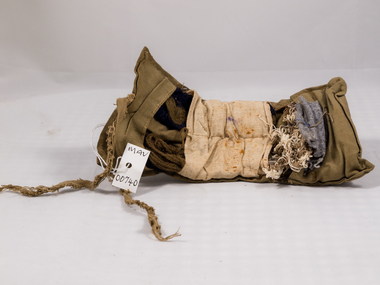
WW11 1939-1945 Australian Army Soldiers Sewing Kit, c1939
... Standard issue sewing kit for Australian Soldiers serving in WW2 1939-45 in New Guinea and tropical areas world war 11 1939-1945, cotton, khaki, soldier field kit, sewing kit, new guinea, army supply department, australian army, moorabbin, bentleigh, cheltenham, A rectangular khaki cotton pouch containing wool and cotton threads, needles, metal buttons, folding stainless steel scissors that rolls up and is tied by two cotton bands. ...1939 - 1945 Australian Army Sewing Kit. This kit is just one of many different brands of sewing kit - issued to Australian troops during the Second World War. Containing the standard requirements for uniform/clothing repair in the field. Items include:- assorted sewing needles,spare metal (quad hole) buttons and spare cotton/wool thread. Originally the "hold-all" (or pouch) was manufactured using leather, which was in plentiful supply in Australia and is quite durable. The major problem with leather however, especially in tropical or damp conditions - is it's susceptibility to moisture. This will then have an adverse affect upon the metal items contained within the kit, obviously resulting in corrosion to the metal sewing needles and buttons. This sewing kit hold-alls was manufactured from a khaki cotton or similar material. The metal thimble is missing.Standard issue sewing kit for Australian Soldiers serving in WW2 1939-45 in New Guinea and tropical areasA rectangular khaki cotton pouch containing wool and cotton threads, needles, metal buttons, folding stainless steel scissors that rolls up and is tied by two cotton bands.world war 11 1939-1945, cotton, khaki, soldier field kit, sewing kit, new guinea, army supply department, australian army, moorabbin, bentleigh, cheltenham, -
 Orbost & District Historical Society
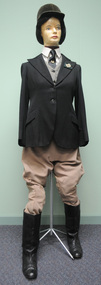
riding costume, first half 20th century
... ARMY STORES REG" A woman's riding costume. It consists of a brown felt cap (2524.1); a long-sleeved, hand-made black lined coat made of serge with two black buttons and two pockets (2524.2); a cotton cloth badge with "MLC" inside an eight-pointed star pinned to the coat (2524.3); a gold tie clasp with a horse and rider jumping through a horseshoe (2524.4); a black silk tie (2524.6); a hand-made black and white herringbone patterned waistcoat, lined with blue striped silk material (2524.7); a pair of light brown jodhpur style riding breeches with patching on the inside of legs (2524.8); a pair of black leather calf high riding boots with leather soles (2524.9 and 2524.10). riding costume ...This outfit was worn for competitive riding by Nancy Bland in 1930's.A woman's riding costume. It consists of a brown felt cap (2524.1); a long-sleeved, hand-made black lined coat made of serge with two black buttons and two pockets (2524.2); a cotton cloth badge with "MLC" inside an eight-pointed star pinned to the coat (2524.3); a gold tie clasp with a horse and rider jumping through a horseshoe (2524.4); a black silk tie (2524.6); a hand-made black and white herringbone patterned waistcoat, lined with blue striped silk material (2524.7); a pair of light brown jodhpur style riding breeches with patching on the inside of legs (2524.8); a pair of black leather calf high riding boots with leather soles (2524.9 and 2524.10).2524.6 - "LOWES" 2524.8 - "Rankine & Dorrs Melbourne ARMY STORES REG"equestrian horses jodhpurs outfit-riding bland-nancy
