
Showing 16 items matching "army-small ships"
-
 Waverley RSL Sub Branch
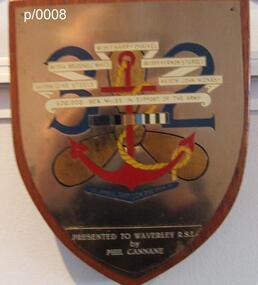
Plaque 600000 Sea Miles in support of the Army 32 Small Ship Squadron RAE 59-73, 600000 Sea Miles in support of the Army 32 Small Ship Squadron RAE 59-73
... Plaque 600000 Sea Miles in support of the Army 32 Small Ship Squadron RAE 59-73 ...600000 Sea Miles in support of the Army 32 Small Ship Squadron RAE 59-73 ...Wooden Plaque 600000 Sea Miles in support of the Army 32 Small Ship Squadron RAE 59-73 ...600000 Sea Miles in support of the Army 32 Small Ship Squadron RAE 59-73 ...600000 Sea Miles in support of the Army 32 Small Ship Squadron RAE 59-73 Wooden Plaque 600000 Sea Miles in support of the Army 32 Small Ship Squadron RAE 59-73 600000 Sea Miles in support of the Army 32 Small Ship Squadron RAE 59-73 Plaque 600000 Sea Miles in support of the Army 32 Small Ship Squadron RAE 59-73 ...Wooden Plaque 600000 Sea Miles in support of the Army 32 Small Ship Squadron RAE 59-73 600000 Sea Miles in support of the Army 32 Small Ship Squadron RAE 59-73 -
 Bendigo Military Museum
Award - MEDALS, WW2, c.1945
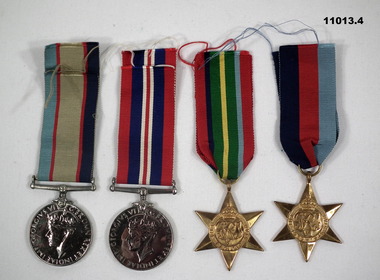
... ...Army-small ships...Small Ships Coy. Overseas service is listed as New Guinea 11.1.1945 - 30.11.1946. Discharged 23/1/47 with the Rank of Lieutenant.. WW2 17th MG Regt Armoured Regt Army ..."Lieut. Ivor Brook Hamilton BEVES" VX102665 (born Cairns QLD, enlisted in the Field, living in Bendigo at the time) Initially enlisted in the CMF No V25163 in the 17th MG Regt age 30 years 10 months at Puckapunyal. Transferred to AIF 16/8/42 No VX102665. Unit 4th Armoured Regt, then to 14th Armoured Regt, finally to 16 Aust Small Ships Coy. Overseas service is listed as New Guinea 11.1.1945 - 30.11.1946. Discharged 23/1/47 with the Rank of Lieutenant.. Four medals with ribbons unmounted. .1) 1939 - 45 Star. .2) Pacific Star. .3) British War Medal 1939 - 45. .4) Australian Service Medal 1939 - 45.Stamped on all medals. “VX102665 I.B.H. Beves”ww2, 17th mg regt, armoured regt, army-small ships, lt. ivor beves -
 4th/19th Prince of Wales's Light Horse Regiment Unit History Room
Medal, War Medal 1939-45
... The War Medal 1939-45 is awarded to Australian Civilian Personnel who served afloat with the United States Army Small Ships Section between 8 December 1941 and 2 September 1945. ...The War Medal 1939-45 is awarded to Australian Civilian Personnel who served afloat with the United States Army Small Ships Section between 8 December 1941 and 2 September 1945. ...The War Medal 1939-45 was awarded for full-time service in the Armed Forces, wherever that service may have been rendered during the war. Operational and non-operational service may be counted, providing that it was of 28 days or more duration. Eligibility The War Medal 1939-45 is awarded for 28 days full-time service between 3 September 1939 and 2 September 1945. In the Merchant Navy there is a requirement that the 28 days should have been served at sea. A member qualifies for the award where service was brought to an end by death, wounds or other disabilities due to service or by cessation of hostilities on 2 September 1945. The War Medal 1939-45 is awarded to Australian Civilian Personnel who served afloat with the United States Army Small Ships Section between 8 December 1941 and 2 September 1945. Eligibility is the same as that for Merchant Navy personnel. See required evidence to support a claim. The Medal The War Medal 1939-45 is cupro-nickel with the crowned effigy of King George VI on the obverse. The reverse has a lion standing on a fallen dragon. The top of the reverse shows the dates 1939 and 1945. The Ribbon The War Medal 1939-45 ribbon colours of red, white and blue represent the colours of the Union Flag. Emblem The single bronze oak leaf Emblem signifying either a Mention in Despatches, King's Commendation for brave conduct, or a King's Commendation for valuable service in the air, will, if granted for service during World War II, be worn on the ribbon of the War Medal 1939-45.Full size and miniature medals with ribbons. Miniature has MID claspnilwar medal 1939-45 -
4th/19th Prince of Wales's Light Horse Regiment Unit History Room
Medal, 1939-45 Star
... Eligibility The 1939-45 Star is awarded for service between 3 September 1939 and 2 September 1945 for: a period of six months (180 days) operational service for RAN and Army personnel and RAAF non-air crew personnel a period of two months operational service for air crew personnel a period of six months service at sea for Merchant Navy provided at least one voyage was made through one of the specified areas of active operations The 1939-45 Star is awarded to Australian Civilian Personnel who served afloat with the United States Army Small Ships Section between 8 December 1941 and 2 September 1945. ...Eligibility The 1939-45 Star is awarded for service between 3 September 1939 and 2 September 1945 for: a period of six months (180 days) operational service for RAN and Army personnel and RAAF non-air crew personnel a period of two months operational service for air crew personnel a period of six months service at sea for Merchant Navy provided at least one voyage was made through one of the specified areas of active operations The 1939-45 Star is awarded to Australian Civilian Personnel who served afloat with the United States Army Small Ships Section between 8 December 1941 and 2 September 1945. ...The 1939-45 Star may be awarded for those who undertook operational service during World War II. Eligibility The 1939-45 Star is awarded for service between 3 September 1939 and 2 September 1945 for: a period of six months (180 days) operational service for RAN and Army personnel and RAAF non-air crew personnel a period of two months operational service for air crew personnel a period of six months service at sea for Merchant Navy provided at least one voyage was made through one of the specified areas of active operations The 1939-45 Star is awarded to Australian Civilian Personnel who served afloat with the United States Army Small Ships Section between 8 December 1941 and 2 September 1945. Eligibility is the same as that for Merchant Navy personnel. See required evidence to support a claim. The Medal The 1939-45 Star is a six–pointed star of yellow copper zinc alloy. The obverse has a central design of the Royal and Imperial cypher, surmounted by a crown. The cypher is surrounded by a circlet containing the words ‘The 1939-45 Star'. Stars issued to Australian personnel have recipient names engraved on the plain reverse. The Ribbon The 1939-45 Star ribbon has three vertical stripes of dark blue, red and light blue. The dark blue stripe represents the Naval Forces and the Merchant Navy, the red stripe the Armies and the light blue stripe the Air Forces. Clasps The ‘BATTLE OF BRITAIN' clasp was awarded to eligible air crew involved in the Battle of Britain. When the ribbon is worn alone a gilt rosette ribbon emblem is worn to denote the award of the ‘BATTLE OF BRITAIN' clasp. The ‘BOMBER COMMAND’ clasp was introduced in 2012 and is awarded to eligible Bomber Command aircrew. When the ribbon is worn alone the standard silver rosette ribbon emblem is worn to denote the award of the ‘BOMBER COMMAND’ clasp. Full size and miniature medals with ribbons. Miniature has clasp : Battle of Britainnilmedal 1939-45 star -
 Mission to Seafarers Victoria
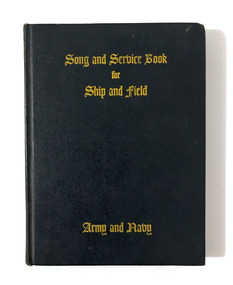
Book - Prayer Book, Ivan Loveridge Bennett, Song and Service Book for Ship and Field - Army and Navy, 1942
... Ship and Field, Army and Navy, edited by Ivan Loveridge Bennett, features prayers, hymns, and patriotic songs used in various military ceremonies and religious services. Walter was interviewed by the Australian at War Film Archive in 2003. He served on these ships: SS Corinda SS Macumba SS Mildura SS Nellor SS Ormiston SS Reynella anne rennie collection wal harbord merchant navy seamen seafarers ww2 battle of the atlantic walter harbord navigation prayers army navy soldiers balikpapan borneo indonesia battle of balikpapan lt d. bacon Inscription and signatures in black ink on pages 2, 3 and 4. Small ...Small book with black cover; 195 pagesnon-fictionanne rennie collection, wal harbord, merchant navy, seamen, seafarers, ww2, battle of the atlantic, walter harbord, navigation, prayers, army, navy, soldiers, balikpapan, borneo, indonesia, battle of balikpapan, lt d. bacon -
 Federation University Historical Collection
Document - Document - Correspondence, ZILLES COLLECTION: Letter paper and cards - Defence Forces, Portsea and Queenscliff
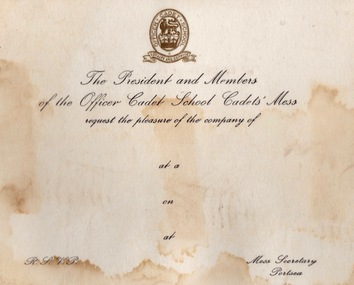
... ships to provide a clean bill of health from the last port of call. If this was not possible all on board would be transferred to the Quarantine Station by boat for observations. This was to stop the spread of diseases such as cholera, small pox, typhoid fever, influenza and the plague. In 1952 it became a military training base - Officer Cadet School. The quarantine station still operated and the Army...ships to provide a clean bill of health from the last port of call. If this was not possible all on board would be transferred to the Quarantine Station by boat for observations. This was to stop the spread of diseases such as cholera, small pox, typhoid fever, influenza and the plague. In 1952 it became a military training base - Officer Cadet School. The quarantine station still operated and the Army ...Zilles Printers was begun by Lewis Zilles in the early 1930s. It was in McKenzie Street Ballarat. His son Jeffrey also became a printer - letterpress, offset and screen printer. The business became Zilles Printers/Graphics and was in Armstrong Street and later Bell Street Ballarat. Items are work done for the Australian Defence Force bases at Portsea and Queenscliff. They were training bases - Officer Cadet School and Australian Staff College. Originally the base at Portsea was the Quarantine Station established in the late 1800s. International protocols required captains of arriving ships to provide a clean bill of health from the last port of call. If this was not possible all on board would be transferred to the Quarantine Station by boat for observations. This was to stop the spread of diseases such as cholera, small pox, typhoid fever, influenza and the plague. In 1952 it became a military training base - Officer Cadet School. The quarantine station still operated and the Army had to be prepared to evacuated in an emergency. This occurred in 1954 when 113 passengers on board the Strathaird were quarantined with smallpox. Cadets and staff came with their families and was a small township. Training for the Vietnam War was here, Now gone the remnants of the quarantine station and army activites can be seen. Under Point Nepean Community Trust. Fort Queenscliff dates from 1860 when it was an open battery known as Shortlands Bluff. The Garrison included volunteer artillery, engineers and infantry. It was a Coastal Defence Installation from 1883-1946. The base on Swan Island was part of this and soldiers from the Fort would go on detail to the Island each day. A permanent group with their families were housed there. The children would attend the local school in Queenscliff. It eventually became and still is a restricted area. In 1946 the Fort became home of the Army Command and Staff College. Officers came from overseas to train. Families would come with them and be accommodated in the main officers residence "Maytone" or private housing rented by the Army. Their children would attend local schools. Staff Colleges were all moved to Canberra. The Fort is now the Army Soldiers Career Management Agency and houses all historical documents related to the Army. .1 Off-white card with gold badge and black writing. .2 White card with separate page held together with blue and red ribbon. Badge in gold on front. Two Officer Cadet School flags - crossed and Christmas Greeting in blue inside card. .3 Off-white paper with Australian Staff College emblem. Blue print.2 Officer Cadet School emblem - lion and crown in centre. Flags - British and Australian .3 Emblem - crossed swords, owl and crownzilles printers, australian defence force, quarantine station portsea, officer cadet school, fort queenscliff, open battery, swan island, staff college, army command, zilles collection -
 Flagstaff Hill Maritime Museum and Village
Equipment - Sand peg set, Mid-19th to mid-20th Century
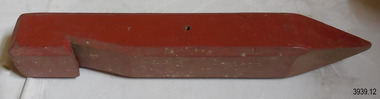
... Flagstaff Hill Maritime Museum & Village Flagstaff Hill Maritime Museum Maritime Village Warrnambool Great Ocean Road shipwreck Life-saving lifesaving rescue crew rescue rocket rescue maritime accidents shipwreck victim rocket crew beach rescue line rescue rescue equipment rocket firing equipment rocket rescue equipment rocket apparatus beach apparatus breeches buoy Rocket house Rocket equipment rocket launcher rocket line Marine technology Beach Rescue Set Traveller block running block pulley hawser faked line Lady Bay Warrnambool Harbour Port of Warrnambool volunteer lifesavers volunteer crew Breakwater rocket rescue method rocket rescue apparatus shore to ship rocket apparatus rescue stranded vessel whip line endless whip Harbour Board sand anchor rocket set anchor backer beach anchor backer steel cable wire cable sand peg wooden tent peg army peg military peg Peg or spike; set of twelve wooden pegs, painted red. Pages have a long, thick square shank with bevelled side edges, flat top with broad hook on one side of the top and a point at the other end. A small ...This set of Victorian era wooden sand pegs was part of the equipment used by the Rocket Rescue Crew when attending a shipwreck. The broad pegs were designed to give a strong grip on soft sand and soil. The pegs could be used with the sand anchor as well as to give a stronger hold on the tripod holding the hawser. The same design is still available today and is used by the Army and by campers. The rocket rescue crews used a sand anchor at a beach rescue site to weigh down the rescue apparatus. The crew would connect the shackle to the other cable on the anchor and to the loose steel cable to form a triangle with the cable lengths. They would then bury the anchor in about a 0.75-meter trench, keeping the free end of the cable above the surface. This end of the cable was then connected to a block that was attached to the heavy hawser line. The block and a crotch pole were used to keep the hawser line high and taught as the survivors were hauled to shore on a line or in a breeches buoy. Saving lives in Warrnambool – The coastline of South West Victoria is the site of over 600 shipwrecks and many lost lives; even in Warrnambool’s Lady Bay there were around 16 known shipwrecks between 1850 and 1905, with eight lives lost. In 1859 the first Government-built lifeboat arrived at Warrnambool Harbour and a shed was soon built to house it. In 1858 the provision of rocket and mortar apparatus was approved for lifeboat stations in Victoria, and in 1864 a rocket house was built to safely store the rocket rescue equipment. In 1878 the buildings were moved to the Breakwater area, and in 1910 the new Lifeboat Warrnambool arrived with its ‘self-righting’ design. For almost a hundred years the lifeboat and rocket crews, mostly local volunteers, trained regularly to maintain their rescue skills. They were summoned when needed by alarms, gunshots, ringing bells and foghorns. Some became local heroes but all served an important role. By the end of the 1950s, the lifeboat and rescue equipment had become obsolete. Rocket Rescue Method - The Government of Victoria adopted lifesaving methods based on Her Majesty’s Coast Guard in Great Britain. It authorised the first line-throwing rescue system in 1858. Captain Manby’s mortar powered a projectile connected to a rope, invented in 1808. The equipment was updated to John Dennett’s 8-foot shaft and rocket method that had a longer range of about 250 yards. From the 1860s the breeches buoy apparatus was in use. The apparatus was suspended on a hawser line and manually pulled to and from the distressed vessel carrying passengers and items. In the early 1870s Colonel Boxer’s rocket rescue method became the standard in Victoria. His two-stage rockets, charged by a gunpowder composition, could fire the line up to 500-600 yards, although 1000 yards range was possible. Boxer’s rocket carried the light line, which was faked, or coiled, in a particular way between pegs in a faking box to prevent twists and tangles when fired. The angle of firing the rocket to the vessel in distress was measured by a quadrant-type instrument on the side of the rocket machine. Decades later, in about 1920, Schermuly invented the line-throwing pistol that used a small cartridge to fire the rocket. The British Board of Trade published instructions for both the beach rescue crew and ship’s crew. It involved setting up the rocket launcher on shore at a particular angle measured by the quadrant, inserting a rocket that had a lightweight line threaded through its shaft, and then firing it across the stranded vessel, the line issuing freely from the faking board. A tally board was then sent out to the ship with instructions in four languages. The ship’s crew would haul on the line to bring out the heavier, continuous whip line, then secure the attached whip block to the mast or other sturdy part of the ship. The rescue crew on shore then hauled out a stronger hawser line, which the ship’s crew fixed above the whip block. The hawser was then tightened using the block on the shore end of the whip. The breeches buoy and endless whip are then attached to the traveller block on the hawser, allowing the shore crew to haul the breeches buoy to and from the vessel, rescuing the stranded crew one at a time. This set of sand pegs would have been used with sand anchor that is part of the rocket rescue equipment . It is significant for its connection with local history, maritime history and marine technology. Lifesaving has been an important part of the services performed from Warrnambool's very early days, supported by State and Local Government, and based on the methods and experience of Great Britain. Hundreds of shipwrecks along the coast are evidence of the rough weather and rugged coastline. Ordinary citizens, the Harbour employees, and the volunteer boat and rescue crew, saved lives in adverse circumstances. Some were recognised as heroes, others went unrecognised. In Lady Bay, Warrnambool, there were around 16 known shipwrecks between 1850 and 1905. Many lives were saved but tragically, eight lives were lost.Peg or spike; set of twelve wooden pegs, painted red. Pages have a long, thick square shank with bevelled side edges, flat top with broad hook on one side of the top and a point at the other end. A small hole goes from one side to the other side near the centre of the shank, on the face without the hook. flagstaff hill maritime museum & village, flagstaff hill, maritime museum, maritime village, warrnambool, great ocean road, shipwreck, life-saving, lifesaving, rescue crew, rescue, rocket rescue, maritime accidents, shipwreck victim, rocket crew, beach rescue, line rescue, rescue equipment, rocket firing equipment, rocket rescue equipment, rocket apparatus, beach apparatus, breeches buoy, rocket house, rocket equipment, rocket launcher, rocket line, marine technology, beach rescue set, traveller, block, running block, pulley, hawser, faked line, lady bay, warrnambool harbour, port of warrnambool, volunteer lifesavers, volunteer crew, breakwater, rocket rescue method, rocket rescue apparatus, shore to ship, rocket apparatus rescue, stranded vessel, whip line, endless whip, harbour board, sand anchor, rocket set, anchor backer, beach anchor, backer, steel cable, wire cable, sand peg, wooden tent peg, army peg, military peg -
 Bendigo Military Museum
Photograph - NEW GUINEA, POST WW2, Post WW2
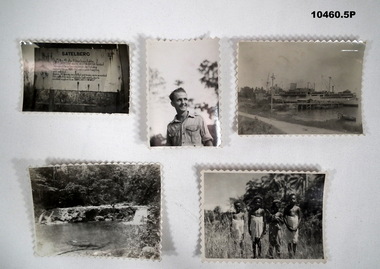
... army shirt. Edge trimmed with pinking shears. 3. Black and white photograph of a ship at dock. Small...army shirt. Edge trimmed with pinking shears. 3. Black and white photograph of a ship at dock. Small ...Photographs collected by Alva Marie Bennetts during a stopover in PNG on Alva Bennetts journey to Japan as part of BCOF. Part of the Bennetts Collection. See Catalogue No. 9726P for details of "Alva Marie Bennetts" No.VFX128835, service.1. Black and white photograph of a sign. Sign has text in black. Rust damage on sign. Edge of photograph trimmed with pinking sheers. 2. Black and white photograph of a man wearing an army shirt. Edge trimmed with pinking shears. 3. Black and white photograph of a ship at dock. Small boat anchored in foreground. Road passing diagonally across the bottom LH corner. Edge trimmed with pinking shears. 4. Black and white photograph of a swimming hole in a creek. Small waterfall on RH side. Edges trimmed with pinking shears. 5. Black and white photograph of five boys. Edges trimmed with pinking shears. 1. Handwritten in black ink on back; "Army" sign-board on the Satelburg Road. 2. Handwritten in black ink on back: "Keith (Finchhafen N.G.)". 3. Handwritten in black ink on back: "HMAS Kanimbla anchored at Finchhafen, New Guinea". 4. "Swimming Pool Buta Wang CRK, FINSCHHAFEN". 5. Handwritten in black ink on back: "Four native boys".alva bennetts, new guinea, bcof, photographs -
 Kiewa Valley Historical Society
Book - Country Women's Association of Victoria, Warworkers Woolcraft - Compiled by the CWA of Victoria, c1940's
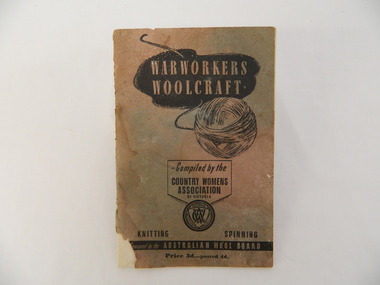
... shipped overseas. After the war, the ladies may have wanted to continue meeting and hence decided to form a C.W.A. branch. ww11. warworkers. tawonga. country women's association of victoria. woolcraft. australian wool board. c.w.a. Cover: Warworkers Woolcraft / Compiled by the CWA / Knitting Spinning / Sponsored by the Australian Wool Board Small brown book with black writing. 32 pages held by 2 rusty staples.The book gives patterns and instructions for making woolcraft (knitting & spinning) eg. socks & scarves, for the Airforce, Navy and Army with specific colours, thickness of wool and notes eg. no frills. ...Tawonga CWA branch commenced on 7th Feb. 1946. Prior to this the ladies would have been involved in supporting the war effort with knitted and spun items as described in this book. The branch often combined activities with the other branches in the Kiewa Valley. The C.W.A. aimed to improve health, welfare and education for women and children in the country. Getting together for the war effort would have succeeded in this aim perhaps encouraging the women to continue meeting under the banner of C.W.A.The Tawonga ladies would have been involved in assisting the war effort from home. Most of the ladies lived on remote farms so they may have got together, learnt together and felt happier while contributing to the war effort and supporting the men fighting overseas. Wool was available and easily made into useful items that could be shipped overseas. After the war, the ladies may have wanted to continue meeting and hence decided to form a C.W.A. branch.Small brown book with black writing. 32 pages held by 2 rusty staples.The book gives patterns and instructions for making woolcraft (knitting & spinning) eg. socks & scarves, for the Airforce, Navy and Army with specific colours, thickness of wool and notes eg. no frills. Price 3d. posted 4d. Sponsored by the Australian Wool BoardCover: Warworkers Woolcraft / Compiled by the CWA / Knitting Spinning / Sponsored by the Australian Wool Boardww11. warworkers. tawonga. country women's association of victoria. woolcraft. australian wool board. c.w.a. -
 Bendigo Historical Society Inc.
Document - The Reynolds Family Records Collection (Folder 4 of 4) Clement Reynolds and Mary Paxman, Abt 1920
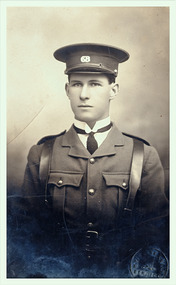
... He left Denmark in the year 1861, embarking at Hamburg in a small sailing Ship. bendigo sandhurst peter jorgensen eleanor hinde eleanor reynolds eleanor opie reynolds collection Clement gladston reynolds mary jane louise paxman The four folders contain family history documents and photos of the descendants of Eleanor Hinde. This item contains the following documents: Family history sheet of Clement Gladstone Reynolds and Mary Jane Louise Paxman. Included is a postcard of Clement in a uniform, he was the son of William John Reynolds and Anne Dorethea Jorgensen. He was a Brigadier General in the British Army ...Eleanor Hinde (1842-1902) was born in Lancashire England. In 1858, Eleanor married Richard Reynold in the Forest St Wesleyn Methodist Church in Sandhurst. They both gave their address as Sailors Gully Goldfields. They had seven children together. Richard was a skilled tradesman and after he died in 1872 from lung disease, Eleanor married Arculus Opie. Eleanor owned a property on the corner of Gladstone and Stanley Streets which later became an electrical substation. She sold poultry and eggs and preserves. One of Eleanor's sons, William John, married Anna (Annie) Jorgensen, and one of her daughters. Amelia, married Anna's brother Thomas Joynes Jorgensen. The Jorgensens founded and managed Jorgensen and Sons foundry and engineering works. Peter Jorgensen (1849-1914), was a mining contractor, he lived at, "Bro," Russell street, Quarry Hill. His firm was Jorgensen and Sons, mining contractors. He was a native of the Island of Alsen, Denmark. He left Denmark in the year 1861, embarking at Hamburg in a small sailing Ship. The four folders contain family history documents and photos of the descendants of Eleanor Hinde. This item contains the following documents: Family history sheet of Clement Gladstone Reynolds and Mary Jane Louise Paxman. Included is a postcard of Clement in a uniform, he was the son of William John Reynolds and Anne Dorethea Jorgensen. He was a Brigadier General in the British Army, 1st intake from Duntroon Australia.bendigo, sandhurst, peter jorgensen, eleanor hinde, eleanor reynolds, eleanor opie, reynolds collection, clement gladston reynolds, mary jane louise paxman -
 National Vietnam Veterans Museum (NVVM)
Memorabilia, A Collection of Newspaper Clippings
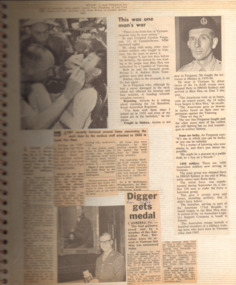
... Newspaper clippings Cpl Gordon Maxwell Ferguson Ferguson Gordon Maxwell 212779 Royal Australian Infantry Corps 1st Battalion The Royal Australian Regiment Major Peter John Naughton Capt Peter John Naughton Sgt Brian Wilson 215193 Royal Australian Army Dental Corps Australian Logistics Support Company Ships Army Staff (HMAS Sydney) Munday David Maxwell L/Cpl David Maxwell Munday 214922 Military Medal A Collection of Newspaper Clippings from three separate donors. The first is titled "this Was one Man's War" which is a story on Cpl Gordon Maxwell Ferguson describing part of his time serving. Also mention in the article is Pte L.A. Bakker. The second article is a photograph of a small ...Cpl Gordon Maxwell Ferguson served with the Royal Australian Infantry Corps and he served in Vietnam from June 1965 to August 1965 with 1st Battalion, The Royal Australian Regiment. Copt/Major Peter John Naughton served with the Royal Australian Army Dental Corps. He did two tours of Vietnam, the first from May 1965 to May 1966 with Australian Logistics Support Company and the second from March 1968 to April 1968 with Ships Army Staff (HMAS Sydney). L/Cpl David Maxwell Munday served with the Royal Australian Infantry Corps and served in Vietnam from May 1965 to July 1965 with the 1st Battalion, The Royal Australian Regiment when he was badly wounded. He was awarded the Military Medal.A Collection of Newspaper Clippings from three separate donors. The first is titled "this Was one Man's War" which is a story on Cpl Gordon Maxwell Ferguson describing part of his time serving. Also mention in the article is Pte L.A. Bakker. The second article is a photograph of a small Vietnamese boy being treated by Australian Army dentist Capt Peter Naughton with is assistant Sgt Brian Wilson. There is an article under the photograph starting with the words A RAAMC Officer now in Britain. The third article is titled 'Digger gets medal' is about the bravery of L/Cpl David Maxwell Munday who was awarded a Military Medal. These are on page seventeen of Personal Collections 5.newspaper clippings, cpl gordon maxwell ferguson, ferguson gordon maxwell, 212779, royal australian infantry corps, 1st battalion, the royal australian regiment, major peter john naughton, capt peter john naughton, sgt brian wilson, 215193, royal australian army dental corps, australian logistics support company, ships army staff (hmas sydney), munday david maxwell, l/cpl david maxwell munday, 214922, military medal -
 National Vietnam Veterans Museum (NVVM)
Book, Perham, Dave, Rolling through 32: pictures and memories from the Soldiers of 32 Small ship Squadron: Royal Australian Engineers
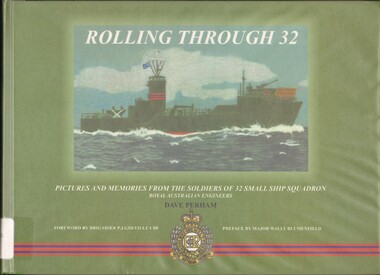
... Army. Royal Australian Engineers...Small Ship...Army. Royal Australian Engineers Small Ship Squadron 32nd - History It takes little skill or imagination to see where you would like to army to be and when. ...It takes little skill or imagination to see where you would like to army to be and when.It takes little skill or imagination to see where you would like to army to be and when.australia. army. royal australian engineers, small ship squadron, 32nd - history -
 Alfred Hospital Nurses League - Nursing History Collection
Book - Illustrated book, Grantlee Kieza, Sister Viv, 2024
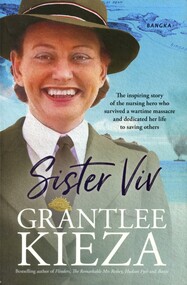
... Also on front cover is a coloured photograph of a woman in Australian Army Uniform (Siter Vivian Bullwinkle) In the bakground ther is a map of Banka Island and a ship. Title and author's name are printed on front cover and spine. Summary of the book is printed on the back cover, along with a small...Also on front cover is a coloured photograph of a woman in Australian Army Uniform (Siter Vivian Bullwinkle) In the bakground ther is a map of Banka Island and a ship. Title and author's name are printed on front cover and spine. Summary of the book is printed on the back cover, along with a small ...A biography about Vivivien Bullwinkel : the astonishing story of the courage, sacrifice and love of a young army nurse who became an Australian iconIllustrated book with light blue cover and black and white print. Also on front cover is a coloured photograph of a woman in Australian Army Uniform (Siter Vivian Bullwinkle) In the bakground ther is a map of Banka Island and a ship. Title and author's name are printed on front cover and spine. Summary of the book is printed on the back cover, along with a small photoraph and information about the author.non-fictionA biography about Vivivien Bullwinkel : the astonishing story of the courage, sacrifice and love of a young army nurse who became an Australian iconvivian bullwinkel, world war 1939-1945, prisoners of war -
 Returned Nurses RSL Sub-branch
Newspaper - Photocopy of a newspaper clipping, The Australasian, The pin, March 17, 1900
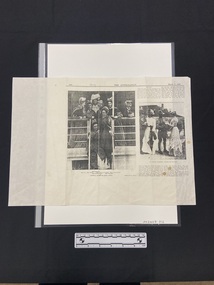
... Army Nurses Victorian Nurses - South Africa Pins - history 'NC17' [Handwritten in blue ink on the top of the page] Photocopy of a newspaper article. The article is in the top right corner and there is some white space on the left hand side and below. The article consists of a large photo of a group of women and a Captain boarding a ship. To the right of the image is a smaller ...The large photo is of seven Victorian nurses bound for South Africa (Sister Ivy, Sister Langlands, Sister Walker, Sister Rawson, Sister Bernhard Smith, Sister Dorothy Smith, Sister Thompson). The article discusses the history of the pin, introduced in Britain in the fifteenth century as personal fasteners used in the dressing process. It explains the materials used for 'pins' and the connection to the phrase 'pin-money'. The second photo was taken at Victoria Barracks, it shows a well-dressed lady pinning on favours to a soldier in uniform, beside them stands another lady arm-in-arm with another soldier.Photocopy of a newspaper article. The article is in the top right corner and there is some white space on the left hand side and below. The article consists of a large photo of a group of women and a Captain boarding a ship. To the right of the image is a smaller photo of two men and two women at Victoria Barracks, above and below this picture are two small columns of text.'NC17' [Handwritten in blue ink on the top of the page]australian army nurses, victorian nurses - south africa, pins - history -
 Returned Nurses RSL Sub-branch
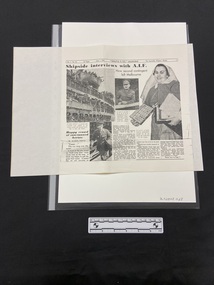
Newspaper - Photocopy of a newspaper clipping, The Australian Women's Weekly, Shipside interviews with A.I.F, June 1, 1940
... ship and the great task of feeding so many at sea. Australian Army Nurses WWII WW2 Australian troops Troop Ships Black and white photocopy of a newspaper page with header across the top with a line border followed by the title in bold print. On the left side of the page is a photo of many soldiers waving goodbye from a ship leaving Australia, below is one column of text next to a smaller ...An article from the Australian Women's Weekly about the troops and nurses leaving Melbourne to serve overseas, how they settled in to their living quarters on the ship and the great task of feeding so many at sea.Black and white photocopy of a newspaper page with header across the top with a line border followed by the title in bold print. On the left side of the page is a photo of many soldiers waving goodbye from a ship leaving Australia, below is one column of text next to a smaller image of a soldier walking with his head down. The right side of the page shows a smiling nurse holding multiple board games, with a smaller inset image in the middle of Captain Gorman. Below these images are three more columns of text.australian army nurses, wwii, ww2, australian troops, troop ships -
 Returned Nurses RSL Sub-branch
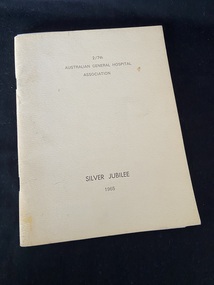
Booklet, 2/7th Australian General Hospital Assiciation, Silver Jubilee : 1965, 1965
... Contains a unit history (including anecdotes, but very precise about the order of events as the unit assembled), extracts from what appears to be the official unit diary (1/7/1940 - 24/12/1945), statistics for the 2/7th (May 1941- August 1945), List of hospitals on active service (including casualty clearing stations, camp hospitals 46 and 66, field ambulances and hospital ships).The booklet also contains a list of members of the 2/7th AGH Association, notes regarding AANS and AAMWS, and a list of appointmenta available in the AAMC (medical offices, pharmacists, etc.). 2/7th Australian General Hospital World War II medical care WW2 WWII 2/7th 'Foreword / The Australian Army Nursing Service, 1939-45. / Compiled by VFX 47777 / This small volume represents a brief account of the work done by its members, at home, and abroad.' ...Contains a unit history (including anecdotes, but very precise about the order of events as the unit assembled), extracts from what appears to be the official unit diary (1/7/1940 - 24/12/1945), statistics for the 2/7th (May 1941- August 1945), List of hospitals on active service (including casualty clearing stations, camp hospitals 46 and 66, field ambulances and hospital ships).The booklet also contains a list of members of the 2/7th AGH Association, notes regarding AANS and AAMWS, and a list of appointmenta available in the AAMC (medical offices, pharmacists, etc.).Cream coloured booklet with two staples. The title and author are typed in black ink on the cover.non-fiction'B88' [Handwritten in pencil on the first page] 2/7th australian general hospital, world war ii medical care, ww2, wwii, 2/7th
