
Showing 5 items matching "artificial feeding"
-
 Alfred Hospital Nurses League - Nursing History Collection
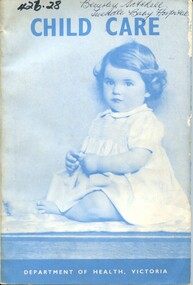
Book - Illustrated Book, Department of Health, Victoria, Child care - a manual for the guidance of all caring for infants and young children from 0-6 years, 1961
... ...artificial feeding...One of a series of child-rearing piblications provided to parents in Victoria during the 1960's Insight into infant and child care practices in the early 1960's infant welfare breastfeeding artificial feeding Infectious diseases children's ailments accident prevention Historic manual of child care, comprising 35 sections covering topics such as infant welfare, breastfrrding, atificial feeding,weaning and childhood ailments Handwritten on front cover at top left is the previous catalogue number [black ink] at top right 'Beverley Satchell/ Tweedle Baby Hospital' [blue ink]. ...Historic manual of child care, comprising 35 sections covering topics such as infant welfare, breastfrrding, atificial feeding,weaning and childhood ailmentsIllustrated booklet printed in black on off white paper. Cover is printed in blue on off white. Front cover features a photograph of a seated toddler wearing a dress. Title is printed in darker blue above this photograph, and publisher printed in white on a darker blue rectangle at base.non-fictionHistoric manual of child care, comprising 35 sections covering topics such as infant welfare, breastfrrding, atificial feeding,weaning and childhood ailmentsinfant welfare, breastfeeding, artificial feeding, infectious diseases, children's ailments, accident prevention -
 Camberwell Girls Grammar School
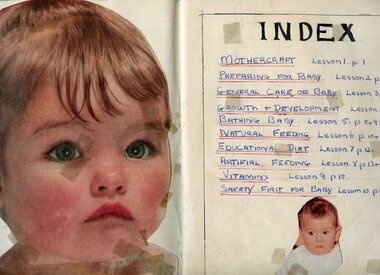
Student exercise book, Mothercraft
... Student exercise book with lessons on Mothercraft includes 10 lessons handwritten by donor Barbara Richmond (CGGS 1950-1961) on topics including: Mothercraft; Preparing for baby; General care of baby; Growth & Development; Bathing Baby; Natural feeding; Educational diet; Artificial feeding; Vitamins; Safety first for baby....GG School" Student exercise book with lessons on Mothercraft includes 10 lessons handwritten by donor Barbara Richmond (CGGS 1950-1961) on topics including: Mothercraft; Preparing for baby; General care of baby; Growth & Development; Bathing Baby; Natural feeding; Educational diet; Artificial feeding; Vitamins; Safety first for baby. ...Barbara Richmond was Head Prefect in 1961 and was President of the Old Grammarians 1967-1997 [there was a period of four years when she was a committee member only]Student exercise book with lessons on Mothercraft includes 10 lessons handwritten by donor Barbara Richmond (CGGS 1950-1961) on topics including: Mothercraft; Preparing for baby; General care of baby; Growth & Development; Bathing Baby; Natural feeding; Educational diet; Artificial feeding; Vitamins; Safety first for baby.Front cover; handwritten in blue pen: "Barbara Richmond VC, Mothercraft, Camberwell C. of E. GG School" -
 Northern District School of Nursing. Managed by Bendigo Historical Society Inc.
Book - Northern District School of Nursing Graduates Association - Procedure Book for a Student Nurse, 1952 to 1956
... The document contains detailed tables listing required nursing procedures, including: Admission and discharge of patients Preparation and administration of anaesthetics. Artificial feeding methods Bandaging, bathing, and bedmaking Care of bedlinen, patient clothing, and valuables Catheterization and care of catheters Charting vital signs and fluid balanceCleaning and sterilizing equipment Counter irritants, enemata, feeding, hygiene, infant care Inhalations, injections, specimen collection, sterilization Special procedures, tray preparation, urine testing, and more Emphasizes the importance of accurate record-keeping, report writing, and communication between staff. ...The document contains detailed tables listing required nursing procedures, including: Admission and discharge of patients Preparation and administration of anaesthetics. Artificial feeding methods Bandaging, bathing, and bedmaking Care of bedlinen, patient clothing, and valuables Catheterization and care of catheters Charting vital signs and fluid balanceCleaning and sterilizing equipment Counter irritants, enemata, feeding, hygiene, infant care Inhalations, injections, specimen collection, sterilization Special procedures, tray preparation, urine testing, and more Emphasizes the importance of accurate record-keeping, report writing, and communication between staff. ...The Northern District School of Nursing in Victoria, Australia Graduates Association: History of the School Managed by a committee including hospital administrators, medical professionals, and nursing leaders from several regional hospitals. Associated with major hospitals in the Northern District, including Bendigo Base, Mildura Base, Castlemaine, Echuca, Swan Hill, St. Arnaud, and Kyneton District Hospitals. Provide high-quality theoretical and practical nursing training. Raise the standard of nursing education in the region. Maintain the highest principles of nursing practice. Applicants must be at least 17 years old and hold a Proficiency Certificate or higher educational qualification. Application involves submitting forms, certificates, an interview, an aptitude test, and a medical examination. A three-month probationary period follows initial acceptance. Preliminary Training School: Four-week introductory course covering basic nursing, anatomy, hygiene, and practical skills. Practical experience in various hospital departments, guided by senior staff. Study Block Plan: Includes several blocks of theoretical and practical instruction throughout the three-year program. Regular school exams and two state exams (First Professional and Final State) are required for progression and graduation. Nurses work a 40-hour week with at least one or two days off per week and three weeks of annual leave. Accommodation is provided in comfortable hostels with good facilities. Uniforms are supplied free; nurses provide their own shoes and stockings. Salaries and allowances are regulated, with deductions for board and free medical care. Additional Information Post-Graduate Opportunities. Senior positions require further experience and additional certificates (e.g., Midwifery, Infant Welfare).Diploma courses available in administration, teaching, and specialized nursing fields. Bursaries are available for advanced study.Career Prospects: Graduates can pursue roles in administration, teaching, ward and departmental leadership, district and visiting nursing, industrial and school nursing, and more. Opportunities existed both within hospitals and in community or specialized settings.FAQs and Practical Details. Minimal training costs (mainly exam fees and personal items).Living out allowances and travel expenses are covered. Four training intakes per year; waiting periods are short if qualifications are met.Northern District School of Nursing Graduates Association - Procedure (Report) Book for a Student Nurse 1952 to 1956, that belonged to Ann Rosemary Haigh Archibald 14 pages, also Joan Stot and Jeanette Mary Jobe This item contains the following documents: 3793.2a Procedure Book for a Student Nurse 1952 to 1956, that belonged to Ann Rosemary Haigh Archibald 3793.2b Procedure Book for a Student Nurse 1952 to 1956, that belonged to Joan Stot Front Cover 3793.2c Procedure Book for a Student Nurse 1952 to 1956, that belonged to Jeanette Mary Jobe Front Cover This document is a procedural guide for student nurses, outlining the requirements for recording clinical procedures, charting, and examination preparation. The Procedure Book is filled out by the Sister Tutor in the Training School and by Sisters in wards or departments. Entries in the ward columns are initialed by the supervising Sister.Comments on performance can be added in the Remarks column, which must be initialed and dated. Each student nurse is responsible for carrying their Procedure Book when moving between wards or hospitals. Procedure Books are subject to inspection by Matron, Nursing Supervisor, or Sister Tutor and must be brought to lectures and demonstrations. Marking Code for Procedures D: DemonstratedP: Practised in ClassroomS: Practised under supervision in the wards(Blank): Procedure Books must be presented during the Practical and Oral Sections of the First Professional and State Final Examinations if requested by Examiners. The document contains detailed tables listing required nursing procedures, including: Admission and discharge of patients Preparation and administration of anaesthetics. Artificial feeding methods Bandaging, bathing, and bedmaking Care of bedlinen, patient clothing, and valuables Catheterization and care of catheters Charting vital signs and fluid balanceCleaning and sterilizing equipment Counter irritants, enemata, feeding, hygiene, infant care Inhalations, injections, specimen collection, sterilization Special procedures, tray preparation, urine testing, and more Emphasizes the importance of accurate record-keeping, report writing, and communication between staff. The document includes an index for quick reference to procedures and topics.This guide ensures that student nurses are systematically trained, supervised, and assessed on a wide range of essential clinical skills, with clear documentation and accountability throughout their training.nurse training, lister house, procedure report book, ann archibald, joan stot, jeanette jobe -
 National Wool Museum
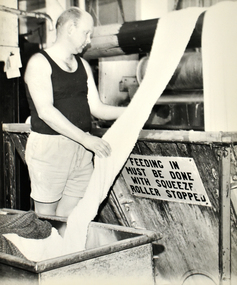
Photograph - Returned Sailors and Soldiers Mill, Norm Holroyd, 1960's - 1970's
... artificial fibres as mid-century market demands shifted. R. S. & S Mill Returned Sailors and Soldiers Mill Newtown Geelong World War I Soldiers Veterans Co-operative Textile Industry Woollen Mills Wool Worsted Cloth Tweed Retsol Monarch Travel Rugs Machinery Factory Working Life Norm Holroyd Photo Album Photography Design Fabric front: FEEDING IN / MUST BE DONE / WITH SQUEEZE / ROLLER STOPPED back: [handwritten] 37 Black and white photograph attached to cardboard backing with sticky tape. ...One of thirty eight photographs from a photo album featuring images of the Returned Sailors and Soldiers Woollen Mill in Newtown, Geelong. The images were taken between the 1960's-1970's by Norm Holroyd who worked at the mills. They were developed in his own private dark room and kept at his home for private viewing. The Returned Sailors and Soldiers Woollen Mill operated as a self-sufficient co-operative, funded and run by World War I veterans using their War Gratuity Bonds. The facility functioned as a complete raw-to-finished assembly line where raw fleece was brought on-site to be scoured, carded, dyed, spun into yarn and woven. It specialised in heavy worsted cloths, high-quality tweed, and its signature "Retsol" and "Monarch" pure-wool travelling rugs, later adapting its machinery to blend natural wool with artificial fibres as mid-century market demands shifted.Black and white photograph attached to cardboard backing with sticky tape. Image shows a man feeding fabric into a machine. Backing card has four holes in left side.front: FEEDING IN / MUST BE DONE / WITH SQUEEZE / ROLLER STOPPED back: [handwritten] 37r. s. & s mill, returned sailors and soldiers mill, newtown, geelong, world war i, soldiers, veterans, co-operative, textile industry, woollen mills, wool, worsted cloth, tweed, retsol, monarch, travel rugs, machinery, factory, working life, norm holroyd, photo album, photography, design, fabric -
 Wodonga & District Historical Society Inc
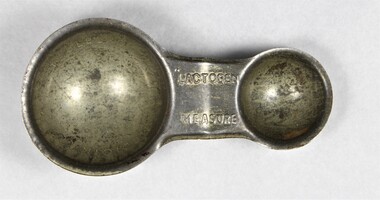
Domestic object - Haeusler Collection Lactogen baby formula measuring spoon c.1920s
... feed her son Alfred who was born in 1922. Ilma died in childbirth in 1928. This measuring spoon is one of several objects in the Haeusler Collection concerning early childhood that provide insight into family and home life in early twentieth century Wodonga. The first fully artificial...feed her son Alfred who was born in 1922. Ilma died in childbirth in 1928. This measuring spoon is one of several objects in the Haeusler Collection concerning early childhood that provide insight into family and home life in early twentieth century Wodonga. The first fully artificial ...The Wodonga Historical Society Haeusler Collection provides invaluable insight into life in late nineteenth and early twentieth century north east Victoria. The collection comprises manuscripts, personal artefacts used by the Haeusler family on their farm in Wodonga, and a set of glass negatives which offer a unique visual snapshot of the domestic and social lives of the Haeusler family and local Wodonga community. The Haeusler family migrated from Prussia (Germany) to South Australia in the 1840s and 1850s, before purchasing 100 acres of Crown Land made available under the Victorian Lands Act 1862 (also known as ‘Duffy’s Land Act’) in 1866 in what is now Wodonga West. The Haeusler family were one of several German families to migrate from South Australia to Wodonga in the 1860s. This item is a Nestlé Lactogen baby formula measuring scoop used in the preparation of formula for bottle feeding. It was used by Ilma Margaret Ernestine Haeusler (née Tasker, b.1900 in Tallangatta) to feed her son Alfred who was born in 1922. Ilma died in childbirth in 1928. This measuring spoon is one of several objects in the Haeusler Collection concerning early childhood that provide insight into family and home life in early twentieth century Wodonga. The first fully artificial infant milk formula, Farine Lactee, was developed in the 1860s. Companies continued to attempt to develop synthetic formulas which nutritionally replicated human breast milk in the decades that followed. Nestlé began producing Lactogen in 1921. It was marketed to women as a nutritionally superior substitute for breast milk, and as a nutritional supplement for breast feeding mothers. From the 1920s, when the Haeusler Collection measure was produced and used, Nestlé employed nurses in major Australian cities to promote Lactogen and its supposed health benefits to new mothers. They also used print advertisements to offer free product samples and instruction booklets advising on pregnancy and infant care for the same purpose. Nestlé was formed in 1905 by the merger of the Anglo-Swiss Milk Company, established in 1866 by brothers George and Charles Page, and Farine Lactée Henri Nestlé, founded in 1866 by Henri Nestlé. The company grew significantly during the First World War and again following the Second World War, expanding its offerings beyond its early condensed milk and infant formula products. In the twenty-first century, Nestlé has faced criticism and boycotts over its decision to market baby formula as an alternative to breastfeeding in developing countries. The adoption of bottle feeding in countries without access to clean water and sanitation infrastructure has contributed to high infant mortality rates. This item has well documented provenance and a known owner. It forms part of a significant and representative historical collection which reflects the local history of Wodonga. It contributes to our understanding of domestic and family life in early twentieth century Wodonga, as well as providing interpretative capacity for themes including local history, social history, and women’s history.Silver toned alloy measuring spoon for Lactogen infant formula, produced by food and drink manufacturing company Nestlé. Embossed with the Lactogen brand name, and teaspoon and tablespoon measurements. "LACTOGEN MEASURE" on central handle/"TABLESPOON" on large inner scoop/"TEASPOON" on small inner scoopchildren, babies, household, domestic, motherhood, family, kitchen
