
Showing 17 items matching "artillery detachment"
-
 Flagstaff Hill Maritime Museum and Village
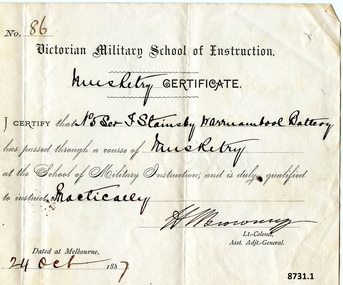
Certificate - Musketry and Sergeant Qualifications, Victorian Military School of Instruction, 1887 - 1894
... ...Artillery detachment...These two certificates were awarded to Sergeant Thomas Stainsby who was a long-time member of the Warrnambool Garrison Artillery detachment during the 1880's and into the 1890's. ...These two certificates were awarded to Sergeant Thomas Stainsby who was a long-time member of the Warrnambool Garrison Artillery detachment during the 1880's and into the 1890's. ...The Crimean War began in 1854 and many people in colonial Australia were afraid of a Russian attack. In 1854 the Volunteer Act was passed to provide some military defence. In 1858 the Warrnambool Volunteer Rifle Corps was established, disbanded in 1863, then a new Warrnambool Detachment was formed in September 1866. In 1870 Australia became responsible for its own naval and military defence. The Permanent Victorian Artillery force was established. It was disbanded in 1880 then re-formed in 1882 as the Victorian Garrison Artillery Corps. Legislation was passed in 1884 that replaced the volunteers’ corps with a partly paid, permanent Militia Defence Force. Volunteer forces were established to strengthen the British Imperial troops posted here. A battery of artillery was raised in Victoria as well as in other Australian states. The Batteries manning the coastal forts of Victoria were termed Garrison Artillery Companies. When the Army was federated in 1901 there were eight Militia Companies in Victoria. Warrnambool and Port Fairy together were known as 8 Coy AGA (Australian Garrison Artillery). Changes to formation and name continued into the 20th century. In 1895 the Geelong, Warrnambool, Port Fairy and Portland Batteries became part of the Western District Garrison Artillery. Many of the volunteers who served in the Artillery were from rural areas. They belonged to rifle clubs and were experienced horsemen as well. Australia's defence at this time relied on these mounted troops, or Light Horse men. In 1899 the Victorian Garrison Artillery Corps amalgamated with the New South Wales and Queensland Permanent Artillery to become the Victorian Regiment of the Royal Australian Artillery (RAA). Then prior to Federation, the RAA and the Permanent Artillery of South Australia, Western Australia and Tasmania all combined, becoming the Royal Australian Artillery Regiment with two Batteries of Field Artillery; Battery A from Sydney and Battery B from Melbourne. These two certificates were awarded to Sergeant Thomas Stainsby who was a long-time member of the Warrnambool Garrison Artillery detachment during the 1880's and into the 1890's. He is mentioned in several newspaper reports of the era, as being an integral member of the local artillery detachments (as Sergeant-in-Charge, Gun Layer or Orderly) participating in local and statewide "Battery Competitions" that were very popular at this time. In one Annual Battery competition held in 1891 at Port Fairy, a target was moored in the bay and each detachment fired four rounds of "plugged shell" at it (at an estimated distance of 1900 yards). The local newspaper (the Warrnambool Standard) reported "the best work was reserved for the last detachment ... in charge of that old warrior Sergeant Stainsby ... who won the first prize with their four shots." Thomas Stainsby was an important member of the Warrnambool Artillery Battery in the years when it was competing for the "Sir William Clarke Trophy" The Sir William Clarke Trophy (a silver trophy) was given as a prize in 1885 to Victorian Militia Garrison Battery competition winners, for artillery firing target accuracy. A Battery needed to win the competition three times to keep the trophy and the Warrnambool Battery won it in 1887, 1889 and 1892. When the Warrnambool Militia Garrison Artillery had won the Trophy, for the third time, they became Absolute Possessors of the prize. Thomas Stainsby was born on October 25th, 1846, in Melbourne. He married Ellen Priddle in Geelong in 1869, and they moved to Camperdown and then Warrnambool in the 1870's. They had ten children. He was a bootmaker and had a shop in Fairy Street. Thomas died on September 26th, 1914, aged 67. His Obituary in the local paper said he "was very keen on cycling and pedestrianism ... and was actively associated with the old volunteer militia and held the position of Sergeant in the old Battery." Thomas Stainsby features in several photographs of the Warrnambool Battery held in the Flagstaff Hill collection. The Warrnambool Garrison has been added to the Victorian Heritage Register H1250 “for its intact battery and guns, a strong reminder of Victoria’s wealth and determination to protect itself from the perceived threat of invasion in the 1880’s.” The City of Warrnambool is one of several custodians of a collection of artillery pieces of heritage significance at a state, national and international level. These pieces are directly related to the defence of south-west Victoria in the 19th century. The care and preservation come under the Heritage Act 1995. The certificates belonging to Sergeant Thomas Stainsby are a significant example of the work and dedication of a Warrnambool Garrison volunteer.Two paper certificates awarded to Sergeant T. Stainsby. Certificate 8731 is from the "Victorian Military School of Instruction" and was awarded to Sergeant Stainsby of the Warrnambool Battery on 24th October 1887, for passing a course of "Musketry" which enabled him to become a qualified "practical" instructor. The certificate has printed and handwritten sections. Certificate 8732 is from the "Victorian Military Forces", dated 1st July 1894 and certifies that Sergeant Stainsby of the Warrnambool Battery Garrison Artillery passed through a course of Instruction and has qualified for the rank of "Sergeant in the Garrison Artillery, Victoria". The certificate has printed and handwritten sections, is yellowed with age and has some rips and tears along each edge and along its fold lines.Certificate 8731.1 - "No. 86" /Victorian Military School of Instruction/ Musketry CERTIFICATE. / I CERTIFY that No 5 Ser T Stainsby Warrnambool Battery / has passed through a course of Musketry /at the School of Military Instruction, and is duly qualified/ to instruct Practically/ [illegible signature]/Lt-Colonel/ Asst. Adjt.-General / Dated at Melbourne/ 24 Oct 1887." Certificate 8731.2 - "No 480 / Victorian Military Forces - /Re-issue / 2nd Class certificate /I certify that No 1 sergeant/ T Stainsby, Warrnambool Battery G.A. / has passed through a course of instruction / and is qualified for the rank of / Sergeant in the Garrison Artillery, Victoria/ Dated at Melbourne / 1st July 1894 [illegible signature] Lieut-Colonel /Comma? Artillery."flagstaff hill maritime museum and village, warrnambool, great ocean road, shipwreck coast, victorian garrison artillery, warrnambool battery, volunteer militia, garrison artillery, artillery detachment, battery competitions, warrnambool garrison volunteers, sergeant stainsby, thomas stainsby, sir w. clarke trophy, sir w. j. clarke trophy -
 Flagstaff Hill Maritime Museum and Village
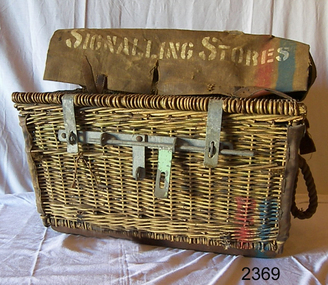
Equipment - Wicker Basket
... artillery, or deployed by flare guns or hand held percussive tubes. Signalling flares have been in use by all branches of the military services since the 1920s also by the maritime services to signal other ships or for distress purposes. The earliest recorded use of gunpowder for signalling purposes was the 'signal bomb' used by the Chinese Song Dynasty as the Mongol-led Yuan Dynasty besieged Yangzhou in 1276. These soft-shelled bombs, timed to explode in mid-air, were used to send messages to a detachment...artillery, or deployed by flare guns or hand held percussive tubes. Signalling flares have been in use by all branches of the military services since the 1920s also by the maritime services to signal other ships or for distress purposes. The earliest recorded use of gunpowder for signalling purposes was the 'signal bomb' used by the Chinese Song Dynasty as the Mongol-led Yuan Dynasty besieged Yangzhou in 1276. These soft-shelled bombs, timed to explode in mid-air, were used to send messages to a detachment ...A flare, also sometimes called a fusee, is a type of pyrotechnic that produces a bright light or intense heat without an explosion. Flares are used for distress signalling, illumination, communication or defensive countermeasures in civilian and military applications. Flares may be ground pyrotechnics, projectile pyrotechnics, or parachute-suspended to provide maximum illumination time over a large area. Projectile pyrotechnics may be dropped from aircraft, fired from rocket or artillery, or deployed by flare guns or hand held percussive tubes. Signalling flares have been in use by all branches of the military services since the 1920s also by the maritime services to signal other ships or for distress purposes. The earliest recorded use of gunpowder for signalling purposes was the 'signal bomb' used by the Chinese Song Dynasty as the Mongol-led Yuan Dynasty besieged Yangzhou in 1276. These soft-shelled bombs, timed to explode in mid-air, were used to send messages to a detachment of troops far in the distance. Another mention of the signal bomb appears in a text dating from 1293 requesting their collection from those still stored in Zhejiang. A signal gun appears in Korea by 1600. The (Wu I Thu Phu Thung Chih or Illustrated Military Encyclopedia) written in 1791 depicts a signal gun in an illustration. The item was used to carry and store flares for signalling use as the inscription on the canvas cover suggests. Given the method of storing flares is in a wicker basket that is non conducting of an electrical charge that may accidentally set of explosive materials. The writer assumes the basket was used from the early 20th century and most likely by maritime or military services to store it's flares.Basket cane square with metal locks & rope handles each end. Canvas reinforced on vertical sides with a canvas cover on top. Canvas cover has leather straps. Stencilled on canvas in white paint "SIGNALLING STORES" flagstaff hill, warrnambool, shipwrecked-coast, flagstaff-hill, flagstaff-hill-maritime-museum, maritime-museum, shipwreck-coast, flagstaff-hill-maritime-village, basket, cane basket, signalling stores -
 Federation University Historical Collection
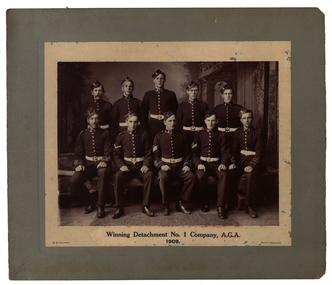
Photograph - black and white, G.C. Wilmot, Winning Detachment No. 1 Company, Geelong Australian Garrison Artillery, 1909, 1909
... Winning Detachment No. 1 Company, Geelong Australian Garrison Artillery, 1909...They are members of the Geelong Australian Garrison Artillery. Winning Detachment No. 1 Company, Geelong Australian Garrison Artillery, 1909 Photograph - black and white G.C. ...They have cannons on their epilets so they are artillery.Mounted black and white photo of 10 men in uniform. They are members of the Geelong Australian Garrison Artillery. Verso: Geelong, May 25th 1909 Capt. Spud Sir Please accept this photo from men who regard it an honour to serve under you. I remain Yours obediently Sergt J.C. Miles armed forces, a.g.a., volunteer forces, military, g.c. wilmot, miles, j.c. miles, captain spud, artillery, geelong australian garrison artillery, australian garrison artillery -
 Flagstaff Hill Maritime Museum and Village
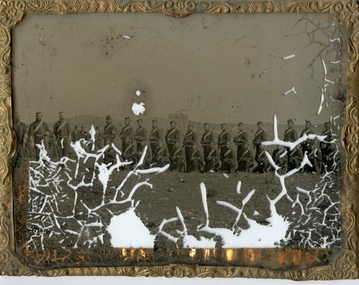
Photograph - Glass plate, circa 1866
... Detachment was formed in September 1866. Legislation was passed in 1884 that replaced the volunteers’ corps with a partly paid, permanent Militia Defence Force. The batteries manning the coastal forts of Victoria were termed Garrison Artillery Companies. ...Detachment was formed in September 1866. Legislation was passed in 1884 that replaced the volunteers’ corps with a partly paid, permanent Militia Defence Force. The batteries manning the coastal forts of Victoria were termed Garrison Artillery Companies. ...This glass plate photograph shows good detail of members of the Warrnambool Garrison posing for their photograph in front of a young township. There are other well-dressed citizens behind them. The three men with frogging on their sleeves were commanders were likely to be commanders. The men are facing north with Cannon Hill and the fortification area in the background. It dates from the 1860s. The firearms held appear to be 1853 pattern Lee Enfield muskets used by the British army in Crimea at this time and in Australia, rather than the later Martini Henry cartridge rifles. The uniforms match other photos of the Warrnambool Garrison Militia and Band in our Collection, taken up until the 1880s. The three storey building in the photograph is likely to be the Manifold & Bostock flour mill, built in 1854 near the ‘cutting’ in Merri Street, which was one of the main streets at the time; if one faced the building’s front from a vantage point and looked south to south-east, the hills around Flagstaff Hill and Cannon Hill would be behind that mill, and the Harbour behind the hills. This is the area of the Fortifications. The glass plate method of photography was widely used during the mid-19th to early-20th century. The donor and maker of the photograph are unknown. Around this time the citizens of Victoria were prospering from the gold rush but felt isolated and uneasy about their security in the colony. In 1854 the Volunteer Act was passed to provide some military defence. In 1858 the Warrnambool Volunteer Rifle Corps was established, disbanded in 1863, then a new Warrnambool Detachment was formed in September 1866. Legislation was passed in 1884 that replaced the volunteers’ corps with a partly paid, permanent Militia Defence Force. The batteries manning the coastal forts of Victoria were termed Garrison Artillery Companies. When the Army was federated in 1901 there were eight Militia Companies in Victoria. Warrnambool and Port Fairy together were known as 8 Coy AGA (Australian Garrison Artillery). Changes to formation and name continued into the 20th century.This photograph is a record of the very early local defence force, circa 1866. The photograph signifies the connection of the colony in Victoria to the growing need for security due to the unrest in Europe at that time. The photograph is also locally significant to the industry of the young township of Warrnambool, showing what is likely to be one of the first flour mills in the town. The photograph is also the only example of the early methods of glass plate photography in our collection. Photograph, rectangular glass plate, positive sepia image. Photograph has brass framed edges that fold over to the back, with mitred corners. The front edges are pressed with a decorative floral pattern. The photograph shows a group of thirty military men, standing or kneeling, in dark uniforms with pillbox forage caps, round-collared jackets with light buttons, light sashes worn from top left shoulder to bottom right side of waist belt, and long, straight-legged trousers. Three of these men have light braid around the buttons on the front of their jackets, light frogging on their sleeve cuffs and stripes on the outside seams of their trousers. The other twenty-seven men have plain uniforms and are holding firearms in their right hands, steadied with their left hands. Other figures are standing behind this group of soldiers, including three or four men wearing top hats, jackets and ties. In the background is a row of buildings. The central building is three stories high. Bare hills are in the far background. The foreground is uneven ground with patches of short grass. Photographer looking towards the south east and Cannon Hill, with the Warrnambool Garrison facing north, ca.1860s.flagstaff hill, warrnambool, shipwrecked coast, flagstaff hill maritime museum, maritime museum, shipwreck coast, flagstaff hill maritime village, great ocean road, glass plate, photography 19th century, colonial forces, military defence, volunteer act 1854, volunteer rifle, garrison artillery, volunteer corps, militia, militia garrison band, pillbox forage caps, helpmann, manifold and bostock, 1853 lee enfield musket, tintype, warrnambool garrison, 1860s, cannon hill, manifold & bostock, flour mill, 3-storey building -
 Bendigo Military Museum
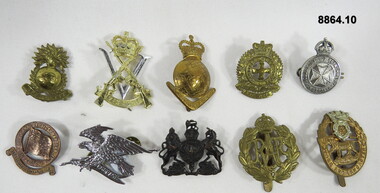
Badge - VARIOUS MILITARY BADGES, Unknown
... Artillery (Militia) collar. 2. Royal Victorian Regiment Hat. 3. Royal Australian Survey Corps hat. 4. Volunteer Cadet Corps Victoria hat. 5. Australian Voluntary Aid Detachment...Artillery (Militia) collar. 2. Royal Victorian Regiment Hat. 3. Royal Australian Survey Corps hat. 4. Volunteer Cadet Corps Victoria hat. 5. Australian Voluntary Aid Detachment ...Military badges either gold, silver or brass colour with or without a backing mounting plate, pins. Sizes vary. 1. Australian Field Artillery (Militia) collar. 2. Royal Victorian Regiment Hat. 3. Royal Australian Survey Corps hat. 4. Volunteer Cadet Corps Victoria hat. 5. Australian Voluntary Aid Detachment. 6. Merchant Service War Australia, For services rendered at sea, 7. 2nd Cavalry Regiment hat. 8. WW1 General Service Corps Hat. 9. Royal Air Force hat. 10. York and Lancaster Regimental hat. passchendaele barracks trust, pbt211to220, badges -
 Monbulk RSL Sub Branch
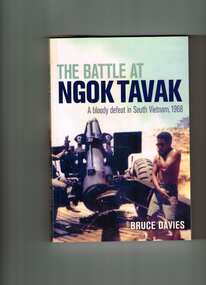
Book, Bruce Davies, The battle at Ngok Tavak: A bloody defeat in South Vietnam 1968, 2008
... Vietnam - History 1945-1975 Vietnam - Special Forces In 1968, in the western jungle of Vietnam near Laos, a Special Forces Company, under the command of an Australian Army Captain, supported by a Marine artillery detachment, occupied an old French fort, on a hill known as Ngok Tavak. ...In 1968, in the western jungle of Vietnam near Laos, a Special Forces Company, under the command of an Australian Army Captain, supported by a Marine artillery detachment, occupied an old French fort, on a hill known as Ngok Tavak. The circumstances of the battle that ensued, and the subsequent retreat from Ngok Tavak, left in their wake issues that cried out for resolution for decades after the event. A number of American bodies were left where they had fallen during the battle, and another American, the nephew of Katharine Hepburn, went missing. After speaking extensively to the battle survivors and loved ones of the American warriors, and searching through accounts from official reports that included Vietnamese documents, eyewitness statements and war diaries, Bruce Davies has pieced together the evidence that will bring resolution to the questions that still haunt many of those connected to the battle. A story that needed to be told for the veterans who survived and for those who did not, for their families and for the sake of history. Lieutenant Colonel Brian Cooper (Retd), Australian Infantry, South Vietnam 1971-72Index, bib, ill, p.241.non-fictionIn 1968, in the western jungle of Vietnam near Laos, a Special Forces Company, under the command of an Australian Army Captain, supported by a Marine artillery detachment, occupied an old French fort, on a hill known as Ngok Tavak. The circumstances of the battle that ensued, and the subsequent retreat from Ngok Tavak, left in their wake issues that cried out for resolution for decades after the event. A number of American bodies were left where they had fallen during the battle, and another American, the nephew of Katharine Hepburn, went missing. After speaking extensively to the battle survivors and loved ones of the American warriors, and searching through accounts from official reports that included Vietnamese documents, eyewitness statements and war diaries, Bruce Davies has pieced together the evidence that will bring resolution to the questions that still haunt many of those connected to the battle. A story that needed to be told for the veterans who survived and for those who did not, for their families and for the sake of history. Lieutenant Colonel Brian Cooper (Retd), Australian Infantry, South Vietnam 1971-72vietnam - history 1945-1975, vietnam - special forces -
 Victorian Interpretive Projects Inc.
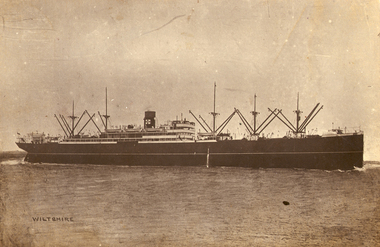
Photograph - Digital, Troopship Wiltshire, 1918, c1918
... detachment of the Australian and New Zealand Imperial Expeditionary Forces. It completed nine transport voyages from Australia commencing 18 October 1914 until final voyage from Sydney 9th November 1918. During that time The Wiltshire carried the 4th Field Artillery...detachment of the Australian and New Zealand Imperial Expeditionary Forces. It completed nine transport voyages from Australia commencing 18 October 1914 until final voyage from Sydney 9th November 1918. During that time The Wiltshire carried the 4th Field Artillery ...The HMAT A18 Wiltshire (1912-1922) weighed 10,390 tons with an average cruise speed of 13.5 knots or 25.00 kmph. Described as a refrigerated steamship it was b uilt 1912 by John Brown, Clydebank for the Federal S N Co Ltd, London and was propelled by a twin screw, quadruple expansion engine 2 x 4 cylinders each 6500 hp. Owned by the Commonwealth & Dominion Line Ltd, London, it was leased by the Commonwealth until 2 October 1917. It embarked from Egypt on 2 February 1918. On 18 October 1914 at Melbourne embarked the 4th Light Horse Regiment (Victoria) A, B & C squadron & their Machine Gun Section, the 2nd Field Ambulance (Victoria) First Division. The disembarked the 4th Light Horse Regiment in Egypt on 10 December 1914. On 01 November 1914 The Wiltshire assembled with the first convoy at King George's Sound, Albany Western Australia in transporting the first detachment of the Australian and New Zealand Imperial Expeditionary Forces. It completed nine transport voyages from Australia commencing 18 October 1914 until final voyage from Sydney 9th November 1918. During that time The Wiltshire carried the 4th Field Artillery Brigade (Victoria) 2nd Division Artillery and their 1st Reinforcements, 1st Division Ammunition Column 1st Division Artillery 4th Reinforcements, thirty-four Infantry Battalion Reinforcements, the 10th, 11th & 12th Field Artillery Battery (Victoria) 4th Field Artillery Brigades, the 4th Brigade Ammunition Column 4th Field Artillery Brigade, the 1st Siege Artillery Brigade 15th Reinforcements, the 4th Light Horse Regiment (Victoria) A, B & C squadron & their Machine Gun Section, six Light Horse Brigade Reinforcements, the 1st Veterinary Section (New South Wales) 11th Reinforcements, the 1st Mobile Veterinary Section (New South Wales) 1st Division 11th Reinforcements, the 2nd Mobile Veterinary Section (Victoria, New South Wales) 2nd Division 11th Reinforcements, the 1st Cyclist Battalion (New South Wales and Queensland) 3rd Reinforcements, the 2nd Field Ambulance (Victoria) First Division & Medical Officers. After the conclusion of World War One is was wrecked Rosalie Bay, Great Barrier Island New Zealand 31 May 1922 on passage London for Dunedin. Onboard was a crew of 103 plus 1 stowaway, and 10,000 ton of general cargo. No lives lost and is now a well frequented 'Dive' wrecksite. (http://www.flotilla-australia.com/hmat.htm#A18)Photographic postcard of the troopship Wiltshire out at sea.world war one, world war, wiltshire, troop ship, mmm -
 National Vietnam Veterans Museum (NVVM)
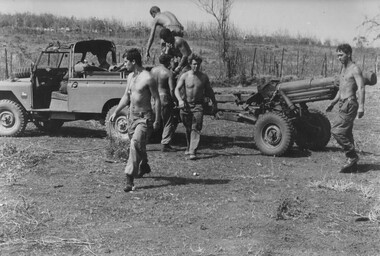
Photograph, Gibbons, Denis, Prepare For Movement
... A black and white photograph of Gunners of the 103 Battery, Royal Australian Artillery, prepare their guns and equipment for movement by US Army CH47 Chinook medium helicopters to a fire support base. The load was one Chinook for one battery detachment (circaJuly 1967)...Photograph 103 Battery 1st Field Regt RAA Chinook Gibbons Collection Catalogue Fire Support Base Gunners Denis Gibbons A black and white photograph of Gunners of the 103 Battery, Royal Australian Artillery, prepare their guns and equipment for movement by US Army CH47 Chinook medium helicopters to a fire support base. The load was one Chinook for one battery detachment (circaJuly 1967) Prepare For Movement Photograph Gibbons, Denis ...Denis Gibbons (1937 – 2011) Trained with the Australian Army, before travelling to Vietnam in January 1966, Denis stayed with the 1st Australian Task Force in Nui Dat working as a photographer. For almost five years Gibbons toured with nine Australian infantry battalions, posting compelling war images from within many combat zones before being flown out in late November 1970 after sustaining injuries. The images held within the National Vietnam Veterans Museum make up the Gibbons Collection. A black and white photograph of Gunners of the 103 Battery, Royal Australian Artillery, prepare their guns and equipment for movement by US Army CH47 Chinook medium helicopters to a fire support base. The load was one Chinook for one battery detachment (circaJuly 1967)photograph, 103 battery, 1st field regt, raa, chinook, gibbons collection catalogue, fire support base, gunners, denis gibbons -
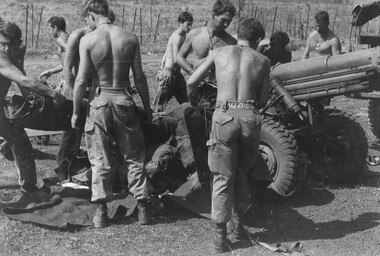 National Vietnam Veterans Museum (NVVM)
Photograph, Gibbons, Denis, Prepare For Movement
... A black and white photograph of Gunners of the 103 Battery, Royal Australian Artillery, prepare their guns and equipment for movement by US Army CH47 Chinook helicopters to a fire support base. The load was one Chinook for one battery detachment (circa July 1967)...Photograph 103 Battery 1st Field Regt RAA Chinook Gibbons Collection Catalogue Fire Support Base Gunners Denis Gibbons A black and white photograph of Gunners of the 103 Battery, Royal Australian Artillery, prepare their guns and equipment for movement by US Army CH47 Chinook helicopters to a fire support base. The load was one Chinook for one battery detachment (circa July 1967) Prepare For Movement Photograph Gibbons, Denis ...Denis Gibbons (1937 – 2011) Trained with the Australian Army, before travelling to Vietnam in January 1966, Denis stayed with the 1st Australian Task Force in Nui Dat working as a photographer. For almost five years Gibbons toured with nine Australian infantry battalions, posting compelling war images from within many combat zones before being flown out in late November 1970 after sustaining injuries. The images held within the National Vietnam Veterans Museum make up the Gibbons Collection. A black and white photograph of Gunners of the 103 Battery, Royal Australian Artillery, prepare their guns and equipment for movement by US Army CH47 Chinook helicopters to a fire support base. The load was one Chinook for one battery detachment (circa July 1967)photograph, 103 battery, 1st field regt, raa, chinook, gibbons collection catalogue, fire support base, gunners, denis gibbons -
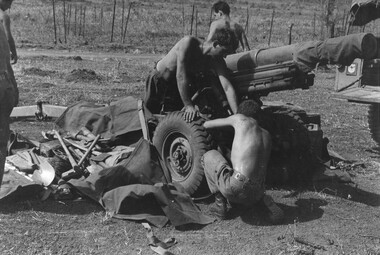 National Vietnam Veterans Museum (NVVM)
Photograph, Gibbons, Denis, Prepare For Movement
... A black and white photograph of Gunners of the 103 Battery Royal Australian Artillery, prepare their guns and equipment for movement by US Army CH47 Chinook helicopters to a fire support base. The load was one Chinook for one battery detachment (circa July 1967)...Photograph 103 Battery 1st Field Regt RAA Chinook Gibbons Collection Catalogue Fire Support Base Gunners Denis Gibbons A black and white photograph of Gunners of the 103 Battery Royal Australian Artillery, prepare their guns and equipment for movement by US Army CH47 Chinook helicopters to a fire support base. The load was one Chinook for one battery detachment (circa July 1967) Prepare For Movement Photograph Gibbons, Denis ...Denis Gibbons (1937 – 2011) Trained with the Australian Army, before travelling to Vietnam in January 1966, Denis stayed with the 1st Australian Task Force in Nui Dat working as a photographer. For almost five years Gibbons toured with nine Australian infantry battalions, posting compelling war images from within many combat zones before being flown out in late November 1970 after sustaining injuries. The images held within the National Vietnam Veterans Museum make up the Gibbons Collection. A black and white photograph of Gunners of the 103 Battery Royal Australian Artillery, prepare their guns and equipment for movement by US Army CH47 Chinook helicopters to a fire support base. The load was one Chinook for one battery detachment (circa July 1967)photograph, 103 battery, 1st field regt, raa, chinook, gibbons collection catalogue, fire support base, gunners, denis gibbons -
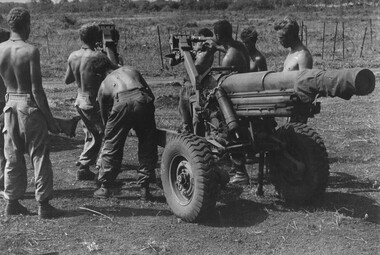 National Vietnam Veterans Museum (NVVM)
Photograph, Gibbons, Denis, Prepare For Movement
... A black and white photograph of Gunners of the 103 Battery Royal Australian Artillery, prepare their guns and equipment for movement by US Army CH47 Chinook helicopters to a fire support base. The load was one Chinook for one battery detachment (circa July 1967)...Photograph 103 Battery 1st Field Regt RAA Chinook Gibbons Collection Catalogue Fire Support Base Gunners Denis Gibbons A black and white photograph of Gunners of the 103 Battery Royal Australian Artillery, prepare their guns and equipment for movement by US Army CH47 Chinook helicopters to a fire support base. The load was one Chinook for one battery detachment (circa July 1967) Prepare For Movement Photograph Gibbons, Denis ...Denis Gibbons (1937 – 2011) Trained with the Australian Army, before travelling to Vietnam in January 1966, Denis stayed with the 1st Australian Task Force in Nui Dat working as a photographer. For almost five years Gibbons toured with nine Australian infantry battalions, posting compelling war images from within many combat zones before being flown out in late November 1970 after sustaining injuries. The images held within the National Vietnam Veterans Museum make up the Gibbons Collection. A black and white photograph of Gunners of the 103 Battery Royal Australian Artillery, prepare their guns and equipment for movement by US Army CH47 Chinook helicopters to a fire support base. The load was one Chinook for one battery detachment (circa July 1967)photograph, 103 battery, 1st field regt, raa, chinook, gibbons collection catalogue, fire support base, gunners, denis gibbons -
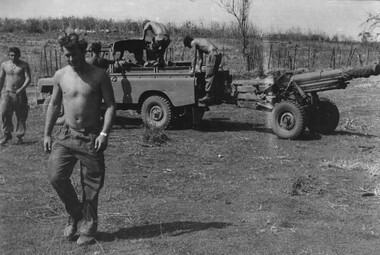 National Vietnam Veterans Museum (NVVM)
Photograph, Gibbons, Denis, Prepare For Movement
... A black and white photograph of Gunners of the 103 Battery, Royal Australian Artillery, prepare their guns and equipment for movement by US Army CH47 Chinook helicopters to a fire support base. The load was one Chinook for one battery detachment (circa July 1967)...Photograph 103 Battery 1st Field Regt RAA Chinook Gibbons Collection Catalogue Fire Support Base Gunners Denis Gibbons A black and white photograph of Gunners of the 103 Battery, Royal Australian Artillery, prepare their guns and equipment for movement by US Army CH47 Chinook helicopters to a fire support base. The load was one Chinook for one battery detachment (circa July 1967) Prepare For Movement Photograph Gibbons, Denis ...Denis Gibbons (1937 – 2011) Trained with the Australian Army, before travelling to Vietnam in January 1966, Denis stayed with the 1st Australian Task Force in Nui Dat working as a photographer. For almost five years Gibbons toured with nine Australian infantry battalions, posting compelling war images from within many combat zones before being flown out in late November 1970 after sustaining injuries. The images held within the National Vietnam Veterans Museum make up the Gibbons Collection. A black and white photograph of Gunners of the 103 Battery, Royal Australian Artillery, prepare their guns and equipment for movement by US Army CH47 Chinook helicopters to a fire support base. The load was one Chinook for one battery detachment (circa July 1967)photograph, 103 battery, 1st field regt, raa, chinook, gibbons collection catalogue, fire support base, gunners, denis gibbons -
 National Vietnam Veterans Museum (NVVM)
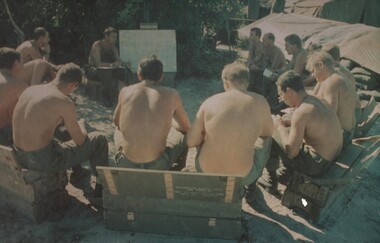
Photograph, Gibbons, Denis, Nightly Situation Report
... Photograph 104 Battery RAA Fire Base Betty Long Bien Gibbons Collection Catalogue Tet Offensive 1969 Royal Australian Artillery Gunners Denis Gibbons A coloured photograph of Gunners of 104 Battery Royal Australian Artillary, at Fire Support Base Betty attend the nightly situation report and orders. It was here that each detachment ...Denis Gibbons (1937 – 2011) Trained with the Australian Army, before travelling to Vietnam in January 1966, Denis stayed with the 1st Australian Task Force in Nui Dat working as a photographer. For almost five years Gibbons toured with nine Australian infantry battalions, posting compelling war images from within many combat zones before being flown out in late November 1970 after sustaining injuries. The images held within the National Vietnam Veterans Museum make up the Gibbons Collection.A coloured photograph of Gunners of 104 Battery Royal Australian Artillary, at Fire Support Base Betty attend the nightly situation report and orders. It was here that each detachment received its harrasment and indiction targets and timings for the night.photograph, 104 battery raa, fire base betty, long bien, gibbons collection catalogue, tet offensive, 1969, royal australian artillery, gunners, denis gibbons -
 National Vietnam Veterans Museum (NVVM)
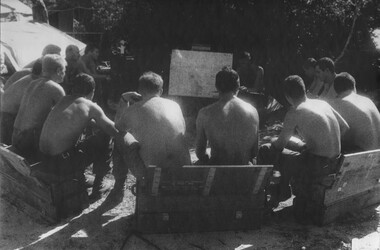
Photograph, Gibbon, Denis, Situation Report
... A black and white photograph of Gunners of 104 Battery Royal Australian Artillery at Fire Base Betty attend the nightly situation report and orders. It was here that each detachment received its harrasment and indiction targets and timings for the night...Photograph Artillery 104 Battery RAA Fire Base Betty Gibbons Collection Catalogue Gunner Royal Australian Artillery Gunners Denis Gibbons A black and white photograph of Gunners of 104 Battery Royal Australian Artillery at Fire Base Betty attend the nightly situation report and orders. It was here that each detachment received its harrasment and indiction targets and timings for the night Situation Report Photograph Gibbon, Denis ...Denis Gibbons (1937 – 2011) Trained with the Australian Army, before travelling to Vietnam in January 1966, Denis stayed with the 1st Australian Task Force in Nui Dat working as a photographer. For almost five years Gibbons toured with nine Australian infantry battalions, posting compelling war images from within many combat zones before being flown out in late November 1970 after sustaining injuries. The images held within the National Vietnam Veterans Museum make up the Gibbons Collection.A black and white photograph of Gunners of 104 Battery Royal Australian Artillery at Fire Base Betty attend the nightly situation report and orders. It was here that each detachment received its harrasment and indiction targets and timings for the nightphotograph, artillery, 104 battery raa, fire base betty, gibbons collection catalogue, gunner, royal australian artillery, gunners, denis gibbons -
 National Vietnam Veterans Museum (NVVM)
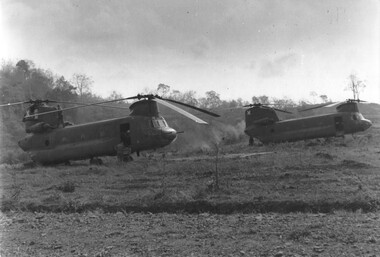
Photograph, Gibbons, Denis, Chinooks 2
... A black and white photograph of United States Army Chinook medium helicopters wait on Kanga pad at 1 ATF Base Nui Dat, Phuoc Tuy Province, to move an artillery battery to form an operartional fire support base. Each Chinook was able to move one full detachment. ...Army Nui Dat Phuoc Tuy Province Fire Support Base Gibbons Collection Catalogue Denis Gibbons Photographer Vietnam War A black and white photograph of United States Army Chinook medium helicopters wait on Kanga pad at 1 ATF Base Nui Dat, Phuoc Tuy Province, to move an artillery battery to form an operartional fire support base. Each Chinook was able to move one full detachment. ...Denis Gibbons (1937 – 2011) Trained with the Australian Army, before travelling to Vietnam in January 1966, Denis stayed with the 1st Australian Task Force in Nui Dat working as a photographer. For almost five years Gibbons toured with nine Australian infantry battalions, posting compelling war images from within many combat zones before being flown out in late November 1970 after sustaining injuries. The images held within the National Vietnam Veterans Museum make up the Gibbons Collection. A black and white photograph of United States Army Chinook medium helicopters wait on Kanga pad at 1 ATF Base Nui Dat, Phuoc Tuy Province, to move an artillery battery to form an operartional fire support base. Each Chinook was able to move one full detachment. (Circa June 1967)photograph, kanga pad, 1 atf base, chinook, united states. army, nui dat, phuoc tuy province, fire support base, gibbons collection catalogue, denis gibbons, photographer, vietnam war -
 National Vietnam Veterans Museum (NVVM)
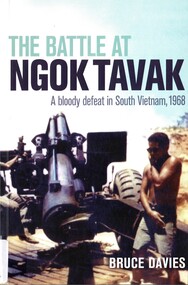
Book, Davies, Bruce, The Battle at Ngok Tavak: A bloody defeat in South Vietnam, 1968. (Copy 2), 2008
... Vietnam AATTV Military participation -- American Battle of Ngok Tavak Australian Army Training Team Vietnam (AATTV) Laos Special Forces Company In 1968, in the western jungle of Vietnam near Loas, a Special Forces Company under the command of an Australian Army Captain, supported by a Marine artillery detachment, occupied an old French Fort on a hill know as Ngok Tavak. ...In 1968, in the western jungle of Vietnam near Loas, a Special Forces Company under the command of an Australian Army Captain, supported by a Marine artillery detachment, occupied an old French Fort on a hill know as Ngok Tavak.In 1968, in the western jungle of Vietnam near Loas, a Special Forces Company under the command of an Australian Army Captain, supported by a Marine artillery detachment, occupied an old French Fort on a hill know as Ngok Tavak. vietnam, aattv, military participation -- american, battle of ngok tavak, australian army training team vietnam (aattv), laos, special forces company -
 National Vietnam Veterans Museum (NVVM)
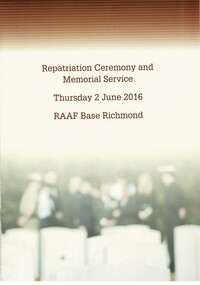
Booklet, Repatriation Ceremony and Memorial Service: Thursday 2 June 2016: RAAF Base, Richmond, 2016
... Artillery...4th Field Regiment...Cpl Robert Walter Bowtell...213151...Royal Australian Engineers...3 Field Troop...Sgt Ronald Thomas Carroll...14208...3rd Battalion...The Royal Australian Regiment...Gunner Thomas William Checkley...311534...Detachment...Australia - Soldiers - Repatriation Ceremonies Repatriation - Australia RAAF Base Richmond Australian War Graves Pte Norman George Allen 2784699 Royal Australian Infantry Corps 7th Battalion 6th Battalion the Royal Australian Regiment Pte Gary Alex Archer 2788583 9th Battalion Lt Robert Graham Birse 215349 Royal Regiment Of Australian Artillery 4th Field Regiment Cpl Robert Walter Bowtell 213151 Royal Australian Engineers 3 Field Troop Sgt Ronald Thomas Carroll 14208 3rd Battalion The Royal Australian Regiment Gunner Thomas William Checkley 311534 Detachment 131 Divisional Locating Battery Pte Christopher Clark 215214 1st Battalion WO2 (Temp) Kevin George Conway 13097 Australian Army Training Team Vietnam (AATTV) Pte Ronald Eric Field 214479 WO2 John Garrigan 310089 WO2 (Temp) Maxwell Powell Hanley 43593 Australian Intelligence Corp Cpl Reginald Hedley Hillier 42774 Trooper Tony Holland 3786634 Royal Australian Armoured Corps 1st Armoured Personnel Carrier Squadron Pte Neville Wayne Horne 215217 39510 Australian Army Aviation Corps 161 (Indep) Recce Flt 2Lt Alan Douglas Jellie Cpl (Temp) Kenneth Charles Johnson 215949 Headquarters Australian Force Vietnam WO2 (Temp) Ronald Victor Lees 26182 Cpl John Gregory Stinson Pearce 2784043 WO2 (Temp) Thomas Dudley 42352 Pte Thomas Ross L/Cpl Thomas Ross 212612 L/Cpl Arthur Ruduss 3410295 1st Australian Task Force Cpl (Temp) Francis John Smith 37003 Pte Mervyn Arthur Frederick Wilson 213780 Killed in Action Australian National Serviceman Repatriation Ceremony and Memorial Service: Thursday 2 June 2016: RAAF Base, Richmond for the remains of thirty-three Australians, who were buried in military cemeteries in Malaysia and Singapore, have been returned to Australia. ...Repatriation Ceremony and Memorial Service: Thursday 2 June 2016: RAAF Base, Richmond for the remains of thirty-three Australians, who were buried in military cemeteries in Malaysia and Singapore, have been returned to Australia.australia - soldiers - repatriation ceremonies, repatriation - australia, raaf base, richmond, australian war graves, pte norman george allen, 2784699, royal australian infantry corps, 7th battalion, 6th battalion the royal australian regiment, pte gary alex archer, 2788583, 9th battalion, lt robert graham birse, 215349, royal regiment of australian artillery, 4th field regiment, cpl robert walter bowtell, 213151, royal australian engineers, 3 field troop, sgt ronald thomas carroll, 14208, 3rd battalion, the royal australian regiment, gunner thomas william checkley, 311534, detachment, 131 divisional locating battery, pte christopher clark, 215214, 1st battalion, wo2 (temp) kevin george conway, 13097, australian army training team vietnam (aattv), pte ronald eric field, 214479, wo2 john garrigan, 310089, wo2 (temp) maxwell powell hanley, 43593, australian intelligence corp, cpl reginald hedley hillier, 42774, trooper tony holland, 3786634, royal australian armoured corps, 1st armoured personnel carrier squadron, pte neville wayne horne, 215217, 39510, australian army aviation corps, 161 (indep) recce flt, 2lt alan douglas jellie, cpl (temp) kenneth charles johnson, 215949, headquarters, australian force vietnam, wo2 (temp) ronald victor lees, 26182, cpl john gregory stinson pearce, 2784043, wo2 (temp) thomas dudley, 42352, pte thomas ross, l/cpl thomas ross, 212612, l/cpl arthur ruduss, 3410295, 1st australian task force, cpl (temp) francis john smith, 37003, pte mervyn arthur frederick wilson, 213780, killed in action, australian national serviceman
