
Showing 5 items matching "association of victorian blind workers"
-
 Vision Australia
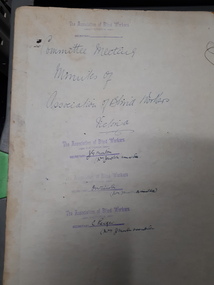
Administrative record - Text, Association of Victorian Blind Workers Committee: 7/6/1931 - 25/1/1940, 1931-1940
... Association of Victorian Blind Workers Committee: 7/6/1931 - 25/1/1940...Association of Victorian Blind Workers... Blind Workers Royal Victorian Institute for the Blind 1 volume of handwritten notes Association of Victorian Blind Workers Committee: 7/6/1931 - 25/1/1940 Administrative record Text ...These minutes include Present, Apologies, Correspondence, Registrations, Reports and Interviews with workers. 16/12/1938 it was noted the Secretary created a brochure called 'Social Justice for the Blind' and other publications for promotion of the organisation. It was also reported re the Institutions decision to pay Christmas pay on the basis of Married pensioners, £3-7-6, Married non-pensioners £4-7-6 per week and single men £2-2-6 per week. The child allowance has been discontinued. Meetings were often held in private homes or in spaces provided by churches.1 volume of handwritten notesassociation of victorian blind workers, royal victorian institute for the blind -
 Vision Australia
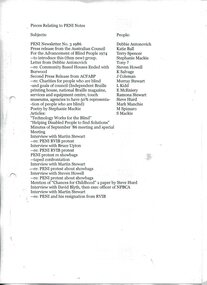
Audio - Sound recording, Pieces relating to PENI (People for Equality Not Institutionalisation)
... Blind Workers Union) to this. The final recording is a telephone conversation between Jeff Kennett and Andrew Peacock, which has been transcribed elsewhere and does not appear to relate to anything related to PENI. PENI Ramona Mandy David Blyth Martin Stewart Debbie Antonovich Bruce Upton Stephanie Mackie Steven Howell Terry Spencer Australian Council for the Advancement of Blind People Royal Victorian Institute for the Blind Blind Workers Association Blind Workers Union Employment National Federation of Blind Citizens Jeff Kennett Andrew Peacock 1 CD with 3 sound files Pieces relating to PENI (People for Equality Not Institutionalisation) Audio Sound recording ...In 1985, amidst a backdrop of limited expectations for people who are blind or have low vision, PENI (People for Equality Not Institutionalisation) was formed. Frustrated by the lack of support from the agencies that were designed to help them and community attitudes, the group sought to increase representation at agencies management, employment opportunities, accessible information, participation in decisions and change perception of how they should live their lives. In these recordings, Ramona Mandy reads the PENI Newsletter number 3 and a radio show covers the formation of PENI and the reaction of RVIB management and the BWU (Blind Workers Union) to this. The final recording is a telephone conversation between Jeff Kennett and Andrew Peacock, which has been transcribed elsewhere and does not appear to relate to anything related to PENI.1 CD with 3 sound filespeni, ramona mandy, david blyth, martin stewart, debbie antonovich, bruce upton, stephanie mackie, steven howell, terry spencer, australian council for the advancement of blind people, royal victorian institute for the blind, blind workers association, blind workers union, employment, national federation of blind citizens, jeff kennett, andrew peacock -
 Vision Australia
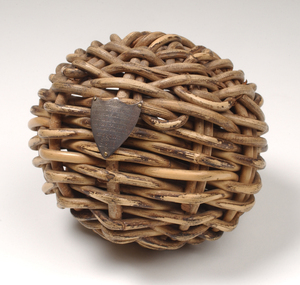
Award - Object, Wicker cricket ball, 1928
... Blind cricket was invented in Melbourne in 1922 when two blind factory workers started playing a game using a tin can containing rocks. The game soon gained popularity and the Victorian Blind Cricketers' Association was formed. ...Blind cricket was invented in Melbourne in 1922 when two blind factory workers started playing a game using a tin can containing rocks. The game soon gained popularity and the Victorian Blind Cricketers' Association was formed. ...This cricket ball is made of cane wicker and was used in cricket games with visually impaired players by people who lived or were educated at the Royal Victorian Institute for the Blind from the 1920's through till 1972. It is a circular shape made of plaited strips of woven natural cane and is lighter than a conventional cricket ball. The hollow center of the ball contains pieces of twisted metal pieces which rattle as the ball is moved to aid players in tracking the ball's movement. The stumps also had bells attached so fielders knew when the batsman was out. Blind cricket was invented in Melbourne in 1922 when two blind factory workers started playing a game using a tin can containing rocks. The game soon gained popularity and the Victorian Blind Cricketers' Association was formed. Mr William Paterson, a volunteer worker and advocate for blind people for over 60 years, was instrumental in acquiring and developing the sports ground and clubhouse in Glenferrie Road Kooyong, Victoria on behalf of the Association for the Advancement of the Blind (now called Vision Australia). In 1928 play began on the world's first sports ground for blind cricketers, in the first official blind cricket match. Blind cricket is now played internationally. This particular cricket ball was awarded to William Paterson Esq in 1928 in recognition of his support in establishing the world's first blind cricket ground in Kooyong. On the front of this ball is attached a small metal crest with an inscription: 'Presented to W.H. Paterson, Esq as a token of esteem for his interest in Blind cricket being the first ball bowled on the cricket ground for Blind Kooyong 7. 4.28'.1 wicker cricket ball with metal shield attached and metal bells in the hollow centre'Presented to W.H. Paterson, Esq / as a token of esteem for his/ interest in Blind cricket/ being the first ball bowled /on the cricket /ground for Blind /Kooyong / 7. 4.28'. recreation, cricket, awards -
 Vision Australia
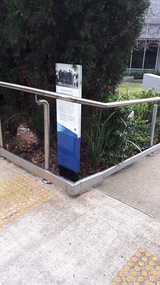
Sign - Object, Caroline Smith, World's First Sports Ground for Blind Cricketers, 11/6/2020
... World's First Sports Ground for Blind Cricketers On 7 April 1928 the playing field at this location was inaugurated as the World's first permanent sports ground for blind cricketers when the first ball was bowled at a competition between the Royal Victorian Institute for the Blind and the Association for the Advancement of the Blind, both now known as Vision Australia. Mr William Paterson, a volunteer worker...Victorian Blind Cricket Association Association for the Blind William Paterson Cricket World's First Sports Ground for Blind Cricketers On 7 April 1928 the playing field at this location was inaugurated as the World's first permanent sports ground for blind cricketers when the first ball was bowled at a competition between the Royal Victorian Institute for the Blind and the Association for the Advancement of the Blind, both now known as Vision Australia. Mr William Paterson, a volunteer worker ...Blind cricket had been played since 1922 and originated in Melbourne, yet had no permanent home. In 1926, William Paterson (who had helped establish the first retirement home for the blind in Brighton,) approached Council asking if a section of land fronting Glenferrie Road could be used by blind sporting groups. The Council agreed, upon the proviso that a trust be set up (and one of the trustees be the Town Clerk) and that if the land was not used for recreation or sporting purposes, they would have first option to buy it back. Under this agreement, the first blind cricket oval was established and on the 7th April 1928 the first ball was bowled at a competition between the Victorian Blind Cricket Association and interstate teams. To commemorate this event and the man who helped it come about, this marker (part of the Federation Markers project, jointly funded by the Commonwealth Government and Stonnington Council,) was placed.1 plastic sign with images and wordingWorld's First Sports Ground for Blind Cricketers On 7 April 1928 the playing field at this location was inaugurated as the World's first permanent sports ground for blind cricketers when the first ball was bowled at a competition between the Royal Victorian Institute for the Blind and the Association for the Advancement of the Blind, both now known as Vision Australia. Mr William Paterson, a volunteer worker and advocate for blind people for over 60 years, was instrumental in obtaining access to these facilities on behalf of the cricketers.victorian blind cricket association, association for the blind, william paterson, cricket -
 Vision Australia
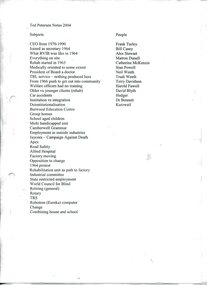
Audio - Sound recording, Interview with Ted Petersen by Judith Buckrich, 16/6/2004
... blindness and low vision changed over the years. Royal Victorian Institute for the Blind Oral history Judith Buckrich Michele Prentice E.E. (Ted) Petersen Frank Turley Bill Casey Rehabilitation Association for the Blind Esme Dunnell RVIB Burwood School Cathryn McKenzie Neil Westh Terry Davidson Harold Fawell Blind Workers Union Employment Fundraising Alfred Hospital David Blyth S.W. ...Oral history interview of Ted Petersen by Judith Buckrich, with Michele Prentice. Recorded as part of 'Lighthouse on the Boulevard'. Former students and staff recall their days at RVIB, the impact of what they learned and experienced there, and how the attitudes to blindness and low vision changed over the years. 2 audio recordings of recollections from former RVIB attendeesroyal victorian institute for the blind, oral history, judith buckrich, michele prentice, e.e. (ted) petersen, frank turley, bill casey, rehabilitation, association for the blind, esme dunnell, rvib burwood school, cathryn mckenzie, neil westh, terry davidson, harold fawell, blind workers union, employment, fundraising, alfred hospital, david blyth, s.w. hedger, dr charles bennett, charles douglas, jamie kelly, peter evans
